

Cloud security has reached a clear inflection point: new IDC research — amplified by Microsoft’s security team — reports that organizations saw an average of more than nine cloud security incidents in 2024, with 89% of respondents saying incidents increased year‑over‑year, and the data is pushing security leaders toward unified, cloud‑native defenses.
Cloud adoption accelerated through the last several years, and the security picture has changed from perimeter defense to continuous, lifecycle‑wide protection. Misconfigurations, leaked credentials, exposed APIs, and the rise of AI‑amplified phishing are shortening the window between deployment and compromise, creating a demand for platforms that protect from code to runtime. Markets and vendor messaging now converge on the same operational thesis: point‑tool accumulation — the old “best‑of‑breed by committee” approach — is producing blind spots and operational friction. Analysts and vendor surveys show consolidation pressure toward Cloud‑Native Application Protection Platforms (CNAPPs) and unified SecOps offerings that combine posture, workload protection, identity controls, telemetry, and automation.
Source: Microsoft New IDC research highlights a major cloud security shift | Microsoft Security Blog
 Background
Cloud adoption accelerated through the last several years, and the security picture has changed from perimeter defense to continuous, lifecycle‑wide protection. Misconfigurations, leaked credentials, exposed APIs, and the rise of AI‑amplified phishing are shortening the window between deployment and compromise, creating a demand for platforms that protect from code to runtime. Markets and vendor messaging now converge on the same operational thesis: point‑tool accumulation — the old “best‑of‑breed by committee” approach — is producing blind spots and operational friction. Analysts and vendor surveys show consolidation pressure toward Cloud‑Native Application Protection Platforms (CNAPPs) and unified SecOps offerings that combine posture, workload protection, identity controls, telemetry, and automation. Why this IDC finding matters now
The headline stat — average of nine cloud security incidents and nearly nine in ten organizations seeing increases — is more than an attention‑grabbing metric. It reframes cloud security as a business risk that directly affects uptime, compliance, and product velocity. Organizations can no longer treat cloud security as an IT checkbox; it must be embedded into engineering and product lifecycles. Two practical consequences follow immediately:- Security must operate at development velocity. Detection and response must be integrated into CI/CD, containers, and serverless pipelines.
- Risk prioritization must be contextual. Not all findings are equally exploitable; defenders need contextualized risk scoring that links vulnerabilities and misconfigurations to sensitive assets and runtime evidence.
Overview: Five fast, structural shifts the research highlights
1. CNAPP is now a top security investment
IDC frames CNAPPs as a top‑three security investment area for 2025 — not because the acronym is fashionable, but because organizations need consolidated, lifecycle‑aware tooling. Vendors position CNAPP as the architectural answer to multi‑cloud visibility, runtime detection, and developer‑friendly remediation workflows. Market coverage and vendor surveys independently show CNAPP and adjacent runtime detection solutions climbing budget priority lists.2. The CISO role is morphing into a business‑facing leader
IDC’s briefing describes an evolution in the CISO role: more CISOs now own cloud security management and act as strategic enablers — translating technical risk into business outcomes and aligning security with product roadmaps. The research labels these leaders “3D CISOs” — practitioners who manage risk, accelerate innovation, and connect security KPIs to executive decision‑making. This shift requires CISOs to speak both engineering and boardroom languages.3. Tool sprawl is real — and expensive
Tool sprawl remains among the most cited operational problems. Multiple surveys and vendor reports show large organizations using dozens of security tools; other studies report an average north of ten cloud security tools per enterprise, with many respondents saying tool fragmentation creates duplication, missed signals, and higher costs. This is the problem CNAPP consolidation is trying to address.4. Generative AI is already altering SOC economics
Generative AI is no longer theoretical in security operations. Organizations are using AI for faster triage, alert summarization, and playbook automation; attackers are simultaneously using AI to craft high‑quality phishing and adaptive malware. The net effect: defenses that harness AI for detection and response can scale—but only if model governance, telemetry, and data protections are in place. Microsoft and independent industry reports both flag AI as a force‑multiplier for attackers and defenders.5. Moving from integrated to autonomous SecOps
The forward horizon IDC sketches is a unified SecOps platform that blends CNAPP, XDR, SIEM, threat intelligence, and AI automation — and, in some deployments, early experiments with agentic or autonomous AI that can isolate and remediate routine threats without human intervention. This trajectory promises speed but introduces governance and safety challenges that organizations must design for.Deep dive: What CNAPP actually delivers (and where it falls short)
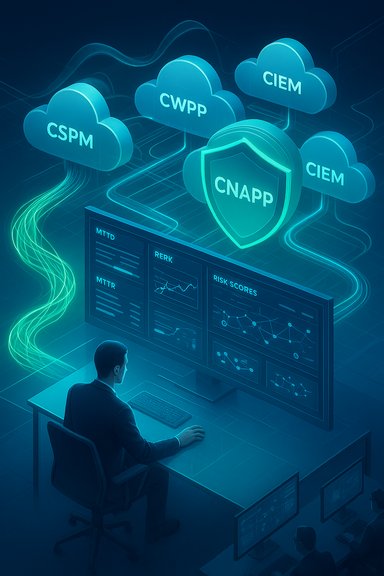
CNAPP attempts to collapse a lifecycle of disparate signals into one operating model:- Shift‑left artifact scanning (SCA/ASPM) for IaC, container images, and dependencies.
- Posture management (CSPM) to detect misconfigurations and exposure.
- Workload protection (CWPP) for runtime behavior and in‑process detections.
- Entitlement/identity controls (CIEM) to map who and what can act in cloud estates.
- Fewer handoffs between DevOps and SecOps.
- Prioritization that ties a misconfiguration or CVE to the actual runtime asset and data.
- Faster Mean Time To Remediate (MTTR) because alerts are fused with contextual metadata.
- No single CNAPP vendor covers everything equally well; some excel at runtime detection, others at SCA or CIEM. Buyers still face capability gaps when their environments include specialized needs (API inspection, host‑based telemetry, or deep supply chain provenance).
- Consolidation can create monoculture risk: a single misconfiguration or supply‑chain flaw in the platform itself could affect broader detection coverage.
- Cost and migration pain: replacing existing toolchains requires operational change management, retraining, and careful pilot validation.
The evolving CISO mandate: from gatekeeper to growth enabler
IDC’s framing of a “3D CISO” reflects a broader operational reality: security leaders must now balance four objectives simultaneously:- Protect the organization against present threats.
- Enable business velocity by embedding security into product lifecycles.
- Translate technical risk into business outcomes for boards and executives.
- Build resilient, measurable incident response capability.
- Security metrics must be business‑oriented (time to contain, transaction impact, % of critical assets covered) not just tool metrics (alerts/sec).
- Security teams must own developer‑facing controls (e.g., gating CI pipelines) and deliver friction‑free guardrails.
- Hiring will prioritize platform and automation skills over purely alert‑triage roles; automation and AI become force multipliers when governed well.
Tool sprawl: facts, consequences, and an operational plan
Reality check: multiple industry surveys show that many organizations use more than ten security tools for cloud protection, and a sizable portion use dozens. That fragmentation creates:- Siloed telemetry and missed correlations.
- High operational overhead and license costs.
- Analyst fatigue and slower incident response.
- Inventory and map your controls: what each tool covers, which telemetry flows it produces, and SOC pain points.
- Pilot consolidation by outcomes, not brands: choose a pilot that ties posture, runtime, and identity signals to a small business domain.
- Set measurable goals: reduce mean time to detect/contain (MTTD/MTTC), lower tool overlap, and keep a fixed set of ROI metrics for any consolidation decision.
- Preserve escape hatches: maintain vendor diversity for critical detections until confidence grows.
Generative AI: practical security impacts and immediate controls
Generative AI creates new attack vectors (prompt injection, data exfiltration through RAG pipelines, agent compromise) and magnifies existing ones (phishing quality, malware polymorphism). Effective controls to deploy now:- Treat models, agents, and pipelines as first‑class identities: enforce least privilege, short‑lived credentials, and conditional access.
- Map AI data flows: inventory training data, retrieval indexes, and connectors to downstream stores.
- Instrument prompts and outputs: log and monitor prompt patterns and suspicious retrieval chains for SOC integration.
- Apply content safety and prompt shielding: implement runtime filters and redaction at retrieval boundaries.
Where caution is required: unverified and paywalled claims
A responsible read of the landscape requires one explicit caution: many of the IDC findings referenced in vendor materials and blog posts come from industry research that is often distributed behind paywalls or via commissioned studies. The headline IDC numbers cited in vendor posts (average of nine cloud incidents, 89% YoY increase, CNAPP ranking) are compelling; however, organizations should treat any single vendor summary of an analyst report as a signal to validate, not a substitute for direct access to the underlying methodology. Where the IDC document itself is not publicly accessible, verify sample sizes, geography, and question phrasing before using a quoted percent as a program justification. Practical guidance: request the original IDC brief or methodology appendix, cross‑check with independent surveys (Gartner, Check Point/Cybersecurity Insiders, Westcon/partner surveys), and run short internal telemetry audits to test whether the vendor claim maps to your reality.Microsoft’s positioning and real product considerations
Microsoft positions Microsoft Defender for Cloud and its integrated CNAPP posture as a unified vehicle to protect cloud and AI workloads from code to runtime, linking runtime detections, preventative posture, and identity telemetry into Sentinel and XDR workflows. Microsoft emphasizes:- Real‑time cloud detection and response across hybrid and multi‑cloud.
- AI‑driven prioritization and threat intelligence signals.
- Mapping CNAPP into SecOps and SIEM/XDR ecosystems.
- Side‑by‑side pilots measuring detection fidelity and mean time metrics.
- Red‑team validation of AI‑specific detections (prompt injection, jailbreaks).
- Supply‑chain and data‑ownership contractual clarity when telemetry is shared for managed detection or model improvements.
Recommendations for CISOs, security architects, and product leaders
- Map the cloud‑and‑AI estate now
- Inventory all compute footprints, model endpoints, RAG indices, and CI/CD pipelines.
- Label and prioritize by data criticality and regulatory exposure.
- Adopt a lifecycle‑first security architecture
- Prioritize solutions that link code/ASPM and SCA to runtime detections and asset maps.
- Ensure CI/CD gates and ephemeral workload scanning are enforced.
- Reduce tool sprawl pragmatically
- Pilot CNAPP/XDR integration on a high‑value application; measure MTTD and MTTR improvements before wider roll‑out.
- Keep best‑of‑breed integrations where needed (API security, specialized SCA) and rationalize overlapping coverage.
- Treat AI systems as identities and data as first‑class assets
- Short‑lived credentials, JIT elevation, and token rotation for agentic workflows.
- Logging of prompts and retrievals for forensics and privacy controls.
- Build measurable SecOps playbooks for autonomous actions
- Automate low‑risk containment actions (network isolation, token revocation) and require human review for high‑impact changes.
- Implement audit trails and human‑in‑the‑loop gates for automated remediation.
- Validate vendor claims with pilots and third‑party testing
- Demand pilot metrics, independent testing (red‑team), and measurable ROI before consolidating toolsets.
Risks and governance for an AI‑augmented future
Agentic or autonomous AI that can remediate and reconfigure systems at machine speed introduces a dual risk: it can slash time‑to‑contain or — if misconfigured — cause inappropriate changes and operational outages. Governance must be explicit:- Define a risk tiering for automatic actions (what can be auto‑fixed vs what requires human approval).
- Impose canary releases and progressive rollouts for autonomous remediation.
- Keep immutable logs and rollback mechanisms; treat automated changes as change requests with full traceability.
Conclusion
The IDC‑aligned findings underscored by Microsoft are a wake‑up call: cloud security incidents are up, environments are more complex, and defenders must adapt by consolidating signals, automating smartly, and treating AI workloads as first‑class elements in the security architecture. CNAPPs, unified SecOps platforms, and AI augmentation are not silver bullets — they are tools that must be validated, integrated carefully, and governed. Organizations that combine inventory discipline, lifecycle‑aware tooling, and cautious automation stand the best chance of converting today’s cloud security headwinds into manageable, well‑measured risk.Source: Microsoft New IDC research highlights a major cloud security shift | Microsoft Security Blog
