

Cognizant is repositioning itself from a classic global outsourcer into an AI-native, cloud-first services platform—anchored by its Neuro® AI initiative, a broadened Microsoft partnership announced in December 2025, and the strategic acquisition of Azure specialist 3Cloud—moves designed to close the “last‑mile” gap between pilots and production-grade enterprise AI.
For two decades Cognizant prospered as a scale-driven provider of application maintenance, systems integration, and business process outsourcing. That labor‑arbitrage model still underpins a large part of revenue, but the market has shifted: enterprises now prioritize cloud-native architectures, reusable vertical platforms, and generative AI‑enabled outcomes over headcount delivery alone.
Cognizant’s current repositioning centers on three strategic pillars: generative AI adoption and governance (Neuro® AI), cloud modernization and Azure engineering, and vertical, productized platforms for healthcare, life sciences, and financial services. These are packaged to deliver repeatable, measurable outcomes rather than open‑ended proof‑of‑concepts.
The 3Cloud purchase (definitive agreement announced November 13, 2025) is explicitly tactical: it adds Azure engineering depth, Databricks and Fabric patterns, and a bench of Azure‑certified specialists to shorten runway for production AI workloads on Azure. Both the Cognizant announcement and the seller’s release confirm the deal will close under typical regulatory timelines and expand Cognizant’s Azure credentials materially.
Investor focus areas:
Downside case: execution missteps—talent attrition after acquisition, slow deal conversion, or weaker-than‑expected license consumption for Copilot integrations—could keep revenue growth muted and pressure valuations.
However, the strategy depends on flawless execution across many moving parts: acquisition integration, disciplined productization (not just “accelerators”), rigorous governance, and the ability to win and scale joint Microsoft deals. In a market where perception and brand equity matter as much as engineering depth, Cognizant must also keep selling the narrative: unified Neuro® AI, demonstrable platform economics, and pipeline to back its claims.
Key recent references and public signals visible in the market: Cognizant’s Nov. 13, 2025 3Cloud acquisition announcement and the Dec. 18, 2025 expanded Microsoft partnership (Neuro® AI and Copilot integration), along with public statements about Azure growth and partner Copilot scaling plans—facts disclosed in company releases and corroborated by industry reporting and partner statements. Treat company‑reported certification and growth figures as vendor claims pending independent audit or third‑party confirmation.
Source: AD HOC NEWS Cognizant Technology: How a Legacy IT Giant Is Rebuilding Its Future in the GenAI Era
 Background / Overview
For two decades Cognizant prospered as a scale-driven provider of application maintenance, systems integration, and business process outsourcing. That labor‑arbitrage model still underpins a large part of revenue, but the market has shifted: enterprises now prioritize cloud-native architectures, reusable vertical platforms, and generative AI‑enabled outcomes over headcount delivery alone.Cognizant’s current repositioning centers on three strategic pillars: generative AI adoption and governance (Neuro® AI), cloud modernization and Azure engineering, and vertical, productized platforms for healthcare, life sciences, and financial services. These are packaged to deliver repeatable, measurable outcomes rather than open‑ended proof‑of‑concepts.
What Cognizant is Betting On
Neuro® AI: an enterprise adoption framework, not a single model
Cognizant’s Neuro® AI is presented as a practical, domain‑aware adoption framework: use‑case libraries, pre‑built copilots for specific workflows (claims intake, customer support, engineering productivity), and a responsible‑AI overlay for governance, bias mitigation, and data‑residency controls. The core premise is pragmatic: assemble hyperscaler models and vendor foundation models inside enterprise controls rather than attempt to compete by building a proprietary foundation model. This reduces R&D capital intensity while leaning heavily on integration, data engineering, and vertical expertise. Key productized Neuro® AI capabilities include:- Use‑case libraries mapped to vertical workflows (banking onboarding, claims adjudication, clinical trial operations).
- Pre‑built copilots and agents tuned for regulated workflows.
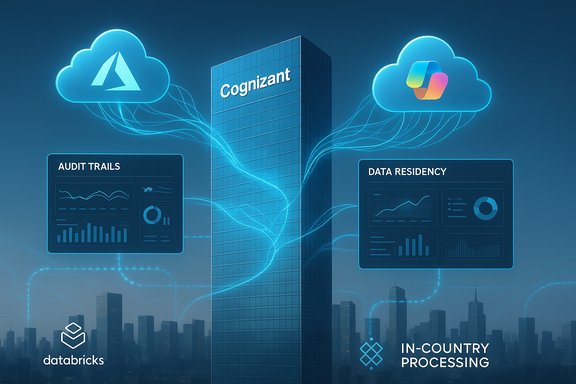
- Responsible AI frameworks covering audit trails, model lineage, and in‑country processing where required.
Cloud modernization: migration factories and Azure engineering
Cognizant continues to industrialize application migrations with automated migration factories, containerization and microservices accelerators, and FinOps/observability tooling to control cloud spend. The company has chosen a hyperscaler‑aligned path—deep partner plays with Microsoft Azure (recently strengthened by the acquisition of 3Cloud) while maintaining multi‑hyperscaler delivery on AWS and Google Cloud where clients require it.The 3Cloud purchase (definitive agreement announced November 13, 2025) is explicitly tactical: it adds Azure engineering depth, Databricks and Fabric patterns, and a bench of Azure‑certified specialists to shorten runway for production AI workloads on Azure. Both the Cognizant announcement and the seller’s release confirm the deal will close under typical regulatory timelines and expand Cognizant’s Azure credentials materially.
Vertical platforms: moving from bespoke services to productized IP
A central tenet of the strategy is converting institutional delivery experience into reusable, industry‑specific platforms:- Healthcare: claims, payer‑provider workflows, member engagement and analytics.
- Life sciences: pharmacovigilance, clinical data management, regulatory operations.
- Financial services: digital banking, risk and compliance orchestration.
The Microsoft Nexus: why the December 18, 2025 pact matters
Cognizant and Microsoft announced a multi‑year co‑innovation and co‑sell agreement that binds Cognizant’s platforms and Neuro® AI to Microsoft’s Copilot, Work IQ / Fabric IQ / Foundry IQ primitives and Azure AI foundations. The pact frames Cognizant as a preferred builder of Copilot‑embedded, agentic solutions for regulated verticals and formally positions both companies to pursue large, joint enterprise deals. Strategic implications:- Accelerates “last‑mile” operationalization of Copilot and agentic workflows inside enterprise systems.
- Encourages large‑scale Copilot license adoption via partner deployments and co‑selling.
- Strengthens Cognizant’s access to Azure product roadmaps and co‑innovation channels.
How Cognizant’s play stacks up against Accenture, TCS, and Infosys
The competitive field has bifurcated: large systems integrators now sell platform narratives with embedded AI, while vendors with long‑standing vertical platforms compete on depth and scale.- Accenture: excels in premium, strategy‑led transformations and markets high‑visibility platforms such as myNav and SynOps along with an expanding Accenture Gen AI stack and AI Refinery—a productized approach targeting agentic AI and industry agent solutions. Accenture’s brand commands consulting fees and strategy price premia.
- TCS: leverages deep, core banking and vertical platforms such as TCS BaNCS, now fronting AI upgrades like BaNCS AI Compass to capture transactional banking revenue and embed AI within mission‑critical core systems. TCS’s advantage is entrenched platform adoption and execution at scale.
- Infosys: pushes cloud and enterprise AI with Infosys Cobalt and Topaz—AI‑first suites that productize generative AI capabilities for SAP and other enterprise platforms. Infosys emphasizes composable AI fabrics and agent stacks to accelerate IT and business process transformation.
- Speed to value and implementation focus: positions itself as the execution powerhouse for clients who want outcome‑oriented rollouts rather than long strategic engagements.
- North American vertical depth: built around US healthcare and financial services regulatory nuances—an advantage in the world’s largest enterprise IT market.
- Hyperscaler alignment (especially Microsoft/Azure): deepening with 3Cloud and the Microsoft partnership, enabling rapid Azure‑native AI production.
- Mindshare and branding: Accenture’s thought leadership and the highly visible product names of rivals create a perception gap that Cognizant is actively trying to close with Neuro® AI and platform unification.
- Proprietary platform portfolio: rivals own marquee platforms (myNav, BaNCS, Cobalt), whereas Cognizant’s portfolio historically felt more fragmented—hence the push to productize and brand offerings coherently.
Execution levers that will determine success
- Technical delivery: moving pilots to production reliably—instrumented with telemetry, governance, and rollback capabilities—remains the central operational test. Embedding reproducible DevOps and MLOps practices across vertical platforms is non‑negotiable.
- Talent and certifications: acquisitions like 3Cloud add certified Azure engineers and Databricks/Fabric experience. The raw counts (for example, company statements referencing “21,000+ Azure‑certified specialists”) are company‑reported and should be treated as indicative rather than independently audited until third‑party confirmation is available.
- Commercial proofs: joint case studies with measured KPIs (time saved, cost avoided, revenue uplift) will convert skeptics. The partnership rhetoric around “Frontier Firms” is persuasive only when accompanied by audited case evidence.
- Governance and compliance: deploying agentic AI in finance and healthcare invites regulator scrutiny. Robust model‑audit trails, identity‑aware agent controls, and in‑country processing options will be deal enablers.
Financial and valuation implications
Cognizant remains publicly traded as CTSH (ISIN: US1924461023). As of the latest market quote during the close of trading on December 30, 2025, the share price was around US$84.26 (intraday), reflecting a market that still prices Cognizant as a steady enterprise services firm rather than a hyper‑growth software multiple.Investor focus areas:
- Revenue mix shift: investors will watch the percentage of revenue coming from high‑margin, recurring platform and AI services versus legacy labor‑arbitrage contracts.
- Margins: productized platforms and managed services should improve gross margins if deployed at scale; evidence will be visible in operating margin trends and segment disclosures.
- Bookings and pipeline: quality of AI and cloud bookings (multi‑year, platform‑driven deals) versus short‑term consulting revenue will indicate strategic traction.
- Capital allocation: Cognizant has shown shareholder focus via buybacks and disciplined capital deployment in prior quarters; acquisition integration economics (for 3Cloud) and subsequent disclosed synergies will be monitored as the deal closes in Q1 2026. Past buyback increases suggest management sensitivity to the valuation gap between market perception and strategic intent.
Downside case: execution missteps—talent attrition after acquisition, slow deal conversion, or weaker-than‑expected license consumption for Copilot integrations—could keep revenue growth muted and pressure valuations.
Risk matrix: what could go wrong
- Integration risk: folding specialist boutiques (3Cloud) into large global delivery organizations often creates cultural and operational friction. Success requires retention incentives, clear engineering leadership, and preserved specialist teams.
- Vendor concentration: heavy alignment to a single hyperscaler accelerates time‑to‑value for Azure‑standardized customers but raises portability and vendor‑dependency concerns for multi‑cloud clients. Contracts and escape clauses will matter.
- Regulatory and audit risk: agentic AI in regulated workflows invites higher standards for explainability and auditability. Emerging rules (EU AI Act style frameworks and sectoral guidance) could require additional engineering effort and slow deployments across jurisdictions.
- Pilot fatigue and sales friction: enterprise buyers have grown wary of vendor promises that do not convert to measurable operational outcomes. Cognizant must demonstrate delivered ROI, not just proof‑of‑concepts.
- Competitive pressure: rivals are investing aggressively—Accenture on high‑value strategy plus AI Refinery/agent stacks, TCS around entrenched core platforms, Infosys with Topaz/Cobalt fabrics. Competitors may match price points or bundle licences with their own platform narratives.
Practical signals to watch over the next 12–24 months
- Published case studies with quantifiable KPIs (time saved, cost reduction, engagement uplift) in financial services and healthcare.
- Azure consumption and Copilot seat activation metrics generated from joint Cognizant‑Microsoft deals.
- Integration updates post‑3Cloud close: retention figures, client onboarding speed, and evidence of Databricks/Fabric patterns at scale.
- Revenue mix disclosures: trending increases in managed, recurring and platform revenue in quarterly filings.
- Regulatory attestations: third‑party audits, SOC/ISO certifications, and industry‑specific compliance wrappers for agentic AI deployments.
Tactical advice for CIOs and procurement teams evaluating Cognizant
- Demand measurable activation metrics: require named KPIs, SLAs for in‑country processing, and staged rollouts with control groups before enterprise‑wide adoption.
- Insist on runbooks: where data is processed, model provenance, telemetry capture, and threadable audit trails for model outputs.
- Negotiate portability: clarify how copilots and agents are plumbed—are they tightly coupled to Azure Fabric primitives or delivered as modular services to reduce lock‑in?
- Require third‑party verification: audits for privacy, security, and model performance in regulated sectors before signed rollouts.
Why Cognizant’s approach may ultimately win (and why it may not)
Cognizant’s strength is pragmatic: focus on industry workflows, productized platforms, and an integration‑first posture that embraces hyperscaler capabilities rather than trying to own every layer. This is an economically sensible model—less capital‑intensive than building a proprietary foundation model, and more immediately relevant to regulated industries that need governance and predictable ROI.However, the strategy depends on flawless execution across many moving parts: acquisition integration, disciplined productization (not just “accelerators”), rigorous governance, and the ability to win and scale joint Microsoft deals. In a market where perception and brand equity matter as much as engineering depth, Cognizant must also keep selling the narrative: unified Neuro® AI, demonstrable platform economics, and pipeline to back its claims.
Conclusion
Cognizant’s transformation toward an AI‑native, cloud‑first, vertical platform company is coherent and well‑calibrated to market demand: enterprises want outcomes, not experiments. The December 18, 2025 Microsoft partnership and the November 2025 3Cloud acquisition are tangible moves that accelerate its ability to industrialize Copilot and agentic AI inside regulated workflows while improving Azure engineering capacity. The company’s success will hinge on demonstrable production wins, audited KPIs, and the disciplined conversion of delivery IP into genuine recurring platform revenue. For investors, the near‑term story remains executional; for CIOs, the question is whether Cognizant can reliably turn Neuro® AI and Azure engineering into repeatable business outcomes that reduce cost, risk, and time‑to‑value. If it does, Cognizant will have converted legacy trust and delivery scale into a credible leadership position for enterprise AI adoption.Key recent references and public signals visible in the market: Cognizant’s Nov. 13, 2025 3Cloud acquisition announcement and the Dec. 18, 2025 expanded Microsoft partnership (Neuro® AI and Copilot integration), along with public statements about Azure growth and partner Copilot scaling plans—facts disclosed in company releases and corroborated by industry reporting and partner statements. Treat company‑reported certification and growth figures as vendor claims pending independent audit or third‑party confirmation.
Source: AD HOC NEWS Cognizant Technology: How a Legacy IT Giant Is Rebuilding Its Future in the GenAI Era
