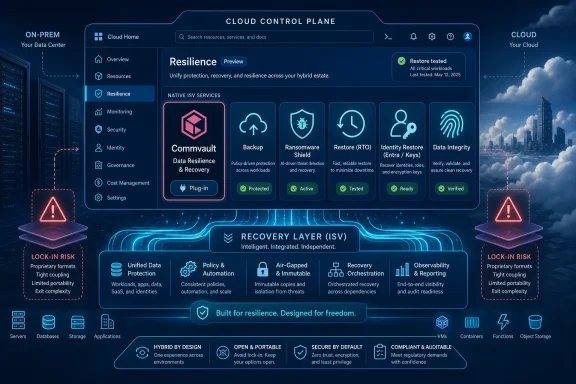
Commvault expanded its Microsoft Azure partnership on June 24, 2026, by announcing that Commvault Cloud will become a native independent software vendor service in Azure, with a New Zealand angle tied to Microsoft’s local cloud region and data sovereignty demand. The announcement is not just another marketplace listing; it is a bet that cyber recovery has become part of cloud infrastructure rather than an add-on sold after the architecture is finished. For New Zealand organisations, the pitch is especially pointed: keep more of the operational experience inside Azure, keep more data governance anchored locally, and make resilience easier to buy before the next ransomware drill becomes a board-level postmortem.
The important word in this announcement is native. Commvault has long supported Microsoft environments, and the two companies have spent decades circling the same enterprise customers. What changes here is the packaging: Commvault’s AI and cyber resilience platform is being brought into Azure as a native ISV service, available through the Microsoft Marketplace with Azure-style procurement and management.
That sounds like partner-program plumbing, but procurement plumbing matters. In large organisations, many good security ideas die not because the technology is weak, but because the path to buying, deploying, approving, integrating, and operating it is too messy. If Commvault Cloud can be provisioned inside Azure with a unified onboarding and management experience, Microsoft and Commvault are trying to remove a layer of friction that routinely slows resilience projects.
For Microsoft, the move also reinforces Azure’s pitch as more than compute, storage, databases, and AI accelerators. Azure is increasingly sold as the operating environment for enterprise risk management. Backup, recovery, identity resilience, clean-room restoration, and ransomware response are no longer peripheral chores; they are part of the platform story.
For Commvault, the advantage is obvious. Native presence inside Azure gives it better access to customers who have already standardised on Microsoft’s commercial machinery. Being easier to buy through Microsoft Marketplace, and potentially eligible to count toward Microsoft Azure Consumption Commitment spending, turns resilience into something customers can align with existing cloud commitments rather than treat as a separate budget fight.
The expanded Azure integration pushes that logic further. If critical workloads are already moving into Azure, then recovery systems must be close enough — operationally and commercially — to be useful during a crisis. A backup platform that satisfies a sovereignty requirement but feels bolted on during an incident is only half a solution.
That is why Martin Creighan’s line about data sovereignty and cyber resilience becoming “two sides of the same coin” lands better than most partner-announcement rhetoric. In practice, a sovereign cloud strategy that cannot restore operations after ransomware is incomplete. Likewise, a recovery architecture that depends on opaque cross-border dependencies may fail the governance test before it fails the technical one.
New Zealand’s regulated sectors have particular reasons to care. Banking, retail, healthcare, and public-sector-adjacent organisations are all increasing cloud dependency while facing more sophisticated cyber threats and tighter expectations around data handling. For them, “where is the data?” and “how fast can we recover?” are converging into a single operational question.
When a service can be purchased through Microsoft Marketplace, customers may be able to fold it into existing commercial agreements, apply eligible spending toward MACC commitments, and simplify vendor onboarding. That does not make the technology better by itself, but it makes the buying motion more compatible with how cloud-first enterprises already operate. In a world where cloud spend is scrutinised monthly, that can be decisive.
This is part of a broader shift in enterprise software. The cloud provider console is becoming the place where administrators expect to discover, deploy, meter, govern, and retire services. Vendors that once sold around the hyperscalers now want to be embedded inside them, because the platform’s procurement and identity systems are becoming as important as its APIs.
The trade-off is dependence. A native Azure service gives Commvault reach, but it also makes the customer experience more tightly coupled to Microsoft’s ecosystem. That is convenient for Azure-centric organisations and potentially awkward for those with serious multi-cloud ambitions. The closer resilience gets to one hyperscaler’s operating model, the more carefully architects must examine failure domains, portability, and exit planning.
Traditional backup thinking often starts with files, databases, and virtual machines. Modern resilience has to account for application context, identities, permissions, metadata, automation, and the sequence in which services must come back online. That is especially true when AI workloads depend on fresh data pipelines and sensitive business information.
Commvault’s pitch is that its platform can help recover data, applications, and identities after cyber attacks, outages, or human error. The identity part is crucial. Many ransomware events are not just data-destruction incidents; they are trust-destruction incidents. If administrators cannot trust the identity plane, the backup catalogue, or the recovery environment, restoration becomes a forensic exercise rather than an operational one.
Azure gives Microsoft a natural place to host that discussion. Enterprises already running AI workloads on Azure will want recovery workflows that understand the Azure environment rather than treating it as an external target. The more native the integration, the easier it becomes to imagine resilience policies being woven into deployment patterns rather than bolted on after a project goes live.
That mess is why operational integration matters. If Commvault’s service can be managed alongside existing Azure resources, administrators may have a better chance of making resilience part of normal operations. Recovery plans that live outside the daily cloud workflow tend to age badly. Runbooks drift, permissions change, subscriptions multiply, and nobody notices until the restore window is measured in panic.
Native integration could also make resilience more visible to cloud teams that do not think of themselves as backup administrators. In many companies, the people deploying workloads in Azure are not the same people who historically owned backup infrastructure. If recovery controls are surfaced in the Azure environment, the gap between builders and protectors narrows.
Still, “native” should not be confused with automatic. Customers will still need to define recovery objectives, test restores, harden identity, segment environments, and decide what level of isolation is required. A service that is easy to provision can create a false sense of readiness if the organisation treats deployment as the finish line.
Microsoft’s own sovereign-cloud messaging has increasingly acknowledged that sovereignty is a spectrum of controls rather than a single checkbox. Data residency, encryption, customer-managed keys, operational oversight, disconnected options, and local infrastructure all address different parts of the problem. Commvault’s contribution sits mainly in the resilience layer: protecting and recovering workloads in ways that support sovereignty goals.
That distinction matters because boards and executives can be tempted by comforting labels. A workload can be locally hosted and still poorly protected. A backup can be regionally compliant and still unrecoverable at speed. A cloud environment can have strong residency controls and still depend on compromised identities.
The better reading of this partnership is not that it solves sovereignty for New Zealand customers. It gives them another tool to align sovereignty and recovery inside the Azure ecosystem. That is useful, but it still demands architecture, testing, governance, and uncomfortable tabletop exercises.
Commvault is useful to Microsoft because cyber resilience remains a domain where customers often want a specialist. Microsoft has its own security, backup, and disaster recovery services, but many enterprises have complex hybrid estates, long retention requirements, and established recovery platforms. Partnering with a major resilience vendor lets Microsoft offer choice while keeping the customer motion inside Azure.
The announcement also creates a joint-sales opportunity. Microsoft sellers can point to a resilience partner that strengthens the Azure story, while Commvault can ride Azure’s enterprise reach. That is standard alliance logic, but it becomes more potent when the product is purchasable and manageable through Microsoft’s own cloud channels.
There is also a competitive subtext. AWS, Google Cloud, and regional cloud providers are all fighting for regulated workloads. Sovereignty, resilience, and AI are now intertwined battlegrounds. By making Commvault easier to consume inside Azure, Microsoft is trying to make its cloud feel less like one component in the stack and more like the place where the stack is assembled.
The real questions begin after the marketplace transaction. Which workloads are covered? How are identities protected? Where are backup copies stored? What isolation exists from compromised production credentials? How quickly can a clean environment be brought online? How often are restores tested against realistic ransomware scenarios?
New Zealand organisations should be especially precise about locality claims. If data sovereignty is part of the business case, architects need to understand where data, metadata, logs, indexes, support access, and recovery environments reside. They should also understand what happens during cross-region replication, disaster recovery, and support escalation.
The same caution applies to MACC alignment. Counting eligible purchases toward an Azure commitment can be financially attractive, but it should not become the primary design driver. Resilience architecture should be judged first by recoverability, risk reduction, and governance fit. Commercial convenience is valuable only if the resulting system survives contact with an incident.
The preview will need to answer practical questions. How smooth is provisioning? Which Azure regions and workloads are supported at launch? How deeply does the service integrate with Azure identity, monitoring, policy, and billing? What limitations exist for hybrid environments? How does the experience differ from existing Commvault Cloud offerings and Azure Marketplace images?
Early adopters should treat the preview as an evaluation environment, not a reason to relax existing resilience plans. The worst outcome would be for organisations to defer hard recovery work because a more integrated service is on the horizon. Cyber attackers will not wait for a public preview to mature.
Still, previews matter because they expose the gap between alliance language and operational reality. If Microsoft and Commvault deliver a clean, Azure-native experience that reduces procurement friction and improves day-two management, the partnership could become more than a regional news item. It could become a template for how cyber resilience vendors embed into hyperscale clouds.
Commvault and Microsoft are not simply bringing another backup option to Azure; they are acknowledging that cloud adoption has changed what recovery must look like. For New Zealand customers, the local-region story gives the partnership a sharper edge, but the real test will be whether native integration turns resilience from a separately managed insurance policy into a practiced, visible, and governed part of Azure operations. If the public preview delivers on that promise, the next phase of cloud security may be judged less by how quickly organisations can deploy workloads and more by how confidently they can bring them back.
 Commvault Moves From Azure-Compatible to Azure-Native
The important word in this announcement is native. Commvault has long supported Microsoft environments, and the two companies have spent decades circling the same enterprise customers. What changes here is the packaging: Commvault’s AI and cyber resilience platform is being brought into Azure as a native ISV service, available through the Microsoft Marketplace with Azure-style procurement and management.That sounds like partner-program plumbing, but procurement plumbing matters. In large organisations, many good security ideas die not because the technology is weak, but because the path to buying, deploying, approving, integrating, and operating it is too messy. If Commvault Cloud can be provisioned inside Azure with a unified onboarding and management experience, Microsoft and Commvault are trying to remove a layer of friction that routinely slows resilience projects.
For Microsoft, the move also reinforces Azure’s pitch as more than compute, storage, databases, and AI accelerators. Azure is increasingly sold as the operating environment for enterprise risk management. Backup, recovery, identity resilience, clean-room restoration, and ransomware response are no longer peripheral chores; they are part of the platform story.
For Commvault, the advantage is obvious. Native presence inside Azure gives it better access to customers who have already standardised on Microsoft’s commercial machinery. Being easier to buy through Microsoft Marketplace, and potentially eligible to count toward Microsoft Azure Consumption Commitment spending, turns resilience into something customers can align with existing cloud commitments rather than treat as a separate budget fight.
New Zealand Turns Data Residency Into a Recovery Argument
The New Zealand framing is not decorative. Microsoft’s New Zealand cloud region has been important because local infrastructure gives organisations a clearer path to data residency, latency improvements, and jurisdictional comfort. Commvault’s local availability in that region already gave customers a way to discuss cyber resilience and sovereignty in the same sentence.The expanded Azure integration pushes that logic further. If critical workloads are already moving into Azure, then recovery systems must be close enough — operationally and commercially — to be useful during a crisis. A backup platform that satisfies a sovereignty requirement but feels bolted on during an incident is only half a solution.
That is why Martin Creighan’s line about data sovereignty and cyber resilience becoming “two sides of the same coin” lands better than most partner-announcement rhetoric. In practice, a sovereign cloud strategy that cannot restore operations after ransomware is incomplete. Likewise, a recovery architecture that depends on opaque cross-border dependencies may fail the governance test before it fails the technical one.
New Zealand’s regulated sectors have particular reasons to care. Banking, retail, healthcare, and public-sector-adjacent organisations are all increasing cloud dependency while facing more sophisticated cyber threats and tighter expectations around data handling. For them, “where is the data?” and “how fast can we recover?” are converging into a single operational question.
The Marketplace Is Becoming the New Control Plane
The most underrated part of the announcement is Microsoft Marketplace. To casual observers, marketplace availability can look like a sales-channel detail. To IT leaders, it can determine whether a platform is adopted quickly, slowly, or not at all.When a service can be purchased through Microsoft Marketplace, customers may be able to fold it into existing commercial agreements, apply eligible spending toward MACC commitments, and simplify vendor onboarding. That does not make the technology better by itself, but it makes the buying motion more compatible with how cloud-first enterprises already operate. In a world where cloud spend is scrutinised monthly, that can be decisive.
This is part of a broader shift in enterprise software. The cloud provider console is becoming the place where administrators expect to discover, deploy, meter, govern, and retire services. Vendors that once sold around the hyperscalers now want to be embedded inside them, because the platform’s procurement and identity systems are becoming as important as its APIs.
The trade-off is dependence. A native Azure service gives Commvault reach, but it also makes the customer experience more tightly coupled to Microsoft’s ecosystem. That is convenient for Azure-centric organisations and potentially awkward for those with serious multi-cloud ambitions. The closer resilience gets to one hyperscaler’s operating model, the more carefully architects must examine failure domains, portability, and exit planning.
AI Workloads Raise the Stakes for Recovery
The announcement repeatedly links cyber resilience to cloud and AI workloads, and that is not accidental. AI projects tend to sprawl across data stores, model pipelines, identity systems, application services, and integration layers. They create new dependency chains that can be difficult to reconstruct after an outage or attack.Traditional backup thinking often starts with files, databases, and virtual machines. Modern resilience has to account for application context, identities, permissions, metadata, automation, and the sequence in which services must come back online. That is especially true when AI workloads depend on fresh data pipelines and sensitive business information.
Commvault’s pitch is that its platform can help recover data, applications, and identities after cyber attacks, outages, or human error. The identity part is crucial. Many ransomware events are not just data-destruction incidents; they are trust-destruction incidents. If administrators cannot trust the identity plane, the backup catalogue, or the recovery environment, restoration becomes a forensic exercise rather than an operational one.
Azure gives Microsoft a natural place to host that discussion. Enterprises already running AI workloads on Azure will want recovery workflows that understand the Azure environment rather than treating it as an external target. The more native the integration, the easier it becomes to imagine resilience policies being woven into deployment patterns rather than bolted on after a project goes live.
The Best Resilience Product Is the One Deployed Before the Breach
Cyber resilience vendors like to talk about recovery as if it is a clean sequence: detect, isolate, restore, resume. Real incidents are messier. Teams argue over what is clean, which backups are safe, which credentials can be trusted, whether the attacker is still present, and how much downtime the business can tolerate.That mess is why operational integration matters. If Commvault’s service can be managed alongside existing Azure resources, administrators may have a better chance of making resilience part of normal operations. Recovery plans that live outside the daily cloud workflow tend to age badly. Runbooks drift, permissions change, subscriptions multiply, and nobody notices until the restore window is measured in panic.
Native integration could also make resilience more visible to cloud teams that do not think of themselves as backup administrators. In many companies, the people deploying workloads in Azure are not the same people who historically owned backup infrastructure. If recovery controls are surfaced in the Azure environment, the gap between builders and protectors narrows.
Still, “native” should not be confused with automatic. Customers will still need to define recovery objectives, test restores, harden identity, segment environments, and decide what level of isolation is required. A service that is easy to provision can create a false sense of readiness if the organisation treats deployment as the finish line.
Sovereignty Is Not a Magic Word
The New Zealand angle invites a broader warning: data sovereignty is powerful, but it is not magic. Keeping data in a local region can help satisfy residency and governance expectations, reduce latency, and improve public-sector confidence. It does not, by itself, solve ransomware, insider risk, legal complexity, or operational resilience.Microsoft’s own sovereign-cloud messaging has increasingly acknowledged that sovereignty is a spectrum of controls rather than a single checkbox. Data residency, encryption, customer-managed keys, operational oversight, disconnected options, and local infrastructure all address different parts of the problem. Commvault’s contribution sits mainly in the resilience layer: protecting and recovering workloads in ways that support sovereignty goals.
That distinction matters because boards and executives can be tempted by comforting labels. A workload can be locally hosted and still poorly protected. A backup can be regionally compliant and still unrecoverable at speed. A cloud environment can have strong residency controls and still depend on compromised identities.
The better reading of this partnership is not that it solves sovereignty for New Zealand customers. It gives them another tool to align sovereignty and recovery inside the Azure ecosystem. That is useful, but it still demands architecture, testing, governance, and uncomfortable tabletop exercises.
Microsoft Wins When Partners Fill the Gaps Around Azure
For Microsoft, bringing Commvault closer to Azure fits a familiar platform strategy. The company wants Azure to be the default enterprise environment for cloud migration, AI adoption, security operations, and regulated workloads. To do that, it needs a partner ecosystem that fills specialised gaps without forcing customers into awkward integration work.Commvault is useful to Microsoft because cyber resilience remains a domain where customers often want a specialist. Microsoft has its own security, backup, and disaster recovery services, but many enterprises have complex hybrid estates, long retention requirements, and established recovery platforms. Partnering with a major resilience vendor lets Microsoft offer choice while keeping the customer motion inside Azure.
The announcement also creates a joint-sales opportunity. Microsoft sellers can point to a resilience partner that strengthens the Azure story, while Commvault can ride Azure’s enterprise reach. That is standard alliance logic, but it becomes more potent when the product is purchasable and manageable through Microsoft’s own cloud channels.
There is also a competitive subtext. AWS, Google Cloud, and regional cloud providers are all fighting for regulated workloads. Sovereignty, resilience, and AI are now intertwined battlegrounds. By making Commvault easier to consume inside Azure, Microsoft is trying to make its cloud feel less like one component in the stack and more like the place where the stack is assembled.
Customers Should Read the Fine Print Before Calling It Plug-and-Play
Sanjay Mirchandani described the goal as making resilience “plug-and-play” for Microsoft customers. That is the right aspiration, but IT pros know the phrase can be dangerous. Plug-and-play procurement is not the same as plug-and-play recovery.The real questions begin after the marketplace transaction. Which workloads are covered? How are identities protected? Where are backup copies stored? What isolation exists from compromised production credentials? How quickly can a clean environment be brought online? How often are restores tested against realistic ransomware scenarios?
New Zealand organisations should be especially precise about locality claims. If data sovereignty is part of the business case, architects need to understand where data, metadata, logs, indexes, support access, and recovery environments reside. They should also understand what happens during cross-region replication, disaster recovery, and support escalation.
The same caution applies to MACC alignment. Counting eligible purchases toward an Azure commitment can be financially attractive, but it should not become the primary design driver. Resilience architecture should be judged first by recoverability, risk reduction, and governance fit. Commercial convenience is valuable only if the resulting system survives contact with an incident.
The Public Preview Clock Will Decide How Real This Becomes
Commvault’s native ISV service for Azure is expected to enter public preview in the coming months. That means the announcement is strategically important but not yet the same thing as general availability. Public preview will be where customers learn what “native” actually means in daily administration.The preview will need to answer practical questions. How smooth is provisioning? Which Azure regions and workloads are supported at launch? How deeply does the service integrate with Azure identity, monitoring, policy, and billing? What limitations exist for hybrid environments? How does the experience differ from existing Commvault Cloud offerings and Azure Marketplace images?
Early adopters should treat the preview as an evaluation environment, not a reason to relax existing resilience plans. The worst outcome would be for organisations to defer hard recovery work because a more integrated service is on the horizon. Cyber attackers will not wait for a public preview to mature.
Still, previews matter because they expose the gap between alliance language and operational reality. If Microsoft and Commvault deliver a clean, Azure-native experience that reduces procurement friction and improves day-two management, the partnership could become more than a regional news item. It could become a template for how cyber resilience vendors embed into hyperscale clouds.
What New Zealand Azure Shops Should Put on the Whiteboard
This announcement is most useful when treated as a planning signal rather than a finished destination. New Zealand organisations already committed to Azure should use it to revisit where recovery, sovereignty, and cloud procurement intersect.- Organisations using Azure in New Zealand should map which critical workloads need local recovery controls, not merely local hosting.
- Security and infrastructure teams should test whether marketplace procurement changes the business case for resilience investments already blocked by budget or onboarding friction.
- Architects should validate where Commvault data, metadata, logs, and recovery workflows reside before relying on sovereignty language in compliance documents.
- Cloud teams should treat identity recovery as part of the resilience design, because restoring data is not enough if the control plane remains compromised.
- Early adopters should use the public preview to test operational fit, while keeping production recovery plans grounded in proven, tested capabilities.
Commvault and Microsoft are not simply bringing another backup option to Azure; they are acknowledging that cloud adoption has changed what recovery must look like. For New Zealand customers, the local-region story gives the partnership a sharper edge, but the real test will be whether native integration turns resilience from a separately managed insurance policy into a practiced, visible, and governed part of Azure operations. If the public preview delivers on that promise, the next phase of cloud security may be judged less by how quickly organisations can deploy workloads and more by how confidently they can bring them back.
References
- Primary source: IT Brief New Zealand
Published: 2026-06-25T00:30:11.427606
Commvault expands Microsoft Azure partnership in NZ
New Zealand organisations may gain faster recovery and simpler compliance as Commvault's tools become part of Microsoft Azure's native service. itbrief.co.nz
- Official source: learn.microsoft.com
What is Microsoft Sovereign Cloud? | Microsoft Learn
Understand Microsoft Sovereign Cloud and its role in addressing sovereignty requirements.learn.microsoft.com - Related coverage: docs.commvault.com
- Official source: blogs.microsoft.com
Microsoft Sovereign Cloud adds governance, productivity and support for large AI models securely running even when completely disconnected - The Official Microsoft Blog
As digital sovereignty becomes a strategic requirement, organizations are rethinking how they deploy critical infrastructure and AI capabilities under tighter regulatory expectations and higher risk conditions. Microsoft’s approach to sovereignty is grounded in enabling enterprises...blogs.microsoft.com - Related coverage: commvault.com
Commvault Geo Shield | Commvault Unified Resilience
Deliver compliant, secure cloud sovereignty with Commvault — unified data protection, flexible data locality, operational control, and regulatory support for hybrid and multi-cloud environments.www.commvault.com - Related coverage: marketscreener.com
Commvault Signs Multi-Year Microsoft Deal to Embed Recovery Tools in Azure
By Adriano Marchese Commvault Systems has signed a multi-year partnership with Microsoft that will make its artificial intelligence-driven cyber-resilience platform a native service inside...www.marketscreener.com

- Related coverage: au.investing.com
Commvault stock surges on Microsoft Azure partnership By Investing.com
Commvault stock surges on Microsoft Azure partnershipau.investing.com - Related coverage: channele2e.com
Commvault, Microsoft partner to bring cyber resilience services natively to Azure | brief | ChannelE2E
Through the partnership, Microsoft will offer Commvault’s extensive AI and cyber resilience technologies as a native ISV service on Microsoft Azure.www.channele2e.com - Official source: microsoft.com
Microsoft Sovereign Cloud | Microsoft AI
Empower digital resilience and digital and operational sovereignty with trusted, comprehensive cloud solutions from Microsoft. Discover Microsoft Sovereign Cloud.www.microsoft.com
- Related coverage: itpro.com
Satya Nadella talks up Microsoft's sovereign cloud credentials as firm announces general availability for Azure Local Disconnected, new capabilities for Foundry Local | IT Pro
Microsoft has expanded its Sovereign Cloud for AI and regulated environments, as CEO Satya Nadella hypes up the full extent of AI support the firm now offers.www.itpro.com - Official source: microsoft.commvault.com