

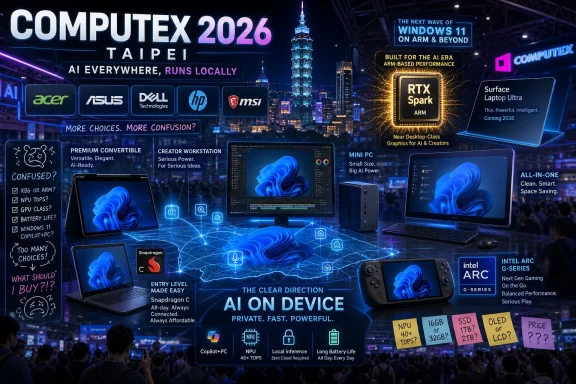
Microsoft used Computex 2026 in Taipei to cast Windows 11 as the operating system for a new generation of AI PCs, with Acer, ASUS, Dell, HP, MSI, Surface, Intel, NVIDIA, and Qualcomm announcing laptops, desktops, handhelds, and silicon aimed at more than a billion daily Windows users. The message was not subtle: Windows wants to be the broad, messy, price-spanning home of local AI. The question is whether that ecosystem breadth becomes Microsoft’s advantage, or whether it turns into another confusing hardware cycle where buyers need a decoder ring before they can pick a PC.
Computex has always been more than a parts show. It is where the PC industry explains what it thinks the next buying cycle is about, and this year Microsoft’s answer was unmistakable: AI moves from cloud demo to device feature only if Windows OEMs can ship it everywhere.
That is a different argument from the one Microsoft made during the first Copilot+ PC wave. In 2024 and 2025, the pitch centered on NPUs, battery life, and a cleaner Windows on Arm story. At Computex 2026, the pitch became broader and more muscular: local agents, creator-class GPUs, handheld gaming silicon, new entry-tier Arm chips, premium convertibles, mini PCs, and mobile workstations all orbiting Windows 11.
The result is a showcase that feels both impressive and unresolved. Microsoft can credibly say Windows still reaches more form factors, price points, and OEM design philosophies than any rival desktop platform. But the company is also asking users and IT departments to accept a fast-expanding vocabulary: Copilot+ PC, RTX Spark, Snapdragon C, Snapdragon X2, Intel Arc G-Series, OpenShell, MXC, TOPS, unified memory, local agents, and petaflop-class AI compute.
That complexity is not a side effect. It is the Windows model. Microsoft does not win by making one perfect laptop; it wins by convincing every hardware vendor that Windows is the safest place to experiment.
That matters because NVIDIA is not merely bringing another GPU tier to the Windows PC. It is bringing a full-stack platform argument: Blackwell RTX graphics, CUDA support, up to 128GB of unified memory, local model execution, and a developer ecosystem already trained to think in NVIDIA terms. For Windows users, especially creators and AI developers, this is the closest the PC ecosystem has come in years to answering Apple’s unified-memory MacBook Pro pitch with something that is not just “more watts, more fans, more ports.”
Microsoft’s own Surface Laptop Ultra makes the strategy explicit. It is described as the most powerful Surface Laptop yet, built around NVIDIA RTX Spark, a 15-inch mini-LED PixelSense Ultra touchscreen, creator-ready ports, all-day battery claims, and up to 1 petaflop of AI compute. The device is being positioned for “world makers,” creative pros, developers, and AI builders — language that sounds like marketing, but also reveals the competitive target.
This is Microsoft attempting to make Windows on Arm feel serious at the high end. Surface RT was a cautionary tale. Early Windows on Arm machines were often defined by compromise. RTX Spark is pitched as the opposite: not Arm for thin-and-light thrift, but Arm for workstation-class local AI.
The risk is that Windows users have heard transformation stories before. Local AI agents sound compelling, but the value will depend on software that is not merely compatible, but meaningfully better. CUDA support and NVIDIA’s developer gravity give RTX Spark a stronger foundation than most new PC platforms, but buyer trust will be earned in benchmarks, thermals, app behavior, driver maturity, and whether those “agentic” workflows become real work instead of keynote theater.
That distinction matters. Microsoft’s Surface business has often been most useful when it creates permission structures for partners: detachable tablets, premium Windows laptops, tall displays, pen-first workflows, and later Copilot+ PC reference designs. Surface Laptop Ultra appears to play that role again, but in a more aggressive category: portable AI workstation.
The claimed ability to run large local models, handle rendering and compiling, and support multi-model workflows is a direct challenge to the idea that serious AI development must either live in the cloud or on a deskbound workstation. Microsoft is effectively saying that Windows should own the mobile developer workstation before Apple, Linux vendors, or cloud IDEs define that category for everyone else.
But there is a practical ceiling here. A thin laptop with extreme AI claims still has to obey heat, acoustics, battery chemistry, and price. The more Microsoft and NVIDIA talk about petaflop-class compute, 120B-parameter models, and million-token contexts, the more reviewers and enterprise buyers will ask what those claims look like after 20 minutes of sustained work, on battery, in a real app, with background security tools running.
That is where the Surface Laptop Ultra becomes interesting rather than merely loud. If it performs well, it could validate a new premium Windows tier. If it stumbles, it risks reinforcing the oldest criticism of the PC ecosystem: spectacular spec sheets, uneven experiences.
Acer’s lineup shows the familiar Windows pattern at scale. The company is spreading Copilot+ PCs across mainstream Aspire machines, premium Swift convertibles, large-screen creative laptops, and all-in-one desktops. The Aspire X 16 AI, Aspire 18 AI, Aspire C AI Series, and Swift Spin 14 AI are not trying to define one ideal AI PC; they are trying to make AI PC branding unavoidable across the aisle at retail.
ASUS is pushing in two directions at once. Its ProArt P16 and P14, powered by NVIDIA RTX Spark, aim at creators and developers who need local AI horsepower. Meanwhile, Zenbook and Vivobook models push AI-enhanced Windows experiences toward mainstream consumers, and the ROG Strix SCAR 18 remains a reminder that the PC gaming market still rewards glorious excess.
Dell’s announcements are more revealing than they first appear. The new XPS 13 starting at $699 is a pricing statement as much as a product statement: premium design language cannot remain trapped above the psychologically painful price bands if the PC market wants volume. At the other end, the XPS 16 Creator Edition with RTX Spark puts Dell in the same local-AI workstation conversation as Surface.
HP and MSI add still more variations. HP plans RTX Spark systems in OmniBook laptops and a compact desktop, while MSI’s Prestige N16 Flip AI+ combines RTX Spark with a 16-inch UHD+ Tandem OLED panel and a 2-in-1 design. In classic PC fashion, the same silicon story is being translated into radically different industrial-design stories.
That is what Apple cannot and does not try to match. The Windows ecosystem’s strength is not elegance; it is coverage. If local AI turns out to matter, Microsoft wants Windows to appear in every plausible shape it could matter in.
This is where Microsoft’s “billion users” framing becomes more than ceremonial. If AI PCs remain confined to premium laptops, they become a margin story, not a platform story. The Snapdragon C pitch is that modern, responsive, cool-and-quiet Windows machines with all-day battery life can move downmarket without feeling like punishment.
Acer’s Aspire Go 15, announced as the first device powered by Snapdragon C, will therefore be worth watching. Not because it will top performance charts, but because the low end of the Windows market has historically shaped user expectations just as much as the high end. A bad cheap Windows laptop can make the whole platform feel worse; a good one can expand the upgrade cycle.
Qualcomm’s broader Computex presence also matters because it shows the company trying to avoid being boxed into one tier. Snapdragon C aims at affordability. Snapdragon X2 Elite and X2 Plus push into higher performance, with Acer’s Swift Spin 14 AI and ASUS’s Ascent QN10 mini PC showing new form factors for the same Arm strategy.
For Microsoft, this is the dream: Arm not as a niche, but as a continuum. The challenge is that Windows buyers do not shop by architecture; they shop by price, brand, battery life, app compatibility, and whether the thing feels fast after two years. Qualcomm and Microsoft need the entry-tier machines to feel boringly competent, not aspirationally experimental.
The Intel Arc G3 and Arc G3 Extreme processors are presented as purpose-built for handhelds, with optimized core counts, power management, graphics performance, and efficiency. Acer’s Predator Atlas 8, MSI’s Claw 8 EX AI+, and OneXPlayer are named as early designs. On paper, this is exactly what Windows handhelds need: silicon designed for the category, not laptop parts squeezed into smaller shells.
But the handheld problem has never been only silicon. It is interface, sleep behavior, updates, launchers, driver cadence, game compatibility, anti-cheat, battery life, and the awkward fact that Windows still behaves like a desktop OS when the user wants a console. Better chips can make handheld PCs faster; they cannot automatically make Windows feel handheld-native.
That is why Intel’s “console-like accessibility” language is so important. It acknowledges the gap. The best Windows handhelds have offered enormous game libraries and tweakability, but often at the cost of friction. The next generation has to make the PC advantage feel invisible until the user wants it.
Microsoft has been circling this problem for years. Computex 2026 suggests the ecosystem is finally treating handheld gaming as a first-class Windows category, not a novelty. Whether Windows itself evolves quickly enough is the real test.
The first is the everyday Copilot+ PC. These machines promise better battery life, faster local AI features, and a more responsive Windows experience. They will be judged by normal laptop criteria: price, portability, app compatibility, keyboard quality, webcam behavior, and whether AI features feel useful enough to mention after the first week.
The second is the creator and developer AI workstation. RTX Spark lives here, alongside Surface Laptop Ultra, Dell’s XPS 16 Creator Edition, ASUS ProArt systems, MSI’s Prestige N16 Flip AI+, and HP’s planned OmniBook devices. These systems will be judged by sustained performance, local model support, CUDA workflows, memory capacity, display quality, and whether they can replace a desktop or cloud instance for meaningful chunks of work.
The third is the edge case that may become mainstream later: agentic computing. NVIDIA and Microsoft are talking about always-on local agents, OpenShell runtime, MXC integration, and autonomous workflows. This is the most ambitious part of the story and the least proven from a user-experience standpoint.
Microsoft’s challenge is that it wants all three markets to reinforce each other. A student buying an entry Snapdragon C laptop, a developer buying an RTX Spark Surface, and a gamer buying an Intel-powered handheld are all supposed to feel part of the same Windows future. That is possible, but only if Windows 11 makes the differences understandable rather than chaotic.
A fleet that once meant “Intel or AMD Windows laptops” increasingly means x86 and Arm, NPUs and GPUs, local AI features, emulation layers, model runtimes, vendor utilities, firmware update pipelines, and security policies for on-device agents. That is exciting if it solves problems. It is exhausting if it creates new ones.
The most interesting enterprise angle is local AI. Running models on-device can reduce latency, preserve data locality, and potentially lower cloud inference costs. For regulated industries or organizations with strict data boundaries, that is a serious argument.
But local agents also raise governance questions. What data can an agent see? What actions can it take? How is behavior logged? How are models updated? How does endpoint detection respond to autonomous workflows that look, from a distance, like scripted user activity?
Microsoft and NVIDIA’s OpenShell and MXC language hints at an attempt to make agent deployment safer and more standardized. That is necessary, but IT buyers will want more than architecture diagrams. They will want policy controls, audit trails, rollback options, and clear separation between consumer convenience and enterprise automation.
The same goes for Windows on Arm. Prism emulation has improved the story, and native app support is better than it used to be. Still, enterprise estates are full of old VPN clients, printer tools, line-of-business apps, shell extensions, endpoint agents, and hardware dongles that can turn architecture transitions into support tickets.
A billion-user platform cannot pivot like a startup. It has to carry gamers, schools, hospitals, factories, banks, developers, creators, government offices, hobbyists, and people who just want a cheap laptop that opens Chrome and Office. Every exciting new Windows capability arrives attached to legacy expectations.
That is why the Computex announcements feel so wide. Microsoft is not choosing between premium AI workstations and affordable student laptops, between gaming handhelds and all-in-one desktops, between Intel, Qualcomm, and NVIDIA. It is trying to say yes to all of them because Windows has always been the platform of pluralism.
Pluralism, however, has costs. Buying a Windows PC in late 2026 may require consumers to understand whether they need an NPU, whether their apps run natively on Arm, whether a GPU matters for local AI, whether “Copilot+” guarantees the feature they saw in an ad, and whether a given laptop’s AI number means anything for their workload. The industry loves badges; users mostly want confidence.
This is where Microsoft must do more than cheerlead partners. It has to impose enough clarity that the ecosystem’s variety does not become self-sabotage. Windows succeeds when choice feels empowering. It struggles when choice feels like homework.
The hardware looks formidable. RTX Spark promises an unusually strong combination of CPU, GPU, unified memory, and AI acceleration. Snapdragon is stretching from entry-tier PCs to high-end mini desktops. Intel is targeting handheld gaming with more specialized silicon. OEMs are wrapping these chips in premium screens, convertibles, all-in-ones, compact desktops, and gaming machines.
But users do not experience silicon directly. They experience apps, battery life, fan noise, update reliability, game compatibility, export times, meeting quality, and whether the machine wakes when they open the lid. The AI PC will only matter if it changes those daily interactions.
For creators, that means AI-assisted editing and rendering that save real time. For developers, it means local model workflows that are cheaper, faster, or more private than the cloud. For office workers, it means agents that handle drudgery without creating risk. For gamers, it means better frame rates and smoother handheld experiences without Windows getting in the way.
Microsoft’s ecosystem can deliver all of that, but not by branding alone. The company needs Windows 11 to become the connective tissue between heterogeneous hardware and consistent user value. That is a harder job than shipping another Copilot button.
The next six to twelve months will determine whether RTX Spark becomes a serious new Windows tier or another premium curiosity. They will determine whether Snapdragon C can improve the reputation of affordable Windows laptops. They will determine whether Intel’s handheld silicon can make portable Windows gaming feel less like a hobbyist compromise.
They will also determine whether Microsoft can make local AI legible. The company has the ecosystem, the user base, and the partner incentives. What it still needs is a set of experiences that normal people can describe without repeating marketing language.
 Microsoft Turns Computex Into a Windows Ecosystem Referendum
Computex has always been more than a parts show. It is where the PC industry explains what it thinks the next buying cycle is about, and this year Microsoft’s answer was unmistakable: AI moves from cloud demo to device feature only if Windows OEMs can ship it everywhere.That is a different argument from the one Microsoft made during the first Copilot+ PC wave. In 2024 and 2025, the pitch centered on NPUs, battery life, and a cleaner Windows on Arm story. At Computex 2026, the pitch became broader and more muscular: local agents, creator-class GPUs, handheld gaming silicon, new entry-tier Arm chips, premium convertibles, mini PCs, and mobile workstations all orbiting Windows 11.
The result is a showcase that feels both impressive and unresolved. Microsoft can credibly say Windows still reaches more form factors, price points, and OEM design philosophies than any rival desktop platform. But the company is also asking users and IT departments to accept a fast-expanding vocabulary: Copilot+ PC, RTX Spark, Snapdragon C, Snapdragon X2, Intel Arc G-Series, OpenShell, MXC, TOPS, unified memory, local agents, and petaflop-class AI compute.
That complexity is not a side effect. It is the Windows model. Microsoft does not win by making one perfect laptop; it wins by convincing every hardware vendor that Windows is the safest place to experiment.
RTX Spark Is the Main Character, Even in Microsoft’s Story
The most important Computex announcement in Microsoft’s roundup was not a laptop from Acer or a price cut from Dell. It was NVIDIA’s RTX Spark, an Arm-based AI superchip developed with MediaTek and Microsoft, designed to run local AI agents on Windows laptops and compact desktops.That matters because NVIDIA is not merely bringing another GPU tier to the Windows PC. It is bringing a full-stack platform argument: Blackwell RTX graphics, CUDA support, up to 128GB of unified memory, local model execution, and a developer ecosystem already trained to think in NVIDIA terms. For Windows users, especially creators and AI developers, this is the closest the PC ecosystem has come in years to answering Apple’s unified-memory MacBook Pro pitch with something that is not just “more watts, more fans, more ports.”
Microsoft’s own Surface Laptop Ultra makes the strategy explicit. It is described as the most powerful Surface Laptop yet, built around NVIDIA RTX Spark, a 15-inch mini-LED PixelSense Ultra touchscreen, creator-ready ports, all-day battery claims, and up to 1 petaflop of AI compute. The device is being positioned for “world makers,” creative pros, developers, and AI builders — language that sounds like marketing, but also reveals the competitive target.
This is Microsoft attempting to make Windows on Arm feel serious at the high end. Surface RT was a cautionary tale. Early Windows on Arm machines were often defined by compromise. RTX Spark is pitched as the opposite: not Arm for thin-and-light thrift, but Arm for workstation-class local AI.
The risk is that Windows users have heard transformation stories before. Local AI agents sound compelling, but the value will depend on software that is not merely compatible, but meaningfully better. CUDA support and NVIDIA’s developer gravity give RTX Spark a stronger foundation than most new PC platforms, but buyer trust will be earned in benchmarks, thermals, app behavior, driver maturity, and whether those “agentic” workflows become real work instead of keynote theater.
Surface Laptop Ultra Is Microsoft’s MacBook Pro Moment, Not Its MacBook Air Moment
Surface Laptop Ultra is not trying to be the laptop most people buy. It is trying to be the laptop that changes what OEMs believe a Windows flagship can be.That distinction matters. Microsoft’s Surface business has often been most useful when it creates permission structures for partners: detachable tablets, premium Windows laptops, tall displays, pen-first workflows, and later Copilot+ PC reference designs. Surface Laptop Ultra appears to play that role again, but in a more aggressive category: portable AI workstation.
The claimed ability to run large local models, handle rendering and compiling, and support multi-model workflows is a direct challenge to the idea that serious AI development must either live in the cloud or on a deskbound workstation. Microsoft is effectively saying that Windows should own the mobile developer workstation before Apple, Linux vendors, or cloud IDEs define that category for everyone else.
But there is a practical ceiling here. A thin laptop with extreme AI claims still has to obey heat, acoustics, battery chemistry, and price. The more Microsoft and NVIDIA talk about petaflop-class compute, 120B-parameter models, and million-token contexts, the more reviewers and enterprise buyers will ask what those claims look like after 20 minutes of sustained work, on battery, in a real app, with background security tools running.
That is where the Surface Laptop Ultra becomes interesting rather than merely loud. If it performs well, it could validate a new premium Windows tier. If it stumbles, it risks reinforcing the oldest criticism of the PC ecosystem: spectacular spec sheets, uneven experiences.
OEM Breadth Is Still Windows’ Superpower
Microsoft’s Computex post reads like a roll call because that is the point. Acer, ASUS, Dell, HP, MSI, Surface, Intel, NVIDIA, and Qualcomm are not just filling out a press release; they are making the case that Windows can absorb every version of the next PC.Acer’s lineup shows the familiar Windows pattern at scale. The company is spreading Copilot+ PCs across mainstream Aspire machines, premium Swift convertibles, large-screen creative laptops, and all-in-one desktops. The Aspire X 16 AI, Aspire 18 AI, Aspire C AI Series, and Swift Spin 14 AI are not trying to define one ideal AI PC; they are trying to make AI PC branding unavoidable across the aisle at retail.
ASUS is pushing in two directions at once. Its ProArt P16 and P14, powered by NVIDIA RTX Spark, aim at creators and developers who need local AI horsepower. Meanwhile, Zenbook and Vivobook models push AI-enhanced Windows experiences toward mainstream consumers, and the ROG Strix SCAR 18 remains a reminder that the PC gaming market still rewards glorious excess.
Dell’s announcements are more revealing than they first appear. The new XPS 13 starting at $699 is a pricing statement as much as a product statement: premium design language cannot remain trapped above the psychologically painful price bands if the PC market wants volume. At the other end, the XPS 16 Creator Edition with RTX Spark puts Dell in the same local-AI workstation conversation as Surface.
HP and MSI add still more variations. HP plans RTX Spark systems in OmniBook laptops and a compact desktop, while MSI’s Prestige N16 Flip AI+ combines RTX Spark with a 16-inch UHD+ Tandem OLED panel and a 2-in-1 design. In classic PC fashion, the same silicon story is being translated into radically different industrial-design stories.
That is what Apple cannot and does not try to match. The Windows ecosystem’s strength is not elegance; it is coverage. If local AI turns out to matter, Microsoft wants Windows to appear in every plausible shape it could matter in.
The Cheap PC Is Back in the AI Conversation
The most strategically important device in the entire roundup may not be the flashiest one. Qualcomm’s Snapdragon C Platform, described as an entry-tier processor for students, families, and small businesses, is the quiet counterweight to the RTX Spark spectacle.This is where Microsoft’s “billion users” framing becomes more than ceremonial. If AI PCs remain confined to premium laptops, they become a margin story, not a platform story. The Snapdragon C pitch is that modern, responsive, cool-and-quiet Windows machines with all-day battery life can move downmarket without feeling like punishment.
Acer’s Aspire Go 15, announced as the first device powered by Snapdragon C, will therefore be worth watching. Not because it will top performance charts, but because the low end of the Windows market has historically shaped user expectations just as much as the high end. A bad cheap Windows laptop can make the whole platform feel worse; a good one can expand the upgrade cycle.
Qualcomm’s broader Computex presence also matters because it shows the company trying to avoid being boxed into one tier. Snapdragon C aims at affordability. Snapdragon X2 Elite and X2 Plus push into higher performance, with Acer’s Swift Spin 14 AI and ASUS’s Ascent QN10 mini PC showing new form factors for the same Arm strategy.
For Microsoft, this is the dream: Arm not as a niche, but as a continuum. The challenge is that Windows buyers do not shop by architecture; they shop by price, brand, battery life, app compatibility, and whether the thing feels fast after two years. Qualcomm and Microsoft need the entry-tier machines to feel boringly competent, not aspirationally experimental.
Intel’s Handheld Push Shows the PC Is Still Chasing Consoles
Intel’s Arc G-Series processors are aimed at next-generation handheld gaming systems, and their inclusion in Microsoft’s Computex roundup is a reminder that Windows has unfinished business in portable gaming. Steam Deck proved the demand. Windows handhelds proved the difficulty.The Intel Arc G3 and Arc G3 Extreme processors are presented as purpose-built for handhelds, with optimized core counts, power management, graphics performance, and efficiency. Acer’s Predator Atlas 8, MSI’s Claw 8 EX AI+, and OneXPlayer are named as early designs. On paper, this is exactly what Windows handhelds need: silicon designed for the category, not laptop parts squeezed into smaller shells.
But the handheld problem has never been only silicon. It is interface, sleep behavior, updates, launchers, driver cadence, game compatibility, anti-cheat, battery life, and the awkward fact that Windows still behaves like a desktop OS when the user wants a console. Better chips can make handheld PCs faster; they cannot automatically make Windows feel handheld-native.
That is why Intel’s “console-like accessibility” language is so important. It acknowledges the gap. The best Windows handhelds have offered enormous game libraries and tweakability, but often at the cost of friction. The next generation has to make the PC advantage feel invisible until the user wants it.
Microsoft has been circling this problem for years. Computex 2026 suggests the ecosystem is finally treating handheld gaming as a first-class Windows category, not a novelty. Whether Windows itself evolves quickly enough is the real test.
The AI PC Is Becoming Three Different Markets
The phrase “AI PC” is now doing too much work. Computex 2026 makes clear that the category is splitting into at least three markets, each with different buyers and different standards of success.The first is the everyday Copilot+ PC. These machines promise better battery life, faster local AI features, and a more responsive Windows experience. They will be judged by normal laptop criteria: price, portability, app compatibility, keyboard quality, webcam behavior, and whether AI features feel useful enough to mention after the first week.
The second is the creator and developer AI workstation. RTX Spark lives here, alongside Surface Laptop Ultra, Dell’s XPS 16 Creator Edition, ASUS ProArt systems, MSI’s Prestige N16 Flip AI+, and HP’s planned OmniBook devices. These systems will be judged by sustained performance, local model support, CUDA workflows, memory capacity, display quality, and whether they can replace a desktop or cloud instance for meaningful chunks of work.
The third is the edge case that may become mainstream later: agentic computing. NVIDIA and Microsoft are talking about always-on local agents, OpenShell runtime, MXC integration, and autonomous workflows. This is the most ambitious part of the story and the least proven from a user-experience standpoint.
Microsoft’s challenge is that it wants all three markets to reinforce each other. A student buying an entry Snapdragon C laptop, a developer buying an RTX Spark Surface, and a gamer buying an Intel-powered handheld are all supposed to feel part of the same Windows future. That is possible, but only if Windows 11 makes the differences understandable rather than chaotic.
Enterprise IT Will Read the Fine Print Before the Keynote Slides
For sysadmins, the Computex story is not just new hardware. It is new support matrices.A fleet that once meant “Intel or AMD Windows laptops” increasingly means x86 and Arm, NPUs and GPUs, local AI features, emulation layers, model runtimes, vendor utilities, firmware update pipelines, and security policies for on-device agents. That is exciting if it solves problems. It is exhausting if it creates new ones.
The most interesting enterprise angle is local AI. Running models on-device can reduce latency, preserve data locality, and potentially lower cloud inference costs. For regulated industries or organizations with strict data boundaries, that is a serious argument.
But local agents also raise governance questions. What data can an agent see? What actions can it take? How is behavior logged? How are models updated? How does endpoint detection respond to autonomous workflows that look, from a distance, like scripted user activity?
Microsoft and NVIDIA’s OpenShell and MXC language hints at an attempt to make agent deployment safer and more standardized. That is necessary, but IT buyers will want more than architecture diagrams. They will want policy controls, audit trails, rollback options, and clear separation between consumer convenience and enterprise automation.
The same goes for Windows on Arm. Prism emulation has improved the story, and native app support is better than it used to be. Still, enterprise estates are full of old VPN clients, printer tools, line-of-business apps, shell extensions, endpoint agents, and hardware dongles that can turn architecture transitions into support tickets.
The Billion-User Frame Is Both a Flex and a Burden
Microsoft’s claim that Windows serves more than a billion daily users is meant to project inevitability. It also defines the size of the problem.A billion-user platform cannot pivot like a startup. It has to carry gamers, schools, hospitals, factories, banks, developers, creators, government offices, hobbyists, and people who just want a cheap laptop that opens Chrome and Office. Every exciting new Windows capability arrives attached to legacy expectations.
That is why the Computex announcements feel so wide. Microsoft is not choosing between premium AI workstations and affordable student laptops, between gaming handhelds and all-in-one desktops, between Intel, Qualcomm, and NVIDIA. It is trying to say yes to all of them because Windows has always been the platform of pluralism.
Pluralism, however, has costs. Buying a Windows PC in late 2026 may require consumers to understand whether they need an NPU, whether their apps run natively on Arm, whether a GPU matters for local AI, whether “Copilot+” guarantees the feature they saw in an ad, and whether a given laptop’s AI number means anything for their workload. The industry loves badges; users mostly want confidence.
This is where Microsoft must do more than cheerlead partners. It has to impose enough clarity that the ecosystem’s variety does not become self-sabotage. Windows succeeds when choice feels empowering. It struggles when choice feels like homework.
The Computex Bet Comes Down to Software That Justifies the Silicon
The PC industry has a habit of announcing hardware before the software case is fully mature. Computex 2026 is no exception.The hardware looks formidable. RTX Spark promises an unusually strong combination of CPU, GPU, unified memory, and AI acceleration. Snapdragon is stretching from entry-tier PCs to high-end mini desktops. Intel is targeting handheld gaming with more specialized silicon. OEMs are wrapping these chips in premium screens, convertibles, all-in-ones, compact desktops, and gaming machines.
But users do not experience silicon directly. They experience apps, battery life, fan noise, update reliability, game compatibility, export times, meeting quality, and whether the machine wakes when they open the lid. The AI PC will only matter if it changes those daily interactions.
For creators, that means AI-assisted editing and rendering that save real time. For developers, it means local model workflows that are cheaper, faster, or more private than the cloud. For office workers, it means agents that handle drudgery without creating risk. For gamers, it means better frame rates and smoother handheld experiences without Windows getting in the way.
Microsoft’s ecosystem can deliver all of that, but not by branding alone. The company needs Windows 11 to become the connective tissue between heterogeneous hardware and consistent user value. That is a harder job than shipping another Copilot button.
The Real Computex Winner Is the Buyer Who Waits for Proof
There is a temptation to treat Computex as a finish line, as if the industry has already delivered the AI PC future because the demos were polished and the partner list was long. It is better understood as the opening bid.The next six to twelve months will determine whether RTX Spark becomes a serious new Windows tier or another premium curiosity. They will determine whether Snapdragon C can improve the reputation of affordable Windows laptops. They will determine whether Intel’s handheld silicon can make portable Windows gaming feel less like a hobbyist compromise.
They will also determine whether Microsoft can make local AI legible. The company has the ecosystem, the user base, and the partner incentives. What it still needs is a set of experiences that normal people can describe without repeating marketing language.
The Computex 2026 Windows Map Is Crowded, but the Direction Is Clear
The useful way to read Microsoft’s Computex 2026 showcase is not as a shopping list, but as a map of where the Windows ecosystem is placing its bets. The map is crowded, uneven, and full of claims that need independent testing, but it points in a clear direction.- Windows 11 is being positioned as the broadest platform for local AI, spanning entry laptops, creator workstations, gaming handhelds, mini PCs, and all-in-one desktops.
- NVIDIA RTX Spark is the most consequential new platform in the announcement because it brings Arm, Blackwell RTX graphics, CUDA, unified memory, and local AI ambitions into high-end Windows machines.
- Qualcomm’s Snapdragon C Platform matters because Microsoft cannot make AI PCs mainstream if the category remains trapped in premium price bands.
- Intel’s Arc G-Series handheld push shows that Windows gaming is expanding into console-like form factors, but software experience remains as important as raw performance.
- Surface Laptop Ultra is less about volume sales than about proving a new class of Windows on Arm workstation can exist without apology.
- Enterprise buyers should treat local AI as both an opportunity and a governance challenge, especially where agents, data access, and mixed silicon fleets intersect.
References
- Primary source: Windows Blog
Published: 2026-06-10T16:52:09.286317
Computex 2026: Empowering a billion users with Windows across the ecosystem
Computex has always been one of the most important moments of the year for the PC industry — a stage where our partners come together to show what is next for hardware, silicon and the experiences they unlock. This year our partner ecosystem is shablogs.windows.com - Related coverage: windowscentral.com
Microsoft launches new Windows 11 Beta channel for next-gen Arm PCs powered by Snapdragon X2 and RTX Spark chips | Windows Central
Windows 11 version 26H1 just gained a new preview channel, splitting testing between Experimental and Beta Channels on devices powered by Snapdragon X2 and RTX Spark chips.www.windowscentral.com - Related coverage: techradar.com
'Resistance is futile': the 5 most revealing quotes from Computex 2026 — and what they tell us about the future of computing | TechRadar
AI and the PC component crisis figured prominentlywww.techradar.com - Related coverage: tomsguide.com
I'm at Computex 2026 LIVE — testing every Nvidia RTX Spark laptop and so much more on day two | Tom's Guide
The most significant Computex I've ever been to!www.tomsguide.com - Related coverage: pcgamer.com
Computex 2026 Live: The biggest PC gaming hardware announcements at this year's show | PC Gamer
It's here, it's happening, and we're on the ground covering all the latest hardware news.www.pcgamer.com - Related coverage: tomshardware.com
Nvidia unveils RTX Spark Superchip for laptops and desktop PCs at Computex 2026 – new platform promises to turn Windows into an agentic AI OS with Arm CPU, Blackwell GPU, and 128GB unified memory | Tom's Hardware
Over 30 laptops and 10 desktops coming this fall with "the most efficent platform ever built"www.tomshardware.com
- Related coverage: theguardian.com
Nvidia launches ‘superchip’ putting AI power into laptops and PCs | Nvidia | The Guardian
Firm says its RTX Spark PC chip for Microsoft Windows will let AI agents replace the mouse and keyboardwww.theguardian.com
