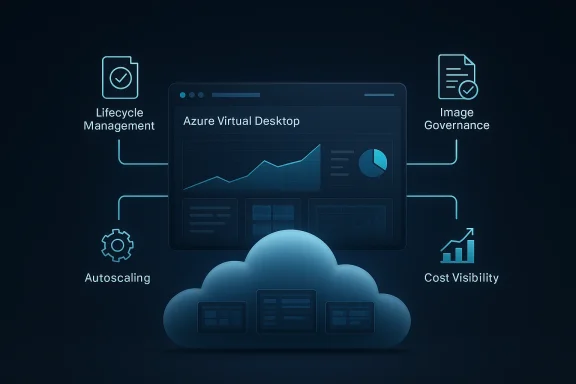
ControlUp’s launch of DaaS IQ for Microsoft Azure Virtual Desktop lands at exactly the right moment for a market that has matured beyond simple desktop delivery and into a much harder problem: how to run cloud desktops efficiently, consistently and at scale. The company is positioning the product as a standalone management layer for AVD estates, promising a single control plane for lifecycle operations, autoscaling, image management, cost visibility and governance. In practical terms, that means it is chasing one of the biggest pain points in the DaaS world: the gap between having cloud desktops and operating them well. The move also extends ControlUp’s already deep AVD story, which has grown from monitoring and remediation into broader platform control.
Azure Virtual Desktop has long been attractive because it lets organizations deliver Windows desktops without building and maintaining their own full VDI stack. Microsoft’s native autoscale, scaling plans, host pool controls and Insights tooling already cover an important part of the operational picture, and Microsoft explicitly recommends autoscale for balancing session host capacity against demand. At the same time, Microsoft documents several operational guardrails that show how much care AVD still requires, including region alignment, access permissions, max-session settings and the warning not to mix scaling methods on the same host pool.
That matters because the hardest part of AVD is not launching it; it is making it behave like a dependable service. Cloud desktops can be easy to spin up, but their economics depend on constant tuning. Microsoft’s own guidance on autoscale and cost-oriented tagging makes clear that a well-run AVD deployment still needs deliberate planning, good visibility and disciplined governance to avoid waste.
ControlUp has been moving toward this broader control story for years. Its earlier AVD work focused on monitoring, troubleshooting and cost breakdowns, including the addition of more than 160 AVD-specific metrics in 2023 and deeper Microsoft integrations in 2023 and 2024. That history suggests DaaS IQ is less a sudden pivot than a logical next layer: from observing AVD to actively running it.
There is also a wider market context. The rise of hybrid work, front-line digital workspaces and outsourced support functions has made cloud desktops more common, but also more complex. As deployments scale across host pools, subscriptions, user groups and time zones, the operational burden grows faster than many teams expect. That is the gap ControlUp is trying to exploit: a fragmented management model built from Azure Portal, Intune, scripts and separate admin workflows is workable for small estates, but it becomes brittle at enterprise scale.
For enterprises, the strategic question is no longer whether AVD can work. It is whether AVD can be managed predictably enough to serve as a core workplace platform. ControlUp is arguing that the answer increasingly depends on adding a stronger orchestration layer on top of Microsoft’s native stack.
That is significant because AVD already has many of those ingredients separately. Microsoft provides scaling plans, host pool controls, Insights and tagging guidance, but those pieces are distributed across the Azure ecosystem and still require configuration discipline. DaaS IQ is trying to convert that distribution into a simpler operating model, which is often where third-party platforms earn their keep.
DaaS IQ is also designed to make repetitive tasks reusable. Rather than creating one-off autoscaling rules or maintaining fragile scripts across host pools, organizations can define controls that apply consistently. That should especially appeal to teams running dozens or hundreds of pooled hosts, where standardization becomes a survival mechanism rather than a nice-to-have.
A useful way to think about the product is that it sits between Microsoft’s infrastructure and the IT team’s operational intent. It does not replace AVD; it tries to make AVD behave more like a managed service with clear policies, repeatable actions and more visible outcomes.
ControlUp says DaaS IQ uses schedule-based and policy-driven autoscaling to align compute more closely with demand. In plain English, that means the platform is trying to stop paying for idle capacity while still keeping enough hosts available when users arrive. If it works as advertised, this could reduce one of the most common sources of AVD waste: overprovisioned session hosts that sit powered on because nobody wants to risk an outage.
There is also a subtle difference between having autoscale and having confidence in autoscale. Many administrators are comfortable with a schedule. Fewer are comfortable trusting a schedule they can’t easily observe, audit or adjust in one place. ControlUp appears to be betting that visibility and automation together are more persuasive than either on its own.
A mature AVD operation must also balance cost reduction against user experience. The fastest way to save money is to shut down too much capacity. The fastest way to frustrate users is to underprovision it. DaaS IQ is being sold as a way to manage that tension with buffers, policy logic and real-time oversight rather than rough guesswork.
ControlUp is responding by putting cost visibility at the center of the product. The company says DaaS IQ exposes utilization, health and cost data in a single dashboard, helping IT and FinOps teams identify waste and improve predictability. That is an important framing because modern desktop operations are no longer purely an IT issue; they are a finance and governance issue too.
Microsoft’s own cost guidance reinforces the point. Tagging, scaling plans and insights all exist because Azure Virtual Desktop creates many cost-bearing objects and requires active management to stay efficient. In that sense, ControlUp is not arguing against Microsoft’s model; it is arguing that Microsoft’s model still needs a more opinionated operational layer for busy enterprises.
There is also a FinOps angle that extends beyond desktop teams. The more AVD estates are monitored for cost anomalies, the easier it becomes to justify capacity choices, forecast usage and compare business units. That could make DaaS IQ useful not just for the admin who powers on hosts, but for the manager who has to defend the monthly bill.
That matters because image drift is a real problem in any desktop estate. If different host pools are updated on different schedules, or if scripting varies from environment to environment, the result can be uneven behavior that is hard to debug. A consolidated management layer can reduce that drift by making the expected workflow more visible and repeatable.
There is also a compliance dimension. Audit tracking across the environment helps answer simple but important questions: who changed what, when and across which host pools? In regulated environments or large enterprises with strict change controls, that can be as valuable as the automation itself.
The practical takeaway is that lifecycle management is not just about speed. It is about reducing variance. The more an AVD environment can be managed through reusable policy rather than hand-built exceptions, the less likely it is to surprise either IT or the business.
The company says DaaS IQ includes smart policies, built-in buffers and real-time visibility so IT can act before capacity shortfalls affect performance. That language suggests the product is designed to protect the user journey rather than simply maximize utilization. In other words, it is trying to optimize for service continuity, not just for lower cloud spend.
This is where ControlUp’s established monitoring background gives the launch credibility. The company has long marketed deep telemetry and remediation capabilities for VDI and DaaS environments, so DaaS IQ feels like an extension of an existing performance and observability story rather than a brand-new claim.
That history matters because buyers are increasingly skeptical of products that promise automation without instrumentation. IT leaders want evidence that a system can detect anomalies, correlate them to capacity or policy issues and then take corrective action. ControlUp is clearly trying to say that DaaS IQ sits on top of a mature monitoring stack, not a speculative one.
ControlUp says DaaS IQ supports granular delegation controls for multi-tenant environments, making it easier to run multiple customer estates from a central interface. That could make the product especially appealing to service providers that want to scale without multiplying administrative overhead. It is also a natural fit for a vendor that has recently expanded its MSP-focused messaging across other parts of the ControlUp portfolio.
MSPs also care about repeatability in a very specific way. They need one operational model that can be applied across many customers, each with different policies, different sensitivity to downtime and different appetite for automation. A platform that can standardize the repetitive parts while preserving per-tenant controls has a better chance of becoming part of a provider’s core toolkit.
This also hints at where ControlUp may see growth beyond direct enterprise sales. The MSP channel can multiply distribution if the platform genuinely saves labor. If DaaS IQ reduces the number of consoles, scripts and manual checks an MSP needs to manage, it becomes easier to package AVD management as a profitable service.
That positioning is important because Microsoft does not appear to be pushing a fully opinionated, end-to-end desktop operations layer in the same way. Instead, the Microsoft model gives customers the primitives and expects them to assemble their own workflows. Third-party vendors like ControlUp can then sell a more unified experience on top of that foundation.
This is a familiar pattern in Microsoft’s ecosystem. Native tools set the baseline, then specialized vendors compete on depth, integration and usability. The winning products are usually those that reduce toil without creating new complexity, and that is exactly the bar ControlUp now has to clear.
There is also a platform-lock-in question for buyers. If DaaS IQ becomes the operational heart of an AVD estate, switching away later could become difficult. That is not necessarily a flaw, but it is a reminder that simplification often comes with a long-term dependency.
That trend was already visible in ControlUp’s partnership work with Nerdio, which aimed to accelerate AVD adoption by combining management, cost optimization and experience monitoring. DaaS IQ sharpens that strategy by giving ControlUp a more direct product answer to the operational challenges that enterprises associate with AVD.
At the same time, the product’s strongest differentiator may be breadth. ControlUp is leaning hard on the claim that it can manage the full AVD stack and connect monitoring, synthetic testing, automation, remote management and AI-assisted operations. Even if that claim is partly marketing, the underlying message is clear: the vendor wants to own the workflow, not just the alarm bell.
That strategy could pressure rivals that specialize narrowly in scaling or image automation. If buyers can get enough of those functions in one place, the economics of a fragmented toolchain become harder to justify. The question is whether ControlUp can deliver enough depth in each area to make the bundle feel superior rather than merely broader.
The language around AI, automation and self-healing is especially telling. The company is not merely promising better reporting; it is suggesting a future in which the platform can detect, decide and act with less human intervention. That is a bold message, and it reflects a broader industry push toward agentic operations even if the practical reality will remain more incremental.
ControlUp’s claim that it can “manage the full AVD stack” is therefore best read as an ambition, not a proven universal fact. Buyers will want to test how far the platform goes in real estates with custom images, complex app sets and mixed user profiles. The operational burden in AVD is often in the edge cases, not the happy path.
Even so, the strategy is coherent. If ControlUp can make AVD easier to run, easier to govern and easier to justify financially, it has a strong story for both enterprise and MSP customers. That combination is far more compelling than a product that simply adds another dashboard to an already crowded admin workflow.
There is also a philosophical concern: the more the tool does, the more the organization may stop understanding its own environment. Automation is powerful, but only when teams still have enough insight to diagnose exceptions and override bad decisions. That balance will be a crucial test for DaaS IQ.
It will also be worth watching how ControlUp frames the product relative to Microsoft’s own native tools. The best third-party platforms in the Microsoft ecosystem usually succeed by complementing built-in capabilities while removing the hard parts of daily administration. That is a narrow line to walk, and ControlUp will need customer proof, not just feature parity, to stay on the right side of it.
Source: IT Brief UK https://itbrief.co.uk/story/controlup-launches-daas-iq-for-azure-virtual-desktop/
 Background
Azure Virtual Desktop has long been attractive because it lets organizations deliver Windows desktops without building and maintaining their own full VDI stack. Microsoft’s native autoscale, scaling plans, host pool controls and Insights tooling already cover an important part of the operational picture, and Microsoft explicitly recommends autoscale for balancing session host capacity against demand. At the same time, Microsoft documents several operational guardrails that show how much care AVD still requires, including region alignment, access permissions, max-session settings and the warning not to mix scaling methods on the same host pool.That matters because the hardest part of AVD is not launching it; it is making it behave like a dependable service. Cloud desktops can be easy to spin up, but their economics depend on constant tuning. Microsoft’s own guidance on autoscale and cost-oriented tagging makes clear that a well-run AVD deployment still needs deliberate planning, good visibility and disciplined governance to avoid waste.
ControlUp has been moving toward this broader control story for years. Its earlier AVD work focused on monitoring, troubleshooting and cost breakdowns, including the addition of more than 160 AVD-specific metrics in 2023 and deeper Microsoft integrations in 2023 and 2024. That history suggests DaaS IQ is less a sudden pivot than a logical next layer: from observing AVD to actively running it.
There is also a wider market context. The rise of hybrid work, front-line digital workspaces and outsourced support functions has made cloud desktops more common, but also more complex. As deployments scale across host pools, subscriptions, user groups and time zones, the operational burden grows faster than many teams expect. That is the gap ControlUp is trying to exploit: a fragmented management model built from Azure Portal, Intune, scripts and separate admin workflows is workable for small estates, but it becomes brittle at enterprise scale.
For enterprises, the strategic question is no longer whether AVD can work. It is whether AVD can be managed predictably enough to serve as a core workplace platform. ControlUp is arguing that the answer increasingly depends on adding a stronger orchestration layer on top of Microsoft’s native stack.
What ControlUp Is Actually Launching
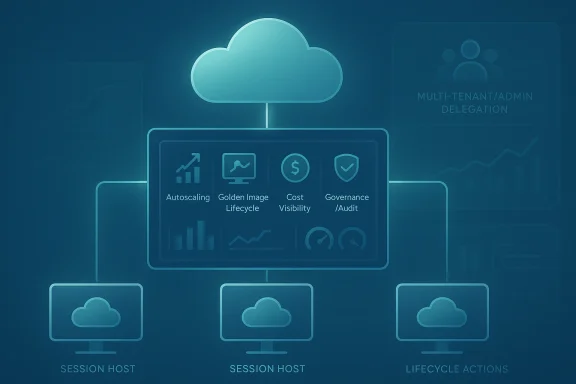
The headline feature of DaaS IQ is not a single tool, but a bundled operational model for AVD. ControlUp says the product combines autoscaling, utilization dashboards, host lifecycle actions, golden image management and audit tracking into one interface. The pitch is that IT teams can manage capacity, performance and cost in a unified way rather than juggling multiple consoles and scripts.That is significant because AVD already has many of those ingredients separately. Microsoft provides scaling plans, host pool controls, Insights and tagging guidance, but those pieces are distributed across the Azure ecosystem and still require configuration discipline. DaaS IQ is trying to convert that distribution into a simpler operating model, which is often where third-party platforms earn their keep.
The control-plane argument
ControlUp’s core argument is that AVD needs a single control plane. That phrase is not just marketing fluff; in large desktop estates, the difference between “we can manage this” and “we can manage this well” often comes down to how many places administrators must touch for routine work. The more systems involved, the easier it is for policies to drift or for actions to be missed.DaaS IQ is also designed to make repetitive tasks reusable. Rather than creating one-off autoscaling rules or maintaining fragile scripts across host pools, organizations can define controls that apply consistently. That should especially appeal to teams running dozens or hundreds of pooled hosts, where standardization becomes a survival mechanism rather than a nice-to-have.
A useful way to think about the product is that it sits between Microsoft’s infrastructure and the IT team’s operational intent. It does not replace AVD; it tries to make AVD behave more like a managed service with clear policies, repeatable actions and more visible outcomes.
Autoscaling and Capacity Management
Autoscaling is the most obvious value proposition, because desktop workloads are notoriously uneven. Business users do not consume desktops like steady-state servers; they log in waves, spike at the start of the day, settle at lunchtime and rise again around shift changes or regional handoffs. AVD supports autoscale, but organizations still need policies that match the actual rhythm of their workforce.ControlUp says DaaS IQ uses schedule-based and policy-driven autoscaling to align compute more closely with demand. In plain English, that means the platform is trying to stop paying for idle capacity while still keeping enough hosts available when users arrive. If it works as advertised, this could reduce one of the most common sources of AVD waste: overprovisioned session hosts that sit powered on because nobody wants to risk an outage.
Why autoscale is harder than it looks
Microsoft’s own documentation shows why autoscale is useful but not effortless. Scaling plans need the right permissions, the right regional placement and the right host pool configuration, and Microsoft warns against combining autoscale with other scaling mechanisms on the same host pool. That complexity creates a natural opening for a higher-level management product that can standardize the process across many estates.There is also a subtle difference between having autoscale and having confidence in autoscale. Many administrators are comfortable with a schedule. Fewer are comfortable trusting a schedule they can’t easily observe, audit or adjust in one place. ControlUp appears to be betting that visibility and automation together are more persuasive than either on its own.
A mature AVD operation must also balance cost reduction against user experience. The fastest way to save money is to shut down too much capacity. The fastest way to frustrate users is to underprovision it. DaaS IQ is being sold as a way to manage that tension with buffers, policy logic and real-time oversight rather than rough guesswork.
Cost Control and FinOps Pressure
Cost control is the second pillar of the launch, and arguably the one with the broadest executive appeal. Cloud desktops promise lower infrastructure overhead than traditional VDI, but they also make spending more elastic and therefore easier to mismanage. Unused session hosts, poorly tuned schedules and excess capacity can all turn a supposedly efficient AVD environment into a quiet budget leak.ControlUp is responding by putting cost visibility at the center of the product. The company says DaaS IQ exposes utilization, health and cost data in a single dashboard, helping IT and FinOps teams identify waste and improve predictability. That is an important framing because modern desktop operations are no longer purely an IT issue; they are a finance and governance issue too.
The economics of “always on”
One reason AVD can drift into overspend is that desktop environments feel safer when kept warm. Administrators often prefer to preserve extra headroom rather than risk a user login failure or a midday performance complaint. Over time, that caution can harden into a default always-on posture that quietly erodes the savings cloud desktops are supposed to deliver.Microsoft’s own cost guidance reinforces the point. Tagging, scaling plans and insights all exist because Azure Virtual Desktop creates many cost-bearing objects and requires active management to stay efficient. In that sense, ControlUp is not arguing against Microsoft’s model; it is arguing that Microsoft’s model still needs a more opinionated operational layer for busy enterprises.
There is also a FinOps angle that extends beyond desktop teams. The more AVD estates are monitored for cost anomalies, the easier it becomes to justify capacity choices, forecast usage and compare business units. That could make DaaS IQ useful not just for the admin who powers on hosts, but for the manager who has to defend the monthly bill.
Lifecycle Management and Image Operations
Image management is one of those AVD tasks that looks routine until it becomes a source of operational drag. Golden images must be updated, versioned, tested and rolled across host pools without breaking profiles, apps or login performance. ControlUp is pitching DaaS IQ as a way to centralize that lifecycle work alongside host actions such as drain, restart and delete.That matters because image drift is a real problem in any desktop estate. If different host pools are updated on different schedules, or if scripting varies from environment to environment, the result can be uneven behavior that is hard to debug. A consolidated management layer can reduce that drift by making the expected workflow more visible and repeatable.
Why lifecycle consistency matters
For end users, lifecycle inconsistency often shows up as the most annoying kind of IT problem: one group gets a better desktop experience than another for reasons nobody can immediately explain. For administrators, it creates support debt because every exception becomes another manual check. A product like DaaS IQ is attractive precisely because it promises to lower that debt.There is also a compliance dimension. Audit tracking across the environment helps answer simple but important questions: who changed what, when and across which host pools? In regulated environments or large enterprises with strict change controls, that can be as valuable as the automation itself.
The practical takeaway is that lifecycle management is not just about speed. It is about reducing variance. The more an AVD environment can be managed through reusable policy rather than hand-built exceptions, the less likely it is to surprise either IT or the business.
User Experience and Service Continuity
ControlUp’s messaging strongly emphasizes that cost savings should not come at the expense of user experience. That is not surprising, because AVD’s reputation depends on whether employees can log in quickly, reconnect reliably and keep working when demand spikes. If the desktop experience collapses under load, cost optimization becomes irrelevant very quickly.The company says DaaS IQ includes smart policies, built-in buffers and real-time visibility so IT can act before capacity shortfalls affect performance. That language suggests the product is designed to protect the user journey rather than simply maximize utilization. In other words, it is trying to optimize for service continuity, not just for lower cloud spend.
The hidden cost of bad experience
Poor AVD performance does not always look dramatic. Sometimes it is a few extra seconds at login, a slightly sluggish session launch or a host that is slow to come online after a schedule shift. Over thousands of users, those small delays add up to real productivity loss and a real increase in help desk tickets.This is where ControlUp’s established monitoring background gives the launch credibility. The company has long marketed deep telemetry and remediation capabilities for VDI and DaaS environments, so DaaS IQ feels like an extension of an existing performance and observability story rather than a brand-new claim.
That history matters because buyers are increasingly skeptical of products that promise automation without instrumentation. IT leaders want evidence that a system can detect anomalies, correlate them to capacity or policy issues and then take corrective action. ControlUp is clearly trying to say that DaaS IQ sits on top of a mature monitoring stack, not a speculative one.
MSP and Multi-Tenant Operations
The managed service provider angle is one of the more commercially interesting parts of the launch. Multi-tenant AVD operations are difficult because providers must standardize workflows across customers while preserving separation, governance and delegated access. That combination is awkward enough that many MSPs end up building separate toolchains or heavily customized procedures.ControlUp says DaaS IQ supports granular delegation controls for multi-tenant environments, making it easier to run multiple customer estates from a central interface. That could make the product especially appealing to service providers that want to scale without multiplying administrative overhead. It is also a natural fit for a vendor that has recently expanded its MSP-focused messaging across other parts of the ControlUp portfolio.
Why MSPs care differently
For an enterprise IT team, the issue is efficiency. For an MSP, the issue is also isolation. A centralized platform has to improve control without muddying tenant boundaries or increasing the risk of cross-customer mistakes. Granular delegation is therefore not a cosmetic feature; it is a prerequisite for trust.MSPs also care about repeatability in a very specific way. They need one operational model that can be applied across many customers, each with different policies, different sensitivity to downtime and different appetite for automation. A platform that can standardize the repetitive parts while preserving per-tenant controls has a better chance of becoming part of a provider’s core toolkit.
This also hints at where ControlUp may see growth beyond direct enterprise sales. The MSP channel can multiply distribution if the platform genuinely saves labor. If DaaS IQ reduces the number of consoles, scripts and manual checks an MSP needs to manage, it becomes easier to package AVD management as a profitable service.
How It Fits the Microsoft Ecosystem
DaaS IQ does not arrive in a vacuum. Microsoft already provides the foundation for AVD management through autoscale, Insights, host pool controls and documentation that helps administrators govern everything from permissions to cost visibility. ControlUp’s opportunity lies in filling the gaps between those native tools and the day-to-day realities of operating at scale.That positioning is important because Microsoft does not appear to be pushing a fully opinionated, end-to-end desktop operations layer in the same way. Instead, the Microsoft model gives customers the primitives and expects them to assemble their own workflows. Third-party vendors like ControlUp can then sell a more unified experience on top of that foundation.
Complement or competition?
At one level, DaaS IQ is complementary. It uses Microsoft’s cloud desktop platform as the substrate and helps teams orchestrate it better. At another level, it is a competitive statement: ControlUp is effectively saying Microsoft’s native tooling is not enough for enterprise-grade operational simplicity. Both can be true at once.This is a familiar pattern in Microsoft’s ecosystem. Native tools set the baseline, then specialized vendors compete on depth, integration and usability. The winning products are usually those that reduce toil without creating new complexity, and that is exactly the bar ControlUp now has to clear.
There is also a platform-lock-in question for buyers. If DaaS IQ becomes the operational heart of an AVD estate, switching away later could become difficult. That is not necessarily a flaw, but it is a reminder that simplification often comes with a long-term dependency.
Competition and Market Positioning
The ControlUp launch also has competitive implications beyond Microsoft. The AVD management and optimization market includes tools aimed at monitoring, cost control, automation and workspace orchestration, and vendors are increasingly trying to bundle those capabilities into broader platform stories. ControlUp’s move suggests that the market is shifting away from point solutions and toward integrated operational stacks.That trend was already visible in ControlUp’s partnership work with Nerdio, which aimed to accelerate AVD adoption by combining management, cost optimization and experience monitoring. DaaS IQ sharpens that strategy by giving ControlUp a more direct product answer to the operational challenges that enterprises associate with AVD.
Why differentiation now matters
The DaaS market is becoming harder to win with generic “visibility” messaging alone. Buyers want automation that actually reduces administrative work, not just dashboards that show them more clearly how busy they already are. ControlUp is trying to jump from observation to action, and that is a meaningful competitive shift.At the same time, the product’s strongest differentiator may be breadth. ControlUp is leaning hard on the claim that it can manage the full AVD stack and connect monitoring, synthetic testing, automation, remote management and AI-assisted operations. Even if that claim is partly marketing, the underlying message is clear: the vendor wants to own the workflow, not just the alarm bell.
That strategy could pressure rivals that specialize narrowly in scaling or image automation. If buyers can get enough of those functions in one place, the economics of a fragmented toolchain become harder to justify. The question is whether ControlUp can deliver enough depth in each area to make the bundle feel superior rather than merely broader.
What the Launch Signals About ControlUp’s Strategy
This is also a story about company direction. ControlUp has been steadily expanding from observability toward operational control, and DaaS IQ fits neatly into that evolution. The product looks like a deliberate attempt to own more of the workplace stack where control, cost and experience intersect.The language around AI, automation and self-healing is especially telling. The company is not merely promising better reporting; it is suggesting a future in which the platform can detect, decide and act with less human intervention. That is a bold message, and it reflects a broader industry push toward agentic operations even if the practical reality will remain more incremental.
The AI angle, with caution
It is tempting to treat “AI” in this context as a magic wand, but desktop operations are unforgiving. Autonomy only works when the underlying policy logic is trustworthy and the failure modes are well understood. In that sense, the real value may come not from AI replacing admins, but from AI helping admins notice patterns sooner and automate safer tasks first. That is the more credible reading of the launch.ControlUp’s claim that it can “manage the full AVD stack” is therefore best read as an ambition, not a proven universal fact. Buyers will want to test how far the platform goes in real estates with custom images, complex app sets and mixed user profiles. The operational burden in AVD is often in the edge cases, not the happy path.
Even so, the strategy is coherent. If ControlUp can make AVD easier to run, easier to govern and easier to justify financially, it has a strong story for both enterprise and MSP customers. That combination is far more compelling than a product that simply adds another dashboard to an already crowded admin workflow.
Strengths and Opportunities
ControlUp’s launch has real strengths because it addresses the operational problems that AVD customers actually feel every day. The strongest opportunity is not just lower cost, but lower friction across the whole desktop lifecycle. If the product delivers on its promise, it could become the layer that makes AVD manageable at larger scale.- Unified operations could reduce the sprawl of portals, scripts and ad hoc admin tasks.
- Better cost visibility may help IT and FinOps teams defend cloud spending more confidently.
- Automated autoscaling can cut idle capacity without forcing teams into constant manual tuning.
- Reusable controls may lower configuration drift across host pools and regions.
- Host lifecycle actions can make maintenance less disruptive and more repeatable.
- MSP delegation opens the door to multi-tenant management at lower overhead.
- AI-assisted workflows may reduce alert fatigue and speed up response to anomalies.
Why buyers may care now
The timing is favorable because many organizations are reassessing cloud desktop economics after the initial enthusiasm of remote work has given way to a harder question: what is the best long-term operating model? DaaS IQ offers a way to keep the flexibility of AVD while putting a firmer grip on spend and governance.Risks and Concerns
The biggest risk is that a platform promising simplicity could still introduce another layer of complexity. Every control plane adds its own learning curve, policy model and vendor dependency, and organizations will want to be sure the trade-off is worth it. In practice, the value will depend on how much manual work the product actually removes.- Vendor lock-in could make future platform changes more difficult.
- Automation errors may have wider impact if policies are misconfigured.
- Overpromised AI could raise expectations faster than the product can satisfy them.
- Integration friction may remain in estates with custom scripts or hybrid workflows.
- Cost savings could be offset if buyers need substantial onboarding or redesign.
- Competitive overlap with native Microsoft features may blur the value proposition.
- Operational trust will depend on real-world evidence, not launch-day claims.
The trust problem
Desktop administrators are cautious by nature, and for good reason. If an autoscaling policy or lifecycle rule fails, the result is immediately visible to end users. That means vendors in this space must prove reliability over time, not just announce a feature set.There is also a philosophical concern: the more the tool does, the more the organization may stop understanding its own environment. Automation is powerful, but only when teams still have enough insight to diagnose exceptions and override bad decisions. That balance will be a crucial test for DaaS IQ.
Looking Ahead
The next phase will be less about the launch itself and more about how customers operationalize it. If DaaS IQ can demonstrably reduce host waste, simplify lifecycle work and stabilize end-user experience, it could become a serious reference point for AVD management. If not, it risks being seen as another attractive abstraction layer over problems teams already know how to solve, albeit less elegantly.It will also be worth watching how ControlUp frames the product relative to Microsoft’s own native tools. The best third-party platforms in the Microsoft ecosystem usually succeed by complementing built-in capabilities while removing the hard parts of daily administration. That is a narrow line to walk, and ControlUp will need customer proof, not just feature parity, to stay on the right side of it.
Key things to watch
- Whether customers report measurable reductions in AVD spend.
- How well DaaS IQ handles large, multi-host-pool estates.
- Whether MSPs adopt the multi-tenant controls at scale.
- How ControlUp integrates DaaS IQ with its broader observability stack.
- Whether Microsoft’s native AVD tooling narrows the gap over time.
Source: IT Brief UK https://itbrief.co.uk/story/controlup-launches-daas-iq-for-azure-virtual-desktop/