

ControlUp used its weekly public updates in June 2026 to reinforce two connected enterprise IT themes: Windows 11 migration performance analytics through its “The Upload” podcast and SaaS license optimization through guidance on identifying idle software seats. The message is not subtle. ControlUp is arguing that the next wave of desktop management will be judged less by whether IT can deploy change and more by whether it can prove the change improved work.
That is a timely argument because Windows 11 migrations have moved from planning decks into operational reality. The easy part was identifying hardware that could pass Microsoft’s requirements. The harder part is explaining why a supposedly newer, better endpoint still feels slow to the person trying to use it at 9:05 on a Monday morning.
ControlUp’s latest messaging lands in a market crowded with tools that promise visibility. Every endpoint platform claims to collect telemetry, surface issues, and spare administrators from another war room. The differentiator ControlUp is trying to press is not visibility in the abstract, but operational proof.
That distinction matters. A Windows 11 migration can look successful in a project dashboard while still creating a worse employee experience. Devices may report as upgraded, compliant, and online, yet users may encounter slower logons, application hangs, degraded Teams performance, or storage bottlenecks that did not exist—or were at least not as visible—before the move.
ControlUp’s podcast framing around Windows 11 performance problems after hardware upgrades is therefore a useful tell. The company is not merely saying, “We can help you get to Windows 11.” It is saying that the migration itself is now a measurement problem. IT teams need baseline performance data before the upgrade, comparative data after the upgrade, and enough context to know whether complaints are isolated noise or early evidence of a systemic rollout flaw.
That is the right battlefield. Enterprises are under pressure to complete Windows 11 transitions while also rationalizing cloud spend, reducing help desk load, and showing the business that IT investments produce measurable returns. In that environment, telemetry that cannot be converted into decisions is just another dashboard.
The lived reality is messier. A device can satisfy the compatibility checklist and still deliver a poor user experience after migration. Driver maturity, endpoint security overhead, profile handling, app compatibility, startup tasks, background update behavior, and collaboration workloads can all produce symptoms that the readiness report alone will not explain.
This is where ControlUp’s emphasis on real performance data makes sense. A migration at scale is not one event; it is thousands of slightly different events happening across hardware models, departments, network conditions, user profiles, and application stacks. The enterprise does not need one answer to “Is Windows 11 faster?” It needs to know which populations improved, which declined, and why.
The most important shift is from anecdote to comparison. If a finance user says the laptop feels slower after the upgrade, IT needs to know whether that complaint matches endpoint metrics, whether peers on similar hardware are seeing the same pattern, and whether the problem began with the OS upgrade or with something adjacent, such as an agent update, a policy change, or a new SaaS workflow.
That is why the phrase “despite hardware upgrades” carries weight. Buying newer PCs should reduce friction, but it does not automatically eliminate it. If the performance problem follows the user, the profile, the application, or the security stack rather than the physical device, replacing hardware becomes an expensive way to avoid asking better questions.
The content strategy also reflects a broader change in how infrastructure vendors sell. The old pitch was product-led: here are the dashboards, agents, integrations, and remediation scripts. The newer pitch is problem-led: here is the operational mess you are already living through, and here is how our telemetry makes it manageable.
That is especially important for WindowsForum.com readers because the Windows 11 migration story is often reduced to compatibility drama or interface complaints. Those are real, but enterprise IT’s bigger concern is variance. A rollout can succeed in one business unit and fail in another for reasons that are invisible unless the organization has already instrumented the environment.
ControlUp is trying to attach itself to that variance. Its message is that IT should not wait for ticket volume or executive complaints to discover whether a migration is degrading employee experience. It should measure performance continuously, compare cohorts, and intervene before a bad rollout becomes accepted as the new normal.
There is a self-serving element here, naturally. ControlUp benefits when organizations believe native tooling is not enough. But the argument is not wrong simply because a vendor makes it. Microsoft’s own management stack can handle enormous parts of the Windows lifecycle, yet many enterprises still struggle to connect endpoint health, user experience, application behavior, and real-time remediation into one operational picture.
SaaS waste has become one of the more politically convenient targets in IT cost control. Unlike headcount reduction or infrastructure consolidation, license reclamation sounds painless. If users are not using paid seats, remove them, negotiate better renewals, and declare savings.
The problem is that “not using” is harder to define than it sounds. Login events are a crude signal. A user may authenticate into a service because single sign-on did it automatically, because a browser session refreshed, or because a connected workflow touched the application without meaningful engagement. Conversely, some usage may be intermittent but business-critical.
ControlUp’s point that logins alone are unreliable is therefore more than a feature pitch. It is a warning against lazy optimization. If an organization reclaims licenses based on shallow telemetry, it may create support incidents, disrupt legitimate workflows, or punish teams whose software usage is seasonal but necessary.
The better approach is to combine signals: authentication, application activity, endpoint context, user population, department ownership, renewal timing, and business justification. That is harder than exporting a login report, but it is also the difference between governance and guesswork.
That does not mean endpoint analytics vendors automatically become procurement systems. It does mean the boundaries are blurring. The administrator responsible for employee experience increasingly needs to answer questions that once lived outside endpoint operations: Which tools are actually used? Which users are licensed but inactive? Which app subscriptions are creating risk? Which renewals should be challenged?
This is one reason SaaS optimization is attractive to vendors like ControlUp. Performance analytics can be difficult to translate into a simple dollar figure. Avoided frustration and reduced ticket volume are valuable, but they are often modeled indirectly. Idle license reclamation is more CFO-friendly: number of unused seats multiplied by cost per seat, adjusted for renewal timing and business exceptions.
The risk is that vendors overstate the ease of the savings. A dashboard can identify candidates for reclamation, but organizations still need process. They need owners who can approve changes, exception handling for low-frequency users, and integration with identity and license assignment workflows. Without that, “found savings” becomes another report nobody acts on.
ControlUp appears to understand that the value is not merely in surfacing unused licenses, but in helping teams act on the data. That is the correct emphasis. In enterprise IT, the gap between insight and outcome is where many tools go to die.
That is why the Windows 11 and SaaS optimization themes pair so neatly. One speaks to risk during a forced platform transition. The other speaks to cost discipline in a subscription-heavy workplace. Together, they frame ControlUp as a platform for IT teams that need to defend both experience and expense.
This is not unique to ControlUp. The digital employee experience market has spent the last few years expanding from endpoint monitoring into remediation, sentiment, application visibility, collaboration analytics, and asset intelligence. Vendors know that telemetry alone is not enough. They need to attach telemetry to decisions that executives understand.
For sysadmins, this can be both useful and irritating. Useful because better analytics can validate what frontline teams already know: that user experience problems are often complex, intermittent, and poorly represented by simple uptime metrics. Irritating because every platform now claims to be the missing layer that will make IT proactive, strategic, and magically aligned to business value.
The test is whether the tool reduces the time between symptom and action. If ControlUp can help an administrator identify that a Windows 11 slowdown is tied to a specific driver version, app build, policy, or device cohort, the value is obvious. If it can show that 300 expensive SaaS seats are idle and route that finding into a reclamation workflow, the value is equally obvious.
That is the hurdle ControlUp and similar vendors must clear. They are not selling into a vacuum. They are selling into estates where Microsoft tooling is already licensed, partially deployed, politically favored, and familiar enough to be the default answer.
The opening for third-party tools is fragmentation. Real environments rarely operate as clean Microsoft reference architectures. They include legacy apps, multiple identity sources, virtual desktop platforms, nonstandard endpoints, contractor devices, remote networks, inherited policies, and business units that made their own SaaS decisions years before central IT tried to govern them.
In those environments, a specialized analytics layer can justify itself by connecting signals Microsoft does not fully unify for that customer’s use case. But the burden of proof is high. A pretty dashboard will not beat bundled tooling unless it produces faster troubleshooting, clearer decisions, or measurable savings.
That makes ControlUp’s current emphasis sensible. Windows 11 migration and SaaS waste are areas where customers can define before-and-after outcomes. Did the migration improve or degrade user experience? Which devices or users need attention? How much license spend can be reclaimed without harming work? These are questions with consequences.
Deadline pressure is dangerous because it rewards superficial metrics. A migration program can become obsessed with percentage complete, leaving experience validation as an afterthought. That is how IT ends up with a green project dashboard and a red help desk queue.
ControlUp’s messaging is a direct response to that failure mode. It is telling enterprises to treat Windows 11 migration as a performance-management exercise rather than a deployment-only exercise. That means baselining before the change, watching the rollout in cohorts, and keeping enough historical data to distinguish migration effects from ordinary environmental noise.
The practical lesson for administrators is not vendor-specific. Before migrating a large population, capture meaningful endpoint and user-experience baselines. After migrating, compare like with like. Do not compare a new executive laptop on a clean profile with a five-year-old shared device running three security agents and a bloated startup stack.
The better the measurement, the less political the conversation becomes. Users are not “just complaining” if telemetry shows longer logon times, higher CPU pressure, or application instability. Conversely, IT can push back on vague dissatisfaction if the data shows no regression and points instead to training, workflow change, or isolated configuration issues.
Still, the wrapper is a reminder to read vendor-adjacent updates carefully. A weekly update is not independent validation of product performance. It tells us what the company wants the market to notice. In this case, ControlUp wants customers and potential buyers to see it as more than a monitoring tool and more than a Windows migration helper.
That is not inherently a problem. Companies reveal strategy through the problems they choose to highlight. ControlUp is choosing problems that sit close to budget, executive visibility, and user frustration. That is exactly where vendors want to be when IT teams decide which platforms survive consolidation.
The more interesting question is whether customers will connect these capabilities in practice. The team managing Windows 11 migration may not be the same team reviewing SaaS renewals. The endpoint engineering group may care about logon performance, while finance cares about unused seats. ControlUp’s opportunity is to make those conversations feel like part of the same operational discipline.
That is a powerful pitch because enterprise IT is full of invisible risk. Slow endpoints waste time in fragments too small for any one ticket to capture. Unused SaaS seats drain budgets in recurring increments that become visible only at renewal. Both problems thrive when organizations rely on assumptions.
The danger, as always, is that analytics becomes a substitute for judgment. A device score does not know every business context. A usage metric does not know why a user needs occasional access to a tool. A reclamation candidate is not the same thing as a license that should be removed immediately.
The best version of ControlUp’s argument is not automation without humans. It is better evidence for humans who are already overloaded. In a well-run IT organization, telemetry should narrow the field of investigation, expose patterns, and make decisions auditable. It should not become a blunt instrument that turns every low-usage account into a help desk ticket waiting to happen.
The same is true for SaaS governance. Buying, assigning, and revoking licenses are administrative tasks. Understanding whether those licenses represent real work, wasted spend, or latent business need requires a richer view of user behavior and application context.
For WindowsForum.com’s audience, the most important takeaway is that these trends are converging. Endpoint performance, app usage, identity events, SaaS access, and cost optimization are no longer separate conversations. They are becoming different views of the same digital workplace.
That is a timely argument because Windows 11 migrations have moved from planning decks into operational reality. The easy part was identifying hardware that could pass Microsoft’s requirements. The harder part is explaining why a supposedly newer, better endpoint still feels slow to the person trying to use it at 9:05 on a Monday morning.
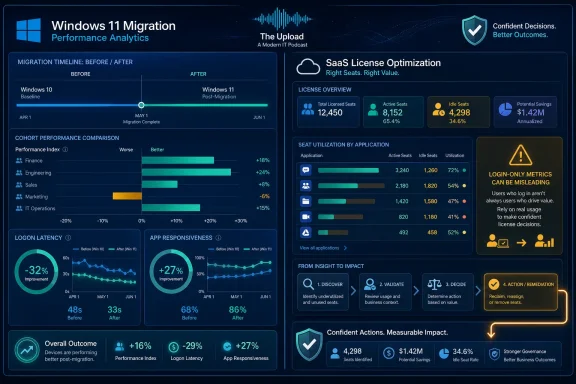 ControlUp Is Selling Proof, Not Just Monitoring
ControlUp’s latest messaging lands in a market crowded with tools that promise visibility. Every endpoint platform claims to collect telemetry, surface issues, and spare administrators from another war room. The differentiator ControlUp is trying to press is not visibility in the abstract, but operational proof.That distinction matters. A Windows 11 migration can look successful in a project dashboard while still creating a worse employee experience. Devices may report as upgraded, compliant, and online, yet users may encounter slower logons, application hangs, degraded Teams performance, or storage bottlenecks that did not exist—or were at least not as visible—before the move.
ControlUp’s podcast framing around Windows 11 performance problems after hardware upgrades is therefore a useful tell. The company is not merely saying, “We can help you get to Windows 11.” It is saying that the migration itself is now a measurement problem. IT teams need baseline performance data before the upgrade, comparative data after the upgrade, and enough context to know whether complaints are isolated noise or early evidence of a systemic rollout flaw.
That is the right battlefield. Enterprises are under pressure to complete Windows 11 transitions while also rationalizing cloud spend, reducing help desk load, and showing the business that IT investments produce measurable returns. In that environment, telemetry that cannot be converted into decisions is just another dashboard.
Windows 11 Migration Has Become an Experience Audit
For years, the Windows 11 conversation was dominated by readiness. TPM 2.0, supported CPUs, Secure Boot, RAM, disk space, and device age shaped the first phase of enterprise planning. That phase was necessary, but it also encouraged a narrow definition of success: if the machine can upgrade, the machine is ready.The lived reality is messier. A device can satisfy the compatibility checklist and still deliver a poor user experience after migration. Driver maturity, endpoint security overhead, profile handling, app compatibility, startup tasks, background update behavior, and collaboration workloads can all produce symptoms that the readiness report alone will not explain.
This is where ControlUp’s emphasis on real performance data makes sense. A migration at scale is not one event; it is thousands of slightly different events happening across hardware models, departments, network conditions, user profiles, and application stacks. The enterprise does not need one answer to “Is Windows 11 faster?” It needs to know which populations improved, which declined, and why.
The most important shift is from anecdote to comparison. If a finance user says the laptop feels slower after the upgrade, IT needs to know whether that complaint matches endpoint metrics, whether peers on similar hardware are seeing the same pattern, and whether the problem began with the OS upgrade or with something adjacent, such as an agent update, a policy change, or a new SaaS workflow.
That is why the phrase “despite hardware upgrades” carries weight. Buying newer PCs should reduce friction, but it does not automatically eliminate it. If the performance problem follows the user, the profile, the application, or the security stack rather than the physical device, replacing hardware becomes an expensive way to avoid asking better questions.
The Podcast Is Really a Positioning Document
A vendor podcast can be marketing fluff, but the subject ControlUp chose for its inaugural “The Upload” push is strategically revealing. Windows 11 migration is a large, expensive, deadline-shaped problem that sits at the intersection of endpoint management, security compliance, user sentiment, and productivity. It is exactly the kind of problem where a digital employee experience platform can argue for budget beyond traditional monitoring.The content strategy also reflects a broader change in how infrastructure vendors sell. The old pitch was product-led: here are the dashboards, agents, integrations, and remediation scripts. The newer pitch is problem-led: here is the operational mess you are already living through, and here is how our telemetry makes it manageable.
That is especially important for WindowsForum.com readers because the Windows 11 migration story is often reduced to compatibility drama or interface complaints. Those are real, but enterprise IT’s bigger concern is variance. A rollout can succeed in one business unit and fail in another for reasons that are invisible unless the organization has already instrumented the environment.
ControlUp is trying to attach itself to that variance. Its message is that IT should not wait for ticket volume or executive complaints to discover whether a migration is degrading employee experience. It should measure performance continuously, compare cohorts, and intervene before a bad rollout becomes accepted as the new normal.
There is a self-serving element here, naturally. ControlUp benefits when organizations believe native tooling is not enough. But the argument is not wrong simply because a vendor makes it. Microsoft’s own management stack can handle enormous parts of the Windows lifecycle, yet many enterprises still struggle to connect endpoint health, user experience, application behavior, and real-time remediation into one operational picture.
SaaS License Waste Is the Same Story in a Different Budget Line
The second half of ControlUp’s weekly emphasis—idle SaaS licenses—may look unrelated to Windows 11 performance analytics. It is not. Both messages are about replacing assumption with measurement.SaaS waste has become one of the more politically convenient targets in IT cost control. Unlike headcount reduction or infrastructure consolidation, license reclamation sounds painless. If users are not using paid seats, remove them, negotiate better renewals, and declare savings.
The problem is that “not using” is harder to define than it sounds. Login events are a crude signal. A user may authenticate into a service because single sign-on did it automatically, because a browser session refreshed, or because a connected workflow touched the application without meaningful engagement. Conversely, some usage may be intermittent but business-critical.
ControlUp’s point that logins alone are unreliable is therefore more than a feature pitch. It is a warning against lazy optimization. If an organization reclaims licenses based on shallow telemetry, it may create support incidents, disrupt legitimate workflows, or punish teams whose software usage is seasonal but necessary.
The better approach is to combine signals: authentication, application activity, endpoint context, user population, department ownership, renewal timing, and business justification. That is harder than exporting a login report, but it is also the difference between governance and guesswork.
Cost Optimization Is Becoming a Digital Workplace Feature
SaaS cost optimization used to belong mostly to procurement, finance, or dedicated SaaS management platforms. ControlUp’s move into this language shows how much the digital workplace category has expanded. If employees work through browsers, SaaS apps, virtual desktops, local Windows endpoints, and collaboration tools, then the platform that observes the work environment can also observe waste.That does not mean endpoint analytics vendors automatically become procurement systems. It does mean the boundaries are blurring. The administrator responsible for employee experience increasingly needs to answer questions that once lived outside endpoint operations: Which tools are actually used? Which users are licensed but inactive? Which app subscriptions are creating risk? Which renewals should be challenged?
This is one reason SaaS optimization is attractive to vendors like ControlUp. Performance analytics can be difficult to translate into a simple dollar figure. Avoided frustration and reduced ticket volume are valuable, but they are often modeled indirectly. Idle license reclamation is more CFO-friendly: number of unused seats multiplied by cost per seat, adjusted for renewal timing and business exceptions.
The risk is that vendors overstate the ease of the savings. A dashboard can identify candidates for reclamation, but organizations still need process. They need owners who can approve changes, exception handling for low-frequency users, and integration with identity and license assignment workflows. Without that, “found savings” becomes another report nobody acts on.
ControlUp appears to understand that the value is not merely in surfacing unused licenses, but in helping teams act on the data. That is the correct emphasis. In enterprise IT, the gap between insight and outcome is where many tools go to die.
The Enterprise Buyer Wants Fewer Consoles and Better Arguments
ControlUp’s combined messaging also reflects a buying reality: IT leaders are under pressure to consolidate tools while improving outcomes. A vendor that only solves one narrow problem may be easier to replace than a vendor that can support multiple board-level narratives: user productivity, migration assurance, operational efficiency, security posture, and cost savings.That is why the Windows 11 and SaaS optimization themes pair so neatly. One speaks to risk during a forced platform transition. The other speaks to cost discipline in a subscription-heavy workplace. Together, they frame ControlUp as a platform for IT teams that need to defend both experience and expense.
This is not unique to ControlUp. The digital employee experience market has spent the last few years expanding from endpoint monitoring into remediation, sentiment, application visibility, collaboration analytics, and asset intelligence. Vendors know that telemetry alone is not enough. They need to attach telemetry to decisions that executives understand.
For sysadmins, this can be both useful and irritating. Useful because better analytics can validate what frontline teams already know: that user experience problems are often complex, intermittent, and poorly represented by simple uptime metrics. Irritating because every platform now claims to be the missing layer that will make IT proactive, strategic, and magically aligned to business value.
The test is whether the tool reduces the time between symptom and action. If ControlUp can help an administrator identify that a Windows 11 slowdown is tied to a specific driver version, app build, policy, or device cohort, the value is obvious. If it can show that 300 expensive SaaS seats are idle and route that finding into a reclamation workflow, the value is equally obvious.
Native Tools Still Set the Baseline
Any serious discussion of Windows 11 migration analytics has to acknowledge Microsoft’s gravity. Intune, Windows Update for Business, Endpoint analytics, Configuration Manager, Entra ID, Defender, and Microsoft 365 admin telemetry already give organizations a substantial management and reporting base. For many environments, especially those standardized on Microsoft 365 E3 or E5, the first question is not whether another tool is useful. It is whether another tool is necessary.That is the hurdle ControlUp and similar vendors must clear. They are not selling into a vacuum. They are selling into estates where Microsoft tooling is already licensed, partially deployed, politically favored, and familiar enough to be the default answer.
The opening for third-party tools is fragmentation. Real environments rarely operate as clean Microsoft reference architectures. They include legacy apps, multiple identity sources, virtual desktop platforms, nonstandard endpoints, contractor devices, remote networks, inherited policies, and business units that made their own SaaS decisions years before central IT tried to govern them.
In those environments, a specialized analytics layer can justify itself by connecting signals Microsoft does not fully unify for that customer’s use case. But the burden of proof is high. A pretty dashboard will not beat bundled tooling unless it produces faster troubleshooting, clearer decisions, or measurable savings.
That makes ControlUp’s current emphasis sensible. Windows 11 migration and SaaS waste are areas where customers can define before-and-after outcomes. Did the migration improve or degrade user experience? Which devices or users need attention? How much license spend can be reclaimed without harming work? These are questions with consequences.
The Windows 10 Deadline Changed the Tone
The Windows 11 migration push is no longer a distant modernization initiative. Windows 10’s end of support has turned the conversation into a deadline-driven operational campaign, even for organizations that purchased or considered extended support options. That changes the tone from “Should we move?” to “How do we move without making work worse?”Deadline pressure is dangerous because it rewards superficial metrics. A migration program can become obsessed with percentage complete, leaving experience validation as an afterthought. That is how IT ends up with a green project dashboard and a red help desk queue.
ControlUp’s messaging is a direct response to that failure mode. It is telling enterprises to treat Windows 11 migration as a performance-management exercise rather than a deployment-only exercise. That means baselining before the change, watching the rollout in cohorts, and keeping enough historical data to distinguish migration effects from ordinary environmental noise.
The practical lesson for administrators is not vendor-specific. Before migrating a large population, capture meaningful endpoint and user-experience baselines. After migrating, compare like with like. Do not compare a new executive laptop on a clean profile with a five-year-old shared device running three security agents and a bloated startup stack.
The better the measurement, the less political the conversation becomes. Users are not “just complaining” if telemetry shows longer logon times, higher CPU pressure, or application instability. Conversely, IT can push back on vague dissatisfaction if the data shows no regression and points instead to training, workflow change, or isolated configuration issues.
The Ad-Tech Wrapper Should Not Distract From the Signal
The submitted TipRanks item is an awkward little artifact of modern business news: a short company update wrapped in investment-site furniture, complete with promotional lines for premium tools and newsletters. That packaging is not the story. The story is that ControlUp’s public messaging is converging around two enterprise anxieties that are not going away: endpoint experience and software spend.Still, the wrapper is a reminder to read vendor-adjacent updates carefully. A weekly update is not independent validation of product performance. It tells us what the company wants the market to notice. In this case, ControlUp wants customers and potential buyers to see it as more than a monitoring tool and more than a Windows migration helper.
That is not inherently a problem. Companies reveal strategy through the problems they choose to highlight. ControlUp is choosing problems that sit close to budget, executive visibility, and user frustration. That is exactly where vendors want to be when IT teams decide which platforms survive consolidation.
The more interesting question is whether customers will connect these capabilities in practice. The team managing Windows 11 migration may not be the same team reviewing SaaS renewals. The endpoint engineering group may care about logon performance, while finance cares about unused seats. ControlUp’s opportunity is to make those conversations feel like part of the same operational discipline.
The Real Product Is Confidence
ControlUp’s weekly updates are easy to summarize as two product-adjacent messages: Windows 11 performance analytics and SaaS license optimization. But the deeper product being sold is confidence. Confidence that a migration is not silently damaging productivity. Confidence that license cuts are based on usage rather than guesswork. Confidence that IT can act before complaints or invoices force the issue.That is a powerful pitch because enterprise IT is full of invisible risk. Slow endpoints waste time in fragments too small for any one ticket to capture. Unused SaaS seats drain budgets in recurring increments that become visible only at renewal. Both problems thrive when organizations rely on assumptions.
The danger, as always, is that analytics becomes a substitute for judgment. A device score does not know every business context. A usage metric does not know why a user needs occasional access to a tool. A reclamation candidate is not the same thing as a license that should be removed immediately.
The best version of ControlUp’s argument is not automation without humans. It is better evidence for humans who are already overloaded. In a well-run IT organization, telemetry should narrow the field of investigation, expose patterns, and make decisions auditable. It should not become a blunt instrument that turns every low-usage account into a help desk ticket waiting to happen.
ControlUp’s Week Points to a More Measurable Desktop
The practical reading of ControlUp’s latest push is that Windows management is becoming less about the OS image and more about the measured experience around it. That does not make traditional endpoint management obsolete. It makes it insufficient on its own.The same is true for SaaS governance. Buying, assigning, and revoking licenses are administrative tasks. Understanding whether those licenses represent real work, wasted spend, or latent business need requires a richer view of user behavior and application context.
For WindowsForum.com’s audience, the most important takeaway is that these trends are converging. Endpoint performance, app usage, identity events, SaaS access, and cost optimization are no longer separate conversations. They are becoming different views of the same digital workplace.
The Week’s Quiet Message Is That Guesswork Is Getting Expensive
ControlUp’s updates are not a dramatic product launch, but they are a useful marker of where enterprise desktop management is heading. The company is leaning into the idea that IT teams need evidence before, during, and after major changes—and that the same evidence can support both productivity and cost control.- Windows 11 migration success should be measured by user experience and endpoint performance, not just upgrade completion rates.
- Hardware readiness does not guarantee post-migration performance, especially when drivers, profiles, security tools, and collaboration workloads vary across the estate.
- SaaS login events are a weak proxy for meaningful application usage, and license reclamation needs richer context before IT starts cutting seats.
- Cost optimization is becoming part of the digital employee experience conversation because software waste and endpoint friction both affect business productivity.
- ControlUp’s current positioning is strongest when it connects telemetry to action, such as migration validation, troubleshooting, remediation, and license governance.
References
- Primary source: TipRanks
Published: 2026-06-20T15:24:08.678715
- Related coverage: support.controlup.com

Tracking App License Utilization And Unused Spend
support.controlup.com
- Related coverage: controlup.com
ControlUp with Microsoft | Optimize Windows 365 & AVD
Real-time monitoring, remediation, and DEX insights for Windows 365 Cloud PCs, AVD, Intune, and Teams environments.www.controlup.com
- Related coverage: digitalitnews.com
ControlUp Reports Slow Windows 11 Migration Across Endpoints
Education and technology sectors lead the way in Windows 11, while healthcare and financial services lag behind. digitalitnews.com
- Related coverage: techtarget.com
What to do when device settings don't migrate to Windows 11 | TechTarget
Learn why device settings sometimes fail to migrate from Windows 10 to Windows 11 and how IT teams can manage hardware conflicts and other possible causes.www.techtarget.com - Official source: podcasts.apple.com
The Upload w/ ControlUp - Podcast - Apple Podcasts
Listen to Eugenia Schipelliti | Jeff Johnson's The Upload w/ ControlUp podcast on Apple Podcasts. podcasts.apple.com
- Related coverage: controlupcommunity.com
How to Check if a User Accessed an Application such as a VPN in ControlUp | ControlUp Community
The user asked if it was possible to see if a user had used an application such as a VPN. @member recommended checking stopped processes and authentication logs, then provided a script to check the VPN default gateway. It was suggested that an alert could be set, but the user noted they were...www.controlupcommunity.com - Related coverage: visualedgeit.com
Print
IT support, customer service concept. Computer engineer, technician coding on laptop computer connection with big data storage as backgrounds, digital technology, database, data managementvisualedgeit.com
