

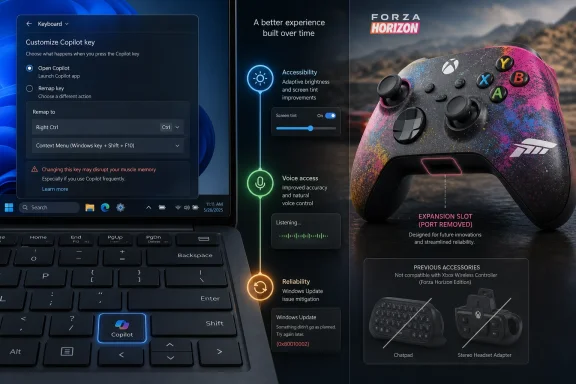
Microsoft’s week of Windows and Xbox news, published May 23, 2026, centered on two small hardware reversals: Windows 11 is getting a native way to turn the Copilot key back into Right Ctrl or Menu, while a new Forza Horizon 6 Xbox controller appears to drop the long-running expansion port. The pairing is almost too neat. One change restores a missing physical affordance after user pushback; the other quietly removes one from a mature gaming accessory line. Together, they show Microsoft still trying to bend hardware around services, telemetry, accessibility, and cost — and still learning that users remember every key and port they lose.
The Copilot key was never just another shortcut. When Microsoft and PC makers began placing it on new Windows laptops, it was framed as the biggest change to the Windows keyboard in decades: a physical endorsement of AI as the next default layer of personal computing. That made the key symbolically powerful, but it also made every practical annoyance more irritating.
For users who did not rely on the right-side Control key or the Menu key, the change may have looked trivial. For power users, developers, multilingual typists, accessibility users, virtual machine operators, and anyone with years of muscle memory, it was not trivial at all. Microsoft had turned a familiar input surface into a billboard.
The company’s latest promise to let users remap the Copilot key to Right Ctrl or the Context menu key is therefore more than a quality-of-life tweak. It is an admission that the Windows ecosystem cannot treat the keyboard like a promotional canvas without consequences. Keys are not icons. They are interfaces with decades of habits attached.
The irony is that Windows has always been at its best when it lets users make the machine their own. PowerToys, registry edits, keyboard layouts, accessibility settings, enterprise policies, and third-party utilities all exist because Windows won by being malleable. The Copilot key tried to make one AI behavior immovable. The new remapping option concedes that even Microsoft’s preferred future has to share space with the user’s preferred workflow.
That distinction matters. A dedicated AI key at the edge of the keyboard would have been easy to ignore. A dedicated AI key occupying the place where Right Ctrl or Menu used to live was impossible to ignore for the people affected. It turned Copilot from an optional assistant into a daily interruption in the physical layout of the PC.
Right Ctrl has a niche reputation, but niche is not the same as irrelevant. Remote desktop sessions, terminal shortcuts, development tools, gaming input schemes, assistive workflows, keyboard-driven navigation, and international layouts can all depend on predictable modifier behavior. A user who never touches Right Ctrl can dismiss the complaint as fussy; a user who depends on it can see the change as a regression in the machine itself.
The Context menu key has a similar story. It was never fashionable, but it offered a keyboard path into right-click behavior, and that is precisely the kind of thing that matters to users who avoid the mouse or rely on screen readers. Microsoft’s own accessibility story becomes harder to sell when an AI branding decision disrupts established keyboard paths.
The company’s coming fix does not erase the original mistake. It does, however, place the issue where it should have been from the beginning: in Settings, under user control. A remappable key is a feature. A non-negotiable key is a tax.
The updated taskbar is the obvious example. Windows 11 launched with a simplified taskbar that stripped away capabilities many Windows users considered basic, including more flexible positioning and density choices. Years later, Microsoft is gradually putting some of that configurability back. The lesson is not that every old Windows behavior must live forever. The lesson is that removing long-standing affordances requires a better argument than visual tidiness.
The Copilot key is now traveling the same road. Microsoft made a bet, users objected, and the company is adding a switch. This is not failure in the catastrophic sense. It is the messy process by which a platform vendor relearns that defaults are powerful only when exits exist.
That matters because Windows 11 is increasingly a platform of layered defaults. Copilot appears in the shell, Office apps, Edge, search surfaces, and hardware keys. Microsoft can argue that this reduces friction for AI adoption, and for some users it probably does. But when every surface points to the same service, even small controls become important pressure valves.
The recent adjustment to the Copilot button in Office apps follows the same logic. Microsoft is discovering that enthusiasm for AI features does not automatically translate into enthusiasm for AI placement. Users may want summarization, drafting, and analysis tools; they may not want them sitting in the visual and physical spaces where established commands used to live.
For consumers, Windows Update errors are frustrating. For IT teams, they are operational risk. A failed update pipeline means delayed fixes, inconsistent fleet state, more support tickets, and awkward conversations about whether a machine is unpatched because of user negligence or platform failure.
This is where Microsoft’s dual identity creates tension. The company wants Windows to feel like a continuously improving cloud-connected product, but it is still the base layer for regulated businesses, schools, hospitals, factories, and government offices. In that world, reliability is not a vibe; it is a deployment property.
The Secure Boot deployment script improvements point in the opposite direction: a recognition that administrators need centralized tooling to push mandatory security changes safely. That is the Microsoft enterprise customers prefer to see — less spectacle, more repeatability. It is also the Microsoft that can sometimes be obscured by the Copilot-first narrative.
Security teams are already juggling long-standing local privilege escalation issues, firmware requirements, boot-chain hardening, driver hygiene, and compatibility testing. An update error code may not trend on social media, but it is the kind of detail that determines whether Windows feels dependable. No AI key can compensate for a patching experience that loses trust.
This is the most compelling version of Microsoft’s Windows strategy. Accessibility work rarely produces the loudest demo, but it often produces the most durable platform improvements. Voice access, screen readability, better narration, and clearer editing feedback can help users with disabilities while also benefiting users in noisy rooms, tired eyes, temporary injuries, or mobile work setups.
The Copilot key controversy becomes sharper in that context. If a hardware change disrupts screen reader workflows or keyboard-driven interaction, then the company’s accessibility investments and its AI hardware push are working against each other. That is not just a messaging problem. It is a design governance problem.
Microsoft has spent years arguing that inclusive design leads to better products for everyone. The argument is sound. But inclusive design also means resisting the temptation to override existing access paths in the name of a new strategic priority.
The best accessibility features disappear into the reliability of the system. They do not require users to fight the machine. A remappable Copilot key is not the end of the story, but it moves the hardware closer to that principle.
The reported inclusion of a built-in privacy screen is particularly telling. That is not a flashy creator feature or a gamer-friendly spec. It is a corporate feature aimed at airplanes, open offices, client sites, and compliance-conscious workers. Surface has always lived or died on whether its industrial design could justify prices above the commodity Windows laptop market, and privacy hardware is the sort of detail that gives procurement departments something concrete to point to.
The problem, as ever, is price. Premium Surface devices can make sense for executives, mobile professionals, and organizations that value standardization and support. They are harder to defend when Windows hardware partners offer aggressive pricing, repairability trade-offs, broader port selections, and similar silicon.
Microsoft’s Surface challenge in 2026 is not whether it can build attractive PCs. It can. The challenge is whether Surface can justify being both a reference design and a premium line while the rest of the Windows ecosystem races to package the same AI-era claims into cheaper machines.
The Copilot key issue shadows this too. Surface and its OEM peers helped normalize AI branding on the keyboard. Now Microsoft is building the escape hatch. The best hardware leadership the company can offer may be less about declaring the next key and more about proving that premium Windows devices respect users enough to let them configure it.
This is classic platform-owner behavior. A port becomes less central over time, wireless accessories mature, USB-C becomes the default physical connector, and the proprietary slot begins to look like legacy baggage. From an engineering and manufacturing standpoint, removing it may simplify the controller. From a user standpoint, it can strand accessories that worked yesterday.
The important word is quietly. Microsoft did not make the missing port the headline feature of the controller. Users found it, compared it, and began drawing conclusions. That discovery pattern tends to make hardware removals feel more suspicious than they might otherwise be.
There may be a rational case for the change. The Xbox accessory ecosystem is not what it was in the Xbox One era, and many players now use wireless headsets, standard USB connections, Bluetooth, or platform-level chat features. But rational does not mean costless. A mature platform earns trust by communicating compatibility changes clearly.
The Xbox controller is one of Microsoft’s best hardware products precisely because it changes slowly. Its shape, buttons, and compatibility have become a cross-platform standard for console, PC, cloud, and mobile play. That makes any missing piece more visible, not less.
The Game Pass lineup remains Microsoft’s strongest argument for staying inside the Xbox ecosystem. New and upcoming games, including racing, survival, simulation, and action titles, keep the subscription feeling active. GeForce NOW availability and promotional offers add to the sense that Xbox is less a box under the TV than a distribution layer.
But the controller port story cuts against that service-first optimism. Subscriptions can expand infinitely in marketing copy; hardware compatibility is stubbornly finite. If a player bought accessories around a controller standard, the removal of a port is not an abstraction. It is a compatibility boundary.
That is why Microsoft needs to be careful. Xbox’s future may be multi-device, cloud-connected, and subscription-heavy, but its credibility still rests on physical objects: controllers, consoles, headsets, storage, handhelds, and living-room setups. A platform that asks users to buy into a long-term ecosystem should avoid surprising them with silent hardware edits.
The new feedback hub may help here if Microsoft uses it honestly. If the expansion slot is being phased out, say so. If it is only missing from certain limited editions, say that too. Ambiguity invites the community to fill in the gaps, and gamers are very good at filling gaps with suspicion.
Both companies are trying to solve the same problem from opposite directions. Microsoft has pushed aggressively toward services, PC availability, cloud play, and Game Pass distribution. Sony has experimented with PC ports but still depends heavily on the PlayStation console as the premium home of its first-party identity. Each approach has risks.
Microsoft risks making Xbox hardware feel optional too quickly. Sony risks leaving money on the table by keeping too much behind the console wall. Both risk annoying customers when subscriptions rise, exclusives shift, or old assumptions about ownership and access change.
The Forza Horizon 6 discussion fits neatly into this era. A major Xbox-associated franchise coming to PlayStation 5 would once have sounded like a console-war earthquake. In 2026, it reads more like another step toward platform diffusion. Microsoft wants its games and services everywhere; Sony wants to preserve the value of PlayStation while selectively reaching beyond it.
The physical controller, again, becomes symbolic. Microsoft’s games may roam, but the Xbox controller remains one of the company’s most recognizable gaming anchors. If Xbox hardware is going to matter less as a console boundary, it has to matter more as a trusted interface.
These browser changes matter to Windows users because the browser remains the real daily shell for many people. Microsoft can push Copilot through Windows, Edge, and Office, but Firefox and Vivaldi remind us that user loyalty often forms around small interface decisions: tab placement, customization, density, speed, privacy posture, extension behavior, and whether a redesign feels like help or interference.
The AMD driver updates are less glamorous but more concrete. New chipset drivers with support for recently announced Ryzen AI processors and Radeon fixes for older Polaris and Vega graphics cards represent the maintenance layer that keeps Windows gaming and productivity machines viable. For users with older GPUs, a crash fix can matter more than any AI feature announcement.
This is the weekly reality of the Windows ecosystem. Big strategic moves get the headlines, but the lived experience is shaped by firmware, graphics drivers, browser UI changes, accessibility refinements, update reliability, and the persistence of old hardware. Microsoft may steer the platform, but the platform is never only Microsoft.
That complexity is why abrupt hardware decisions can backfire. Windows users are accustomed to variety, workarounds, and long tails. They do not expect every device to remain unchanged forever, but they do expect the ecosystem to respect continuity.
Leadership changes are easy to overread, but timing matters. Microsoft is trying to turn Copilot from a brand into a habit across Windows, Office, devices, and cloud services. It is trying to keep Surface relevant in a crowded AI PC market. It is trying to redefine Xbox without convincing players that Xbox hardware no longer matters. Those are not small transitions.
The Copilot key reversal is a useful case study for the next generation of Microsoft leadership. AI cannot be imposed successfully merely by adding buttons, icons, and default placements. The product has to earn its way into workflows. When it does not, users will either ignore it, remap it, or resent it.
Xbox faces a parallel test. A service strategy can be powerful, but it cannot make hardware compatibility feel disposable. If Microsoft wants Xbox to mean “play anywhere,” it should be especially careful about the devices players hold in their hands.
The company’s next leaders inherit a Microsoft that is financially dominant but experientially contested. Users do not doubt Microsoft’s ambition. They doubt whether that ambition will make their machines better on their terms.
 Microsoft’s Copilot Key Retreat Is a Hardware Lesson Disguised as a Settings Toggle
The Copilot key was never just another shortcut. When Microsoft and PC makers began placing it on new Windows laptops, it was framed as the biggest change to the Windows keyboard in decades: a physical endorsement of AI as the next default layer of personal computing. That made the key symbolically powerful, but it also made every practical annoyance more irritating.For users who did not rely on the right-side Control key or the Menu key, the change may have looked trivial. For power users, developers, multilingual typists, accessibility users, virtual machine operators, and anyone with years of muscle memory, it was not trivial at all. Microsoft had turned a familiar input surface into a billboard.
The company’s latest promise to let users remap the Copilot key to Right Ctrl or the Context menu key is therefore more than a quality-of-life tweak. It is an admission that the Windows ecosystem cannot treat the keyboard like a promotional canvas without consequences. Keys are not icons. They are interfaces with decades of habits attached.
The irony is that Windows has always been at its best when it lets users make the machine their own. PowerToys, registry edits, keyboard layouts, accessibility settings, enterprise policies, and third-party utilities all exist because Windows won by being malleable. The Copilot key tried to make one AI behavior immovable. The new remapping option concedes that even Microsoft’s preferred future has to share space with the user’s preferred workflow.
The Right Ctrl Key Was a Small Casualty With a Large Blast Radius
The backlash to the Copilot key was not really about AI fatigue, though that certainly helped fuel it. It was about replacement. Microsoft did not merely add another way to open Copilot; on many laptops, it displaced a key people already used.That distinction matters. A dedicated AI key at the edge of the keyboard would have been easy to ignore. A dedicated AI key occupying the place where Right Ctrl or Menu used to live was impossible to ignore for the people affected. It turned Copilot from an optional assistant into a daily interruption in the physical layout of the PC.
Right Ctrl has a niche reputation, but niche is not the same as irrelevant. Remote desktop sessions, terminal shortcuts, development tools, gaming input schemes, assistive workflows, keyboard-driven navigation, and international layouts can all depend on predictable modifier behavior. A user who never touches Right Ctrl can dismiss the complaint as fussy; a user who depends on it can see the change as a regression in the machine itself.
The Context menu key has a similar story. It was never fashionable, but it offered a keyboard path into right-click behavior, and that is precisely the kind of thing that matters to users who avoid the mouse or rely on screen readers. Microsoft’s own accessibility story becomes harder to sell when an AI branding decision disrupts established keyboard paths.
The company’s coming fix does not erase the original mistake. It does, however, place the issue where it should have been from the beginning: in Settings, under user control. A remappable key is a feature. A non-negotiable key is a tax.
Windows 11 Keeps Becoming More Flexible, One Controversy at a Time
This week’s Windows 11 preview news fits into a broader pattern. Microsoft is adding accessibility improvements, taskbar changes, preview ISO updates, Secure Boot deployment tools, and fixes for audio and notification bugs. Some of these are glamorous; most are not. But the operating system’s trajectory is being shaped as much by user resistance as by Microsoft’s roadmap.The updated taskbar is the obvious example. Windows 11 launched with a simplified taskbar that stripped away capabilities many Windows users considered basic, including more flexible positioning and density choices. Years later, Microsoft is gradually putting some of that configurability back. The lesson is not that every old Windows behavior must live forever. The lesson is that removing long-standing affordances requires a better argument than visual tidiness.
The Copilot key is now traveling the same road. Microsoft made a bet, users objected, and the company is adding a switch. This is not failure in the catastrophic sense. It is the messy process by which a platform vendor relearns that defaults are powerful only when exits exist.
That matters because Windows 11 is increasingly a platform of layered defaults. Copilot appears in the shell, Office apps, Edge, search surfaces, and hardware keys. Microsoft can argue that this reduces friction for AI adoption, and for some users it probably does. But when every surface points to the same service, even small controls become important pressure valves.
The recent adjustment to the Copilot button in Office apps follows the same logic. Microsoft is discovering that enthusiasm for AI features does not automatically translate into enthusiasm for AI placement. Users may want summarization, drafting, and analysis tools; they may not want them sitting in the visual and physical spaces where established commands used to live.
Patch Tuesday’s 0x80010002 Bug Is a Reminder That Plumbing Still Beats Branding
The less flashy Windows news this week may be more important to administrators. Microsoft acknowledged a bug in recent Patch Tuesday updates that can prevent some Windows 11 users from downloading and installing updates, with Windows Update surfacing error code 0x80010002. The issue reportedly does not affect every Windows 11 system, but it lands in a sensitive place: the update channel itself.For consumers, Windows Update errors are frustrating. For IT teams, they are operational risk. A failed update pipeline means delayed fixes, inconsistent fleet state, more support tickets, and awkward conversations about whether a machine is unpatched because of user negligence or platform failure.
This is where Microsoft’s dual identity creates tension. The company wants Windows to feel like a continuously improving cloud-connected product, but it is still the base layer for regulated businesses, schools, hospitals, factories, and government offices. In that world, reliability is not a vibe; it is a deployment property.
The Secure Boot deployment script improvements point in the opposite direction: a recognition that administrators need centralized tooling to push mandatory security changes safely. That is the Microsoft enterprise customers prefer to see — less spectacle, more repeatability. It is also the Microsoft that can sometimes be obscured by the Copilot-first narrative.
Security teams are already juggling long-standing local privilege escalation issues, firmware requirements, boot-chain hardening, driver hygiene, and compatibility testing. An update error code may not trend on social media, but it is the kind of detail that determines whether Windows feels dependable. No AI key can compensate for a patching experience that loses trust.
Accessibility Is Becoming the Strongest Argument for Slower Windows Design
The Windows Insider builds this week also put accessibility near the center of the development story. The Dev Channel build includes features such as Screen Tint and enhanced Voice Access, while Beta and Release Preview builds carry smaller accessibility-related improvements and bug fixes. Microsoft’s Word team is also improving the Narrator experience in Editor, changing how errors, context, and suggestions are presented.This is the most compelling version of Microsoft’s Windows strategy. Accessibility work rarely produces the loudest demo, but it often produces the most durable platform improvements. Voice access, screen readability, better narration, and clearer editing feedback can help users with disabilities while also benefiting users in noisy rooms, tired eyes, temporary injuries, or mobile work setups.
The Copilot key controversy becomes sharper in that context. If a hardware change disrupts screen reader workflows or keyboard-driven interaction, then the company’s accessibility investments and its AI hardware push are working against each other. That is not just a messaging problem. It is a design governance problem.
Microsoft has spent years arguing that inclusive design leads to better products for everyone. The argument is sound. But inclusive design also means resisting the temptation to override existing access paths in the name of a new strategic priority.
The best accessibility features disappear into the reliability of the system. They do not require users to fight the machine. A remappable Copilot key is not the end of the story, but it moves the hardware closer to that principle.
Surface for Business Shows Microsoft Still Knows How to Sell Premium Windows Hardware
The new Surface business machines announced this week sit in a different part of the Microsoft hardware story. Powered by Intel Core Ultra 300 processors and aimed at commercial customers, they appear designed to reassure enterprises that Surface remains a serious Windows fleet option, not merely a showcase for consumer AI PCs.The reported inclusion of a built-in privacy screen is particularly telling. That is not a flashy creator feature or a gamer-friendly spec. It is a corporate feature aimed at airplanes, open offices, client sites, and compliance-conscious workers. Surface has always lived or died on whether its industrial design could justify prices above the commodity Windows laptop market, and privacy hardware is the sort of detail that gives procurement departments something concrete to point to.
The problem, as ever, is price. Premium Surface devices can make sense for executives, mobile professionals, and organizations that value standardization and support. They are harder to defend when Windows hardware partners offer aggressive pricing, repairability trade-offs, broader port selections, and similar silicon.
Microsoft’s Surface challenge in 2026 is not whether it can build attractive PCs. It can. The challenge is whether Surface can justify being both a reference design and a premium line while the rest of the Windows ecosystem races to package the same AI-era claims into cheaper machines.
The Copilot key issue shadows this too. Surface and its OEM peers helped normalize AI branding on the keyboard. Now Microsoft is building the escape hatch. The best hardware leadership the company can offer may be less about declaring the next key and more about proving that premium Windows devices respect users enough to let them configure it.
Xbox’s Missing Expansion Port Is the Kind of Quiet Change Gamers Notice First
On the gaming side, the new Forza Horizon 6 Limited Edition Xbox Wireless Controller has drawn attention because users noticed what appears to be the absence of the controller’s proprietary expansion slot. That port has been part of the Xbox controller accessory story for years, supporting devices such as chatpads and certain audio accessories. Its disappearance from a high-profile special edition controller is not definitive proof that Microsoft is eliminating it everywhere, but it is a loud hint.This is classic platform-owner behavior. A port becomes less central over time, wireless accessories mature, USB-C becomes the default physical connector, and the proprietary slot begins to look like legacy baggage. From an engineering and manufacturing standpoint, removing it may simplify the controller. From a user standpoint, it can strand accessories that worked yesterday.
The important word is quietly. Microsoft did not make the missing port the headline feature of the controller. Users found it, compared it, and began drawing conclusions. That discovery pattern tends to make hardware removals feel more suspicious than they might otherwise be.
There may be a rational case for the change. The Xbox accessory ecosystem is not what it was in the Xbox One era, and many players now use wireless headsets, standard USB connections, Bluetooth, or platform-level chat features. But rational does not mean costless. A mature platform earns trust by communicating compatibility changes clearly.
The Xbox controller is one of Microsoft’s best hardware products precisely because it changes slowly. Its shape, buttons, and compatibility have become a cross-platform standard for console, PC, cloud, and mobile play. That makes any missing piece more visible, not less.
Game Pass Keeps Expanding While Xbox Hardware Sends Mixed Signals
Microsoft’s gaming announcements this week were otherwise familiar: more Game Pass additions, more cloud-adjacent availability, more feedback mechanisms, and more evidence that Xbox is a service ecosystem as much as a console platform. A new Xbox feedback hub gives players a more structured way to submit and upvote suggestions, and Microsoft can respond directly to criticism or confusion. That is a sensible move for a platform whose strategy often needs explanation.The Game Pass lineup remains Microsoft’s strongest argument for staying inside the Xbox ecosystem. New and upcoming games, including racing, survival, simulation, and action titles, keep the subscription feeling active. GeForce NOW availability and promotional offers add to the sense that Xbox is less a box under the TV than a distribution layer.
But the controller port story cuts against that service-first optimism. Subscriptions can expand infinitely in marketing copy; hardware compatibility is stubbornly finite. If a player bought accessories around a controller standard, the removal of a port is not an abstraction. It is a compatibility boundary.
That is why Microsoft needs to be careful. Xbox’s future may be multi-device, cloud-connected, and subscription-heavy, but its credibility still rests on physical objects: controllers, consoles, headsets, storage, handhelds, and living-room setups. A platform that asks users to buy into a long-term ecosystem should avoid surprising them with silent hardware edits.
The new feedback hub may help here if Microsoft uses it honestly. If the expansion slot is being phased out, say so. If it is only missing from certain limited editions, say that too. Ambiguity invites the community to fill in the gaps, and gamers are very good at filling gaps with suspicion.
Sony’s Reversal Shows the Console War Is Now a Distribution War
The week’s gaming context also included Sony reportedly changing course again on PC ports, with a renewed emphasis on console-first or console-only first-party releases while keeping some multiplayer titles on PC. At the same time, PlayStation Plus price increases triggered predictable anger from players already sensitive to subscription creep. This is not just Sony drama; it is the mirror image of Microsoft’s own strategic tension.Both companies are trying to solve the same problem from opposite directions. Microsoft has pushed aggressively toward services, PC availability, cloud play, and Game Pass distribution. Sony has experimented with PC ports but still depends heavily on the PlayStation console as the premium home of its first-party identity. Each approach has risks.
Microsoft risks making Xbox hardware feel optional too quickly. Sony risks leaving money on the table by keeping too much behind the console wall. Both risk annoying customers when subscriptions rise, exclusives shift, or old assumptions about ownership and access change.
The Forza Horizon 6 discussion fits neatly into this era. A major Xbox-associated franchise coming to PlayStation 5 would once have sounded like a console-war earthquake. In 2026, it reads more like another step toward platform diffusion. Microsoft wants its games and services everywhere; Sony wants to preserve the value of PlayStation while selectively reaching beyond it.
The physical controller, again, becomes symbolic. Microsoft’s games may roam, but the Xbox controller remains one of the company’s most recognizable gaming anchors. If Xbox hardware is going to matter less as a console boundary, it has to matter more as a trusted interface.
Browser Redesigns and Driver Updates Fill the Week’s Practical Middle
Away from Microsoft’s own products, the week also brought a familiar stream of browser and driver updates. Mozilla’s Firefox redesign, including the desktop “Nova” UI and Android’s “Shake to Summarize” feature arriving after its earlier iOS debut, shows that even browsers are now fighting on interface freshness and AI-adjacent convenience. Vivaldi 8.0’s major redesign makes the same point from the power-user side of the market.These browser changes matter to Windows users because the browser remains the real daily shell for many people. Microsoft can push Copilot through Windows, Edge, and Office, but Firefox and Vivaldi remind us that user loyalty often forms around small interface decisions: tab placement, customization, density, speed, privacy posture, extension behavior, and whether a redesign feels like help or interference.
The AMD driver updates are less glamorous but more concrete. New chipset drivers with support for recently announced Ryzen AI processors and Radeon fixes for older Polaris and Vega graphics cards represent the maintenance layer that keeps Windows gaming and productivity machines viable. For users with older GPUs, a crash fix can matter more than any AI feature announcement.
This is the weekly reality of the Windows ecosystem. Big strategic moves get the headlines, but the lived experience is shaped by firmware, graphics drivers, browser UI changes, accessibility refinements, update reliability, and the persistence of old hardware. Microsoft may steer the platform, but the platform is never only Microsoft.
That complexity is why abrupt hardware decisions can backfire. Windows users are accustomed to variety, workarounds, and long tails. They do not expect every device to remain unchanged forever, but they do expect the ecosystem to respect continuity.
Leadership Changes Put Microsoft’s AI Moment Under a Harsher Light
The reported leadership changes inside Microsoft add another layer to the week. Yusuf Mehdi, long associated with Windows, Surface, Microsoft 365, Copilot, and the company’s consumer-facing AI push, is reportedly leaving after 35 years. Xbox is also adding senior strategy and technology leadership.Leadership changes are easy to overread, but timing matters. Microsoft is trying to turn Copilot from a brand into a habit across Windows, Office, devices, and cloud services. It is trying to keep Surface relevant in a crowded AI PC market. It is trying to redefine Xbox without convincing players that Xbox hardware no longer matters. Those are not small transitions.
The Copilot key reversal is a useful case study for the next generation of Microsoft leadership. AI cannot be imposed successfully merely by adding buttons, icons, and default placements. The product has to earn its way into workflows. When it does not, users will either ignore it, remap it, or resent it.
Xbox faces a parallel test. A service strategy can be powerful, but it cannot make hardware compatibility feel disposable. If Microsoft wants Xbox to mean “play anywhere,” it should be especially careful about the devices players hold in their hands.
The company’s next leaders inherit a Microsoft that is financially dominant but experientially contested. Users do not doubt Microsoft’s ambition. They doubt whether that ambition will make their machines better on their terms.
The Week Microsoft Rediscovered the Cost of Taking Things Away
The practical lessons from this week are not buried in any one build number or accessory listing. They are visible in the pattern: Microsoft adds, removes, restores, and repositions features while users measure the difference against the workflows they already have. That is the real operating system, and it spans Windows, Office, Surface, Xbox, and the browser tabs people actually live in.- Microsoft’s planned Copilot key remapping is a welcome correction, but it also confirms that replacing established keys with AI shortcuts created real workflow and accessibility problems.
- The Windows 11 update error 0x80010002 is a reminder that update reliability remains more important to administrators than any single new feature.
- The latest Insider accessibility work shows Microsoft at its strongest when it improves the platform without forcing users into a new behavior.
- The apparent removal of the Xbox controller expansion port may be technically defensible, but Microsoft needs clearer communication if accessory compatibility is changing.
- Game Pass and broader Xbox distribution keep growing, yet physical hardware decisions still shape whether players trust the ecosystem.
- Surface’s premium business push makes sense only if Microsoft pairs high-end design with practical controls, predictable manageability, and fewer forced defaults.
References
- Primary source: Neowin
Published: Sat, 23 May 2026 11:18:43 GMT
Microsoft Weekly: Removing ports from Xbox controllers and fixing the Copilot key - Neowin
Catch up with this week's Microsoft stories in our weekly recap where Microsoft fixes the Copilot key on your laptop, adds new games to Game Pass, releases new Windows 11 preview builds, and more. www.neowin.net
- Related coverage: windowscentral.com
Microsoft admits Windows 11's dedicated Copilot key breaks certain workflows: Confirms plans to let users restore "Right Ctrl" or "Context menu" key later this year | Windows Central
Windows 11's special Copilot Key has not been the popular hit that Microsoft was hoping it would be, and has now confirmed plans to let users remap the button back to its old functionality.www.windowscentral.com - Related coverage: techradar.com
Microsoft's finally letting you change the Copilot key back to what it was before Windows 11's AI assistant existed | TechRadar
Taking back Right Controlwww.techradar.com - Related coverage: tomsguide.com
Microsoft admits Windows users 'experienced some challenges' with the forced CoPilot key — now it's finally doing something about it | Tom's Guide
Microsoft has acknowledged the dedicated Copilot key on Windows hasn't been universally loved, and a future Windows 11 update will allow users to remap it.www.tomsguide.com - Official source: support.microsoft.com
Informazioni sugli aggiornamenti del tasto Copilot nei dispositivi Windows | Microsoft Support
Informazioni sugli aggiornamenti del tasto Copilot nei dispositivi Windowssupport.microsoft.com - Related coverage: xbox.com
Forza Horizon 6 Limited Edition Xbox Controller & Headset | Xbox
Explore breathtaking Japan with the Xbox Wireless Controller and Headset – Forza Horizon 6 Limited Edition.www.xbox.com
- Related coverage: techmymoney.com
Xbox Controller Expansion Port Is Being Phased Out | TMM
Xbox controller expansion port is gone from the Forza Horizon 6 and Elite Series 3. Microsoft has not made a formal announcement. techmymoney.com
- Related coverage: gamespot.com
New Xbox Controller Is Missing One Key Feature, Suggesting A Permanent Change - GameSpot
The expansion port has featured on Xbox controllers since 2013, supporting more than just headsets.www.gamespot.com - Related coverage: news.xbox.com
トップ レーサーには最高のギアを: 『Forza Horizon 6』限定エディション Xbox ワイヤレスコントローラーとヘッドセットが登場 - XBOX Wire Japan
限定エディションのコレクションは、Xbox.com や Microsoft Store を含む Xbox 販売店で本日から予約開始!news.xbox.com - Related coverage: notebookcheck.com
Microsoft nimmt offenbar stillschweigend Änderung am Xbox-Controller vor - Notebookcheck News
Microsoft entfernt bei neuen Xbox-Controllern offenbar still und heimlich den Expansion-Port. Für viele Spieler dürfte das kaum auffallen. Nutzer von Chatpads, Headset-Adaptern und älterem Zubehör haben jedoch das Nachsehen. www.notebookcheck.com
- Related coverage: business-standard.com
Soon, Microsoft will let users reconfigure control of Copilot key: Know why | Tech News - Business Standard
Windows 11 Copilot key and Updates: Microsoft has confirmed a future Windows 11 update that will allow users to convert the Copilot key back into a Right Ctrl or Context Menu keywww.business-standard.com
- Related coverage: windowsnews.ai
Windows 11 2026 Update Finally Adds Native Copilot Key Remapping to Settings - Windows News
The Windows 11 2026 Update finally allows remapping the dedicated Copilot key to Right Ctrl or Context Menu. Here's how it works and why users have been...windowsnews.ai - Related coverage: notebookcheck.net
Microsoft is apparently making silent changes to the Xbox controller - Notebookcheck News
Microsoft appears to be removing the expansion port from new Xbox controllers without making an official announcement. For many players, the change will likely go unnoticed. Users of chatpads, headset adapters or older accessories, however, may be left behind. www.notebookcheck.net
- Official source: answers.microsoft.com
Reprogram Copilot key - Microsoft Q&A
On my new Windows 11 computer, the right Ctrl button has been converted to a button that opens Copilot. I would like to reassign the button but to being a Ctrl button. There are a lot of posts out there about how the Copilot button is really a…answers.microsoft.com - Related coverage: techspot.com
Microsoft is finally letting you remap the Copilot key nobody asked for | TechSpot
In a recently updated support page, Microsoft has confirmed what keyboard enthusiasts have known for years: the Copilot key – a dedicated button for quickly launching Windows'...www.techspot.com
