

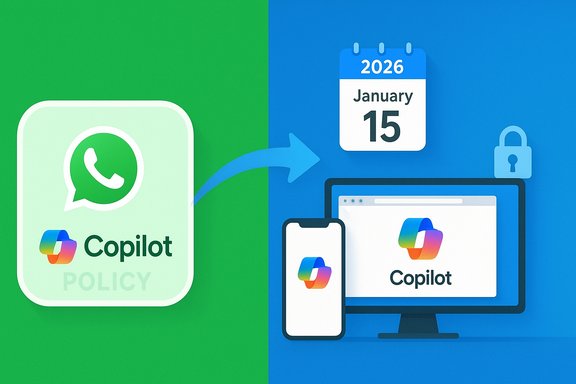
Microsoft confirmed this week that Copilot will stop working on WhatsApp on January 15, 2026, a direct consequence of revised WhatsApp Business API (platform) rules that bar third‑party large language model (LLM) chatbots from operating through the service. The change forces a simple but consequential reality: users who relied on Copilot inside WhatsApp must export any chat record they want to keep and move to Microsoft’s own Copilot apps, the Copilot web experience, or other channels before the January 15 cutoff. The shift also signals a broader industry fault line as platforms re-evaluate how — and whether — they expose their messaging audiences to rival AI services.
WhatsApp’s owner updated its business platform terms in October 2025 to introduce a new prohibition on “AI Providers” using the WhatsApp Business Solution to distribute general‑purpose LLM chatbots. The policy distinguishes between businesses that use AI as part of customer support workflows and providers that deliver AI assistants as the primary product via WhatsApp. Meta’s change, effective January 15, 2026, has prompted multiple AI vendors to pull their chatbots from WhatsApp rather than redesign their services to comply.
Microsoft’s announcement makes this immediate and practical for Copilot users: the WhatsApp integration will remain active only until January 15, 2026. After that date, Copilot will continue to exist on Microsoft’s own surfaces — the Copilot mobile app, the Copilot web portal, and the Windows Copilot experience — but the WhatsApp interface will no longer function. Microsoft explicitly warns that chat history created within WhatsApp cannot be ported automatically into those Copilot surfaces because the WhatsApp integration was unauthenticated.
Key characteristics of the policy change:
Copilot’s departure from WhatsApp is not an isolated event but part of a broader reordering of how AI services are distributed, regulated, and consumed. The January 15, 2026 deadline gives vendors, enterprises, and users a narrow but manageable window to adjust — and underscores one persistent truth in modern tech: control of the platform equals control of distribution.
Source: ETV Bharat Microsoft’s Copilot Will No Longer Be Available On WhatsApp Starting January 15 Next Year
 Background
WhatsApp’s owner updated its business platform terms in October 2025 to introduce a new prohibition on “AI Providers” using the WhatsApp Business Solution to distribute general‑purpose LLM chatbots. The policy distinguishes between businesses that use AI as part of customer support workflows and providers that deliver AI assistants as the primary product via WhatsApp. Meta’s change, effective January 15, 2026, has prompted multiple AI vendors to pull their chatbots from WhatsApp rather than redesign their services to comply.Microsoft’s announcement makes this immediate and practical for Copilot users: the WhatsApp integration will remain active only until January 15, 2026. After that date, Copilot will continue to exist on Microsoft’s own surfaces — the Copilot mobile app, the Copilot web portal, and the Windows Copilot experience — but the WhatsApp interface will no longer function. Microsoft explicitly warns that chat history created within WhatsApp cannot be ported automatically into those Copilot surfaces because the WhatsApp integration was unauthenticated.
Why this matters now
- Platform reach: WhatsApp is a global distribution channel with billions of users; some vendors had begun using it as a convenient front end for consumer AI assistants.
- Policy scope: The platform policy is not a narrow technical restriction; it explicitly targets the business model of distributing generative AIs on WhatsApp.
- Immediate deadlines: The effective date is fixed and publicly announced; vendors and users face a defined migration window.
What changed in WhatsApp’s Business API rules
Meta’s policy update introduces a new category in the WhatsApp Business Solution terms addressing “AI Providers.” Under the new rules, providers and developers of LLMs and similar generative AI technologies are prohibited from accessing the Business Solution to make those technologies available to end users when the AI itself is the primary capability offered.Key characteristics of the policy change:
- The ban applies specifically to business accounts using the WhatsApp Business Solution (the Business API) to deliver general‑purpose AI assistants.
- It does not ban businesses from using AI internally to support customers — the restriction targets the distribution of general‑purpose chatbots as the principal product.
- Meta reserves discretion to determine what qualifies as an AI Provider or general‑purpose assistant.
Microsoft’s response and the user-facing details
Microsoft published guidance to affected users explaining the timetable and next steps. The most important points for consumers and organizations:- Effective date: Copilot will be discontinued on WhatsApp on January 15, 2026. The service will continue to function on WhatsApp until that date.
- Where Copilot will remain available: Copilot will continue to be available on Microsoft’s own platforms — Copilot mobile apps (iOS and Android), Copilot on the web, and Copilot integrated into Windows — and Microsoft says these surfaces provide feature parity plus additional capabilities such as voice and vision features.
- Chat history: Because Copilot’s WhatsApp integration used an unauthenticated interface, Microsoft cannot migrate WhatsApp chat history into Copilot accounts. Users who want a local copy of chats should export them from WhatsApp before January 15, 2026.
- Recommendation: Microsoft advises users to export any WhatsApp chat logs they want to keep using WhatsApp’s built‑in export tools prior to the cutoff.
What users should do now — a practical migration checklist
If you used Copilot (or any AI assistant) on WhatsApp and you want to keep your conversations or maintain continuity, take these steps now — the procedure is straightforward but has limitations.- Export important WhatsApp chats
- On Android: Open the chat → tap the three‑dot menu → More → Export chat → choose to include media or not → select a destination (email, cloud, files).
- On iPhone: Open the chat → tap the contact or group name → Scroll → Export Chat → choose to include media or not → send or save the resulting ZIP / text file.
- Exported files are typically plain text (.txt) and, if media is included, bundled in a .zip archive.
- Secure the exported files carefully
- Exported conversations are no longer protected by WhatsApp’s end‑to‑end encryption once saved outside the app. Store them in encrypted storage if they contain sensitive information.
- Sign up for the vendor’s native app or web service
- Install the Copilot mobile app or sign in on copilot.microsoft.com and create an account to continue using the assistant outside WhatsApp.
- Recreate essential prompts or saved patterns
- If you relied on a set of prompts or templates with Copilot in WhatsApp, copy them into the Copilot app (or elsewhere) to maintain workflows.
- Update business workflows
- Businesses that used AI assistants for customer engagement via WhatsApp should evaluate alternate channels (SMS, website chat, in‑app chat, or their own apps) and plan migration paths for customers.
- Export files are not re‑importable into WhatsApp in an official, structured way. WhatsApp’s export feature is meant for archival and external review, not for restoring a live chat inside WhatsApp or transferring it to another chatbot.
- Exported chat files may contain sensitive metadata and content. Treat them the same way you would treat any backups containing personal data.
Privacy and security trade-offs
Exporting chats and moving services off of WhatsApp introduces real privacy trade‑offs that users need to weigh.- Loss of end‑to‑end protection: Chat contents exported from WhatsApp are typically saved in plain text and are not protected by the app’s in‑transit encryption. This increases the risk if the file is mishandled.
- Vendor authentication differences: Some vendors — for example, ChatGPT’s public guidance — offered account linking on WhatsApp so users could retain conversation history by associating a phone number with a vendor account. Microsoft’s Copilot integration, by contrast, operated unauthenticated and therefore cannot preserve history on other Microsoft surfaces.
- Data residency and retention: Exported files may be stored in cloud services with different geographic or retention policies than WhatsApp backups, which may raise compliance considerations for regulated users and businesses.
- Third‑party auditors and compliance: Organizations relying on WhatsApp chat histories for audits or customer records must export and secure those records ahead of the deadline and confirm that the exported formats meet regulatory or retention requirements.
Impact on businesses, customer support, and third‑party AI vendors
Meta’s policy does not stop businesses from using AI to support customers on WhatsApp; it stops providers from distributing a general‑purpose AI assistant via the Business Solution. The distinction matters:- Customer support bots remain allowed (with restrictions): If AI is used as a backend tool within a broader customer support workflow, that usage is permitted in many cases.
- Distribution of general‑purpose assistants is banned: Vendors that engineered a WhatsApp contact where the chatbot itself was the product (e.g., an AI assistant citizens could message directly) are forced to withdraw or otherwise pivot.
- Platform control and market dynamics: This policy centralizes power over who can access WhatsApp’s messaging surface for AI interactions. For vendors, the decision is an operational one: comply by rearchitecting or withdraw.
- Loss of a low‑friction channel for reaching customers and prospects.
- Potential need to rebuild integrations in other channels (web chat, SMS, email, in‑app messaging).
- A requirement to communicate changes clearly to customers ahead of the sunset date.
Broader competitive and regulatory implications
Meta’s move has prompted regulatory scrutiny and political commentary over platform power and potential exclusionary conduct. Several dimensions are worth noting:- Competition concerns: Reserving WhatsApp’s messaging surface for Meta’s own AI assistant raises the specter of platform self‑preferencing and market foreclosure. Regulators in some jurisdictions may treat the change as potentially anti‑competitive, especially where WhatsApp is a dominant messaging channel.
- Antitrust probes and investigations: Policy changes that materially disadvantage rival products can draw the attention of competition authorities — particularly in the EU and other regions with strong digital markets regulation.
- User choice and platform control: The technical and commercial reality is that platform operators control access to their interfaces and can choose to limit particular classes of third‑party integrations. That control has downstream consequences for innovation and distribution strategies.
Technical considerations for developers and IT teams
Developers and IT leaders should treat the WhatsApp policy shift as part of a broader risk assessment for conversational AI channels.- Reassess architecture: Avoid single‑channel dependencies for customer‑facing AI; design systems that can route conversations through web chat widgets, mobile SDKs, SMS, and other programmable channels.
- Authentication and identity: Where possible, integrate authenticated user accounts so chat history and personalization can follow users across channels. Unauthenticated bot endpoints are fragile and non‑portable.
- Data exportability and retention: Implement logging, archiving, and export processes that meet regulatory retention schedules; do not rely on third‑party platform exports as a long‑term archive.
- Privacy by design: Treat exported chat files as sensitive data; encrypt and limit access using role‑based controls.
- Monitoring and alerts: Add monitoring to vendor channels to detect policy changes or abrupt service discontinuations in order to minimize user‑facing downtime.
Possible scenarios and what to expect next
This policy change is not just a one‑time event; it may create patterns other platforms will follow or provoke responses from vendors and regulators.- Platform lock‑in intensifies
- Messaging platforms may increasingly treat their messaging surfaces as strategic assets reserved for their own AI features, ratcheting up barriers to distribution for rivals.
- Multi‑channel strategies become mandatory
- Vendors will accelerate investments in native apps, web apps, and other channels where they control the user relationship.
- Regulatory pushback
- Expect deeper scrutiny in regions where regulators view platform gatekeeping as a competitive threat. This can lead to enforcement actions or negotiated settlements.
- New business models
- AI vendors may pivot to offering embeddable SDKs or white‑label solutions embedded directly in partners’ apps to bypass platform restrictions.
- User education needs increase
- As assistants migrate off of widely used platforms like WhatsApp, users will need clearer guidance for exporting histories and re‑establishing accounts.
Recommendations for users and organizations
For consumers:- Export any WhatsApp conversations with Copilot that you want to keep before January 15, 2026, and store them in encrypted storage.
- Install the Copilot mobile app or sign in to the Copilot web experience to continue using Copilot features.
- Be mindful that exported chat files are not protected by WhatsApp’s end‑to‑end encryption once saved externally.
- Reassess channel risk and avoid single point of failure dependence on third‑party messaging platforms for critical services.
- Migrate customer‑facing AI workflows to multi‑channel architectures that include authenticated access and data portability.
- Communicate the change proactively to customers and provide clear migration paths and timelines.
- Prioritize authenticated integrations so user data and personalization can be migrated across devices or channels.
- Build export and backup features natively into services so customers retain control of their interaction history.
- Monitor platform policy pages and set up alerts to detect and respond to abrupt policy changes.
What this means for the Windows ecosystem and Copilot users
Windows users who liked the convenience of messaging Copilot in WhatsApp will still be able to access Copilot — but via Microsoft’s own channels. That shift is strategically significant for Microsoft because it consolidates the Copilot experience inside Microsoft’s app ecosystem where the company can offer richer features tied to the operating system, cloud identity, and paid tiers. For users, the trade‑off is between convenience (messaging inside WhatsApp) and a more integrated, authenticated experience that preserves continuity, personalization, and possibly deeper capabilities on Microsoft’s surfaces.- Feature parity: Microsoft states the Copilot app and web provide the same core features previously on WhatsApp and add capabilities such as Copilot Voice and Vision.
- Authenticated benefits: Moving to Microsoft’s Copilot surfaces allows for authenticated accounts, data continuity, and potential integration with Microsoft 365 and Windows identities — advantages not available through an unauthenticated WhatsApp bot.
- Opportunity cost: Users lose the friction‑free convenience of a WhatsApp contact, but they gain a path to richer and more persistent features.
Final assessment — strengths, risks, and the big picture
Strengths of Microsoft’s approach- Clear migration path: Microsoft published concrete guidance and alternatives for Copilot users, pointing them to native apps and web experiences.
- Feature continuity and expansion: By consolidating Copilot on Microsoft platforms, the company can offer deeper, authenticated features that integrate with Windows and Microsoft 365.
- User guidance: Microsoft’s recommendation to export chats provides a concrete, if manual, solution for archival needs.
- Loss of convenience and fragmentation: Users who adopted Copilot via WhatsApp for convenience will face friction moving to a new app and losing in‑place chat history.
- Privacy exposure through exports: Exported chats lose end‑to‑end protections; mishandling those exports poses a real privacy risk.
- Platform concentration: Meta’s policy tightens its control over a major distribution channel, raising competitive and regulatory concerns with real implications for innovation and market access.
- This change is a watershed moment for conversational AI distribution. Platforms are asserting control over how AI reaches users, and vendors must adapt to a multi‑channel reality where authenticated, portable user experiences are increasingly valuable. For consumers, the immediate priority is practical: export chats, secure backups, and migrate to the vendor’s official apps before the January 15, 2026 deadline. For businesses and developers, it’s time to harden channel strategies, adopt better data portability practices, and prepare for regulatory scrutiny as platform gatekeeping becomes a central battleground in AI competition.
Copilot’s departure from WhatsApp is not an isolated event but part of a broader reordering of how AI services are distributed, regulated, and consumed. The January 15, 2026 deadline gives vendors, enterprises, and users a narrow but manageable window to adjust — and underscores one persistent truth in modern tech: control of the platform equals control of distribution.
Source: ETV Bharat Microsoft’s Copilot Will No Longer Be Available On WhatsApp Starting January 15 Next Year
