

Microsoft’s revised OpenAI partnership, announced April 27, 2026, ended a major exclusivity arrangement while leaving Microsoft 365 Copilot, Azure OpenAI Service, and Dynamics 365 customers tied to a fast-changing AI supply chain shaped by Microsoft, OpenAI, Amazon, and other hyperscale cloud providers. That is the plain answer to the procurement question now landing on CIO desks. The risk is not that Microsoft suddenly becomes an unsafe vendor. The risk is that enterprise AI contracts increasingly depend on commercial arrangements most buyers never negotiated, may not fully understand, and cannot directly control.
The important shift is psychological as much as contractual. For the past three years, Microsoft sold Copilot as the sensible enterprise version of the generative AI boom: familiar tenant boundaries, familiar identity controls, familiar procurement channels, and a reassuring Redmond wrapper around OpenAI’s models. That pitch still has force, but it now sits inside a less tidy reality. OpenAI is no longer simply Microsoft’s captive AI engine, and Microsoft’s AI growth story is no longer separable from OpenAI’s hunger for compute, capital, distribution, and leverage.
Enterprises tend to buy Microsoft products as if they are buying from Microsoft alone. That habit made sense in the Office and Windows eras, where the core product stack was overwhelmingly designed, built, packaged, and delivered by Microsoft. Even when the company depended on OEMs, chipmakers, or third-party developers, the enterprise contract usually pointed back to a product whose roadmap Microsoft substantially owned.
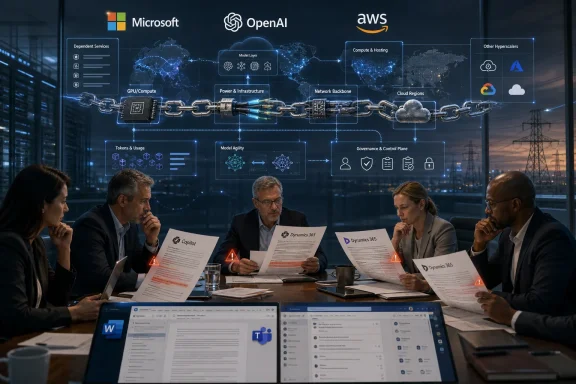
AI has scrambled that model. A Microsoft 365 Copilot agreement is not just a seat license for a productivity assistant; it is a commercial endpoint of a much larger arrangement among model builders, cloud operators, infrastructure suppliers, data-center power constraints, and GPU allocation schedules. The user sees a button in Word or Teams. The procurement team signs an enterprise agreement. Underneath, the service depends on model access, inference economics, Azure capacity, safety layers, Microsoft Graph integration, tenant data controls, and an evolving legal relationship between Microsoft and OpenAI.
That does not make Copilot uniquely fragile. It makes it representative of the new enterprise AI stack. Salesforce, Google, ServiceNow, AWS, Oracle, Anthropic, and OpenAI are all assembling versions of the same machine: a polished application layer resting on an expensive, constrained, and politically complicated compute layer.
The practical consequence is that procurement can no longer treat AI features as ordinary software modules. If a CRM workflow, contact-center routing system, or compliance review process is rebuilt around a particular model family, the contract has inherited risk from that model provider’s business model. That risk may be manageable, but it is not imaginary.
For customers, the bargain was attractive. OpenAI alone looked exciting but operationally risky. Microsoft plus OpenAI looked like the same excitement passed through enterprise procurement, identity management, compliance documentation, and support channels. That wrapper mattered, especially for regulated industries and global companies that could not simply tell employees to paste sensitive information into a consumer chatbot.
Copilot became the product expression of that bargain. Microsoft did not pitch it as a toy, a plug-in, or a side experiment. It repositioned large parts of the Microsoft 365 story around AI assistance embedded into daily work. The premise was that the company already owned the work surface, so it could make AI adoption feel less like transformation and more like an upgrade.
But the very strength of that strategy created a dependency. If Microsoft’s AI differentiation came from being the safest enterprise path to OpenAI-grade models, then any change in the Microsoft-OpenAI relationship matters to customers. Not because every change breaks the product, but because it changes the assumptions behind the roadmap.
That last clause is doing a lot of work. It preserves Microsoft’s privileged position while acknowledging a reality that had become impossible to ignore: no single cloud provider can comfortably satisfy all of OpenAI’s ambitions forever. Frontier AI is no longer merely a software race. It is a contest over data centers, chips, power, cooling, networking, and sovereign customer requirements.
Amazon’s reported multibillion-dollar OpenAI arrangement made the tension visible. OpenAI wanted more distribution and compute options. Amazon wanted a stronger answer to Azure’s OpenAI advantage. Microsoft wanted to protect the strategic value of its investment without becoming the bottleneck that slowed OpenAI’s expansion.
The result is not a clean divorce. It is more like a carefully renegotiated marriage with permission to see other clouds. That may be rational for both companies, but it makes the old enterprise sales story less simple. Microsoft can still say Azure is central to OpenAI. It can no longer imply, in quite the same way, that OpenAI’s enterprise future is effectively synonymous with Microsoft’s cloud.
There is nothing automatically improper about that. Cloud providers really do supply scarce infrastructure. AI labs really do need it. Strategic investments have long been part of platform markets, from telecom equipment financing to console subsidies to startup cloud credits.
The danger is that circularity can blur the line between organic customer demand and financed ecosystem expansion. If a cloud provider’s future revenue backlog is significantly tied to a model company that also depends on the provider’s capital, investors and customers need to ask how durable that revenue is. Is it evidence of broad market pull, or evidence that a small number of AI labs are committing to historically large compute bills because the entire industry is racing to scale before the economics settle?
That question matters to enterprise customers because roadmaps follow capital allocation. If Microsoft is spending tens of billions to support AI infrastructure, it needs Copilot, Azure AI, and Dynamics AI services to become not merely impressive demos but durable profit engines. If adoption lags, pricing pressure rises. If inference costs remain high, bundling strategies change. If OpenAI shifts more workloads elsewhere, Microsoft’s AI story becomes more dependent on its own model portfolio, smaller models, and multi-model orchestration.
Reported paid Microsoft 365 Copilot adoption figures in early 2026 suggested meaningful growth but still modest penetration relative to the overall commercial Microsoft 365 base. That gap is not surprising. A $30-per-user-per-month add-on is not trivial at enterprise scale, especially when many knowledge workers already have access to ChatGPT, Gemini, Claude, or internally approved AI tools.
The adoption problem becomes sharper in contact centers and customer-experience environments. These are not casual productivity settings where a worker might ask an assistant to summarize a meeting or rewrite an email. Contact centers are operational systems with measurable handle times, escalation rates, compliance scripts, workforce management constraints, and customer satisfaction targets. AI must prove itself in the workflow, not merely in the demo.
Microsoft’s Dynamics 365 Contact Center strategy depends on the idea that Copilot-style assistance can become part of the customer-service fabric. Agents can receive suggested responses, supervisors can analyze trends, bots can handle routine requests, and back-end systems can trigger next-best actions. Done well, that is genuinely valuable. Done poorly, it becomes another expensive layer between customers and resolution.
The question for CX leaders is not whether AI can improve contact centers. It can. The question is whether Microsoft’s version delivers enough predictable value, under stable enough commercial terms, to justify embedding it into workflows that are difficult to unwind.
A company may believe it is buying a model-agnostic AI system because the vendor can technically swap models behind the scenes. But technical substitutability is not the same as operational portability. Prompts, retrieval pipelines, evaluation harnesses, safety filters, latency assumptions, cost profiles, and agent behaviors can all become tuned to a particular model family.
That is especially true for agentic workflows. A simple chatbot can be replaced more easily than an AI agent that opens tickets, updates CRM records, drafts refunds, escalates complaints, and coordinates with workforce management systems. Once AI is allowed to act, not merely answer, switching costs rise.
Microsoft knows this, which is why Copilot Studio, Dynamics, Power Platform, Microsoft Graph, Entra ID, Teams, and Azure AI Foundry matter as much as the model itself. The strategic prize is not just selling tokens. It is becoming the orchestration layer for enterprise work.
From a customer perspective, that can be useful and dangerous at the same time. A unified Microsoft control plane may simplify governance, identity, auditability, and deployment. It may also make it harder to benchmark alternatives honestly once processes have been redesigned around Microsoft’s assumptions.
That makes roadmap language unusually important. If a sales team says a Copilot capability is coming, procurement should ask whether it is in the product, in private preview, on a committed release calendar, or merely in the strategic direction slide. Those distinctions are not pedantic. They determine whether a customer is buying a deliverable or subsidizing a vendor’s ambition.
Model portability deserves the same treatment. It is no longer enough to ask whether Microsoft supports multiple models somewhere in the stack. Buyers should ask whether their specific workflow can move from one model to another without reauthoring prompts, revalidating outputs, changing compliance controls, or accepting degraded performance. If the answer is unclear, the lock-in risk is real.
Pricing also needs sharper scrutiny. AI costs are not shaped like traditional SaaS costs. Token consumption, retrieval calls, agent actions, grounding operations, and premium model access can all complicate the economics. Vendors may prefer simple per-user pricing because it feels familiar, but the cost base underneath may remain volatile.
The best enterprise agreements will make that volatility explicit. The weakest ones will hide it until renewal.
That depth can produce better returns. Contact centers generate large volumes of repetitive, measurable interactions, which makes them attractive targets for automation and agent assistance. A well-tuned AI layer can reduce after-call work, improve consistency, surface knowledge-base answers faster, and help supervisors identify systemic issues.
But the same environment is unforgiving. A hallucinated answer can become a compliance incident. A poorly routed escalation can anger a customer. A model latency spike can disrupt service levels. A pricing change can turn a cost-saving automation plan into a budget problem.
Microsoft’s advantage is that many enterprises already run their productivity, identity, collaboration, and CRM-adjacent processes in its ecosystem. That gives Dynamics 365 Contact Center a credible integration story. Its vulnerability is that buyers may assume integration equals insulation. It does not.
If OpenAI’s commercial path changes, Microsoft will not necessarily lose access to models overnight. But the balance of incentives, investment priorities, and feature differentiation can shift. In enterprise AI, that is enough to matter.
Microsoft’s difference is visibility. Because Copilot is attached to Microsoft 365, Windows, Teams, GitHub, Dynamics, and Azure, its AI strategy touches a larger installed base than almost anyone else’s. When Microsoft changes the economics of AI, the effect ripples through procurement plans across industries.
That visibility can make Microsoft look riskier than smaller or newer competitors, but scale cuts both ways. Microsoft has the balance sheet, distribution, security credibility, and enterprise relationships to absorb turbulence that would crush weaker vendors. If OpenAI becomes less exclusive, Microsoft can lean harder on its own models, third-party models, small language models, and Azure as a model marketplace.
The issue is not vendor survival. The issue is customer leverage. A company that signs a large Copilot or Dynamics AI commitment should understand where Microsoft’s flexibility ends and the customer’s obligations begin.
That is where Microsoft’s ecosystem remains formidable. Entra ID, Purview, Defender, Microsoft 365 admin controls, Conditional Access, sensitivity labels, audit logs, and Graph-connected context give Microsoft a governance story that many AI-native vendors cannot match at enterprise scale. For regulated buyers, that matters more than benchmark bragging rights.
But governance is not the same as value. A secure AI assistant that employees rarely use is still an expensive assistant. A compliant contact-center agent that cannot reliably resolve real cases is still a failed automation project. Microsoft’s challenge is to convert trust into daily utility.
For customers, the right posture is neither panic nor blind confidence. Microsoft’s AI stack may be the safest way for many organizations to operationalize generative AI. It is still a stack with dependencies, pricing uncertainty, and fast-moving contractual assumptions.
Procurement teams should bring technical, legal, security, finance, and operations leaders into the same conversation. AI contracts are too consequential to be treated as either a pure IT purchase or a pure business transformation initiative. They sit at the point where both can fail.
The most mature buyers will also insist on pilots that measure actual workflow outcomes, not just user enthusiasm. In a contact center, that means handle time, first-contact resolution, escalation quality, compliance accuracy, customer satisfaction, and supervisor workload. In Microsoft 365, it means whether users keep returning to Copilot when alternatives are available.
Vendor competition should be real, not theatrical. If Genesys, NICE, Five9, Salesforce, Google, AWS, or specialist AI vendors are only brought in to pressure Microsoft on price, the buyer has not learned much. Competitive evaluation should test portability, governance, latency, integration depth, model performance, and total cost under plausible usage patterns.
The important shift is psychological as much as contractual. For the past three years, Microsoft sold Copilot as the sensible enterprise version of the generative AI boom: familiar tenant boundaries, familiar identity controls, familiar procurement channels, and a reassuring Redmond wrapper around OpenAI’s models. That pitch still has force, but it now sits inside a less tidy reality. OpenAI is no longer simply Microsoft’s captive AI engine, and Microsoft’s AI growth story is no longer separable from OpenAI’s hunger for compute, capital, distribution, and leverage.
 The Copilot Contract Is Also a Supply-Chain Contract
Enterprises tend to buy Microsoft products as if they are buying from Microsoft alone. That habit made sense in the Office and Windows eras, where the core product stack was overwhelmingly designed, built, packaged, and delivered by Microsoft. Even when the company depended on OEMs, chipmakers, or third-party developers, the enterprise contract usually pointed back to a product whose roadmap Microsoft substantially owned.AI has scrambled that model. A Microsoft 365 Copilot agreement is not just a seat license for a productivity assistant; it is a commercial endpoint of a much larger arrangement among model builders, cloud operators, infrastructure suppliers, data-center power constraints, and GPU allocation schedules. The user sees a button in Word or Teams. The procurement team signs an enterprise agreement. Underneath, the service depends on model access, inference economics, Azure capacity, safety layers, Microsoft Graph integration, tenant data controls, and an evolving legal relationship between Microsoft and OpenAI.
That does not make Copilot uniquely fragile. It makes it representative of the new enterprise AI stack. Salesforce, Google, ServiceNow, AWS, Oracle, Anthropic, and OpenAI are all assembling versions of the same machine: a polished application layer resting on an expensive, constrained, and politically complicated compute layer.
The practical consequence is that procurement can no longer treat AI features as ordinary software modules. If a CRM workflow, contact-center routing system, or compliance review process is rebuilt around a particular model family, the contract has inherited risk from that model provider’s business model. That risk may be manageable, but it is not imaginary.
Microsoft Won the First Round by Making OpenAI Look Enterprise-Ready
Microsoft’s early OpenAI deal was one of the great strategic moves of the cloud era. The company took a research lab with extraordinary technical momentum and gave it what every frontier AI company needed most: capital, compute, and enterprise distribution. In return, Microsoft obtained privileged access to models that made Bing, GitHub, Azure, Office, and Dynamics look like they had jumped a generation overnight.For customers, the bargain was attractive. OpenAI alone looked exciting but operationally risky. Microsoft plus OpenAI looked like the same excitement passed through enterprise procurement, identity management, compliance documentation, and support channels. That wrapper mattered, especially for regulated industries and global companies that could not simply tell employees to paste sensitive information into a consumer chatbot.
Copilot became the product expression of that bargain. Microsoft did not pitch it as a toy, a plug-in, or a side experiment. It repositioned large parts of the Microsoft 365 story around AI assistance embedded into daily work. The premise was that the company already owned the work surface, so it could make AI adoption feel less like transformation and more like an upgrade.
But the very strength of that strategy created a dependency. If Microsoft’s AI differentiation came from being the safest enterprise path to OpenAI-grade models, then any change in the Microsoft-OpenAI relationship matters to customers. Not because every change breaks the product, but because it changes the assumptions behind the roadmap.
The End of Exclusivity Did Not End the Dependency
The April 2026 restructuring was widely described as Microsoft and OpenAI ending exclusivity, and that is broadly correct. The amended partnership made Microsoft’s license to OpenAI intellectual property non-exclusive and allowed OpenAI more room to work with other cloud providers. Microsoft remained OpenAI’s primary cloud partner, and OpenAI products were still expected to appear first on Azure unless Microsoft could not, or chose not to, support the required capabilities.That last clause is doing a lot of work. It preserves Microsoft’s privileged position while acknowledging a reality that had become impossible to ignore: no single cloud provider can comfortably satisfy all of OpenAI’s ambitions forever. Frontier AI is no longer merely a software race. It is a contest over data centers, chips, power, cooling, networking, and sovereign customer requirements.
Amazon’s reported multibillion-dollar OpenAI arrangement made the tension visible. OpenAI wanted more distribution and compute options. Amazon wanted a stronger answer to Azure’s OpenAI advantage. Microsoft wanted to protect the strategic value of its investment without becoming the bottleneck that slowed OpenAI’s expansion.
The result is not a clean divorce. It is more like a carefully renegotiated marriage with permission to see other clouds. That may be rational for both companies, but it makes the old enterprise sales story less simple. Microsoft can still say Azure is central to OpenAI. It can no longer imply, in quite the same way, that OpenAI’s enterprise future is effectively synonymous with Microsoft’s cloud.
Circular AI Finance Makes Revenue Look Cleaner Than the Risk Beneath It
The phrase circular AI investment sounds like analyst jargon, but it captures a real problem. Hyperscalers invest in AI companies, AI companies spend heavily on the hyperscalers’ cloud infrastructure, and those cloud commitments then support the growth narratives of the same hyperscalers. Money moves in a loop, and each participant can point to the loop as evidence of demand.There is nothing automatically improper about that. Cloud providers really do supply scarce infrastructure. AI labs really do need it. Strategic investments have long been part of platform markets, from telecom equipment financing to console subsidies to startup cloud credits.
The danger is that circularity can blur the line between organic customer demand and financed ecosystem expansion. If a cloud provider’s future revenue backlog is significantly tied to a model company that also depends on the provider’s capital, investors and customers need to ask how durable that revenue is. Is it evidence of broad market pull, or evidence that a small number of AI labs are committing to historically large compute bills because the entire industry is racing to scale before the economics settle?
That question matters to enterprise customers because roadmaps follow capital allocation. If Microsoft is spending tens of billions to support AI infrastructure, it needs Copilot, Azure AI, and Dynamics AI services to become not merely impressive demos but durable profit engines. If adoption lags, pricing pressure rises. If inference costs remain high, bundling strategies change. If OpenAI shifts more workloads elsewhere, Microsoft’s AI story becomes more dependent on its own model portfolio, smaller models, and multi-model orchestration.
Adoption Is the Quiet Counterweight to the Hype
Microsoft’s Copilot challenge is not awareness. Every enterprise IT department knows Copilot exists. The harder problem is converting curiosity, pilots, and executive mandates into paid usage that feels indispensable enough to survive budget scrutiny.Reported paid Microsoft 365 Copilot adoption figures in early 2026 suggested meaningful growth but still modest penetration relative to the overall commercial Microsoft 365 base. That gap is not surprising. A $30-per-user-per-month add-on is not trivial at enterprise scale, especially when many knowledge workers already have access to ChatGPT, Gemini, Claude, or internally approved AI tools.
The adoption problem becomes sharper in contact centers and customer-experience environments. These are not casual productivity settings where a worker might ask an assistant to summarize a meeting or rewrite an email. Contact centers are operational systems with measurable handle times, escalation rates, compliance scripts, workforce management constraints, and customer satisfaction targets. AI must prove itself in the workflow, not merely in the demo.
Microsoft’s Dynamics 365 Contact Center strategy depends on the idea that Copilot-style assistance can become part of the customer-service fabric. Agents can receive suggested responses, supervisors can analyze trends, bots can handle routine requests, and back-end systems can trigger next-best actions. Done well, that is genuinely valuable. Done poorly, it becomes another expensive layer between customers and resolution.
The question for CX leaders is not whether AI can improve contact centers. It can. The question is whether Microsoft’s version delivers enough predictable value, under stable enough commercial terms, to justify embedding it into workflows that are difficult to unwind.
The Real Lock-In Is Moving Up the Stack
Enterprises used to think about lock-in mainly at the infrastructure layer. If the application ran on Azure, AWS, or Google Cloud, the lock-in question was about hosting, storage, identity, databases, and network architecture. In AI, lock-in is climbing into the workflow layer.A company may believe it is buying a model-agnostic AI system because the vendor can technically swap models behind the scenes. But technical substitutability is not the same as operational portability. Prompts, retrieval pipelines, evaluation harnesses, safety filters, latency assumptions, cost profiles, and agent behaviors can all become tuned to a particular model family.
That is especially true for agentic workflows. A simple chatbot can be replaced more easily than an AI agent that opens tickets, updates CRM records, drafts refunds, escalates complaints, and coordinates with workforce management systems. Once AI is allowed to act, not merely answer, switching costs rise.
Microsoft knows this, which is why Copilot Studio, Dynamics, Power Platform, Microsoft Graph, Entra ID, Teams, and Azure AI Foundry matter as much as the model itself. The strategic prize is not just selling tokens. It is becoming the orchestration layer for enterprise work.
From a customer perspective, that can be useful and dangerous at the same time. A unified Microsoft control plane may simplify governance, identity, auditability, and deployment. It may also make it harder to benchmark alternatives honestly once processes have been redesigned around Microsoft’s assumptions.
Procurement Needs to Stop Buying Roadmaps as If They Were Features
Enterprise software buyers have always purchased a mix of current capability and promised future value. The difference with AI is that the promised future value is changing faster than normal procurement cycles. A three-year agreement can now outlive multiple model generations, pricing resets, architecture shifts, and partnership restructurings.That makes roadmap language unusually important. If a sales team says a Copilot capability is coming, procurement should ask whether it is in the product, in private preview, on a committed release calendar, or merely in the strategic direction slide. Those distinctions are not pedantic. They determine whether a customer is buying a deliverable or subsidizing a vendor’s ambition.
Model portability deserves the same treatment. It is no longer enough to ask whether Microsoft supports multiple models somewhere in the stack. Buyers should ask whether their specific workflow can move from one model to another without reauthoring prompts, revalidating outputs, changing compliance controls, or accepting degraded performance. If the answer is unclear, the lock-in risk is real.
Pricing also needs sharper scrutiny. AI costs are not shaped like traditional SaaS costs. Token consumption, retrieval calls, agent actions, grounding operations, and premium model access can all complicate the economics. Vendors may prefer simple per-user pricing because it feels familiar, but the cost base underneath may remain volatile.
The best enterprise agreements will make that volatility explicit. The weakest ones will hide it until renewal.
Contact Centers Will Feel the Risk First
The contact center is where Microsoft’s AI contract risk becomes concrete. A law firm experimenting with Copilot in Word can throttle adoption if value disappoints. A contact center that automates triage, response generation, quality monitoring, and escalation logic around an AI platform has made a deeper operational commitment.That depth can produce better returns. Contact centers generate large volumes of repetitive, measurable interactions, which makes them attractive targets for automation and agent assistance. A well-tuned AI layer can reduce after-call work, improve consistency, surface knowledge-base answers faster, and help supervisors identify systemic issues.
But the same environment is unforgiving. A hallucinated answer can become a compliance incident. A poorly routed escalation can anger a customer. A model latency spike can disrupt service levels. A pricing change can turn a cost-saving automation plan into a budget problem.
Microsoft’s advantage is that many enterprises already run their productivity, identity, collaboration, and CRM-adjacent processes in its ecosystem. That gives Dynamics 365 Contact Center a credible integration story. Its vulnerability is that buyers may assume integration equals insulation. It does not.
If OpenAI’s commercial path changes, Microsoft will not necessarily lose access to models overnight. But the balance of incentives, investment priorities, and feature differentiation can shift. In enterprise AI, that is enough to matter.
Microsoft Is Not the Only Hyperscaler Selling a Fragile Certainty
It would be a mistake to treat this as a Microsoft-only story. Oracle, Amazon, Google, Nvidia, Anthropic, OpenAI, and a long list of infrastructure partners are all entangled in a market where capital expenditure is racing ahead of proven end-user monetization. Every major vendor wants to look like the indispensable platform for enterprise AI. Every major vendor is also exposed to the possibility that customers adopt more slowly, spend less per seat, or demand cheaper models.Microsoft’s difference is visibility. Because Copilot is attached to Microsoft 365, Windows, Teams, GitHub, Dynamics, and Azure, its AI strategy touches a larger installed base than almost anyone else’s. When Microsoft changes the economics of AI, the effect ripples through procurement plans across industries.
That visibility can make Microsoft look riskier than smaller or newer competitors, but scale cuts both ways. Microsoft has the balance sheet, distribution, security credibility, and enterprise relationships to absorb turbulence that would crush weaker vendors. If OpenAI becomes less exclusive, Microsoft can lean harder on its own models, third-party models, small language models, and Azure as a model marketplace.
The issue is not vendor survival. The issue is customer leverage. A company that signs a large Copilot or Dynamics AI commitment should understand where Microsoft’s flexibility ends and the customer’s obligations begin.
Security and Governance Are Still Microsoft’s Strongest Cards
For all the concern about OpenAI dependency, Microsoft retains a powerful argument: enterprise AI without governance is a liability. Many organizations do not want a patchwork of consumer AI accounts, browser extensions, unsanctioned bots, and departmental experiments pushing sensitive data into unknown systems. They want identity, logging, retention, compliance, data-loss prevention, and admin controls.That is where Microsoft’s ecosystem remains formidable. Entra ID, Purview, Defender, Microsoft 365 admin controls, Conditional Access, sensitivity labels, audit logs, and Graph-connected context give Microsoft a governance story that many AI-native vendors cannot match at enterprise scale. For regulated buyers, that matters more than benchmark bragging rights.
But governance is not the same as value. A secure AI assistant that employees rarely use is still an expensive assistant. A compliant contact-center agent that cannot reliably resolve real cases is still a failed automation project. Microsoft’s challenge is to convert trust into daily utility.
For customers, the right posture is neither panic nor blind confidence. Microsoft’s AI stack may be the safest way for many organizations to operationalize generative AI. It is still a stack with dependencies, pricing uncertainty, and fast-moving contractual assumptions.
The Questions Buyers Should Put in the Room Before Redmond Does
The practical response is not to freeze AI procurement. Waiting for the market to become simple is a good way to fall behind. The better response is to make the hidden dependencies explicit before signing, renewing, or expanding a Copilot or Dynamics 365 AI agreement.Procurement teams should bring technical, legal, security, finance, and operations leaders into the same conversation. AI contracts are too consequential to be treated as either a pure IT purchase or a pure business transformation initiative. They sit at the point where both can fail.
The most mature buyers will also insist on pilots that measure actual workflow outcomes, not just user enthusiasm. In a contact center, that means handle time, first-contact resolution, escalation quality, compliance accuracy, customer satisfaction, and supervisor workload. In Microsoft 365, it means whether users keep returning to Copilot when alternatives are available.
Vendor competition should be real, not theatrical. If Genesys, NICE, Five9, Salesforce, Google, AWS, or specialist AI vendors are only brought in to pressure Microsoft on price, the buyer has not learned much. Competitive evaluation should test portability, governance, latency, integration depth, model performance, and total cost under plausible usage patterns.
The Contract Risk Hides in the Clauses Everyone Skims
Before committing to Microsoft’s AI stack at scale, enterprise leaders should treat the OpenAI relationship as one part of a broader contract-risk review rather than as a reason to walk away. The goal is not to punish Microsoft for being early to a market-defining partnership. The goal is to stop pretending that AI SaaS contracts are ordinary SaaS contracts with a shinier interface.- Buyers should distinguish between features available today, features in preview, and features described only as roadmap intent.
- Enterprises should require clarity on whether Copilot and Dynamics workflows can shift among OpenAI, Microsoft, and third-party models without major redesign.
- Pricing protections should address AI-specific cost drivers, including premium model access, token consumption, agent actions, and future packaging changes.
- Contact-center deployments should be measured against operational outcomes before being expanded across thousands of agents.
- Competitive evaluations should test real alternatives for portability and governance, not merely serve as leverage in Microsoft renewal negotiations.
- Legal and security teams should review how data, prompts, outputs, logs, and model interactions are handled when services depend on external model providers.
References
- Primary source: CX Today
Published: 2026-06-03T15:50:34.894950
Is Microsoft's OpenAI Bet Putting Your AI Contract at Risk? - CX Today
Nearly half of Microsoft's future revenue depends on OpenAI. Here's what that means for CX buyers...www.cxtoday.com - Related coverage: forbes.com
Microsoft And OpenAI End Exclusive Partnership
The two companies are overhauling an agreement central to OpenAI’s for-profit model.www.forbes.com - Related coverage: tomshardware.com
Microsoft and OpenAI end exclusivity agreement, opening up potential partnerships with Amazon and Google — Microsoft will continue to receive revenue share through 2030 | Tom's Hardware
OpenAI has broken Microsoft's containment.www.tomshardware.com - Related coverage: arstechnica.com
OpenAI ends its exclusive partnership with Microsoft - Ars Technica
Amended agreement clears the way for OpenAI models to run on Amazon Bedrock.arstechnica.com - Related coverage: windowscentral.com
"The work we’re doing together remains ambitious": OpenAI ends Microsoft exclusivity in a tone that doesn’t match last week’s leaked memo | Windows Central
OpenAI’s official announcement sounds optimistic, but last week’s leaked memo told a different story.www.windowscentral.com - Related coverage: stackfutures.com
OpenAI Ends Microsoft Exclusivity — AWS and Google Can Now Compete for OpenAI Workloads | Stack Futures
Microsoft's exclusive license to OpenAI IP becomes non-exclusive through 2032. Microsoft stops paying OpenAI revenue share. OpenAI can now deploy across any cloud. Microsoft stock fell 5% on the announcement. stackfutures.com
- Related coverage: computerworld.com
Microsoft, OpenAI change contract terms — again – Computerworld
When the two firms announced a revised agreement on Monday, it reinforced the need for enterprise IT executives to work with as many major AI players as possible, given the constantly changing landscape. www.computerworld.com
- Related coverage: theregister.com
Microsoft and OpenAI's open relationship is now official
: No. More. Exclusivity. Redmond keeps the ring until 2032, but OpenAI is free to see other cloudswww.theregister.com - Related coverage: elpais.com
Sacudida en la industria de la IA: Microsoft y OpenAI reformulan su alianza y recortan relaciones
El fabricante de Windows renuncia al derecho exclusivo para vender los modelos de inteligencia artificial de la ‘start-up’elpais.com
- Related coverage: theinformation.com
OpenAI Branches Out from Microsoft with New Products For Amazon’s Cloud — The Information
OpenAI’s agreement with Amazon, announced on Friday, means that it will now build applications that will be available on Amazon’s cloud platform after previously offering most of its products on Microsoft’s Azure cloud. OpenAI and Amazon will work together on new AI agent products, and...www.theinformation.com - Related coverage: startupfortune.com
Microsoft drops OpenAI exclusivity and ends revenue share in landmark deal restructure - Startup Fortune
Microsoft ends OpenAI exclusivity, enabling full AWS and multi-cloud deployment as partnership restructures.startupfortune.com - Related coverage: letsdatascience.com
Microsoft and OpenAI End Exclusive Deal: New Terms April 2026 | Let's Data Science
OpenAI can now serve products across any cloud provider. Microsoft stops paying revenue share, retains 27% stake worth $135B, license runs to 2032 regardless of AGI. letsdatascience.com
- Related coverage: beri.net
Microsoft Loses OpenAI Exclusivity: What CIOs Should Do Now | THE D*AI*LY BRIEF
Microsoft ended OpenAI cloud exclusivity on April 27, 2026. OpenAI can now deploy on AWS, Google Cloud, or any provider, giving CIOs pricing leverage.www.beri.net - Related coverage: techradar.com
AWS and OpenAI confirm cloud partnership — a day after ChatGPT maker ended its Microsoft exclusivity | TechRadar
OpenAI deepens its relationship with AWSwww.techradar.com - Related coverage: axios.com
OpenAI secures $110B funding round with Amazon, Nvidia, SoftBank
Amazon, Nvidia and SoftBank are all investing, valuing the company at $840 billion.www.axios.com
- Related coverage: nextepinvestimentos.com.br
Microsoft’s Pivotal AI Product Is Running Into Big Problems - WSJ
PDF documentnextepinvestimentos.com.br
