

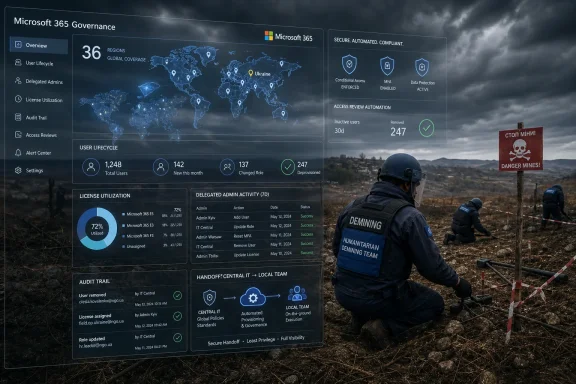
CoreView has deployed its Microsoft 365 governance and security platform across The HALO Trust’s operations in 36 countries and territories, including Ukraine, with Cyber Vigilance supporting implementation for a humanitarian organisation managing thousands of users in volatile field conditions. The announcement is not just another cloud-admin win story. It is a reminder that Microsoft 365 governance has become operational infrastructure for organisations whose work depends on speed, trust, and tight control. In HALO’s case, the “tenant” is not a neat corporate directory; it is a living map of staff, contractors, temporary workers, and local teams working near some of the world’s most dangerous ground.
The headline version is simple: CoreView has been rolled out to automate user management, delegate administration, and improve licence visibility across HALO’s Microsoft 365 estate. That sounds like a familiar IT operations project, the sort of thing many enterprises file under governance, security, or cost optimisation. But the context makes it more interesting.
HALO is not a conventional multinational with offices, badge readers, and predictable joiner-mover-leaver workflows. It clears landmines, cluster munitions, small-arms stockpiles, and improvised explosive devices, often in places where communications are patchy, personnel change quickly, and local responsiveness is not a convenience but a requirement. A delayed account removal in that setting is not merely an untidy directory object. It is a potential exposure in an organisation handling sensitive operational, personnel, and geographic information.
Microsoft 365 has become the default operating layer for a huge range of organisations, including charities and NGOs that would once have run more fragmented systems. Email, Teams, SharePoint, OneDrive, identity, device policy, and compliance functions all accumulate inside the same administrative universe. That consolidation is powerful, but it also creates a governance problem: the more work that moves into the platform, the more dangerous sloppy administration becomes.
HALO’s deployment speaks to a broader shift in the Microsoft ecosystem. The old assumption was that Microsoft 365 administration could be handled centrally by a capable IT team using native tools, scripts, and a few well-understood processes. That assumption breaks down when the organisation is decentralised, constantly changing, and spread across dozens of jurisdictions. At that point, governance becomes less about knowing where the settings are and more about building a control model that can survive real-world messiness.
HALO’s workforce model makes the problem especially sharp. With more than 8,000 staff, many of them temporary or locally based, the organisation has a directory that is structurally more fluid than a corporate headquarters environment. People join country programmes, shift roles, leave assignments, and sometimes operate under difficult local conditions where administrative lag is easy to understand but risky to tolerate.
For IT departments, dormant accounts are a classic enemy because they are quiet. They rarely trigger the urgency of a failed system, a ransomware note, or a downed network link. Yet they are exactly the kind of weakness attackers and opportunistic insiders can exploit, particularly when accounts retain group memberships, mailbox access, SharePoint permissions, or Teams membership long after a person’s operational need has ended.
That is why the HALO story is best understood as an identity hygiene story rather than a software procurement story. CoreView is being positioned as the operational layer that helps HALO turn policy intent into repeatable action. In plain terms, the system is supposed to reduce the gap between what central IT believes should happen and what actually happens across dozens of programmes.
There is also a human factor here. Manual lifecycle management does not fail because administrators are lazy; it fails because human workflows are overloaded, interrupted, and dependent on timely information from the edge. In organisations with high staff movement, the volume of small changes becomes a governance risk in itself. Automation is not magic, but it is often the only realistic way to make the boring controls happen consistently.
In a stable office environment, centralisation can look efficient. In humanitarian operations, it can look like a bottleneck. If an in-country team needs a user created, a group updated, or a permission changed, waiting for a distant helpdesk queue may slow work that has real operational consequences. The temptation is to grant broad administrative rights locally, but that creates the opposite risk: inconsistent privileges, weak oversight, and security drift.
The interesting promise of tools like CoreView is not that they eliminate delegation. It is that they make delegation narrower and more visible. Instead of handing a local operator the keys to an entire tenant, central IT can define what that person can do, where they can do it, and how those actions are logged. That is a more realistic version of least privilege than the textbook one.
For WindowsForum readers who administer Microsoft 365 tenants, this is the part that should feel familiar. Native Microsoft admin roles are powerful, but they do not always map cleanly to the messy responsibilities inside real organisations. The gap between “can do nothing” and “can do far too much” is where third-party governance vendors have found their market.
There is a caution, though. Delegated administration is only as good as the operational design behind it. If roles are poorly scoped, if exception handling becomes routine, or if audit logs are collected but never reviewed, the model can become theatre. HALO’s case sounds disciplined because the public framing emphasises central visibility and audit control, but the long-term value will depend on whether those guardrails remain intact after the urgency of rollout fades.
In that environment, IT administration is not some detached back-office function. Field teams need communications, collaboration, identity access, and document control to work under pressure. Staff may be hired locally, deployed across regions, or moved as operational needs change. The Microsoft 365 tenant becomes part of the logistical nervous system.
That is why the phrase “operational within weeks” matters. Enterprise IT vendors love rapid-deployment claims, and they should always be read with some scepticism. But in this case, speed was not just a sales metric. A governance platform that takes a year to produce value may be poorly matched to an NGO dealing with active conflict zones and rapidly changing staffing patterns.
The deployment also illustrates a larger truth about cloud administration in crisis-adjacent environments. Resilience is not only about uptime. It is about whether the administrative model can absorb churn without losing control. If a team expands quickly, if a programme spins up in a new region, or if local staff need limited authority immediately, the system has to adapt without turning central IT into the permanent choke point.
Ukraine also highlights the sensitivity of the data involved. Demining work can involve location information, staff records, donor relationships, and coordination with government or local authorities. The public announcement does not spell out the data architecture, and it should not. But the governance logic is obvious: identity, permissions, and auditability matter more when the information in the tenant has operational and safety implications.
Microsoft 365 licensing has become increasingly layered, with different plans, add-ons, security bundles, compliance features, and role-specific entitlements. In a static organisation, administrators can periodically audit usage and claw back unused licences. In a fast-moving workforce, licence allocation can quietly drift away from reality. Accounts linger, premium licences attach to users who no longer need them, and country programmes may accumulate costs that central IT cannot easily explain.
There is a governance point hiding inside the finance story. Licence waste often correlates with weak lifecycle management. If the organisation does not know who has which licence and why, it may also struggle to know who has which data access and why. Cost visibility and security visibility are not identical, but they frequently move together.
For charities, this matters because software spend competes with mission spend. Every unnecessary licence is money not used elsewhere. That does not mean NGOs should underinvest in security or collaboration tools; underinvestment can be more expensive in the long run. It means they need a stronger link between operational reality and cloud entitlement.
CoreView’s reporting tools are being presented as the mechanism for exposing that gap. The practical value will come from whether HALO can turn reports into routines: reclaiming unused licences, matching entitlements to roles, and spotting where a local staffing change has not been reflected in the Microsoft 365 estate. Reporting is useful only if it changes behaviour.
That is not necessarily a failure by Microsoft. The platform serves small businesses, schools, governments, global corporations, and NGOs. No native admin interface can perfectly match every operational model. The issue is that Microsoft 365 often becomes mission-critical before the organisation has built mature governance around it.
Third-party governance vendors thrive in that gap. They package visibility, role scoping, reporting, automation, and policy enforcement into workflows that may be easier for distributed IT teams to operate. In HALO’s case, the selling point is not that Microsoft lacks the underlying controls. It is that HALO needed a way to make those controls usable across a decentralised humanitarian organisation.
There is a familiar Windows ecosystem pattern here. Microsoft builds the platform; partners build the operational scaffolding. Sometimes that scaffolding compensates for complexity, sometimes it accelerates adoption, and sometimes it simply gives administrators a safer interface for tasks they could technically perform elsewhere. In the Microsoft 365 world, that scaffolding has become a serious governance category.
For sysadmins, the lesson is not “buy a tool.” The lesson is to examine whether the native administrative model matches the organisation’s actual risk and workflow. If the answer is no, scripting, process design, role redesign, or third-party tooling may all be valid responses. The wrong answer is to pretend that central admins can manually keep pace forever.
A governance tool has to be mapped to the organisation. Who is allowed to create users? Which country teams get delegated rights? What happens when someone changes programmes? Which licence types map to which roles? How are exceptions approved? Who reviews audit trails? These are operational questions before they are technical ones.
Training is also essential because delegated administration changes the social contract between central IT and local teams. Local staff must understand what they can do, what they cannot do, and why the boundaries exist. Central IT must trust the model enough not to recentralise every decision at the first sign of discomfort.
The “within weeks” timeline suggests a focused rollout rather than a sprawling transformation programme. That can be a strength. Governance projects sometimes collapse under their own ambition, especially when organisations try to solve identity, licensing, security posture, compliance, data classification, and process redesign in one grand exercise. A narrower deployment that solves urgent lifecycle and delegation problems may deliver faster practical value.
Still, implementation speed creates a second-phase obligation. Once the platform is live, the organisation has to revisit assumptions. Delegated rights that made sense at launch may need refinement. Licence reports may reveal new categories of waste. Local teams may request additional capabilities. Governance is not a one-time installation; it is an operating discipline.
International charities often operate with decentralised teams, limited IT headcount, donor reporting obligations, sensitive personal data, and difficult physical environments. They may not have the luxury of slow procurement cycles or large internal security teams. Yet attackers do not grade on mission. A humanitarian organisation can be targeted, phished, impersonated, misconfigured, or compromised like any other Microsoft 365 customer.
Cloud platforms have lowered the barrier to modern collaboration, but they have also standardised the attack surface. A compromised mailbox, overprivileged account, weak admin role, or abandoned guest access path can cause serious damage regardless of whether the organisation is a Fortune 500 company or a landmine clearance charity. The difference is that NGOs may have fewer people available to monitor and correct those weaknesses.
That makes governance tooling more than an enterprise luxury. For distributed nonprofits, automation and delegated control can be a force multiplier. The central IT team cannot be everywhere, but the system can enforce certain boundaries everywhere. That is the promise HALO is pursuing.
The danger is that NGOs may inherit enterprise complexity without enterprise budgets. Microsoft 365 can look deceptively simple at the user level and brutally complicated at the administrative level. The more an organisation relies on the platform, the more it needs mature identity governance, licence governance, security baselines, audit review, and incident response. Those capabilities cost money, attention, and expertise.
Those claims are plausible, but they should be read as vendor and customer positioning rather than independent proof of long-term outcomes. The deployment is newly announced, and the most meaningful measures will emerge over time: fewer dormant accounts, faster onboarding and offboarding, reduced licence waste, cleaner delegation, and better audit evidence. Those are the outcomes that matter to administrators.
The absence of hard metrics is not unusual. Few organisations publish the number of stale accounts removed, licence savings achieved, or admin actions delegated after a security governance deployment. But for readers evaluating similar tools, the lack of quantified results means the case study should be treated as directional rather than definitive.
Even so, the direction is significant. HALO is not buying governance because governance is fashionable. It is trying to solve a concrete operational tension: local teams need speed, central IT needs control, and the organisation cannot afford loose identity practices in sensitive environments. That tension is common far beyond humanitarian work.
The best reading of this deployment is that Microsoft 365 administration is becoming a board-level resilience issue in organisations that never used to talk that way. When collaboration tools become the system of record for operations, identity and licence controls stop being housekeeping. They become part of how the organisation protects its mission.
 The Real Problem Was Never Just Microsoft 365
The headline version is simple: CoreView has been rolled out to automate user management, delegate administration, and improve licence visibility across HALO’s Microsoft 365 estate. That sounds like a familiar IT operations project, the sort of thing many enterprises file under governance, security, or cost optimisation. But the context makes it more interesting.HALO is not a conventional multinational with offices, badge readers, and predictable joiner-mover-leaver workflows. It clears landmines, cluster munitions, small-arms stockpiles, and improvised explosive devices, often in places where communications are patchy, personnel change quickly, and local responsiveness is not a convenience but a requirement. A delayed account removal in that setting is not merely an untidy directory object. It is a potential exposure in an organisation handling sensitive operational, personnel, and geographic information.
Microsoft 365 has become the default operating layer for a huge range of organisations, including charities and NGOs that would once have run more fragmented systems. Email, Teams, SharePoint, OneDrive, identity, device policy, and compliance functions all accumulate inside the same administrative universe. That consolidation is powerful, but it also creates a governance problem: the more work that moves into the platform, the more dangerous sloppy administration becomes.
HALO’s deployment speaks to a broader shift in the Microsoft ecosystem. The old assumption was that Microsoft 365 administration could be handled centrally by a capable IT team using native tools, scripts, and a few well-understood processes. That assumption breaks down when the organisation is decentralised, constantly changing, and spread across dozens of jurisdictions. At that point, governance becomes less about knowing where the settings are and more about building a control model that can survive real-world messiness.
Identity Hygiene Becomes a Field Operations Issue
The most concrete part of the CoreView deployment is user lifecycle automation: creating, updating, and removing Microsoft 365 accounts as staff move through HALO’s programmes. That is the unglamorous work that defines whether cloud security policies actually mean anything. Conditional access, MFA, least privilege, and data-loss prevention all matter less if the organisation cannot reliably answer who should still have access.HALO’s workforce model makes the problem especially sharp. With more than 8,000 staff, many of them temporary or locally based, the organisation has a directory that is structurally more fluid than a corporate headquarters environment. People join country programmes, shift roles, leave assignments, and sometimes operate under difficult local conditions where administrative lag is easy to understand but risky to tolerate.
For IT departments, dormant accounts are a classic enemy because they are quiet. They rarely trigger the urgency of a failed system, a ransomware note, or a downed network link. Yet they are exactly the kind of weakness attackers and opportunistic insiders can exploit, particularly when accounts retain group memberships, mailbox access, SharePoint permissions, or Teams membership long after a person’s operational need has ended.
That is why the HALO story is best understood as an identity hygiene story rather than a software procurement story. CoreView is being positioned as the operational layer that helps HALO turn policy intent into repeatable action. In plain terms, the system is supposed to reduce the gap between what central IT believes should happen and what actually happens across dozens of programmes.
There is also a human factor here. Manual lifecycle management does not fail because administrators are lazy; it fails because human workflows are overloaded, interrupted, and dependent on timely information from the edge. In organisations with high staff movement, the volume of small changes becomes a governance risk in itself. Automation is not magic, but it is often the only realistic way to make the boring controls happen consistently.
Delegation Is the Security Model, Not a Compromise
The second major feature in the deployment is delegated administration. HALO wanted local teams to perform defined Microsoft 365 tasks directly while central IT retained visibility, auditability, and control. That is the right problem to solve, because the false choice between central control and local autonomy has caused trouble in enterprise IT for decades.In a stable office environment, centralisation can look efficient. In humanitarian operations, it can look like a bottleneck. If an in-country team needs a user created, a group updated, or a permission changed, waiting for a distant helpdesk queue may slow work that has real operational consequences. The temptation is to grant broad administrative rights locally, but that creates the opposite risk: inconsistent privileges, weak oversight, and security drift.
The interesting promise of tools like CoreView is not that they eliminate delegation. It is that they make delegation narrower and more visible. Instead of handing a local operator the keys to an entire tenant, central IT can define what that person can do, where they can do it, and how those actions are logged. That is a more realistic version of least privilege than the textbook one.
For WindowsForum readers who administer Microsoft 365 tenants, this is the part that should feel familiar. Native Microsoft admin roles are powerful, but they do not always map cleanly to the messy responsibilities inside real organisations. The gap between “can do nothing” and “can do far too much” is where third-party governance vendors have found their market.
There is a caution, though. Delegated administration is only as good as the operational design behind it. If roles are poorly scoped, if exception handling becomes routine, or if audit logs are collected but never reviewed, the model can become theatre. HALO’s case sounds disciplined because the public framing emphasises central visibility and audit control, but the long-term value will depend on whether those guardrails remain intact after the urgency of rollout fades.
Ukraine Turns a Back-Office Upgrade Into a Stress Test
The mention of Ukraine is not incidental. HALO’s Ukrainian operations were brought onto the platform shortly after the initial deployment, and that detail gives the project its edge. Ukraine is one of the most complex humanitarian demining environments in the world, with mine and unexploded ordnance contamination at a scale that has drawn sustained international concern since Russia’s full-scale invasion in February 2022.In that environment, IT administration is not some detached back-office function. Field teams need communications, collaboration, identity access, and document control to work under pressure. Staff may be hired locally, deployed across regions, or moved as operational needs change. The Microsoft 365 tenant becomes part of the logistical nervous system.
That is why the phrase “operational within weeks” matters. Enterprise IT vendors love rapid-deployment claims, and they should always be read with some scepticism. But in this case, speed was not just a sales metric. A governance platform that takes a year to produce value may be poorly matched to an NGO dealing with active conflict zones and rapidly changing staffing patterns.
The deployment also illustrates a larger truth about cloud administration in crisis-adjacent environments. Resilience is not only about uptime. It is about whether the administrative model can absorb churn without losing control. If a team expands quickly, if a programme spins up in a new region, or if local staff need limited authority immediately, the system has to adapt without turning central IT into the permanent choke point.
Ukraine also highlights the sensitivity of the data involved. Demining work can involve location information, staff records, donor relationships, and coordination with government or local authorities. The public announcement does not spell out the data architecture, and it should not. But the governance logic is obvious: identity, permissions, and auditability matter more when the information in the tenant has operational and safety implications.
Licence Waste Is a Governance Signal
The cost-optimisation angle may sound less dramatic than conflict-zone administration, but it is important. HALO wanted clearer oversight of Microsoft 365 licence usage because limited visibility had created a risk of unnecessary spending through overprovisioning. For an NGO, that is not merely an accounting concern.Microsoft 365 licensing has become increasingly layered, with different plans, add-ons, security bundles, compliance features, and role-specific entitlements. In a static organisation, administrators can periodically audit usage and claw back unused licences. In a fast-moving workforce, licence allocation can quietly drift away from reality. Accounts linger, premium licences attach to users who no longer need them, and country programmes may accumulate costs that central IT cannot easily explain.
There is a governance point hiding inside the finance story. Licence waste often correlates with weak lifecycle management. If the organisation does not know who has which licence and why, it may also struggle to know who has which data access and why. Cost visibility and security visibility are not identical, but they frequently move together.
For charities, this matters because software spend competes with mission spend. Every unnecessary licence is money not used elsewhere. That does not mean NGOs should underinvest in security or collaboration tools; underinvestment can be more expensive in the long run. It means they need a stronger link between operational reality and cloud entitlement.
CoreView’s reporting tools are being presented as the mechanism for exposing that gap. The practical value will come from whether HALO can turn reports into routines: reclaiming unused licences, matching entitlements to roles, and spotting where a local staffing change has not been reflected in the Microsoft 365 estate. Reporting is useful only if it changes behaviour.
The Microsoft Admin Center Was Not Built for Every Kind of Organisation
This deployment also says something about Microsoft’s own administrative model. Microsoft 365 is enormous, and Microsoft has steadily improved its native management portals, security tooling, Entra ID capabilities, compliance features, and reporting. Yet the continued market for companies like CoreView shows that many organisations still need an abstraction layer above Microsoft’s tools.That is not necessarily a failure by Microsoft. The platform serves small businesses, schools, governments, global corporations, and NGOs. No native admin interface can perfectly match every operational model. The issue is that Microsoft 365 often becomes mission-critical before the organisation has built mature governance around it.
Third-party governance vendors thrive in that gap. They package visibility, role scoping, reporting, automation, and policy enforcement into workflows that may be easier for distributed IT teams to operate. In HALO’s case, the selling point is not that Microsoft lacks the underlying controls. It is that HALO needed a way to make those controls usable across a decentralised humanitarian organisation.
There is a familiar Windows ecosystem pattern here. Microsoft builds the platform; partners build the operational scaffolding. Sometimes that scaffolding compensates for complexity, sometimes it accelerates adoption, and sometimes it simply gives administrators a safer interface for tasks they could technically perform elsewhere. In the Microsoft 365 world, that scaffolding has become a serious governance category.
For sysadmins, the lesson is not “buy a tool.” The lesson is to examine whether the native administrative model matches the organisation’s actual risk and workflow. If the answer is no, scripting, process design, role redesign, or third-party tooling may all be valid responses. The wrong answer is to pretend that central admins can manually keep pace forever.
Cyber Vigilance Supplies the Missing Ingredient: Implementation
The announcement gives Cyber Vigilance a supporting role, but implementation partners often determine whether governance projects succeed. HALO’s deployment involved commercial scoping, deployment, and training. Those details matter because the hardest part of a project like this is rarely clicking the switch that turns the platform on.A governance tool has to be mapped to the organisation. Who is allowed to create users? Which country teams get delegated rights? What happens when someone changes programmes? Which licence types map to which roles? How are exceptions approved? Who reviews audit trails? These are operational questions before they are technical ones.
Training is also essential because delegated administration changes the social contract between central IT and local teams. Local staff must understand what they can do, what they cannot do, and why the boundaries exist. Central IT must trust the model enough not to recentralise every decision at the first sign of discomfort.
The “within weeks” timeline suggests a focused rollout rather than a sprawling transformation programme. That can be a strength. Governance projects sometimes collapse under their own ambition, especially when organisations try to solve identity, licensing, security posture, compliance, data classification, and process redesign in one grand exercise. A narrower deployment that solves urgent lifecycle and delegation problems may deliver faster practical value.
Still, implementation speed creates a second-phase obligation. Once the platform is live, the organisation has to revisit assumptions. Delegated rights that made sense at launch may need refinement. Licence reports may reveal new categories of waste. Local teams may request additional capabilities. Governance is not a one-time installation; it is an operating discipline.
NGOs Are Now Cloud Enterprises, Whether They Like the Label or Not
One reason this story matters is that it pulls a humanitarian organisation into a conversation usually dominated by banks, manufacturers, governments, and large commercial enterprises. HALO may not think of itself primarily as a cloud enterprise, but its technology footprint creates enterprise-grade problems. That is increasingly true across the nonprofit and aid sector.International charities often operate with decentralised teams, limited IT headcount, donor reporting obligations, sensitive personal data, and difficult physical environments. They may not have the luxury of slow procurement cycles or large internal security teams. Yet attackers do not grade on mission. A humanitarian organisation can be targeted, phished, impersonated, misconfigured, or compromised like any other Microsoft 365 customer.
Cloud platforms have lowered the barrier to modern collaboration, but they have also standardised the attack surface. A compromised mailbox, overprivileged account, weak admin role, or abandoned guest access path can cause serious damage regardless of whether the organisation is a Fortune 500 company or a landmine clearance charity. The difference is that NGOs may have fewer people available to monitor and correct those weaknesses.
That makes governance tooling more than an enterprise luxury. For distributed nonprofits, automation and delegated control can be a force multiplier. The central IT team cannot be everywhere, but the system can enforce certain boundaries everywhere. That is the promise HALO is pursuing.
The danger is that NGOs may inherit enterprise complexity without enterprise budgets. Microsoft 365 can look deceptively simple at the user level and brutally complicated at the administrative level. The more an organisation relies on the platform, the more it needs mature identity governance, licence governance, security baselines, audit review, and incident response. Those capabilities cost money, attention, and expertise.
The Vendor Story Is Useful, but the Operational Story Is Bigger
CoreView’s public framing is unsurprising: its platform provided governance, resilience, insight, automation, and secure delegation at scale. Cyber Vigilance framed its role around helping secure a business-critical Microsoft 365 environment. HALO’s own comments emphasised delegated responsibility, full control, improved visibility, and rapid deployment into Ukraine.Those claims are plausible, but they should be read as vendor and customer positioning rather than independent proof of long-term outcomes. The deployment is newly announced, and the most meaningful measures will emerge over time: fewer dormant accounts, faster onboarding and offboarding, reduced licence waste, cleaner delegation, and better audit evidence. Those are the outcomes that matter to administrators.
The absence of hard metrics is not unusual. Few organisations publish the number of stale accounts removed, licence savings achieved, or admin actions delegated after a security governance deployment. But for readers evaluating similar tools, the lack of quantified results means the case study should be treated as directional rather than definitive.
Even so, the direction is significant. HALO is not buying governance because governance is fashionable. It is trying to solve a concrete operational tension: local teams need speed, central IT needs control, and the organisation cannot afford loose identity practices in sensitive environments. That tension is common far beyond humanitarian work.
The best reading of this deployment is that Microsoft 365 administration is becoming a board-level resilience issue in organisations that never used to talk that way. When collaboration tools become the system of record for operations, identity and licence controls stop being housekeeping. They become part of how the organisation protects its mission.
HALO’s Microsoft 365 Rollout Shows Where the Admin Burden Is Moving
The practical lessons from HALO’s deployment are sharper than the usual governance marketing language. They point to a Microsoft 365 world where the hardest work is not enabling collaboration, but keeping that collaboration bounded, auditable, and economically sane as the organisation changes shape.- HALO’s deployment shows that Microsoft 365 lifecycle management is now a frontline security control for decentralised organisations with fast-changing workforces.
- Delegated administration is becoming essential where local teams need speed but central IT still needs auditability and policy control.
- Licence optimisation is not just a finance exercise, because unused or mismatched licences often reveal deeper weaknesses in user and access governance.
- Ukraine’s inclusion in the rollout demonstrates why cloud administration must be resilient enough for unstable environments, not just tidy headquarters workflows.
- The role of Cyber Vigilance underlines that successful governance projects depend on process design, training, and implementation discipline as much as software features.
- The case study is promising, but its real success will be measured by sustained reductions in stale accounts, over-permissioned users, and unnecessary Microsoft 365 spend.
References
- Primary source: IT Brief UK
Published: Tue, 02 Jun 2026 07:45:00 GMT
CoreView rolls out Microsoft 365 controls across HALO
The charity can now automate account changes and licence tracking across 36 countries, reducing security risks and IT workload. itbrief.co.uk
- Related coverage: anews-securite.fr
Coreview et Cyber Viligence sécurisent HALO Trust à l'échelle mondiale
CoreView et Cyber Vigilance accompagnent HALO Trust dans la sécurisation de ses opérations Microsoft 365 à l’échelle mondiale. Déployée dans 36 pays, dont l’Ukraine, la plateforme de gouvernance et de sécurité Microsoft 365 de CoreView permet à la plus grande organisation humanitaire de déminage...www.anews-securite.fr - Related coverage: itbrief.news
CoreView rolls out Microsoft 365 controls across HALO
The charity can now automate account changes and licence tracking across 36 countries, reducing security risks and IT workload. itbrief.news
- Related coverage: coreview.com
Microsoft 365 Cyber Resilience for Enterprises
Secure your Microsoft 365 environment with CoreView. Gain cyber resilience, automate administration, and uncover hidden license waste—all from a single platform. www.coreview.com
- Related coverage: coreview.helpjuice.com

CoreView — Governance Center: overview
The Governance Center is a centralized panel and primary interface for monitoring, managing, and maintaining compliance and security across your Microsoft
coreview.helpjuice.com
- Related coverage: halotrust.org
