

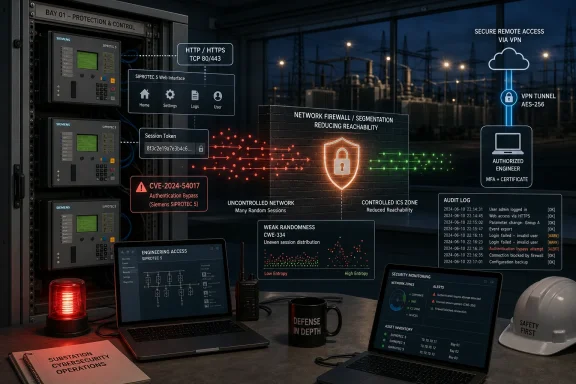
The uncomfortable lesson is that web-server plumbing has become part of the protection-device attack surface. SIPROTEC 5 relays are not consumer routers and should not be treated as if a firmware update is a casual Tuesday reboot. But once these devices expose HTTP-accessible management functions, the quality of their session identifiers becomes more than an implementation detail; it becomes a boundary between observation and unauthorized access.
A Medium CVSS Score Hides an Operationally Awkward Bug
The advisory assigns CVE-2024-54017 a CVSS 3.1 base score of 5.3, which lands squarely in “medium” territory. That score reflects a vulnerability that is exploitable over the network, requires low attack complexity, needs no privileges, and requires no user interaction, but is currently described as affecting confidentiality only, with no direct integrity or availability impact.
That distinction matters. Siemens and CISA are not saying an attacker can trip a breaker, rewrite protection logic, or render a device unavailable through this flaw alone. The reported impact is more limited: an unauthenticated remote attacker could brute-force a valid session identifier and gain read access to limited information from the web server.
Still, in industrial environments, “limited information” is rarely meaningless information. Device identity, configuration hints, topology clues, firmware status, and operational metadata can all become reconnaissance material. Attackers do not always need a single spectacular exploit if they can stitch together small exposures into a path through a poorly segmented environment.
The vulnerability is classified under CWE-334, “Small Space of Random Values.” That is a dry phrase for a familiar mistake: the system does not give attackers a large enough haystack to search when it creates values that are supposed to be unguessable. In web security, weak randomness in session tokens is one of the oldest ways to turn authentication from a gate into a guessing game.
The Web Interface Is the New Control Boundary
The affected session identifiers are used only in a subset of endpoints provided by the affected products, which narrows the immediate blast radius. But that caveat should not lull operators into underreacting. Industrial web interfaces have a history of becoming the place where old assumptions about trusted networks collide with modern remote access habits.
A relay or protection device may sit in a cabinet, but its management interface increasingly lives in a networked workflow. Engineers expect diagnostics, configuration visibility, logs, and status information to be reachable without walking the yard. Vendors have responded by building richer interfaces into equipment that once would have been operated through more constrained tooling.
That convenience changes the security model. If the device presents a web server, the device inherits web-server problems: session handling, entropy, cookie design, authentication flows, endpoint scoping, and brute-force resistance. Those are not optional concerns just because the box is painted for a substation rather than a rack in a data center.
SIPROTEC 5 devices are used for protection, control, measurement, and automation in electrical substations and related industrial settings. In that context, even read-only exposure can be sensitive. Operational technology defenders tend to care less about whether a vulnerability is elegant and more about whether it gives an adversary a foothold, a map, or confidence.
Version Sprawl Turns a Simple Fix Into a Field Campaign
Siemens’ central remediation message is straightforward where it applies: update affected devices to version 11.0 or later. The complexity is not the destination. It is the journey across a product family with many device models, communications processor variants, and version ranges.
The affected list spans SIPROTEC 5 6MD, 6MU, 7KE, 7SA, 7SD, 7SJ, 7SK, 7SL, 7SS, 7ST, 7SX, 7SY, 7UM, 7UT, 7VE, 7VK, 7VU, and SIPROTEC 5 Compact models. Some CP300-based devices are affected from version 7.80 up to but not including 11.0. Some CP150 and CP050 devices are affected below 11.0. Some CP100 devices are listed as affected from 7.80 onward, and many CP200 variants are listed as affected across all versions, with no CVE mapping shown in the supplied CSAF summary for those entries.
That patch matrix is the part administrators will feel. Security advisories often compress product reality into a neat table, but the field inventory may include devices installed across different projects, substations, regions, and maintenance regimes. “Update to V11.0” is easy to write and harder to operationalize when every relay has a protection role and every outage window is negotiated.
This is why asset inventory remains the unglamorous center of OT security. The first question is not whether CVE-2024-54017 is medium or high. The first question is whether the organization knows which SIPROTEC 5 models it has, which communication processors they use, which firmware they run, and which web interfaces are reachable from which networks.
Siemens Is Fixing the Future, but Operators Own the Present
The advisory says Siemens is preparing fixed versions and recommends countermeasures where fixes are not available or not yet available. That split is important. Some products have a vendor-fix path to V11.0 or later, while other entries are described as having no fix currently available.
For enterprise IT, the phrase “no fix available” usually triggers compensating controls. For OT, it triggers a more delicate calculation. These systems may be safety-adjacent, reliability-critical, and bound to vendor tooling, engineering validation, and staged deployment procedures. A rushed firmware rollout can be as unacceptable as ignoring the vulnerability.
Siemens recommends applying security updates through the documented product procedures and validating updates before applying them in target environments. That is not boilerplate. In protection environments, validation is part of the security control because incorrect deployment can create operational risk even when the patch itself is legitimate.
The more immediate controls are familiar but still essential: restrict network access, use segmentation, place control systems and remote devices behind firewalls, isolate them from business networks, and use secure remote access methods when remote access is required. None of those controls fix weak session randomness. They reduce the number of attackers who can reach the weak point in the first place.
CISA’s Republication Makes the Audience Wider, Not the Bug Newer
CISA’s page identifies this advisory as a republication of Siemens ProductCERT SSA-786884, converted from the vendor’s Common Security Advisory Framework material and provided for visibility. Siemens’ advisory was published on May 12, 2026, and CISA republished it on May 14, 2026. That two-day gap is not unusual; it reflects the way vendor advisories and national ICS notices now overlap.
The republication matters because CISA reaches audiences that may not monitor every vendor portal directly. Municipal utilities, regional operators, integrators, and managed service providers often rely on CISA ICS advisories as a triage feed. When an advisory lands there, it becomes part of the broader defensive calendar.
The advisory also notes that Siemens ProductCERT reported the vulnerability to CISA and that SEC Consult Vulnerability Lab reported it to Siemens. That chain is a healthy sign. Coordinated disclosure is not glamorous, but it is the mechanism that turns a bug report into a patch plan, mitigation guidance, and a common reference point for asset owners.
There is also a subtle warning in CISA’s disclaimer: republished vendor advisories are provided as-is, and CISA does not take responsibility for the vendor’s editorial or technical accuracy. In practice, operators should treat Siemens ProductCERT as the authoritative technical source and CISA as an amplifier that helps the advisory reach critical infrastructure defenders.
The Real Risk Is Reachability
For WindowsForum readers, the instinct may be to compare this to a weak web session bug in a typical enterprise appliance. That analogy is useful, but only up to a point. The technical pattern is familiar; the operational consequences are different.
If a Windows admin finds a weak-session flaw in a lab management appliance, the fix may be to patch, rotate credentials, restrict access, and move on. If a utility finds the same class of weakness in protection equipment, the fix has to pass through engineering ownership, change control, maintenance windows, vendor compatibility, and sometimes regulatory scrutiny. The security team may know what should happen before the organization is able to make it happen.
That is why reachability is the practical dividing line. A vulnerable SIPROTEC 5 web interface exposed to the open internet would be a serious misconfiguration regardless of CVSS score. A vulnerable interface reachable only from a tightly controlled engineering network, with strong monitoring and no broad lateral access from corporate IT, is still a concern but a different one.
The advisory’s recommended practices point in exactly that direction. Minimize exposure. Keep control-system devices off the internet. Put firewalls between control networks and business networks. Treat VPNs as necessary but imperfect, because remote access is only as secure as the endpoints and credentials behind it.
Session Tokens Are Small Things Until They Are Not
Weak randomness is easy to underestimate because it lacks drama. There is no buffer overflow, no wormable payload, no destructive command sequence. The flaw lives in probability, and probability can feel abstract until an attacker automates the guessing.
A session identifier is supposed to be a temporary bearer secret. If an attacker can predict or brute-force it, authentication becomes less about knowing a password and more about landing on the right value before the session expires. That is why the size and quality of the random space matter so much.
In ordinary web applications, mature frameworks usually handle session generation well. In embedded and industrial products, especially those with long development lifecycles and constrained environments, the record is more uneven. Devices may carry legacy assumptions, vendor-specific stacks, and code paths that were never designed for hostile network exposure.
That does not mean Siemens is uniquely careless. It means industrial vendors are being dragged into a security model where every management interface is judged by internet-era standards, even when the product’s deployment model still assumes layers of physical and network trust. The gap between those assumptions is where many ICS vulnerabilities live.
The Affected List Tells a Story About Platform Security
The breadth of the affected SIPROTEC 5 list suggests this is not a one-off defect in a single niche model. It appears tied to shared web-server or platform behavior across multiple device families and communication processor variants. That makes remediation more efficient for the vendor but inventory more complex for customers.
Platform reuse is a double-edged sword. It lets vendors ship consistent features, unified tooling, and repeatable maintenance processes across a large product family. It also means a security design flaw can propagate widely before anyone sees it as a systemic issue.
The advisory’s version boundaries reinforce that point. Many CP300 devices are affected from 7.80 up to 11.0, while other processor variants have different affected ranges or no current fix. Those distinctions are not trivia; they determine which assets can be remediated by firmware and which must depend more heavily on compensating controls.
For administrators, the lesson is to inventory by model and communication processor, not just by product brand. “We run SIPROTEC 5” is not enough. The remediation path may depend on whether the device is CP100, CP150, CP200, CP300, or CP050, and on whether the deployed firmware sits below or above the relevant boundary.
Defense in Depth Is Not a Slogan Here
CISA’s generic ICS recommendations can sound repetitive because they appear in advisory after advisory. But in this case, the repetition is the point. A weak session-token vulnerability should not be reachable by just anyone with network access, and it certainly should not be reachable from the public internet.
Industrial environments need layered failure. If the web interface has a flaw, segmentation should limit who can reach it. If segmentation is misconfigured, authentication and monitoring should still matter. If remote access is required, it should be brokered through hardened, patched, monitored systems rather than broad network tunnels into engineering workstations.
Siemens also points to resilient protection schemes for critical power systems, including multi-level redundant secondary protection. That recommendation acknowledges a truth security advisories often avoid: cyber risk in grid environments is partly managed by electrical engineering. A properly designed system should not collapse because a single digital component behaves badly.
But resilience is not an excuse for slow remediation. Redundancy protects the grid from single failures; it does not eliminate the need to reduce attack surface. The best operators will treat this as both a patch-management issue and a network-architecture audit.
The Patch Window Is Also a Governance Test
Every OT vulnerability advisory tests whether an organization’s cyber governance has caught up with its equipment reality. If the security team cannot identify affected assets, it has an inventory problem. If it can identify them but cannot tell who owns the patch decision, it has a governance problem. If it knows the owner but cannot schedule validation, it has an operational capacity problem.
CVE-2024-54017 is useful because it forces those questions without presenting an immediate catastrophic narrative. Medium-severity advisories are often where process maturity shows. High-severity emergencies can mobilize an organization through sheer alarm; medium issues require a functioning routine.
For IT pros supporting mixed enterprise and OT environments, this is also a reminder that Windows-domain thinking does not transfer cleanly to protection relays. The right answer is not to push updates as fast as possible. The right answer is to build a repeatable process that can prove exposure, prioritize reachable devices, validate firmware, and document compensating controls for assets that cannot yet be updated.
That process should include monitoring. If an affected web interface must remain reachable, operators should look for abnormal request patterns, repeated session-token attempts, unfamiliar source systems, and unexpected access to diagnostic endpoints. The advisory does not describe active exploitation, but waiting for a headline is not a strategy.
The Practical Read for SIPROTEC 5 Operators
This advisory is not a reason to panic, but it is a reason to get precise. The vulnerable condition is narrow enough to manage, yet broad enough across the SIPROTEC 5 family that assumptions are dangerous. Operators should resist both extremes: dismissing it because the score is medium, or treating it as proof that every affected relay is one packet away from disaster.
The actionable path is to reduce reachability first, then remediate where firmware is available, then document compensating controls where it is not. That sequence fits the reality of industrial systems: you can often change firewall policy faster than you can validate a protection-device firmware upgrade.
- Organizations should identify every deployed SIPROTEC 5 device by model, communication processor, and firmware version before deciding whether CVE-2024-54017 applies.
- Devices with vendor-supported fixes should be planned for update to V11.0 or later through Siemens’ documented procedures and validated before field deployment.
- Devices without a currently available fix should be isolated behind strong network controls and treated as higher-priority candidates for exposure reduction.
- Web management interfaces should not be reachable from the internet and should not be broadly reachable from business networks.
- Remote access paths should be reviewed because VPN access reduces exposure only when the VPN, endpoints, accounts, and downstream routing are all controlled.
- Security teams should monitor affected interfaces for abnormal session activity and repeated access attempts while remediation is pending.
The bigger story is not that Siemens found another medium-severity bug in a large industrial product family. It is that the management surfaces around critical infrastructure continue to inherit the same web-security obligations as everything else, while remaining much harder to patch than everything else. SIPROTEC 5 operators now have a concrete vulnerability to chase, but the durable lesson is broader: in modern OT, the humble session identifier has joined firmware provenance, network segmentation, and change control as part of the reliability story.