

Siemens’ June 23, 2026 CISA-republished advisory warns that authenticated users can upload arbitrary files to many SIPROTEC 5 protection devices through the DIGSI 5 protocol, with Siemens assigning CVE-2025-40808 a medium CVSS 3.1 score of 6.1. That score undersells the operational headache for anyone running substations, industrial power distribution, or protection automation at scale. This is not a flashy internet worm story; it is the more familiar industrial-security problem of a trusted engineering channel being too trusting. The fix path is clear for some devices, incomplete for others, and awkward everywhere because protection relays are not laptops.
The vulnerability sits in a place defenders cannot simply block and forget: the DIGSI 5 protocol used to engineer and manage Siemens SIPROTEC 5 devices. SIPROTEC 5 gear is not consumer Windows hardware, but it lives in environments WindowsForum readers know well: engineering workstations, jump hosts, VPNs, certificate stores, remote maintenance paths, and change windows that have to be negotiated with operations.
CVE-2025-40808 is an unrestricted upload flaw. In plain terms, an authenticated user with access to the DIGSI 5 channel can upload files the device should not accept. Siemens and CISA describe the risk as malicious configuration files that could create a denial-of-service condition and potentially lead to code execution.
That “authenticated” condition matters, but it should not lull anyone. Industrial networks routinely depend on shared maintenance credentials, vendor access arrangements, engineering laptops that roam between sites, and long-lived operational trust. A vulnerability that requires credentials is less exposed than a zero-click internet bug, but in OT, the line between authorized user and dangerous capability is often much thinner than policy documents imply.
The practical issue is not that every affected relay is about to be popped from the public internet. The issue is that a management pathway designed for legitimate configuration changes can be abused to push a device into a bad state. In power protection, a bad state is not just an IT outage; it is a maintenance event, a protection availability issue, and potentially a safety conversation.
The adjacent-network requirement is a meaningful limiter. These devices should be on segmented control networks, not casually reachable from enterprise LANs or the internet. But industrial incidents often begin with a compromise of the places where segmentation is bridged: remote access services, engineering workstations, contractor laptops, asset-management servers, or domain accounts that should never have had the reach they accumulated.
The high-privilege requirement is also a real constraint. An attacker apparently needs authenticated access sufficient to use the relevant DIGSI 5 functionality. Yet that also means the bug becomes most concerning after an attacker has already achieved the kind of access defenders fear most: the access that lets them look like an engineer.
That is why the wording “potentially lead to code execution” deserves careful handling. Siemens’ advisory language does not mean every affected device is trivially exploitable for remote code execution in the wild. It means the upload primitive is dangerous enough that malicious content may move the consequence beyond configuration corruption and denial of service, depending on device behavior and attack details.
That breadth is the operational story. Asset owners rarely have one neat generation of hardware in one neat firmware state. They have substations commissioned across different years, replacement relays installed under outage pressure, pilot deployments, spares in stores, and engineering projects that leave behind version diversity.
Siemens’ remediation guidance reflects that complexity. CP050 and CP150 device models are advised to move to version 9.90 or later. For CP300 models, 7ST85 and 7ST86 are advised to move to version 10.00 or later, while remaining CP300 models should move to version 9.90 or later. The purpose of those newer versions is an allow-list feature that restricts arbitrary file uploads.
That version split is easy to summarize and hard to execute. In IT, patching usually means rings, reboot coordination, and rollback planning. In protection environments, firmware changes may require engineering validation, outage coordination, model-specific checks, regulatory documentation, and trained personnel on hand if something does not behave as expected.
For a management protocol, allow-listing is the right instinct. Engineering tools often need powerful privileges because their job is to alter behavior. But the device should still know the difference between a valid configuration artifact and an arbitrary payload riding along a trusted channel.
The advisory therefore marks a shift from access-based trust toward content-based restraint. Authentication says who is at the door. Allow-listing says what that person is allowed to bring inside. CVE-2025-40808 exists in the gap between those two controls.
That gap is especially important in OT because credentials are not magic. An authorized channel can be reached by the wrong person, used from the wrong workstation, or abused after a legitimate account is compromised. The more dangerous the managed device, the less acceptable it is to rely only on the fact that the session was authenticated.
For many organizations, the practical route to this vulnerability would not begin at the relay. It would begin with a compromised Windows engineering workstation or stolen credentials. Once an attacker can operate from a trusted endpoint, the network boundary that looked strong on a diagram may offer less protection than expected.
That makes endpoint hygiene directly relevant to relay security. Engineering workstations should be treated as high-value systems, not ordinary desktops with a few specialized tools installed. They deserve stricter software control, tighter credential handling, monitored remote access, and a change-management process that recognizes their ability to touch operational equipment.
There is also a logging challenge. IT security teams are used to collecting Windows event logs, EDR telemetry, VPN logs, and identity-provider signals. OT teams may have device logs and engineering records. The attack path crosses both domains, and the response has to do the same.
Some environments still carry inherited shared accounts because relay work is performed by teams rather than individuals. Some remote access is granted to vendors or integrators for practical reasons. Some substations have limited connectivity and inconsistent monitoring. Some engineering laptops need broad access because field work is unpredictable.
That does not mean every operator is negligent. It means industrial systems have constraints that consumer and enterprise software scoring models only partially capture. A relay that rejects arbitrary file uploads after authentication is a better relay than one that assumes authenticated upload is inherently safe.
The right lesson is not “panic because credentials can be stolen.” It is more specific: access control must be paired with protocol-level and device-level guardrails. If an authenticated user can do something the device has no valid reason to permit, the security model is incomplete.
Siemens’ advisory warns that malicious configuration files could cause a denial-of-service condition, and the provided summary mentions the possibility of a permanent denial-of-service state. That phrase should focus attention. A recoverable service crash is one kind of incident; a device that must be manually restored, reimaged, replaced, or recommissioned is another.
The operational consequence depends on architecture. Siemens itself points to the importance of resilient grid design, including multi-level redundant secondary protection schemes for critical power systems. In well-designed environments, one relay being unavailable should not translate directly into a catastrophic outcome.
But redundancy is not a reason to be casual. Redundancy buys time and reduces single points of failure; it does not eliminate the cost of remediation. If a vulnerability can impair multiple devices of the same class through a common engineering path, the resilience question becomes fleet-wide, not device-by-device.
That is the clean version of the plan. The messy version begins with finding every affected device, confirming its platform variant, checking firmware level, understanding whether the fixed version applies, validating the update against local configurations, and scheduling the work around operational constraints.
Firmware updates on protection devices are not equivalent to monthly desktop patching. A failed update may require physical access or specialized recovery steps. A successful update still needs validation because protection settings are not abstract preferences; they are part of the system’s safety and reliability posture.
The advisory also notes that Siemens is preparing fix versions and recommends countermeasures where fixes are not available or not yet available. That phrasing matters. Some asset owners will not have a single universal firmware answer today, and their near-term security posture will depend on compensating controls.
RBAC deserves particular attention. Siemens says role-based access control is supported on available CP050, CP100, CP150, and CP300 devices with SIPROTEC 5 firmware version 7.80 and higher. If an organization has not enabled it, the vulnerability should be treated as a forcing function to revisit why.
Customer PKI is another practical dividing line between mature and fragile environments. Vendor-default trust models and long-lived certificates are convenient, but they age badly. A customer-controlled certificate chain gives operators more authority over who and what can initiate sensitive engineering connections.
Network segmentation remains necessary, but it should not be mistaken for a complete fix. Segmentation reduces reachability. It does not sanitize the engineering workstation inside the segment, prevent credential misuse, or constrain what an authenticated protocol session can upload. That is why the allow-list firmware change matters.
CISA’s role still matters. An ICS advisory on CISA’s site tends to move the issue from vendor inboxes into risk registers, compliance discussions, and executive dashboards. It gives security teams a common reference point when asking operations to prioritize work that may be inconvenient.
The initial Siemens publication date was June 9, 2026, and the CISA republication date was June 23, 2026. That two-week gap is not unusual in the advisory ecosystem, but it does mean some operators may already have seen the vendor notice before CISA amplified it. Others may only now be encountering it through national cyber channels.
The timing also matters because industrial patch programs often move by maintenance windows, not by news cycles. A June advisory may translate into summer planning, autumn outage coordination, or emergency exceptions depending on the asset’s role and exposure. The right response begins immediately, even if the update itself cannot be applied immediately.
The first cut should be exposure. Which devices are reachable via DIGSI 5 from engineering workstations, jump hosts, or remote access paths? Which stations have internet access, email, removable media use, or contractor access? Which credentials can initiate configuration uploads?
The second cut should be operational consequence. Which devices support the most critical processes? Which sites have less redundancy? Which relays would be difficult to physically access if a bad upload caused a persistent failure? Which locations have limited trained staff available for recovery?
The third cut should be fix availability. Where firmware 9.90 or 10.00 is applicable and operationally validated, the allow-list update should become the preferred control. Where fixes are unavailable or not yet approved for deployment, compensating controls need to be documented rather than assumed.
DIGSI 5 is a legitimate toolchain path. That makes the vulnerability more consequential than a random exposed service no one needs. The channel must exist, so the security question becomes how tightly it is governed.
This is the awkward middle ground of OT security. The safest device from a cyber perspective is one no one can reach, but the useful device must be configured, tested, maintained, and sometimes changed urgently. Engineering access is therefore a controlled hazard, not a removable nuisance.
Allow-listing uploads is a product-side answer to that hazard. Stronger identity, certificates, RBAC, segmentation, and workstation hardening are operator-side answers. Neither side is sufficient alone.
When a vulnerability affects all versions of a large family, the install base can include devices at very different points in their lifecycle. Some may be close to current firmware. Others may be several major releases behind because they have been stable, certified, or simply left untouched after commissioning.
Security teams tend to say “patch,” but the field reality is “qualify, schedule, execute, verify, document, and monitor.” If an update changes file acceptance behavior, teams also need to confirm that legitimate engineering workflows still function. A security fix that surprises an operations team can create its own resistance.
This is why the best time to prepare for advisories is before the advisory exists. Asset inventories, firmware baselines, standard test plans, backup configurations, certificate processes, and role definitions are not glamorous. They determine whether a medium CVE becomes a manageable maintenance item or a months-long scramble.
The more realistic threat path is credentialed misuse from a trusted zone. An attacker compromises a business account, moves to a remote access path, lands on a jump host, obtains engineering credentials, or compromises a technician’s workstation. By the time the relay sees the session, it may look legitimate.
That is why monitoring has to be behavior-aware. A DIGSI session outside a normal maintenance window, from an unusual workstation, using a rarely used account, or touching an unusual set of devices should stand out. If the first time a team notices suspicious activity is when protection equipment stops responding, the detection model has failed.
This is also where Windows administration and OT engineering should meet. Privileged access workstations, application control, credential isolation, and remote session recording are not just enterprise security fashions. In environments where Windows hosts mediate access to protection devices, they become part of the relay security boundary.
That friction is not an argument against the fix. It is an argument for testing it before the maintenance window. If the new firmware blocks something the organization considered normal, the right place to discover that is in a controlled validation environment, not during field work under time pressure.
The same applies to RBAC. Turning on role-based controls can reveal that too many users had broad privileges because nobody wanted to risk blocking urgent work. Cleaning that up is painful, but it is exactly the kind of pain that reduces the blast radius of authenticated vulnerabilities.
Certificate changes can be similarly disruptive. Moving to customer PKI improves control, but it requires lifecycle management: issuance, renewal, revocation, documentation, and recovery procedures. In OT, expired certificates can become operational incidents if no one owns the process.
Windows is often the operator interface, the engineering workstation, the remote access endpoint, the log collector, the domain member, the patch-management client, or the platform running the tools that touch the device. Even when the vulnerable product is not Windows, the administrative ecosystem frequently is.
This is where IT and OT cultures still collide. IT wants standardized patch velocity, centralized identity, and broad telemetry. OT wants stability, deterministic change, and operational authority. CVE-2025-40808 is a reminder that neither side can solve the problem alone.
The best response is a shared one. OT identifies device criticality, safe update paths, and operational constraints. IT tightens the Windows and identity environment around engineering access. Security correlates the two into a threat model that reflects how an attacker would actually move.
The vulnerability affects a trusted engineering protocol, a broad product family, and devices whose availability matters in the physical world. It requires authentication and adjacent access, which keeps it out of the worst-case remote-exploitation category. But once an attacker is inside the operational trust boundary, the weakness points at exactly the kind of capability defenders least want abused.
Siemens’ allow-list fix is the right kind of product response because it reduces what authenticated users can upload. But the operational response has to be broader: know the fleet, harden the Windows workstations and remote access paths, constrain privileges, validate firmware, and treat engineering channels as high-risk administrative interfaces. The future of OT security will not be won by pretending relays are isolated appliances; it will be won by managing them as software-defined infrastructure whose most dangerous doors are often the ones legitimate operators use every day.
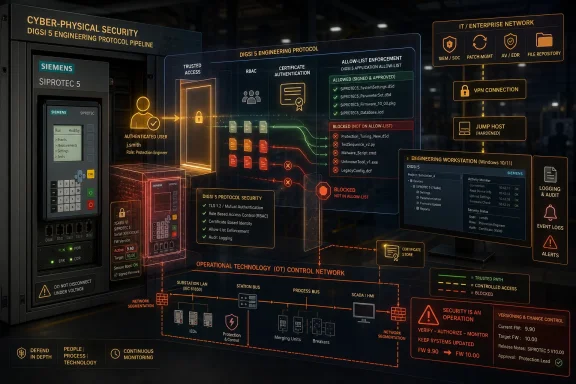 The Dangerous Door Is the One Engineers Already Use
The vulnerability sits in a place defenders cannot simply block and forget: the DIGSI 5 protocol used to engineer and manage Siemens SIPROTEC 5 devices. SIPROTEC 5 gear is not consumer Windows hardware, but it lives in environments WindowsForum readers know well: engineering workstations, jump hosts, VPNs, certificate stores, remote maintenance paths, and change windows that have to be negotiated with operations.CVE-2025-40808 is an unrestricted upload flaw. In plain terms, an authenticated user with access to the DIGSI 5 channel can upload files the device should not accept. Siemens and CISA describe the risk as malicious configuration files that could create a denial-of-service condition and potentially lead to code execution.
That “authenticated” condition matters, but it should not lull anyone. Industrial networks routinely depend on shared maintenance credentials, vendor access arrangements, engineering laptops that roam between sites, and long-lived operational trust. A vulnerability that requires credentials is less exposed than a zero-click internet bug, but in OT, the line between authorized user and dangerous capability is often much thinner than policy documents imply.
The practical issue is not that every affected relay is about to be popped from the public internet. The issue is that a management pathway designed for legitimate configuration changes can be abused to push a device into a bad state. In power protection, a bad state is not just an IT outage; it is a maintenance event, a protection availability issue, and potentially a safety conversation.
A Medium Score Can Still Mean a Very Bad Day
The CVSS 3.1 vector tells the story of why the score lands at 6.1: adjacent network access, low attack complexity, high privileges required, no user interaction, unchanged scope, no confidentiality impact, and high integrity and availability impact. That is a medium vulnerability by the scoring rubric. It is not medium in the sense that asset owners can file it under “check next quarter.”The adjacent-network requirement is a meaningful limiter. These devices should be on segmented control networks, not casually reachable from enterprise LANs or the internet. But industrial incidents often begin with a compromise of the places where segmentation is bridged: remote access services, engineering workstations, contractor laptops, asset-management servers, or domain accounts that should never have had the reach they accumulated.
The high-privilege requirement is also a real constraint. An attacker apparently needs authenticated access sufficient to use the relevant DIGSI 5 functionality. Yet that also means the bug becomes most concerning after an attacker has already achieved the kind of access defenders fear most: the access that lets them look like an engineer.
That is why the wording “potentially lead to code execution” deserves careful handling. Siemens’ advisory language does not mean every affected device is trivially exploitable for remote code execution in the wild. It means the upload primitive is dangerous enough that malicious content may move the consequence beyond configuration corruption and denial of service, depending on device behavior and attack details.
The Affected List Reads Like a Fleet Inventory
The advisory’s affected-products section is less a product list than a snapshot of how deeply SIPROTEC 5 is embedded across power and industrial environments. It includes 6MD, 6MU, 7KE, 7SA, 7SD, 7SJ, 7SK, 7SL, 7SS, 7ST, 7SX, 7SY, 7UM, 7UT, 7VE, 7VK, 7VU, and SIPROTEC 5 Compact 7SX800 variants across CP050, CP100, CP150, CP200, and CP300 platforms.That breadth is the operational story. Asset owners rarely have one neat generation of hardware in one neat firmware state. They have substations commissioned across different years, replacement relays installed under outage pressure, pilot deployments, spares in stores, and engineering projects that leave behind version diversity.
Siemens’ remediation guidance reflects that complexity. CP050 and CP150 device models are advised to move to version 9.90 or later. For CP300 models, 7ST85 and 7ST86 are advised to move to version 10.00 or later, while remaining CP300 models should move to version 9.90 or later. The purpose of those newer versions is an allow-list feature that restricts arbitrary file uploads.
That version split is easy to summarize and hard to execute. In IT, patching usually means rings, reboot coordination, and rollback planning. In protection environments, firmware changes may require engineering validation, outage coordination, model-specific checks, regulatory documentation, and trained personnel on hand if something does not behave as expected.
Siemens Is Moving from Trust to Allow-Listing
The important security design change is not merely “new firmware exists.” It is that Siemens is introducing an allow-list mechanism for uploads. That is a familiar defensive move in modern software: stop trying to identify every bad file and instead define the narrow set of files the system should accept.For a management protocol, allow-listing is the right instinct. Engineering tools often need powerful privileges because their job is to alter behavior. But the device should still know the difference between a valid configuration artifact and an arbitrary payload riding along a trusted channel.
The advisory therefore marks a shift from access-based trust toward content-based restraint. Authentication says who is at the door. Allow-listing says what that person is allowed to bring inside. CVE-2025-40808 exists in the gap between those two controls.
That gap is especially important in OT because credentials are not magic. An authorized channel can be reached by the wrong person, used from the wrong workstation, or abused after a legitimate account is compromised. The more dangerous the managed device, the less acceptable it is to rely only on the fact that the session was authenticated.
Windows Workstations Are Part of the Attack Surface
This is a Siemens device advisory, not a Windows vulnerability. But Windows administrators should not treat it as someone else’s problem. DIGSI engineering stations, maintenance laptops, certificate-management processes, VPN clients, remote desktop pathways, endpoint protection exclusions, and account provisioning often sit squarely in the Windows estate.For many organizations, the practical route to this vulnerability would not begin at the relay. It would begin with a compromised Windows engineering workstation or stolen credentials. Once an attacker can operate from a trusted endpoint, the network boundary that looked strong on a diagram may offer less protection than expected.
That makes endpoint hygiene directly relevant to relay security. Engineering workstations should be treated as high-value systems, not ordinary desktops with a few specialized tools installed. They deserve stricter software control, tighter credential handling, monitored remote access, and a change-management process that recognizes their ability to touch operational equipment.
There is also a logging challenge. IT security teams are used to collecting Windows event logs, EDR telemetry, VPN logs, and identity-provider signals. OT teams may have device logs and engineering records. The attack path crosses both domains, and the response has to do the same.
“Authenticated” Is Not a Comfort Word in OT
Security advisories often put authenticated bugs into a lower-priority bucket, and sometimes that is sensible. If exploitation requires a local admin account on a well-managed server, the marginal risk may be limited. But OT authentication is shaped by operational realities that do not always map to enterprise assumptions.Some environments still carry inherited shared accounts because relay work is performed by teams rather than individuals. Some remote access is granted to vendors or integrators for practical reasons. Some substations have limited connectivity and inconsistent monitoring. Some engineering laptops need broad access because field work is unpredictable.
That does not mean every operator is negligent. It means industrial systems have constraints that consumer and enterprise software scoring models only partially capture. A relay that rejects arbitrary file uploads after authentication is a better relay than one that assumes authenticated upload is inherently safe.
The right lesson is not “panic because credentials can be stolen.” It is more specific: access control must be paired with protocol-level and device-level guardrails. If an authenticated user can do something the device has no valid reason to permit, the security model is incomplete.
Denial of Service Has a Different Weight in Protection Systems
In a conventional IT environment, denial of service might mean an application outage, a failed service, or a degraded user experience. In power protection environments, availability has a more physical meaning. Protection relays exist to detect faults and trigger actions that protect equipment, people, and grid stability.Siemens’ advisory warns that malicious configuration files could cause a denial-of-service condition, and the provided summary mentions the possibility of a permanent denial-of-service state. That phrase should focus attention. A recoverable service crash is one kind of incident; a device that must be manually restored, reimaged, replaced, or recommissioned is another.
The operational consequence depends on architecture. Siemens itself points to the importance of resilient grid design, including multi-level redundant secondary protection schemes for critical power systems. In well-designed environments, one relay being unavailable should not translate directly into a catastrophic outcome.
But redundancy is not a reason to be casual. Redundancy buys time and reduces single points of failure; it does not eliminate the cost of remediation. If a vulnerability can impair multiple devices of the same class through a common engineering path, the resilience question becomes fleet-wide, not device-by-device.
The Patch Is Simple to Name and Complicated to Schedule
For CP050 and CP150 models, Siemens advises upgrading to version 9.90 or later. For CP300 devices, the 7ST85 and 7ST86 models should move to version 10.00 or later, while other CP300 models should move to version 9.90 or later. Those versions introduce the allow-list capability meant to restrict arbitrary uploads.That is the clean version of the plan. The messy version begins with finding every affected device, confirming its platform variant, checking firmware level, understanding whether the fixed version applies, validating the update against local configurations, and scheduling the work around operational constraints.
Firmware updates on protection devices are not equivalent to monthly desktop patching. A failed update may require physical access or specialized recovery steps. A successful update still needs validation because protection settings are not abstract preferences; they are part of the system’s safety and reliability posture.
The advisory also notes that Siemens is preparing fix versions and recommends countermeasures where fixes are not available or not yet available. That phrasing matters. Some asset owners will not have a single universal firmware answer today, and their near-term security posture will depend on compensating controls.
The Countermeasures Are Familiar Because the Weakness Is Familiar
Siemens’ recommended mitigations read like the standard OT defense-in-depth playbook, but that does not make them boilerplate. Password protection on DIGSI connections, customer PKI-signed certificates for DIGSI access, RBAC activation where supported, and network access protection through firewalls, segmentation, and VPNs all address the same central reality: management access must be narrowed and made attributable.RBAC deserves particular attention. Siemens says role-based access control is supported on available CP050, CP100, CP150, and CP300 devices with SIPROTEC 5 firmware version 7.80 and higher. If an organization has not enabled it, the vulnerability should be treated as a forcing function to revisit why.
Customer PKI is another practical dividing line between mature and fragile environments. Vendor-default trust models and long-lived certificates are convenient, but they age badly. A customer-controlled certificate chain gives operators more authority over who and what can initiate sensitive engineering connections.
Network segmentation remains necessary, but it should not be mistaken for a complete fix. Segmentation reduces reachability. It does not sanitize the engineering workstation inside the segment, prevent credential misuse, or constrain what an authenticated protocol session can upload. That is why the allow-list firmware change matters.
CISA’s Republication Is a Signal, Not a Rewrite
The advisory is a CISA republication of Siemens ProductCERT SSA-139483 through the Common Security Advisory Framework flow. CISA explicitly notes that this kind of republication is provided as-is for visibility and that Siemens remains the technical source for the product-specific advisory. That distinction is useful because it tells operators where to look for device-specific updates as fixes evolve.CISA’s role still matters. An ICS advisory on CISA’s site tends to move the issue from vendor inboxes into risk registers, compliance discussions, and executive dashboards. It gives security teams a common reference point when asking operations to prioritize work that may be inconvenient.
The initial Siemens publication date was June 9, 2026, and the CISA republication date was June 23, 2026. That two-week gap is not unusual in the advisory ecosystem, but it does mean some operators may already have seen the vendor notice before CISA amplified it. Others may only now be encountering it through national cyber channels.
The timing also matters because industrial patch programs often move by maintenance windows, not by news cycles. A June advisory may translate into summer planning, autumn outage coordination, or emergency exceptions depending on the asset’s role and exposure. The right response begins immediately, even if the update itself cannot be applied immediately.
The Real Inventory Problem Is Knowing Which Boxes Matter Most
The affected list is long enough that asset owners should resist the temptation to treat it as a spreadsheet exercise only. Inventory is necessary, but prioritization is the hard part. A relay in a highly segmented lab environment and a relay reachable from a frequently used remote engineering path do not carry the same immediate risk.The first cut should be exposure. Which devices are reachable via DIGSI 5 from engineering workstations, jump hosts, or remote access paths? Which stations have internet access, email, removable media use, or contractor access? Which credentials can initiate configuration uploads?
The second cut should be operational consequence. Which devices support the most critical processes? Which sites have less redundancy? Which relays would be difficult to physically access if a bad upload caused a persistent failure? Which locations have limited trained staff available for recovery?
The third cut should be fix availability. Where firmware 9.90 or 10.00 is applicable and operationally validated, the allow-list update should become the preferred control. Where fixes are unavailable or not yet approved for deployment, compensating controls need to be documented rather than assumed.
This Is a Supply-Chain Trust Story in Miniature
Industrial cybersecurity debates often use “supply chain” to mean compromised vendors, malicious updates, or third-party software dependencies. CVE-2025-40808 is narrower, but it still exposes a supply-chain trust issue: asset owners rely on vendor engineering tools and protocols to safely modify equipment that cannot be casually interrupted.DIGSI 5 is a legitimate toolchain path. That makes the vulnerability more consequential than a random exposed service no one needs. The channel must exist, so the security question becomes how tightly it is governed.
This is the awkward middle ground of OT security. The safest device from a cyber perspective is one no one can reach, but the useful device must be configured, tested, maintained, and sometimes changed urgently. Engineering access is therefore a controlled hazard, not a removable nuisance.
Allow-listing uploads is a product-side answer to that hazard. Stronger identity, certificates, RBAC, segmentation, and workstation hardening are operator-side answers. Neither side is sufficient alone.
The Advisory Also Reveals the Cost of Long Product Lifecycles
SIPROTEC 5 devices are deployed worldwide in critical manufacturing, transportation, energy, healthcare and public health, financial services, and government facilities. Those sectors do not refresh critical equipment on the cadence of consumer electronics. Long service life is a feature, but it makes security maintenance more complicated.When a vulnerability affects all versions of a large family, the install base can include devices at very different points in their lifecycle. Some may be close to current firmware. Others may be several major releases behind because they have been stable, certified, or simply left untouched after commissioning.
Security teams tend to say “patch,” but the field reality is “qualify, schedule, execute, verify, document, and monitor.” If an update changes file acceptance behavior, teams also need to confirm that legitimate engineering workflows still function. A security fix that surprises an operations team can create its own resistance.
This is why the best time to prepare for advisories is before the advisory exists. Asset inventories, firmware baselines, standard test plans, backup configurations, certificate processes, and role definitions are not glamorous. They determine whether a medium CVE becomes a manageable maintenance item or a months-long scramble.
Attackers Do Not Need Internet Exposure If They Can Borrow the Engineer’s Seat
CISA’s recommended practices emphasize minimizing network exposure for control system devices, keeping them off the internet, isolating control networks from business networks, and using secure remote access such as updated VPNs when remote access is required. That guidance remains correct. It is also only the beginning.The more realistic threat path is credentialed misuse from a trusted zone. An attacker compromises a business account, moves to a remote access path, lands on a jump host, obtains engineering credentials, or compromises a technician’s workstation. By the time the relay sees the session, it may look legitimate.
That is why monitoring has to be behavior-aware. A DIGSI session outside a normal maintenance window, from an unusual workstation, using a rarely used account, or touching an unusual set of devices should stand out. If the first time a team notices suspicious activity is when protection equipment stops responding, the detection model has failed.
This is also where Windows administration and OT engineering should meet. Privileged access workstations, application control, credential isolation, and remote session recording are not just enterprise security fashions. In environments where Windows hosts mediate access to protection devices, they become part of the relay security boundary.
The Allow-List Era Will Create Its Own Operational Friction
A new allow-list feature should reduce arbitrary upload risk, but it may also expose undocumented habits. Engineering teams often develop local workflows over years: file naming conventions, backup practices, template reuse, vendor scripts, commissioning bundles, or emergency procedures that were never designed around strict upload validation.That friction is not an argument against the fix. It is an argument for testing it before the maintenance window. If the new firmware blocks something the organization considered normal, the right place to discover that is in a controlled validation environment, not during field work under time pressure.
The same applies to RBAC. Turning on role-based controls can reveal that too many users had broad privileges because nobody wanted to risk blocking urgent work. Cleaning that up is painful, but it is exactly the kind of pain that reduces the blast radius of authenticated vulnerabilities.
Certificate changes can be similarly disruptive. Moving to customer PKI improves control, but it requires lifecycle management: issuance, renewal, revocation, documentation, and recovery procedures. In OT, expired certificates can become operational incidents if no one owns the process.
The WindowsForum Angle Is Not Windows, It Is Stewardship
For WindowsForum readers, the temptation may be to skip past a Siemens relay advisory as niche industrial equipment news. That would be a mistake. Modern infrastructure security is increasingly about the systems around the device as much as the device itself.Windows is often the operator interface, the engineering workstation, the remote access endpoint, the log collector, the domain member, the patch-management client, or the platform running the tools that touch the device. Even when the vulnerable product is not Windows, the administrative ecosystem frequently is.
This is where IT and OT cultures still collide. IT wants standardized patch velocity, centralized identity, and broad telemetry. OT wants stability, deterministic change, and operational authority. CVE-2025-40808 is a reminder that neither side can solve the problem alone.
The best response is a shared one. OT identifies device criticality, safe update paths, and operational constraints. IT tightens the Windows and identity environment around engineering access. Security correlates the two into a threat model that reflects how an attacker would actually move.
The Relay Cabinet Has Become a Software Boundary
Here is the compressed version for teams trying to turn the advisory into action without losing the plot.- Siemens SIPROTEC 5 devices using the DIGSI 5 protocol are affected by CVE-2025-40808, an authenticated arbitrary file upload vulnerability tied to CWE-434.
- The CVSS 3.1 score is 6.1 medium, but the high integrity and availability impacts make the issue more urgent in protection and control environments than the label may suggest.
- CP050 and CP150 device models should move to version 9.90 or later, while CP300 7ST85 and 7ST86 devices should move to version 10.00 or later and other CP300 models should move to version 9.90 or later where applicable.
- The key product-side mitigation is an upload allow-list, which narrows what authenticated DIGSI 5 users can place on the device.
- Operators should pair firmware updates with password-protected DIGSI connections, customer PKI certificates, RBAC where supported, segmentation, restricted remote access, and hardened engineering workstations.
- Teams that cannot patch immediately should document compensating controls, prioritize exposed and high-consequence devices, and monitor engineering access for unusual behavior.
Medium Severity Is the Wrong Mental Model
The most misleading thing about this advisory may be the comfort of classification. Medium severity sounds like a middle lane: not ignored, not urgent, not executive-level. In industrial protection environments, that framing is too tidy.The vulnerability affects a trusted engineering protocol, a broad product family, and devices whose availability matters in the physical world. It requires authentication and adjacent access, which keeps it out of the worst-case remote-exploitation category. But once an attacker is inside the operational trust boundary, the weakness points at exactly the kind of capability defenders least want abused.
Siemens’ allow-list fix is the right kind of product response because it reduces what authenticated users can upload. But the operational response has to be broader: know the fleet, harden the Windows workstations and remote access paths, constrain privileges, validate firmware, and treat engineering channels as high-risk administrative interfaces. The future of OT security will not be won by pretending relays are isolated appliances; it will be won by managing them as software-defined infrastructure whose most dangerous doors are often the ones legitimate operators use every day.
References
- Primary source: CISA
Published: 2026-06-23T12:00:00+00:00

Siemens SIPROTEC 5 Using DIGSI5 Protocol | CISA
www.cisa.gov
- Related coverage: cyber.gc.ca
[Control systems] Siemens security advisory (AV26-566) - Canadian Centre for Cyber Security
[Control systems] Siemens security advisory (AV26-566)www.cyber.gc.ca - Related coverage: sdxcentral.com
CISA issues twenty Industrial Control Systems advisories - SDxCentral
CISA's twenty ICS advisories released on February 13, 2025, address vulnerabilities within various Siemens systems.www.sdxcentral.com - Related coverage: cert-portal.siemens.com
- Related coverage: support.industry.siemens.com
- Related coverage: vulners.com
Siemens SIPROTEC 5 - vulnerability database | Vulners.com
1. SUMMARY The SIPROTEC 5 devices do not use sufficiently random numbers to generate session identifiers. This could facilitate a brute-force attack against a valid session identifier which could allow an unauthenticated remote attacker to hijack ...vulners.com
