

Microsoft has assigned CVE-2025-62219 to a newly disclosed local elevation‑of‑privilege defect in the Windows Wireless Provisioning System — a double‑free memory corruption that, if successfully exploited by a low‑privileged local actor, can permit privilege escalation to higher system privileges on affected Windows hosts.
The Wireless Provisioning System in Windows is part of the platform that handles Wi‑Fi provisioning, credential handling, and related wireless configuration tasks. These components sit at the intersection of user‑facing networking features and privileged system services, which makes them a frequent focus for researchers: a successful local exploit often becomes an easy path to SYSTEM privileges because the service executing provisioning logic runs in an elevated context. Recent vulnerability disclosures across the wireless stack illustrate this pattern — vendor advisories and vulnerability records for WLAN‑ and WWAN‑related services show how memory‑safety defects and improper synchronization in these components can become high‑value local escalation vectors. What we know at publication:
(Operational note: treat the Microsoft Security Update Guide entry for CVE‑2025‑62219 as the canonical reference for KB names and per‑build applicability; use your configuration management system to verify installations and reconcile inventory after deployment.
Source: MSRC Security Update Guide - Microsoft Security Response Center
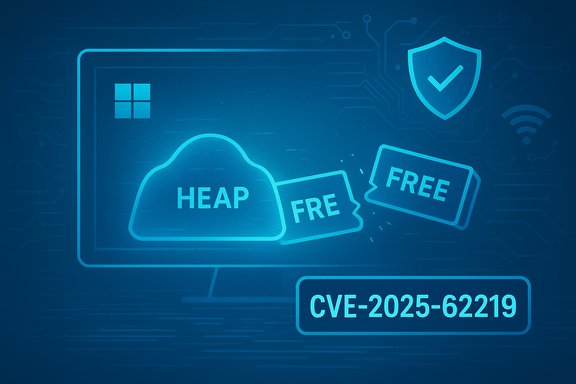 Background / Overview
The Wireless Provisioning System in Windows is part of the platform that handles Wi‑Fi provisioning, credential handling, and related wireless configuration tasks. These components sit at the intersection of user‑facing networking features and privileged system services, which makes them a frequent focus for researchers: a successful local exploit often becomes an easy path to SYSTEM privileges because the service executing provisioning logic runs in an elevated context. Recent vulnerability disclosures across the wireless stack illustrate this pattern — vendor advisories and vulnerability records for WLAN‑ and WWAN‑related services show how memory‑safety defects and improper synchronization in these components can become high‑value local escalation vectors. What we know at publication:- The vulnerability is tracked as CVE‑2025‑62219 and has been described by Microsoft as a double‑free vulnerability in the Wireless Provisioning System.
- Public aggregators and threat trackers have assigned an approximate CVSS v3.1 base score in the high range (Feedly lists a base score of 7.0) and classify it as a local attack vector requiring low privileges to initiate.
- Microsoft lists remedial updates via its Security Update Guide; administrators should map CVE → KB for their specific builds before deployment.
Why this matters: the operational significance of a double‑free in provisioning code
Memory corruption bugs come in many flavors; double‑free is one of the most dangerous because it can produce use‑after‑free or heap corruption primitives that attackers convert into controlled memory writes or code‑execution paths. In privileged services that handle user input (like provisioning data, certificates, or network configuration), a double‑free can be leveraged to:- Overwrite function pointers or vtables used by the elevated service,
- Force the service to follow attacker‑controlled code paths,
- Manipulate security tokens or spawn processes in elevated contexts.
Technical analysis — what the publicly available information supports
What vendors say (summary)
Microsoft’s advisory labels CVE‑2025‑62219 as a double‑free in the Wireless Provisioning System and links remediation to a Microsoft update. That advisory entry is the authoritative source for KB mapping and should be the starting point for all operational action. Public aggregator summaries (for example, the Feedly vulnerability index) describe the defect consistently: local attack vector, low privileges required, no user interaction, and a high impact to confidentiality, integrity and availability if exploited. Feedly further notes that no public proof‑of‑concept or confirmed in‑the‑wild exploitation had been observed as of the aggregator’s capture. Where details exist, they describe the double‑free as the root cause enabling escalation.Exploit mechanics (what is plausible and what is unverified)
Based on the double‑free classification and historical exploitation techniques against similar Windows components, a realistic exploitation chain might look like:- Trigger a code path in the Wireless Provisioning System that allocates an object for provisioning data.
- Cause the service to free that object twice (either via logical error or race), creating a stale reference or corrupted heap metadata.
- Reallocate the freed slot with attacker‑controlled data (heap grooming) from the low‑privileged process.
- Force the privileged service to dereference the stale pointer or otherwise use corrupted memory, producing a write‑what‑where primitive, vtable overwrite, or control flow hijack.
- Use the resulting primitive to spawn code or manipulate tokens in the elevated context, achieving privilege escalation.
Confidence and corroboration
- Vendor confirmation (Microsoft’s Security Update Guide) establishes high confidence in the vulnerability’s existence and the remediation path. Rely on Microsoft for KB mapping and package names.
- Independent aggregators and vulnerability trackers (Feedly and others) corroborate the classification and impact but do not add low‑level exploit details. Use them to cross‑check CVSS and public visibility.
Affected systems and patching guidance
Affected platforms
Microsoft’s advisory is the final authority for affected builds and KB mapping. Public trackers indicate that the issue affects multiple Windows client builds that include the Wireless Provisioning System module (various Windows 10/11 servicing branches were listed by aggregators), but precise per‑build mappings must be pulled from Microsoft’s Security Update Guide before deployment decisions are made.Immediate remediation priority
- Validate the exact KB for each Windows build in your environment using Microsoft’s Security Update Guide. Microsoft lists the CVE entry and links to per‑SKU updates — confirm that the KB applies to your image/branch before mass deployment.
- Apply vendor updates as soon as practical. For local EoP bugs that elevate to SYSTEM, the window for attackers to weaponize the bug after disclosure is typically days to weeks — rapid patching minimizes risk.
- Reboot hosts if the update requires it (follow the KB guidance). Many Windows servicing updates require reboots to bring corrected binaries into use.
If you cannot patch immediately (temporary compensations)
- Restrict local interactive access: remove unnecessary local admin rights and tighten interactive logon controls for account types that can reach the host.
- Use endpoint controls: enforce application allow‑listing (WDAC/AppLocker) on sensitive hosts to reduce the value of local code execution primitives.
- Monitor and isolate: place high‑value machines in isolated management segments, and increase EDR/SIEM monitoring for privilege escalation patterns (see “Detection and hunting” below).
Detection, telemetry, and forensic indicators
A local privilege escalation bug leaves limited but useful forensic traces when attempted or abused. Hunt for the following signals and collect triage artifacts immediately if an exploitation attempt is suspected:- Unexpected crashes or repeated faults in wireless provisioning services or related binaries; examine System and Application event logs for service crashes and faulting module names.
- Process creation events where low‑privilege user processes spawn unexpected elevated processes (monitor security event IDs for process creation and service control manager changes).
- Kernel or user‑mode dumps taken at or near the time of the suspected exploit — double‑free bugs often trigger heap corruption crashes that are diagnosable from memory dumps. Capture full memory dumps where feasible.
- Signs of post‑exploit activity typical of privilege escalation: creation of new services, scheduled tasks created by non‑admin accounts, or sudden additions to registry autoruns. Correlate with process lineage to identify suspicious parent→child relationships.
- EDR filters for child processes launched by wireless provisioning‑related processes,
- Unusual privileges being requested or duplicated by non‑system processes,
- Newly created or modified service entries outside of normal patch windows.
Risk assessment: threat actors, weaponization timeline, and impact
- Threat actors value robust local elevation bugs as post‑compromise force multipliers. A short, reliable exploit for a double‑free in an elevated service will likely be integrated into attacker toolsets quickly. Expect that motivated attackers who already have deliverable code execution on a target host will prioritize turning this into SYSTEM.
- The vulnerability’s local vector reduces its immediate impact for internet‑only threat models, but does not meaningfully reduce the operational urgency: combined with phishing, malicious installers, or chained remote exploits, CVE‑2025‑62219 can facilitate full host compromise.
- The real‑world severity hinges on exploit reliability and the presence of modern mitigations (CFG, Control Flow Enforcement, ASLR, heap‑hardening). Until a PoC or robust technical analysis is public, treat exploitation as plausible and prioritize remediation accordingly.
Practical remediation playbook (step‑by‑step)
- Inventory: Map all Windows endpoints and servers that include wireless components (client endpoints, laptops, mobile‑workstation images). Query your configuration management database and update management tools for precise build numbers.
- Confirm: Open Microsoft’s Security Update Guide entry for CVE‑2025‑62219 and note the exact KB(s) that apply to each OS build in your estate. The vendor KB mapping is authoritative.
- Test: Stage the provided KB in a small pilot group that represents your most critical configuration variants and test for functional impact on wireless provisioning workflows (Wi‑Fi profiles, enterprise provisioning, certificate enrollment).
- Deploy: Use WSUS, ConfigMgr, Intune, or your chosen patch‑orchestration tool to roll out updates in controlled rings (pilot → broad). Schedule reboots as required by KB guidance.
- Monitor: After deployment, validate completion via inventory reconciliation and watch EDR/SIEM for anomalies associated with privilege escalation during the rollout window.
- Harden: Where hosts cannot be patched immediately, reduce attack surface by limiting interactive local access, enforcing application allow‑listing, and tightening local group membership.
Operational caveats and secondary risks
- Vendor fixes sometimes alter functionality or remove diagnostic features as a side effect of the remediation. Past out‑of‑band Microsoft fixes have temporarily removed or changed diagnostic behaviors in affected services — prepare validation and troubleshooting playbooks for any functional changes after update application. (Example: prior WSUS remediation temporarily removed certain diagnostic displays in the console. Administrators should plan for both security and operational validation.
- Patching at scale: large rollouts of servicing patches frequently require careful scheduling because servicing stack updates and LCUs may be bundled and require coordinated reboots. Validate each KB’s prerequisites and the potential impact on enterprise imaging and driver compatibility.
- False positives in hunt rules: aggressive detection rules for EoP activity may yield many benign matches; tune rules against known good baselines and prioritize high‑confidence indicators for immediate response.
What to tell leadership and desktop owners (brief, actionable messaging)
- Security teams: treat CVE‑2025‑62219 as a high‑value post‑compromise tool that must be remediated quickly. Confirm KB mappings from Microsoft’s Security Update Guide, stage, and then roll out updates with validated testing.
- Desktop and workstation owners: do not run untrusted installers or macros, and apply the security updates when offered. If your device is a privileged workstation (admin console, jump host), consider immediate isolation until the update is applied and validated.
Closing analysis — strengths, uncertainties, and recommended next steps
Strengths in the public record:- Microsoft has registered the vulnerability and published the advisory entry, which establishes remediation channels and per‑SKU KB mapping as the operational reference point. That vendor confirmation is the single most important factor in response planning.
- Independent aggregation confirms the defect class (double‑free) and expected impact profile (local EoP, high confidentiality/integrity/availability impact). Multiple trackers converge on the same headline assessment.
- At the time of the public captures used for this analysis, no vendor‑published exploit code or reproducible public proof‑of‑concept was widely available; however, the absence of a PoC is not a safe indicator that exploitation risk is low. Local EoP bugs are frequently weaponized quickly in offensive toolchains. Treat this as a high‑urgency remediation item for hosts that are exposed to local compromise risks.
- Low‑level exploit mechanics (exact heap grooming steps, required timing windows, or additional prerequisite conditions) are not documented in vendor advisories — these remain the domain of technical research and forensic analysts. Avoid depending on unverified, researcher‑level reconstructions for detection rules; instead, base operational detection on process anomalies and service crashes described above.
- Immediately map CVE‑2025‑62219 to KB(s) for each Windows build via Microsoft’s Security Update Guide and schedule remediation windows.
- Patch pilot groups and validate wireless provisioning workflows and device connectivity before broad rollout.
- Harden hosts that can’t be patched immediately by tightening local access and enabling application allow‑listing.
- Increase EDR/SIEM telemetry collection for privilege escalation indicators and be prepared to collect memory dumps if suspicious activity is detected.
(Operational note: treat the Microsoft Security Update Guide entry for CVE‑2025‑62219 as the canonical reference for KB names and per‑build applicability; use your configuration management system to verify installations and reconcile inventory after deployment.
Source: MSRC Security Update Guide - Microsoft Security Response Center
