

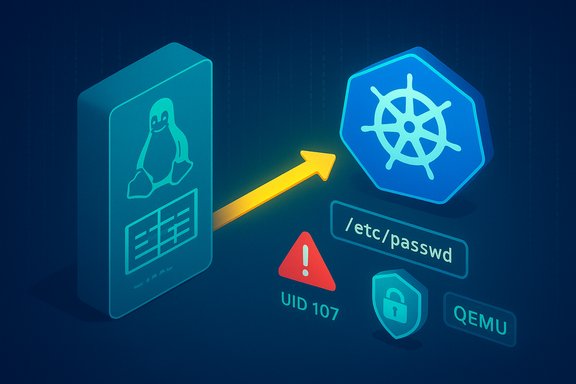
KubeVirt's virt-handler contains a symlink-handling bug that can be abused to change ownership of arbitrary host files to the unprivileged qemu user (UID 107), creating a surprising path from a compromised pod filesystem to host-level file-permission changes and undermining multi-tenant isolation guarantees.
KubeVirt is a Kubernetes extension that runs virtual machines alongside containers by mapping VM lifecycle operations into Kubernetes primitives. On November 7, 2025, a moderate-severity vulnerability was published as CVE-2025-64437 describing a logic flaw in the KubeVirt virt-handler isolation-detection code: the component does not reliably check whether a launcher socket file (launcher-sock) is a symlink or a regular file, and under specific conditions that omission can be weaponized to change ownership of files on the host node to the unprivileged user employed by virt-launcher. The bug is not a straightforward remote code execution — instead it is an isolation-detection weakness that, when combined with control over the virt-launcher pod filesystem and additional symlink tricks, can cause virt-handler to misinterpret root mounts and inadvertently perform chown operations against host files. The vulnerability is fixed in KubeVirt releases 1.5.3, 1.6.1 and newer; maintainers merged targeted commits to detect and safely resolve symlinks before taking actions that affect host-side paths. This article explains how the flaw works at a technical level, outlines realistic exploitation prerequisites and risk models, and provides a detailed remediation and detection playbook for administrators and Windows-centric ops teams who run or manage Kubernetes platforms that may host KubeVirt.
Priority guidance:
CVE-2025-64437 is a contained but meaningful reminder that path resolution and symlink handling are critical in code that crosses the container/host boundary. The technical fix is available; the operational imperative is clear: patch shared and multi-tenant hosts fast, tighten volume and pod admission policies, and watch for the small artifacts that betray big errors.
Source: MSRC Security Update Guide - Microsoft Security Response Center
 Background / Overview
KubeVirt is a Kubernetes extension that runs virtual machines alongside containers by mapping VM lifecycle operations into Kubernetes primitives. On November 7, 2025, a moderate-severity vulnerability was published as CVE-2025-64437 describing a logic flaw in the KubeVirt virt-handler isolation-detection code: the component does not reliably check whether a launcher socket file (launcher-sock) is a symlink or a regular file, and under specific conditions that omission can be weaponized to change ownership of files on the host node to the unprivileged user employed by virt-launcher. The bug is not a straightforward remote code execution — instead it is an isolation-detection weakness that, when combined with control over the virt-launcher pod filesystem and additional symlink tricks, can cause virt-handler to misinterpret root mounts and inadvertently perform chown operations against host files. The vulnerability is fixed in KubeVirt releases 1.5.3, 1.6.1 and newer; maintainers merged targeted commits to detect and safely resolve symlinks before taking actions that affect host-side paths. This article explains how the flaw works at a technical level, outlines realistic exploitation prerequisites and risk models, and provides a detailed remediation and detection playbook for administrators and Windows-centric ops teams who run or manage Kubernetes platforms that may host KubeVirt.Why this matters: attack surface and real-world impact
KubeVirt is frequently run on clusters that serve as shared infrastructure for developers, CI/CD pipelines, testbeds, and hybrid workloads. Virtualization on Kubernetes creates a high-value attack surface because VMs often touch host resources (storage, block devices, network interfaces) and because cloud-native orchestration can obscure lateral movement. The vulnerability’s practical impact is primarily the unauthorized change of file ownership and the consequent compromise of confidentiality, integrity and availability of host files — a class of damage that is dangerous in multi-tenant environments and for providers of shared cluster infrastructure. Key high-level effects:- Unauthorized file permission changes on the node filesystem (ownership switched to UID 107 / qemu), enabling a low-privileged user inside an attacked VM/pod to influence host files.
- Isolation erosion: symlink manipulation and mount-path confusion enable an attacker to move beyond the intended chroot-like view the virt-launcher pod should have.
- Chained abuse potential: once host files lose correct ownership, further escalation or persistence techniques may become feasible (for example, replacing configuration files, dropping credential files, or allowing subsequent injection by other processes).
Technical anatomy — how the flaw works
Core mistake: failing to treat launcher-sock as a symlink
At the heart of CVE-2025-64437 is a logic error in the isolation detector used by virt-handler. The component locates the runtime root of a virt-launcher pod by inspecting a socket-like artifact referred to as launcher-sock. The code assumed that the socket file was a concrete regular file within the container’s filesystem; it did not robustly verify whether the path was a symlink that could point into a different mount namespace or into host paths. When that assumption is violated, the detector can compute the wrong “virt-launcher root”, and subsequent host-side operations (for example, preparing disk images or creating host-disks) are performed against paths that the attacker has chosen — including files owned by root on the host.The proof-of-concept (PoC) pattern
The published advisory and commits describe a multi-step PoC that chains symlink manipulation with pivot_root and user-namespace tricks. A condensed description:- An attacker with control of the virt-launcher pod filesystem replaces the launcher-sock with a symlink that points into a crafted path controlled by an attacker process (for example, a socket inside a pivot_root’ed isolated environment).
- The attacker also places a symlink (named
disk.imgin the advisory PoC) inside the PVC mount path that points to a sensitive host file such as/etc/passwdvia the preserved old-root path. - virt-handler calls the isolation detector, obtains a mistaken root-mount result, and then proceeds to prepare host-disk artifacts (e.g., creating or chown'ing the
disk.imgpath). - Because the detector resolved the symlinked launcher-sock as if it were a regular file inside the expected root, virt-handler’s host operations operate on the attacker-chosen host file (and change ownership to UID 107).
The underlying weakness classification
The weakness is a classic link-following bug (CWE-59 — Improper Link Resolution Before File Access). Code that follows unvetted symlinks when making host filesystem changes can inadvertently operate on files outside intended boundaries. Git patch commits introduce a safepath or equivalent strategy that resolves symlinks safely and rejects ambiguous launcher-sock targets before executing host-affecting operations.Exploitation complexity and threat model
This is not an “attacker on the internet presses a button and owns the host” vulnerability. The exploit model requires several preconditions and attacker capabilities:- The attacker must control or be able to write into the filesystem of a virt-launcher pod (for example, by running a malicious image, via a prior container escape, or through a misconfigured volume).
- The attacker typically needs the ability to create symlinks and to manipulate socket files inside that container filesystem.
- The exploit in the PoC leverages unprivileged user namespaces and pivot_root operations to craft a deceptive environment; kernel/userns configuration (for example, the availability of unprivileged user namespaces) can be relevant.
- The victim cluster must be running an affected KubeVirt version: versions earlier than 1.5.3 or 1.6.1 (depending on your branch) are vulnerable. Maintainers list patched versions as 1.5.3, 1.6.1, and 1.7.0.
Verified facts and what is still uncertain
- Verified: the vulnerability description, affected versions, PoC outline, CWE classification and the existence of targeted commits and advisory were published by the KubeVirt project and are reflected in NVD and public CVE aggregators. The maintainers merged fixes that resolve symlink resolution and add safepath checks.
- Verified: patched versions are 1.5.3, 1.6.1, and 1.7.0.
- Verified: the vulnerability has a CNA-supplied CVSSv3.1 base score of 5.0 (Medium) per the GitHub CNA metadata compiled into NVD. That score reflects the local vector and the need for several preconditions.
- Unverified / no public evidence: mass or widespread in-the-wild exploitation specifically using CVE-2025-64437 at scale. No public incident reports at time of disclosure attribute active campaigns to this exact issue. Treat claims of active mass exploitation as unverified until telemetry or CERT advisories demonstrate otherwise.
Detection and incident-hunting guidance
Focus on identifying the telltale artifacts and the preconditions the PoC requires. Practical indicators include:- Host filesystem ownership changes to unexpected UIDs (notably UID 107, used by
qemu/virt-launcher). Monitor for sudden chown operations or files that suddenly show UID 107 on host files that should not be owned by that user. - Creation of unexpected symlinks within PVC mount directories associated with VM disks (e.g., look for
disk.imgsymlinks or socket symlinks in/var/run/kubevirt-private/vmi-disks/*paths). - Presence of atypical ephemeral sockets (socat or similar) listening inside pod filesystem namespaces, and unusual socket paths referenced in virt-handler logs.
- virt-handler logs that show unexpected errors, path resolution messages, or messages from the pod isolation detector. Enable additional logging for virt-handler during triage windows if feasible.
- Audit logs or host-level inotify/auditd alerts that report pathname changes or chown syscalls originating from virt-handler processes.
- Check for files owned by UID 107: find / -uid 107 -ls
- Inspect KubeVirt-specific paths: ls -l /var/run/kubevirt-private || journalctl -u kubelet | grep kubevirt
- Tail virt-handler logs in the cluster: kubectl -n kubevirt logs -l kubevirt.io=virt-handler --tail=500
- Audit host for recent chown syscalls (auditd) or check system audit logs for unusual activity correlated with VMI updates.
Remediation and mitigation checklist
Immediate actions (0–24 hours)- Patch: upgrade KubeVirt to a patched release: 1.5.3, 1.6.1, 1.7.0 or later. The maintainer commits explicitly implement safepath resolution for the launcher-sock edge cases. Prioritize multi-tenant and CI hosts for immediate upgrades.
- Short-term hardening: reduce attack surface while you patch:
- Restrict who can write to virt-launcher pod filesystems; avoid mounting untrusted writable volumes into virt-launcher.
- Disallow or carefully control hostPath mounts and PVC sources that could allow path trickery.
- If operationally acceptable, disable unprivileged user namespaces (sysctl kernel.unprivileged_userns_clone=0) to remove one exploitation lever used in the PoC. Note: this may affect legitimate workloads that require user namespaces.
- Apply Pod Security constraints, read-only root filesystems, strict seccomp profiles and minimal capabilities on pods that provision or manage virt-launcher.
- Inventory: enumerate clusters and nodes running KubeVirt and map versions; treat older branches as higher priority. Use automated tooling to find KubeVirt operator versions and cluster workloads.
- Upgrade the KubeVirt operator and all virt-handler daemonsets to patched versions as part of a tested maintenance window.
- Recreate or re-provision any VMI pods if advised by vendor notes — ensure the patched virt-handler runs cleanly on all nodes.
- Re-evaluate cluster admission controls and image-signing policies. Block or require review for container images that include unusual privileged tooling (socat, pivot_root helper scripts, etc..
- If any host files were changed unexpectedly, perform a forensic triage: compare file metadata, check integrity measures, and consider node rebuilds if evidence of tampering exists.
- Enforce strict RBAC and admission policies on CSI volumes, PVC creation, and privileged Pods.
- Use runtime security tooling that watches for cross-namespace or host-path symlink creation, and that enforces syscall-level policies (via seccomp, AppArmor, SELinux).
- Add filesystem integrity monitoring on nodes to detect unexpected UID/ownership changes (osquery, auditd, Tripwire-style checks).
- Harden CI/CD and developer pipelines: avoid running untrusted images on nodes that are also used as hypervisors or build hosts, and maintain SBOMs and supply-chain verification.
Windows-focused operational notes
While KubeVirt itself runs on Linux nodes, Windows administrators and operations teams should treat this advisory as relevant when:- Windows management or monitoring servers interact with clusters that host KubeVirt (for example, patch orchestration consoles, logging collectors, or build systems).
- Windows-hosted CI/CD components push images or PVCs into Kubernetes clusters; insecure images or misconfigured volume claims are a common initial vector for container filesystem compromise.
- Organizations run mixed-platform orchestration where Windows teams are responsible for inventory, compliance, and vulnerability management — coordinate a cross-team response and ensure that the inventory includes Kubernetes operator and KubeVirt versions.
- Verify inventories and CMDB entries: list clusters that host virtualization workloads and confirm versions.
- Coordinate with Linux/K8s teams to prioritize the patching of multi-tenant clusters and infrastructure nodes.
- Check centralized logging and SIEM pipelines for the indicators listed above (ownership changes, virt-handler errors) and escalate anomalies for immediate triage.
Risk assessment and final recommendations
CVE-2025-64437 is a textbook example of how small path-resolution and symlink-handling mistakes in orchestration code can have outsized effect in multi-tenant, cloud-native environments. The technical fix is surgical and available in the maintained KubeVirt branches; the operational task is rapid identification and prioritized rollout.Priority guidance:
- Treat clusters that schedule untrusted workloads, CI runners, and multi-tenant nodes as the highest patch priority.
- Apply the fixed KubeVirt versions immediately and follow the short-term hardening checklist while upgrades are staged.
- Implement detection logic for the narrow but telling indicators (UID 107 ownership changes, symlinked disk.img artifacts, virt-handler isolation-detector logs).
- Incorporate lessons from this advisory into admission controls, secure image practices and volume-mount hygiene: never assume a file is a regular file without explicit checks.
Appendix — Quick action checklist
- Inventory clusters and KubeVirt operator versions. Prioritize clusters running versions older than 1.5.3 / 1.6.1.
- Patch to KubeVirt 1.5.3, 1.6.1, 1.7.0 or later as soon as feasible.
- Restrict writes to virt-launcher pod filesystems and avoid mounting untrusted writable volumes into virt-launcher.
- Consider disabling unprivileged user namespaces temporarily if your environment does not depend on them.
- Add detection rules for UID 107 ownership spikes, unexpected symlink creation in PVC paths, and unusual virt-handler logs.
- If you detect suspicious ownership changes, isolate the node, preserve logs, and perform forensic triage or rebuild the node if tampering is confirmed.
CVE-2025-64437 is a contained but meaningful reminder that path resolution and symlink handling are critical in code that crosses the container/host boundary. The technical fix is available; the operational imperative is clear: patch shared and multi-tenant hosts fast, tighten volume and pod admission policies, and watch for the small artifacts that betray big errors.
Source: MSRC Security Update Guide - Microsoft Security Response Center
