

The Werkzeug safe_join vulnerability tracked as CVE-2025-66221 lets Windows-only special device names (for example, CON, AUX, NUL, COMx, LPTx) slip past path validation and be treated like ordinary files — a behavior that allowed web endpoints using send_from_directory to open a device path and then hang indefinitely when attempting to read it, producing a denial-of-service (DoS) condition; the bug was fixed in Werkzeug 3.1.4 with a targeted check that disallows Windows device names on NT platforms.
Werkzeug is a core WSGI utility library used by many Python web frameworks and applications (Flask historically adapts and exposes portions of Werkzeug’s API, including its file-serving utilities). Its utility function safe_join is designed to join untrusted path components to a base directory while preventing path traversal and other filesystem escapes. Applications commonly rely on send_from_directory (a higher-level helper that uses safe_join to safely serve uploaded files or static content from a configured directory. On Windows, certain legacy device names — historically created by the OS and available in every directory — are treated by the kernel as device interfaces rather than regular files. Names such as CON, PRN, AUX, NUL, COM0–COM9 and LPT0–LPT9 have special semantics; opening one of these paths can return a file-like handle that represents a device rather than a disk file. Prior to the 3.1.4 patch, Werkzeug’s safe_join didn’t reject path segments that matched those special device names on Windows, so a crafted request that targeted a path ending with one of those names would pass safe_join validation and could be opened by the process — an operation that, when subsequently read, can block or otherwise behave differently from a regular file, causing service disruption. This is a platform-specific availability bug (DoS) rather than a confidentiality/integrity flaw or a remote code execution. It only materializes when the application is running on Windows and the vulnerable code path uses safe_join/send_from_directory to serve client-supplied path segments. Multiple independent vulnerability trackers and the Werkzeug project itself classify the severity as moderate (CVSS scores reported around the mid-range) because the exploit requires the target to be running on Windows and uses a fairly narrow API surface.
Source: MSRC Security Update Guide - Microsoft Security Response Center
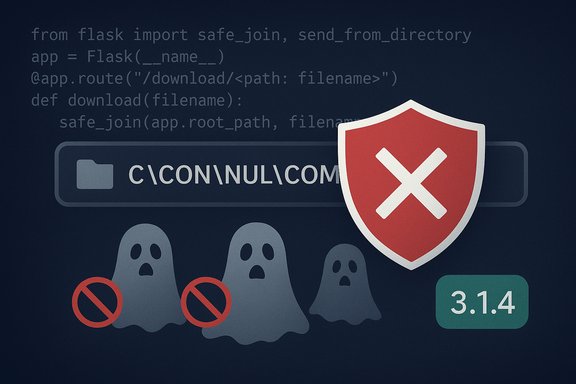 Background / Overview
Werkzeug is a core WSGI utility library used by many Python web frameworks and applications (Flask historically adapts and exposes portions of Werkzeug’s API, including its file-serving utilities). Its utility function safe_join is designed to join untrusted path components to a base directory while preventing path traversal and other filesystem escapes. Applications commonly rely on send_from_directory (a higher-level helper that uses safe_join to safely serve uploaded files or static content from a configured directory. On Windows, certain legacy device names — historically created by the OS and available in every directory — are treated by the kernel as device interfaces rather than regular files. Names such as CON, PRN, AUX, NUL, COM0–COM9 and LPT0–LPT9 have special semantics; opening one of these paths can return a file-like handle that represents a device rather than a disk file. Prior to the 3.1.4 patch, Werkzeug’s safe_join didn’t reject path segments that matched those special device names on Windows, so a crafted request that targeted a path ending with one of those names would pass safe_join validation and could be opened by the process — an operation that, when subsequently read, can block or otherwise behave differently from a regular file, causing service disruption. This is a platform-specific availability bug (DoS) rather than a confidentiality/integrity flaw or a remote code execution. It only materializes when the application is running on Windows and the vulnerable code path uses safe_join/send_from_directory to serve client-supplied path segments. Multiple independent vulnerability trackers and the Werkzeug project itself classify the severity as moderate (CVSS scores reported around the mid-range) because the exploit requires the target to be running on Windows and uses a fairly narrow API surface. What exactly went wrong: a technical breakdown
Windows device names and filesystem semantics
Windows historically exposes a set of reserved device names that are recognized whether or not a corresponding file exists on disk. Examples include:- CON (console)
- PRN (printer)
- AUX
- NUL (null device)
- COM0..COM9 (serial ports)
- LPT0..LPT9 (parallel ports)
How safe_join was intended to work
*safe_join(directory, pathnames)** is intended to:- Combine a trusted base directory with one or more untrusted path components.
- Validate that the final resolved path is contained within the base directory (preventing directory traversal like
../). - Return a safe path string suitable for opening and serving.
The concrete bug
Before the fix, valid-looking path segments that were device names would pass safe_join’s checks. On Windows the application could then call open and receive a handle that mapped to a device; attempting to read that handle produced indefinite blocking or other unexpected behavior, so the web request would hang and consume worker resources — a straightforward denial-of-service vector when triggered repeatedly or at scale. The exploit model does not require authentication and can be triggered over the network against any endpoint that forwards user-supplied path elements to send_from_directory (or an equivalent wrapper), provided the application is hosted on a Windows environment.Timeline & verification
- Public disclosure and advisory: The Werkzeug maintainers published a GitHub security advisory (GHSA-hgf8-39gv-g3f2) describing the issue and classifying it as Moderate; the advisory identifies affected versions as < 3.1.4 and the fix as 3.1.4.
- Fix implemented: The code change that explicitly disallows Windows device names in safe_join was merged into the Werkzeug repository in a commit that introduces a _windows_device_files list and a platform check (os.name == "nt") to reject matching segments; the merge commit message and diff show the change and the CHANGES.rst entry for version 3.1.4.
- Independent cataloging: Multiple vulnerability databases (NVD, Snyk, Debian, and others) recorded CVE‑2025‑66221 and list
 .1.4 as affected and 3.1.4 as the remedial release; they also note the platform-limited nature of the bug (Windows-only). These independent entries corroborate the advisory and the repository change.
Who is affected and practical impact
- Affected: Any Python web application using Werkzeug < 3.1.4 that calls send_from_directory (or other code paths that use safe_join while running on Windows hosts.
- Not affected: Deployments that run exclusively on Linux, macOS or other non-NT platforms; applications that do not expose file-serving endpoints built on safe_join/send_from_directory; Werkzeug versions >= 3.1.4.
- Many development environments and some production deployments still run Windows servers for Python apps, particularly in mixed infrastructure or legacy enterprise environments. In those cases the DoS can be triggered remotely without credentials by requesting a path that ends in a device name.
- For Flask users: Flask’s send_from_directory historically delegates to Werkzeug’s implementation; therefore many Flask-based apps that use send_from_directory inherit the same risk when deployed on Windows. Developers relying on Flask’s helper should treat their code as potentially vulnerable if running on NT platforms and using an affected Werkzeug version.
How the fix works (code-level explanation)
The upstream fix introduces:- An explicit set of canonical Windows device names (CON, PRN, AUX, NUL, COM0–COM9, LPT0–LPT9).
- A platform check so that the additional validation only runs on NT platforms (os.name == "nt").
- A filename-level check that strips extension and normalizes case (uppercasing) before membership testing against the device set, because device names can be provided in mixed case or with extensions.
Risk analysis — strengths and remaining risks
Strengths of the patch and disclosure
- The fix is targeted and small, reducing the risk of regressions: the change is a clear file-name membership test guarded by an OS check.
- The maintainers released the patch in a standard minor release (3.1.4) and documented the change in the project changelog, facilitating rapid remediation.
- Multiple third-party vulnerability trackers (NVD, Snyk, Debian advisory pages) recorded the CVE and mapped the fix, enabling ecosystem tooling (scanners, package managers, distro backports) to respond.
Residual and operational risks
- Platform coupling: Because the vulnerability is only exploitable on Windows, many Linux/macOS deployments are unaffected — that reduces the blast radius but can create false assurance if teams assume Python stack security is identical across platforms.
- Application design: The real-world risk hinges on whether an application exposes send_from_directory (or similar unsafe file-serving flows) to untrusted input. Many apps avoid that pattern; others (file upload managers, CMS, developer utilities) commonly use it and therefore remain at higher risk if hosted on Windows. Audit is required.
- Detection difficulty: A hung worker thread that results from reading a device handle may look like a slow request or a crash loop; standard monitoring might not flag the root cause immediately. Attackers could attempt to amplify resource exhaustion by sending many such requests. Defensive logging and request timeouts are helpful but not universally configured.
- Supply-chain and packaging: Some package ecosystems or distribution backports may lag: while upstream released 3.1.4, vendor-packaged distributions might have different timelines for pushing updates. The Debian tracker and others indicate how distros are handling the fix; operators should confirm their environment’s package version directly.
Practical remediation and mitigation steps (developer & ops checklist)
- Upgrade immediately
- Ensure your application’s Python environment uses werkzeug >= 3.1.4. This is the authoritative fix and the fastest remediation route.
- If your project uses pinned dependencies, update your lockfile and rebuild artifacts so CI/CD picks up the patched version.
- Confirm in production that the deployed wheel / package is the patched version (pip show werkzeug or check installed metadata).
- If you cannot patch immediately — temporary mitigations
- Sanitize input: explicitly reject client-supplied path segments that equal or normalize to Windows device names (case-insensitive, remove file extensions before testing).
- Apply application-level timeouts: ensure request handling has reasonable read timeouts to avoid indefinite blocking on file reads.
- Use server-side file transfer offload: configure your webserver (IIS, nginx with X-Sendfile/X-Accel-Redirect, or equivalent) to handle file delivery so the application does not directly open user-provided paths.
- WAF rules: block or rate-limit requests where the final path segment matches known device names (e.g., URI pattern matching "/.../CON" or "/.../NUL"). This is a stopgap and should be crafted to avoid false positives.
- Audit & harden
- Inventory endpoints: list all uses of send_from_directory or any code that joins untrusted path segments and serves files.
- Test: write unit and integration tests that exercise safe_join/send_from_directory with device-name inputs on Windows CI runners (or test VMs) to ensure the patched behavior rejects them.
- Monitor: add observability for long-running requests, worker thread hangs, and repeated 200/500 responses originating from file-serving endpoints. Correlate with request paths to spot abuse.
- Packaging: for distributed systems (containers, wheels, platform packages), ensure images are rebuilt with the updated dependency and that rebuilds are promoted through your CI/CD pipeline and configuration management.
- Developer guidance (code hygiene)
- Never serve arbitrary user-controlled filesystem paths directly.
- Prefer whitelisting filenames or using file identifiers mapped in a server-side database rather than exposing filesystem names to clients.
- When using helpers like send_from_directory, prefer to keep the base directory fixed, validate inputs strictly, and add explicit platform-aware checks if your software supports both Windows and POSIX hosts.
Detection, logging and post-fix verification
- After upgrading to werkzeug 3.1.4, run a smoke test suite that attempts to request well-known device names (e.g., “CON”, “NUL”, “COM1”) and assert that the server returns a 404/400/other safe rejection rather than hanging.
- Use synthetic traffic generators to confirm that long-running request counts drop and that worker thread utilization returns to baseline under adversarial patterns.
- If running on Windows, add a focused log rule to capture requests whose final path segment (after splitting on path separators) matches the device name set. That rule should feed into incident dashboards for rapid triage.
Broader lessons for Windows deployments and web application security
- Platform differences matter: Security checks implemented for POSIX semantics can fail on Windows because of legacy device name semantics or alternate filename behaviors. Cross-platform libraries must either normalize checks based on platform or avoid making platform assumptions that lead to gaps.
- Don’t treat helper functions as a panacea: send_from_directory and safe_join are helpful, but they are not substitutes for application-level design that minimizes the exposure of arbitrary filesystem paths to untrusted clients.
- Supply chain hygiene: keep dependency scanning active (SCA tools, OS package advisories) and track both upstream project advisories and the distribution-specific security feed (for example, Debian or other distro advisories). The same CVE can have multiple vendor timelines for backporting or release.
Example quick-check checklist (operational)
- List all services running on Windows that import Werkzeug (pip freeze / environment manifests).
- Identify all endpoints which call send_from_directory or otherwise join untrusted path input to OS filenames.
- Upgrade environments to werkzeug >= 3.1.4; rebuild containers and packages.
- Add unit tests that validate device-name rejection on Windows CI runners.
- Configure request-level timeouts and monitoring for long open file reads.
- Deploy WAF rule to temporarily block URI paths ending in device names if immediate patching is impossible.
Conclusion
CVE‑2025‑66221 is a clear example of a small, platform-dependent gap that can create an outsized operational impact — a denial-of-service that is simple to trigger in the right environment. The Werkzeug maintainers issued a direct fix in 3.1.4 that adds a short, defensive check against Windows special device names; operators and developers should prioritize upgrading affected environments, audit any code that serves user-supplied paths, and adopt the mitigation patterns described above while verifying patched deployments through tests and monitoring. Multiple independent vulnerability trackers and the upstream project’s advisory and commit confirm the scope and the remediation; applying the patch is the most straightforward and reliable resolution. Community discussion and ecosystem notices tracked the patch and its urgency around the disclosure window; administrators are advised to treat this as a standard dependency patch — quick to remediate when inventory and automation are in place, but potentially painful if Windows-hosted applications or legacy packaging are overlooked.Source: MSRC Security Update Guide - Microsoft Security Response Center
