

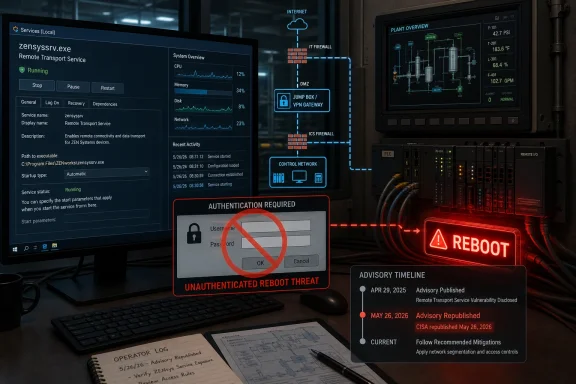
The Vulnerability Is Small; the Blast Radius Is Not
The uncomfortable detail in this advisory is not that ABB zenon has a flaw. Industrial software is software, and software accumulates sharp edges over long product lifetimes. The issue is that the vulnerable function sits in the operational plumbing: the Remote Transport Service, backed by the automatically started zensyssrv.exe system service in the default configuration.
According to the advisory, users are supposed to configure a password before using Remote Transport. The vulnerability breaks that expectation by allowing an unauthorized attacker to reach the reboot function without the required authentication. The result is not stolen credentials, altered recipes, or a shell on the engineering workstation. It is a remotely triggered operating system reboot.
That distinction matters, but it should not comfort anyone responsible for uptime. In enterprise IT, a reboot is an annoyance; in industrial control, it can be a line stop, a failed batch, a delayed alarm-handling workflow, or a maintenance window created by an adversary rather than a planner. Availability-only vulnerabilities often look modest on paper until they intersect with a plant schedule.
The CVSS 3.1 score of 7.5 lands this in “high” territory because the attack is network-accessible, low-complexity, requires no privileges, and needs no user interaction. Its impact is limited to availability, but the availability hit is rated high. That is the scoring system doing its job: it does not need confidentiality or integrity impact to tell operators that a reachable reboot primitive is serious.
CISA’s Republication Turns a Vendor Advisory Into an Operational Deadline
The chronology is easy to miss. ABB’s advisory dates back to August 12, 2025, while the CISA ICS advisory was republished on May 26, 2026. That gap does not necessarily mean the vulnerability suddenly became worse; it means the warning has entered a broader public channel used by asset owners, vulnerability-management teams, and regulators as a practical signal.
CISA also labels the advisory as a verbatim republication of ABB’s CSAF material. That is bureaucratic language, but it has consequences. It means security teams should treat ABB as the authority on product behavior and remediation specifics, while treating CISA’s publication as the distribution mechanism that makes the issue harder to ignore.
For WindowsForum readers, the Windows angle is not incidental. The named service, zensyssrv.exe, is a Windows executable associated with ABB zenon’s system service. The vulnerable condition therefore lives in the familiar territory of Windows service startup behavior, network exposure, local service management, and segmentation policy.
This is where many industrial advisories become actionable for ordinary Windows administrators. You may not own the process logic. You may not be allowed to patch the HMI image without validation. But you can usually inventory services, review firewall rules, restrict host-to-host reachability, and determine whether a service that starts automatically is actually needed.
“Remote” Does Not Mean “Internet-Scale,” and That Is the Point
ABB’s advisory includes an important limitation: remote exploitation is not feasible unless the attacker has already gained access to the network where the affected zenon system is deployed. That sentence will tempt some readers to downgrade the issue mentally. It should do the opposite.
Industrial networks are not supposed to be flat, porous, or casually reachable from corporate IT, but reality has been catching up with theory for years. Remote support jump boxes, VPN concentrators, domain trusts, shared engineering laptops, and misconfigured firewall rules can all turn “must already be on the network” into a much lower bar than defenders would like.
The advisory does not say an attacker can exploit this from the public internet in a typical deployment. It says that once the attacker is on the relevant network, authentication may not protect the reboot function. That makes the vulnerability particularly relevant to post-compromise scenarios, insider-risk models, and ransomware crews that already prize disruption over elegance.
There is also a subtle asymmetry here. An attacker does not need to understand the whole control process to cause harm with a reboot. They only need to know that a particular Windows host matters and that the vulnerable service is reachable. In many environments, that can be learned from hostnames, banners, shared documentation, network scans, or tribal naming conventions that were never designed to withstand hostile interpretation.
The Default Service Behavior Deserves More Scrutiny Than the CVE Number
The advisory’s most operationally useful sentence may be the one noting that, in the default configuration, the zensyssrv.exe service starts automatically. Automatic startup is convenient for engineering workflows. It is also how rarely used functionality becomes permanently exposed.
This is a recurring pattern in industrial software: tools built for trusted networks age into a world where trust is segmented, audited, and frequently violated. A remote transport feature may make sense for authorized deployment, project transfer, or maintenance activity. It does not follow that the supporting service should be available every hour of every day on every machine where the platform is installed.
The recommended workaround reflects that logic. If Remote Transport is not needed, stop or terminate the ABB zenon System Service. If it is needed only occasionally, stop it after authorized use. That is not a glamorous mitigation, but it is a practical one, and it fits the maintenance rhythms of many plants better than an emergency software upgrade.
The catch is governance. Somebody has to know which stations run zenon, which versions they run, whether Remote Transport is in use, who depends on it, and whether stopping the service breaks an accepted workflow. Without that asset knowledge, a clean workaround becomes another ticket in a queue.
A Reboot Bug Can Be a Denial-of-Service Tool in Work Boots
Security teams sometimes divide vulnerabilities into exciting and boring categories. Remote code execution is exciting. Credential theft is exciting. Missing authentication for a reboot function sounds boring until the target is a supervisory machine that operators rely on to see, acknowledge, and coordinate the state of a process.
Availability is the foundational promise of industrial control systems. Confidentiality matters, and integrity may matter even more, but uptime is the condition under which everything else becomes manageable. A forced reboot cuts across that promise in a way that is simple, visible, and disruptive.
The advisory does not claim that the vulnerability can damage physical equipment by itself. That distinction is important. A reboot is not automatically a safety event, and ABB notes no evidence of active exploitation at the time of writing.
Still, defenders should resist the urge to model only the best case. If a reboot happens during a quiet maintenance period, it may be a nuisance. If it happens during an operator response, a handoff, a constrained production run, or an unrelated incident, it can become part of a chain of failures. Industrial risk rarely arrives as a single spectacular exploit; more often, it stacks ordinary disruptions until the process loses resilience.
The Affected Version Range Is a Long Tail Problem
ABB lists ABB Ability zenon versions from 7.50 through 14 as affected. That range matters because industrial software versions tend to persist for years. Plants do not refresh HMI and SCADA environments on the same cadence as browsers, collaboration apps, or even server operating systems.
The result is a long tail of installations that may be perfectly stable from an operational perspective and uncomfortably stale from a security perspective. Version 14 being included also prevents the common assumption that only old deployments are exposed. This is not merely a forgotten legacy branch limping along in a corner of the network.
For asset owners, the version span turns the question from “Are we outdated?” into “Do we run zenon at all, and where?” That is a harder question in large organizations than it should be. Engineering workstations, runtime servers, archived project machines, training systems, and vendor-maintained boxes may all fall outside normal enterprise software inventory.
Windows administrators can contribute materially here. Endpoint management, service inventory, process telemetry, network flow logs, and vulnerability scanners may not understand every nuance of industrial operations, but they can identify where zensyssrv.exe exists and whether it listens or communicates on networks it should never touch.
Segmentation Is the Real Patch When the Function Must Remain
The published workaround begins with network restriction, and that is the right order. Control system hosts should not be broadly reachable, and systems with ABB zenon installed should be protected by access controls that limit who can talk to them. The advisory’s recommended posture is not novel, but the CVE gives teams a concrete reason to test whether the posture is real.
Segmentation is often described at the architecture level: firewalls between business and control networks, jump hosts for remote access, VPNs for authorized support, and isolation of remote devices. Those controls are necessary, but they are not sufficient if they remain diagrams rather than enforced paths.
This vulnerability asks a more specific question: from which machines can an unauthenticated actor reach the Remote Transport Service on a zenon host? If the answer is “most of the engineering VLAN,” that is a finding. If the answer includes corporate desktops, vendor laptops, or general-purpose IT subnets, that is worse.
VPN language in ICS advisories is also worth reading carefully. A VPN is not a magic shield; it is a controlled doorway. If the devices behind that doorway are unmanaged, compromised, shared, or running broad network access once connected, the VPN can become a liability wrapped in compliance vocabulary. The safer model is narrow access, current VPN software, monitored sessions, and explicit rules that allow only the systems and services required for the task.
Windows Shops Should Treat This as a Service-Exposure Audit
For Windows-heavy organizations, the most useful response is not panic patching. It is a service-exposure audit. The service name is known, the affected product range is known, and the vulnerable function is tied to a specific remote capability.
Start with discovery. Identify systems with ABB Ability zenon installed, paying particular attention to engineering workstations, runtime servers, operator stations, and test or staging systems that may be connected more casually than production hosts. Then determine which versions are deployed and whether they fall from 7.50 through 14.
Next, validate service state. If zensyssrv.exe starts automatically, decide whether that is operationally required. If Remote Transport is used only during project deployment or maintenance, the default “always on” state may no longer be defensible.
Finally, check reachability rather than assuming topology. A firewall rule that looks narrow in a change record can be broad in practice, especially after years of exceptions. Network scans from representative subnets, combined with flow telemetry and host firewall policy review, can reveal whether this service is exposed beyond its intended administrative path.
The advantage of this approach is that it produces defensive value even if an official software update is pending, delayed, or constrained by validation. Reducing exposed services and tightening network paths are durable improvements. They help with this CVE, and they help with the next one.
The Missing Patch Detail Is Not an Excuse for Inaction
The advisory text provided to CISA emphasizes workarounds rather than a simple “upgrade to version X” fix. That leaves administrators in a familiar industrial bind: the risk is real, but the remediation path may not be a one-click update. In production environments, even when a vendor fix exists, deployment is often mediated by test cycles, maintenance windows, vendor contracts, and safety assessments.
That is why the workaround language matters. Restrict network access. Assess whether Remote Transport is necessary. Stop or terminate the ABB zenon System Service when the function is not in use. These are not substitutes for vendor remediation forever, but they are legitimate controls when immediate replacement or patching is not practical.
The key is to avoid confusing a workaround with a memo. A workaround only works if it is implemented, verified, and monitored. If the service is stopped today but restarts automatically after a reboot, the mitigation may evaporate at precisely the wrong moment. If a firewall rule is added but an alternate path remains open through a jump host, the exposure persists.
Change management should therefore capture not only the intended control but also the persistence mechanism. Is the service startup type changed? Is host firewall policy enforced centrally? Are exceptions logged? Are operations teams told what may break when Remote Transport is disabled? These mundane details are where advisory response becomes security rather than theater.
No Known Exploitation Is Reassuring, Not Exculpatory
ABB says there is no evidence, at the time of writing, that the vulnerability is being actively exploited in the wild. That is good news. It is not a reason to wait for the first incident report.
Public ICS advisories change attacker economics. They give defenders notice, but they also tell curious adversaries what class of function to examine and which product versions are worth testing. The vulnerability is described at a high level, not as a weaponized exploit, but “missing authentication for a critical function” is not an obscure hint.
The absence of known exploitation also has a measurement problem. Industrial environments are not uniformly instrumented for early detection. A reboot may be logged as an operational hiccup, a Windows event, a service restart, or a nuisance call to the help desk rather than as a suspicious remote action. Unless teams correlate service access, network source, and reboot timing, exploitation could be easy to miss.
That does not mean defenders should assume compromise. It means they should improve observability around the affected hosts. Log service control events, monitor unexpected reboots, review access to zenon systems from unusual sources, and treat repeated or unexplained restarts as security-relevant until proven otherwise.
The Lesson Is Bigger Than One ABB Service
The broader lesson is that industrial software often exposes functions that are perfectly legitimate in the hands of authorized engineers and dangerous when authentication or network boundaries fail. Remote transport, remote management, project deployment, and service control are not optional conveniences in modern operations. They are also high-value abuse paths.
This is where the old perimeter story falls apart. If a function is unauthenticated, the network becomes the authentication layer. That may have been acceptable in isolated designs, but it is brittle in mixed IT/OT environments where remote access, vendor support, and data integration are business requirements.
Modern defense has to assume that internal reachability is a privilege, not a default. Engineering networks should be treated as sensitive zones with their own identity, logging, segmentation, and service allowlists. The goal is not to make industrial environments impossible to administer. It is to ensure that administrative convenience does not quietly become unauthenticated operational control.
ABB’s advisory is therefore less a spectacular emergency than a useful x-ray. It shows where a trusted operational feature can become a denial-of-service lever. It also shows why security work in industrial Windows environments is often about constraining ordinary services, not chasing cinematic malware.
The Reboot Button Belongs Behind More Than a Password
The practical path from this advisory is narrow but clear.
- Organizations should identify every ABB Ability zenon deployment and confirm whether it falls within versions 7.50 through 14.
- Administrators should determine whether the ABB zenon Remote Transport function is actually required on each affected host.
- Systems that do not need Remote Transport should have the ABB zenon System Service stopped or disabled according to operational change-control requirements.
- Networks should be tested to confirm that zenon systems are reachable only from approved administrative hosts and not from broad corporate or vendor-access segments.
- Unexpected reboots of zenon hosts should be investigated as security events, especially when they coincide with unusual network connections or remote access sessions.
- Any long-term remediation plan should separate emergency exposure reduction from later vendor-guided patching or upgrade work.
The significance of CVE-2025-8754 is not that it gives attackers everything. It gives them one thing that industrial operators care deeply about: the ability to make a system stop and start on someone else’s schedule. If defenders use this advisory to narrow service exposure, validate segmentation, and retire always-on remote functions that nobody really needs, the episode can become more than another CVE in the queue; it can become a small but concrete correction to the way Windows-based control environments are defended.
References
- ABB AbilityTM Zenon Remote Transport Vulnerability CISA · 2026-05-26T12:00:00+00:00