

Google’s CVE-2026-11010 is a Chrome-on-Android WebShare use-after-free flaw disclosed on June 4, 2026, fixed before version 149.0.7827.53, and scored by CISA’s ADP process as a high-severity issue despite Chromium’s own “Medium” label. The oddity is not merely the mismatch between severity labels. It is that NVD’s configuration data appears to describe Chrome plus Android as a combined affected platform, while the underlying bug is specifically in Chrome on Android. That distinction matters because vulnerability databases are no longer passive indexes; they are now inputs into patch automation, exposure management, compliance dashboards, and executive risk reports.
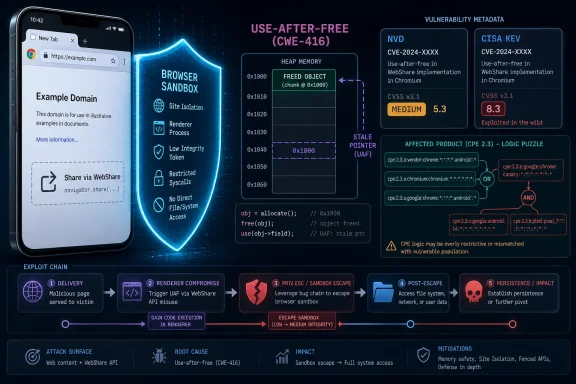
CVE-2026-11010 is not a garden-variety “visit a bad website and immediately lose the device” bug. The description says the attacker first needs a compromised renderer process, then can potentially use a crafted HTML page to escape the Chrome sandbox through a use-after-free in WebShare. That makes it a chained-exploitation vulnerability, not a standalone magic key.
That caveat is important, but it should not make administrators shrug. Modern browser exploitation is often a sequence of smaller wins: first a renderer compromise, then a sandbox escape, then persistence or data access through some additional weakness. A bug that only becomes dangerous after a renderer compromise can still be highly valuable in the exploit market because it turns a contained compromise into something closer to device-level impact.
The WebShare angle also deserves attention because it sits in the part of the browser that mediates between web content and native platform behavior. Web APIs increasingly blur the line between “website” and “app,” especially on mobile. The more a browser brokers access to device-native workflows, the more valuable memory-safety bugs in those brokers become.
Google’s severity label of “Medium” reflects Chromium’s internal assessment of the bug in context. CISA’s ADP CVSS 3.1 score of 8.3, however, reflects a different framing: network attack vector, no privileges required, user interaction required, high complexity, changed scope, and high impact across confidentiality, integrity, and availability. Both can be defensible, but they tell different audiences different things.
The configuration reportedly uses an AND relationship containing two OR branches: Google Chrome versions below 149.0.7827.53 and Google Android with version “-”. In plain English, that means “Chrome below the fixed version, when running on Android.” That is a common way to express platform-specific application exposure when the vulnerable product is an app but the vulnerability only applies on a particular operating system.
The problem is that this encoding can be misread by tools and humans alike. A scanner or dashboard that flattens CPE data may present Android itself as vulnerable, when the CVE description is about Chrome on Android. Another tool may see only the Chrome CPE and mark desktop Chrome as exposed, despite the description narrowing the flaw to Android. A third may fail to match mobile Chrome inventory at all if it expects a more explicit Android package identifier.
This is the perennial weakness of CPE: it is good at naming products, weaker at modeling how software actually ships. Chrome on Android is not the same operational object as Chrome on Windows, Chrome on Linux, Chromium in Debian, WebView embedded in an OEM build, or a managed browser distributed through enterprise mobility tooling. CPE tries to compress that world into product strings and Boolean logic.
So, yes, there is a reasonable argument that the entry would benefit from clearer affected-platform modeling. But no, the obvious fix is not necessarily “add Android as a standalone vulnerable product.” That would risk making the data less accurate, not more.
That matters because CVE-2026-11010’s fixed version is 149.0.7827.53. On desktop, Chrome 149’s stable promotion was visible through the familiar Chrome release cadence for Windows, macOS, and Linux. On Android, the release relationship is more indirect: Android releases often contain the same security fixes as the corresponding desktop releases unless Google says otherwise, but actual device exposure depends on whether the Android Chrome app has received and installed the update.
For a WindowsForum audience, this may sound like somebody else’s problem. It is not. Many Microsoft shops manage Android devices through Intune, allow Chrome as a work-profile browser, publish web apps that assume Chrome behavior, or rely on Google account sync across desktop and mobile. A sandbox escape in mobile Chrome may not compromise a Windows endpoint, but it can compromise the same user’s identity perimeter.
That is the modern browser reality. The browser is not an app at the edge of the enterprise anymore; it is one of the enterprise’s identity clients, document viewers, password vaults, collaboration surfaces, and application runtimes. On mobile, that concentration is even more pronounced.
Chromium’s “Medium” label tells us Google did not rank CVE-2026-11010 among the most urgent standalone browser bugs in the release. The CISA-ADP score of 8.3 tells us that if the precondition is met — a renderer process has already been compromised — the consequences can be severe. The real risk lives in the gap between those two statements.
A renderer compromise is not exotic in browser security. Chrome’s architecture is explicitly designed around the assumption that renderer bugs happen, which is why the sandbox exists. A sandbox escape is dangerous precisely because it attacks the containment layer that makes renderer bugs survivable.
The phrase “attacker who had compromised the renderer process” should therefore be read less like a dismissal and more like a chain marker. It says CVE-2026-11010 is probably not step one. It may be step two.
That is why patch prioritization based only on vendor severity can be misleading. A medium-rated sandbox escape can matter more than a high-rated bug in a less reachable component, depending on whether exploit developers can pair it with another issue. Browser patching is about reducing chainability, not just closing isolated defects.
Browsers are fertile ground for this class of bug because they are enormous, asynchronous, multi-process systems. They parse untrusted content, expose complicated APIs, juggle permissions, coordinate with native operating-system services, and handle objects whose lifetimes may be affected by user gestures, page navigation, garbage collection, or IPC messages. The WebShare API sits in exactly the kind of boundary zone where lifetime mistakes can become security bugs.
Google and the broader Chromium ecosystem have spent years investing in mitigations, fuzzing, sandboxing, process isolation, and memory-safety improvements. Those efforts have made exploitation harder. They have not made memory-unsafe browser code disappear.
That is the uncomfortable truth behind Chrome’s frequent security updates. The browser is better defended than it used to be, but it is also more important, more complex, and more deeply integrated with the operating system and user account. A memory bug in the browser is rarely “just a browser bug” anymore.
For the first few days of a CVE’s life, organizations may be making decisions from partial records. The vendor description exists. CVSS may or may not exist. CPE data may not yet be analyzed. References may be sparse. Exploit status may be unknown. Meanwhile, patch-management systems, threat-intelligence feeds, and security dashboards are already ingesting the record.
This is why the “missing CPE” question is more than pedantry. CPE data is the bridge between a sentence in a CVE description and an asset inventory. If the bridge is late, too broad, too narrow, or semantically confusing, organizations can either miss exposure or waste time chasing false positives.
NVD’s later addition of the AND configuration is an attempt to express the platform condition. But the need for a human to ask whether something is missing shows the weakness of the format. It is machine-readable, but not always machine-obvious.
This is not unusual, but it is annoying for defenders. A desktop release post can be the canonical vendor advisory for a vulnerability that affects Android Chrome. The result is a paper trail that looks cross-platform even when the actual vulnerable configuration is narrower.
For Windows administrators, that creates two failure modes. One team may overreact and treat every Chrome desktop install as vulnerable to this specific CVE, even if the affected surface is Android-only. Another team may underreact because the advisory page they see looks like a desktop release and the affected devices are mobile.
The right approach is to read the CVE description, the affected version, and the configuration logic together. CVE-2026-11010 is best understood as a Chrome vulnerability fixed in the Chrome 149 line, with the described affected surface being Android prior to 149.0.7827.53.
Chromium is upstream. Google Chrome is Google’s branded browser. Debian’s Chromium packages are downstream builds with their own versions, backports, security support windows, and end-of-life constraints. Android Chrome is yet another distribution channel. A single CVE identifier must travel across all of that.
This is where CPE can become misleading. The vulnerable code may exist upstream, the exploitability may be platform-specific, and the fixed version may appear in multiple downstream packages on different schedules. A Linux package tracker may mark Chromium as vulnerable because the codebase is affected, even if the original CVE prose emphasizes Android behavior. That does not necessarily contradict the Android-specific description; it may reflect downstream caution or code-level inclusion.
Security teams should avoid treating any one database as omniscient. NVD, vendor advisories, distribution trackers, and EDR vulnerability modules all see the same event through different operational lenses. The most accurate picture usually emerges from comparing them.
The browser is one of the few applications that follows users across all of those environments. Password managers, sync state, SSO cookies, conditional-access flows, device trust signals, and web app sessions all intersect there. A mobile browser escape can become an identity incident even if no Windows workstation is directly exploited.
This is especially relevant for organizations that still think of mobile security as an MDM checkbox. If Chrome updates are not enforced, if stale Android devices remain enrolled, or if personal devices are allowed into corporate apps with minimal posture checks, then a mobile browser flaw becomes a corporate exposure path.
The fix is not panic. It is inventory discipline. Know which Android devices can access corporate resources, know which browser versions they are running, and know whether conditional access actually blocks stale or unmanaged browser clients.
A more explicit platform or package representation would help, but CPE has limited vocabulary for mobile app distribution. Ideally, vulnerability data would distinguish the affected product, affected platform, package ecosystem, update channel, and exploitability conditions without forcing all of that into legacy product identifiers. That is not how most CVE consumption works today.
Administrators should therefore validate exposure using actual Chrome version telemetry rather than relying only on CPE matching. If an Android device has Chrome below 149.0.7827.53, it should be treated as exposed to the described issue. If a desktop Chrome install is below that version, it may still need updating for the broader Chrome 149 security release, but CVE-2026-11010’s published description is not enough by itself to claim that desktop Chrome is affected by this WebShare sandbox escape path.
That distinction matters in reporting. Saying “Chrome before 149.0.7827.53 is vulnerable everywhere” is overbroad for this CVE. Saying “only Android matters and desktop can wait” may also be dangerous if the same release includes many other security fixes. The accurate statement is narrower and more useful: this CVE describes a Chrome-on-Android WebShare use-after-free fixed before 149.0.7827.53, while the surrounding Chrome milestone contains additional fixes that may affect other platforms.
Enterprise Chrome management has long encouraged staged rollout, testing, and channel discipline. That remains sensible. But security teams need a fast lane for browser fixes because the browser has become too exposed and too chainable to treat like ordinary productivity software.
The June 2026 Chrome 149 release line also appears in a noisy context, with additional Chrome vulnerabilities and later advisories landing within days. That cadence is not an anomaly; it is the normal pressure of maintaining a dominant browser. Attackers watch these release notes too, and they understand that reverse-engineering patches can reveal vulnerable code paths before every endpoint has updated.
For admins, the hardest part is not clicking “update.” It is proving that update actually happened across desktops, mobile devices, VDI images, kiosks, unmanaged BYOD, and stale secondary devices. CVE-2026-11010 is a reminder that the asset you forgot to count may be the browser somebody uses every day.
 The Browser Bug Is Narrower Than the Risk Signal Around It
CVE-2026-11010 is not a garden-variety “visit a bad website and immediately lose the device” bug. The description says the attacker first needs a compromised renderer process, then can potentially use a crafted HTML page to escape the Chrome sandbox through a use-after-free in WebShare. That makes it a chained-exploitation vulnerability, not a standalone magic key.That caveat is important, but it should not make administrators shrug. Modern browser exploitation is often a sequence of smaller wins: first a renderer compromise, then a sandbox escape, then persistence or data access through some additional weakness. A bug that only becomes dangerous after a renderer compromise can still be highly valuable in the exploit market because it turns a contained compromise into something closer to device-level impact.
The WebShare angle also deserves attention because it sits in the part of the browser that mediates between web content and native platform behavior. Web APIs increasingly blur the line between “website” and “app,” especially on mobile. The more a browser brokers access to device-native workflows, the more valuable memory-safety bugs in those brokers become.
Google’s severity label of “Medium” reflects Chromium’s internal assessment of the bug in context. CISA’s ADP CVSS 3.1 score of 8.3, however, reflects a different framing: network attack vector, no privileges required, user interaction required, high complexity, changed scope, and high impact across confidentiality, integrity, and availability. Both can be defensible, but they tell different audiences different things.
The CPE Is Doing Too Much Work
The user-facing concern here is simple: are we missing a CPE? The better answer is that the CPE configuration shown by NVD appears to be structurally awkward rather than simply absent.The configuration reportedly uses an AND relationship containing two OR branches: Google Chrome versions below 149.0.7827.53 and Google Android with version “-”. In plain English, that means “Chrome below the fixed version, when running on Android.” That is a common way to express platform-specific application exposure when the vulnerable product is an app but the vulnerability only applies on a particular operating system.
The problem is that this encoding can be misread by tools and humans alike. A scanner or dashboard that flattens CPE data may present Android itself as vulnerable, when the CVE description is about Chrome on Android. Another tool may see only the Chrome CPE and mark desktop Chrome as exposed, despite the description narrowing the flaw to Android. A third may fail to match mobile Chrome inventory at all if it expects a more explicit Android package identifier.
This is the perennial weakness of CPE: it is good at naming products, weaker at modeling how software actually ships. Chrome on Android is not the same operational object as Chrome on Windows, Chrome on Linux, Chromium in Debian, WebView embedded in an OEM build, or a managed browser distributed through enterprise mobility tooling. CPE tries to compress that world into product strings and Boolean logic.
So, yes, there is a reasonable argument that the entry would benefit from clearer affected-platform modeling. But no, the obvious fix is not necessarily “add Android as a standalone vulnerable product.” That would risk making the data less accurate, not more.
Chrome on Android Is Not Just “Chrome, But Smaller”
Desktop administrators tend to think of Chrome as a browser package with a version number, an update channel, and a management template. Android changes the operational picture. Chrome may be updated through Google Play, tied to device policy, affected by OEM behavior, constrained by enterprise mobility controls, or replaced in practice by a managed browser profile.That matters because CVE-2026-11010’s fixed version is 149.0.7827.53. On desktop, Chrome 149’s stable promotion was visible through the familiar Chrome release cadence for Windows, macOS, and Linux. On Android, the release relationship is more indirect: Android releases often contain the same security fixes as the corresponding desktop releases unless Google says otherwise, but actual device exposure depends on whether the Android Chrome app has received and installed the update.
For a WindowsForum audience, this may sound like somebody else’s problem. It is not. Many Microsoft shops manage Android devices through Intune, allow Chrome as a work-profile browser, publish web apps that assume Chrome behavior, or rely on Google account sync across desktop and mobile. A sandbox escape in mobile Chrome may not compromise a Windows endpoint, but it can compromise the same user’s identity perimeter.
That is the modern browser reality. The browser is not an app at the edge of the enterprise anymore; it is one of the enterprise’s identity clients, document viewers, password vaults, collaboration surfaces, and application runtimes. On mobile, that concentration is even more pronounced.
The “Medium” Label Hides the Shape of the Attack
Severity labels are supposed to simplify risk. In cases like this, they can obscure it.Chromium’s “Medium” label tells us Google did not rank CVE-2026-11010 among the most urgent standalone browser bugs in the release. The CISA-ADP score of 8.3 tells us that if the precondition is met — a renderer process has already been compromised — the consequences can be severe. The real risk lives in the gap between those two statements.
A renderer compromise is not exotic in browser security. Chrome’s architecture is explicitly designed around the assumption that renderer bugs happen, which is why the sandbox exists. A sandbox escape is dangerous precisely because it attacks the containment layer that makes renderer bugs survivable.
The phrase “attacker who had compromised the renderer process” should therefore be read less like a dismissal and more like a chain marker. It says CVE-2026-11010 is probably not step one. It may be step two.
That is why patch prioritization based only on vendor severity can be misleading. A medium-rated sandbox escape can matter more than a high-rated bug in a less reachable component, depending on whether exploit developers can pair it with another issue. Browser patching is about reducing chainability, not just closing isolated defects.
Use-After-Free Still Refuses to Leave the Browser
CVE-2026-11010 is classified as CWE-416, use after free. That is one of the oldest and most stubborn classes of memory corruption in complex C and C++ software. The concept is straightforward: software frees memory, then later continues to use a stale reference to it. The exploitation details are anything but straightforward.Browsers are fertile ground for this class of bug because they are enormous, asynchronous, multi-process systems. They parse untrusted content, expose complicated APIs, juggle permissions, coordinate with native operating-system services, and handle objects whose lifetimes may be affected by user gestures, page navigation, garbage collection, or IPC messages. The WebShare API sits in exactly the kind of boundary zone where lifetime mistakes can become security bugs.
Google and the broader Chromium ecosystem have spent years investing in mitigations, fuzzing, sandboxing, process isolation, and memory-safety improvements. Those efforts have made exploitation harder. They have not made memory-unsafe browser code disappear.
That is the uncomfortable truth behind Chrome’s frequent security updates. The browser is better defended than it used to be, but it is also more important, more complex, and more deeply integrated with the operating system and user account. A memory bug in the browser is rarely “just a browser bug” anymore.
NVD’s Change Log Tells a Small Story About a Bigger System
The CVE timeline is compact. Chrome submitted the CVE on June 4, 2026. CISA-ADP added a CVSS 3.1 vector on June 6. NIST’s later analysis added a CPE configuration and references on June 8. That is a normal enrichment flow, but it also shows why early vulnerability data often looks unfinished.For the first few days of a CVE’s life, organizations may be making decisions from partial records. The vendor description exists. CVSS may or may not exist. CPE data may not yet be analyzed. References may be sparse. Exploit status may be unknown. Meanwhile, patch-management systems, threat-intelligence feeds, and security dashboards are already ingesting the record.
This is why the “missing CPE” question is more than pedantry. CPE data is the bridge between a sentence in a CVE description and an asset inventory. If the bridge is late, too broad, too narrow, or semantically confusing, organizations can either miss exposure or waste time chasing false positives.
NVD’s later addition of the AND configuration is an attempt to express the platform condition. But the need for a human to ask whether something is missing shows the weakness of the format. It is machine-readable, but not always machine-obvious.
Desktop Release Notes Can Still Matter for a Mobile Bug
One oddity in the record is the reference to a Chrome stable-channel desktop release note. That can look wrong at first glance because the CVE description says Chrome on Android. In practice, Chrome security fixes are often announced through release posts that cover the milestone broadly, while Android-specific publication and rollout details may be less prominent.This is not unusual, but it is annoying for defenders. A desktop release post can be the canonical vendor advisory for a vulnerability that affects Android Chrome. The result is a paper trail that looks cross-platform even when the actual vulnerable configuration is narrower.
For Windows administrators, that creates two failure modes. One team may overreact and treat every Chrome desktop install as vulnerable to this specific CVE, even if the affected surface is Android-only. Another team may underreact because the advisory page they see looks like a desktop release and the affected devices are mobile.
The right approach is to read the CVE description, the affected version, and the configuration logic together. CVE-2026-11010 is best understood as a Chrome vulnerability fixed in the Chrome 149 line, with the described affected surface being Android prior to 149.0.7827.53.
The Debian Tracker Shows Why Ecosystem Mirrors Complicate the Picture
Debian’s security tracker lists Chromium package status for CVE-2026-11010, including vulnerable and fixed package versions in Debian releases. That is useful for Linux administrators, but it also illustrates how quickly a Chrome CVE becomes an ecosystem-wide metadata problem.Chromium is upstream. Google Chrome is Google’s branded browser. Debian’s Chromium packages are downstream builds with their own versions, backports, security support windows, and end-of-life constraints. Android Chrome is yet another distribution channel. A single CVE identifier must travel across all of that.
This is where CPE can become misleading. The vulnerable code may exist upstream, the exploitability may be platform-specific, and the fixed version may appear in multiple downstream packages on different schedules. A Linux package tracker may mark Chromium as vulnerable because the codebase is affected, even if the original CVE prose emphasizes Android behavior. That does not necessarily contradict the Android-specific description; it may reflect downstream caution or code-level inclusion.
Security teams should avoid treating any one database as omniscient. NVD, vendor advisories, distribution trackers, and EDR vulnerability modules all see the same event through different operational lenses. The most accurate picture usually emerges from comparing them.
Windows Shops Should Care Because Browser Policy Crosses Device Boundaries
A Windows-centric organization might be tempted to file CVE-2026-11010 under “Android only” and move on. That would be tidy, but modern endpoint management is not tidy. The same workforce that signs into Entra ID on Windows laptops may also access corporate SaaS from Android phones, personal tablets, contractor devices, or managed work profiles.The browser is one of the few applications that follows users across all of those environments. Password managers, sync state, SSO cookies, conditional-access flows, device trust signals, and web app sessions all intersect there. A mobile browser escape can become an identity incident even if no Windows workstation is directly exploited.
This is especially relevant for organizations that still think of mobile security as an MDM checkbox. If Chrome updates are not enforced, if stale Android devices remain enrolled, or if personal devices are allowed into corporate apps with minimal posture checks, then a mobile browser flaw becomes a corporate exposure path.
The fix is not panic. It is inventory discipline. Know which Android devices can access corporate resources, know which browser versions they are running, and know whether conditional access actually blocks stale or unmanaged browser clients.
The CPE Question Has a Practical Answer
If the question is “are we missing a CPE here,” the practical answer is: probably not in the simple sense, but the current modeling may still be insufficient for some consumers. A Chrome application CPE combined with an Android operating-system CPE is a reasonable way to express “Chrome on Android.” The risk is that some tools may not interpret the AND condition correctly.A more explicit platform or package representation would help, but CPE has limited vocabulary for mobile app distribution. Ideally, vulnerability data would distinguish the affected product, affected platform, package ecosystem, update channel, and exploitability conditions without forcing all of that into legacy product identifiers. That is not how most CVE consumption works today.
Administrators should therefore validate exposure using actual Chrome version telemetry rather than relying only on CPE matching. If an Android device has Chrome below 149.0.7827.53, it should be treated as exposed to the described issue. If a desktop Chrome install is below that version, it may still need updating for the broader Chrome 149 security release, but CVE-2026-11010’s published description is not enough by itself to claim that desktop Chrome is affected by this WebShare sandbox escape path.
That distinction matters in reporting. Saying “Chrome before 149.0.7827.53 is vulnerable everywhere” is overbroad for this CVE. Saying “only Android matters and desktop can wait” may also be dangerous if the same release includes many other security fixes. The accurate statement is narrower and more useful: this CVE describes a Chrome-on-Android WebShare use-after-free fixed before 149.0.7827.53, while the surrounding Chrome milestone contains additional fixes that may affect other platforms.
Patch Management Needs to Track the Chain, Not the Label
The correct remediation is not subtle: update Chrome on Android to 149.0.7827.53 or later. But the operational lesson is broader. Browser updates should not wait for perfect CVE enrichment, especially when the bug class involves memory corruption and sandbox boundaries.Enterprise Chrome management has long encouraged staged rollout, testing, and channel discipline. That remains sensible. But security teams need a fast lane for browser fixes because the browser has become too exposed and too chainable to treat like ordinary productivity software.
The June 2026 Chrome 149 release line also appears in a noisy context, with additional Chrome vulnerabilities and later advisories landing within days. That cadence is not an anomaly; it is the normal pressure of maintaining a dominant browser. Attackers watch these release notes too, and they understand that reverse-engineering patches can reveal vulnerable code paths before every endpoint has updated.
For admins, the hardest part is not clicking “update.” It is proving that update actually happened across desktops, mobile devices, VDI images, kiosks, unmanaged BYOD, and stale secondary devices. CVE-2026-11010 is a reminder that the asset you forgot to count may be the browser somebody uses every day.
The Real Lesson Is in the Metadata, Not the Memory Bug
The most concrete lesson from CVE-2026-11010 is that vulnerability management is now as dependent on data modeling as it is on patch availability.- Organizations should treat Chrome on Android versions prior to 149.0.7827.53 as exposed to the WebShare use-after-free described in CVE-2026-11010.
- The NVD configuration appears to model the issue as Chrome below the fixed version running on Android, rather than Android itself being independently vulnerable.
- Security tools that flatten CPE logic may overstate or understate exposure, so teams should verify results against actual browser version telemetry.
- The “Medium” Chromium severity should not obscure the fact that a sandbox escape can be valuable when chained with a renderer compromise.
- Windows-focused teams should still review Android Chrome posture if those devices can access corporate identities, SaaS apps, email, or managed resources.
- Patch reporting should separate this Android-specific CVE from the broader Chrome 149 security update, which may contain fixes relevant to other platforms.
References
- Primary source: NVD / Chromium
Published: 2026-06-09T07:00:25-07:00
NVD - CVE-2026-11010
 nvd.nist.gov
- Security advisory: MSRC
Published: 2026-06-09T07:00:25-07:00
Original feed URL
Security Update Guide - Microsoft Security Response Center
 msrc.microsoft.com
- Related coverage: vulnerability.circl.lu
Vulnerability-Lookup
Vulnerability-Lookup - Fast vulnerability lookup correlation from different sources.vulnerability.circl.lu - Related coverage: vuldb.com
CVE-2026-11010 Google Chrome WebShare use after free (ID 496266 / EUVD-2026-34459)
A vulnerability has been found in Google Chrome on Android. This vulnerability is referenced as CVE-2026-11010. It is suggested to upgrade the affected component.vuldb.com
