

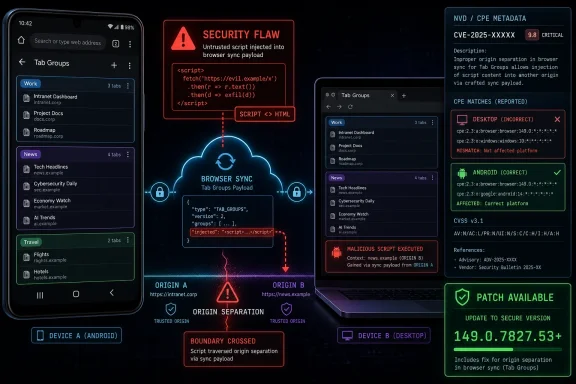
Google’s CVE-2026-11034 entry describes a medium-severity Chrome-on-Android flaw fixed before version 149.0.7827.53, where insufficient validation in Tab Group Sync could let a remote attacker inject script or HTML through malicious network traffic. The oddity is not the bug class; universal cross-site scripting in a sync-adjacent browser feature is exactly the sort of seam security teams watch. The oddity is the metadata: NVD’s configuration ties vulnerable Chrome versions to Android, yet the public vendor reference points at a desktop stable-channel post. That mismatch is why the CPE question matters.
CVE-2026-11034 is not presented as a generic Chromium engine bug. The description is explicit: “Google Chrome on Android prior to 149.0.7827.53” is the affected product, and the vulnerable component is Tab Group Sync. The attack scenario is also bounded: a remote attacker uses malicious network traffic, with user interaction required under the CISA ADP CVSS vector.
That makes this a browser-state and trust-boundary issue rather than a classic “visit a page, lose the machine” memory-corruption story. UXSS is still serious because it can collapse origin boundaries inside the browser, but the published severity lands at medium, with low confidentiality and integrity impact and no availability impact. In other words, this is not the Chrome zero-day that makes CISOs cancel lunch. It is the kind of flaw that becomes important because Chrome is now an identity, sync, and workflow substrate, not merely a renderer.
The metadata, however, muddies the clean product story. NVD’s initial analysis reportedly added a CPE configuration that combines Google Chrome versions before 149.0.7827.53 with Android as the operating system. That is a reasonable way to express “Chrome running on Android,” but it is not the same as identifying a dedicated Android Chrome application CPE. For vulnerability scanners, asset inventories, and risk dashboards, that distinction is more than clerical.
For CVE-2026-11034, the reported CPE pattern uses the Chrome application CPE with a version range capped before 149.0.7827.53, plus Android as the operating system. That expresses a relationship: vulnerable Chrome plus Android. The question is whether NVD should also carry a more specific CPE for Chrome for Android, if such a CPE exists and is consistently used in the dictionary.
This is where CVE metadata often falls short of how software actually ships. On Windows, macOS, and Linux, “Google Chrome” maps neatly enough to desktop binaries and enterprise update controls. On Android, Chrome may be preinstalled, Play Store-managed, OEM-mediated, or tied into WebView-adjacent platform behavior depending on device and policy. A single application CPE plus an OS CPE can be technically defensible while still leaving mobile device management teams wondering whether their tooling will match correctly.
The second answer is that something may still be missing from a practical asset-management standpoint. If an organization or scanner expects a mobile-specific Chrome CPE, or if its CPE matching engine does not gracefully handle NVD’s configuration tree, the finding may be suppressed or misclassified. That is especially plausible in environments where Android inventory is handled by MDM platforms while desktop Chrome is handled by endpoint management tools.
The NVD page’s own “Are we missing a CPE?” prompt is not evidence of an error by itself; it appears broadly across NVD entries as part of the enrichment workflow. But in this case the prompt lands on a real ambiguity: Chrome on Android is clearly the affected product, while the referenced release blog and CPE modeling may look desktop-oriented to anyone reading the page quickly.
The referenced Chromium issue is permission-restricted, which is also normal. Browser vendors commonly limit bug details until patches have propagated and downstream projects have had time to respond. The result is that defenders see just enough to act, but not enough to independently reconstruct the bug’s full reach.
That opacity puts more weight on the product strings. If the CVE says “Chrome on Android,” the safe operational reading is exactly that. Do not assume desktop Chrome is vulnerable to this specific UXSS simply because the vendor reference is a desktop stable-channel post. Conversely, do not ignore the CVE on Android fleets because the release note title says “Desktop.”
A sync feature must validate not just web content, but metadata that can later be rendered inside privileged browser UI. Titles, URLs, group names, favicons, annotations, sync payloads, and recovered state all become potential carriers for hostile input if they are not normalized and escaped correctly. That is why “insufficient validation of untrusted input” in a browser sync feature should make security engineers lean forward.
The UXSS label is particularly telling. Universal cross-site scripting implies the browser itself may be tricked into injecting script or HTML in a way that defeats normal origin separation. Even if exploitation requires user interaction and has only low rated confidentiality and integrity impact, the class of bug strikes at the browser’s central promise: that one site cannot impersonate or interfere with another merely by confusing the client.
User interaction is often misunderstood. It does not mean exploitation is hard; it means the victim must do something, such as browse, sync, open, accept, or otherwise trigger the vulnerable path. In consumer and mobile environments, user interaction is usually the easiest part of the kill chain.
The changed-scope marker is the piece defenders should notice. It suggests successful exploitation crosses a security boundary, which fits a UXSS-style issue. A medium score can still describe a bug that matters when chained with another weakness, paired with phishing, or used against high-value mobile users whose browser state is deeply connected to personal and work accounts.
That matters for CVE-2026-11034 because the affected product is mobile Chrome. A desktop patch dashboard showing Chrome 149.0.7827.53 or later does not prove the Android exposure is gone. The vulnerable population may be sitting in a separate MDM console, an EMM compliance report, or nowhere at all.
For enterprises, the practical question is not “did Google ship the patch?” but “can we prove the patched Android app is installed and launched?” Browser updates sometimes require app refresh, device connectivity, managed Play policy enforcement, or user action. In BYOD environments, even finding the answer can be politically and technically awkward.
None of those behaviors is automatically malicious or incompetent. They reflect different ways of translating messy vulnerability metadata into deployable checks. But the administrator receives the consequences: false positives on desktops, false negatives on phones, or an exception queue full of findings that need hand interpretation.
The correct remediation language should therefore be concrete. Chrome on Android should be updated to 149.0.7827.53 or later. Desktop Chrome should continue to follow the broader Chrome 149 stable-channel security updates, but CVE-2026-11034 itself should not be treated as proof of a desktop exposure unless later vendor data expands the affected platforms.
CVE-2026-11034 sits in that uncomfortable middle. The human-readable description is clear. The scoring is clear enough. The weakness classification, CWE-20, is unsurprising. The affected-version boundary is actionable. But the release reference and CPE modeling leave enough ambiguity to prompt exactly the question raised here: is there a missing CPE, or is the existing configuration merely inelegant?
The best answer is that defenders should not wait for perfect elegance. If your tooling depends on NVD CPEs, validate how it interprets the AND configuration. If your mobile fleet depends on MDM inventory, verify Chrome app versions directly. If your risk register distinguishes desktop and mobile Chrome, record this one as Android-specific unless Google or NVD later broadens the affected software list.
 The Vulnerability Is Android-Specific, but the Paper Trail Looks Desktop-First
CVE-2026-11034 is not presented as a generic Chromium engine bug. The description is explicit: “Google Chrome on Android prior to 149.0.7827.53” is the affected product, and the vulnerable component is Tab Group Sync. The attack scenario is also bounded: a remote attacker uses malicious network traffic, with user interaction required under the CISA ADP CVSS vector.That makes this a browser-state and trust-boundary issue rather than a classic “visit a page, lose the machine” memory-corruption story. UXSS is still serious because it can collapse origin boundaries inside the browser, but the published severity lands at medium, with low confidentiality and integrity impact and no availability impact. In other words, this is not the Chrome zero-day that makes CISOs cancel lunch. It is the kind of flaw that becomes important because Chrome is now an identity, sync, and workflow substrate, not merely a renderer.
The metadata, however, muddies the clean product story. NVD’s initial analysis reportedly added a CPE configuration that combines Google Chrome versions before 149.0.7827.53 with Android as the operating system. That is a reasonable way to express “Chrome running on Android,” but it is not the same as identifying a dedicated Android Chrome application CPE. For vulnerability scanners, asset inventories, and risk dashboards, that distinction is more than clerical.
CPEs Are Boring Until They Break Your Patch Metrics
Common Platform Enumeration is the plumbing of vulnerability management. It gives scanners and security platforms a structured way to say which product, vendor, version, edition, and platform are affected. When CPE data is precise, an administrator gets a useful finding. When it is vague, missing, or oddly modeled, the organization gets noise, silence, or both.For CVE-2026-11034, the reported CPE pattern uses the Chrome application CPE with a version range capped before 149.0.7827.53, plus Android as the operating system. That expresses a relationship: vulnerable Chrome plus Android. The question is whether NVD should also carry a more specific CPE for Chrome for Android, if such a CPE exists and is consistently used in the dictionary.
This is where CVE metadata often falls short of how software actually ships. On Windows, macOS, and Linux, “Google Chrome” maps neatly enough to desktop binaries and enterprise update controls. On Android, Chrome may be preinstalled, Play Store-managed, OEM-mediated, or tied into WebView-adjacent platform behavior depending on device and policy. A single application CPE plus an OS CPE can be technically defensible while still leaving mobile device management teams wondering whether their tooling will match correctly.
The Missing CPE Question Has Two Plausible Answers
The first answer is that nothing is “missing” in the strict NVD configuration sense. If the vulnerable configuration is modeled as Chrome versions before 149.0.7827.53 running on Android, then the AND relationship between the Chrome application CPE and the Android OS CPE is enough for machines that understand the configuration logic. A scanner that evaluates CPE applicability correctly should not flag desktop Chrome merely because the Chrome CPE appears; it should require the Android operating system condition too.The second answer is that something may still be missing from a practical asset-management standpoint. If an organization or scanner expects a mobile-specific Chrome CPE, or if its CPE matching engine does not gracefully handle NVD’s configuration tree, the finding may be suppressed or misclassified. That is especially plausible in environments where Android inventory is handled by MDM platforms while desktop Chrome is handled by endpoint management tools.
The NVD page’s own “Are we missing a CPE?” prompt is not evidence of an error by itself; it appears broadly across NVD entries as part of the enrichment workflow. But in this case the prompt lands on a real ambiguity: Chrome on Android is clearly the affected product, while the referenced release blog and CPE modeling may look desktop-oriented to anyone reading the page quickly.
Google’s Release Cadence Makes the Reference Trail Messier Than the Fix
Google’s Chrome release posts are not written for vulnerability database elegance. They are release notes first, security breadcrumbs second. The June 2026 stable-channel update moved desktop Chrome to 149.0.7827.53 or .54 depending on platform, and the same version boundary appears in CVE-2026-11034’s Android description. That reuse of version numbers is normal in Chromium-world, but it can make advisories look cross-platform even when a specific CVE is not.The referenced Chromium issue is permission-restricted, which is also normal. Browser vendors commonly limit bug details until patches have propagated and downstream projects have had time to respond. The result is that defenders see just enough to act, but not enough to independently reconstruct the bug’s full reach.
That opacity puts more weight on the product strings. If the CVE says “Chrome on Android,” the safe operational reading is exactly that. Do not assume desktop Chrome is vulnerable to this specific UXSS simply because the vendor reference is a desktop stable-channel post. Conversely, do not ignore the CVE on Android fleets because the release note title says “Desktop.”
Tab Group Sync Turns Convenience Into Attack Surface
Tab groups sound harmless, almost quaint: a way to herd browser clutter into labeled piles. Sync changes the security story. Once browser state moves between devices and accounts, it becomes input that crosses process, device, and trust boundaries.A sync feature must validate not just web content, but metadata that can later be rendered inside privileged browser UI. Titles, URLs, group names, favicons, annotations, sync payloads, and recovered state all become potential carriers for hostile input if they are not normalized and escaped correctly. That is why “insufficient validation of untrusted input” in a browser sync feature should make security engineers lean forward.
The UXSS label is particularly telling. Universal cross-site scripting implies the browser itself may be tricked into injecting script or HTML in a way that defeats normal origin separation. Even if exploitation requires user interaction and has only low rated confidentiality and integrity impact, the class of bug strikes at the browser’s central promise: that one site cannot impersonate or interfere with another merely by confusing the client.
Medium Severity Does Not Mean Optional Patching
The CISA ADP vector reportedly gives CVE-2026-11034 a CVSS 3.1 score of 6.1. The important parts are network attack vector, low attack complexity, no privileges required, user interaction required, and changed scope. That combination says the bug is not a local-only nuisance and not a post-auth administrative edge case.User interaction is often misunderstood. It does not mean exploitation is hard; it means the victim must do something, such as browse, sync, open, accept, or otherwise trigger the vulnerable path. In consumer and mobile environments, user interaction is usually the easiest part of the kill chain.
The changed-scope marker is the piece defenders should notice. It suggests successful exploitation crosses a security boundary, which fits a UXSS-style issue. A medium score can still describe a bug that matters when chained with another weakness, paired with phishing, or used against high-value mobile users whose browser state is deeply connected to personal and work accounts.
Android Fleets Need a Different Patch Conversation
On managed Windows endpoints, Chrome patching is usually a solved problem until it is not. Admins can use Chrome enterprise policies, software deployment tools, browser cloud management, and reporting to see who is behind. On Android, the answer depends on whether devices are corporate-owned, personally owned, fully managed, work-profile only, Play Store-controlled, OEM-controlled, or partially outside IT’s line of sight.That matters for CVE-2026-11034 because the affected product is mobile Chrome. A desktop patch dashboard showing Chrome 149.0.7827.53 or later does not prove the Android exposure is gone. The vulnerable population may be sitting in a separate MDM console, an EMM compliance report, or nowhere at all.
For enterprises, the practical question is not “did Google ship the patch?” but “can we prove the patched Android app is installed and launched?” Browser updates sometimes require app refresh, device connectivity, managed Play policy enforcement, or user action. In BYOD environments, even finding the answer can be politically and technically awkward.
Scanner Vendors May Disagree Before Administrators Do
This is the kind of CVE that can produce inconsistent scanner behavior. One product may flag Chrome installations broadly because it keys off the Chrome CPE and version range. Another may suppress findings unless Android is present. A third may rely on package inventory rather than CPE logic and look for the Android app version directly.None of those behaviors is automatically malicious or incompetent. They reflect different ways of translating messy vulnerability metadata into deployable checks. But the administrator receives the consequences: false positives on desktops, false negatives on phones, or an exception queue full of findings that need hand interpretation.
The correct remediation language should therefore be concrete. Chrome on Android should be updated to 149.0.7827.53 or later. Desktop Chrome should continue to follow the broader Chrome 149 stable-channel security updates, but CVE-2026-11034 itself should not be treated as proof of a desktop exposure unless later vendor data expands the affected platforms.
The Real Risk Is Metadata Drift Across the Chromium Ecosystem
Chromium is not one product. It is an upstream project, a Google browser, a mobile app, an embedded base for other browsers, and a component in many operating-system-adjacent workflows. CVE metadata tries to flatten that into structured fields. Sometimes the flattening works. Sometimes it produces a record that is technically understandable only if you already know the ecosystem.CVE-2026-11034 sits in that uncomfortable middle. The human-readable description is clear. The scoring is clear enough. The weakness classification, CWE-20, is unsurprising. The affected-version boundary is actionable. But the release reference and CPE modeling leave enough ambiguity to prompt exactly the question raised here: is there a missing CPE, or is the existing configuration merely inelegant?
The best answer is that defenders should not wait for perfect elegance. If your tooling depends on NVD CPEs, validate how it interprets the AND configuration. If your mobile fleet depends on MDM inventory, verify Chrome app versions directly. If your risk register distinguishes desktop and mobile Chrome, record this one as Android-specific unless Google or NVD later broadens the affected software list.
What the CPE Oddity Means for This Chrome Bug
The concrete lesson from CVE-2026-11034 is that vulnerability management still needs human review at the edges, especially where mobile apps, sync features, and browser release channels intersect. Treat the record as actionable, but do not let the desktop-looking reference override the Android-specific description.- CVE-2026-11034 affects Google Chrome on Android before version 149.0.7827.53, according to the published vulnerability description.
- The NVD configuration using Chrome plus Android may be sufficient logically, but it can still confuse tools that expect a more mobile-specific product match.
- The bug class is insufficient input validation in Tab Group Sync, with UXSS as the reported impact.
- The medium CVSS score should not be read as permission to defer patching on managed Android devices.
- Administrators should verify Android Chrome versions directly rather than relying only on desktop Chrome patch reports.
- Scanner discrepancies should be resolved against the affected-platform description first, then against vendor and NVD updates as they mature.
References
- Primary source: NVD / Chromium
Published: 2026-06-09T07:00:53-07:00
NVD - CVE-2026-11034
 nvd.nist.gov
- Security advisory: MSRC
Published: 2026-06-09T07:00:53-07:00
Original feed URL
Security Update Guide - Microsoft Security Response Center
 msrc.microsoft.com
- Related coverage: govcert.gov.hk
GovCERT.HK - Security Alert (A26-06-08): Multiple Vulnerabilities in Google Chrome
Security Alert (A26-06-08): Multiple Vulnerabilities in Google Chromewww.govcert.gov.hk
- Related coverage: radar.offseq.com
CVE-2026-11026: Insufficient policy enforcement in Google Chrome - Live Threat Intelligence - Threat Radar | OffSeq.com
Detailed information about CVE-2026-11026: Insufficient policy enforcement in Google Chrome affecting Google Chrome. Get real-time updates, technical details, aradar.offseq.com
