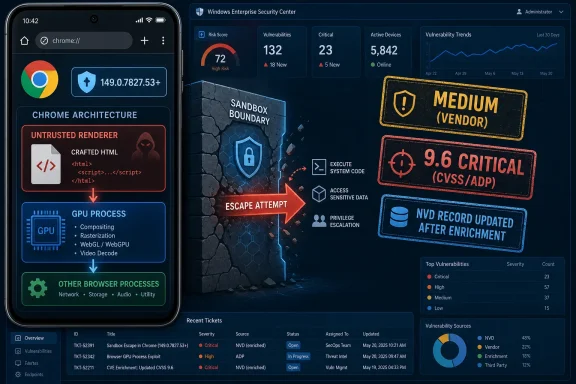
Google Chrome’s CVE-2026-11119 was published by NVD on June 4, 2026, and describes a Chrome-on-Android GPU flaw fixed before version 149.0.7827.53 that could let an attacker escape the browser sandbox after first compromising the renderer with a crafted HTML page. The record is messy in exactly the way modern vulnerability records often are: Chrome calls the bug “Medium,” CISA’s ADP scoring makes it look “Critical,” and NVD’s own enrichment now carries a warning that the record changed after analysis. That gap between vendor severity and database severity is not clerical noise. It is the real story for administrators trying to decide whether a mobile browser bug deserves desktop-style emergency handling.
The phrase “sandbox escape” tends to flatten the risk conversation because it sounds binary: either the attacker gets out, or they do not. In Chrome’s architecture, however, the sandbox is one of the walls between a compromised renderer and the rest of the device. A bug that requires renderer compromise is not a standalone door into the system, but it can become the second stage of a chain.
That appears to be the essential shape of CVE-2026-11119. The attacker needs a renderer process already under their control, and then the GPU issue may allow escape from the sandbox. That dependency matters, because it explains why Chromium can mark the vulnerability as Medium while external scoring systems can still produce a frightening CVSS number.
This is not a contradiction so much as a collision of scoring philosophies. Chrome’s internal severity is informed by exploitability in the browser’s actual defense model, the preconditions required, and what Google’s security team knows about the bug class. CVSS, especially when applied by external enrichment programs, often scores the outcome if the preconditions are met. If the end state is confidentiality, integrity, and availability compromise across a changed scope, the number can shoot upward.
For WindowsForum readers, the lesson is familiar from years of Patch Tuesday triage: severity labels are not interchangeable currencies. A “Medium” in a vendor advisory, a “Critical” in a vulnerability scanner, and “N/A” from NVD do not mean three different bugs exist. They mean three different systems are trying to describe the same bug from different angles.
Chrome’s sandbox model is built to survive malicious pages. The renderer handles untrusted web content under tight restrictions, while other browser processes mediate access to more sensitive capabilities. The GPU process complicates that clean separation because rendering is not just another library call; it depends on queues, command buffers, drivers, memory sharing, and platform-specific implementations.
That is why “inappropriate implementation in GPU” should not be read as a vague throwaway phrase. It is vendor shorthand for the kind of implementation flaw that may not be a classic memory corruption bug in the public description but still breaks an assumption at a security boundary. In this case, the public record also carries CWE-20, improper input validation, though the change history indicates the weakness mapping itself has been modified by CISA-ADP activity.
GPU bugs have long had an outsized role in browser exploit chains. They are attractive because they can turn a browser-only compromise into something with broader device impact. They are also frustrating for defenders because the relevant code may span Chromium, Android, hardware acceleration paths, graphics APIs, and vendor-specific behavior.
That distinction matters for Windows administrators who see Chrome CVEs flow into scanners and dashboards every day. A fleet vulnerability report that flags every Chrome installation across Windows, macOS, Linux, and Android for CVE-2026-11119 may be overbroad if it ignores the platform qualifier. Conversely, a mobile device management console that inventories Android Chrome but fails to connect it to this CVE may be underreporting the exact population that matters.
There is a catch, though. The referenced Chrome release blog is a desktop stable-channel update, while the CVE description specifically names Chrome on Android prior to 149.0.7827.53. That mismatch is the sort of packaging oddity that sends security teams chasing ghosts. It can happen because Chromium security fixes land in shared code, because release notes are reused or cross-linked, or because public references lag behind the most precise affected-platform data.
Administrators should therefore resist two bad shortcuts. The first is assuming that every Chromium-based browser on every OS is equally affected just because the component is Chromium GPU. The second is assuming Windows estates can ignore the issue entirely because the CVE text says Android. If your environment includes Android work profiles, managed Chrome on Android, kiosk devices, shared tablets, or bring-your-own-device access to corporate resources, the Android CPE is not academic.
But the CVE description itself says the attacker must already have compromised the renderer process. That is not a small detail. It means the bug is best understood as a sandbox-escape stage rather than the initial browser compromise.
In the real world, exploit chains are assembled from pieces. A malicious page may first use a renderer bug, a JavaScript engine bug, a type confusion issue, or a memory corruption flaw to gain code execution inside the renderer. Then it needs another vulnerability to escape the sandbox. CVE-2026-11119 appears to fit the second role.
That is why CVSS can look simultaneously accurate and misleading. If the attacker can deliver a crafted HTML page, win renderer compromise, and then exploit the GPU flaw, the impact can be severe. But if a scanner reduces all of that to “remote critical Chrome bug,” it erases the dependency chain that matters for triage.
This is where security teams need better language than “critical or not critical.” A more useful classification would be: chainable sandbox escape in Chrome GPU on Android, fixed before 149.0.7827.53, no NVD base score yet, CISA-ADP score critical, Chrome severity Medium. That sentence is uglier than a dashboard badge, but it is truer.
The change history shows why. The CVE arrived from Chrome on June 4 with the description, CWE-20, and references. CISA-ADP added a CVSS vector and CWE on June 6. NIST added the CPE configuration and reference types on June 8. Then CISA-ADP removed CWE-20 later that same day. The visible record still presents CWE-20 under the weakness enumeration, but the change history indicates the enrichment trail is not entirely settled.
That is exactly the kind of inconsistency that makes vulnerability operations harder than it looks from the outside. A security team may see one feed classify the weakness as improper input validation, another drop the CWE, and another vendor mirror preserve an older copy. None of those necessarily means the vulnerability is fictional or misreported; it means the metadata around it is still moving.
For organizations that rely heavily on CPE matching, the timing matters even more. If a scanner imported the CVE before the Android platform condition was added, it may have flagged the wrong estate. If it imported after the CPE update but before other corrections, it may have better product matching but stale weakness data. If it normalizes Chrome and Chromium packages across desktop and mobile, it may still need manual tuning.
The uncomfortable truth is that vulnerability records are no longer single authoritative cards. They are living documents stitched together from CNA submissions, vendor advisories, enrichment programs, scanners, mirrors, package maintainers, and threat-intelligence products. CVE-2026-11119 is a small case study in why blind automation can make a patch program look precise while quietly becoming less accurate.
That is why the “on Android” qualifier should change the response, not end it. The question for enterprise IT is not whether this bug affects Windows binaries directly. The question is whether Chrome on Android is part of the organization’s access perimeter.
If the answer is yes, the action moves from desktop patch management to mobile device management. Admins should confirm managed Android devices have Chrome at or above 149.0.7827.53, verify that Play Store updates are not being deferred by policy, and check whether work-profile browsers are controlled separately from personal-profile apps. In a BYOD environment, the best control may be conditional access that requires a minimum browser or OS version for sensitive resources.
There is also a browser-ecosystem angle. Many Android browsers depend on Chromium code, but the public CVE names Google Chrome on Android. That does not automatically prove every Chromium-derived Android browser is affected or patched on the same timeline. It does mean security teams should watch the advisories from any browser they allow for corporate access, especially if that browser embeds Chromium components or uses Android WebView in ways relevant to the vulnerable path.
For Windows admins, the operational muscle memory remains useful. Inventory first, patch second, validate third, and suppress false positives only after documenting why the asset is not affected. The platform may be Android, but the discipline is the same one used for Windows cumulative updates and Edge security releases.
Chrome’s stable-channel posts are designed to announce builds, fixes, and broad security work without disclosing exploit-enabling technical detail. CVE records, by contrast, are supposed to support vulnerability management. When the two are connected imperfectly, administrators inherit the ambiguity.
The timing compounds the confusion because Chrome 149 appears to be a large security release, and shortly afterward Google also issued additional Chrome security updates for a separate V8 issue reportedly exploited in the wild. In that kind of week, CVEs can blur together in patch tools and news summaries. One bug may be a medium-severity Android sandbox escape, another may be a high-severity desktop zero-day, and both may share adjacent version numbers.
This is where version precision becomes the difference between useful action and noise. CVE-2026-11119 points to Chrome on Android before 149.0.7827.53. Later desktop stable updates such as 149.0.7827.102 or 149.0.7827.103 may matter for other Chrome vulnerabilities, but they do not rewrite the specific affected-product statement for this one. Treating every Chrome 149 patch as interchangeable is how organizations end up both overpatching the wrong assets and underpatching the right ones.
The better approach is to separate the advisory stream into buckets. One bucket contains Chrome-on-Android exposure for CVE-2026-11119. Another contains desktop Chrome updates and any CVEs that explicitly apply to Windows, macOS, or Linux builds. A third contains Chromium-derived products and WebView dependencies that need vendor-specific confirmation.
A scanner that keys only on Chrome version less than 149.0.7827.53 may flag desktop Chrome even if the CPE condition says Android. A scanner that keys on package family may flag Linux Chromium distributions even when distro maintainers have not mapped the issue the same way. A scanner that keys on CVSS may escalate the ticket as Critical without preserving Chrome’s Medium severity or the renderer-compromise precondition.
None of this means scanners are useless. It means scanner results are claims, not verdicts. The more complex the product-platform relationship, the more important it is to inspect the evidence behind the finding.
For CVE-2026-11119, a defensible triage note should include the affected platform, the fixed version, the exploit precondition, and the scoring discrepancy. That gives patch teams enough context to act without turning every Chrome CVE into an all-hands incident. It also gives auditors a clear explanation for why some assets were patched, some were marked not applicable, and some were held pending vendor confirmation.
There is a cultural issue here as well. Organizations have spent years training teams to treat CVSS as a universal truth. CVE-2026-11119 is another reminder that CVSS is a useful severity lens, not a substitute for product knowledge. A 9.6 attached to a chainable sandbox escape is serious, but it is not the same operational event as a wormable unauthenticated service flaw sitting on a public Windows server.
This controlled disclosure model creates an information gap. Administrators get enough to patch but not enough to fully validate exploitability. Researchers get a breadcrumb trail but not necessarily immediate access to the bug report. Attackers, meanwhile, may reverse-engineer patches or diff source changes to infer the vulnerable path.
That gap is especially relevant for GPU bugs. The exploitability of a GPU flaw can depend on device class, driver behavior, Android version, hardware acceleration state, and mitigations that are hard to describe in a one-line CVE. A public advisory that says “crafted HTML page” may be accurate but wildly incomplete from an engineering standpoint.
The lack of detail should not be used as an excuse to delay patching. It should be used as a reason to avoid overclaiming. There is no public basis, from the supplied record, to say this CVE is being exploited in the wild. There is also no public basis to dismiss it as harmless merely because Chrome labeled it Medium. In browser security, chainable bugs are inventory problems before they are headline problems.
Chrome’s rapid release model assumes updates move quickly. That assumption often holds for consumer devices, but enterprise controls can slow things down. Managed Play policies, testing rings, app pinning, network constraints, and kiosk configurations can all leave devices behind even when the fix is available.
This is particularly dangerous for mobile browsers because they are often treated as less manageable than desktop endpoints while carrying equal or greater access to corporate identity. A compromised mobile browser session can interact with email, documents, admin portals, chat history, and authentication flows. The browser may be on a phone, but the blast radius lives in the cloud.
The right response is not panic. It is boring operational hygiene done quickly: find affected Android Chrome installations, update them, and verify that the update actually landed. If your organization cannot answer those questions, the CVE has revealed a more durable problem than the GPU bug itself.
That is a harder challenge than simply clicking “remediate.” It requires asset data that distinguishes Chrome on Android from Chrome on Windows. It requires tooling that understands CPE relationships. It requires ticket language that does not discard exploit prerequisites. And it requires leadership that can tolerate nuance without hearing it as inaction.
There is a temptation to simplify the story into one of two headlines: “Critical Chrome sandbox escape” or “Medium Android-only Chrome bug.” Both are incomplete. The first overstates the immediate standalone exploitability; the second understates what a sandbox escape can mean inside a browser exploit chain.
The accurate headline is less catchy: a Chrome-on-Android GPU bug fixed before 149.0.7827.53 may allow sandbox escape after renderer compromise, and the public vulnerability metadata is still settling. That is the version security teams can actually use.
 A Medium Chrome Bug Can Still Describe a Very Bad Day
The phrase “sandbox escape” tends to flatten the risk conversation because it sounds binary: either the attacker gets out, or they do not. In Chrome’s architecture, however, the sandbox is one of the walls between a compromised renderer and the rest of the device. A bug that requires renderer compromise is not a standalone door into the system, but it can become the second stage of a chain.That appears to be the essential shape of CVE-2026-11119. The attacker needs a renderer process already under their control, and then the GPU issue may allow escape from the sandbox. That dependency matters, because it explains why Chromium can mark the vulnerability as Medium while external scoring systems can still produce a frightening CVSS number.
This is not a contradiction so much as a collision of scoring philosophies. Chrome’s internal severity is informed by exploitability in the browser’s actual defense model, the preconditions required, and what Google’s security team knows about the bug class. CVSS, especially when applied by external enrichment programs, often scores the outcome if the preconditions are met. If the end state is confidentiality, integrity, and availability compromise across a changed scope, the number can shoot upward.
For WindowsForum readers, the lesson is familiar from years of Patch Tuesday triage: severity labels are not interchangeable currencies. A “Medium” in a vendor advisory, a “Critical” in a vulnerability scanner, and “N/A” from NVD do not mean three different bugs exist. They mean three different systems are trying to describe the same bug from different angles.
The GPU Process Remains One of the Browser’s Sharpest Edges
The GPU has become one of the most important attack surfaces in modern browsers because it sits at the intersection of performance, rendering complexity, graphics drivers, and platform integration. Browsers cannot simply ignore the GPU; web pages expect accelerated graphics, video decode, canvas operations, WebGL, WebGPU-adjacent workloads, compositing, and smooth mobile rendering. The result is a component that is both highly privileged in practice and continually exposed to hostile web content by design.Chrome’s sandbox model is built to survive malicious pages. The renderer handles untrusted web content under tight restrictions, while other browser processes mediate access to more sensitive capabilities. The GPU process complicates that clean separation because rendering is not just another library call; it depends on queues, command buffers, drivers, memory sharing, and platform-specific implementations.
That is why “inappropriate implementation in GPU” should not be read as a vague throwaway phrase. It is vendor shorthand for the kind of implementation flaw that may not be a classic memory corruption bug in the public description but still breaks an assumption at a security boundary. In this case, the public record also carries CWE-20, improper input validation, though the change history indicates the weakness mapping itself has been modified by CISA-ADP activity.
GPU bugs have long had an outsized role in browser exploit chains. They are attractive because they can turn a browser-only compromise into something with broader device impact. They are also frustrating for defenders because the relevant code may span Chromium, Android, hardware acceleration paths, graphics APIs, and vendor-specific behavior.
The Android-Specific CPE Is Not a Footnote
The NVD configuration added on June 8 is important because it does not merely say “Chrome before 149.0.7827.53.” It describes Google Chrome versions up to, but excluding, 149.0.7827.53 running on Android. That Android platform condition is a practical boundary for risk management, and it answers the immediate “are we missing a CPE?” concern: based on the NVD configuration now shown, the affected software relationship is Chrome-on-Android, not a generic all-platform Chrome exposure.That distinction matters for Windows administrators who see Chrome CVEs flow into scanners and dashboards every day. A fleet vulnerability report that flags every Chrome installation across Windows, macOS, Linux, and Android for CVE-2026-11119 may be overbroad if it ignores the platform qualifier. Conversely, a mobile device management console that inventories Android Chrome but fails to connect it to this CVE may be underreporting the exact population that matters.
There is a catch, though. The referenced Chrome release blog is a desktop stable-channel update, while the CVE description specifically names Chrome on Android prior to 149.0.7827.53. That mismatch is the sort of packaging oddity that sends security teams chasing ghosts. It can happen because Chromium security fixes land in shared code, because release notes are reused or cross-linked, or because public references lag behind the most precise affected-platform data.
Administrators should therefore resist two bad shortcuts. The first is assuming that every Chromium-based browser on every OS is equally affected just because the component is Chromium GPU. The second is assuming Windows estates can ignore the issue entirely because the CVE text says Android. If your environment includes Android work profiles, managed Chrome on Android, kiosk devices, shared tablets, or bring-your-own-device access to corporate resources, the Android CPE is not academic.
The CVSS 9.6 Score Says More About the Chain Than the Single Link
CISA-ADP’s CVSS 3.1 vector gives CVE-2026-11119 a 9.6 Critical score: network attack vector, low complexity, no privileges required, user interaction required, changed scope, and high impact across confidentiality, integrity, and availability. On paper, that is the kind of score that triggers urgent patch windows, executive dashboards, and pointed emails from compliance teams.But the CVE description itself says the attacker must already have compromised the renderer process. That is not a small detail. It means the bug is best understood as a sandbox-escape stage rather than the initial browser compromise.
In the real world, exploit chains are assembled from pieces. A malicious page may first use a renderer bug, a JavaScript engine bug, a type confusion issue, or a memory corruption flaw to gain code execution inside the renderer. Then it needs another vulnerability to escape the sandbox. CVE-2026-11119 appears to fit the second role.
That is why CVSS can look simultaneously accurate and misleading. If the attacker can deliver a crafted HTML page, win renderer compromise, and then exploit the GPU flaw, the impact can be severe. But if a scanner reduces all of that to “remote critical Chrome bug,” it erases the dependency chain that matters for triage.
This is where security teams need better language than “critical or not critical.” A more useful classification would be: chainable sandbox escape in Chrome GPU on Android, fixed before 149.0.7827.53, no NVD base score yet, CISA-ADP score critical, Chrome severity Medium. That sentence is uglier than a dashboard badge, but it is truer.
NVD’s “Modified After Enrichment” Banner Is a Warning About Automation
The NVD record says the CVE was modified after enrichment efforts were completed. That is not just bureaucratic housekeeping. It means the machine-readable data that vulnerability management tools ingest may have changed after the initial analysis, and downstream systems may need to refresh, reconcile, or correct their understanding.The change history shows why. The CVE arrived from Chrome on June 4 with the description, CWE-20, and references. CISA-ADP added a CVSS vector and CWE on June 6. NIST added the CPE configuration and reference types on June 8. Then CISA-ADP removed CWE-20 later that same day. The visible record still presents CWE-20 under the weakness enumeration, but the change history indicates the enrichment trail is not entirely settled.
That is exactly the kind of inconsistency that makes vulnerability operations harder than it looks from the outside. A security team may see one feed classify the weakness as improper input validation, another drop the CWE, and another vendor mirror preserve an older copy. None of those necessarily means the vulnerability is fictional or misreported; it means the metadata around it is still moving.
For organizations that rely heavily on CPE matching, the timing matters even more. If a scanner imported the CVE before the Android platform condition was added, it may have flagged the wrong estate. If it imported after the CPE update but before other corrections, it may have better product matching but stale weakness data. If it normalizes Chrome and Chromium packages across desktop and mobile, it may still need manual tuning.
The uncomfortable truth is that vulnerability records are no longer single authoritative cards. They are living documents stitched together from CNA submissions, vendor advisories, enrichment programs, scanners, mirrors, package maintainers, and threat-intelligence products. CVE-2026-11119 is a small case study in why blind automation can make a patch program look precise while quietly becoming less accurate.
Windows Shops Still Have a Chrome-on-Android Problem
A Windows-focused publication might seem like an odd place to dwell on an Android Chrome CVE, but most Windows environments are not Windows-only environments anymore. Employees authenticate from phones. Conditional access policies evaluate mobile browsers. Password managers, SSO portals, VPN enrollment pages, and internal SaaS dashboards are opened from Android devices every day.That is why the “on Android” qualifier should change the response, not end it. The question for enterprise IT is not whether this bug affects Windows binaries directly. The question is whether Chrome on Android is part of the organization’s access perimeter.
If the answer is yes, the action moves from desktop patch management to mobile device management. Admins should confirm managed Android devices have Chrome at or above 149.0.7827.53, verify that Play Store updates are not being deferred by policy, and check whether work-profile browsers are controlled separately from personal-profile apps. In a BYOD environment, the best control may be conditional access that requires a minimum browser or OS version for sensitive resources.
There is also a browser-ecosystem angle. Many Android browsers depend on Chromium code, but the public CVE names Google Chrome on Android. That does not automatically prove every Chromium-derived Android browser is affected or patched on the same timeline. It does mean security teams should watch the advisories from any browser they allow for corporate access, especially if that browser embeds Chromium components or uses Android WebView in ways relevant to the vulnerable path.
For Windows admins, the operational muscle memory remains useful. Inventory first, patch second, validate third, and suppress false positives only after documenting why the asset is not affected. The platform may be Android, but the discipline is the same one used for Windows cumulative updates and Edge security releases.
The Desktop Reference Muddying the Water Is a Familiar Chrome Problem
The CVE references Google’s “Stable Channel Update for Desktop” post, even though the vulnerability description is Android-specific. That mismatch is not necessarily evidence of a broken advisory, but it does expose a chronic problem in Chrome security communications: the release machinery and the vulnerability metadata are not always written for the same audience.Chrome’s stable-channel posts are designed to announce builds, fixes, and broad security work without disclosing exploit-enabling technical detail. CVE records, by contrast, are supposed to support vulnerability management. When the two are connected imperfectly, administrators inherit the ambiguity.
The timing compounds the confusion because Chrome 149 appears to be a large security release, and shortly afterward Google also issued additional Chrome security updates for a separate V8 issue reportedly exploited in the wild. In that kind of week, CVEs can blur together in patch tools and news summaries. One bug may be a medium-severity Android sandbox escape, another may be a high-severity desktop zero-day, and both may share adjacent version numbers.
This is where version precision becomes the difference between useful action and noise. CVE-2026-11119 points to Chrome on Android before 149.0.7827.53. Later desktop stable updates such as 149.0.7827.102 or 149.0.7827.103 may matter for other Chrome vulnerabilities, but they do not rewrite the specific affected-product statement for this one. Treating every Chrome 149 patch as interchangeable is how organizations end up both overpatching the wrong assets and underpatching the right ones.
The better approach is to separate the advisory stream into buckets. One bucket contains Chrome-on-Android exposure for CVE-2026-11119. Another contains desktop Chrome updates and any CVEs that explicitly apply to Windows, macOS, or Linux builds. A third contains Chromium-derived products and WebView dependencies that need vendor-specific confirmation.
Scanner Output Will Be the First Place This Goes Wrong
Most administrators will not meet CVE-2026-11119 by reading the NVD change log. They will meet it as a red item in a vulnerability scanner, an endpoint-management dashboard, a ticket from a managed service provider, or an angry line in a compliance export. That translation layer is where the nuance is most likely to be lost.A scanner that keys only on Chrome version less than 149.0.7827.53 may flag desktop Chrome even if the CPE condition says Android. A scanner that keys on package family may flag Linux Chromium distributions even when distro maintainers have not mapped the issue the same way. A scanner that keys on CVSS may escalate the ticket as Critical without preserving Chrome’s Medium severity or the renderer-compromise precondition.
None of this means scanners are useless. It means scanner results are claims, not verdicts. The more complex the product-platform relationship, the more important it is to inspect the evidence behind the finding.
For CVE-2026-11119, a defensible triage note should include the affected platform, the fixed version, the exploit precondition, and the scoring discrepancy. That gives patch teams enough context to act without turning every Chrome CVE into an all-hands incident. It also gives auditors a clear explanation for why some assets were patched, some were marked not applicable, and some were held pending vendor confirmation.
There is a cultural issue here as well. Organizations have spent years training teams to treat CVSS as a universal truth. CVE-2026-11119 is another reminder that CVSS is a useful severity lens, not a substitute for product knowledge. A 9.6 attached to a chainable sandbox escape is serious, but it is not the same operational event as a wormable unauthenticated service flaw sitting on a public Windows server.
Google’s Silence Is Part of the Security Model
The public Chromium issue referenced by the CVE appears to require permissions, which is normal for recent browser security bugs. Google and other browser vendors routinely restrict details until users have had time to patch. That can frustrate defenders who want root-cause analysis, proof-of-concept indicators, or exact exploit mechanics, but it is also one reason browser bugs do not immediately become copy-paste exploit fodder.This controlled disclosure model creates an information gap. Administrators get enough to patch but not enough to fully validate exploitability. Researchers get a breadcrumb trail but not necessarily immediate access to the bug report. Attackers, meanwhile, may reverse-engineer patches or diff source changes to infer the vulnerable path.
That gap is especially relevant for GPU bugs. The exploitability of a GPU flaw can depend on device class, driver behavior, Android version, hardware acceleration state, and mitigations that are hard to describe in a one-line CVE. A public advisory that says “crafted HTML page” may be accurate but wildly incomplete from an engineering standpoint.
The lack of detail should not be used as an excuse to delay patching. It should be used as a reason to avoid overclaiming. There is no public basis, from the supplied record, to say this CVE is being exploited in the wild. There is also no public basis to dismiss it as harmless merely because Chrome labeled it Medium. In browser security, chainable bugs are inventory problems before they are headline problems.
The Patch Decision Is Boring, Which Is Exactly the Point
For individual Android users, the practical advice is simple: update Chrome through Google Play and confirm the installed version is at least 149.0.7827.53. For managed environments, the work is less glamorous but more important: verify update policy, inventory browser versions, and make sure Android devices are not falling through a desktop-centric patch process.Chrome’s rapid release model assumes updates move quickly. That assumption often holds for consumer devices, but enterprise controls can slow things down. Managed Play policies, testing rings, app pinning, network constraints, and kiosk configurations can all leave devices behind even when the fix is available.
This is particularly dangerous for mobile browsers because they are often treated as less manageable than desktop endpoints while carrying equal or greater access to corporate identity. A compromised mobile browser session can interact with email, documents, admin portals, chat history, and authentication flows. The browser may be on a phone, but the blast radius lives in the cloud.
The right response is not panic. It is boring operational hygiene done quickly: find affected Android Chrome installations, update them, and verify that the update actually landed. If your organization cannot answer those questions, the CVE has revealed a more durable problem than the GPU bug itself.
The Real Risk Is Losing the Platform Qualifier
The most useful way to read CVE-2026-11119 is as a test of vulnerability-management maturity. The record asks whether a team can preserve a platform-specific condition while still responding to a severe possible outcome. It asks whether a team can reconcile a vendor Medium with an external Critical without pretending one must be wrong. It asks whether mobile browsers are visible enough to patch with the same confidence as Windows desktops.That is a harder challenge than simply clicking “remediate.” It requires asset data that distinguishes Chrome on Android from Chrome on Windows. It requires tooling that understands CPE relationships. It requires ticket language that does not discard exploit prerequisites. And it requires leadership that can tolerate nuance without hearing it as inaction.
There is a temptation to simplify the story into one of two headlines: “Critical Chrome sandbox escape” or “Medium Android-only Chrome bug.” Both are incomplete. The first overstates the immediate standalone exploitability; the second understates what a sandbox escape can mean inside a browser exploit chain.
The accurate headline is less catchy: a Chrome-on-Android GPU bug fixed before 149.0.7827.53 may allow sandbox escape after renderer compromise, and the public vulnerability metadata is still settling. That is the version security teams can actually use.
The Useful Answer Fits in the Change Log
The practical reading of this CVE is narrow but not trivial. One paragraph of triage should be enough to steer most teams, but only if it keeps the messy details intact.- CVE-2026-11119 applies, according to the NVD configuration shown after enrichment, to Google Chrome versions before 149.0.7827.53 running on Android.
- The public description frames the bug as a GPU issue that may allow sandbox escape only after the renderer process has already been compromised.
- Chrome’s own severity is Medium, while CISA-ADP supplied a CVSS 3.1 score of 9.6 Critical, so severity dashboards should preserve both labels rather than collapse them into one.
- The NVD record was modified after enrichment, and the change history shows updates to CPE configuration, references, CVSS data, and CWE handling.
- Windows desktop Chrome should not be automatically treated as affected by this CVE unless a vendor or scanner provides platform-specific evidence beyond the Android CPE.
- Organizations with managed Android devices should verify Chrome is updated to 149.0.7827.53 or later and ensure mobile browser inventory is included in patch compliance.
References
- Primary source: NVD / Chromium
Published: 2026-06-09T07:00:28-07:00
NVD - CVE-2026-11119
 nvd.nist.gov
- Security advisory: MSRC
Published: 2026-06-09T07:00:28-07:00
Original feed URL
Security Update Guide - Microsoft Security Response Center
 msrc.microsoft.com
- Related coverage: security.snyk.io
Improper Input Validation in chromium | CVE-2026-11119 | Snyk
Medium severity (6.9) Improper Input Validation in chromium | CVE-2026-11119security.snyk.io - Related coverage: stack.watch