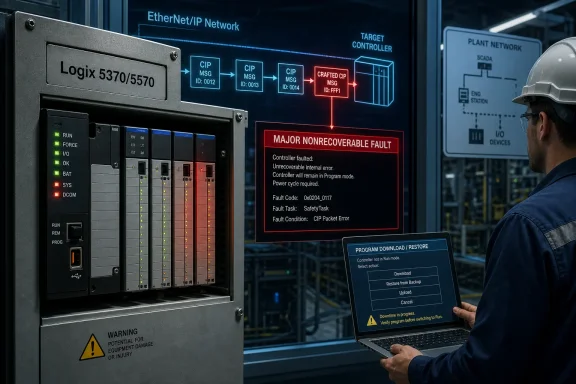
On June 16, 2026, CISA republished Rockwell Automation advisory SD1772 warning that several Logix 5370 and 5570 controller families can be forced into denial of service by a crafted CIP message, potentially causing a major nonrecoverable fault that requires a program download to restore operation. The affected products sit in the unglamorous but critical layer of industrial control where “availability” is not a dashboard metric but the difference between a running line and an outage. The bug is not being reported as exploited in the wild, and Rockwell says it was found internally, but that should not lull operators into treating it as routine firmware hygiene. In operational technology, a remotely triggerable crash that survives ordinary recovery is not a nuisance; it is a production event waiting for a maintenance window.
The headline number is familiar enough to risk disappearing into the daily vulnerability fog: CVSS 3.1 at 7.5, CVSS 4.0 at 8.7, severity high, no confidentiality impact, no integrity impact, high availability impact. That scoring tells a narrow truth. This is not a credential-stealing bug, not a ransomware loader, and not a remote code execution flaw that lets an attacker rewrite logic.
But industrial systems have a different center of gravity than IT systems. In a corporate network, a denial-of-service condition may mean a service restart, a failover, or an angry Slack thread. In a Logix controller running real equipment, a major nonrecoverable fault can mean stopping a process, dispatching engineers, reloading a program, validating behavior, and explaining downtime to people who measure disruption in units, batches, scrap, or safety procedures.
The vulnerability, CVE-2026-11317, is described as a fault triggered by a crafted Common Industrial Protocol message. CIP is not an exotic side channel; it is part of the communication fabric used across EtherNet/IP and Rockwell’s industrial ecosystem. That makes the boundary question more important than the exploit mechanics. If untrusted systems can talk CIP to the affected controllers, the plant has a bigger problem than this single CVE.
The affected families are also not obscure lab gear. CompactLogix 5370, Compact GuardLogix 5370, ControlLogix 5570, and GuardLogix 5570 controllers are the kinds of automation platforms that persist for years because they are stable, certified, understood, and expensive to disturb. That longevity is the great strength of industrial automation and the great weakness of industrial cybersecurity.
A program download is not the same thing as pressing reboot. It implies that the organization has the correct project file, the right software environment, the appropriate access, a known-good backup, and personnel authorized to touch the system. It also implies that restoring the controller is only part of the work. In many environments, operations must confirm that the restored program matches the intended state and that the process can safely resume.
This is where vulnerability management often collides with plant reality. The people reading the advisory may be security staff, but the people carrying the consequences may be controls engineers, maintenance teams, production supervisors, and safety personnel. The advisory says “denial of service.” The plant hears “line down until someone who knows this cell is available.”
Devices with less memory are reportedly more likely to be affected. That detail matters because it nudges the risk toward older or resource-constrained deployments, which are often exactly the systems least likely to be patched quickly. Industrial sites frequently standardize firmware versions around validation, vendor support, spare parts strategy, and known behavior. The result is a fleet that can be both reliable and brittle.
The slightly awkward overlap between “affected through” and “corrected in” language deserves careful reading by administrators rather than a casual skim. Industrial advisories often encode product-family differences, firmware train behavior, and vendor support realities in terse tables. Before anyone schedules remediation, they should compare the advisory against the exact catalog numbers, firmware revisions, safety certifications, and application requirements in their environment.
The wider point is that this advisory lands in the long tail of controller lifecycle management. Unlike a browser update or a Windows cumulative update, controller firmware changes can carry compatibility implications. A firmware update may require engineering software alignment, safety validation, module compatibility checks, and planned downtime.
That does not make patching optional. It means patching must be treated as a controlled engineering change rather than a security checkbox. The responsible response is not “apply immediately everywhere” or “wait until next year.” It is inventory, exposure analysis, testing, backup verification, and staged deployment.
The most interesting thing about this vulnerability is not that a crafted protocol message can crash a controller. It is that the mitigation language once again points back to architecture. If a random host cannot send CIP traffic to a controller, the exploit path narrows dramatically. If every engineering workstation, historian, HMI, remote support jump box, and vendor laptop lives in the same broad trust zone, the path stays open.
This is where WindowsForum readers should pay attention. Windows machines are often the bridge between IT and OT: engineering workstations, operator terminals, patch servers, domain controllers, remote desktop gateways, EDR consoles, file shares, and jump hosts. A controller vulnerability may not be “a Windows bug,” but Windows infrastructure often determines who can reach the controller, how credentials are handled, and how quickly an attacker can pivot from a compromised business system into industrial traffic.
That makes this advisory a reminder that OT security is rarely contained inside PLC firmware. The controller is the endpoint of a chain. The chain includes Active Directory groups, firewall rules, RDP exposure, VPN posture, workstation hardening, backup practices, and whether anyone can still locate the final project file at 2 a.m.
Industrial exploitation often has a different public signal than enterprise exploitation. A plant outage may be handled privately, attributed to equipment failure, or investigated under legal and operational constraints. Proof-of-concept code may not be public, but adversaries do not need press coverage to read advisories and infer what kind of traffic deserves attention.
The disclosure also gives defenders a clock. Once the affected families, version boundaries, protocol surface, and failure mode are public, capable attackers can begin testing in labs. The difficulty may be nontrivial, and the exploit may depend on specific memory conditions or firmware behavior, but disclosure narrows the search space.
That does not mean panic. It means the window between advisory publication and operational response matters. Sites with direct or loosely controlled CIP exposure should treat this as urgent. Sites with properly segmented controller networks still need to patch, but their risk calculus is different because architecture is buying time.
A denial-of-service flaw in a controller can produce cascading consequences without ever giving the attacker control of the process. Stopping a controller can interrupt a production sequence, trigger safety logic, cause material loss, or force manual procedures. Even when the system fails safely, “safely stopped” can still be expensive, disruptive, and operationally complex.
This is why CVSS scores can undercommunicate the boardroom relevance of industrial advisories. A 7.5 high-severity flaw in an office application and a 7.5 high-severity flaw in a controller do not carry the same operational meaning. The score is a useful index, but it is not a risk assessment.
The phrase major nonrecoverable fault should do more work in the reader’s mind than the score. It tells operators that recovery may require more than resilience; it may require preparedness. Backups, spare hardware, engineering software access, documented recovery procedures, and trained staff become part of the security control.
Industrial asset inventories are notoriously uneven. A plant may have excellent knowledge inside the controls team and poor visibility in the central security platform. A corporate vulnerability scanner may know every Windows Server build but have no safe way to query controllers. An engineer may know the cell by memory but not have that information represented in a searchable system tied to risk workflows.
This is why advisories like SD1772 should start a cross-functional conversation rather than a ticket tossed into a generic patch queue. Security teams need operations context. Operations teams need threat context. Engineering teams need time and authority to validate firmware changes.
The most useful first move is not heroic. Identify affected controller families, confirm firmware revisions, map network exposure, verify recoverability, and determine whether corrected firmware is compatible with the specific application. If that sounds basic, it is because the basics are still where many incident responses fail.
That makes ordinary Windows hygiene unusually relevant. Credential theft from an engineer’s workstation can become protocol access to controllers. A misconfigured Remote Desktop host can become a launch point. A VPN account intended for maintenance can become a tunnel into devices that were never meant to face arbitrary traffic.
Segmentation is therefore not simply an OT firewall project. It is an identity, endpoint, and operations project. Which Windows hosts can initiate CIP traffic? Which users can log into them? Are those hosts managed differently from office desktops? Are they allowed to browse the web, read email, or accept remote support tools? Are backups of controller programs stored securely and tested?
The uncomfortable answer in many environments is that the systems most capable of affecting production are also the systems granted exceptions because production cannot tolerate disruption. That inversion is how a corporate compromise becomes an industrial incident. The more critical the workstation, the less it should resemble a general-purpose endpoint.
The phrase “VPN is only as secure as the connected devices” is especially apt here. If a contractor laptop, unmanaged home machine, or compromised corporate endpoint can establish a remote session and reach controller networks, the encryption of the tunnel is beside the point. The tunnel protects traffic from outsiders; it does not prove the endpoint is trustworthy.
Modern remote access for OT needs more than a login prompt. It needs strong identity, device posture, session recording where appropriate, time-bound access, explicit allow lists, and network paths that expose only what is needed. Most importantly, it needs an owner who can say why each route exists and when it should be removed.
That governance work is tedious until the day it becomes decisive. A crafted CIP message can only do damage if it can arrive. The difference between “the vulnerability exists” and “the vulnerability is exploitable here” is often written in firewall policy, jump-host discipline, and remote access exceptions.
Safety environments also tend to have stricter change-control expectations. Firmware updates may intersect with validation procedures, documentation requirements, and operational approvals. That can slow remediation, but it also provides a structured path for doing remediation correctly.
The danger is using safety rigor as a reason for indefinite delay. If a controller family is affected and exposed, the organization needs a plan, not a shrug. That plan may involve testing in a representative environment, coordinating with Rockwell or an integrator, scheduling downtime, and verifying both the controller program and safety function after the update.
In the meantime, compensating controls become more important. Reducing who can send CIP traffic, isolating safety controllers from unnecessary hosts, and monitoring for unusual protocol activity are not substitutes for corrected firmware, but they are meaningful risk reducers while engineering change proceeds.
The upside is stability. Plants can run known programs on known hardware for years, and that predictability is valuable. The downside is that protocol assumptions, memory constraints, and embedded software design choices age into a threat environment that has changed around them.
This is the background hum behind many ICS advisories. The vulnerable code path may be specific, but the systemic issue is broad: long-lived devices increasingly live in networks where attackers, remote access, IT integration, cloud reporting, and vendor maintenance have expanded the reachable surface. A controller designed for a trusted industrial network may still be doing its job perfectly, right up until the network stops being trusted.
That does not mean every plant should rip and replace working automation. It means lifecycle planning has to include security support, firmware availability, test environments, spare strategy, and migration paths. The worst time to discover that a controller cannot be easily updated is after an advisory makes it urgent.
A mature response starts before the firmware file is downloaded. Engineers should confirm the exact controller model and revision, back up the current program, document the running state, review compatibility, and test where possible. Operations should understand downtime requirements and rollback options. Security teams should assess whether exposure justifies emergency action before the next planned outage.
Monitoring also deserves a role. If an organization has visibility into EtherNet/IP or CIP traffic, this is the time to baseline which hosts normally communicate with affected controllers. Unexpected CIP messages from business networks, remote access subnets, or unmanaged hosts should not be treated as harmless noise.
None of this is glamorous. It is the operational version of defense in depth: boring controls layered until an attacker runs out of easy paths. The advisory gives a specific bug to fix, but the response should leave the environment better prepared for the next one.
That does not make the vulnerability harmless. It means the ecosystem worked as designed up to the point of publication. The next phase belongs to asset owners.
Vendors can publish advisories, but they cannot patch the installed base by declaration. CISA can amplify recommendations, but it cannot make a maintenance window appear. The hard work now moves into plants, utilities, manufacturers, integrators, and support organizations that must translate the advisory into site-specific action.
This is also where vendor language and operator reality diverge. “Corrected: Yes” is a product statement. “Remediated” is an operational state. Between those two words sit procurement portals, firmware qualification, backup verification, outage scheduling, and the unglamorous fact that someone must be responsible for the controller at the end of the wire.
 This Is Not Just Another High-Severity Advisory
The headline number is familiar enough to risk disappearing into the daily vulnerability fog: CVSS 3.1 at 7.5, CVSS 4.0 at 8.7, severity high, no confidentiality impact, no integrity impact, high availability impact. That scoring tells a narrow truth. This is not a credential-stealing bug, not a ransomware loader, and not a remote code execution flaw that lets an attacker rewrite logic.But industrial systems have a different center of gravity than IT systems. In a corporate network, a denial-of-service condition may mean a service restart, a failover, or an angry Slack thread. In a Logix controller running real equipment, a major nonrecoverable fault can mean stopping a process, dispatching engineers, reloading a program, validating behavior, and explaining downtime to people who measure disruption in units, batches, scrap, or safety procedures.
The vulnerability, CVE-2026-11317, is described as a fault triggered by a crafted Common Industrial Protocol message. CIP is not an exotic side channel; it is part of the communication fabric used across EtherNet/IP and Rockwell’s industrial ecosystem. That makes the boundary question more important than the exploit mechanics. If untrusted systems can talk CIP to the affected controllers, the plant has a bigger problem than this single CVE.
The affected families are also not obscure lab gear. CompactLogix 5370, Compact GuardLogix 5370, ControlLogix 5570, and GuardLogix 5570 controllers are the kinds of automation platforms that persist for years because they are stable, certified, understood, and expensive to disturb. That longevity is the great strength of industrial automation and the great weakness of industrial cybersecurity.
The Crafted Packet Is the Easy Part; Recovery Is the Hard Part
Rockwell’s most important sentence is the one that says a program download is required to recover. That phrase changes the practical risk. A device that crashes and comes back on its own creates one class of incident; a controller that enters a major nonrecoverable fault and needs intervention creates another.A program download is not the same thing as pressing reboot. It implies that the organization has the correct project file, the right software environment, the appropriate access, a known-good backup, and personnel authorized to touch the system. It also implies that restoring the controller is only part of the work. In many environments, operations must confirm that the restored program matches the intended state and that the process can safely resume.
This is where vulnerability management often collides with plant reality. The people reading the advisory may be security staff, but the people carrying the consequences may be controls engineers, maintenance teams, production supervisors, and safety personnel. The advisory says “denial of service.” The plant hears “line down until someone who knows this cell is available.”
Devices with less memory are reportedly more likely to be affected. That detail matters because it nudges the risk toward older or resource-constrained deployments, which are often exactly the systems least likely to be patched quickly. Industrial sites frequently standardize firmware versions around validation, vendor support, spare parts strategy, and known behavior. The result is a fleet that can be both reliable and brittle.
The Version Table Tells a Migration Story
The affected versions cut across multiple controller families: CompactLogix 5370 through 34.016, Compact GuardLogix 5370 through 35.015, ControlLogix 5570 through 35.015, and GuardLogix 5570 at 36.012. Rockwell’s corrected versions move each family forward: CompactLogix 5370 to 34.016 and later, Compact GuardLogix 5370 to 35.015 and later, ControlLogix 5570 to 36.012 and later, and GuardLogix 5570 to 37.011 and later.The slightly awkward overlap between “affected through” and “corrected in” language deserves careful reading by administrators rather than a casual skim. Industrial advisories often encode product-family differences, firmware train behavior, and vendor support realities in terse tables. Before anyone schedules remediation, they should compare the advisory against the exact catalog numbers, firmware revisions, safety certifications, and application requirements in their environment.
The wider point is that this advisory lands in the long tail of controller lifecycle management. Unlike a browser update or a Windows cumulative update, controller firmware changes can carry compatibility implications. A firmware update may require engineering software alignment, safety validation, module compatibility checks, and planned downtime.
That does not make patching optional. It means patching must be treated as a controlled engineering change rather than a security checkbox. The responsible response is not “apply immediately everywhere” or “wait until next year.” It is inventory, exposure analysis, testing, backup verification, and staged deployment.
CISA’s Old Advice Still Applies Because the Architecture Still Fails the Same Way
CISA’s recommendations are familiar because the industrial security problem has been familiar for decades: reduce network exposure, keep control systems away from the public internet, separate OT networks from business networks, place remote access behind managed controls, and remember that VPNs are not magic shields. None of that is novel. All of it remains necessary because many real environments still rely on flat networks, inherited exceptions, vendor tunnels, and undocumented connectivity.The most interesting thing about this vulnerability is not that a crafted protocol message can crash a controller. It is that the mitigation language once again points back to architecture. If a random host cannot send CIP traffic to a controller, the exploit path narrows dramatically. If every engineering workstation, historian, HMI, remote support jump box, and vendor laptop lives in the same broad trust zone, the path stays open.
This is where WindowsForum readers should pay attention. Windows machines are often the bridge between IT and OT: engineering workstations, operator terminals, patch servers, domain controllers, remote desktop gateways, EDR consoles, file shares, and jump hosts. A controller vulnerability may not be “a Windows bug,” but Windows infrastructure often determines who can reach the controller, how credentials are handled, and how quickly an attacker can pivot from a compromised business system into industrial traffic.
That makes this advisory a reminder that OT security is rarely contained inside PLC firmware. The controller is the endpoint of a chain. The chain includes Active Directory groups, firewall rules, RDP exposure, VPN posture, workstation hardening, backup practices, and whether anyone can still locate the final project file at 2 a.m.
The Absence of Known Exploitation Is Comfort, Not Clearance
CISA says it has no report of known public exploitation specifically targeting this vulnerability. Rockwell’s advisory likewise marks it as not in the Known Exploited Vulnerabilities catalog. That is good news, but it is not the same as low risk.Industrial exploitation often has a different public signal than enterprise exploitation. A plant outage may be handled privately, attributed to equipment failure, or investigated under legal and operational constraints. Proof-of-concept code may not be public, but adversaries do not need press coverage to read advisories and infer what kind of traffic deserves attention.
The disclosure also gives defenders a clock. Once the affected families, version boundaries, protocol surface, and failure mode are public, capable attackers can begin testing in labs. The difficulty may be nontrivial, and the exploit may depend on specific memory conditions or firmware behavior, but disclosure narrows the search space.
That does not mean panic. It means the window between advisory publication and operational response matters. Sites with direct or loosely controlled CIP exposure should treat this as urgent. Sites with properly segmented controller networks still need to patch, but their risk calculus is different because architecture is buying time.
Availability Bugs Are Security Bugs in Industrial Control
IT security culture has spent years prioritizing confidentiality and integrity because those are the dimensions that dominate breaches: stolen data, altered records, fraudulent transactions, poisoned software. OT flips that hierarchy. Availability is not a lesser pillar when the system under control is physical.A denial-of-service flaw in a controller can produce cascading consequences without ever giving the attacker control of the process. Stopping a controller can interrupt a production sequence, trigger safety logic, cause material loss, or force manual procedures. Even when the system fails safely, “safely stopped” can still be expensive, disruptive, and operationally complex.
This is why CVSS scores can undercommunicate the boardroom relevance of industrial advisories. A 7.5 high-severity flaw in an office application and a 7.5 high-severity flaw in a controller do not carry the same operational meaning. The score is a useful index, but it is not a risk assessment.
The phrase major nonrecoverable fault should do more work in the reader’s mind than the score. It tells operators that recovery may require more than resilience; it may require preparedness. Backups, spare hardware, engineering software access, documented recovery procedures, and trained staff become part of the security control.
The Patch Is Necessary, but the Inventory Is the First Test
For many organizations, the immediate challenge will not be applying the update. It will be knowing whether they own the affected devices, where those devices are, what firmware they run, what they control, and who has authority to change them. That is still the least glamorous and most decisive layer of OT defense.Industrial asset inventories are notoriously uneven. A plant may have excellent knowledge inside the controls team and poor visibility in the central security platform. A corporate vulnerability scanner may know every Windows Server build but have no safe way to query controllers. An engineer may know the cell by memory but not have that information represented in a searchable system tied to risk workflows.
This is why advisories like SD1772 should start a cross-functional conversation rather than a ticket tossed into a generic patch queue. Security teams need operations context. Operations teams need threat context. Engineering teams need time and authority to validate firmware changes.
The most useful first move is not heroic. Identify affected controller families, confirm firmware revisions, map network exposure, verify recoverability, and determine whether corrected firmware is compatible with the specific application. If that sounds basic, it is because the basics are still where many incident responses fail.
Windows Infrastructure Is the Quiet Dependency
Although the vulnerability lives in Rockwell controllers, many realistic exposure paths run through Windows-managed environments. Engineering workstations running automation software are often Windows PCs. HMIs and historian clients frequently depend on Windows. Remote access may terminate on Windows jump hosts. Domain credentials may govern access to machines that can reach OT networks.That makes ordinary Windows hygiene unusually relevant. Credential theft from an engineer’s workstation can become protocol access to controllers. A misconfigured Remote Desktop host can become a launch point. A VPN account intended for maintenance can become a tunnel into devices that were never meant to face arbitrary traffic.
Segmentation is therefore not simply an OT firewall project. It is an identity, endpoint, and operations project. Which Windows hosts can initiate CIP traffic? Which users can log into them? Are those hosts managed differently from office desktops? Are they allowed to browse the web, read email, or accept remote support tools? Are backups of controller programs stored securely and tested?
The uncomfortable answer in many environments is that the systems most capable of affecting production are also the systems granted exceptions because production cannot tolerate disruption. That inversion is how a corporate compromise becomes an industrial incident. The more critical the workstation, the less it should resemble a general-purpose endpoint.
Remote Access Remains the Permanent Exception That Becomes the Rule
CISA’s reminder about VPNs is not boilerplate. Remote access is one of the enduring weak points in industrial environments because it sits at the intersection of convenience, vendor support, emergency maintenance, and underdocumented trust. A VPN can reduce exposure compared with direct internet access, but it can also create a highly privileged path into OT if poorly segmented or weakly governed.The phrase “VPN is only as secure as the connected devices” is especially apt here. If a contractor laptop, unmanaged home machine, or compromised corporate endpoint can establish a remote session and reach controller networks, the encryption of the tunnel is beside the point. The tunnel protects traffic from outsiders; it does not prove the endpoint is trustworthy.
Modern remote access for OT needs more than a login prompt. It needs strong identity, device posture, session recording where appropriate, time-bound access, explicit allow lists, and network paths that expose only what is needed. Most importantly, it needs an owner who can say why each route exists and when it should be removed.
That governance work is tedious until the day it becomes decisive. A crafted CIP message can only do damage if it can arrive. The difference between “the vulnerability exists” and “the vulnerability is exploitable here” is often written in firewall policy, jump-host discipline, and remote access exceptions.
Safety Controllers Raise the Stakes Without Changing the Basic Playbook
The inclusion of GuardLogix and Compact GuardLogix models may make some readers instinctively more nervous. Safety-rated controllers carry a different psychological weight because they sit close to systems designed to protect people and equipment. The advisory describes a denial-of-service condition, not an attacker bypassing safety logic, but availability disruptions in safety-related systems still demand careful treatment.Safety environments also tend to have stricter change-control expectations. Firmware updates may intersect with validation procedures, documentation requirements, and operational approvals. That can slow remediation, but it also provides a structured path for doing remediation correctly.
The danger is using safety rigor as a reason for indefinite delay. If a controller family is affected and exposed, the organization needs a plan, not a shrug. That plan may involve testing in a representative environment, coordinating with Rockwell or an integrator, scheduling downtime, and verifying both the controller program and safety function after the update.
In the meantime, compensating controls become more important. Reducing who can send CIP traffic, isolating safety controllers from unnecessary hosts, and monitoring for unusual protocol activity are not substitutes for corrected firmware, but they are meaningful risk reducers while engineering change proceeds.
The Advisory’s Quiet Message Is About Product Aging
The Logix 5370 and 5570 families belong to a generation of industrial platforms that many facilities still depend on. That should surprise no one. Industrial automation does not refresh on the cadence of consumer electronics, cloud services, or even enterprise servers.The upside is stability. Plants can run known programs on known hardware for years, and that predictability is valuable. The downside is that protocol assumptions, memory constraints, and embedded software design choices age into a threat environment that has changed around them.
This is the background hum behind many ICS advisories. The vulnerable code path may be specific, but the systemic issue is broad: long-lived devices increasingly live in networks where attackers, remote access, IT integration, cloud reporting, and vendor maintenance have expanded the reachable surface. A controller designed for a trusted industrial network may still be doing its job perfectly, right up until the network stops being trusted.
That does not mean every plant should rip and replace working automation. It means lifecycle planning has to include security support, firmware availability, test environments, spare strategy, and migration paths. The worst time to discover that a controller cannot be easily updated is after an advisory makes it urgent.
The Real Remediation Is a Maintenance Discipline
Rockwell’s recommendation is clear: update affected products to corrected firmware versions. For organizations already running tight OT maintenance programs, this becomes a scheduled but manageable task. For everyone else, the advisory exposes the gap between having assets and managing them.A mature response starts before the firmware file is downloaded. Engineers should confirm the exact controller model and revision, back up the current program, document the running state, review compatibility, and test where possible. Operations should understand downtime requirements and rollback options. Security teams should assess whether exposure justifies emergency action before the next planned outage.
Monitoring also deserves a role. If an organization has visibility into EtherNet/IP or CIP traffic, this is the time to baseline which hosts normally communicate with affected controllers. Unexpected CIP messages from business networks, remote access subnets, or unmanaged hosts should not be treated as harmless noise.
None of this is glamorous. It is the operational version of defense in depth: boring controls layered until an attacker runs out of easy paths. The advisory gives a specific bug to fix, but the response should leave the environment better prepared for the next one.
Rockwell’s Disclosure Shows the Value of Internal Testing
One notable detail is that Rockwell says the issue was found internally during routine testing. That matters because it is the best-case disclosure path: the vendor discovers a vulnerability, publishes an advisory, provides corrected firmware, and coordinates with CISA. No public exploit, no known active campaign, no scramble after customer incidents.That does not make the vulnerability harmless. It means the ecosystem worked as designed up to the point of publication. The next phase belongs to asset owners.
Vendors can publish advisories, but they cannot patch the installed base by declaration. CISA can amplify recommendations, but it cannot make a maintenance window appear. The hard work now moves into plants, utilities, manufacturers, integrators, and support organizations that must translate the advisory into site-specific action.
This is also where vendor language and operator reality diverge. “Corrected: Yes” is a product statement. “Remediated” is an operational state. Between those two words sit procurement portals, firmware qualification, backup verification, outage scheduling, and the unglamorous fact that someone must be responsible for the controller at the end of the wire.
The June 16 Advisory Leaves Operators With a Narrow, Practical Checklist
This advisory is not a reason to panic, but it is a reason to move deliberately. The systems affected are important, the exploit condition is network-reachable, and the recovery path can be disruptive. Organizations that already know where these controllers are and how they are segmented are in a far better position than those discovering their automation inventory in real time.- Confirm whether CompactLogix 5370, Compact GuardLogix 5370, ControlLogix 5570, or GuardLogix 5570 controllers are present in the environment.
- Verify the exact firmware revision against Rockwell’s corrected versions rather than relying on product family names alone.
- Treat any controller that can receive CIP traffic from broad IT networks, remote access pools, or unmanaged hosts as higher priority.
- Back up controller programs and verify that recovery procedures work before relying on them during an outage.
- Schedule firmware updates as controlled engineering changes, especially where safety controllers or validated processes are involved.
- Use segmentation, firewall rules, and remote access controls to reduce exposure while remediation is being planned and tested.
References
- Primary source: CISA
Published: 2026-06-16T12:00:00+00:00