

Google assigned CVE-2026-11657 to a high-severity use-after-free flaw in Chrome’s Payments component on macOS, fixed in Chrome 149.0.7827.103 after disclosure on June 8, 2026, with NVD and CISA-ADP describing a crafted HTML page as the remote attack path. The short version is simple: Mac users running Chrome below that build should update. The longer version is more interesting, because this is not just another line item in the endless Chrome patch treadmill. It is a reminder that browser security increasingly lives in the seams between web features, platform integration, and the payment flows users are trained to trust.
The word “Payments” can make this vulnerability sound narrower than it is. In ordinary consumer language, payments means checkout pages, saved cards, wallets, and perhaps a failed attempt to buy something online. In browser security language, it means a feature area with privileged plumbing, complex state, platform-specific behavior, and enough moving parts to make memory safety mistakes consequential.
CVE-2026-11657 is described as a use-after-free vulnerability. That class of bug occurs when software continues to use memory after it has been released, creating an opening for corrupted state, crashes, or carefully shaped code execution. The NVD entry says the flaw affected Google Chrome on Mac before 149.0.7827.103 and could allow a remote attacker to execute arbitrary code through a crafted HTML page.
That “crafted HTML page” phrasing is doing a lot of work. It means the exploit path is web-deliverable, not something that requires local shell access or a malicious app already installed on the machine. User interaction is still part of the scoring, but in browser terms that can be as mundane as opening a link, landing on a compromised site, or being redirected through an ad or phishing chain.
The CISA-ADP CVSS vector rates the issue 8.8, high severity, with network attack vector, low complexity, no privileges required, and user interaction required. Confidentiality, integrity, and availability are all scored high. That is the profile of a vulnerability administrators do not get to ignore simply because the bug lives in a named feature that many users may not consciously touch.
The NVD CPE configuration is also telling. It expresses the vulnerable application as Google Chrome versions before 149.0.7827.103, paired with Apple macOS as the operating system condition. That is the right shape for a Mac-specific exposure: the vulnerable software is Chrome, but the affected configuration depends on the platform underneath it.
For WindowsForum readers, the immediate instinct may be to ask whether Windows Chrome is affected. Based on the CVE wording, this specific entry targets macOS prior to 149.0.7827.103. But the same Stable Channel update also carried a broader Chrome security payload across desktop platforms, and the safest operational answer is not to split hairs in the patch window. If Chrome is below the current stable build, update it.
This distinction matters for inventory teams. A scanner that only sees “Chrome prior to 149.0.7827.103” without honoring the macOS condition may overreport Windows systems. A scanner that ignores the Chrome version because it treats this as an Apple OS problem may underreport Macs. The correct reading is narrower than “all Chrome everywhere,” but more serious than “just a payment UI glitch.”
The configuration shown in the change history uses an AND relationship: Chrome versions up to, but excluding, 149.0.7827.103, plus Apple macOS. That is a meaningful machine-readable statement. It says the vulnerable configuration requires both the application and the platform condition.
The oddity is the macOS CPE itself. It appears as a generic Apple macOS operating system entry rather than a narrowed version range. That may be appropriate if the vulnerability is in Chrome’s Mac implementation rather than a particular macOS release, but it can still cause friction for vulnerability managers trying to produce clean exposure reports. In asset systems, “Chrome on any macOS” is often actionable enough; in compliance dashboards, it can look imprecise.
So, are we missing a CPE? Probably not in the sense that the record lacks the core product identifier. But there may be room for improved enrichment if NVD later refines the affected platform expression, Chrome CPE matching, or version boundary display. The safer conclusion is that the current record is usable for patch prioritization, even if it is not a beautifully polished example of vulnerability metadata.
That complexity is precisely why memory bugs in feature-specific components deserve respect. An attacker does not need the victim to understand the Payments component. The victim only has to run vulnerable code in a path the attacker can trigger.
This is also why the “remote code execution” language should not be softened too much. Modern Chrome exploitation usually means fighting through layers of sandboxing and mitigations, and not every RCE primitive becomes a full device compromise. But defenders have learned the hard way that browser RCE is often the first stage in a larger chain, especially when paired with a sandbox escape, kernel bug, credential theft, or post-exploitation tooling.
CVE-2026-11657 is not described as exploited in the wild in the provided record. That matters. It should not be inflated into a confirmed zero-day unless Google or another authoritative source says so. But high-severity browser bugs do not need known exploitation to justify rapid patching, because the exploitability window is defined by browser update latency and attacker reverse engineering.
Enterprise environments are different. Chrome updates may be pinned, staged, deferred, wrapped inside endpoint management tooling, or delayed by compatibility testing. Those practices are not irrational; a broken browser build can disrupt line-of-business apps, authentication flows, virtual desktops, kiosk systems, and web-based management consoles. But every delay turns a vendor-fixed vulnerability into an organization-owned risk.
The version number here is the operational anchor: Chrome for Mac must be at least 149.0.7827.103 to clear CVE-2026-11657. Windows and Linux administrators should still validate their corresponding stable builds from the same update wave, because attackers do not respect neat CVE scoping when a fleet contains multiple platforms and browser channels.
For managed environments, this is the kind of patch where reporting matters as much as deployment. It is not enough to say that Chrome auto-updates are enabled. Admins need proof that endpoints actually reached the fixed version, that relaunch prompts were accepted, and that stale browser processes are not still running vulnerable code after the update landed.
A vulnerability in the Payments component does not necessarily mean card numbers are directly stolen. The CVE description does not say that, and responsible coverage should not imply it. The risk is broader and more technical: a malicious page may be able to drive a memory corruption path in Chrome’s payment code and achieve arbitrary code execution within the constraints of the browser process model.
Still, the payment context matters psychologically and architecturally. Features that bridge web pages and trusted browser UI require careful separation. If a hostile page can influence object lifetimes in that area, the browser has to defend not only against classic memory corruption but also against user confusion, spoofed flows, and privileged UI assumptions.
This is where Chrome’s security model is strongest and weakest at the same time. The browser is highly compartmentalized, but it is also packed with features that intentionally cross compartments to make the web usable. Every convenience surface becomes a place where attackers look for state confusion.
The browser is now a primary enterprise runtime. SaaS consoles, identity portals, password managers, admin dashboards, webmail, source repositories, ticketing systems, and remote support tools all run through it. A compromised browser session on a Mac can be just as useful to an attacker as one on a Windows workstation.
This is especially true in mixed identity environments. A Mac user signed into Chrome, Microsoft 365, Google Workspace, Okta, GitHub, Slack, Azure portals, or internal SSO applications may carry tokens and access paths that matter more than the local operating system. The attacker’s goal is rarely “own this Mac” as an end in itself; it is “own the session, the account, the workflow, or the next hop.”
That should change how IT teams think about platform-specific browser bugs. They are not peripheral because they are not Windows. They are central because the browser is the new perimeter, and the perimeter is wherever privileged users browse.
This creates a recurring problem for vulnerability teams. Vendor advisories usually tell you what to patch first. NVD tells you how the vulnerability will appear in scanners, dashboards, and compliance workflows. Those two systems do not always synchronize cleanly in the first hours or days after disclosure.
For CVE-2026-11657, the practical intelligence is already sufficient: vulnerable Chrome on macOS is fixed by 149.0.7827.103. The missing pieces are mostly enrichment details: final NVD scoring, refined CPE presentation, and any later clarification from Chromium’s restricted bug tracker once access opens up. Those details may improve the record, but they should not delay the update.
Security teams should be comfortable acting before the metadata becomes perfect. Waiting for a fully polished vulnerability record is a luxury attackers do not extend. The better model is to patch from vendor truth, reconcile with NVD later, and document any scanner quirks in the interim.
For administrators, the annoying part is that “installed” and “running” are not always the same state. Chrome can download an update while an old process remains active until the user relaunches. In a risk report, that distinction can decide whether a machine is actually remediated or merely waiting to become remediated.
Managed Chrome policies can help, but they need teeth. Relaunch notification policies, update deadlines, and telemetry from endpoint management tools should all be part of the response. A high-severity browser RCE path is not the time to let users defer restarts indefinitely because a tab has become a personal filing cabinet.
The same logic applies to Chromium-based browsers, though the CVE at hand is specifically Chrome. Microsoft Edge, Brave, Vivaldi, Opera, and Electron-based applications may share upstream Chromium code but ship fixes on their own schedules and with their own affected-component boundaries. Administrators should not assume protection solely because Chrome is patched; they should check each Chromium-derived product in the environment against its vendor’s advisory.
But the restraint is not arbitrary. Publishing exploit details before a majority of users have patched would hand attackers a roadmap. Browser vendors are balancing transparency against mass exploitation risk, and the first few days after a security release are the most dangerous time to turn a fixed bug into a weaponized one.
That leaves IT teams working from sparse signals. The useful signals here are strong enough: high severity, use-after-free, remote crafted HTML, no privileges required, user interaction required, and potential arbitrary code execution. If a vulnerability manager cannot prioritize that, the problem is not lack of detail.
The broader lesson is that browser patching has to be treated more like threat containment than routine software maintenance. The adversary can reach the browser from anywhere the user can browse. The fix is available. The only question is how long the organization chooses to remain in the gap.
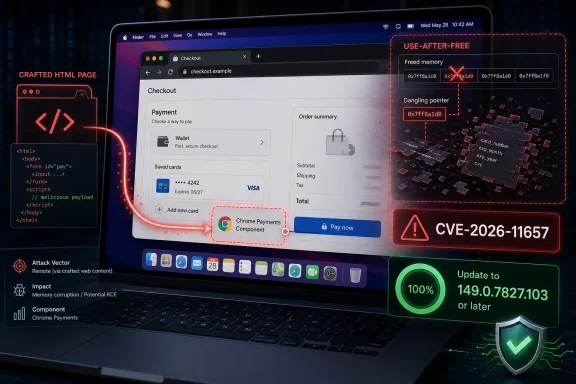 A Browser Payment Bug Is Still a Browser Code-Execution Bug
The word “Payments” can make this vulnerability sound narrower than it is. In ordinary consumer language, payments means checkout pages, saved cards, wallets, and perhaps a failed attempt to buy something online. In browser security language, it means a feature area with privileged plumbing, complex state, platform-specific behavior, and enough moving parts to make memory safety mistakes consequential.CVE-2026-11657 is described as a use-after-free vulnerability. That class of bug occurs when software continues to use memory after it has been released, creating an opening for corrupted state, crashes, or carefully shaped code execution. The NVD entry says the flaw affected Google Chrome on Mac before 149.0.7827.103 and could allow a remote attacker to execute arbitrary code through a crafted HTML page.
That “crafted HTML page” phrasing is doing a lot of work. It means the exploit path is web-deliverable, not something that requires local shell access or a malicious app already installed on the machine. User interaction is still part of the scoring, but in browser terms that can be as mundane as opening a link, landing on a compromised site, or being redirected through an ad or phishing chain.
The CISA-ADP CVSS vector rates the issue 8.8, high severity, with network attack vector, low complexity, no privileges required, and user interaction required. Confidentiality, integrity, and availability are all scored high. That is the profile of a vulnerability administrators do not get to ignore simply because the bug lives in a named feature that many users may not consciously touch.
The Mac-Only Detail Is Not a Permission Slip for Everyone Else
The most notable line in the description is “Google Chrome on Mac.” That gives defenders a useful boundary, but it should not become an excuse for complacency. Chrome release trains are cross-platform, Chromium components are shared, and enterprise browser fleets rarely exist in a tidy single-operating-system world.The NVD CPE configuration is also telling. It expresses the vulnerable application as Google Chrome versions before 149.0.7827.103, paired with Apple macOS as the operating system condition. That is the right shape for a Mac-specific exposure: the vulnerable software is Chrome, but the affected configuration depends on the platform underneath it.
For WindowsForum readers, the immediate instinct may be to ask whether Windows Chrome is affected. Based on the CVE wording, this specific entry targets macOS prior to 149.0.7827.103. But the same Stable Channel update also carried a broader Chrome security payload across desktop platforms, and the safest operational answer is not to split hairs in the patch window. If Chrome is below the current stable build, update it.
This distinction matters for inventory teams. A scanner that only sees “Chrome prior to 149.0.7827.103” without honoring the macOS condition may overreport Windows systems. A scanner that ignores the Chrome version because it treats this as an Apple OS problem may underreport Macs. The correct reading is narrower than “all Chrome everywhere,” but more serious than “just a payment UI glitch.”
NVD’s CPE Entry Is Clumsy, but the Meaning Is Clear Enough
The user-facing question here is whether a CPE is missing. In practical terms, the NVD record already shows the essential CPE pieces: a vulnerable Google Chrome application range and a macOS operating system condition. The entry’s display may look unfinished or awkward because NVD pages often lag in enrichment, UI rendering, or full platform normalization shortly after publication.The configuration shown in the change history uses an AND relationship: Chrome versions up to, but excluding, 149.0.7827.103, plus Apple macOS. That is a meaningful machine-readable statement. It says the vulnerable configuration requires both the application and the platform condition.
The oddity is the macOS CPE itself. It appears as a generic Apple macOS operating system entry rather than a narrowed version range. That may be appropriate if the vulnerability is in Chrome’s Mac implementation rather than a particular macOS release, but it can still cause friction for vulnerability managers trying to produce clean exposure reports. In asset systems, “Chrome on any macOS” is often actionable enough; in compliance dashboards, it can look imprecise.
So, are we missing a CPE? Probably not in the sense that the record lacks the core product identifier. But there may be room for improved enrichment if NVD later refines the affected platform expression, Chrome CPE matching, or version boundary display. The safer conclusion is that the current record is usable for patch prioritization, even if it is not a beautifully polished example of vulnerability metadata.
Use-After-Free Bugs Keep Surviving the Patch Machine
Chrome has spent years moving toward stronger sandboxing, site isolation, fuzzing, and memory-safety mitigations. Yet use-after-free vulnerabilities keep surfacing because browser internals remain a brutally complicated place to write safe code. Payment APIs are not just a form field; they connect web content to browser UI, user data, platform services, and permission decisions.That complexity is precisely why memory bugs in feature-specific components deserve respect. An attacker does not need the victim to understand the Payments component. The victim only has to run vulnerable code in a path the attacker can trigger.
This is also why the “remote code execution” language should not be softened too much. Modern Chrome exploitation usually means fighting through layers of sandboxing and mitigations, and not every RCE primitive becomes a full device compromise. But defenders have learned the hard way that browser RCE is often the first stage in a larger chain, especially when paired with a sandbox escape, kernel bug, credential theft, or post-exploitation tooling.
CVE-2026-11657 is not described as exploited in the wild in the provided record. That matters. It should not be inflated into a confirmed zero-day unless Google or another authoritative source says so. But high-severity browser bugs do not need known exploitation to justify rapid patching, because the exploitability window is defined by browser update latency and attacker reverse engineering.
The Chrome Release Cadence Is Both the Cure and the Problem
Google’s desktop Stable Channel updates are one of the great defensive advantages of the modern web. Most consumer Chrome installs update quickly, silently, and without the drama that still accompanies some operating system servicing. That speed is why the browser can carry so much risk and still remain defensible.Enterprise environments are different. Chrome updates may be pinned, staged, deferred, wrapped inside endpoint management tooling, or delayed by compatibility testing. Those practices are not irrational; a broken browser build can disrupt line-of-business apps, authentication flows, virtual desktops, kiosk systems, and web-based management consoles. But every delay turns a vendor-fixed vulnerability into an organization-owned risk.
The version number here is the operational anchor: Chrome for Mac must be at least 149.0.7827.103 to clear CVE-2026-11657. Windows and Linux administrators should still validate their corresponding stable builds from the same update wave, because attackers do not respect neat CVE scoping when a fleet contains multiple platforms and browser channels.
For managed environments, this is the kind of patch where reporting matters as much as deployment. It is not enough to say that Chrome auto-updates are enabled. Admins need proof that endpoints actually reached the fixed version, that relaunch prompts were accepted, and that stale browser processes are not still running vulnerable code after the update landed.
The Payment Surface Is a Trust Boundary Users Cannot See
Payment-related browser features are built to reduce friction. Autofill, saved cards, wallets, payment request APIs, and platform payment sheets all exist to make checkout feel safer and faster than typing card data into a random form. That user trust is valuable, and attackers understand it.A vulnerability in the Payments component does not necessarily mean card numbers are directly stolen. The CVE description does not say that, and responsible coverage should not imply it. The risk is broader and more technical: a malicious page may be able to drive a memory corruption path in Chrome’s payment code and achieve arbitrary code execution within the constraints of the browser process model.
Still, the payment context matters psychologically and architecturally. Features that bridge web pages and trusted browser UI require careful separation. If a hostile page can influence object lifetimes in that area, the browser has to defend not only against classic memory corruption but also against user confusion, spoofed flows, and privileged UI assumptions.
This is where Chrome’s security model is strongest and weakest at the same time. The browser is highly compartmentalized, but it is also packed with features that intentionally cross compartments to make the web usable. Every convenience surface becomes a place where attackers look for state confusion.
Windows Shops Should Treat Mac Chrome as First-Class Infrastructure
Many Windows-heavy organizations still treat Macs as exceptions. They are issued to executives, developers, designers, security teams, or mobile employees, and they sometimes sit outside the tightest update enforcement paths. That is exactly why a Mac-specific Chrome CVE deserves attention on a Windows-focused site.The browser is now a primary enterprise runtime. SaaS consoles, identity portals, password managers, admin dashboards, webmail, source repositories, ticketing systems, and remote support tools all run through it. A compromised browser session on a Mac can be just as useful to an attacker as one on a Windows workstation.
This is especially true in mixed identity environments. A Mac user signed into Chrome, Microsoft 365, Google Workspace, Okta, GitHub, Slack, Azure portals, or internal SSO applications may carry tokens and access paths that matter more than the local operating system. The attacker’s goal is rarely “own this Mac” as an end in itself; it is “own the session, the account, the workflow, or the next hop.”
That should change how IT teams think about platform-specific browser bugs. They are not peripheral because they are not Windows. They are central because the browser is the new perimeter, and the perimeter is wherever privileged users browse.
The Metadata Lag Is Part of the Vulnerability Lifecycle
The NVD record tells its own small story. Chrome submitted the CVE on June 8. CISA-ADP added a CVSS 3.1 score shortly afterward. NIST added initial analysis, references, and the CPE configuration on June 9. That is a fast-moving but still layered process, and each layer can look incomplete if viewed too early.This creates a recurring problem for vulnerability teams. Vendor advisories usually tell you what to patch first. NVD tells you how the vulnerability will appear in scanners, dashboards, and compliance workflows. Those two systems do not always synchronize cleanly in the first hours or days after disclosure.
For CVE-2026-11657, the practical intelligence is already sufficient: vulnerable Chrome on macOS is fixed by 149.0.7827.103. The missing pieces are mostly enrichment details: final NVD scoring, refined CPE presentation, and any later clarification from Chromium’s restricted bug tracker once access opens up. Those details may improve the record, but they should not delay the update.
Security teams should be comfortable acting before the metadata becomes perfect. Waiting for a fully polished vulnerability record is a luxury attackers do not extend. The better model is to patch from vendor truth, reconcile with NVD later, and document any scanner quirks in the interim.
The Real Test Is Whether the Browser Relaunched
For end users, the fix path is boring in the best possible way. Open Chrome’s About page, let it check for updates, and relaunch when prompted. On macOS, the relevant safe target for this CVE is 149.0.7827.103 or later.For administrators, the annoying part is that “installed” and “running” are not always the same state. Chrome can download an update while an old process remains active until the user relaunches. In a risk report, that distinction can decide whether a machine is actually remediated or merely waiting to become remediated.
Managed Chrome policies can help, but they need teeth. Relaunch notification policies, update deadlines, and telemetry from endpoint management tools should all be part of the response. A high-severity browser RCE path is not the time to let users defer restarts indefinitely because a tab has become a personal filing cabinet.
The same logic applies to Chromium-based browsers, though the CVE at hand is specifically Chrome. Microsoft Edge, Brave, Vivaldi, Opera, and Electron-based applications may share upstream Chromium code but ship fixes on their own schedules and with their own affected-component boundaries. Administrators should not assume protection solely because Chrome is patched; they should check each Chromium-derived product in the environment against its vendor’s advisory.
The Patch Note Is Small Because the Attack Surface Is Huge
Chrome security advisories often feel underwritten. They list CVEs, component names, severities, researcher credits, and sometimes rewards, while the underlying bug details remain restricted until enough users are updated. That opacity can frustrate defenders who want to know exactly how worried they should be.But the restraint is not arbitrary. Publishing exploit details before a majority of users have patched would hand attackers a roadmap. Browser vendors are balancing transparency against mass exploitation risk, and the first few days after a security release are the most dangerous time to turn a fixed bug into a weaponized one.
That leaves IT teams working from sparse signals. The useful signals here are strong enough: high severity, use-after-free, remote crafted HTML, no privileges required, user interaction required, and potential arbitrary code execution. If a vulnerability manager cannot prioritize that, the problem is not lack of detail.
The broader lesson is that browser patching has to be treated more like threat containment than routine software maintenance. The adversary can reach the browser from anywhere the user can browse. The fix is available. The only question is how long the organization chooses to remain in the gap.
The Narrow Mac CVE That Still Belongs on Every Patch Board
The practical response to CVE-2026-11657 is straightforward, but the operational lessons are broader. This is a Mac-scoped Chrome vulnerability with a clear fixed version, yet it touches cross-platform browser management, vulnerability metadata quality, and the uncomfortable truth that web features users barely notice can become high-value attack surfaces.- Chrome on macOS should be updated to 149.0.7827.103 or later to address CVE-2026-11657.
- The vulnerability is a high-severity use-after-free flaw in Chrome’s Payments component, with remote exploitation possible through a crafted HTML page.
- The NVD CPE data appears to include the core affected configuration: Google Chrome before the fixed version, constrained by Apple macOS.
- Windows-only teams should still track the issue if they manage mixed fleets, because browser compromise often targets accounts and sessions rather than operating systems.
- Administrators should verify successful browser relaunches, not merely update download status.
- Other Chromium-based browsers should be checked separately against their own vendor advisories rather than assumed safe by association.
References
- Primary source: NVD / Chromium
Published: 2026-06-15T19:14:10-07:00
NVD - CVE-2026-11657
 nvd.nist.gov
- Security advisory: MSRC
Published: 2026-06-15T19:14:10-07:00
Original feed URL
Security Update Guide - Microsoft Security Response Center
 msrc.microsoft.com
- Related coverage: radar.offseq.com
CVE-2026-11657: Use after free in Google Chrome - Live Threat Intelligence - Threat Radar | OffSeq.com
Detailed information about CVE-2026-11657: Use after free in Google Chrome affecting Google Chrome. Get real-time updates, technical details, and mitigation strradar.offseq.com
