

Google disclosed CVE-2026-11660 on June 8, 2026, as a high-severity Chromium flaw in Chrome’s New Tab Page that, before version 149.0.7827.103, could let an attacker who had already compromised the renderer potentially escape the browser sandbox through a crafted HTML page. The plain-English version is more uncomfortable than the bureaucratic one: a surface most users treat as inert browser furniture became part of a possible chain from web content to higher-privilege browser territory. That does not make CVE-2026-11660 a one-click apocalypse by itself, but it does make it the kind of bug enterprise teams should patch without waiting for a perfect score or a public exploit write-up. In modern browser security, the danger is often not the single CVE; it is the way one CVE becomes the missing rung in an exploit ladder.
The phrase “New Tab Page” sounds almost quaint. For many users, it is the page with a search box, a few tiles, a background image, maybe some promotional content, and the faint suspicion that the browser vendor is trying to turn a blank canvas into real estate. But in Chromium, the New Tab Page is not merely a static placeholder. It is a privileged-feeling browser surface sitting at the intersection of local preferences, web UI, account state, search integration, and content supplied or influenced by the broader browser stack.
That is why CVE-2026-11660 lands differently from a routine memory bug buried in a parser. The vulnerability is described as insufficient validation of untrusted input in the New Tab Page, mapped to CWE-20, the broad class of improper input validation. The attacker model is already constrained: the remote attacker must have compromised the renderer process first. But once that precondition is met, the flaw could potentially support a sandbox escape.
That caveat matters, but it should not lull anyone to sleep. Chrome’s renderer sandbox exists because the web is hostile by design: browsers deliberately process attacker-controlled HTML, CSS, JavaScript, images, video, fonts, and binary formats all day long. A bug that helps move from a compromised renderer toward more privileged territory is therefore not a side note. It is part of the boundary that keeps a malicious page from becoming a system-level incident.
The security severity assigned by Chromium is High, and CISA’s ADP scoring placed it at 8.3 under CVSS 3.1, with network attack vector, high attack complexity, no privileges required, user interaction required, changed scope, and high impact to confidentiality, integrity, and availability. That vector tells a story: this is not advertised as a trivial unauthenticated wormable bug, but it is potentially serious once paired with the right initial foothold.
A modern Chrome exploit chain often needs at least two pieces. First comes the bug that gets code execution or meaningful control inside the renderer, the sandboxed process tasked with handling web content. Then comes the bug that escapes containment, reaches a more privileged browser process, abuses an IPC boundary, or otherwise converts a web foothold into something more durable and dangerous. CVE-2026-11660 appears to live in that second category.
That distinction is important for Windows administrators because it changes how risk should be modeled. If a vulnerability requires a renderer compromise, it may not be the spear tip of an attack. It may instead be the blade behind the spear tip, the component that makes a successful initial exploit worth much more. A single CVE entry rarely captures that operational reality.
This is also why public exploit availability is only one signal. Google’s June 2026 Chrome update was already drawing attention because another flaw in the same release, CVE-2026-11645 in V8, was reportedly exploited in the wild. CVE-2026-11660 is not, based on the supplied record, described as exploited in the wild. But if a release contains both renderer-compromise-class bugs and sandbox-escape-class bugs, defenders should resist the urge to triage them in isolation.
In the browser world, the distance between “not known exploited” and “valuable in a chain” can be uncomfortably short. Attackers do not need every bug in a patch bundle to be independently famous. They need enough compatible primitives to get from a web page to something defenders care about.
That uneven-looking version notation is familiar to anyone who manages Chrome at scale. Stable channel versioning can differ slightly by platform, and vendor advisories often express patched builds as a pair rather than a single universal number. The practical instruction is less nuanced: get Chrome onto the current stable build for the platform and verify that the update actually landed.
For consumers, Chrome’s auto-update machinery usually does the work quietly. For IT teams, “usually” is not good enough. Managed Windows fleets can have browsers held back by update policies, packaging delays, golden images, VDI refresh cycles, application control rules, or the simple fact that Chrome needs a restart to finish applying an update. A patched installer sitting in a cache is not the same thing as a patched browser process running on endpoints.
The New Tab Page angle also undercuts a common user instinct. Many people imagine browser danger as something that happens only on obviously suspicious sites. But a crafted HTML page does not need to announce itself as malicious, and the user interaction requirement in the CVSS vector can be satisfied by ordinary browsing behavior. The chain may begin with a link, an ad, a compromised legitimate site, a watering-hole page, or a document that launches a browser session.
This is the mundane cruelty of browser security. The safer browsers become, the more attackers need chains. The more attackers need chains, the more defenders must treat “secondary” bugs as strategically important.
But a sandbox is not magic. It is a complicated set of process boundaries, broker decisions, IPC interfaces, validation routines, and assumptions about what untrusted content is allowed to influence. CVE-2026-11660 sits squarely in that philosophical space: untrusted input, insufficient validation, privileged-ish browser UI. The weakness class is not glamorous, but it is foundational.
Improper input validation bugs are security’s equivalent of bad plumbing. They do not always look spectacular in isolation, yet they become catastrophic when pressure builds in the wrong part of the system. If untrusted data can be shaped to influence a component that was designed with stronger assumptions, the attacker may be able to turn a minor trust mistake into a boundary violation.
For administrators, this is where severity labels can be both useful and misleading. “High” is serious enough to demand action, but it can sound routine in a month where Chrome ships dozens of fixes. The better lens is exploit utility. A sandbox escape candidate in a browser used across the enterprise deserves faster treatment than a similarly scored bug in a less exposed component.
The browser has become the universal client for work. It holds sessions to identity providers, admin consoles, SaaS dashboards, email, file stores, ticketing systems, source repositories, device management portals, and financial tools. A browser escape is not just a browser problem; it is a potential identity and data access problem.
Still, the sensible operational stance is that Chromium vulnerabilities deserve a Chromium-wide inventory check. Microsoft Edge, Brave, Vivaldi, Opera, Electron-based applications, embedded WebView components, and managed app runtimes may all depend on Chromium-derived code in one form or another. Some will ingest fixes quickly; others will lag. Some may not expose the exact affected surface; others may carry adjacent risk.
For Windows administrators, Edge deserves special attention because it is present by default on modern Windows systems and often allowed through enterprise controls even when Chrome is not formally supported. Microsoft generally publishes Edge security updates that incorporate Chromium fixes, but enterprises still need to verify installed versions and release channels. Stable, Extended Stable, Beta, Dev, and application-embedded runtimes do not all move at the same tempo.
This is one of the less glamorous consequences of the Chromium monoculture. The industry benefits when security fixes land in one upstream project and flow outward. The industry also inherits a synchronized patch race whenever a serious upstream bug appears. A vulnerability in a shared browser foundation can become a coordination exercise across vendors, admins, software packagers, and users.
The right question is not “Does this CVE mention my browser’s name?” The right question is “Where do we run Chromium code, who updates it, and how do we know the fixed build is active?” In many organizations, that answer is messier than the asset inventory suggests.
This is a recurring trap in vulnerability management programs that over-automate around a single field. If a scanner or dashboard relies only on NVD’s completed scoring, a newly published vulnerability can appear underweighted during precisely the window when patch urgency is highest. Vendor severity, exploit context, affected surface, and chained exploit potential all matter before the database record looks tidy.
CVE-2026-11660 is a good example of why mature teams use multiple signals. Chromium rates it High. CISA-ADP scores it 8.3. The description includes sandbox escape potential. The affected product is a mass-deployed browser. The attack vector is remote, and the exploit path involves crafted HTML. Those facts are enough to prioritize remediation even without a final NIST vector.
The CPE detail is also worth reading carefully. NVD’s initial analysis lists Chrome versions up to, but excluding, 149.0.7827.103, alongside operating system CPEs for Windows, Linux, and macOS as part of the affected configuration. That does not mean Windows itself is vulnerable in the same way Chrome is vulnerable. It means vulnerable Chrome is modeled in the context of those operating systems.
That distinction matters for communication. Security teams should avoid telling users “Windows has this CVE” when the affected application is Chrome. But they should also avoid minimizing it just because it is “only the browser.” On a Windows endpoint, the browser is often the highest-value userland target.
That hybrid nature is convenient and risky. Web technologies make these surfaces fast to build and easy to iterate. But web-like UI also invites web-like threat models, especially when untrusted input can cross into a context that developers mentally categorize as browser-owned. Every time a browser surface displays remote content, user-controlled strings, search suggestions, tiles, previews, logos, or metadata, validation becomes a security boundary.
CVE-2026-11660 does not give us public bug details from the restricted Chromium issue. That is normal; vendors often limit access until enough users have updated. But the public description is enough to infer the broad class of failure: something about untrusted input reaching the New Tab Page was not validated sufficiently, and after renderer compromise it could potentially help break out of the sandbox.
This is why browser hardening cannot be reduced to memory safety alone. Memory corruption bugs still matter enormously, as V8 and graphics stack vulnerabilities remind us every month. But logic, validation, privilege, and trust-boundary mistakes are just as important in a browser that increasingly behaves like an operating system for web apps.
The New Tab Page is a particularly symbolic place for such a bug because it represents the browser vendor’s ambition. It is where search, identity, recommendations, shortcuts, branding, and now sometimes AI-adjacent features converge. The more the page does, the more it must be treated like attack surface rather than decoration.
Managed environments should therefore treat the patch as a two-step event: deliver the fixed build, then close the execution gap. Browser relaunch prompts, forced restarts after a grace period, endpoint compliance checks, and telemetry from management tools matter. So does communication that is specific enough to be useful: users should know that leaving the browser open can keep an old vulnerable process alive.
There is also a packaging lag problem. Third-party patch management platforms, software deployment rings, and enterprise app catalogs may not receive or approve the latest Chrome build at the same moment Google publishes it. That delay is understandable, especially when organizations test browser compatibility with internal apps. But with browser security fixes, the default should be rapid rings and rollback readiness, not leisurely certification.
For high-risk users, administrators may want to go further. Journalists, executives, finance staff, developers with production access, help desk personnel, and administrators with privileged SaaS sessions are disproportionately valuable targets. If a browser patch contains sandbox escape potential, those users should be in the first enforcement wave, not the last.
The same logic applies to non-persistent desktops and images. Updating the running endpoint is not enough if the base image reintroduces the vulnerable build at next logon. Browser patching is not complete until images, deployment packages, and compliance baselines all agree.
Attackers have many ways to create that interaction. They can send links, compromise legitimate sites, buy malicious ads, poison search results, seed forums, abuse redirects, or attach HTML content to workflows that users already trust. A browser exploit does not need a user to disable security controls or run an executable. It may only need normal browsing.
To be clear, CVE-2026-11660’s public description does not say it is being exploited in the wild. It also does not say it alone gives an attacker code execution from scratch. But defenders who focus only on those two caveats are reading the CVE like a legal disclaimer rather than a threat model. The risk is the combination of mass exposure, web delivery, sandbox escape potential, and patch availability.
This is the reason Chrome security advisories often feel repetitive. Every few weeks, users are told to update because a crafted HTML page can trigger something bad. The repetition can numb people. But it also reflects the browser’s reality: Chrome is one of the most intensively attacked and intensively defended pieces of software in the world.
The correct response is not panic. It is disciplined impatience. Patch quickly, verify version state, restart the browser, and keep watching for downstream Chromium-based updates.
An input that is harmless in a sandboxed renderer may be dangerous when reflected into a privileged UI surface. A string that is safe as display text may be unsafe as markup, script-adjacent data, a URL, a command parameter, a policy decision, or an IPC payload. A value that appears to come from the browser may have been influenced by web content earlier in the chain.
This is where the New Tab Page becomes instructive for developers beyond Chromium. Modern applications increasingly blur web UI and native privilege. Electron apps, WebView2-based enterprise tools, admin dashboards, hybrid desktop clients, and internal portals all make similar bets. They use web technologies for speed and consistency, then connect them to local capabilities, credentials, files, or privileged APIs.
The security rule is simple but hard to execute: trust must not follow convenience. If data originates from a renderer, a web page, a remote service, a user profile, sync state, or any place an attacker can influence, it needs validation at the boundary where privilege changes. Sanitizing once upstream is not enough if downstream components reinterpret the data.
CVE-2026-11660 is therefore more than a Chrome patch notice. It is a case study in how small trust mistakes can matter when they sit near the browser’s internal seams.
For organizations, the advice is more pointed. Inventory every Chrome installation, confirm the version is at or beyond the fixed stable release for the platform, verify browser restarts, and check whether Chromium-based alternatives have shipped corresponding fixes. If your vulnerability management workflow waits for a NIST score before acting, this is a useful moment to revisit that policy.
The more interesting policy question is how to treat chained-risk vulnerabilities. A sandbox escape candidate may not trigger the same automation as a known exploited zero-day, especially if the CVE itself lacks public exploitation reports. But when it arrives in the same general patch cycle as other serious browser bugs, including a reported in-the-wild V8 issue, the security value of delay is hard to defend.
Browser updates also deserve a different service-level agreement than many desktop applications. A PDF utility or line-of-business helper app may justify a slower test cycle. A mass-deployed browser that processes hostile content by design does not. If the browser is the front door to work, its patch cadence must look more like an exposed service than a convenience app.
That is an uncomfortable shift for organizations still built around monthly patch rituals. Chrome, Edge, and the broader Chromium ecosystem do not politely wait for Patch Tuesday. Attackers do not either.
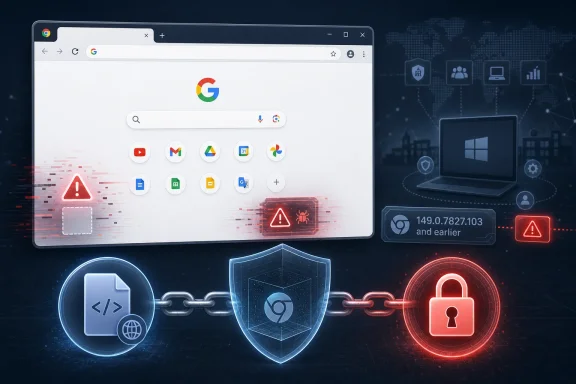 The New Tab Page Is No Longer Just Chrome’s Wallpaper
The phrase “New Tab Page” sounds almost quaint. For many users, it is the page with a search box, a few tiles, a background image, maybe some promotional content, and the faint suspicion that the browser vendor is trying to turn a blank canvas into real estate. But in Chromium, the New Tab Page is not merely a static placeholder. It is a privileged-feeling browser surface sitting at the intersection of local preferences, web UI, account state, search integration, and content supplied or influenced by the broader browser stack.That is why CVE-2026-11660 lands differently from a routine memory bug buried in a parser. The vulnerability is described as insufficient validation of untrusted input in the New Tab Page, mapped to CWE-20, the broad class of improper input validation. The attacker model is already constrained: the remote attacker must have compromised the renderer process first. But once that precondition is met, the flaw could potentially support a sandbox escape.
That caveat matters, but it should not lull anyone to sleep. Chrome’s renderer sandbox exists because the web is hostile by design: browsers deliberately process attacker-controlled HTML, CSS, JavaScript, images, video, fonts, and binary formats all day long. A bug that helps move from a compromised renderer toward more privileged territory is therefore not a side note. It is part of the boundary that keeps a malicious page from becoming a system-level incident.
The security severity assigned by Chromium is High, and CISA’s ADP scoring placed it at 8.3 under CVSS 3.1, with network attack vector, high attack complexity, no privileges required, user interaction required, changed scope, and high impact to confidentiality, integrity, and availability. That vector tells a story: this is not advertised as a trivial unauthenticated wormable bug, but it is potentially serious once paired with the right initial foothold.
The Precondition Is the Point, Not the Escape Hatch
The most common mistake in reading a CVE like this is to over-focus on the phrase “who had compromised the renderer process.” Some readers will hear that and mentally file the bug under “already compromised,” as though the vulnerability begins only after the battle is lost. Browser attackers do not think that way. They think in chains.A modern Chrome exploit chain often needs at least two pieces. First comes the bug that gets code execution or meaningful control inside the renderer, the sandboxed process tasked with handling web content. Then comes the bug that escapes containment, reaches a more privileged browser process, abuses an IPC boundary, or otherwise converts a web foothold into something more durable and dangerous. CVE-2026-11660 appears to live in that second category.
That distinction is important for Windows administrators because it changes how risk should be modeled. If a vulnerability requires a renderer compromise, it may not be the spear tip of an attack. It may instead be the blade behind the spear tip, the component that makes a successful initial exploit worth much more. A single CVE entry rarely captures that operational reality.
This is also why public exploit availability is only one signal. Google’s June 2026 Chrome update was already drawing attention because another flaw in the same release, CVE-2026-11645 in V8, was reportedly exploited in the wild. CVE-2026-11660 is not, based on the supplied record, described as exploited in the wild. But if a release contains both renderer-compromise-class bugs and sandbox-escape-class bugs, defenders should resist the urge to triage them in isolation.
In the browser world, the distance between “not known exploited” and “valuable in a chain” can be uncomfortably short. Attackers do not need every bug in a patch bundle to be independently famous. They need enough compatible primitives to get from a web page to something defenders care about.
Chrome 149’s Patch Train Carries More Than One Warning
The affected version line is straightforward: Google Chrome before 149.0.7827.103 is listed as vulnerable for CVE-2026-11660, with NVD showing affected Chrome configurations across Windows, Linux, and macOS. Google’s stable desktop update in early June 2026 moved users to the 149.0.7827.102/.103 family depending on platform, with the Chrome advisory referenced as the vendor source.That uneven-looking version notation is familiar to anyone who manages Chrome at scale. Stable channel versioning can differ slightly by platform, and vendor advisories often express patched builds as a pair rather than a single universal number. The practical instruction is less nuanced: get Chrome onto the current stable build for the platform and verify that the update actually landed.
For consumers, Chrome’s auto-update machinery usually does the work quietly. For IT teams, “usually” is not good enough. Managed Windows fleets can have browsers held back by update policies, packaging delays, golden images, VDI refresh cycles, application control rules, or the simple fact that Chrome needs a restart to finish applying an update. A patched installer sitting in a cache is not the same thing as a patched browser process running on endpoints.
The New Tab Page angle also undercuts a common user instinct. Many people imagine browser danger as something that happens only on obviously suspicious sites. But a crafted HTML page does not need to announce itself as malicious, and the user interaction requirement in the CVSS vector can be satisfied by ordinary browsing behavior. The chain may begin with a link, an ad, a compromised legitimate site, a watering-hole page, or a document that launches a browser session.
This is the mundane cruelty of browser security. The safer browsers become, the more attackers need chains. The more attackers need chains, the more defenders must treat “secondary” bugs as strategically important.
The Sandbox Is a Seatbelt, Not a Force Field
Chrome’s sandbox remains one of the major reasons drive-by web exploitation is harder today than it was in the plug-in-heavy browser era. It constrains what a compromised renderer can do, narrows access to system resources, and forces attackers to cross additional privilege boundaries. That design has raised the cost of exploitation across the industry.But a sandbox is not magic. It is a complicated set of process boundaries, broker decisions, IPC interfaces, validation routines, and assumptions about what untrusted content is allowed to influence. CVE-2026-11660 sits squarely in that philosophical space: untrusted input, insufficient validation, privileged-ish browser UI. The weakness class is not glamorous, but it is foundational.
Improper input validation bugs are security’s equivalent of bad plumbing. They do not always look spectacular in isolation, yet they become catastrophic when pressure builds in the wrong part of the system. If untrusted data can be shaped to influence a component that was designed with stronger assumptions, the attacker may be able to turn a minor trust mistake into a boundary violation.
For administrators, this is where severity labels can be both useful and misleading. “High” is serious enough to demand action, but it can sound routine in a month where Chrome ships dozens of fixes. The better lens is exploit utility. A sandbox escape candidate in a browser used across the enterprise deserves faster treatment than a similarly scored bug in a less exposed component.
The browser has become the universal client for work. It holds sessions to identity providers, admin consoles, SaaS dashboards, email, file stores, ticketing systems, source repositories, device management portals, and financial tools. A browser escape is not just a browser problem; it is a potential identity and data access problem.
Windows Shops Should Read This as a Chromium Event
WindowsForum readers will naturally ask what this means beyond Google Chrome. The CVE record supplied by NVD names Google Chrome CPEs, and the vendor advisory is Google’s Chrome release. That does not automatically mean every Chromium-based browser shipped the same vulnerable code in the same way, at the same time, or with the same exploitability. Chromium is a shared engine, but products differ in patch cadence, feature flags, UI surfaces, hardening, branding layers, and release branches.Still, the sensible operational stance is that Chromium vulnerabilities deserve a Chromium-wide inventory check. Microsoft Edge, Brave, Vivaldi, Opera, Electron-based applications, embedded WebView components, and managed app runtimes may all depend on Chromium-derived code in one form or another. Some will ingest fixes quickly; others will lag. Some may not expose the exact affected surface; others may carry adjacent risk.
For Windows administrators, Edge deserves special attention because it is present by default on modern Windows systems and often allowed through enterprise controls even when Chrome is not formally supported. Microsoft generally publishes Edge security updates that incorporate Chromium fixes, but enterprises still need to verify installed versions and release channels. Stable, Extended Stable, Beta, Dev, and application-embedded runtimes do not all move at the same tempo.
This is one of the less glamorous consequences of the Chromium monoculture. The industry benefits when security fixes land in one upstream project and flow outward. The industry also inherits a synchronized patch race whenever a serious upstream bug appears. A vulnerability in a shared browser foundation can become a coordination exercise across vendors, admins, software packagers, and users.
The right question is not “Does this CVE mention my browser’s name?” The right question is “Where do we run Chromium code, who updates it, and how do we know the fixed build is active?” In many organizations, that answer is messier than the asset inventory suggests.
NVD’s Incomplete Scoring Is Not a Permission Slip
The supplied NVD entry shows no NIST CVSS 4.0, 3.x, or 2.0 base score at the time of enrichment, while CISA-ADP contributed a CVSS 3.1 score of 8.3 High. That split is not unusual. NVD enrichment often trails vendor disclosure, and CPE configuration data can arrive before a full NVD vector. The absence of a NIST base score should not be confused with the absence of risk.This is a recurring trap in vulnerability management programs that over-automate around a single field. If a scanner or dashboard relies only on NVD’s completed scoring, a newly published vulnerability can appear underweighted during precisely the window when patch urgency is highest. Vendor severity, exploit context, affected surface, and chained exploit potential all matter before the database record looks tidy.
CVE-2026-11660 is a good example of why mature teams use multiple signals. Chromium rates it High. CISA-ADP scores it 8.3. The description includes sandbox escape potential. The affected product is a mass-deployed browser. The attack vector is remote, and the exploit path involves crafted HTML. Those facts are enough to prioritize remediation even without a final NIST vector.
The CPE detail is also worth reading carefully. NVD’s initial analysis lists Chrome versions up to, but excluding, 149.0.7827.103, alongside operating system CPEs for Windows, Linux, and macOS as part of the affected configuration. That does not mean Windows itself is vulnerable in the same way Chrome is vulnerable. It means vulnerable Chrome is modeled in the context of those operating systems.
That distinction matters for communication. Security teams should avoid telling users “Windows has this CVE” when the affected application is Chrome. But they should also avoid minimizing it just because it is “only the browser.” On a Windows endpoint, the browser is often the highest-value userland target.
The New Tab Page Is a Trust Boundary Wearing Consumer Clothing
Browser vendors have spent years turning internal pages into polished user experiences. The New Tab Page, settings pages, extension stores, sync prompts, password managers, history views, sidebars, AI surfaces, and account hubs all sit somewhere between “web page” and “browser control panel.” They look like ordinary UI, but under the hood they often have special permissions, special data flows, or special integration with browser services.That hybrid nature is convenient and risky. Web technologies make these surfaces fast to build and easy to iterate. But web-like UI also invites web-like threat models, especially when untrusted input can cross into a context that developers mentally categorize as browser-owned. Every time a browser surface displays remote content, user-controlled strings, search suggestions, tiles, previews, logos, or metadata, validation becomes a security boundary.
CVE-2026-11660 does not give us public bug details from the restricted Chromium issue. That is normal; vendors often limit access until enough users have updated. But the public description is enough to infer the broad class of failure: something about untrusted input reaching the New Tab Page was not validated sufficiently, and after renderer compromise it could potentially help break out of the sandbox.
This is why browser hardening cannot be reduced to memory safety alone. Memory corruption bugs still matter enormously, as V8 and graphics stack vulnerabilities remind us every month. But logic, validation, privilege, and trust-boundary mistakes are just as important in a browser that increasingly behaves like an operating system for web apps.
The New Tab Page is a particularly symbolic place for such a bug because it represents the browser vendor’s ambition. It is where search, identity, recommendations, shortcuts, branding, and now sometimes AI-adjacent features converge. The more the page does, the more it must be treated like attack surface rather than decoration.
Enterprise Patch Management Still Trips Over the Restart
Chrome’s update model is one of the better ones in consumer software, but enterprise reality has a way of defeating elegant systems. A user can run a vulnerable browser for days after an update downloads if the process never restarts. On shared workstations, kiosks, call-center desktops, and developer machines with long-running sessions, this is not hypothetical.Managed environments should therefore treat the patch as a two-step event: deliver the fixed build, then close the execution gap. Browser relaunch prompts, forced restarts after a grace period, endpoint compliance checks, and telemetry from management tools matter. So does communication that is specific enough to be useful: users should know that leaving the browser open can keep an old vulnerable process alive.
There is also a packaging lag problem. Third-party patch management platforms, software deployment rings, and enterprise app catalogs may not receive or approve the latest Chrome build at the same moment Google publishes it. That delay is understandable, especially when organizations test browser compatibility with internal apps. But with browser security fixes, the default should be rapid rings and rollback readiness, not leisurely certification.
For high-risk users, administrators may want to go further. Journalists, executives, finance staff, developers with production access, help desk personnel, and administrators with privileged SaaS sessions are disproportionately valuable targets. If a browser patch contains sandbox escape potential, those users should be in the first enforcement wave, not the last.
The same logic applies to non-persistent desktops and images. Updating the running endpoint is not enough if the base image reintroduces the vulnerable build at next logon. Browser patching is not complete until images, deployment packages, and compliance baselines all agree.
CVE-2026-11660 Is a Reminder That “User Interaction Required” Is Doing Too Much Work
The CVSS vector includes user interaction required, which can sound reassuring. It should not. In browser vulnerabilities, user interaction often means the victim visits or is induced to visit a crafted page. That is the core operating model of the web, not an exotic social-engineering hurdle.Attackers have many ways to create that interaction. They can send links, compromise legitimate sites, buy malicious ads, poison search results, seed forums, abuse redirects, or attach HTML content to workflows that users already trust. A browser exploit does not need a user to disable security controls or run an executable. It may only need normal browsing.
To be clear, CVE-2026-11660’s public description does not say it is being exploited in the wild. It also does not say it alone gives an attacker code execution from scratch. But defenders who focus only on those two caveats are reading the CVE like a legal disclaimer rather than a threat model. The risk is the combination of mass exposure, web delivery, sandbox escape potential, and patch availability.
This is the reason Chrome security advisories often feel repetitive. Every few weeks, users are told to update because a crafted HTML page can trigger something bad. The repetition can numb people. But it also reflects the browser’s reality: Chrome is one of the most intensively attacked and intensively defended pieces of software in the world.
The correct response is not panic. It is disciplined impatience. Patch quickly, verify version state, restart the browser, and keep watching for downstream Chromium-based updates.
The Quiet Lesson Is About Input Validation at Privilege Boundaries
CWE-20 is a broad weakness, but broad does not mean trivial. Improper input validation is the bug class that appears when a component accepts data without proving it is safe for the context in which it will be used. In a browser, context is everything.An input that is harmless in a sandboxed renderer may be dangerous when reflected into a privileged UI surface. A string that is safe as display text may be unsafe as markup, script-adjacent data, a URL, a command parameter, a policy decision, or an IPC payload. A value that appears to come from the browser may have been influenced by web content earlier in the chain.
This is where the New Tab Page becomes instructive for developers beyond Chromium. Modern applications increasingly blur web UI and native privilege. Electron apps, WebView2-based enterprise tools, admin dashboards, hybrid desktop clients, and internal portals all make similar bets. They use web technologies for speed and consistency, then connect them to local capabilities, credentials, files, or privileged APIs.
The security rule is simple but hard to execute: trust must not follow convenience. If data originates from a renderer, a web page, a remote service, a user profile, sync state, or any place an attacker can influence, it needs validation at the boundary where privilege changes. Sanitizing once upstream is not enough if downstream components reinterpret the data.
CVE-2026-11660 is therefore more than a Chrome patch notice. It is a case study in how small trust mistakes can matter when they sit near the browser’s internal seams.
The Patch Window Is Where Policy Meets Reality
For home users, the advice remains boring and effective: open Chrome’s About page, let it check for updates, and relaunch. Boring is good. Most security wins are not cinematic; they are the result of millions of endpoints quietly moving to a fixed build before attackers can scale exploitation.For organizations, the advice is more pointed. Inventory every Chrome installation, confirm the version is at or beyond the fixed stable release for the platform, verify browser restarts, and check whether Chromium-based alternatives have shipped corresponding fixes. If your vulnerability management workflow waits for a NIST score before acting, this is a useful moment to revisit that policy.
The more interesting policy question is how to treat chained-risk vulnerabilities. A sandbox escape candidate may not trigger the same automation as a known exploited zero-day, especially if the CVE itself lacks public exploitation reports. But when it arrives in the same general patch cycle as other serious browser bugs, including a reported in-the-wild V8 issue, the security value of delay is hard to defend.
Browser updates also deserve a different service-level agreement than many desktop applications. A PDF utility or line-of-business helper app may justify a slower test cycle. A mass-deployed browser that processes hostile content by design does not. If the browser is the front door to work, its patch cadence must look more like an exposed service than a convenience app.
That is an uncomfortable shift for organizations still built around monthly patch rituals. Chrome, Edge, and the broader Chromium ecosystem do not politely wait for Patch Tuesday. Attackers do not either.
The Practical Read for WindowsForum Readers Is Written in Version Numbers
CVE-2026-11660 is not the loudest Chrome bug of June 2026, but it is exactly the kind that separates checkbox patching from serious endpoint defense. The concrete actions are simple, and the interpretation is the part that matters.- Chrome installations should be updated to the current stable build, with versions before 149.0.7827.103 treated as exposed for this CVE according to the public record.
- Administrators should verify that Chrome has restarted after updating, because a downloaded update does not protect a still-running vulnerable browser process.
- Windows fleets should inventory Chromium-based browsers and embedded runtimes rather than assuming the Google Chrome CPE captures every practical exposure.
- Security teams should treat the lack of a completed NVD score as a data-lag issue, not as evidence that the vulnerability can wait.
- CVE-2026-11660 should be prioritized as a potential sandbox-escape link in a chain, especially in environments with high-value browser sessions and privileged SaaS access.
References
- Primary source: NVD / Chromium
Published: 2026-06-15T19:14:15-07:00
NVD - CVE-2026-11660
 nvd.nist.gov
- Security advisory: MSRC
Published: 2026-06-15T19:14:15-07:00
Original feed URL
Security Update Guide - Microsoft Security Response Center
 msrc.microsoft.com
