

Google disclosed CVE-2026-12017 on June 11, 2026, as a high-severity Chrome Extensions flaw fixed in Chrome 149.0.7827.114/.115 for desktop, where a compromised renderer could use a crafted HTML page to bypass site isolation. The dry wording makes it sound like just another browser bulletin, but the interesting part is the chain implied by the description: this is not a garden-variety extension bug, and it is not a standalone remote-code-execution story. It is a containment failure, and containment failures are where modern browser security gets uncomfortable. For Windows users and administrators, the practical answer is simple—update Chrome and Chromium-based browsers—but the more important lesson is that version strings, CPE records, and severity scores can lag behind the actual risk model.
CVE-2026-12017 sits in a part of Chrome that has always been both powerful and awkward: Extensions. Extensions are supposed to be fenced by manifests, permissions, content-script boundaries, site isolation, process separation, and increasingly strict browser APIs. They are also, by design, allowed to sit close to the user’s browsing life in ways ordinary web pages are not.
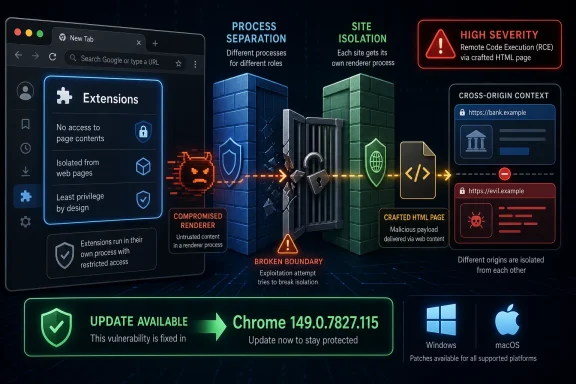
That is why “inappropriate implementation in Extensions” is not a throwaway phrase. In Chrome security language, it usually means the browser did not enforce a boundary correctly in some specific edge case. The description says the attacker first needed to compromise the renderer process, then use a crafted HTML page to bypass site isolation.
That prerequisite matters. This CVE is not described as “visit a page and immediately lose the machine.” It is described as a post-renderer-compromise escape from one of Chrome’s most important defensive layers. But that does not make it irrelevant. Browser exploitation in 2026 is rarely one clean bug; it is a chain, and chains are built out of exactly this kind of boundary failure.
Site isolation is meant to keep data from different sites in separate renderer processes so that a compromised renderer cannot freely read across origins. If a renderer compromise is the opening move, a site isolation bypass is the move that turns a contained wound into a broader privacy and account-compromise problem. That is why Chromium rated the issue High even while the CISA-ADP CVSS vector lands at a surprisingly modest 3.1 Low.
The discrepancy is not necessarily a contradiction. CVSS rewards certain direct-impact patterns and penalizes attack complexity and required user interaction. Browser vendors, meanwhile, tend to score bugs in the context of exploit chains and security architecture. In Chrome’s world, a bug that weakens site isolation after renderer compromise may be less dramatic than a fresh sandbox escape, but it still attacks one of the pillars that makes the browser survivable.
The vendor advisory for this Chrome stable update lists the desktop channel moving to 149.0.7827.114/.115 for Windows and Mac, and 149.0.7827.114 for Linux. That split is normal for Chrome releases: the same stable-channel update may carry slightly different build numbers across platforms or packaging tracks. But CVE databases have to turn that reality into machine-readable applicability statements, and the result is often less elegant than the release note.
So are we missing a CPE? Possibly, but the bigger issue is not simply “one absent CPE.” It is that the CPE model struggles to express platform-specific Chrome build cutoffs cleanly when Windows and macOS may have both .114 and .115 builds in the same release train while Linux stops at .114. A scanner that interprets “less than 149.0.7827.114” too literally could under-report Windows or Mac systems sitting on a vulnerable .114 build if .115 is the actual safe floor for that platform. Conversely, a scanner that treats .114 as universally vulnerable after the vendor’s advisory says Linux .114 is patched could over-report Linux fleets.
This is where IT teams should resist the temptation to treat NVD enrichment as gospel on day one. The CVE was still marked as undergoing reanalysis, and the NVD entry had no NIST CVSS score at the time of the supplied record. The CISA-ADP vector was present, Chrome’s CWE-20 classification was present, and NVD had added its own “insufficient information” weakness placeholder. That is useful metadata, but it is not yet a clean operational truth.
For patch policy, the safer interpretation is straightforward: for Windows and macOS, target Chrome 149.0.7827.115 or later where that build is offered; for Linux, 149.0.7827.114 or later appears to be the fixed stable-channel line. In managed environments, the dashboard should be checked against the actual installed Chrome version, not just the CPE string attached to a still-settling NVD record.
But browser bugs do not live on paper. A renderer compromise is not hypothetical in the browser world; it is a common first stage in more serious exploit chains. Attackers who can already compromise a renderer are trying to answer the next question: what can they reach from there? If the answer is “more cross-site data than site isolation should permit,” the impact becomes more interesting than a single line in CVSS suggests.
The description’s “bypass site isolation” phrase is doing most of the work here. Site isolation was not added to Chrome as a decorative hardening measure. It was a response to the reality that speculative execution attacks, renderer bugs, and complex web platform features made origin boundaries too important to leave entirely inside one renderer’s address space.
A bypass does not automatically mean password theft, mail theft, or session hijacking in every scenario. The public record does not provide enough detail to claim that. The Chromium issue is permission-restricted, which is also normal while users are still updating. But the category points toward confidentiality risk, and confidentiality risk inside a logged-in browser is rarely academic.
This is why browser vendors’ own severity labels often deserve more weight than generic scoring in the first days after disclosure. Chrome called this High. The NVD entry was incomplete. CISA-ADP called it Low under CVSS. Administrators should understand all three facts, but they should not average them into complacency.
Chrome’s security architecture assumes that renderer compromise can happen. The renderer handles enormous amounts of hostile content: JavaScript, HTML, CSS, images, media, fonts, WebAssembly, and a steady parade of edge-case APIs. The browser process, sandbox, site isolation, extension boundaries, and permission checks exist because the renderer is treated as dangerous territory.
That is the point of defense in depth. A renderer bug should not automatically let an attacker read every site open in the browser, escape the sandbox, install software, or impersonate every extension. Each boundary should force the attacker to find another bug. CVE-2026-12017 is concerning because it appears to weaken one of those subsequent boundaries.
This also explains why the exploitability story is not the same as the user story. A user may only see “Chrome update available.” A security engineer sees a potentially chainable primitive: combine a renderer exploit with a site isolation bypass, add a victim already authenticated into cloud apps, and suddenly a nominally “low” confidentiality impact starts looking more like a practical enterprise incident.
There is no public indication in the supplied CVE text that CVE-2026-12017 has been exploited in the wild. That distinction matters, especially because Google had patched a separate Chrome zero-day days earlier in the same 149 release family. The proximity of those updates can easily blur in headlines and scanner chatter. CVE-2026-12017 should be treated as urgent because Chrome patches are urgent, not because the public record currently says this specific bug is under active exploitation.
Chrome’s extension platform has changed substantially over the years, especially with Manifest V3 and tighter controls on background behavior. The security direction is clear: reduce persistent power, narrow APIs, and make permission grants more visible and less abusable. But the platform remains a negotiated compromise between capability and safety.
That compromise is visible in this CVE. A bug in Extensions that interacts with site isolation suggests the boundary between extension logic, page content, and renderer process assumptions was not quite where it needed to be. Without the restricted Chromium issue, we cannot say exactly which code path failed. We can say that extension plumbing is a sensitive place for mistakes because it crosses contexts ordinary web content should not cross.
For enterprise administrators, this should reinforce an old but often ignored policy: extension governance is browser security. It is not just a productivity preference. Allowing unmanaged extensions across a corporate fleet increases the number of privileged browser components that can interact with sensitive pages, identity systems, and internal web apps.
That does not mean every extension is dangerous or that organizations should ban them wholesale. It means extension allowlisting, permission review, automatic removal of abandoned extensions, and separation between personal and work browser profiles belong in the same conversation as endpoint detection and patch SLAs. Chrome vulnerabilities remind us that the browser is no longer “just an app.” It is the place where the company logs in.
Here, the record appears to model Chrome as the vulnerable application and then bind it to Windows, Linux, and macOS as operating-system platforms. The listed Chrome CPE excludes versions before 149.0.7827.114, while the description says prior to 149.0.7827.115. That is an immediate sign that enrichment is not fully settled or that the CPE expression is trying to collapse a platform-specific release into one threshold.
In a perfect database, the applicability statement would distinguish Windows and macOS builds from Linux builds cleanly. In the real world, the NVD pipeline receives vendor data, adds analysis, changes weakness mappings, and may revise affected configurations after publication. During that window, scanners can disagree even when they are all “using NVD.”
The practical consequence is noisy patch management. One tool may declare Chrome 149.0.7827.114 safe because the CPE cutoff says excluding .114. Another may declare it vulnerable because the CVE prose says prior to .115. A third may key off Google’s platform-specific stable-channel advisory and make a more nuanced determination. None of this is rare; it is the normal messiness of vulnerability intelligence meeting real software release engineering.
Administrators should document the decision they make. If the fleet is Windows-heavy, set the compliance target at 149.0.7827.115 or later and avoid the ambiguity. If the fleet includes Linux, validate against Google’s Linux build line rather than forcing a Windows build number onto packages where it may not exist. If a scanner continues to flag or miss systems incorrectly, override with a local policy note until the upstream CPE data settles.
That model is increasingly insufficient. Chrome is an identity client, a SaaS shell, a document viewer, an extension runtime, a password manager host, and often the most exposed application on the machine. A site isolation bypass is not merely a browser bug; it is a possible route around the compartmentalization that keeps one logged-in context from bleeding into another.
The Windows angle is also broader than Google Chrome. Microsoft Edge shares Chromium foundations, though Edge advisories and version numbers follow Microsoft’s own release process. Other Chromium-based browsers may consume upstream fixes on different timelines. A Chrome CVE should therefore trigger a Chromium-family review, not a single-product checkbox.
For managed Windows environments, the useful questions are concrete. Are Chrome updates pinned by policy? Are browser restarts enforced or merely requested? Are users allowed to run side-by-side unmanaged Chrome channels? Are extensions centrally governed? Are kiosk, VDI, and server-hosted browser sessions patched on the same cadence as laptops?
The restart question deserves special attention. Chrome can download an update without fully applying it to every running process until restart. In an enterprise full of users who keep browsers open for weeks, “update installed” and “patched browser actually running” can be different states. CVE-2026-12017 is a reminder that the final mile of browser patching is not package deployment; it is process replacement.
But restricted access is also standard practice for browser vulnerabilities while patches roll out. A detailed public issue can become a recipe for exploit development, especially when the bug lives in a widely deployed component and older builds remain common. Browser vendors are balancing transparency against the reality that not every endpoint updates within hours.
The downside is that defenders must make decisions with partial information. They know the component, the affected version range, the general impact, and the fixed release. They do not know the exact trigger, whether a malicious extension is involved, whether a benign extension configuration increases exposure, or what cross-origin data might be reachable after bypass.
That uncertainty should not paralyze the response. It should narrow it. Patch first, verify versions second, review extensions third, and watch for later technical write-ups after the majority of users have updated. The deeper root-cause lesson can wait; the deployment lesson cannot.
There is also a media literacy point here. When public vulnerability records are sparse, secondary sites often pad the gap with speculative consequences. Some of those consequences may be plausible, but plausible is not the same as confirmed. With CVE-2026-12017, the confirmed facts are enough to justify action without inventing a more dramatic story.
That chronology matters because security teams often ingest “Chrome critical/high update” as a single blob. If one CVE in the week is exploited and another is not known to be exploited, the distinction can disappear in ticket queues. The result is either overstatement in user communications or understatement in executive summaries.
The better approach is to separate urgency from evidence. Chrome browser updates should move quickly because the attack surface is huge and exploit chains are common. But a specific claim of active exploitation should be attached only to the CVE for which the vendor or a credible advisory says so. In this case, CVE-2026-12017 is serious as a boundary-bypass bug, not publicly confirmed as an in-the-wild zero-day.
This precision is not pedantry. It affects incident response. If a CVE is actively exploited, teams may hunt for indicators, preserve logs, and prioritize high-risk users differently. If it is a high-severity patch without known exploitation, the priority may still be rapid deployment, but not necessarily a breach investigation.
Chrome’s release tempo makes that discipline harder. The browser can ship hundreds of security fixes across a major train and then follow with smaller stable-channel updates days later. The patch stream is healthy, but the advisory stream can feel like weather: constant, technical, and easy to tune out until something breaks.
For administrators, the fix is less about one laptop and more about proof. A vulnerability ticket should not close merely because the update was approved. It should close when telemetry shows the vulnerable browser process is gone from the fleet. That may require restart enforcement, user prompting, maintenance windows, or conditional access policies for stale browsers.
Extension policy is the second half of the response. Because this CVE lives in Extensions, organizations should use the patch window as an excuse to review what is installed. The goal is not panic removal. The goal is to reduce unnecessary privileged code in the browser and make sure business-critical extensions are still maintained, still needed, and still aligned with least privilege.
Security teams should also validate Chromium derivatives. Edge, Brave, Vivaldi, Opera, Electron-based apps, and embedded Chromium runtimes do not all update through Chrome’s mechanism. Not every upstream Chrome CVE maps to every downstream product in the same way, but the dependency is close enough that “we patched Chrome” is not the same as “we addressed Chromium exposure.”
The most mature organizations will turn this into a control test. How long did it take from advisory publication to patched browser restart across 90 percent of endpoints? Which systems lagged? Which business units had unmanaged extensions? Which scanners disagreed because of the CPE ambiguity? Those answers are more valuable than a one-time scramble.
The CVE shows that modern browser risk is architectural. A renderer compromise is bad, but it is expected; site isolation is supposed to contain it; extension code complicates the boundary; and a bug in that interaction can matter more than the headline CVSS score suggests. That is the pattern defenders should see.
It also shows that vulnerability data is not a finished product at publication time. The NVD entry’s reanalysis status, missing NIST score, mixed CWE treatment, and questionable version cutoff are not edge cases. They are reminders that automated vulnerability management is only as good as the assumptions encoded in its feeds.
Most importantly, it shows that Windows endpoint security now depends heavily on browser operations. Patch cadence, restart compliance, extension control, SaaS session hygiene, and Chromium derivative tracking are all part of the same surface. The days when browser updates were a consumer convenience are over.
 Chrome’s Extension Layer Is Again Where Isolation Gets Messy
CVE-2026-12017 sits in a part of Chrome that has always been both powerful and awkward: Extensions. Extensions are supposed to be fenced by manifests, permissions, content-script boundaries, site isolation, process separation, and increasingly strict browser APIs. They are also, by design, allowed to sit close to the user’s browsing life in ways ordinary web pages are not.That is why “inappropriate implementation in Extensions” is not a throwaway phrase. In Chrome security language, it usually means the browser did not enforce a boundary correctly in some specific edge case. The description says the attacker first needed to compromise the renderer process, then use a crafted HTML page to bypass site isolation.
That prerequisite matters. This CVE is not described as “visit a page and immediately lose the machine.” It is described as a post-renderer-compromise escape from one of Chrome’s most important defensive layers. But that does not make it irrelevant. Browser exploitation in 2026 is rarely one clean bug; it is a chain, and chains are built out of exactly this kind of boundary failure.
Site isolation is meant to keep data from different sites in separate renderer processes so that a compromised renderer cannot freely read across origins. If a renderer compromise is the opening move, a site isolation bypass is the move that turns a contained wound into a broader privacy and account-compromise problem. That is why Chromium rated the issue High even while the CISA-ADP CVSS vector lands at a surprisingly modest 3.1 Low.
The discrepancy is not necessarily a contradiction. CVSS rewards certain direct-impact patterns and penalizes attack complexity and required user interaction. Browser vendors, meanwhile, tend to score bugs in the context of exploit chains and security architecture. In Chrome’s world, a bug that weakens site isolation after renderer compromise may be less dramatic than a fresh sandbox escape, but it still attacks one of the pillars that makes the browser survivable.
The Version Number Tells a More Complicated Story Than the CVE Summary
The CVE description says Chrome prior to 149.0.7827.115 is affected. The NVD change history, however, records a CPE configuration for Google Chrome versions up to but excluding 149.0.7827.114, paired with operating-system CPEs for Windows, Linux, and macOS. That mismatch is exactly the kind of detail that trips up vulnerability scanners and patch dashboards.The vendor advisory for this Chrome stable update lists the desktop channel moving to 149.0.7827.114/.115 for Windows and Mac, and 149.0.7827.114 for Linux. That split is normal for Chrome releases: the same stable-channel update may carry slightly different build numbers across platforms or packaging tracks. But CVE databases have to turn that reality into machine-readable applicability statements, and the result is often less elegant than the release note.
So are we missing a CPE? Possibly, but the bigger issue is not simply “one absent CPE.” It is that the CPE model struggles to express platform-specific Chrome build cutoffs cleanly when Windows and macOS may have both .114 and .115 builds in the same release train while Linux stops at .114. A scanner that interprets “less than 149.0.7827.114” too literally could under-report Windows or Mac systems sitting on a vulnerable .114 build if .115 is the actual safe floor for that platform. Conversely, a scanner that treats .114 as universally vulnerable after the vendor’s advisory says Linux .114 is patched could over-report Linux fleets.
This is where IT teams should resist the temptation to treat NVD enrichment as gospel on day one. The CVE was still marked as undergoing reanalysis, and the NVD entry had no NIST CVSS score at the time of the supplied record. The CISA-ADP vector was present, Chrome’s CWE-20 classification was present, and NVD had added its own “insufficient information” weakness placeholder. That is useful metadata, but it is not yet a clean operational truth.
For patch policy, the safer interpretation is straightforward: for Windows and macOS, target Chrome 149.0.7827.115 or later where that build is offered; for Linux, 149.0.7827.114 or later appears to be the fixed stable-channel line. In managed environments, the dashboard should be checked against the actual installed Chrome version, not just the CPE string attached to a still-settling NVD record.
The Low CVSS Score Is a Bad Shortcut for Browser Risk
A CVSS 3.1 base score of 3.1 Low looks reassuring until you read the attack story. The vector indicates network attack vector, high attack complexity, no privileges required, user interaction required, unchanged scope, low confidentiality impact, and no integrity or availability impact. On paper, that is a small box.But browser bugs do not live on paper. A renderer compromise is not hypothetical in the browser world; it is a common first stage in more serious exploit chains. Attackers who can already compromise a renderer are trying to answer the next question: what can they reach from there? If the answer is “more cross-site data than site isolation should permit,” the impact becomes more interesting than a single line in CVSS suggests.
The description’s “bypass site isolation” phrase is doing most of the work here. Site isolation was not added to Chrome as a decorative hardening measure. It was a response to the reality that speculative execution attacks, renderer bugs, and complex web platform features made origin boundaries too important to leave entirely inside one renderer’s address space.
A bypass does not automatically mean password theft, mail theft, or session hijacking in every scenario. The public record does not provide enough detail to claim that. The Chromium issue is permission-restricted, which is also normal while users are still updating. But the category points toward confidentiality risk, and confidentiality risk inside a logged-in browser is rarely academic.
This is why browser vendors’ own severity labels often deserve more weight than generic scoring in the first days after disclosure. Chrome called this High. The NVD entry was incomplete. CISA-ADP called it Low under CVSS. Administrators should understand all three facts, but they should not average them into complacency.
“Compromised Renderer” Is a Prerequisite, Not a Comfort Blanket
The phrase “remote attacker who had compromised the renderer process” may cause some readers to shrug. If the renderer is already compromised, hasn’t the attacker already won? In modern Chrome, the answer is no—or at least, not necessarily.Chrome’s security architecture assumes that renderer compromise can happen. The renderer handles enormous amounts of hostile content: JavaScript, HTML, CSS, images, media, fonts, WebAssembly, and a steady parade of edge-case APIs. The browser process, sandbox, site isolation, extension boundaries, and permission checks exist because the renderer is treated as dangerous territory.
That is the point of defense in depth. A renderer bug should not automatically let an attacker read every site open in the browser, escape the sandbox, install software, or impersonate every extension. Each boundary should force the attacker to find another bug. CVE-2026-12017 is concerning because it appears to weaken one of those subsequent boundaries.
This also explains why the exploitability story is not the same as the user story. A user may only see “Chrome update available.” A security engineer sees a potentially chainable primitive: combine a renderer exploit with a site isolation bypass, add a victim already authenticated into cloud apps, and suddenly a nominally “low” confidentiality impact starts looking more like a practical enterprise incident.
There is no public indication in the supplied CVE text that CVE-2026-12017 has been exploited in the wild. That distinction matters, especially because Google had patched a separate Chrome zero-day days earlier in the same 149 release family. The proximity of those updates can easily blur in headlines and scanner chatter. CVE-2026-12017 should be treated as urgent because Chrome patches are urgent, not because the public record currently says this specific bug is under active exploitation.
Extensions Remain the Browser’s Privileged Middle Class
Extensions occupy a strange social class inside the browser. They are not the operating system, but they often observe the user’s relationship with the web more intimately than the OS does. Password managers, ad blockers, screenshot tools, grammar checkers, developer helpers, identity agents, and corporate compliance add-ons all rely on extension privileges.Chrome’s extension platform has changed substantially over the years, especially with Manifest V3 and tighter controls on background behavior. The security direction is clear: reduce persistent power, narrow APIs, and make permission grants more visible and less abusable. But the platform remains a negotiated compromise between capability and safety.
That compromise is visible in this CVE. A bug in Extensions that interacts with site isolation suggests the boundary between extension logic, page content, and renderer process assumptions was not quite where it needed to be. Without the restricted Chromium issue, we cannot say exactly which code path failed. We can say that extension plumbing is a sensitive place for mistakes because it crosses contexts ordinary web content should not cross.
For enterprise administrators, this should reinforce an old but often ignored policy: extension governance is browser security. It is not just a productivity preference. Allowing unmanaged extensions across a corporate fleet increases the number of privileged browser components that can interact with sensitive pages, identity systems, and internal web apps.
That does not mean every extension is dangerous or that organizations should ban them wholesale. It means extension allowlisting, permission review, automatic removal of abandoned extensions, and separation between personal and work browser profiles belong in the same conversation as endpoint detection and patch SLAs. Chrome vulnerabilities remind us that the browser is no longer “just an app.” It is the place where the company logs in.
The CPE Confusion Is a Real Operational Problem
The user-supplied NVD record asks, in effect, whether a CPE is missing. That is the right instinct, because security operations depend on these mappings more than most users realize. A CVE description is prose; a CPE configuration is what many tools use to decide whether a machine is affected.Here, the record appears to model Chrome as the vulnerable application and then bind it to Windows, Linux, and macOS as operating-system platforms. The listed Chrome CPE excludes versions before 149.0.7827.114, while the description says prior to 149.0.7827.115. That is an immediate sign that enrichment is not fully settled or that the CPE expression is trying to collapse a platform-specific release into one threshold.
In a perfect database, the applicability statement would distinguish Windows and macOS builds from Linux builds cleanly. In the real world, the NVD pipeline receives vendor data, adds analysis, changes weakness mappings, and may revise affected configurations after publication. During that window, scanners can disagree even when they are all “using NVD.”
The practical consequence is noisy patch management. One tool may declare Chrome 149.0.7827.114 safe because the CPE cutoff says excluding .114. Another may declare it vulnerable because the CVE prose says prior to .115. A third may key off Google’s platform-specific stable-channel advisory and make a more nuanced determination. None of this is rare; it is the normal messiness of vulnerability intelligence meeting real software release engineering.
Administrators should document the decision they make. If the fleet is Windows-heavy, set the compliance target at 149.0.7827.115 or later and avoid the ambiguity. If the fleet includes Linux, validate against Google’s Linux build line rather than forcing a Windows build number onto packages where it may not exist. If a scanner continues to flag or miss systems incorrectly, override with a local policy note until the upstream CPE data settles.
Windows Fleets Should Treat Browser Patch Drift as Identity Risk
On Windows, Chrome updates are usually fast, quiet, and successful. That is exactly why organizations sometimes stop watching them closely. The browser updates itself, the endpoint agent reports green, and the help desk only hears about Chrome when a web app breaks.That model is increasingly insufficient. Chrome is an identity client, a SaaS shell, a document viewer, an extension runtime, a password manager host, and often the most exposed application on the machine. A site isolation bypass is not merely a browser bug; it is a possible route around the compartmentalization that keeps one logged-in context from bleeding into another.
The Windows angle is also broader than Google Chrome. Microsoft Edge shares Chromium foundations, though Edge advisories and version numbers follow Microsoft’s own release process. Other Chromium-based browsers may consume upstream fixes on different timelines. A Chrome CVE should therefore trigger a Chromium-family review, not a single-product checkbox.
For managed Windows environments, the useful questions are concrete. Are Chrome updates pinned by policy? Are browser restarts enforced or merely requested? Are users allowed to run side-by-side unmanaged Chrome channels? Are extensions centrally governed? Are kiosk, VDI, and server-hosted browser sessions patched on the same cadence as laptops?
The restart question deserves special attention. Chrome can download an update without fully applying it to every running process until restart. In an enterprise full of users who keep browsers open for weeks, “update installed” and “patched browser actually running” can be different states. CVE-2026-12017 is a reminder that the final mile of browser patching is not package deployment; it is process replacement.
Google’s Restricted Bug Tracker Is Not Secrecy for Its Own Sake
The Chromium issue linked from the CVE is permission-restricted, which frustrates researchers and administrators who want details. That frustration is understandable. It is hard to assess exposure when the most interesting technical facts are withheld.But restricted access is also standard practice for browser vulnerabilities while patches roll out. A detailed public issue can become a recipe for exploit development, especially when the bug lives in a widely deployed component and older builds remain common. Browser vendors are balancing transparency against the reality that not every endpoint updates within hours.
The downside is that defenders must make decisions with partial information. They know the component, the affected version range, the general impact, and the fixed release. They do not know the exact trigger, whether a malicious extension is involved, whether a benign extension configuration increases exposure, or what cross-origin data might be reachable after bypass.
That uncertainty should not paralyze the response. It should narrow it. Patch first, verify versions second, review extensions third, and watch for later technical write-ups after the majority of users have updated. The deeper root-cause lesson can wait; the deployment lesson cannot.
There is also a media literacy point here. When public vulnerability records are sparse, secondary sites often pad the gap with speculative consequences. Some of those consequences may be plausible, but plausible is not the same as confirmed. With CVE-2026-12017, the confirmed facts are enough to justify action without inventing a more dramatic story.
The Same Week’s Chrome Noise Makes Precision More Important
CVE-2026-12017 arrived in a noisy Chrome patch cycle. Earlier in June, Google addressed another Chrome issue, CVE-2026-11645, described publicly as a V8 flaw with exploitation in the wild. Then came the 149.0.7827.114/.115 desktop update with a larger set of fixes, including this Extensions-site-isolation issue.That chronology matters because security teams often ingest “Chrome critical/high update” as a single blob. If one CVE in the week is exploited and another is not known to be exploited, the distinction can disappear in ticket queues. The result is either overstatement in user communications or understatement in executive summaries.
The better approach is to separate urgency from evidence. Chrome browser updates should move quickly because the attack surface is huge and exploit chains are common. But a specific claim of active exploitation should be attached only to the CVE for which the vendor or a credible advisory says so. In this case, CVE-2026-12017 is serious as a boundary-bypass bug, not publicly confirmed as an in-the-wild zero-day.
This precision is not pedantry. It affects incident response. If a CVE is actively exploited, teams may hunt for indicators, preserve logs, and prioritize high-risk users differently. If it is a high-severity patch without known exploitation, the priority may still be rapid deployment, but not necessarily a breach investigation.
Chrome’s release tempo makes that discipline harder. The browser can ship hundreds of security fixes across a major train and then follow with smaller stable-channel updates days later. The patch stream is healthy, but the advisory stream can feel like weather: constant, technical, and easy to tune out until something breaks.
The Right Fix Is Boring, Which Is Why It Works
For individual users, the fix is the familiar Chrome ritual: open the browser’s About page, let it check for updates, and restart. The important version target is the fixed 149.0.7827.114/.115 stable-channel update or later, with Windows and macOS users best served by landing on .115 where available. Linux users should follow their distribution or Google package channel and verify that the installed build is at least the fixed .114 line.For administrators, the fix is less about one laptop and more about proof. A vulnerability ticket should not close merely because the update was approved. It should close when telemetry shows the vulnerable browser process is gone from the fleet. That may require restart enforcement, user prompting, maintenance windows, or conditional access policies for stale browsers.
Extension policy is the second half of the response. Because this CVE lives in Extensions, organizations should use the patch window as an excuse to review what is installed. The goal is not panic removal. The goal is to reduce unnecessary privileged code in the browser and make sure business-critical extensions are still maintained, still needed, and still aligned with least privilege.
Security teams should also validate Chromium derivatives. Edge, Brave, Vivaldi, Opera, Electron-based apps, and embedded Chromium runtimes do not all update through Chrome’s mechanism. Not every upstream Chrome CVE maps to every downstream product in the same way, but the dependency is close enough that “we patched Chrome” is not the same as “we addressed Chromium exposure.”
The most mature organizations will turn this into a control test. How long did it take from advisory publication to patched browser restart across 90 percent of endpoints? Which systems lagged? Which business units had unmanaged extensions? Which scanners disagreed because of the CPE ambiguity? Those answers are more valuable than a one-time scramble.
The Small CVE That Exposes the Big Browser Governance Gap
CVE-2026-12017 is unlikely to be remembered as the defining Chrome vulnerability of 2026. It has no public exploit claim, no dramatic sandbox escape language, and no fully enriched NVD scorecard yet. But it is a useful diagnostic for how browser security actually operates.The CVE shows that modern browser risk is architectural. A renderer compromise is bad, but it is expected; site isolation is supposed to contain it; extension code complicates the boundary; and a bug in that interaction can matter more than the headline CVSS score suggests. That is the pattern defenders should see.
It also shows that vulnerability data is not a finished product at publication time. The NVD entry’s reanalysis status, missing NIST score, mixed CWE treatment, and questionable version cutoff are not edge cases. They are reminders that automated vulnerability management is only as good as the assumptions encoded in its feeds.
Most importantly, it shows that Windows endpoint security now depends heavily on browser operations. Patch cadence, restart compliance, extension control, SaaS session hygiene, and Chromium derivative tracking are all part of the same surface. The days when browser updates were a consumer convenience are over.
The Patch Note’s Quiet Lessons for Chrome 149 Administrators
The operational lesson from this CVE is not complicated, but it is easy to blur if teams stare only at the severity score. Treat the vendor-fixed Chrome build as the source of truth, regard the NVD CPE data as still settling, and verify the running browser rather than the package record alone.- Chrome CVE-2026-12017 was disclosed on June 11, 2026, and affects Chrome builds before the fixed 149.0.7827.114/.115 desktop update line.
- The public description says the bug could let an attacker with a compromised renderer bypass site isolation through a crafted HTML page.
- The NVD CPE cutoff shown in the supplied record appears potentially inconsistent with the CVE prose and should not be the only basis for compliance decisions.
- Windows and macOS fleets should target Chrome 149.0.7827.115 or later where available, while Linux fleets should verify the fixed 149.0.7827.114 package line or later.
- The low CISA-ADP CVSS score should not override Chrome’s High severity rating when prioritizing browser patch deployment.
- Extension governance remains a core browser-security control, not an optional cleanup task.
References
- Primary source: NVD / Chromium
Published: 2026-06-15T07:00:37-07:00
NVD - CVE-2026-12017
 nvd.nist.gov
- Security advisory: MSRC
Published: 2026-06-15T07:00:37-07:00
Original feed URL
Security Update Guide - Microsoft Security Response Center
 msrc.microsoft.com
- Official source: nist.gov
National Vulnerability Database
NIST maintains the National Vulnerability Database (NVD), a repository of information on software and hardware flaws that can compromise computer security. This is a key piece of the nation’s cybersecurity infrastructure.www.nist.gov - Related coverage: radar.offseq.com
CVE-2026-12017: Insufficient validation of untrusted input in Google Chrome - Live Threat Intelligence - Threat Radar | OffSeq.com
Detailed information about CVE-2026-12017: Insufficient validation of untrusted input in Google Chrome affecting Google Chrome. Get real-time updates, technicalradar.offseq.com - Related coverage: govcert.gov.hk
GovCERT.HK - Security Alert (A26-06-27): Multiple Vulnerabilities in Google Chrome
Security Alert (A26-06-27): Multiple Vulnerabilities in Google Chromewww.govcert.gov.hk
