

Google disclosed CVE-2026-13026 on June 24, 2026, as a high-severity use-after-free flaw in Chrome’s Digital Credentials implementation on macOS, fixed in Chrome 149.0.7827.197 after a crafted HTML page could potentially trigger heap corruption with user interaction. The advisory is narrow, but the lesson is not: identity features are becoming browser attack surface. For WindowsForum readers, the Mac-only wording should not invite complacency, because Chromium’s component model means today’s platform-specific fix can still signal tomorrow’s cross-browser risk. The sensible response is not panic; it is disciplined patch verification and a renewed suspicion of “just a web page” as a threat boundary.
CVE-2026-13026 is not another anonymous rendering bug buried somewhere in the vast machinery of Blink, V8, or GPU acceleration. It sits in Digital Credentials, the browser plumbing increasingly meant to help websites request and handle cryptographically backed identity documents, passes, and attestations. That makes the vulnerability more interesting than its short description suggests.
The modern browser is no longer merely a document viewer with JavaScript bolted on. It is an identity wallet, payment broker, passkey authenticator, video stack, graphics engine, enterprise policy client, and application runtime. Each new role improves convenience, but it also moves sensitive workflows into code paths that attackers will study with the same intensity once reserved for JavaScript engines.
A use-after-free flaw is familiar territory for browser security teams. Memory is released, later reused incorrectly, and an attacker tries to shape the heap so that stale references become useful primitives rather than crashes. The novelty here is the neighborhood: a component associated with digital identity rather than the older, more obviously dangerous parts of the browser.
That distinction matters because users and administrators still tend to rank browser risk by habit. We expect danger from suspicious downloads, shady extensions, and fake login pages. We are less conditioned to think of identity APIs themselves as places where a malicious page might apply pressure.
But precision is not the same thing as indifference. Chromium is a shared upstream for Chrome, Microsoft Edge, Brave, Vivaldi, Opera, and a long tail of embedded browsers and application shells. A flaw may be exploitable on one operating system because of allocator behavior, API availability, compiler choices, feature flags, or platform-specific integration details, while still revealing a bug pattern that maintainers elsewhere need to audit.
For Windows administrators, the useful question is not “Does this exact CVE affect my Windows fleet?” The better question is whether the browsers in that fleet have consumed the relevant Chromium security updates, whether update channels are lagging, and whether third-party Chromium-based applications are pinned to older builds. The public CVE entry may say Mac; the operational habit should still be to check every Chromium consumer.
This is especially true in mixed environments. Many organizations manage Windows endpoints carefully while leaving Macs to a lighter-touch policy model, especially for executives, developers, designers, and contractors. A Mac-only Chrome bug can become an enterprise incident if the vulnerable machine has privileged SaaS sessions, synced credentials, VPN access, or administrative cloud consoles open in the browser.
A crafted page is the native delivery mechanism of the web. It can arrive through a phishing email, a compromised legitimate site, a poisoned ad placement, a link in a chat platform, or a redirect from a page the user actually intended to visit. Browser exploits do not need the theatrical packaging of malware attachments when the rendering and feature stack itself is the target.
The CISA ADP scoring attached to the vulnerability rates the attack vector as network, attack complexity as low, privileges required as none, and user interaction as required. That combination is the browser exploit archetype: the victim must load or interact with content, but the attacker does not need an account on the target system. The reported technical impact is broad across confidentiality, integrity, and availability.
That does not mean exploitation has been observed. The available public record marks exploitation as none. It does mean the shape of the bug is serious enough that defenders should not wait for proof of active abuse before updating.
The practical rule remains boring and correct: browser patches should be treated more like perimeter patches than ordinary desktop software updates. The browser is exposed to hostile input all day, across trusted and untrusted contexts, often while holding the keys to everything else the user does.
That model can improve privacy and security if implemented well. It can reduce overcollection, make consent clearer, and give relying parties better assurances that an identity claim is genuine. It also gives the browser a more central role in deciding when and how high-value identity data moves between a user, a credential provider, and a website.
That centrality raises the stakes for memory safety. A bug in a media decoder may be severe because it parses untrusted data. A bug in a credential pathway is severe for a second reason: it lives near user trust decisions. Even if CVE-2026-13026 is described in conventional heap-corruption terms, its location invites a broader discussion about hardening browser identity subsystems before they become everyday infrastructure.
This is where vendor messaging can undersell the moment. “High severity, use after free, crafted HTML page” is the standard language of responsible disclosure. But the architecture story is bigger: browsers are becoming identity agents, and identity agents cannot inherit the web’s old tolerance for fragile parsing and rapid feature accretion.
There is also an oddity in the affected version metadata as reproduced in the CVE change history: the affected entry names version 149.0.7827.197 while also stating “less than 149.0.7827.197.” That kind of presentation is easy to misread. The plain-English description is clearer: Chrome on Mac prior to 149.0.7827.197 is affected; 149.0.7827.197 is the fixed target.
This is why security teams should read the advisory prose, vendor release note, and machine-readable metadata together rather than blindly trusting one field. CVE feeds are indispensable, but they are not gospel. They are living records assembled from vendor submissions, enrichment systems, scoring authorities, and platform taxonomies.
The “Are we missing a CPE?” prompt in the NVD interface is also a reminder that affected product configurations can lag or be incomplete. CPE data is helpful for scanners and dashboards, but it is rarely the whole truth for Chromium-based software. If an organization relies only on a CPE match to find vulnerable browser components, it may miss the embedded runtimes and secondary browsers that users actually launch.
That is normal for Chrome. Google’s rapid update model is designed to keep security fixes flowing without making users wait for a classic Patch Tuesday-style bundle. For consumers, automatic updates usually make that invisible. For enterprises, the same velocity can collide with change windows, compatibility testing, VDI images, endpoint controls, and browser extensions that break at inconvenient times.
The tradeoff is blunt. Slowing browser updates may reduce operational surprise, but it increases exposure to bugs whose exploit path is simply web content. Fast-moving browser patch streams are annoying because the browser has become one of the most attacked and most privileged pieces of software on the endpoint.
Chrome’s version split can also trip up audits. The June 2026 advisory ecosystem refers to 149.0.7827.196 and 149.0.7827.197 across platforms. Security tools may flag “prior to .196” in one context and “prior to .197” in another, while the CVE itself calls out Mac prior to .197. Administrators need to verify the actual installed browser version rather than assume that a nearby build number is good enough.
When a Chromium CVE appears, Edge administrators should watch Microsoft’s release notes rather than simply copy Chrome’s platform matrix. The same applies to Brave, Vivaldi, Opera, Electron apps, WebView2-based applications, and managed browsers used inside enterprise tools. Some will absorb fixes quickly; others will lag behind Chromium stable.
The risk is not just the browser icon on the desktop. Many organizations have line-of-business applications that package Chromium or depend on WebView-style runtimes. Those apps may not show up in browser update reports, and users may not recognize them as browser surfaces at all. Yet they parse web content, execute JavaScript, and often inherit upstream security debt.
For Windows shops, WebView2 is the quiet place to look. The runtime is generally serviced well through Microsoft’s update mechanisms, but fixed-version deployments and bundled runtimes can exist. If a product vendor pins Chromium for compatibility, the organization inherits that vendor’s patch discipline.
The industry’s long-term answer is memory safety, but browsers are hard places to retrofit it. Chromium contains millions of lines of C++ and deeply optimized subsystems where rewriting everything is neither quick nor risk-free. Incremental approaches—safer abstractions, MiraclePtr-style mitigations, Rust in selected components, stronger sanitizers, and more aggressive fuzzing—are the realistic path.
CVE-2026-13026 sits inside that unfinished transition. A single use-after-free bug does not prove a component is uniquely unsafe. It does show that new browser features can inherit old implementation hazards unless memory-safety strategy follows the feature roadmap.
That should worry policy makers and enterprise architects more than any one CVE. Digital identity systems will fail politically if users believe they are handing sensitive credentials to software that cannot reliably police its own memory. The security bar for identity features must be higher than the bar for yet another rendering optimization.
People click links because the web is made of links. They preview documents, open dashboards, follow support articles, read invoices, and authenticate into SaaS tools all day. A vulnerability requiring a crafted HTML page is still dangerous because delivering HTML to a user is one of the easiest attack tasks on the internet.
The more interesting constraint is not user interaction but exploit reliability. Heap corruption bugs can be hard to weaponize reliably, especially against hardened browsers and modern operating systems. Public advisories rarely reveal enough detail to judge that. Attackers, however, can invest time once a patch diff or bug reference gives them a starting point.
That is why the update window matters. Even when exploitation is not known at disclosure, a patched vulnerability becomes a race. Defenders want the fixed version deployed before attackers can reverse-engineer the bug and turn it into a working exploit.
Admins should also inventory Chromium-derived browsers and embedded runtimes. A vulnerability announcement for Chrome can be the first public signal of a bug that downstream vendors need to incorporate. The absence of a matching alert in a secondary browser does not prove absence of exposure.
For managed Windows environments, the right workflow is to check Edge and WebView2 servicing status, confirm Chrome auto-update policy is not blocked, and look for stale portable browsers or user-installed alternatives. In mixed fleets, Macs should be brought under the same browser patch compliance reporting as Windows machines. The executive MacBook with unmanaged Chrome is not a rounding error if it is logged into privileged cloud consoles.
There is also a policy angle. Organizations that delay browser updates for compatibility should have a documented exception process, not a silent freeze. If a line-of-business app breaks on current Chrome or Edge, that app has become a security dependency and should be treated as such.
This creates a familiar tension for defenders. Security teams want enough information to prioritize accurately, but vendors withhold details to protect the update window. The result is a public advisory that can feel frustratingly thin: component, severity, version, and a generic exploit condition.
In this case, the thinness should not be mistaken for insignificance. A high-severity use-after-free in a browser identity component, reachable through crafted HTML, is enough to justify urgent patching even without a public exploit. Waiting for full technical disclosure reverses the intended order of operations.
The responsible posture is to patch first and read the postmortem later. Browser vulnerability details are educational; fixed builds are defensive.
That trust is not built by glossy UX alone. It is built by memory-safe code, clear permission prompts, well-scoped APIs, revocation models, privacy-preserving defaults, and fast patch delivery when the inevitable bug appears. A single Chrome CVE does not doom digital credentials, but it does expose the burden carried by the implementation.
Administrators should be especially alert to the way identity features blur old categories. Is Digital Credentials a browser feature, an authentication feature, a privacy feature, or an operating-system integration point? The answer is yes, and that is why ownership can become fuzzy in enterprise risk registers.
Fuzzy ownership is where patch gaps live. Browser teams, identity teams, endpoint teams, and compliance teams may all assume someone else is tracking the issue. CVE-2026-13026 is a useful prompt to decide who owns browser-mediated identity risk before the feature becomes routine.
Real response means checking telemetry. How many devices are still on vulnerable Chrome builds? How many have downloaded but not activated updates? How many users run unmanaged browsers? How many business-critical applications embed Chromium outside normal browser reporting? How quickly do Macs reach compliance compared with Windows systems?
The answers often reveal uncomfortable truths. Browser patching is mature on paper but uneven in practice. BYOD policies, developer workstations, kiosk systems, VDI pools, and lab machines all have a way of escaping the clean lines of a dashboard.
Security teams should also resist the temptation to rank this issue only against headline-grabbing zero-days. Not every high-severity Chrome bug is an emergency of the same magnitude. But the correct baseline for a browser memory corruption flaw is still fast deployment, not next-quarter remediation.
That middle ground is where good security work lives. It avoids sensational claims that CVE-2026-13026 is known to be under active attack when the public data does not say that. It also avoids the lazy dismissal that a Mac-specific Chrome CVE has nothing to teach Windows-heavy shops.
For WindowsForum’s audience, the practical value is in translating a vendor advisory into habits. Verify versions, do not trust partial metadata, watch Chromium downstreams, and remember that identity code in the browser is still browser code. The same web that delivers productivity apps can deliver exploit triggers.
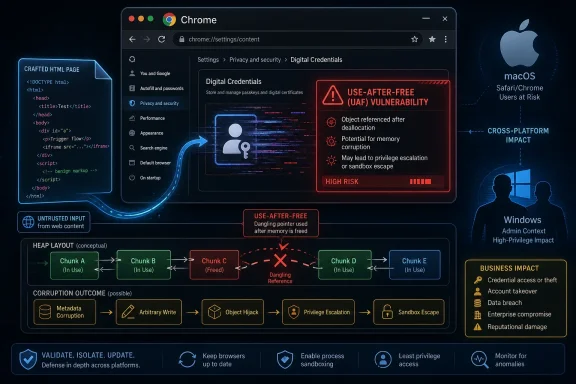 Chrome’s Identity Layer Just Became Security-Critical Plumbing
CVE-2026-13026 is not another anonymous rendering bug buried somewhere in the vast machinery of Blink, V8, or GPU acceleration. It sits in Digital Credentials, the browser plumbing increasingly meant to help websites request and handle cryptographically backed identity documents, passes, and attestations. That makes the vulnerability more interesting than its short description suggests.The modern browser is no longer merely a document viewer with JavaScript bolted on. It is an identity wallet, payment broker, passkey authenticator, video stack, graphics engine, enterprise policy client, and application runtime. Each new role improves convenience, but it also moves sensitive workflows into code paths that attackers will study with the same intensity once reserved for JavaScript engines.
A use-after-free flaw is familiar territory for browser security teams. Memory is released, later reused incorrectly, and an attacker tries to shape the heap so that stale references become useful primitives rather than crashes. The novelty here is the neighborhood: a component associated with digital identity rather than the older, more obviously dangerous parts of the browser.
That distinction matters because users and administrators still tend to rank browser risk by habit. We expect danger from suspicious downloads, shady extensions, and fake login pages. We are less conditioned to think of identity APIs themselves as places where a malicious page might apply pressure.
The Mac-Only Label Is Accurate, but It Is Not a Free Pass
The NVD description says the flaw affected Google Chrome on Mac prior to 149.0.7827.197. That is an important constraint, and administrators should not rewrite it into a universal Windows emergency without evidence. Precision matters in vulnerability management, especially when every advisory competes for attention.But precision is not the same thing as indifference. Chromium is a shared upstream for Chrome, Microsoft Edge, Brave, Vivaldi, Opera, and a long tail of embedded browsers and application shells. A flaw may be exploitable on one operating system because of allocator behavior, API availability, compiler choices, feature flags, or platform-specific integration details, while still revealing a bug pattern that maintainers elsewhere need to audit.
For Windows administrators, the useful question is not “Does this exact CVE affect my Windows fleet?” The better question is whether the browsers in that fleet have consumed the relevant Chromium security updates, whether update channels are lagging, and whether third-party Chromium-based applications are pinned to older builds. The public CVE entry may say Mac; the operational habit should still be to check every Chromium consumer.
This is especially true in mixed environments. Many organizations manage Windows endpoints carefully while leaving Macs to a lighter-touch policy model, especially for executives, developers, designers, and contractors. A Mac-only Chrome bug can become an enterprise incident if the vulnerable machine has privileged SaaS sessions, synced credentials, VPN access, or administrative cloud consoles open in the browser.
The Exploit Chain Still Begins With a Page
The technical impact described for CVE-2026-13026 is heap corruption through a crafted HTML page. That phrase has become so common in browser advisories that it almost disappears into the wallpaper. It should not.A crafted page is the native delivery mechanism of the web. It can arrive through a phishing email, a compromised legitimate site, a poisoned ad placement, a link in a chat platform, or a redirect from a page the user actually intended to visit. Browser exploits do not need the theatrical packaging of malware attachments when the rendering and feature stack itself is the target.
The CISA ADP scoring attached to the vulnerability rates the attack vector as network, attack complexity as low, privileges required as none, and user interaction as required. That combination is the browser exploit archetype: the victim must load or interact with content, but the attacker does not need an account on the target system. The reported technical impact is broad across confidentiality, integrity, and availability.
That does not mean exploitation has been observed. The available public record marks exploitation as none. It does mean the shape of the bug is serious enough that defenders should not wait for proof of active abuse before updating.
The practical rule remains boring and correct: browser patches should be treated more like perimeter patches than ordinary desktop software updates. The browser is exposed to hostile input all day, across trusted and untrusted contexts, often while holding the keys to everything else the user does.
Digital Credentials Make the Browser a Trust Broker
Digital Credentials is part of a broader industry shift toward standardized, browser-mediated identity presentation. The ambition is easy to understand. Rather than having users upload photos of documents, type sensitive details into random forms, or bounce through inconsistent mobile wallet flows, the browser can mediate structured requests and responses.That model can improve privacy and security if implemented well. It can reduce overcollection, make consent clearer, and give relying parties better assurances that an identity claim is genuine. It also gives the browser a more central role in deciding when and how high-value identity data moves between a user, a credential provider, and a website.
That centrality raises the stakes for memory safety. A bug in a media decoder may be severe because it parses untrusted data. A bug in a credential pathway is severe for a second reason: it lives near user trust decisions. Even if CVE-2026-13026 is described in conventional heap-corruption terms, its location invites a broader discussion about hardening browser identity subsystems before they become everyday infrastructure.
This is where vendor messaging can undersell the moment. “High severity, use after free, crafted HTML page” is the standard language of responsible disclosure. But the architecture story is bigger: browsers are becoming identity agents, and identity agents cannot inherit the web’s old tolerance for fragile parsing and rapid feature accretion.
The NVD Record Shows the Messy Middle of Vulnerability Data
The CVE record also illustrates the awkwardness of vulnerability intelligence in real time. At publication, NVD had not assigned its own CVSS score, while CISA ADP supplied a CVSS 3.1 score of 8.8, high. The weakness is classified as CWE-416, the familiar use-after-free category.There is also an oddity in the affected version metadata as reproduced in the CVE change history: the affected entry names version 149.0.7827.197 while also stating “less than 149.0.7827.197.” That kind of presentation is easy to misread. The plain-English description is clearer: Chrome on Mac prior to 149.0.7827.197 is affected; 149.0.7827.197 is the fixed target.
This is why security teams should read the advisory prose, vendor release note, and machine-readable metadata together rather than blindly trusting one field. CVE feeds are indispensable, but they are not gospel. They are living records assembled from vendor submissions, enrichment systems, scoring authorities, and platform taxonomies.
The “Are we missing a CPE?” prompt in the NVD interface is also a reminder that affected product configurations can lag or be incomplete. CPE data is helpful for scanners and dashboards, but it is rarely the whole truth for Chromium-based software. If an organization relies only on a CPE match to find vulnerable browser components, it may miss the embedded runtimes and secondary browsers that users actually launch.
Chrome’s Version Numbers Tell a Patch-Management Story
The fixed version number deserves attention because it sits inside a busy Chrome 149 cycle. Earlier June updates had already moved Chrome through multiple 149 builds, including releases that fixed large numbers of vulnerabilities and at least one separately reported in-the-wild issue. By the time CVE-2026-13026 appeared, administrators were not dealing with a clean monthly cadence; they were dealing with a moving train.That is normal for Chrome. Google’s rapid update model is designed to keep security fixes flowing without making users wait for a classic Patch Tuesday-style bundle. For consumers, automatic updates usually make that invisible. For enterprises, the same velocity can collide with change windows, compatibility testing, VDI images, endpoint controls, and browser extensions that break at inconvenient times.
The tradeoff is blunt. Slowing browser updates may reduce operational surprise, but it increases exposure to bugs whose exploit path is simply web content. Fast-moving browser patch streams are annoying because the browser has become one of the most attacked and most privileged pieces of software on the endpoint.
Chrome’s version split can also trip up audits. The June 2026 advisory ecosystem refers to 149.0.7827.196 and 149.0.7827.197 across platforms. Security tools may flag “prior to .196” in one context and “prior to .197” in another, while the CVE itself calls out Mac prior to .197. Administrators need to verify the actual installed browser version rather than assume that a nearby build number is good enough.
Edge and the Chromium Family Cannot Treat This as Someone Else’s Bug
Microsoft Edge is not Chrome, but it is Chromium. That distinction is essential. Microsoft maintains its own browser, services, policies, and release process, yet the underlying engine and many security fixes flow from the same upstream ecosystem.When a Chromium CVE appears, Edge administrators should watch Microsoft’s release notes rather than simply copy Chrome’s platform matrix. The same applies to Brave, Vivaldi, Opera, Electron apps, WebView2-based applications, and managed browsers used inside enterprise tools. Some will absorb fixes quickly; others will lag behind Chromium stable.
The risk is not just the browser icon on the desktop. Many organizations have line-of-business applications that package Chromium or depend on WebView-style runtimes. Those apps may not show up in browser update reports, and users may not recognize them as browser surfaces at all. Yet they parse web content, execute JavaScript, and often inherit upstream security debt.
For Windows shops, WebView2 is the quiet place to look. The runtime is generally serviced well through Microsoft’s update mechanisms, but fixed-version deployments and bundled runtimes can exist. If a product vendor pins Chromium for compatibility, the organization inherits that vendor’s patch discipline.
Memory Safety Remains the Browser War’s Unfinished Business
Use-after-free bugs are not exotic. They are a consequence of building large, performance-sensitive systems in memory-unsafe languages and then exposing them to adversarial input at internet scale. Chrome’s sandboxing, site isolation, heap hardening, fuzzing, and exploit mitigations have raised the cost of exploitation, but they have not abolished the class.The industry’s long-term answer is memory safety, but browsers are hard places to retrofit it. Chromium contains millions of lines of C++ and deeply optimized subsystems where rewriting everything is neither quick nor risk-free. Incremental approaches—safer abstractions, MiraclePtr-style mitigations, Rust in selected components, stronger sanitizers, and more aggressive fuzzing—are the realistic path.
CVE-2026-13026 sits inside that unfinished transition. A single use-after-free bug does not prove a component is uniquely unsafe. It does show that new browser features can inherit old implementation hazards unless memory-safety strategy follows the feature roadmap.
That should worry policy makers and enterprise architects more than any one CVE. Digital identity systems will fail politically if users believe they are handing sensitive credentials to software that cannot reliably police its own memory. The security bar for identity features must be higher than the bar for yet another rendering optimization.
The User Interaction Requirement Is Not a Comfort Blanket
Security scoring often treats user interaction as a mitigating factor, and mathematically that makes sense. An exploit that requires a user to open a page is not the same as a wormable network service. But in browser land, user interaction is the default state of the universe.People click links because the web is made of links. They preview documents, open dashboards, follow support articles, read invoices, and authenticate into SaaS tools all day. A vulnerability requiring a crafted HTML page is still dangerous because delivering HTML to a user is one of the easiest attack tasks on the internet.
The more interesting constraint is not user interaction but exploit reliability. Heap corruption bugs can be hard to weaponize reliably, especially against hardened browsers and modern operating systems. Public advisories rarely reveal enough detail to judge that. Attackers, however, can invest time once a patch diff or bug reference gives them a starting point.
That is why the update window matters. Even when exploitation is not known at disclosure, a patched vulnerability becomes a race. Defenders want the fixed version deployed before attackers can reverse-engineer the bug and turn it into a working exploit.
Enterprise Defenders Should Patch the Browser, Then Audit the Assumption
The immediate action is straightforward: update Chrome for Mac to 149.0.7827.197 or later and verify that update completion has actually occurred. Chrome’s update mechanism often downloads the patch before it is active; users must relaunch the browser. In enterprises, “installed” and “running the fixed build” are not always the same state.Admins should also inventory Chromium-derived browsers and embedded runtimes. A vulnerability announcement for Chrome can be the first public signal of a bug that downstream vendors need to incorporate. The absence of a matching alert in a secondary browser does not prove absence of exposure.
For managed Windows environments, the right workflow is to check Edge and WebView2 servicing status, confirm Chrome auto-update policy is not blocked, and look for stale portable browsers or user-installed alternatives. In mixed fleets, Macs should be brought under the same browser patch compliance reporting as Windows machines. The executive MacBook with unmanaged Chrome is not a rounding error if it is logged into privileged cloud consoles.
There is also a policy angle. Organizations that delay browser updates for compatibility should have a documented exception process, not a silent freeze. If a line-of-business app breaks on current Chrome or Edge, that app has become a security dependency and should be treated as such.
The Public Bug Link Is Restricted for a Reason
The Chromium issue tracker reference for CVE-2026-13026 requires permissions, which is standard for newly fixed browser vulnerabilities. Google routinely limits access to bug details until enough users have received updates, and that restraint is not mere secrecy. Detailed crash traces, proof-of-concept material, and patch context can accelerate exploit development.This creates a familiar tension for defenders. Security teams want enough information to prioritize accurately, but vendors withhold details to protect the update window. The result is a public advisory that can feel frustratingly thin: component, severity, version, and a generic exploit condition.
In this case, the thinness should not be mistaken for insignificance. A high-severity use-after-free in a browser identity component, reachable through crafted HTML, is enough to justify urgent patching even without a public exploit. Waiting for full technical disclosure reverses the intended order of operations.
The responsible posture is to patch first and read the postmortem later. Browser vulnerability details are educational; fixed builds are defensive.
Digital Identity Will Only Work If the Boring Parts Work
The strategic issue behind CVE-2026-13026 is trust. Digital credentials promise to make online identity less chaotic, less copy-and-paste, and less dependent on brittle document uploads. But the promise depends on users believing the browser can act as a safe mediator.That trust is not built by glossy UX alone. It is built by memory-safe code, clear permission prompts, well-scoped APIs, revocation models, privacy-preserving defaults, and fast patch delivery when the inevitable bug appears. A single Chrome CVE does not doom digital credentials, but it does expose the burden carried by the implementation.
Administrators should be especially alert to the way identity features blur old categories. Is Digital Credentials a browser feature, an authentication feature, a privacy feature, or an operating-system integration point? The answer is yes, and that is why ownership can become fuzzy in enterprise risk registers.
Fuzzy ownership is where patch gaps live. Browser teams, identity teams, endpoint teams, and compliance teams may all assume someone else is tracking the issue. CVE-2026-13026 is a useful prompt to decide who owns browser-mediated identity risk before the feature becomes routine.
The Patch Notes Are Short; the Operational Tail Is Not
The public record for CVE-2026-13026 is compact: disclosed June 24, modified June 25, high severity, CWE-416, fixed before Chrome 149.0.7827.197 on Mac. That is enough for a vulnerability database entry. It is not enough for an enterprise response plan.Real response means checking telemetry. How many devices are still on vulnerable Chrome builds? How many have downloaded but not activated updates? How many users run unmanaged browsers? How many business-critical applications embed Chromium outside normal browser reporting? How quickly do Macs reach compliance compared with Windows systems?
The answers often reveal uncomfortable truths. Browser patching is mature on paper but uneven in practice. BYOD policies, developer workstations, kiosk systems, VDI pools, and lab machines all have a way of escaping the clean lines of a dashboard.
Security teams should also resist the temptation to rank this issue only against headline-grabbing zero-days. Not every high-severity Chrome bug is an emergency of the same magnitude. But the correct baseline for a browser memory corruption flaw is still fast deployment, not next-quarter remediation.
The Useful Lesson Is Smaller Than Panic and Bigger Than Mac
The narrow lesson is easy: Chrome users on macOS should be on 149.0.7827.197 or later. The broader lesson is that browser identity features are now part of the exploit surface that administrators must patch, inventory, and monitor like any other security-critical subsystem.That middle ground is where good security work lives. It avoids sensational claims that CVE-2026-13026 is known to be under active attack when the public data does not say that. It also avoids the lazy dismissal that a Mac-specific Chrome CVE has nothing to teach Windows-heavy shops.
For WindowsForum’s audience, the practical value is in translating a vendor advisory into habits. Verify versions, do not trust partial metadata, watch Chromium downstreams, and remember that identity code in the browser is still browser code. The same web that delivers productivity apps can deliver exploit triggers.
The Version Number Is the Message This Week
CVE-2026-13026 is a small entry in a large Chromium security machine, but it points to concrete actions that should happen now rather than after a cleaner write-up arrives.- Chrome on macOS should be updated to 149.0.7827.197 or later, and administrators should confirm that users have relaunched into the fixed build.
- Windows administrators should still review Chromium-based browser and runtime patch status, because upstream Chromium fixes often matter beyond the platform named in a single CVE entry.
- Vulnerability scanners should not be treated as complete unless they account for embedded Chromium runtimes, portable browsers, and vendor-pinned application frameworks.
- The absence of reported exploitation reduces urgency compared with an active zero-day, but it does not justify deferring a high-severity browser memory-corruption patch.
- Digital credential and wallet-style browser features should be tracked as identity infrastructure, not as cosmetic browser conveniences.
References
- Primary source: NVD / Chromium
Published: 2026-06-26T17:46:35-07:00
NVD - CVE-2026-13026
 nvd.nist.gov
- Security advisory: MSRC
Published: 2026-06-26T17:46:35-07:00
Original feed URL
Security Update Guide - Microsoft Security Response Center
 msrc.microsoft.com
- Related coverage: vuldb.com
CVE-2026-13026 Google Chrome Digital Credentials use after free (ID 519728)
A weakness has been identified in Google Chrome on macOS. The identification of this vulnerability is CVE-2026-13026. Upgrading the affected component is recommended.vuldb.com - Related coverage: govcert.gov.hk
GovCERT.HK - Security Alert (A26-06-27): Multiple Vulnerabilities in Google Chrome
Security Alert (A26-06-27): Multiple Vulnerabilities in Google Chromewww.govcert.gov.hk
