

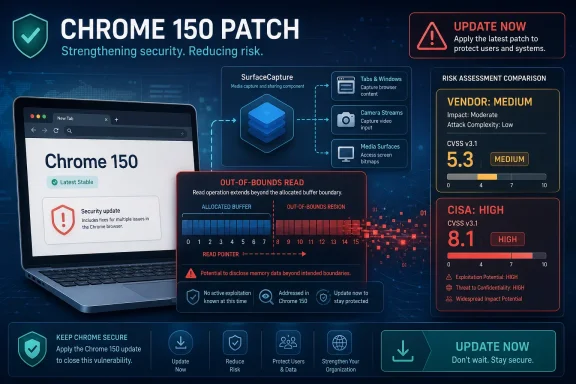
Google fixed CVE-2026-14011, a medium-severity out-of-bounds read in Chrome’s SurfaceCapture component, in the June 30, 2026 Chrome 150 stable desktop update for Windows, macOS, and Linux before version 150.0.7871.47. The bug matters less because it is spectacular and more because it sits in the browser’s increasingly privileged media-capture machinery. As documented by Google’s Chrome Releases blog and the National Vulnerability Database, a crafted HTML page could trigger an out-of-bounds memory read, with CISA’s enrichment assigning it a high CVSS 3.1 score despite Chromium’s own medium severity label. That split is the story: modern browser risk is no longer captured cleanly by a single vendor severity word.
CVE-2026-14011 arrived in Chrome 150.0.7871.46/.47, the stable channel update Google announced on June 30. Google listed the issue as “Medium” and described it plainly: an out-of-bounds read in SurfaceCapture, reported internally by Google on May 27. NVD published the CVE entry the same day as the release and updated it on July 1 as enrichment data began to land.
For ordinary users, that sequence sounds routine. Chrome updates constantly, most people never read the release notes, and “medium” bugs tend to blur into the background noise of browser maintenance. But for administrators, vulnerability managers, and anyone running Chromium-based browsers at fleet scale, this is the kind of entry that deserves a closer look.
The reason is not that Google has said the bug is being exploited in the wild. It has not. NVD’s change history shows CISA’s SSVC enrichment marked exploitation as “none,” automatable as “no,” and technical impact as “partial.” That is a very different posture from an active zero-day emergency.
The reason is that SurfaceCapture is not a dusty corner of the browser. It belongs to the web platform’s capture stack — the layer that lets pages interact with screens, tabs, windows, and media surfaces under permission and browser mediation. When memory-safety flaws appear near capture features, the potential consequence is not just a crash; it can be unintended disclosure from places users assumed the browser was protecting.
That makes the component both useful and sensitive. Screen capture and tab capture features are now basic infrastructure for meetings, remote assistance, streaming, collaborative apps, and enterprise workflows. The web platform tries to make those features safe through user prompts, origin boundaries, browser UI indicators, and careful limits on what a page can see.
An out-of-bounds read does not automatically mean an attacker can take over a system. It means code may read memory outside the intended boundary. Depending on where that memory sits and how reliably it can be reached, the result can range from a benign crash to leakage of sensitive process data or a building block in a larger exploit chain.
That uncertainty is why the “medium” label can mislead non-specialists. Chromium’s severity classification reflects Google’s internal assessment of the bug in its context. CISA’s ADP vector, by contrast, rates the vulnerability as network-accessible, low complexity, requiring no privileges but requiring user interaction, with high confidentiality impact and high availability impact. Both can be true because they answer different questions.
CISA’s vector says the attack is remote and low complexity, but requires user interaction. In browser terms, that usually means the victim must visit or otherwise render a crafted page. That is still a meaningful barrier, but not a comforting one. The web’s entire attack surface is built around persuading users and applications to load content.
The vector also marks confidentiality and availability impact as high, with integrity impact as none. That profile fits an out-of-bounds read better than a classic arbitrary code execution flaw: the danger is exposure and possible instability, not necessarily direct modification. Yet in real-world browser exploitation, information disclosure bugs can be paired with memory corruption to defeat mitigations or improve exploit reliability.
This is where patch triage often goes wrong. A dashboard that sorts by vendor severity might underplay the bug. A dashboard that sorts by CVSS alone might overstate it relative to known exploited vulnerabilities. The correct operational reading is narrower: patch it promptly as part of Chrome 150, but do not confuse it with a confirmed in-the-wild zero-day.
This was not a tiny point release shipped solely for SurfaceCapture. It was a large stable-channel milestone with critical, high, medium, and low severity security fixes across many components. Google’s list included critical use-after-free issues in areas such as Extensions, GPU, ANGLE, Dawn, WebUSB, Chromoting, Views, Bluetooth, Ozone, Skia, and Fullscreen, along with a long tail of high and medium entries.
That matters because enterprise patch decisions are rarely about one CVE in isolation. If an organization is still running Chrome before 150.0.7871.47 on Windows or macOS, CVE-2026-14011 is only one of many reasons it is behind. The practical recommendation is not “patch because of SurfaceCapture”; it is “do not let the Chrome 150 security train sit in staging indefinitely.”
Google also noted that bug details and links may remain restricted until most users are updated, a standard Chrome disclosure practice. That restriction is not proof of active exploitation. It is Google trying to avoid handing exploit writers a roadmap while the patch is still propagating through consumer and enterprise channels.
The user-interaction requirement in CISA’s vector should therefore be read carefully. It does not mean a user must approve a dangerous dialog or install a malicious extension. It may mean the user must land on a page, open a link, view embedded content, or interact with a web app in a way that reaches the vulnerable code path. Without the underlying Chromium bug details fully public, the exact trigger should not be guessed.
The more important operational point is that attackers do not need administrative access to aim at the browser. They need delivery. Phishing, malvertising, compromised legitimate sites, poisoned search results, and malicious collaboration links all remain viable paths to place crafted content in front of a target.
Chrome’s sandbox and site isolation architecture are designed to contain exactly this kind of hostile web content. But memory disclosure bugs can still matter inside those boundaries, especially when chained with other flaws. Browser security is layered because no single mitigation is assumed to be perfect.
That clock includes Google Chrome, Microsoft Edge, Brave, Vivaldi, Opera, and other Chromium derivatives, though each vendor ships on its own schedule and may backport fixes differently. A Chrome CVE does not automatically mean every Chromium-based browser is vulnerable in exactly the same way on the same day. But it does mean administrators should verify the corresponding vendor advisory rather than assuming Chrome’s fix has already landed everywhere.
Microsoft Edge is especially relevant in Windows environments because it rides the Chromium engine while integrating deeply with Microsoft’s management stack. The correct enterprise move is to check the Edge release channel and version against Microsoft’s own release notes, not simply copy Chrome’s version number into an Edge compliance rule. Chromium is shared infrastructure, but product release trains are not identical.
The same applies to embedded Chromium runtimes. Electron apps, WebView2-based applications, and other Chromium consumers can lag the main browser if vendors do not update promptly. CVE-2026-14011 is a Chrome entry, but the pattern it illustrates is broader: browser-engine vulnerabilities are supply-chain issues for desktop software.
The apparent wrinkle is that Google’s release note lists Chrome 150.0.7871.46 for Linux and 150.0.7871.46/.47 for Windows and Mac. NVD’s CPE threshold, however, uses 150.0.7871.47 as the exclusive fixed boundary. That is not necessarily wrong, but it is exactly the kind of versioning mismatch that can frustrate scanners and administrators.
A scanner may flag Linux systems below .47 even though Google’s Linux stable line was published as .46. A compliance team may then ask whether .46 is fixed, whether .47 exists for that platform, or whether the CPE is simply using the highest desktop build number as a universal boundary. Without a platform-specific CPE breakdown, that ambiguity becomes operational noise.
This is not unique to Chrome. Cross-platform products often publish adjacent build numbers for different operating systems, while vulnerability databases prefer normalized affected ranges. The safest reading is to follow the vendor’s stable-channel release for the platform in question and ensure the installed browser is at or beyond the fixed release offered by that vendor. For Chrome on Windows and macOS, that means 150.0.7871.47 or later; for Linux, administrators should verify the current stable package from Google’s repository rather than relying solely on a scanner’s generic threshold.
Browser bugs often become more dangerous after patches land because attackers can diff the fix, infer the vulnerable code path, and develop proof-of-concept triggers. Google’s practice of restricting bug details until the majority of users have updated reflects this reality. The patch itself tells motivated researchers and criminals where to look.
This is why the right patch window is measured in days, not quarters. Consumer Chrome installations usually update automatically, but the update still requires a browser restart. Enterprise environments can delay restarts for user convenience, compatibility testing, or change-control rules. Those delays are where “already patched” becomes “installed but not applied.”
Administrators should verify the running version, not merely the update availability. In Chrome, the familiar path is the About Chrome page or managed inventory reporting. In centrally managed environments, telemetry from endpoint management tools should confirm both installed version and process restart state where possible.
The common failure mode is a browser that has downloaded the update but remains open for days with dozens of tabs preserved. That is especially common on developer workstations, shared kiosks, executive laptops, and remote users who sleep systems rather than rebooting. In practice, the restart prompt is part of the security boundary.
Chrome has invested heavily in sandboxing, fuzzing, exploit mitigations, site isolation, MiraclePtr-style memory hardening, and safer-language experiments. Those investments have made exploitation harder. They have not made memory bugs disappear.
The Chrome 150 security list demonstrates the shape of the problem. Use-after-free, heap buffer overflow, type confusion, uninitialized use, insufficient validation, and out-of-bounds access all appear across graphics, rendering, UI, media, and platform integration layers. The browser is too large and too performance-sensitive for memory safety to be solved by policy alone.
The industry’s long-term answer is a mix of safer languages, hardened allocators, better fuzzing, and compartmentalization. But Windows users and admins live in the present. In the present, the most effective mitigation remains boring: keep the browser current, limit risky extensions, reduce unnecessary exposure, and restart when security updates land.
That does not mean CVE-2026-14011 allowed a page to spy on a screen share. The public description does not support that claim. It says an attacker could perform an out-of-bounds memory read via crafted HTML. Anything more specific would be speculation until Chromium’s bug details become public.
Still, the location matters. A memory read flaw in a calculator widget and a memory read flaw in a capture component do not carry the same intuitive risk. The latter touches workflows where users are presenting documents, sharing tabs, granting media permissions, or working in sensitive browser-based applications.
For regulated organizations, that should influence patch prioritization. A medium Chrome bug in a capture-related component may deserve faster remediation on machines used for telehealth, legal work, financial meetings, incident response, executive communications, and remote support. Risk is not just the CVE score; it is the asset, user role, data context, and exposure path.
That bargain only works if administrators let it work. Long deferrals, frozen browser versions, and untested extension dependencies create artificial exposure. The web does not slow down because an enterprise change board meets every other Thursday.
The Chrome 150 update also demonstrates why “we patch criticals first” is an incomplete browser strategy. A single release can contain dozens of critical and high issues plus many medium bugs that might become useful in chains. Cherry-picking one CVE from a browser train is rarely the right approach unless a vendor has issued an emergency out-of-band fix.
For most environments, the better policy is channel discipline. Stable should move quickly after validation, Extended Stable should be used deliberately rather than as a dumping ground for deferred maintenance, and exception lists should be small enough that security teams can name every machine on them.
For small businesses, the risk is not usually exploit sophistication; it is unmanaged drift. A mix of personal laptops, lightly managed desktops, and shared accounts can leave some users on outdated browsers for weeks. CVE-2026-14011 is a useful excuse to check whether browser inventory is real or merely assumed.
For larger enterprises, the challenge is correlation. Vulnerability scanners may surface NVD’s CPE, endpoint tools may report product versions, browser management consoles may show pending restarts, and helpdesk tickets may complain about post-update behavior. The security team’s job is to reconcile those signals into an actual exposure picture.
That picture should include Chromium-based browsers beyond Chrome. If Edge, Brave, Vivaldi, Opera, or embedded Chromium applications are in scope, each needs its own vendor-version verification. The shared engine is a force multiplier for both features and flaws.
Google’s release notes provide the vendor chronology: reported internally on May 27, shipped in the June 30 stable channel update, with bug details restricted while users update. NVD provides the public vulnerability record: published June 30, modified July 1, affected Chrome versions before 150.0.7871.47, and a CWE-125 classification. CISA’s ADP enrichment adds the tension: no known exploitation, but a high CVSS score because the theoretical impact is meaningful.
That triangulation is exactly how modern security teams should read browser CVEs. Vendor severity gives one view. CVSS gives another. SSVC gives a decision-support snapshot. None is sufficient alone.
The forum-level takeaway is not panic. It is skepticism toward oversimplified labels. Medium does not mean harmless, high does not always mean emergency, and “no exploitation” does not mean “ignore until next month.”
 A Medium Chrome Bug Can Still Be a High-Pressure Patch
CVE-2026-14011 arrived in Chrome 150.0.7871.46/.47, the stable channel update Google announced on June 30. Google listed the issue as “Medium” and described it plainly: an out-of-bounds read in SurfaceCapture, reported internally by Google on May 27. NVD published the CVE entry the same day as the release and updated it on July 1 as enrichment data began to land.For ordinary users, that sequence sounds routine. Chrome updates constantly, most people never read the release notes, and “medium” bugs tend to blur into the background noise of browser maintenance. But for administrators, vulnerability managers, and anyone running Chromium-based browsers at fleet scale, this is the kind of entry that deserves a closer look.
The reason is not that Google has said the bug is being exploited in the wild. It has not. NVD’s change history shows CISA’s SSVC enrichment marked exploitation as “none,” automatable as “no,” and technical impact as “partial.” That is a very different posture from an active zero-day emergency.
The reason is that SurfaceCapture is not a dusty corner of the browser. It belongs to the web platform’s capture stack — the layer that lets pages interact with screens, tabs, windows, and media surfaces under permission and browser mediation. When memory-safety flaws appear near capture features, the potential consequence is not just a crash; it can be unintended disclosure from places users assumed the browser was protecting.
SurfaceCapture Sits Where Convenience Meets Exposure
The modern browser is no longer a document viewer. It is a camera client, a video conferencing endpoint, a remote work portal, a password manager, a file handler, a GPU workload scheduler, and a screen-sharing broker. SurfaceCapture belongs to that newer browser reality, where web apps need controlled access to visual surfaces without gaining free rein over the user’s desktop.That makes the component both useful and sensitive. Screen capture and tab capture features are now basic infrastructure for meetings, remote assistance, streaming, collaborative apps, and enterprise workflows. The web platform tries to make those features safe through user prompts, origin boundaries, browser UI indicators, and careful limits on what a page can see.
An out-of-bounds read does not automatically mean an attacker can take over a system. It means code may read memory outside the intended boundary. Depending on where that memory sits and how reliably it can be reached, the result can range from a benign crash to leakage of sensitive process data or a building block in a larger exploit chain.
That uncertainty is why the “medium” label can mislead non-specialists. Chromium’s severity classification reflects Google’s internal assessment of the bug in its context. CISA’s ADP vector, by contrast, rates the vulnerability as network-accessible, low complexity, requiring no privileges but requiring user interaction, with high confidentiality impact and high availability impact. Both can be true because they answer different questions.
The CVSS Split Reveals the Limits of Security Labels
NVD had not yet provided its own CVSS assessment when the entry was last modified on July 1, but CISA-ADP added a CVSS 3.1 base score of 8.1, which lands in the “High” range. That is a sharp contrast with Chromium’s medium severity classification. It is also a good reminder that vulnerability databases are not neutral weather reports; they are interpretive systems layered over vendor disclosures.CISA’s vector says the attack is remote and low complexity, but requires user interaction. In browser terms, that usually means the victim must visit or otherwise render a crafted page. That is still a meaningful barrier, but not a comforting one. The web’s entire attack surface is built around persuading users and applications to load content.
The vector also marks confidentiality and availability impact as high, with integrity impact as none. That profile fits an out-of-bounds read better than a classic arbitrary code execution flaw: the danger is exposure and possible instability, not necessarily direct modification. Yet in real-world browser exploitation, information disclosure bugs can be paired with memory corruption to defeat mitigations or improve exploit reliability.
This is where patch triage often goes wrong. A dashboard that sorts by vendor severity might underplay the bug. A dashboard that sorts by CVSS alone might overstate it relative to known exploited vulnerabilities. The correct operational reading is narrower: patch it promptly as part of Chrome 150, but do not confuse it with a confirmed in-the-wild zero-day.
Chrome 150 Was Not a One-CVE Update
Google’s Chrome Releases blog said the Chrome 150 desktop promotion included 433 security fixes. That number is startling even by Chrome standards and makes any single medium-severity CVE look like a footnote. But it also changes the context in which CVE-2026-14011 should be handled.This was not a tiny point release shipped solely for SurfaceCapture. It was a large stable-channel milestone with critical, high, medium, and low severity security fixes across many components. Google’s list included critical use-after-free issues in areas such as Extensions, GPU, ANGLE, Dawn, WebUSB, Chromoting, Views, Bluetooth, Ozone, Skia, and Fullscreen, along with a long tail of high and medium entries.
That matters because enterprise patch decisions are rarely about one CVE in isolation. If an organization is still running Chrome before 150.0.7871.47 on Windows or macOS, CVE-2026-14011 is only one of many reasons it is behind. The practical recommendation is not “patch because of SurfaceCapture”; it is “do not let the Chrome 150 security train sit in staging indefinitely.”
Google also noted that bug details and links may remain restricted until most users are updated, a standard Chrome disclosure practice. That restriction is not proof of active exploitation. It is Google trying to avoid handing exploit writers a roadmap while the patch is still propagating through consumer and enterprise channels.
Crafted HTML Is Still the Browser’s Oldest Attack Delivery System
The CVE description says a remote attacker could trigger the issue via a crafted HTML page. That phrase can sound almost quaint in 2026, but it remains the defining feature of browser risk. The browser’s job is to ingest untrusted content all day; the attacker’s job is to make one input path misbehave.The user-interaction requirement in CISA’s vector should therefore be read carefully. It does not mean a user must approve a dangerous dialog or install a malicious extension. It may mean the user must land on a page, open a link, view embedded content, or interact with a web app in a way that reaches the vulnerable code path. Without the underlying Chromium bug details fully public, the exact trigger should not be guessed.
The more important operational point is that attackers do not need administrative access to aim at the browser. They need delivery. Phishing, malvertising, compromised legitimate sites, poisoned search results, and malicious collaboration links all remain viable paths to place crafted content in front of a target.
Chrome’s sandbox and site isolation architecture are designed to contain exactly this kind of hostile web content. But memory disclosure bugs can still matter inside those boundaries, especially when chained with other flaws. Browser security is layered because no single mitigation is assumed to be perfect.
Windows Admins Should Track the Browser, Not Just the OS
For WindowsForum readers, the trap is obvious: Windows patching gets the meeting, browser patching gets the assumption. Microsoft’s Patch Tuesday cadence has trained IT departments to treat the operating system as the main event. Chrome and Chromium-based browsers operate on a faster, more fluid security clock.That clock includes Google Chrome, Microsoft Edge, Brave, Vivaldi, Opera, and other Chromium derivatives, though each vendor ships on its own schedule and may backport fixes differently. A Chrome CVE does not automatically mean every Chromium-based browser is vulnerable in exactly the same way on the same day. But it does mean administrators should verify the corresponding vendor advisory rather than assuming Chrome’s fix has already landed everywhere.
Microsoft Edge is especially relevant in Windows environments because it rides the Chromium engine while integrating deeply with Microsoft’s management stack. The correct enterprise move is to check the Edge release channel and version against Microsoft’s own release notes, not simply copy Chrome’s version number into an Edge compliance rule. Chromium is shared infrastructure, but product release trains are not identical.
The same applies to embedded Chromium runtimes. Electron apps, WebView2-based applications, and other Chromium consumers can lag the main browser if vendors do not update promptly. CVE-2026-14011 is a Chrome entry, but the pattern it illustrates is broader: browser-engine vulnerabilities are supply-chain issues for desktop software.
The CPE Confusion Is a Symptom of a Messy Ecosystem
The user-submitted NVD text asks whether a CPE is missing. NVD’s change history shows that on July 1, NIST added a CPE configuration for Google Chrome versions up to, but excluding, 150.0.7871.47. That aligns with the CVE description’s affected range: Chrome prior to 150.0.7871.47.The apparent wrinkle is that Google’s release note lists Chrome 150.0.7871.46 for Linux and 150.0.7871.46/.47 for Windows and Mac. NVD’s CPE threshold, however, uses 150.0.7871.47 as the exclusive fixed boundary. That is not necessarily wrong, but it is exactly the kind of versioning mismatch that can frustrate scanners and administrators.
A scanner may flag Linux systems below .47 even though Google’s Linux stable line was published as .46. A compliance team may then ask whether .46 is fixed, whether .47 exists for that platform, or whether the CPE is simply using the highest desktop build number as a universal boundary. Without a platform-specific CPE breakdown, that ambiguity becomes operational noise.
This is not unique to Chrome. Cross-platform products often publish adjacent build numbers for different operating systems, while vulnerability databases prefer normalized affected ranges. The safest reading is to follow the vendor’s stable-channel release for the platform in question and ensure the installed browser is at or beyond the fixed release offered by that vendor. For Chrome on Windows and macOS, that means 150.0.7871.47 or later; for Linux, administrators should verify the current stable package from Google’s repository rather than relying solely on a scanner’s generic threshold.
“No Known Exploitation” Is Not a Permission Slip
CISA’s SSVC enrichment says exploitation was “none” as of its July 1 update. That is good news. It should also be read as a snapshot, not a warranty.Browser bugs often become more dangerous after patches land because attackers can diff the fix, infer the vulnerable code path, and develop proof-of-concept triggers. Google’s practice of restricting bug details until the majority of users have updated reflects this reality. The patch itself tells motivated researchers and criminals where to look.
This is why the right patch window is measured in days, not quarters. Consumer Chrome installations usually update automatically, but the update still requires a browser restart. Enterprise environments can delay restarts for user convenience, compatibility testing, or change-control rules. Those delays are where “already patched” becomes “installed but not applied.”
Administrators should verify the running version, not merely the update availability. In Chrome, the familiar path is the About Chrome page or managed inventory reporting. In centrally managed environments, telemetry from endpoint management tools should confirm both installed version and process restart state where possible.
The common failure mode is a browser that has downloaded the update but remains open for days with dozens of tabs preserved. That is especially common on developer workstations, shared kiosks, executive laptops, and remote users who sleep systems rather than rebooting. In practice, the restart prompt is part of the security boundary.
Memory Safety Keeps Haunting the Browser Stack
CVE-2026-14011 is cataloged as CWE-125, an out-of-bounds read. That weakness class is one of the oldest memory-safety failures in C and C++ software. It persists because browsers remain giant native-code systems that must parse hostile inputs, schedule GPU work, decode media, isolate origins, manage extensions, and preserve performance at global scale.Chrome has invested heavily in sandboxing, fuzzing, exploit mitigations, site isolation, MiraclePtr-style memory hardening, and safer-language experiments. Those investments have made exploitation harder. They have not made memory bugs disappear.
The Chrome 150 security list demonstrates the shape of the problem. Use-after-free, heap buffer overflow, type confusion, uninitialized use, insufficient validation, and out-of-bounds access all appear across graphics, rendering, UI, media, and platform integration layers. The browser is too large and too performance-sensitive for memory safety to be solved by policy alone.
The industry’s long-term answer is a mix of safer languages, hardened allocators, better fuzzing, and compartmentalization. But Windows users and admins live in the present. In the present, the most effective mitigation remains boring: keep the browser current, limit risky extensions, reduce unnecessary exposure, and restart when security updates land.
Surface Capture Bugs Carry a Privacy Shadow
Even without public exploit details, a SurfaceCapture out-of-bounds read naturally raises privacy concerns. Capture features sit near the boundary between what a web page may see and what the user’s desktop contains. The whole purpose of browser-mediated capture is to prevent a site from silently grabbing arbitrary visual data.That does not mean CVE-2026-14011 allowed a page to spy on a screen share. The public description does not support that claim. It says an attacker could perform an out-of-bounds memory read via crafted HTML. Anything more specific would be speculation until Chromium’s bug details become public.
Still, the location matters. A memory read flaw in a calculator widget and a memory read flaw in a capture component do not carry the same intuitive risk. The latter touches workflows where users are presenting documents, sharing tabs, granting media permissions, or working in sensitive browser-based applications.
For regulated organizations, that should influence patch prioritization. A medium Chrome bug in a capture-related component may deserve faster remediation on machines used for telehealth, legal work, financial meetings, incident response, executive communications, and remote support. Risk is not just the CVE score; it is the asset, user role, data context, and exposure path.
The Release Cadence Is Now Part of the Security Model
Chrome’s rapid update cadence is often treated as a nuisance by users and a compatibility burden by enterprises. But that cadence is also the browser’s security model in action. Google can ship fixes quickly because Chrome updates quickly, and attackers know the window between disclosure and broad patch adoption is narrowing.That bargain only works if administrators let it work. Long deferrals, frozen browser versions, and untested extension dependencies create artificial exposure. The web does not slow down because an enterprise change board meets every other Thursday.
The Chrome 150 update also demonstrates why “we patch criticals first” is an incomplete browser strategy. A single release can contain dozens of critical and high issues plus many medium bugs that might become useful in chains. Cherry-picking one CVE from a browser train is rarely the right approach unless a vendor has issued an emergency out-of-band fix.
For most environments, the better policy is channel discipline. Stable should move quickly after validation, Extended Stable should be used deliberately rather than as a dumping ground for deferred maintenance, and exception lists should be small enough that security teams can name every machine on them.
The Practical Risk Is Unevenly Distributed
For home users, the answer is simple: update Chrome and restart it. If the browser reports version 150.0.7871.47 or later on Windows or macOS, the specific Chrome fix described by NVD is in place. Linux users should ensure their Google Chrome stable package is current from their distribution or Google’s repository.For small businesses, the risk is not usually exploit sophistication; it is unmanaged drift. A mix of personal laptops, lightly managed desktops, and shared accounts can leave some users on outdated browsers for weeks. CVE-2026-14011 is a useful excuse to check whether browser inventory is real or merely assumed.
For larger enterprises, the challenge is correlation. Vulnerability scanners may surface NVD’s CPE, endpoint tools may report product versions, browser management consoles may show pending restarts, and helpdesk tickets may complain about post-update behavior. The security team’s job is to reconcile those signals into an actual exposure picture.
That picture should include Chromium-based browsers beyond Chrome. If Edge, Brave, Vivaldi, Opera, or embedded Chromium applications are in scope, each needs its own vendor-version verification. The shared engine is a force multiplier for both features and flaws.
Chrome 150’s Lesson Is Bigger Than SurfaceCapture
The cleanest reading of CVE-2026-14011 is that it is a promptly fixed, not-known-exploited Chrome memory read bug in a sensitive component. That is important, but not dramatic. The more interesting reading is that it shows how browser vulnerability management has become a continuous operational discipline rather than a periodic patch task.Google’s release notes provide the vendor chronology: reported internally on May 27, shipped in the June 30 stable channel update, with bug details restricted while users update. NVD provides the public vulnerability record: published June 30, modified July 1, affected Chrome versions before 150.0.7871.47, and a CWE-125 classification. CISA’s ADP enrichment adds the tension: no known exploitation, but a high CVSS score because the theoretical impact is meaningful.
That triangulation is exactly how modern security teams should read browser CVEs. Vendor severity gives one view. CVSS gives another. SSVC gives a decision-support snapshot. None is sufficient alone.
The forum-level takeaway is not panic. It is skepticism toward oversimplified labels. Medium does not mean harmless, high does not always mean emergency, and “no exploitation” does not mean “ignore until next month.”
The Patch Window Is Where This Bug Will Be Won or Lost
CVE-2026-14011 is already fixed upstream, so the remaining risk lives in deployment, restarts, and inventory. That makes the response concrete rather than theoretical.- Chrome for Windows and macOS should be updated to 150.0.7871.47 or later to address CVE-2026-14011 as described by Google and NVD.
- Linux administrators should verify that their Chrome stable package is current for their platform, because Google’s release note lists Linux at 150.0.7871.46 while NVD’s CPE boundary uses 150.0.7871.47.
- CISA’s enrichment reported no known exploitation as of July 1, but that should not be treated as a reason to defer browser patching.
- The flaw is an out-of-bounds read in SurfaceCapture, so administrators should give extra attention to systems used for screen sharing, conferencing, remote support, and sensitive browser-based work.
- Chromium-based browsers and embedded Chromium runtimes should be checked through their own vendor release channels rather than assumed safe because Chrome has updated.
- A downloaded Chrome update is not enough; users must restart the browser for the patched build to replace the running vulnerable process.
References
- Primary source: NVD / Chromium
Published: 2026-07-03T07:00:48-07:00
NVD - CVE-2026-14011
 nvd.nist.gov
- Security advisory: MSRC
Published: 2026-07-03T07:00:48-07:00
Original feed URL
Security Update Guide - Microsoft Security Response Center
 msrc.microsoft.com
- Related coverage: cvefeed.io
CVE-2026-14011 - Google Chrome SurfaceCapture Out-of-Bounds Read
Out of bounds read in SurfaceCapture in Google Chrome prior to 150.0.7871.47 allowed a remote attacker to perform an out of bounds memory read via a crafted HTML page. (Chromium security severity: Medium)cvefeed.io
