

Google Chrome before 150.0.7871.47 is listed as affected by CVE-2026-14021, a medium-severity Chromium StorageAccessAPI flaw disclosed on June 30, 2026, that could let an attacker with a compromised renderer leak cross-origin data through a crafted HTML page. The short answer to the CPE question is: no, the main Chrome CPE does not appear to be missing anymore, because NVD’s July 1 change record added the wildcard Google Chrome application CPE for versions before 150.0.7871.47. The more interesting story is what this vulnerability says about browser isolation in 2026: the security boundary has not disappeared, but it is increasingly made of policy code, permission checks, and subtle browser state transitions rather than one obvious wall.
As documented by NVD from Chrome’s CVE feed and echoed in Google’s Chrome Releases notes for the June 30 stable-channel update, CVE-2026-14021 sits in that awkward middle ground of modern browser bugs. It is not described as a standalone remote-code-execution flaw, and CISA’s ADP enrichment marks exploitation as “none” and automation as “no.” Yet its impact is not cosmetic. A cross-origin data leak is exactly the sort of browser failure that matters most when identity, sessions, embedded services, and third-party storage rules are doing the work once handled by cruder cookie controls.
The CPE confusion is understandable because the record evolved quickly. The CVE arrived from Chrome on June 30, 2026, with affected-version metadata and references, but NVD’s formal CPE configuration was not added until July 1. That means scanners, dashboards, and vulnerability-management platforms looking at the entry during the early window may have seen an incomplete or under-enriched record.
The relevant CPE added by NVD is the expected one:
There is a small wrinkle in the Chrome CNA data shown in the record. The affected-version object lists version
That distinction matters because many enterprise tools treat CVE descriptions, CNA version ranges, CPE configurations, and vendor advisories as separate signals. If one signal arrives before the others, the same vulnerability may look invisible, ambiguous, or mis-scored depending on the scanner. CVE-2026-14021 is a reminder that early CVE records are often moving targets, not final verdicts.
That makes it useful. It also makes it sensitive. Any API that decides whether one origin can regain access to state inside another browsing context is effectively participating in the browser’s privacy and security boundary.
CVE-2026-14021 is described as “insufficient policy enforcement” in StorageAccessAPI. That phrasing is important. This is not presented as a classic memory corruption flaw where a heap overwrite turns into arbitrary code execution; it is a logic or validation failure in the rules that decide what should be allowed.
The CVE description says exploitation required a renderer process that had already been compromised. That condition sharply narrows the threat model, but it does not make the bug irrelevant. Browser security is layered precisely because one compromised component should not automatically become a passport to the rest of the user’s web life.
Chrome’s sandbox design assumes that renderer compromise can happen. The renderer is where hostile web content is parsed, executed, drawn, and constantly mutated. The browser process, site isolation, permission models, origin checks, and storage policies are supposed to limit the damage when the renderer goes bad.
That is why a post-renderer cross-origin data leak deserves attention even at medium severity. If an attacker can chain a renderer bug with a policy-enforcement bug, the second bug may turn a contained compromise into a privacy breach.
The “user interaction required” element is typical for browser vulnerabilities. A user must load or interact with a crafted page, which is not a high bar in a phishing campaign, malvertising chain, compromised website, or targeted watering-hole attack. The “no privileges required” element means the attacker does not need an account on the victim’s machine or inside the target service.
The gating phrase is “had compromised the renderer process.” That implies CVE-2026-14021 would most likely be useful as part of a chain rather than as the first stage. A renderer exploit gets the attacker into the browser’s content process; the StorageAccessAPI flaw could then help extract data across origins that should have remained separated.
That is not theoretical paranoia. Browser exploitation has long favored chains: one bug to execute code, another to escape a sandbox or bypass a policy, and sometimes a third to persist, elevate, or steal. A medium bug with a strong confidentiality impact can become much more valuable when paired with a high-severity renderer vulnerability.
For defenders, the right interpretation is neither panic nor dismissal. This is not a publicly confirmed zero-day in the record supplied here, and CISA’s enrichment says exploitation is not observed. But it is also not “just a browser bug.” It touches a privacy boundary that many modern applications implicitly trust.
That version complexity is normal for Chrome, but it can trip up fleet operators. A Windows machine reporting 150.0.7871.47 is on the safe side of this CVE’s threshold. A machine still on a 149 build, or on any 150 build before the fixed threshold, should be treated as vulnerable for CVE-2026-14021.
The desktop browser ecosystem complicates this further because Chrome is not the only Chromium-based browser in the field. Microsoft Edge, Brave, Vivaldi, Opera, and embedded Chromium runtimes each consume Chromium changes on their own schedules. A CVE that names Google Chrome does not automatically tell you the patch state of every Chromium derivative.
For Windows administrators, that means inventory has to be product-specific. It is not enough to say “Chromium was patched.” You need to know which browser, which channel, which build number, and whether the vendor has shipped the corresponding Chromium security fixes.
That is especially true on managed desktops where Chrome auto-update may be delayed by policy. Deferring browser updates is sometimes rational in environments with regulated workflows, browser extensions, kiosk systems, or brittle internal web apps. But CVE-2026-14021 is part of a larger Chrome 150 security release, not a standalone curiosity, and the risk calculus changes when dozens or hundreds of fixes land together.
That sequencing is the vulnerability-management supply chain in miniature. A browser vendor publishes the security fix. A CNA record appears. CISA enriches it with operational scoring. NVD maps it to CPE so scanners can match assets. Security tools ingest the pieces at different times and sometimes cache incomplete states.
The result is a familiar moment of ambiguity: “Are we missing a CPE here?” In this case, the answer appears to be that the CPE was added after initial publication. If your system still does not show the Chrome CPE, it may be working from stale NVD data or a partially synchronized vulnerability feed.
This matters because CPE matching is how many organizations decide whether a CVE applies to their environment. Without a CPE, a vulnerability can become a manual review item even when the affected product is obvious. With an overly broad CPE, it can generate noise across systems that are not actually exposed.
Chrome also challenges CPE-based thinking because browser versions move quickly. The useful detection logic is often simpler than the taxonomy: if Google Chrome is installed and its version is below 150.0.7871.47, remediate. That direct version check is less elegant than a normalized vulnerability graph, but it is usually what administrators need.
Modern browsers have had to stretch that model to accommodate reality. Sites embed other sites. Identity providers appear inside iframes. Payment processors, analytics platforms, collaboration widgets, and enterprise portals all depend on controlled exceptions. Privacy reforms then restricted third-party state, and APIs like Storage Access emerged to mediate the exceptions to the exceptions.
That is where policy bugs become dangerous. If a browser grants storage access too broadly, too early, or under the wrong conditions, one origin may learn something it should not know about another. That “something” might be a token, a session-dependent response, a state bit, an identifier, or a signal that allows tracking or data inference.
The CVE description does not say exactly what data could leak, and Google’s bug tracker entry is permission-restricted, which is standard for newly patched Chrome security issues. That means public analysis should not pretend to know the exploit internals. The safe conclusion is narrower: the flaw involved insufficient validation or policy enforcement in a sensitive API, and Google considered the resulting confidentiality risk meaningful enough to assign a CVE and ship a fix.
For developers, the lesson is not to avoid Storage Access API categorically. The web needs explicit mechanisms for legitimate embedded access. The lesson is to assume browser privacy APIs are part of the application’s threat model, especially when a service relies on cross-origin embeds for authentication or account state.
A Chrome process can remain open for days. Users suspend laptops instead of rebooting. Virtual desktops preserve sessions. Kiosk machines and conference-room PCs drift. Managed update policies may stage rollouts over time, and security teams may not notice the difference between a downloaded update and a relaunched browser running the patched binary.
CVE-2026-14021 is a good candidate for a simple operational check: identify Chrome installations below 150.0.7871.47 and force update plus restart where needed. The vulnerability does not require administrative privileges from the attacker, and the browser is a high-frequency exposure surface. Even without observed exploitation, reducing the window is cheap compared with investigating a browser-chain incident after the fact.
The same logic applies to Windows Server environments used as jump boxes, admin workstations, or remote browsing platforms. A browser on an administrator’s machine is not just another app. It is a credential-bearing interface into identity providers, cloud consoles, remote management tools, and internal documentation.
Security teams should also watch for Chromium-based application runtimes. Electron applications, embedded WebView components, and vendor-packaged Chromium shells do not necessarily inherit Google Chrome’s update cadence. CVE-2026-14021 is named against Chrome, but the underlying Chromium fix may matter wherever the vulnerable code path exists and is reachable.
That reality has made browser patching a parallel operating-system update channel. For many users, Chrome or Edge is where identity, SaaS, files, messaging, and administrative access converge. A browser confidentiality bug may expose more business data than a local privilege escalation that never meets a useful attacker.
The StorageAccessAPI angle reinforces that shift. The browser is not merely rendering pages; it is enforcing privacy policy, identity boundaries, permission prompts, storage partitioning, anti-tracking behavior, and site isolation. Each of those mechanisms is now security-critical infrastructure.
This is also where vendor language can understate the stakes. “Medium” is a severity bucket, not a business-impact assessment. For a consumer browsing casual websites, the exposure may be modest. For an administrator logged into cloud dashboards and internal apps, a cross-origin data leak chained after renderer compromise is a much more serious proposition.
The practical challenge is that organizations cannot manually triage every Chrome CVE in depth. The sane default is to keep stable browsers current, accelerate updates when confidentiality or sandbox-adjacent bugs appear, and reserve exceptions for cases where a known application breakage is worse than the security risk.
But “none” in this context means no known exploitation signal in the enrichment record, not proof that exploitation is impossible. Browser exploit development often happens behind closed doors, and the public record is usually delayed by design. Google commonly restricts bug details until users have had time to update, which protects lagging users but leaves defenders working from sparse descriptions.
The renderer-compromise prerequisite also cuts both ways. On one hand, it means CVE-2026-14021 is not described as a one-click, end-to-end compromise by itself. On the other hand, attackers who already have renderer execution are precisely the attackers most interested in breaking the next boundary.
That is why medium browser bugs should be read in context. A memory corruption flaw may get the headline because it starts the chain. A policy bypass may determine whether the chain produces useful data. The second bug may be quieter, but it can be the difference between a crash and a breach.
If a vulnerability scanner still reports that the CPE is missing, stale, or unresolved, the July 1 NVD change history is the key fact. NVD added the Google Chrome CPE configuration for versions up to but excluding 150.0.7871.47. A scanner that cannot see that mapping may need a feed refresh, plugin update, or vendor-side content correction.
Administrators should avoid overfitting remediation to the CVSS number. The 6.5 score is a useful prioritization input, but it does not capture whether a vulnerable browser is used by a domain administrator, a finance user, a developer with production access, or a kiosk account with no meaningful secrets. Asset context changes urgency.
There is also a reporting benefit to being precise. Instead of writing “Chrome StorageAccessAPI vulnerability present,” a good ticket should say that Chrome installations below 150.0.7871.47 are affected by CVE-2026-14021 and that the issue can permit cross-origin data leakage after renderer compromise. That framing tells the endpoint team what to patch and tells the risk team why it matters.
The paper trail argues against overlooking it. Chrome assigned the CVE. NVD published it on June 30 and modified it on July 1. CISA-ADP supplied a medium CVSS score with high confidentiality impact. NIST added the Chrome CPE for affected versions before 150.0.7871.47. Google’s stable-channel update is the vendor fix path.
For WindowsForum readers, the answer is both narrow and broad. Narrowly, the CPE is present now, and the affected Chrome range is clear. Broadly, this is another example of browser security moving into the policy layer, where the failures are harder to explain but still capable of exposing real data.
One oddity remains worth watching: the way Chrome’s affected-version object is displayed in the CVE record may confuse automated parsers or human readers because it names the fixed version while also using it as the
That path is increasingly about state. Who is logged in? Which origin can see which storage? What can an embedded frame request? Which privacy exception applies in which browsing context? Those questions once sounded like web-platform arcana. Now they are enterprise security questions.
This is why the StorageAccessAPI placement matters more than the medium label. The API exists because the web is trying to balance privacy restrictions with compatibility. Every such balancing mechanism becomes a place where browser vendors must encode policy perfectly under hostile conditions.
Perfect policy enforcement is hard. It must survive malicious documents, compromised renderers, legacy content, identity flows, edge-case browsing contexts, and platform differences. The surprise is not that bugs appear. The surprise is that the web works as well as it does.
For managed fleets, the better answer is to verify. Query installed Chrome versions, confirm the running version where possible, and check that update policies are not pinning users below 150.0.7871.47. If Chrome is deployed through enterprise management, make sure the policy path actually permits the fixed version.
For environments using Edge as the primary browser and Chrome as a secondary tool, do not assume low usage means low risk. Secondary browsers often escape the tightest controls because they are considered convenience software. They can still hold sessions, cached credentials, extension data, and access to internal sites.
For developers and web-platform teams, the story is less about patching and more about assumptions. Applications that rely on embedded third-party state should be designed with the expectation that browser behavior will evolve and occasionally fail. Sensitive data should not be exposed merely because a storage-access decision flips in an unexpected context.
As documented by NVD from Chrome’s CVE feed and echoed in Google’s Chrome Releases notes for the June 30 stable-channel update, CVE-2026-14021 sits in that awkward middle ground of modern browser bugs. It is not described as a standalone remote-code-execution flaw, and CISA’s ADP enrichment marks exploitation as “none” and automation as “no.” Yet its impact is not cosmetic. A cross-origin data leak is exactly the sort of browser failure that matters most when identity, sessions, embedded services, and third-party storage rules are doing the work once handled by cruder cookie controls.
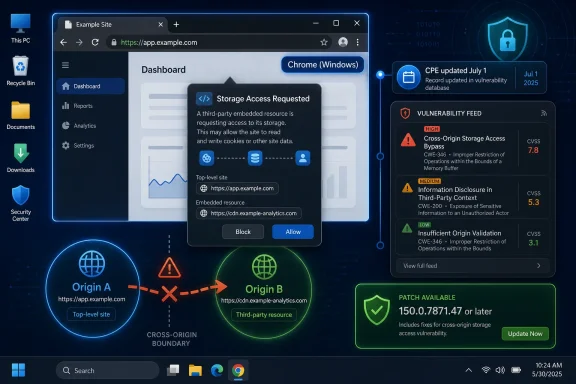 The CPE Was Late, Not Absent
The CPE confusion is understandable because the record evolved quickly. The CVE arrived from Chrome on June 30, 2026, with affected-version metadata and references, but NVD’s formal CPE configuration was not added until July 1. That means scanners, dashboards, and vulnerability-management platforms looking at the entry during the early window may have seen an incomplete or under-enriched record.The relevant CPE added by NVD is the expected one:
cpe:2.3:a:google:chrome:*:*:*:*:*:*:*:*, with versions up to but excluding 150.0.7871.47. In practical terms, that covers Google Chrome desktop releases below the fixed build. It is not a product-family taxonomy masterpiece, but it is the conventional way NVD represents Chrome application exposure.There is a small wrinkle in the Chrome CNA data shown in the record. The affected-version object lists version
150.0.7871.47 with lessThan: 150.0.7871.47, which reads oddly if interpreted too literally. The intended meaning is plain from the description and NVD CPE configuration: Chrome versions prior to 150.0.7871.47 are affected, and 150.0.7871.47 is the fixed threshold.That distinction matters because many enterprise tools treat CVE descriptions, CNA version ranges, CPE configurations, and vendor advisories as separate signals. If one signal arrives before the others, the same vulnerability may look invisible, ambiguous, or mis-scored depending on the scanner. CVE-2026-14021 is a reminder that early CVE records are often moving targets, not final verdicts.
Storage Access Is Now Part of the Browser Security Perimeter
The Storage Access API was built for a web that is trying to recover from the excesses of third-party cookies without breaking every embedded login, payment widget, comment system, and federated identity flow. In broad terms, it gives embedded third-party content a controlled way to request access to storage that would otherwise be blocked by privacy protections.That makes it useful. It also makes it sensitive. Any API that decides whether one origin can regain access to state inside another browsing context is effectively participating in the browser’s privacy and security boundary.
CVE-2026-14021 is described as “insufficient policy enforcement” in StorageAccessAPI. That phrasing is important. This is not presented as a classic memory corruption flaw where a heap overwrite turns into arbitrary code execution; it is a logic or validation failure in the rules that decide what should be allowed.
The CVE description says exploitation required a renderer process that had already been compromised. That condition sharply narrows the threat model, but it does not make the bug irrelevant. Browser security is layered precisely because one compromised component should not automatically become a passport to the rest of the user’s web life.
Chrome’s sandbox design assumes that renderer compromise can happen. The renderer is where hostile web content is parsed, executed, drawn, and constantly mutated. The browser process, site isolation, permission models, origin checks, and storage policies are supposed to limit the damage when the renderer goes bad.
That is why a post-renderer cross-origin data leak deserves attention even at medium severity. If an attacker can chain a renderer bug with a policy-enforcement bug, the second bug may turn a contained compromise into a privacy breach.
Medium Severity Still Means Real Data
CISA’s ADP score of 6.5 places CVE-2026-14021 in the medium bucket, with a vector that reads as network exploitable, low complexity, no privileges required, user interaction required, unchanged scope, high confidentiality impact, and no integrity or availability impact. That is a very specific risk profile. It says the bug is not known as a wormable browser catastrophe, but it also says the confidentiality stakes are serious.The “user interaction required” element is typical for browser vulnerabilities. A user must load or interact with a crafted page, which is not a high bar in a phishing campaign, malvertising chain, compromised website, or targeted watering-hole attack. The “no privileges required” element means the attacker does not need an account on the victim’s machine or inside the target service.
The gating phrase is “had compromised the renderer process.” That implies CVE-2026-14021 would most likely be useful as part of a chain rather than as the first stage. A renderer exploit gets the attacker into the browser’s content process; the StorageAccessAPI flaw could then help extract data across origins that should have remained separated.
That is not theoretical paranoia. Browser exploitation has long favored chains: one bug to execute code, another to escape a sandbox or bypass a policy, and sometimes a third to persist, elevate, or steal. A medium bug with a strong confidentiality impact can become much more valuable when paired with a high-severity renderer vulnerability.
For defenders, the right interpretation is neither panic nor dismissal. This is not a publicly confirmed zero-day in the record supplied here, and CISA’s enrichment says exploitation is not observed. But it is also not “just a browser bug.” It touches a privacy boundary that many modern applications implicitly trust.
The Patch Line Is Clearer Than the Vulnerability Story
Google’s fixed version is the easy part: Chrome 150.0.7871.47 or later for the affected channel described in the CVE. Google’s stable-channel update at the end of June 2026 moved Chrome 150 into the desktop stable stream, with Windows and macOS builds in the 150.0.7871.46/.47 range and Linux listed separately in Google’s release notes.That version complexity is normal for Chrome, but it can trip up fleet operators. A Windows machine reporting 150.0.7871.47 is on the safe side of this CVE’s threshold. A machine still on a 149 build, or on any 150 build before the fixed threshold, should be treated as vulnerable for CVE-2026-14021.
The desktop browser ecosystem complicates this further because Chrome is not the only Chromium-based browser in the field. Microsoft Edge, Brave, Vivaldi, Opera, and embedded Chromium runtimes each consume Chromium changes on their own schedules. A CVE that names Google Chrome does not automatically tell you the patch state of every Chromium derivative.
For Windows administrators, that means inventory has to be product-specific. It is not enough to say “Chromium was patched.” You need to know which browser, which channel, which build number, and whether the vendor has shipped the corresponding Chromium security fixes.
That is especially true on managed desktops where Chrome auto-update may be delayed by policy. Deferring browser updates is sometimes rational in environments with regulated workflows, browser extensions, kiosk systems, or brittle internal web apps. But CVE-2026-14021 is part of a larger Chrome 150 security release, not a standalone curiosity, and the risk calculus changes when dozens or hundreds of fixes land together.
NVD’s Change Log Tells the Story of Modern Vulnerability Plumbing
The NVD change history is almost as revealing as the vulnerability description. Chrome submitted the CVE on June 30. CISA-ADP added CVSS, CWE, and SSVC enrichment on July 1. NIST added the CPE configuration and typed references later that same day.That sequencing is the vulnerability-management supply chain in miniature. A browser vendor publishes the security fix. A CNA record appears. CISA enriches it with operational scoring. NVD maps it to CPE so scanners can match assets. Security tools ingest the pieces at different times and sometimes cache incomplete states.
The result is a familiar moment of ambiguity: “Are we missing a CPE here?” In this case, the answer appears to be that the CPE was added after initial publication. If your system still does not show the Chrome CPE, it may be working from stale NVD data or a partially synchronized vulnerability feed.
This matters because CPE matching is how many organizations decide whether a CVE applies to their environment. Without a CPE, a vulnerability can become a manual review item even when the affected product is obvious. With an overly broad CPE, it can generate noise across systems that are not actually exposed.
Chrome also challenges CPE-based thinking because browser versions move quickly. The useful detection logic is often simpler than the taxonomy: if Google Chrome is installed and its version is below 150.0.7871.47, remediate. That direct version check is less elegant than a normalized vulnerability graph, but it is usually what administrators need.
Cross-Origin Leaks Are the Browser’s Quiet Failure Mode
The browser’s same-origin policy is one of the most important security ideas on the web. It is the reason a malicious page cannot simply read your webmail, bank session, intranet dashboard, or cloud console because those resources happen to be open in the same browser.Modern browsers have had to stretch that model to accommodate reality. Sites embed other sites. Identity providers appear inside iframes. Payment processors, analytics platforms, collaboration widgets, and enterprise portals all depend on controlled exceptions. Privacy reforms then restricted third-party state, and APIs like Storage Access emerged to mediate the exceptions to the exceptions.
That is where policy bugs become dangerous. If a browser grants storage access too broadly, too early, or under the wrong conditions, one origin may learn something it should not know about another. That “something” might be a token, a session-dependent response, a state bit, an identifier, or a signal that allows tracking or data inference.
The CVE description does not say exactly what data could leak, and Google’s bug tracker entry is permission-restricted, which is standard for newly patched Chrome security issues. That means public analysis should not pretend to know the exploit internals. The safe conclusion is narrower: the flaw involved insufficient validation or policy enforcement in a sensitive API, and Google considered the resulting confidentiality risk meaningful enough to assign a CVE and ship a fix.
For developers, the lesson is not to avoid Storage Access API categorically. The web needs explicit mechanisms for legitimate embedded access. The lesson is to assume browser privacy APIs are part of the application’s threat model, especially when a service relies on cross-origin embeds for authentication or account state.
Windows Shops Should Treat Browser Patch Lag as Endpoint Exposure
On Windows desktops, Chrome updates are often treated as background maintenance. The browser updates itself, users restart eventually, and the help page turns green. That folk model works well enough for home users, but it is too casual for enterprise fleets.A Chrome process can remain open for days. Users suspend laptops instead of rebooting. Virtual desktops preserve sessions. Kiosk machines and conference-room PCs drift. Managed update policies may stage rollouts over time, and security teams may not notice the difference between a downloaded update and a relaunched browser running the patched binary.
CVE-2026-14021 is a good candidate for a simple operational check: identify Chrome installations below 150.0.7871.47 and force update plus restart where needed. The vulnerability does not require administrative privileges from the attacker, and the browser is a high-frequency exposure surface. Even without observed exploitation, reducing the window is cheap compared with investigating a browser-chain incident after the fact.
The same logic applies to Windows Server environments used as jump boxes, admin workstations, or remote browsing platforms. A browser on an administrator’s machine is not just another app. It is a credential-bearing interface into identity providers, cloud consoles, remote management tools, and internal documentation.
Security teams should also watch for Chromium-based application runtimes. Electron applications, embedded WebView components, and vendor-packaged Chromium shells do not necessarily inherit Google Chrome’s update cadence. CVE-2026-14021 is named against Chrome, but the underlying Chromium fix may matter wherever the vulnerable code path exists and is reachable.
Privacy Architecture Has Become Patch Tuesday by Another Name
Microsoft administrators are trained to think in monthly rhythms: Patch Tuesday, cumulative updates, out-of-band releases, servicing stack details, and reboot windows. Browser security does not follow that rhythm. Chrome stable updates arrive when they arrive, and Chromium security fixes ripple outward through an ecosystem that is only partly synchronized.That reality has made browser patching a parallel operating-system update channel. For many users, Chrome or Edge is where identity, SaaS, files, messaging, and administrative access converge. A browser confidentiality bug may expose more business data than a local privilege escalation that never meets a useful attacker.
The StorageAccessAPI angle reinforces that shift. The browser is not merely rendering pages; it is enforcing privacy policy, identity boundaries, permission prompts, storage partitioning, anti-tracking behavior, and site isolation. Each of those mechanisms is now security-critical infrastructure.
This is also where vendor language can understate the stakes. “Medium” is a severity bucket, not a business-impact assessment. For a consumer browsing casual websites, the exposure may be modest. For an administrator logged into cloud dashboards and internal apps, a cross-origin data leak chained after renderer compromise is a much more serious proposition.
The practical challenge is that organizations cannot manually triage every Chrome CVE in depth. The sane default is to keep stable browsers current, accelerate updates when confidentiality or sandbox-adjacent bugs appear, and reserve exceptions for cases where a known application breakage is worse than the security risk.
The Record Says “No Known Exploitation,” Not “No Risk”
CISA’s SSVC entry for CVE-2026-14021 marks exploitation as none, automatable as no, and technical impact as partial. That is useful context. It suggests defenders should not treat this CVE like an actively exploited emergency unless new evidence appears.But “none” in this context means no known exploitation signal in the enrichment record, not proof that exploitation is impossible. Browser exploit development often happens behind closed doors, and the public record is usually delayed by design. Google commonly restricts bug details until users have had time to update, which protects lagging users but leaves defenders working from sparse descriptions.
The renderer-compromise prerequisite also cuts both ways. On one hand, it means CVE-2026-14021 is not described as a one-click, end-to-end compromise by itself. On the other hand, attackers who already have renderer execution are precisely the attackers most interested in breaking the next boundary.
That is why medium browser bugs should be read in context. A memory corruption flaw may get the headline because it starts the chain. A policy bypass may determine whether the chain produces useful data. The second bug may be quieter, but it can be the difference between a crash and a breach.
The Scanner View Should Be Simple
For all the nuance around Storage Access, renderer compromise, and CPE timing, the remediation view is mercifully direct. Chrome below 150.0.7871.47 should be updated. Systems already at or above that version are past the fixed threshold for this CVE, assuming they are running the Google Chrome builds covered by the record.If a vulnerability scanner still reports that the CPE is missing, stale, or unresolved, the July 1 NVD change history is the key fact. NVD added the Google Chrome CPE configuration for versions up to but excluding 150.0.7871.47. A scanner that cannot see that mapping may need a feed refresh, plugin update, or vendor-side content correction.
Administrators should avoid overfitting remediation to the CVSS number. The 6.5 score is a useful prioritization input, but it does not capture whether a vulnerable browser is used by a domain administrator, a finance user, a developer with production access, or a kiosk account with no meaningful secrets. Asset context changes urgency.
There is also a reporting benefit to being precise. Instead of writing “Chrome StorageAccessAPI vulnerability present,” a good ticket should say that Chrome installations below 150.0.7871.47 are affected by CVE-2026-14021 and that the issue can permit cross-origin data leakage after renderer compromise. That framing tells the endpoint team what to patch and tells the risk team why it matters.
The Chrome 150 Fix Leaves a Paper Trail Worth Following
CVE-2026-14021 is not the kind of vulnerability that produces dramatic screenshots or easy proof-of-concept demos. It is a browser policy failure in a privacy API, hidden behind a restricted Chromium issue and summarized in one dense sentence. That makes it easy to overlook.The paper trail argues against overlooking it. Chrome assigned the CVE. NVD published it on June 30 and modified it on July 1. CISA-ADP supplied a medium CVSS score with high confidentiality impact. NIST added the Chrome CPE for affected versions before 150.0.7871.47. Google’s stable-channel update is the vendor fix path.
For WindowsForum readers, the answer is both narrow and broad. Narrowly, the CPE is present now, and the affected Chrome range is clear. Broadly, this is another example of browser security moving into the policy layer, where the failures are harder to explain but still capable of exposing real data.
One oddity remains worth watching: the way Chrome’s affected-version object is displayed in the CVE record may confuse automated parsers or human readers because it names the fixed version while also using it as the
lessThan boundary. Mature scanners should follow the version-range semantics rather than treating 150.0.7871.47 itself as affected. If your tool flags the fixed build, verify whether it is misreading the CNA data.The Browser Boundary Is Now a Moving Target
The most concrete lesson from CVE-2026-14021 is that administrators should stop thinking of browser security as a single sandbox story. Chrome’s defenses are a mesh: process isolation, origin policy, permissions, storage partitioning, renderer restrictions, site isolation, and update velocity. A flaw in any one strand may not collapse the web, but attackers do not need collapse; they need a path.That path is increasingly about state. Who is logged in? Which origin can see which storage? What can an embedded frame request? Which privacy exception applies in which browsing context? Those questions once sounded like web-platform arcana. Now they are enterprise security questions.
This is why the StorageAccessAPI placement matters more than the medium label. The API exists because the web is trying to balance privacy restrictions with compatibility. Every such balancing mechanism becomes a place where browser vendors must encode policy perfectly under hostile conditions.
Perfect policy enforcement is hard. It must survive malicious documents, compromised renderers, legacy content, identity flows, edge-case browsing contexts, and platform differences. The surprise is not that bugs appear. The surprise is that the web works as well as it does.
The Practical Reading for Windows Desktops
For most Windows users, the practical advice is to update Chrome and relaunch it. Chrome’s update mechanism can download a fixed build in the background, but the old vulnerable process may continue running until restart. That distinction is mundane, and it is where many browser patches quietly fail in practice.For managed fleets, the better answer is to verify. Query installed Chrome versions, confirm the running version where possible, and check that update policies are not pinning users below 150.0.7871.47. If Chrome is deployed through enterprise management, make sure the policy path actually permits the fixed version.
For environments using Edge as the primary browser and Chrome as a secondary tool, do not assume low usage means low risk. Secondary browsers often escape the tightest controls because they are considered convenience software. They can still hold sessions, cached credentials, extension data, and access to internal sites.
For developers and web-platform teams, the story is less about patching and more about assumptions. Applications that rely on embedded third-party state should be designed with the expectation that browser behavior will evolve and occasionally fail. Sensitive data should not be exposed merely because a storage-access decision flips in an unexpected context.
The July 1 CPE Addition Is the Line Admins Needed
The operational record now points in one direction, even if the early CVE state was messy.- NVD’s change history shows that the Google Chrome CPE was added on July 1, 2026, for versions before 150.0.7871.47.
- CVE-2026-14021 affects Chrome’s StorageAccessAPI policy enforcement and is described as a cross-origin data-leak issue after renderer compromise.
- CISA-ADP scored the flaw as CVSS 3.1 6.5 medium, with high confidentiality impact and no known exploitation in its SSVC enrichment.
- The fixed threshold in the public record is Chrome 150.0.7871.47, so older Chrome builds should be updated and relaunched.
- Vulnerability tools that still lack the CPE mapping may be using stale NVD content or misreading the Chrome CNA version-range data.
- Chromium-based browsers and embedded runtimes should be checked through their own vendor advisories rather than assumed fixed because Google Chrome is fixed.
References
- Primary source: NVD / Chromium
Published: 2026-07-03T07:00:00-07:00
NVD - CVE-2026-14021
 nvd.nist.gov
- Security advisory: MSRC
Published: 2026-07-03T07:00:00-07:00
Original feed URL
Security Update Guide - Microsoft Security Response Center
 msrc.microsoft.com
- Related coverage: cvefeed.io
CVE-2026-14021 - Google Chrome StorageAccessAPI Cross-Origin Data Leak
Insufficient policy enforcement in StorageAccessAPI in Google Chrome prior to 150.0.7871.47 allowed a remote attacker who had compromised the renderer process to leak cross-origin data via a crafted HTML page. (Chromium security severity: Medium)cvefeed.io
