

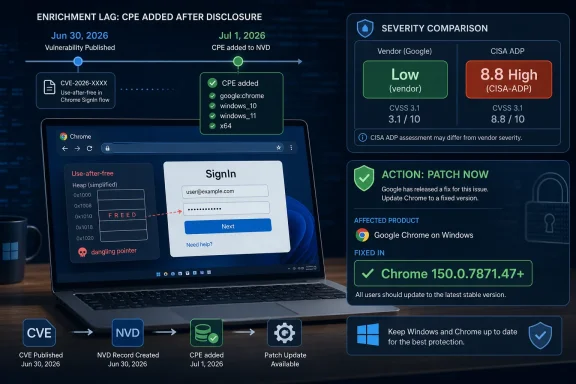
Google Chrome CVE-2026-14027 was published by NVD on June 30, 2026, for a use-after-free flaw in Chrome’s SignIn component before version 150.0.7871.47, with NIST adding the Chrome CPE on July 1 after the original CVE record arrived from Chrome. The short answer to the forum’s practical question is: no, the record does not appear to be missing the core Google Chrome CPE now, but the awkward chronology explains why it may have looked incomplete. This is less a story about one low-severity Chromium bug than about how browser vulnerability metadata is becoming a moving target. For Windows administrators, the lesson is not to wait for NVD to look tidy before treating a Chrome stable-channel security release as actionable.
CVE-2026-14027 is described by Chrome and NVD as a use after free in SignIn, affecting Google Chrome before 150.0.7871.47. The attack scenario is not the nightmare version of a drive-by browser exploit: the attacker must convince the user to perform specific UI gestures on a crafted HTML page. Chromium’s own severity label is Low, which matters because Chrome’s internal severity model is usually closer to exploitability inside its own architecture than a generic scoring system can be.
That said, “Low” does not mean “ignore.” Use-after-free bugs are memory-safety failures, and heap corruption is the kind of primitive attackers like because it can sometimes be shaped into code execution, sandbox escape chains, or account-state manipulation. The CVE text is deliberately restrained — “potentially exploit heap corruption” — but the class of bug is familiar enough to deserve prompt patching.
The friction comes from the scoring. NVD had not provided its own CVSS score when the record was last modified on July 1, while CISA-ADP attached a CVSS 3.1 score of 8.8 High using the vector AV:N/AC:L/PR:N/UI:R/S:U/C:H/I:H/A:H. That is a jarring contrast: Chromium says Low, CISA-ADP’s generic vector says High, and NIST’s own assessment is absent.
This is exactly where vulnerability management teams get burned. The scanner dashboard lights up red because a CVSS vector says 8.8, while the vendor advisory frames the same issue as a lower-priority browser bug requiring user interaction. Neither view is necessarily “wrong”; they are answering different operational questions.
That means the expected CPE is present in the enriched NVD record:
The oddity is in the affected-version block from the CVE source, which says the product is Chrome and includes a version object listing
For administrators, the practical interpretation is simple: Chrome before 150.0.7871.47 is in scope; Chrome 150.0.7871.47 or later is the target baseline. The CPE now matches that interpretation.
That policy shift changes the rhythm of vulnerability operations. In the old mental model, a CVE record became “real” once NVD added a CPE, CVSS score, CWE, and references. In the new model, those fields may arrive in stages, may come from different authorities, or may never be normalized in the way older automation expects.
CVE-2026-14027 illustrates the new world neatly. Chrome supplied the CVE and affected-version data. CISA-ADP supplied CVSS and SSVC information. NIST added the CPE during initial analysis. The final page is useful, but the path to usefulness was not instantaneous.
That matters because many enterprise tools still treat NVD as the canonical source of structured truth. If the CPE is missing for a few hours, matching can fail. If NVD has no CVSS score but CISA-ADP does, prioritization may swing wildly depending on which feed the product trusts. If a vendor calls a bug Low while an external scorer calls it High, dashboards can turn a routine browser update into an incident review.
The CVE says exploitation requires “specific UI gestures.” That phrase is doing a lot of work. It implies the attack is not simply loading a page and waiting for memory corruption; the user must be induced to interact with the page in a particular way. In browser security, however, UI interaction requirements are not always a strong defense, because social engineering, fake prompts, clickjacking-like layouts, and familiar sign-in rituals can make users perform actions they do not understand.
This is why the severity disagreement is not just bureaucratic noise. Chromium may reasonably rate the bug Low because of exploit constraints, mitigations, component context, or lack of evidence of real-world exploitation. CISA-ADP’s CVSS vector, by contrast, scores a network-reachable issue with low attack complexity, no privileges required, user interaction required, and high confidentiality, integrity, and availability impact.
The Windows admin’s job is not to adjudicate which scoring philosophy is purer. It is to decide how quickly to move a browser update that closes a memory-safety bug in a heavily exposed client application. On that question, the answer is boring and firm: update Chrome.
On Windows, Chrome generally updates itself in the background through Google Update. In managed environments, however, that statement has an asterisk the size of an enterprise: update policies, maintenance windows, VDI images, golden builds, browser relaunch deferrals, and application compatibility testing can all delay actual deployment. A machine can have a green policy posture and still be running an exposed browser process until Chrome is relaunched.
That last detail is often overlooked. Browser patching is not finished when the installer lands. It is finished when the running browser instance has restarted into the fixed version. Chrome’s relaunch prompts help, but users can postpone them, and administrators can accidentally permit long-lived sessions to survive beyond the intended patch window.
The version threshold is the only number that matters here: 150.0.7871.47. Anything earlier is in the vulnerable range described by the CVE. Anything at or beyond that build should be treated as remediated for this specific vulnerability, assuming the relevant desktop channel and platform build include the fix.
A Chrome CPE match will not automatically prove that Microsoft Edge is vulnerable, nor will it prove that an Electron application contains the affected SignIn code path. But Chromium bugs frequently matter beyond Chrome because downstream projects share large portions of the codebase. The relevant question is not “does the NVD CPE name my browser?” but “does my browser or embedded runtime include the vulnerable Chromium component and commit range?”
For Microsoft Edge administrators, the right move is to track Microsoft’s Edge release notes and verify the Edge build that absorbs the corresponding Chromium fix. Edge has its own update channels, enterprise controls, and version numbers, so mapping from Chrome 150.0.7871.47 to Edge is not always a one-line exercise. The same logic applies to other Chromium derivatives.
This is one reason CPE-only automation is brittle. CPE is useful for product matching, but it is not a full software supply-chain graph. Chromium’s code moves downstream through release branches, vendor forks, mobile ports, and embedded frameworks faster than many asset tools can model.
Browser vulnerabilities are unusually sensitive to chaining. A single low-severity bug may not be enough to escape a sandbox or compromise a host. But a memory corruption issue in one component can become more interesting when paired with a renderer bug, a sandbox escape, a policy bypass, or a separate credential-harvesting flow. Attackers do not need every link in a chain to be rated Critical.
That does not mean every Chrome CVE deserves emergency change-control treatment. It means severity labels should be interpreted alongside exposure. Chrome is internet-facing by design, used constantly, and trusted by users to process hostile content. The baseline for browser patch urgency should be higher than the baseline for a niche local utility.
The absence of known exploitation is helpful, and CISA’s SSVC entry reportedly listed exploitation as “none.” But “not known exploited” is not the same as “not exploitable,” and memory-safety bugs in browsers have a long record of becoming more valuable after patches disclose the shape of the flaw.
A mature pipeline should ingest vendor advisories, CVE records, NVD enrichment, CISA-ADP scoring, KEV status, SSVC data, and endpoint telemetry as separate signals. It should not collapse them into a single severity number without preserving where that number came from. It should also distinguish between “record incomplete” and “product not affected,” because those are opposite states.
This CVE’s change history is a good test case. If your tooling saw the June 30 CVE without a NIST CPE and ignored it, there was a window where Chrome exposure might have been invisible. If your tooling later saw the CISA-ADP 8.8 score and escalated it as a top-tier emergency despite Chromium’s Low severity and no known exploitation, it may have overcorrected. The right response sits between those extremes.
Patch management should be evidence-driven, not score-driven. For this case, the evidence says a widely deployed browser had a memory-safety bug fixed in a stable-channel release, the vulnerable range is before 150.0.7871.47, and administrators should verify rollout rather than debate whether “Low” or “High” wins the label fight.
For Windows environments, the immediate remediation is to confirm Chrome has reached 150.0.7871.47 or newer and that users have relaunched the browser. This is especially important on shared desktops, persistent VDI, kiosk systems, developer workstations, and machines where browser sessions can stay open for days.
The broader remediation is to examine how your tools handle partial CVE records. NVD’s enrichment strategy has changed, and the neat old assumption that every useful field appears quickly from NIST is no longer safe. Security teams that adapt will patch faster with less noise; teams that do not will alternate between blind spots and false alarms.
 The Browser Bug Is Small, but the Metadata Story Is Not
CVE-2026-14027 is described by Chrome and NVD as a use after free in SignIn, affecting Google Chrome before 150.0.7871.47. The attack scenario is not the nightmare version of a drive-by browser exploit: the attacker must convince the user to perform specific UI gestures on a crafted HTML page. Chromium’s own severity label is Low, which matters because Chrome’s internal severity model is usually closer to exploitability inside its own architecture than a generic scoring system can be.That said, “Low” does not mean “ignore.” Use-after-free bugs are memory-safety failures, and heap corruption is the kind of primitive attackers like because it can sometimes be shaped into code execution, sandbox escape chains, or account-state manipulation. The CVE text is deliberately restrained — “potentially exploit heap corruption” — but the class of bug is familiar enough to deserve prompt patching.
The friction comes from the scoring. NVD had not provided its own CVSS score when the record was last modified on July 1, while CISA-ADP attached a CVSS 3.1 score of 8.8 High using the vector AV:N/AC:L/PR:N/UI:R/S:U/C:H/I:H/A:H. That is a jarring contrast: Chromium says Low, CISA-ADP’s generic vector says High, and NIST’s own assessment is absent.
This is exactly where vulnerability management teams get burned. The scanner dashboard lights up red because a CVSS vector says 8.8, while the vendor advisory frames the same issue as a lower-priority browser bug requiring user interaction. Neither view is necessarily “wrong”; they are answering different operational questions.
The CPE Was Added After the CVE Arrived
The CPE question is the cleanest part of the record. According to the NVD change history provided in the CVE entry, the original CVE arrived from Chrome on June 30, 2026, with the description, references, CWE-416, and affected-version data. On July 1, NIST’s initial analysis added the CPE configuration for Google Chrome versions up to, but excluding, 150.0.7871.47.That means the expected CPE is present in the enriched NVD record:
cpe:2.3:a:google:chrome:*:*:*:*:*:*:*:* with the vulnerable range ending before 150.0.7871.47. If a tool or mirror still shows “CPEs loading” or no CPE, the likely culprit is cache lag, API synchronization, or ingestion timing rather than a genuinely missing product identifier.The oddity is in the affected-version block from the CVE source, which says the product is Chrome and includes a version object listing
150.0.7871.47 with lessThan: 150.0.7871.47 and status “affected.” Read literally, that can look self-contradictory: the fixed version appears in the version field while also serving as the exclusive upper bound. In CVE JSON practice, this is often an artifact of how version ranges are represented rather than a claim that 150.0.7871.47 itself is vulnerable.For administrators, the practical interpretation is simple: Chrome before 150.0.7871.47 is in scope; Chrome 150.0.7871.47 or later is the target baseline. The CPE now matches that interpretation.
NVD’s New Enrichment Model Makes These Gaps More Visible
This record lands during a broader transition at NVD. NIST announced in April 2026 that it would no longer enrich every CVE with the same urgency, citing a surge in CVE submissions and a need to prioritize vulnerabilities in CISA’s Known Exploited Vulnerabilities catalog, software used by the federal government, and “critical software” under Executive Order 14028. NIST also said it would stop routinely producing a separate NVD severity score for every CVE when other sources already provide scoring.That policy shift changes the rhythm of vulnerability operations. In the old mental model, a CVE record became “real” once NVD added a CPE, CVSS score, CWE, and references. In the new model, those fields may arrive in stages, may come from different authorities, or may never be normalized in the way older automation expects.
CVE-2026-14027 illustrates the new world neatly. Chrome supplied the CVE and affected-version data. CISA-ADP supplied CVSS and SSVC information. NIST added the CPE during initial analysis. The final page is useful, but the path to usefulness was not instantaneous.
That matters because many enterprise tools still treat NVD as the canonical source of structured truth. If the CPE is missing for a few hours, matching can fail. If NVD has no CVSS score but CISA-ADP does, prioritization may swing wildly depending on which feed the product trusts. If a vendor calls a bug Low while an external scorer calls it High, dashboards can turn a routine browser update into an incident review.
Chrome’s SignIn Component Sits in an Awkward Trust Zone
The affected component also deserves attention. Chrome SignIn is not merely a login button; it is part of the browser’s account-state machinery, tying local browser behavior to Google account identity, sync, profile state, and authentication flows. A vulnerability there is not automatically a credential theft bug, but it lives near workflows users already trust.The CVE says exploitation requires “specific UI gestures.” That phrase is doing a lot of work. It implies the attack is not simply loading a page and waiting for memory corruption; the user must be induced to interact with the page in a particular way. In browser security, however, UI interaction requirements are not always a strong defense, because social engineering, fake prompts, clickjacking-like layouts, and familiar sign-in rituals can make users perform actions they do not understand.
This is why the severity disagreement is not just bureaucratic noise. Chromium may reasonably rate the bug Low because of exploit constraints, mitigations, component context, or lack of evidence of real-world exploitation. CISA-ADP’s CVSS vector, by contrast, scores a network-reachable issue with low attack complexity, no privileges required, user interaction required, and high confidentiality, integrity, and availability impact.
The Windows admin’s job is not to adjudicate which scoring philosophy is purer. It is to decide how quickly to move a browser update that closes a memory-safety bug in a heavily exposed client application. On that question, the answer is boring and firm: update Chrome.
The Stable Channel Is the Security Boundary Users Actually Have
Google’s Chrome Releases blog is the operational source for this fix, because it is where the stable-channel update is announced and tied to the fixed build. NVD is essential for inventory matching and compliance reporting, but users are protected by installed browser binaries, not by enriched records.On Windows, Chrome generally updates itself in the background through Google Update. In managed environments, however, that statement has an asterisk the size of an enterprise: update policies, maintenance windows, VDI images, golden builds, browser relaunch deferrals, and application compatibility testing can all delay actual deployment. A machine can have a green policy posture and still be running an exposed browser process until Chrome is relaunched.
That last detail is often overlooked. Browser patching is not finished when the installer lands. It is finished when the running browser instance has restarted into the fixed version. Chrome’s relaunch prompts help, but users can postpone them, and administrators can accidentally permit long-lived sessions to survive beyond the intended patch window.
The version threshold is the only number that matters here: 150.0.7871.47. Anything earlier is in the vulnerable range described by the CVE. Anything at or beyond that build should be treated as remediated for this specific vulnerability, assuming the relevant desktop channel and platform build include the fix.
Chromium’s Blast Radius Extends Beyond Google Chrome
The CPE in NVD properly identifies Google Chrome, not every Chromium-based browser on Earth. That is correct for the CVE as issued by Chrome, but it can create a blind spot for administrators who manage Edge, Brave, Vivaldi, Opera, Electron applications, embedded Chromium runtimes, or vendor-bundled browsers.A Chrome CPE match will not automatically prove that Microsoft Edge is vulnerable, nor will it prove that an Electron application contains the affected SignIn code path. But Chromium bugs frequently matter beyond Chrome because downstream projects share large portions of the codebase. The relevant question is not “does the NVD CPE name my browser?” but “does my browser or embedded runtime include the vulnerable Chromium component and commit range?”
For Microsoft Edge administrators, the right move is to track Microsoft’s Edge release notes and verify the Edge build that absorbs the corresponding Chromium fix. Edge has its own update channels, enterprise controls, and version numbers, so mapping from Chrome 150.0.7871.47 to Edge is not always a one-line exercise. The same logic applies to other Chromium derivatives.
This is one reason CPE-only automation is brittle. CPE is useful for product matching, but it is not a full software supply-chain graph. Chromium’s code moves downstream through release branches, vendor forks, mobile ports, and embedded frameworks faster than many asset tools can model.
“Low” Is Not a Patch Deferral Strategy
There is a temptation to look at Chromium’s Low rating and push CVE-2026-14027 into the next normal browser maintenance cycle. In a small unmanaged environment, Chrome’s auto-update behavior may make that decision mostly irrelevant. In a large Windows fleet, though, explicit deferral is a choice with consequences.Browser vulnerabilities are unusually sensitive to chaining. A single low-severity bug may not be enough to escape a sandbox or compromise a host. But a memory corruption issue in one component can become more interesting when paired with a renderer bug, a sandbox escape, a policy bypass, or a separate credential-harvesting flow. Attackers do not need every link in a chain to be rated Critical.
That does not mean every Chrome CVE deserves emergency change-control treatment. It means severity labels should be interpreted alongside exposure. Chrome is internet-facing by design, used constantly, and trusted by users to process hostile content. The baseline for browser patch urgency should be higher than the baseline for a niche local utility.
The absence of known exploitation is helpful, and CISA’s SSVC entry reportedly listed exploitation as “none.” But “not known exploited” is not the same as “not exploitable,” and memory-safety bugs in browsers have a long record of becoming more valuable after patches disclose the shape of the flaw.
Scanner Teams Should Fix Their Logic Before the Next CVE Storm
The most useful operational lesson from CVE-2026-14027 is not about SignIn. It is about vulnerability data pipelines that are too dependent on one field arriving at one time from one source.A mature pipeline should ingest vendor advisories, CVE records, NVD enrichment, CISA-ADP scoring, KEV status, SSVC data, and endpoint telemetry as separate signals. It should not collapse them into a single severity number without preserving where that number came from. It should also distinguish between “record incomplete” and “product not affected,” because those are opposite states.
This CVE’s change history is a good test case. If your tooling saw the June 30 CVE without a NIST CPE and ignored it, there was a window where Chrome exposure might have been invisible. If your tooling later saw the CISA-ADP 8.8 score and escalated it as a top-tier emergency despite Chromium’s Low severity and no known exploitation, it may have overcorrected. The right response sits between those extremes.
Patch management should be evidence-driven, not score-driven. For this case, the evidence says a widely deployed browser had a memory-safety bug fixed in a stable-channel release, the vulnerable range is before 150.0.7871.47, and administrators should verify rollout rather than debate whether “Low” or “High” wins the label fight.
The Practical Reading for WindowsForum Admins
The CVE page’s “Are we missing a CPE?” language is a generic NVD prompt, not proof that this record lacks the Chrome CPE. Based on the change log, NIST added the Google Chrome CPE on July 1, 2026, during initial analysis. If a downstream product still says otherwise, refresh the feed, check the API payload, and verify whether the product is reading NVD’s modified data correctly.For Windows environments, the immediate remediation is to confirm Chrome has reached 150.0.7871.47 or newer and that users have relaunched the browser. This is especially important on shared desktops, persistent VDI, kiosk systems, developer workstations, and machines where browser sessions can stay open for days.
The broader remediation is to examine how your tools handle partial CVE records. NVD’s enrichment strategy has changed, and the neat old assumption that every useful field appears quickly from NIST is no longer safe. Security teams that adapt will patch faster with less noise; teams that do not will alternate between blind spots and false alarms.
The Signal Hidden in This Chrome Record
CVE-2026-14027 is not the Chrome bug that should keep everyone awake by itself, but it is a useful warning about how browser security now reaches administrators: fragmented, staged, and sometimes contradictory.- The Google Chrome CPE for versions before 150.0.7871.47 appears to have been added by NIST on July 1, 2026.
- The fixed Chrome baseline for this vulnerability is 150.0.7871.47 or later.
- Chromium rates the issue Low, while CISA-ADP supplied a CVSS 3.1 score of 8.8 High, so teams should preserve source attribution when prioritizing.
- The attack requires user interaction through specific UI gestures, which lowers exploitability but does not eliminate risk.
- NVD’s newer enrichment model means missing or delayed metadata should be treated as an ingestion state, not as proof that a product is unaffected.
- Chromium-derived browsers and embedded runtimes should be checked through their own vendor release channels rather than inferred solely from the Google Chrome CPE.
References
- Primary source: NVD / Chromium
Published: 2026-07-03T07:00:47-07:00
NVD - CVE-2026-14027
 nvd.nist.gov
- Security advisory: MSRC
Published: 2026-07-03T07:00:47-07:00
Original feed URL
Security Update Guide - Microsoft Security Response Center
 msrc.microsoft.com
- Related coverage: cvefeed.io
CVE-2026-14027 - Google Chrome Use-After-Free
Use after free in SignIn in Google Chrome prior to 150.0.7871.47 allowed a remote attacker who convinced a user to engage in specific UI gestures to potentially exploit heap corruption via a crafted HTML page. (Chromium security severity: Low)cvefeed.io - Official source: nist.gov
National Vulnerability Database
NIST maintains the National Vulnerability Database (NVD), a repository of information on software and hardware flaws that can compromise computer security. This is a key piece of the nation’s cybersecurity infrastructure.www.nist.gov - Related coverage: security.snyk.io
Use After Free in chromium | CVE-2026-13789 | Snyk
High severity (8.7) Use After Free in chromium | CVE-2026-13789security.snyk.io - Related coverage: labs.cloudsecurityalliance.org
NVD Enrichment Triage: Enterprise Vulnerability Programs Must Adapt
PDF documentlabs.cloudsecurityalliance.org
