

CVE-2026-14051 is a low-severity Chromium GamepadAPI information-disclosure flaw, published by NVD on June 30, 2026, fixed in Chrome 150.0.7871.47 for Windows and Mac, and relevant to users on Windows, macOS, and Linux running vulnerable Chrome builds before the stable-channel update. The short version is not that every Chrome user is staring down a drive-by compromise. The more interesting story is that a small memory-safety bug exposes how messy browser vulnerability data becomes when Chrome’s release numbering, NVD enrichment, CISA scoring, and enterprise asset matching all meet in public.
Google’s Chrome Releases blog announced Chrome 150’s stable-channel promotion on June 30, 2026, saying the update would roll out over the coming days and weeks for Windows, Mac, and Linux. The same release post says Chrome 150.0.7871.46 was the Linux build, while Windows and Mac received 150.0.7871.46 and 150.0.7871.47. That detail matters, because CVE-2026-14051 is described by NVD and Chrome as affecting Google Chrome prior to 150.0.7871.47.
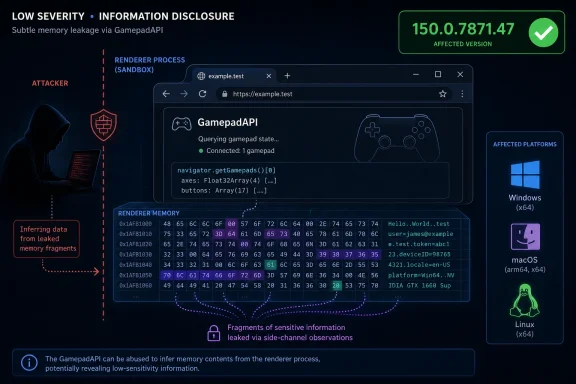
The vulnerability itself is narrow: an uninitialized use in GamepadAPI could allow a remote attacker, after compromising the renderer process, to obtain potentially sensitive information from process memory through a crafted HTML page. Chrome assigned it low severity. CISA’s ADP enrichment, however, attached a CVSS 3.1 score of 6.5, or medium, with high confidentiality impact and no integrity or availability impact.
That apparent mismatch is not automatically a contradiction. Chrome’s internal severity ratings are tuned to the browser project’s exploitability model and sandbox assumptions, while CVSS tries to express impact in a more generic risk language. In Chrome’s world, “the attacker already compromised the renderer” is a huge qualifier; in CVSS, the possibility of reading sensitive memory can still score sharply on confidentiality.
The practical reading for WindowsForum readers is this: CVE-2026-14051 is not the browser bug you panic over in isolation, but it is exactly the kind of bug you do not want lingering in a fleet. Browser exploitation often works as a chain. A memory disclosure that looks modest alone can become useful when paired with a renderer compromise, a sandbox escape, or a bypass that needs leaked process state to become reliable.
This is the core paradox of browser security in 2026. A user may never plug in a controller, never launch a web game, and never think about GamepadAPI, yet the code path exists inside the browser platform that renders their mail, identity provider, SaaS dashboard, ticketing system, and admin console. Attackers do not care whether a feature is prominent. They care whether the feature is reachable, buggy, and useful.
Uninitialized-use bugs are especially unattractive because they often involve software making decisions or returning data from memory that was not properly set before use. MITRE classifies this family under CWE-457, use of an uninitialized variable. In plain English, code touches memory that may contain leftovers from earlier operations, and those leftovers can sometimes become observable.
For a browser, “observable” is the dangerous word. The web security model assumes hostile pages can execute complex code, but only inside carefully drawn boundaries. When a bug lets a crafted page infer or read data it should not see, the boundary has not vanished, but it has become porous. A low-rated leak may not hand over passwords on command, yet it can still provide the kind of process-memory breadcrumbs that make a larger attack more deterministic.
That is why Chrome can label this low severity. A bug that requires a compromised renderer is not a single-click universal compromise by itself. It is a post-compromise primitive inside one layer of the browser, and security teams should treat it as a chain component rather than a standalone catastrophe.
But “not a catastrophe” is not the same as “not important.” Attack chains are assembled from exactly these kinds of pieces: one bug for code execution, another for information disclosure, another for policy bypass, another for sandbox escape. A memory leak can help defeat address-space layout randomization, expose object layouts, or reveal sensitive fragments that should never leave process memory.
For home users, the right answer is mundane: let Chrome update and restart the browser. For administrators, the right answer is more operational: verify the version reported by managed endpoints, pay attention to the platform-specific build numbering, and do not let “low” severity override the reality that browser bugs age badly once exploit researchers have time to study them.
NVD’s initial analysis added a configuration for Google Chrome versions up to, but excluding, 150.0.7871.46, combined with operating-system CPEs for Microsoft Windows, Linux kernel, and Apple macOS. That is awkward because the CVE description says Chrome prior to 150.0.7871.47, while Google’s stable-channel post says Linux is 150.0.7871.46 and Windows/Mac are 150.0.7871.46/.47. In other words, the fixed-version story is not a single clean number across every desktop platform.
This is where enterprise scanners can get noisy. If a tool blindly reads “less than 150.0.7871.46,” it may treat 150.0.7871.46 as fixed everywhere. If another tool reads the prose description, it may flag anything below 150.0.7871.47. If Chrome’s own release packaging means Linux fixed at .46 while some Windows/Mac channels fixed at .47, then the only safe interpretation is platform-aware.
The oddity in the CVE “affected” JSON also deserves attention. The record reportedly lists version 150.0.7871.47 with lessThan 150.0.7871.47 and status “affected,” which is an awkward representation even if the intent is clear: versions below 150.0.7871.47 are affected. This kind of metadata wrinkle is not rare in freshly published CVEs, especially when automated enrichment lands before humans and vendors have fully harmonized the record.
So, are we missing a CPE? If the question is whether Windows, macOS, and Linux should be represented as affected platforms, NVD’s change history already shows those operating-system CPEs. If the question is whether the Chrome application CPE’s version cutoff fully captures the vendor’s “prior to 150.0.7871.47” language, then yes, the record looks like it may need clarification. The most actionable fix would be a corrected or platform-specific CPE range that reconciles Chrome’s Linux .46 build with the Windows/Mac .46/.47 release wording.
That context matters because security triage is relative. A low-severity GamepadAPI memory disclosure will not compete for attention with critical use-after-free bugs in components that attackers prize for reliable code execution. It will not be the headline item in most patch advisories. It should not drive emergency meetings by itself.
But the volume also argues against complacency. Chrome is no longer a single application in the old desktop sense; it is a web runtime, graphics stack, extension platform, device broker, identity surface, media engine, PDF viewer, JavaScript VM, and app container. A release with hundreds of security fixes is not merely polishing rough edges. It is replacing a large chunk of attack surface that hostile sites and exploit brokers are constantly probing.
For Windows administrators, this is why browser patching has become one of the few desktop hygiene tasks that deserves server-class discipline. The browser is often the first privileged interpreter of hostile content in the enterprise. It sits between users and every SaaS app the organization now depends on. Treating Chrome as “just another user app” is a policy failure disguised as convenience.
CISA’s SSVC data, however, tells a more restrained story. The enrichment marks exploitation as none, automatable as no, and technical impact as partial. That combination is closer to the operational reality: there is no public signal in the record that this flaw is being exploited in the wild, and the renderer-compromise precondition limits its standalone usefulness.
This is why modern vulnerability management cannot be reduced to a single number. CVSS asks, “How bad could this be under the model?” SSVC asks a more decision-oriented question: “What should a defender do with this now?” Chrome’s own rating asks yet another question: “How severe is this inside Chromium’s architecture and threat model?”
All three are useful, but none is sufficient. A desktop team looking only at Chrome’s “low” may under-prioritize a memory disclosure in a browser. A scanner looking only at CVSS 6.5 may overstate immediate exploit urgency. A risk program looking at SSVC may correctly conclude that routine rapid patching is enough, not because the bug is harmless, but because the evidence does not support emergency treatment.
That does not mean administrators should invent affected-product claims the CVE does not make. The NVD record discussed here names Chrome, and the vendor advisory is Google’s Chrome release. But the operational instinct should be to check all Chromium-family browsers in the environment, not just Chrome, because users rarely care which browser engine is carrying the vulnerable code path.
Microsoft’s Edge update cadence usually tracks Chromium security work closely, but “usually” is not an asset inventory. Managed Windows shops should verify Edge version status through Microsoft’s release channels and their own endpoint telemetry rather than assuming parity. The same goes for Electron-based applications, which may lag Chromium security fixes by weeks or months depending on the vendor.
This is the part of browser security that users never see. Chrome can patch quickly, but the Chromium supply chain is not a single pipe. It is a river delta of browsers, embedded runtimes, desktop apps, kiosks, webviews, and vendor-frozen builds. A small GamepadAPI bug in Chrome can therefore become a useful reminder to hunt for stale Chromium, not because every derivative is confirmed vulnerable, but because stale Chromium is one of the most reliable findings in real-world Windows fleets.
Still, crafted HTML is not a throwaway detail. The web is the delivery mechanism. Users do not install a malicious binary; they open a page, click a link, follow an ad redirect, preview a document, or interact with an application that contains attacker-controlled content. Browser bugs are dangerous precisely because ordinary web behavior can become exploit delivery.
The renderer condition also highlights why browser sandbox escapes get so much attention. A renderer compromise without a sandbox escape is supposed to be contained. An information disclosure inside that compromised renderer may help the attacker understand memory state or chain into the next stage. The bug’s value depends on the rest of the chain.
That is why “low” can still be strategically meaningful. Attackers do not need every vulnerability in a chain to be spectacular. They need the chain to work. Defenders, conversely, do not need to prove a low-severity bug is actively exploited before they remove it from their environment.
That means security teams should be careful before writing simplistic detection logic. A rule that flags “Chrome less than 150.0.7871.47” may produce false positives on Linux if 150.0.7871.46 is indeed the fixed Linux build from Google’s stable-channel release. A rule that flags “less than 150.0.7871.46” may miss Windows or Mac systems that need .47, depending on how Google’s dual build numbers map to the security fix.
The correct operational answer is to prefer vendor release context over generic CPE matching when they disagree. If your vulnerability scanner has already normalized the CVE, inspect how it models Windows, macOS, and Linux separately. If it cannot distinguish platform-specific Chrome build numbers, treat its result as a triage signal rather than gospel.
This is also a good moment to remember that Chrome updates often require a browser restart to complete. Endpoint tools may report a newer installed version while long-running browser processes continue executing old code. In high-risk environments, version compliance should include restart enforcement or at least detection of pending relaunch state.
The urgency is higher for users and systems exposed to untrusted web content at scale. That includes help desks, analysts, developers browsing issue trackers and proof-of-concept repositories, finance users handling external documents, and anyone using unmanaged extensions or unusual browser flags. It also includes kiosk and shared systems where browser sessions linger and update restarts are easy to miss.
The urgency is lower for locked-down systems that do not browse the open web and receive browser updates through controlled maintenance windows. But even there, the browser should not become frozen infrastructure. The cost of carrying old Chromium code is cumulative, and the benefit of delaying a security-only browser update is usually overstated.
What teams should not do is treat the CPE ambiguity as a reason to ignore the CVE. Metadata uncertainty should trigger verification, not paralysis. Confirm the actual Chrome channel, platform, and version. Then patch to the latest available stable build for that platform.
That quietness is precisely why it is useful as a case study. The vulnerability shows how defenders must reason across several layers at once: vendor severity, CVSS scoring, SSVC decision support, CPE mappings, release-channel versioning, and exploit-chain economics. A browser CVE is not just a row in a scanner dashboard. It is a negotiation between how software is built, how advisories are written, and how enterprises actually patch.
For WindowsForum’s audience, the Windows angle is straightforward but not trivial. Chrome on Windows should be at or beyond the fixed Chrome 150 stable build, and admins should verify whether their tools correctly model 150.0.7871.47 as the relevant Windows/Mac fixed boundary. If a scanner says the cutoff is .46, ask why. If it says every .46 build is vulnerable, ask whether it understands Linux’s release numbering in Google’s advisory.
The broader lesson is that browser security increasingly lives in the gray zone between “not actively exploited” and “too exposed to defer.” CVE-2026-14051 appears to sit in that zone. It does not demand panic, but it does demand the kind of disciplined patching that prevents today’s low-severity primitive from becoming tomorrow’s convenient link in a chain.
 A Low-Severity Bug Still Deserves a Serious Reading
Google’s Chrome Releases blog announced Chrome 150’s stable-channel promotion on June 30, 2026, saying the update would roll out over the coming days and weeks for Windows, Mac, and Linux. The same release post says Chrome 150.0.7871.46 was the Linux build, while Windows and Mac received 150.0.7871.46 and 150.0.7871.47. That detail matters, because CVE-2026-14051 is described by NVD and Chrome as affecting Google Chrome prior to 150.0.7871.47.The vulnerability itself is narrow: an uninitialized use in GamepadAPI could allow a remote attacker, after compromising the renderer process, to obtain potentially sensitive information from process memory through a crafted HTML page. Chrome assigned it low severity. CISA’s ADP enrichment, however, attached a CVSS 3.1 score of 6.5, or medium, with high confidentiality impact and no integrity or availability impact.
That apparent mismatch is not automatically a contradiction. Chrome’s internal severity ratings are tuned to the browser project’s exploitability model and sandbox assumptions, while CVSS tries to express impact in a more generic risk language. In Chrome’s world, “the attacker already compromised the renderer” is a huge qualifier; in CVSS, the possibility of reading sensitive memory can still score sharply on confidentiality.
The practical reading for WindowsForum readers is this: CVE-2026-14051 is not the browser bug you panic over in isolation, but it is exactly the kind of bug you do not want lingering in a fleet. Browser exploitation often works as a chain. A memory disclosure that looks modest alone can become useful when paired with a renderer compromise, a sandbox escape, or a bypass that needs leaked process state to become reliable.
The GamepadAPI Angle Is a Reminder That Browsers Are Operating Systems Now
GamepadAPI sounds almost charmingly niche, like something that should only matter to browser games and couch-friendly web demos. In modern Chromium, though, a web API is not just a feature toggle; it is a contract between untrusted web content, device state, input plumbing, renderer processes, and browser-side mediation. That is a lot of surface area for something many enterprise users will never knowingly touch.This is the core paradox of browser security in 2026. A user may never plug in a controller, never launch a web game, and never think about GamepadAPI, yet the code path exists inside the browser platform that renders their mail, identity provider, SaaS dashboard, ticketing system, and admin console. Attackers do not care whether a feature is prominent. They care whether the feature is reachable, buggy, and useful.
Uninitialized-use bugs are especially unattractive because they often involve software making decisions or returning data from memory that was not properly set before use. MITRE classifies this family under CWE-457, use of an uninitialized variable. In plain English, code touches memory that may contain leftovers from earlier operations, and those leftovers can sometimes become observable.
For a browser, “observable” is the dangerous word. The web security model assumes hostile pages can execute complex code, but only inside carefully drawn boundaries. When a bug lets a crafted page infer or read data it should not see, the boundary has not vanished, but it has become porous. A low-rated leak may not hand over passwords on command, yet it can still provide the kind of process-memory breadcrumbs that make a larger attack more deterministic.
The Renderer Compromise Requirement Is the Line Between Patch Now and Panic Now
The most important phrase in the CVE description is not “crafted HTML page.” It is “had compromised the renderer process.” Chrome’s multiprocess architecture deliberately assumes renderers are exposed to hostile web content, then attempts to contain them through sandboxing and privilege separation. If an attacker already controls the renderer, the battle has moved past ordinary malicious JavaScript into exploit-chain territory.That is why Chrome can label this low severity. A bug that requires a compromised renderer is not a single-click universal compromise by itself. It is a post-compromise primitive inside one layer of the browser, and security teams should treat it as a chain component rather than a standalone catastrophe.
But “not a catastrophe” is not the same as “not important.” Attack chains are assembled from exactly these kinds of pieces: one bug for code execution, another for information disclosure, another for policy bypass, another for sandbox escape. A memory leak can help defeat address-space layout randomization, expose object layouts, or reveal sensitive fragments that should never leave process memory.
For home users, the right answer is mundane: let Chrome update and restart the browser. For administrators, the right answer is more operational: verify the version reported by managed endpoints, pay attention to the platform-specific build numbering, and do not let “low” severity override the reality that browser bugs age badly once exploit researchers have time to study them.
NVD’s CPE Entry Looks Like the Messy Part
The user-facing question here is whether a CPE is missing. Based on the NVD change history shown for CVE-2026-14051, the bigger issue may not be a missing operating-system CPE so much as a potentially confusing version boundary in the CPE configuration.NVD’s initial analysis added a configuration for Google Chrome versions up to, but excluding, 150.0.7871.46, combined with operating-system CPEs for Microsoft Windows, Linux kernel, and Apple macOS. That is awkward because the CVE description says Chrome prior to 150.0.7871.47, while Google’s stable-channel post says Linux is 150.0.7871.46 and Windows/Mac are 150.0.7871.46/.47. In other words, the fixed-version story is not a single clean number across every desktop platform.
This is where enterprise scanners can get noisy. If a tool blindly reads “less than 150.0.7871.46,” it may treat 150.0.7871.46 as fixed everywhere. If another tool reads the prose description, it may flag anything below 150.0.7871.47. If Chrome’s own release packaging means Linux fixed at .46 while some Windows/Mac channels fixed at .47, then the only safe interpretation is platform-aware.
The oddity in the CVE “affected” JSON also deserves attention. The record reportedly lists version 150.0.7871.47 with lessThan 150.0.7871.47 and status “affected,” which is an awkward representation even if the intent is clear: versions below 150.0.7871.47 are affected. This kind of metadata wrinkle is not rare in freshly published CVEs, especially when automated enrichment lands before humans and vendors have fully harmonized the record.
So, are we missing a CPE? If the question is whether Windows, macOS, and Linux should be represented as affected platforms, NVD’s change history already shows those operating-system CPEs. If the question is whether the Chrome application CPE’s version cutoff fully captures the vendor’s “prior to 150.0.7871.47” language, then yes, the record looks like it may need clarification. The most actionable fix would be a corrected or platform-specific CPE range that reconciles Chrome’s Linux .46 build with the Windows/Mac .46/.47 release wording.
Chrome 150’s Security Volume Makes This Bug Look Smaller, Not Irrelevant
CVE-2026-14051 arrived inside a very large Chrome 150 stable-channel update. Google’s release post says the update included 433 security fixes, an unusually large number by the standards of normal browser point releases. The list includes critical, high, medium, and low-severity issues across extensions, GPU, ANGLE, Dawn, WebUSB, Skia, V8, Views, Bluetooth, and many other components.That context matters because security triage is relative. A low-severity GamepadAPI memory disclosure will not compete for attention with critical use-after-free bugs in components that attackers prize for reliable code execution. It will not be the headline item in most patch advisories. It should not drive emergency meetings by itself.
But the volume also argues against complacency. Chrome is no longer a single application in the old desktop sense; it is a web runtime, graphics stack, extension platform, device broker, identity surface, media engine, PDF viewer, JavaScript VM, and app container. A release with hundreds of security fixes is not merely polishing rough edges. It is replacing a large chunk of attack surface that hostile sites and exploit brokers are constantly probing.
For Windows administrators, this is why browser patching has become one of the few desktop hygiene tasks that deserves server-class discipline. The browser is often the first privileged interpreter of hostile content in the enterprise. It sits between users and every SaaS app the organization now depends on. Treating Chrome as “just another user app” is a policy failure disguised as convenience.
The CVSS Score Tells One Story, SSVC Tells Another
CISA’s ADP scoring gives CVE-2026-14051 a 6.5 medium CVSS 3.1 score. The vector is network attackable, low complexity, no privileges required, user interaction required, unchanged scope, high confidentiality impact, and no integrity or availability impact. That produces a score that looks more urgent than Chrome’s low severity label.CISA’s SSVC data, however, tells a more restrained story. The enrichment marks exploitation as none, automatable as no, and technical impact as partial. That combination is closer to the operational reality: there is no public signal in the record that this flaw is being exploited in the wild, and the renderer-compromise precondition limits its standalone usefulness.
This is why modern vulnerability management cannot be reduced to a single number. CVSS asks, “How bad could this be under the model?” SSVC asks a more decision-oriented question: “What should a defender do with this now?” Chrome’s own rating asks yet another question: “How severe is this inside Chromium’s architecture and threat model?”
All three are useful, but none is sufficient. A desktop team looking only at Chrome’s “low” may under-prioritize a memory disclosure in a browser. A scanner looking only at CVSS 6.5 may overstate immediate exploit urgency. A risk program looking at SSVC may correctly conclude that routine rapid patching is enough, not because the bug is harmless, but because the evidence does not support emergency treatment.
Edge, Chromium, and the Windows Reality
The CVE is filed against Google Chrome, but Windows readers should remember the broader Chromium ecosystem. Microsoft Edge is Chromium-based, and many third-party browsers consume Chromium code on their own schedules. A vulnerability in a Chromium component may or may not map immediately to each downstream browser depending on code inclusion, feature exposure, and patch integration timing.That does not mean administrators should invent affected-product claims the CVE does not make. The NVD record discussed here names Chrome, and the vendor advisory is Google’s Chrome release. But the operational instinct should be to check all Chromium-family browsers in the environment, not just Chrome, because users rarely care which browser engine is carrying the vulnerable code path.
Microsoft’s Edge update cadence usually tracks Chromium security work closely, but “usually” is not an asset inventory. Managed Windows shops should verify Edge version status through Microsoft’s release channels and their own endpoint telemetry rather than assuming parity. The same goes for Electron-based applications, which may lag Chromium security fixes by weeks or months depending on the vendor.
This is the part of browser security that users never see. Chrome can patch quickly, but the Chromium supply chain is not a single pipe. It is a river delta of browsers, embedded runtimes, desktop apps, kiosks, webviews, and vendor-frozen builds. A small GamepadAPI bug in Chrome can therefore become a useful reminder to hunt for stale Chromium, not because every derivative is confirmed vulnerable, but because stale Chromium is one of the most reliable findings in real-world Windows fleets.
Why “Crafted HTML Page” Is Both True and Misleading
CVE descriptions often say “via a crafted HTML page,” and the phrase can lull readers into imagining an ordinary web page doing something magical. In this case, the crafted page matters only after an attacker has compromised the renderer process. That is a very different threat model from “visit a page and immediately leak memory.”Still, crafted HTML is not a throwaway detail. The web is the delivery mechanism. Users do not install a malicious binary; they open a page, click a link, follow an ad redirect, preview a document, or interact with an application that contains attacker-controlled content. Browser bugs are dangerous precisely because ordinary web behavior can become exploit delivery.
The renderer condition also highlights why browser sandbox escapes get so much attention. A renderer compromise without a sandbox escape is supposed to be contained. An information disclosure inside that compromised renderer may help the attacker understand memory state or chain into the next stage. The bug’s value depends on the rest of the chain.
That is why “low” can still be strategically meaningful. Attackers do not need every vulnerability in a chain to be spectacular. They need the chain to work. Defenders, conversely, do not need to prove a low-severity bug is actively exploited before they remove it from their environment.
The Version Number Problem Is Not Academic
Chrome’s version detail is the most practical snag in this CVE. Google’s post lists Chrome 150.0.7871.46 for Linux and 150.0.7871.46/.47 for Windows and Mac. NVD’s prose says prior to 150.0.7871.47. NVD’s CPE change history, as provided, says Chrome versions up to but excluding 150.0.7871.46.That means security teams should be careful before writing simplistic detection logic. A rule that flags “Chrome less than 150.0.7871.47” may produce false positives on Linux if 150.0.7871.46 is indeed the fixed Linux build from Google’s stable-channel release. A rule that flags “less than 150.0.7871.46” may miss Windows or Mac systems that need .47, depending on how Google’s dual build numbers map to the security fix.
The correct operational answer is to prefer vendor release context over generic CPE matching when they disagree. If your vulnerability scanner has already normalized the CVE, inspect how it models Windows, macOS, and Linux separately. If it cannot distinguish platform-specific Chrome build numbers, treat its result as a triage signal rather than gospel.
This is also a good moment to remember that Chrome updates often require a browser restart to complete. Endpoint tools may report a newer installed version while long-running browser processes continue executing old code. In high-risk environments, version compliance should include restart enforcement or at least detection of pending relaunch state.
Enterprise IT Should Patch Fast, but Not Rewrite the Weekend
For most organizations, CVE-2026-14051 should ride the normal rapid browser patching process. Chrome’s own rollout is staged over days and weeks, but managed environments do not have to wait passively for the consumer update wave. Admins can push browser updates, enforce relaunch policies, and verify build levels through their endpoint management stack.The urgency is higher for users and systems exposed to untrusted web content at scale. That includes help desks, analysts, developers browsing issue trackers and proof-of-concept repositories, finance users handling external documents, and anyone using unmanaged extensions or unusual browser flags. It also includes kiosk and shared systems where browser sessions linger and update restarts are easy to miss.
The urgency is lower for locked-down systems that do not browse the open web and receive browser updates through controlled maintenance windows. But even there, the browser should not become frozen infrastructure. The cost of carrying old Chromium code is cumulative, and the benefit of delaying a security-only browser update is usually overstated.
What teams should not do is treat the CPE ambiguity as a reason to ignore the CVE. Metadata uncertainty should trigger verification, not paralysis. Confirm the actual Chrome channel, platform, and version. Then patch to the latest available stable build for that platform.
The Real Risk Is the Chain You Do Not See Yet
Security news tends to reward spectacular bugs: zero-days, remote code execution, sandbox escapes, named campaigns, emergency out-of-band updates. CVE-2026-14051 is none of those, at least based on the public record so far. It is a quieter kind of issue: a memory disclosure in a web-exposed API, constrained by a renderer-compromise prerequisite, fixed inside a giant stable-channel security release.That quietness is precisely why it is useful as a case study. The vulnerability shows how defenders must reason across several layers at once: vendor severity, CVSS scoring, SSVC decision support, CPE mappings, release-channel versioning, and exploit-chain economics. A browser CVE is not just a row in a scanner dashboard. It is a negotiation between how software is built, how advisories are written, and how enterprises actually patch.
For WindowsForum’s audience, the Windows angle is straightforward but not trivial. Chrome on Windows should be at or beyond the fixed Chrome 150 stable build, and admins should verify whether their tools correctly model 150.0.7871.47 as the relevant Windows/Mac fixed boundary. If a scanner says the cutoff is .46, ask why. If it says every .46 build is vulnerable, ask whether it understands Linux’s release numbering in Google’s advisory.
The broader lesson is that browser security increasingly lives in the gray zone between “not actively exploited” and “too exposed to defer.” CVE-2026-14051 appears to sit in that zone. It does not demand panic, but it does demand the kind of disciplined patching that prevents today’s low-severity primitive from becoming tomorrow’s convenient link in a chain.
The Patch Window Is Where This CVE Will Be Won or Lost
The concrete actions are simple, but the reasoning behind them is not. CVE-2026-14051 is a small component of a large Chrome 150 security release, and its practical risk depends on whether organizations can translate messy public metadata into accurate endpoint state.- Chrome users on Windows and macOS should move to 150.0.7871.47 or later where that build is offered by the stable channel.
- Linux administrators should verify Google’s platform-specific Chrome 150 release notes before treating 150.0.7871.46 as vulnerable or fixed.
- Vulnerability-management teams should review scanner logic because NVD’s CPE cutoff shown in the change history may not cleanly match the “prior to 150.0.7871.47” description.
- Security teams should treat the flaw as a potential exploit-chain component, not as a standalone drive-by compromise.
- Managed environments should enforce browser restarts after update, because a patched package does not always mean patched running processes.
- Chromium-based browsers and embedded runtimes should be checked separately rather than assumed safe because the CVE names Google Chrome.
References
- Primary source: NVD / Chromium
Published: 2026-07-03T07:00:34-07:00
NVD - CVE-2026-14051
 nvd.nist.gov
- Security advisory: MSRC
Published: 2026-07-03T07:00:34-07:00
Original feed URL
Security Update Guide - Microsoft Security Response Center
 msrc.microsoft.com
- Related coverage: cvefeed.io
CVE-2026-14051 - Google Chrome GamepadAPI Uninitialized Use Information Disclosure
Uninitialized Use in GamepadAPI in Google Chrome prior to 150.0.7871.47 allowed a remote attacker who had compromised the renderer process to obtain potentially sensitive information from process memory via a crafted HTML page. (Chromium security severity: Low)cvefeed.io
