

Google Chrome CVE-2026-14049, disclosed by Chrome and published in NVD on June 30, 2026, is a low-severity GPU information-disclosure flaw fixed in Chrome 150.0.7871.47 that could expose process memory after an attacker had already compromised the renderer through a crafted HTML page. The important part is not that this is another headline-grabbing browser bug; it is that the exploit chain starts after a boundary has already failed. As reflected in NVD’s entry, CISA’s ADP scoring, and Google’s Chrome Releases advisory, this is the kind of quiet Chromium flaw that matters most when it becomes one link in a longer campaign.
Chrome’s own severity rating for CVE-2026-14049 is Low, and on a clean reading that makes sense. The bug does not appear to let a random website directly seize control of the browser. The attacker first needs a compromised renderer process, which means the vulnerability is not the opening move in the attack.
That distinction matters because modern Chrome security is built around layers. The renderer is expected to be hostile if a web-content bug lands, and the browser’s architecture tries to keep that hostile renderer boxed in. A flaw in the GPU component that can leak memory from that position is therefore not “just” an information leak; it is a potential assist to a more serious escape or data-theft chain.
CISA’s ADP CVSS 3.1 score of 5.3, Medium, captures that nuance better than the simple Chromium Low label. The vector requires user interaction and has high attack complexity, but the confidentiality impact is marked High. That is a very Chrome-shaped risk profile: hard to weaponize in isolation, much more interesting when paired with another bug.
The practical reading for Windows users and administrators is straightforward. If Chrome is below 150.0.7871.47, the browser is behind the fix line named in the CVE description. If a fleet is still waiting on staged rollout, update deferral, or third-party Chromium repackaging, this is one more reason not to treat “low severity” as synonymous with “optional.”
CVE-2026-14049 is described as an “inappropriate implementation” in GPU, which is NVD and Chromium shorthand rather than a root-cause tutorial. Google often restricts bug details until most users are updated, and the linked Chromium issue requires permissions at the time of disclosure. That is normal for browser security, but it leaves defenders reading the shape of the bug rather than the code-level mistake.
The shape is still revealing. The attacker needs a crafted HTML page and a compromised renderer, and the payoff is potentially sensitive information from process memory. In other words, the GPU component is not being framed here as the initial code-execution target. It is being framed as a place where a compromised renderer can learn something it should not know.
That is exactly why memory-disclosure bugs deserve more respect than their labels often receive. Attackers use memory disclosure to defeat address-space layout randomization, recover tokens or secrets, or gather state needed for a more reliable second stage. A leak that looks modest in a vulnerability database can be the difference between an unstable proof of concept and a repeatable exploit chain.
That mismatch is not a small clerical curiosity for enterprise scanners. If one feed says the fixed boundary is .47 and another derived configuration appears to stop at .46, vulnerability-management tools can disagree about whether a .46 build is affected. In practice, administrators should follow the vendor advisory and CVE description rather than overfitting to one CPE line in a still-evolving NVD record.
There is another wrinkle. Google’s desktop Stable Channel updates often publish slightly different version numbers across platforms or rollout groups. The Windows and macOS channel may show one pair of numbers while Linux receives another, and the rollout can take days or weeks. That makes vulnerability databases particularly prone to awkward version-boundary representations.
For WindowsForum readers, the safe operational answer is boring but correct: verify the installed Chrome build directly. On managed Windows endpoints, query the browser version through inventory tooling, endpoint management, or Chrome’s own update reporting. On an individual system,
For CVE-2026-14049, the CPE configuration shown in the change history names Google Chrome and then ties the affected configuration to operating-system CPEs for Windows, Linux kernel, and macOS. That is reasonable at a broad level because desktop Chrome runs across those platforms. It is also easy to imagine why scanners, CMDBs, and asset inventories could interpret the statement differently.
The bigger issue is that CPE matching is a proxy for reality. The thing that matters is whether the Chrome binary present on the endpoint contains the fix. If a scanner is keying off a version range that excludes the wrong boundary, or if a vendor package reports version information in a nonstandard way, the CPE result can become a misleading comfort blanket.
This is especially true for Chromium-based browsers that are not Google Chrome. Microsoft Edge, Brave, Vivaldi, Opera, Electron apps, embedded Chromium runtimes, and Linux distribution packages do not all inherit Chrome patches at the same moment or expose versioning in the same way. CVE-2026-14049 is a Chrome CVE, but the underlying Chromium code path may matter more broadly depending on downstream adoption.
That does not mean defenders should invent affected products that the CVE has not named. It does mean they should treat CPE enrichment as a starting point, not an endpoint. If the browser contains the vulnerable Chromium GPU implementation, the risk is technical, not semantic.
But Chrome’s renderer process is exactly where hostile web content lives. The sandbox assumes renderers will be attacked. Site isolation, process boundaries, brokered permissions, and strict inter-process communication exist because the renderer is not trusted with the whole machine.
A post-renderer GPU information leak is therefore a failure of defense in depth. It may not open the front door, but it may loosen the locks on the interior doors. In an exploit chain, that can be enough.
This is the difference between consumer risk and adversary risk. For most home users, the answer is simply to update and move on. For targeted organizations, especially those handling sensitive web sessions, identity portals, SaaS administration, or privileged internal dashboards, a renderer-adjacent leak is not automatically trivial.
The Windows relevance is also magnified by the Chromium ecosystem. Microsoft Edge is Chromium-based, and while this CVE is listed against Google Chrome, Microsoft’s browser inherits large parts of the same engine architecture. Edge security status should be checked through Microsoft’s own release notes rather than assumed from Chrome’s advisory, but the patch cadence relationship is impossible to ignore.
For IT teams, the right question is not merely “Is Chrome updated?” It is “Which Chromium runtimes are present, who owns them, and how quickly do they receive upstream security fixes?” That includes browser installs, WebView2 runtime deployments, packaged apps, kiosk environments, and developer tools that may carry their own Chromium builds.
This is where Windows fleet management can get messy. A fully patched Windows Update state does not guarantee a fully patched browser stack. Chrome’s updater, Edge’s updater, enterprise policies, frozen virtual desktop images, and offline gold images can all tell different stories.
That kind of fast enrichment is useful, but it also means early records can be uneven. NVD had not provided its own CVSS assessment in the submitted snapshot, while CISA-ADP had already scored the issue. The result is a public record that looks simultaneously authoritative and unfinished.
Google’s Chrome Releases blog is therefore the anchor. The vendor advisory names the release channel and fix version, while NVD and CISA add classification and downstream vulnerability-management structure. If those layers appear to disagree at the edges, administrators should privilege the vendor’s fixed version and then watch for database corrections.
There is no indication in the provided record that CVE-2026-14049 is being exploited in the wild. CISA’s SSVC entry lists exploitation as “none,” automatable as “no,” and technical impact as “partial.” That is not a reason to ignore it; it is a reason to patch through normal emergency-but-not-hysterical browser channels.
Attackers chaining browser vulnerabilities usually need reliability. They need to know where code and objects sit in memory, whether a mitigation is active, what process state looks like, and how to move from one trust boundary to another. Information disclosure is the quiet partner in that work.
That is why severity labels are a guide, not a moral ranking. Chrome’s Low rating tells users this is not a standalone catastrophe. CISA’s Medium score reminds defenders that confidentiality impact can still be significant once the prerequisite compromise is met.
The uncomfortable truth is that browser patching is no longer about reacting only to dramatic zero-days. It is about reducing the number of usable chain components available to attackers. CVE-2026-14049 is a small component, but small components are exactly what mature exploit developers collect.
Administrators should care about process lifetime. A browser that has not restarted after an update can keep old processes alive. On shared workstations, VDI pools, and systems that rarely reboot, that distinction is more than pedantry.
Policy-driven update control also deserves scrutiny. Some organizations defer Chrome updates to avoid breaking extensions or web apps. That may be defensible for compatibility testing, but it converts low-severity browser bugs into a rolling backlog of exploit-chain material.
The better pattern is rapid rings, not indefinite delay. Push the update quickly to canaries, watch for breakage, and then move the fleet. Browser updates are too frequent and too security-dense to treat each one as a bespoke change-control ceremony.
That diffusion changes the meaning of a Chrome advisory. Google can patch Chrome, but downstream vendors must pick up, test, package, and ship the fix. Some do it quickly. Others lag behind, especially where Chromium is bundled into a larger application with its own release train.
Windows environments are particularly exposed to this sprawl because Chromium-based software is everywhere on the desktop. IT teams may have excellent visibility into Chrome and Edge while missing Electron-based apps or vendor tools that include older Chromium runtimes. The official CVE may not name those products, but the defensive question remains valid.
The answer is not to panic-scan every executable with “Chromium” in its strings. It is to build better software inventory and vendor accountability. If an application bundles Chromium, its vendor should disclose which Chromium baseline it uses and how fast it absorbs security fixes.
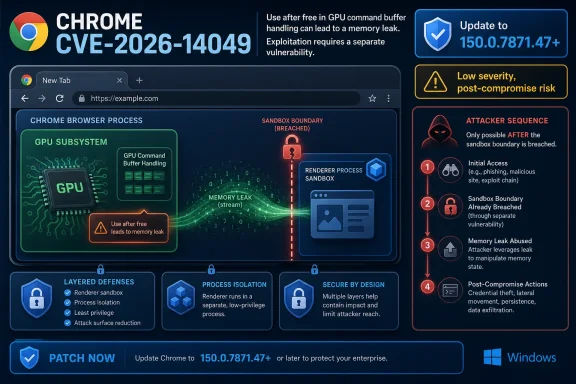 The Low-Severity Label Hides a Post-Compromise Problem
Chrome’s own severity rating for CVE-2026-14049 is Low, and on a clean reading that makes sense. The bug does not appear to let a random website directly seize control of the browser. The attacker first needs a compromised renderer process, which means the vulnerability is not the opening move in the attack.That distinction matters because modern Chrome security is built around layers. The renderer is expected to be hostile if a web-content bug lands, and the browser’s architecture tries to keep that hostile renderer boxed in. A flaw in the GPU component that can leak memory from that position is therefore not “just” an information leak; it is a potential assist to a more serious escape or data-theft chain.
CISA’s ADP CVSS 3.1 score of 5.3, Medium, captures that nuance better than the simple Chromium Low label. The vector requires user interaction and has high attack complexity, but the confidentiality impact is marked High. That is a very Chrome-shaped risk profile: hard to weaponize in isolation, much more interesting when paired with another bug.
The practical reading for Windows users and administrators is straightforward. If Chrome is below 150.0.7871.47, the browser is behind the fix line named in the CVE description. If a fleet is still waiting on staged rollout, update deferral, or third-party Chromium repackaging, this is one more reason not to treat “low severity” as synonymous with “optional.”
Chrome’s GPU Process Remains a Rich Place to Make Mistakes
The GPU stack is one of the browser’s awkward compromises with reality. Users expect web apps, video, canvas rendering, WebGL, WebGPU, compositing, and hardware acceleration to work smoothly across Windows, macOS, Linux, driver branches, virtual machines, remote desktops, and laptops with hybrid graphics. That performance bargain creates a large and unusually platform-sensitive attack surface.CVE-2026-14049 is described as an “inappropriate implementation” in GPU, which is NVD and Chromium shorthand rather than a root-cause tutorial. Google often restricts bug details until most users are updated, and the linked Chromium issue requires permissions at the time of disclosure. That is normal for browser security, but it leaves defenders reading the shape of the bug rather than the code-level mistake.
The shape is still revealing. The attacker needs a crafted HTML page and a compromised renderer, and the payoff is potentially sensitive information from process memory. In other words, the GPU component is not being framed here as the initial code-execution target. It is being framed as a place where a compromised renderer can learn something it should not know.
That is exactly why memory-disclosure bugs deserve more respect than their labels often receive. Attackers use memory disclosure to defeat address-space layout randomization, recover tokens or secrets, or gather state needed for a more reliable second stage. A leak that looks modest in a vulnerability database can be the difference between an unstable proof of concept and a repeatable exploit chain.
The Version Trail Is Messier Than the Patch Message
The clean remediation message is “update to Chrome 150.0.7871.47 or later.” The messier part is the metadata around affected versions. The CVE description says Google Chrome prior to 150.0.7871.47 is affected, while the NVD change record shown in the submitted material lists a CPE configuration with versions up to, but excluding, 150.0.7871.46.That mismatch is not a small clerical curiosity for enterprise scanners. If one feed says the fixed boundary is .47 and another derived configuration appears to stop at .46, vulnerability-management tools can disagree about whether a .46 build is affected. In practice, administrators should follow the vendor advisory and CVE description rather than overfitting to one CPE line in a still-evolving NVD record.
There is another wrinkle. Google’s desktop Stable Channel updates often publish slightly different version numbers across platforms or rollout groups. The Windows and macOS channel may show one pair of numbers while Linux receives another, and the rollout can take days or weeks. That makes vulnerability databases particularly prone to awkward version-boundary representations.
For WindowsForum readers, the safe operational answer is boring but correct: verify the installed Chrome build directly. On managed Windows endpoints, query the browser version through inventory tooling, endpoint management, or Chrome’s own update reporting. On an individual system,
chrome://settings/help remains the blunt instrument that tells you whether the browser has actually pulled the current build.CPE Metadata Is Not the Patch
The user-facing question buried inside the NVD text — “Are we missing a CPE here?” — points to a broader problem with modern vulnerability tracking. CPEs are supposed to translate human-readable affected-product statements into machine-readable inventory matches. They are useful, but they are also brittle when a product has rapid release channels, platform-specific builds, and vendor-controlled staged rollout.For CVE-2026-14049, the CPE configuration shown in the change history names Google Chrome and then ties the affected configuration to operating-system CPEs for Windows, Linux kernel, and macOS. That is reasonable at a broad level because desktop Chrome runs across those platforms. It is also easy to imagine why scanners, CMDBs, and asset inventories could interpret the statement differently.
The bigger issue is that CPE matching is a proxy for reality. The thing that matters is whether the Chrome binary present on the endpoint contains the fix. If a scanner is keying off a version range that excludes the wrong boundary, or if a vendor package reports version information in a nonstandard way, the CPE result can become a misleading comfort blanket.
This is especially true for Chromium-based browsers that are not Google Chrome. Microsoft Edge, Brave, Vivaldi, Opera, Electron apps, embedded Chromium runtimes, and Linux distribution packages do not all inherit Chrome patches at the same moment or expose versioning in the same way. CVE-2026-14049 is a Chrome CVE, but the underlying Chromium code path may matter more broadly depending on downstream adoption.
That does not mean defenders should invent affected products that the CVE has not named. It does mean they should treat CPE enrichment as a starting point, not an endpoint. If the browser contains the vulnerable Chromium GPU implementation, the risk is technical, not semantic.
The Renderer Requirement Narrows the Threat but Sharpens the Chain
The most important phrase in the description is “who had compromised the renderer process.” That phrase keeps CVE-2026-14049 out of the panic bucket. A drive-by webpage does not appear to get the memory leak for free; it first needs another weakness, misconfiguration, exploit, or compromised execution path inside the renderer.But Chrome’s renderer process is exactly where hostile web content lives. The sandbox assumes renderers will be attacked. Site isolation, process boundaries, brokered permissions, and strict inter-process communication exist because the renderer is not trusted with the whole machine.
A post-renderer GPU information leak is therefore a failure of defense in depth. It may not open the front door, but it may loosen the locks on the interior doors. In an exploit chain, that can be enough.
This is the difference between consumer risk and adversary risk. For most home users, the answer is simply to update and move on. For targeted organizations, especially those handling sensitive web sessions, identity portals, SaaS administration, or privileged internal dashboards, a renderer-adjacent leak is not automatically trivial.
Microsoft’s Stake Is Indirect but Real
This is not a Windows vulnerability in the classic sense. It is a Google Chrome vulnerability that happens to affect Chrome on Windows, among other desktop platforms. Yet Windows administrators still own the consequences because Chrome is often the primary enterprise application on Windows endpoints.The Windows relevance is also magnified by the Chromium ecosystem. Microsoft Edge is Chromium-based, and while this CVE is listed against Google Chrome, Microsoft’s browser inherits large parts of the same engine architecture. Edge security status should be checked through Microsoft’s own release notes rather than assumed from Chrome’s advisory, but the patch cadence relationship is impossible to ignore.
For IT teams, the right question is not merely “Is Chrome updated?” It is “Which Chromium runtimes are present, who owns them, and how quickly do they receive upstream security fixes?” That includes browser installs, WebView2 runtime deployments, packaged apps, kiosk environments, and developer tools that may carry their own Chromium builds.
This is where Windows fleet management can get messy. A fully patched Windows Update state does not guarantee a fully patched browser stack. Chrome’s updater, Edge’s updater, enterprise policies, frozen virtual desktop images, and offline gold images can all tell different stories.
The Disclosure Timing Favors Fast, Quiet Remediation
The chronology is compressed. Chrome received the new CVE on June 30, 2026, according to the NVD record. CISA-ADP added CVSS, CWE-200, and SSVC information later that same day. NIST’s initial analysis followed on July 1, adding references and CPE configuration data.That kind of fast enrichment is useful, but it also means early records can be uneven. NVD had not provided its own CVSS assessment in the submitted snapshot, while CISA-ADP had already scored the issue. The result is a public record that looks simultaneously authoritative and unfinished.
Google’s Chrome Releases blog is therefore the anchor. The vendor advisory names the release channel and fix version, while NVD and CISA add classification and downstream vulnerability-management structure. If those layers appear to disagree at the edges, administrators should privilege the vendor’s fixed version and then watch for database corrections.
There is no indication in the provided record that CVE-2026-14049 is being exploited in the wild. CISA’s SSVC entry lists exploitation as “none,” automatable as “no,” and technical impact as “partial.” That is not a reason to ignore it; it is a reason to patch through normal emergency-but-not-hysterical browser channels.
“Low” Browser Bugs Age Badly
The browser security industry has learned to be careful with low-severity bugs because today’s low can become tomorrow’s exploit-chain primitive. A single memory disclosure does not have to be spectacular to be useful. It only has to reveal the right bytes at the right time.Attackers chaining browser vulnerabilities usually need reliability. They need to know where code and objects sit in memory, whether a mitigation is active, what process state looks like, and how to move from one trust boundary to another. Information disclosure is the quiet partner in that work.
That is why severity labels are a guide, not a moral ranking. Chrome’s Low rating tells users this is not a standalone catastrophe. CISA’s Medium score reminds defenders that confidentiality impact can still be significant once the prerequisite compromise is met.
The uncomfortable truth is that browser patching is no longer about reacting only to dramatic zero-days. It is about reducing the number of usable chain components available to attackers. CVE-2026-14049 is a small component, but small components are exactly what mature exploit developers collect.
The Enterprise Fix Is Inventory, Not Anxiety
For unmanaged users, the remediation is simple: update Chrome and restart the browser. For enterprises, the operational problem is proving that happened everywhere. Chrome updates can download without the browser fully relaunching, leaving users technically staged for protection but not actually running the fixed code.Administrators should care about process lifetime. A browser that has not restarted after an update can keep old processes alive. On shared workstations, VDI pools, and systems that rarely reboot, that distinction is more than pedantry.
Policy-driven update control also deserves scrutiny. Some organizations defer Chrome updates to avoid breaking extensions or web apps. That may be defensible for compatibility testing, but it converts low-severity browser bugs into a rolling backlog of exploit-chain material.
The better pattern is rapid rings, not indefinite delay. Push the update quickly to canaries, watch for breakage, and then move the fleet. Browser updates are too frequent and too security-dense to treat each one as a bespoke change-control ceremony.
The Chromium Supply Chain Is the Larger Story
CVE-2026-14049 is a reminder that “the browser” is no longer a single installed application. Chromium is a platform component in disguise. It sits in mainstream browsers, application shells, embedded web controls, desktop clients, and developer tooling.That diffusion changes the meaning of a Chrome advisory. Google can patch Chrome, but downstream vendors must pick up, test, package, and ship the fix. Some do it quickly. Others lag behind, especially where Chromium is bundled into a larger application with its own release train.
Windows environments are particularly exposed to this sprawl because Chromium-based software is everywhere on the desktop. IT teams may have excellent visibility into Chrome and Edge while missing Electron-based apps or vendor tools that include older Chromium runtimes. The official CVE may not name those products, but the defensive question remains valid.
The answer is not to panic-scan every executable with “Chromium” in its strings. It is to build better software inventory and vendor accountability. If an application bundles Chromium, its vendor should disclose which Chromium baseline it uses and how fast it absorbs security fixes.
This Patch Is Small, but the Lesson Is Not
The concrete guidance from CVE-2026-14049 is narrow, and that is a virtue. Update Chrome to 150.0.7871.47 or later, confirm the browser has restarted, and do not let a low severity label delay the rollout. The broader lesson is that vulnerability metadata should support patching decisions, not replace them.- Chrome CVE-2026-14049 is an information-disclosure flaw in the GPU component fixed in version 150.0.7871.47.
- The attack requires a compromised renderer process, which makes the bug more relevant as part of an exploit chain than as a standalone entry point.
- CISA-ADP scored the issue as CVSS 5.3 Medium, while Chromium labeled it Low, reflecting different ways of weighing prerequisite compromise and confidentiality impact.
- The submitted NVD change history appears to show a version-boundary inconsistency around 150.0.7871.46 versus 150.0.7871.47, so administrators should follow the vendor fixed-version statement.
- Windows administrators should verify actual installed and running browser versions rather than relying only on CPE matches or update availability.
- Chromium-based downstream products should be checked separately because Chrome’s patch does not automatically prove every embedded Chromium runtime has been fixed.
References
- Primary source: NVD / Chromium
Published: 2026-07-03T07:00:49-07:00
NVD - CVE-2026-14049
 nvd.nist.gov
- Security advisory: MSRC
Published: 2026-07-03T07:00:49-07:00
Original feed URL
Security Update Guide - Microsoft Security Response Center
 msrc.microsoft.com
- Related coverage: cvefeed.io
CVE-2026-14049 - Google Chrome GPU Information Disclosure
Inappropriate implementation in GPU in Google Chrome prior to 150.0.7871.47 allowed a remote attacker who had compromised the renderer process to obtain potentially sensitive information from process memory via a crafted HTML page. (Chromium security severity: Low)cvefeed.io - Related coverage: radar.offseq.com
CVE-2026-13944: Inappropriate implementation in Google Chrome - Live Threat Intelligence - Threat Radar | OffSeq.com
Detailed information about CVE-2026-13944: Inappropriate implementation in Google Chrome affecting Google Chrome. Get real-time updates, technical details, andradar.offseq.com
