

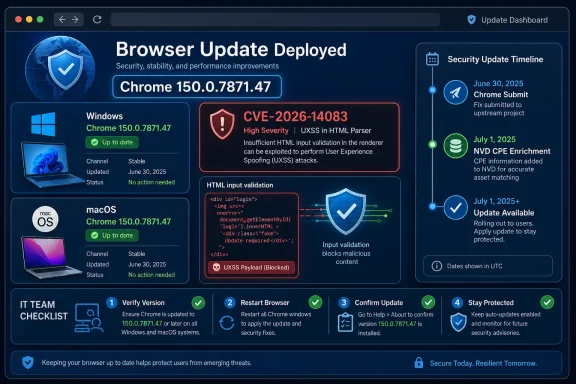
CVE-2026-14083 is a low-severity Chromium HTML input-validation flaw fixed in Google Chrome 150.0.7871.47 for Windows and macOS on June 30, 2026, with NVD later adding a Chrome CPE configuration for versions before that build on July 1, 2026. The short version is that the vulnerability is real, the affected-product mapping now appears to exist, and the practical fix is still the same: get Chrome and Chromium-based browsers onto their patched 150-channel builds. But the more interesting story is not this one bug. It is how a “low” Chromium UXSS issue becomes operationally relevant when buried inside a browser release that reportedly carried hundreds of security fixes at once.
The user-facing confusion around CVE-2026-14083 is understandable because NVD entries often arrive in stages. A CVE can appear with a description, a vendor reference, and affected-version text before the enrichment pipeline has fully attached CPE data, CVSS scoring, and weakness classification. In this case, the change history supplied with the NVD record says NIST added the CPE configuration on July 1, 2026:
That means the answer to “are we missing a CPE here?” is probably “not anymore,” at least for Google Chrome itself. The NVD record’s own change log says the CPE was added after initial receipt from Chrome on June 30. The lag is not unusual, but it matters because many vulnerability scanners, SBOM tools, and patch dashboards depend heavily on CPE matching to decide whether a system is exposed.
The awkward bit is that Chromium vulnerabilities do not map cleanly to Chrome alone. Microsoft Edge, Brave, Vivaldi, Opera, Electron-based applications, embedded WebViews, and downstream Chromium consumers may inherit the vulnerable code at different cadences. NVD’s CPE entry for Google Chrome answers the narrow Chrome question, but it does not automatically prove every Chromium-derived product has been patched or mapped.
That distinction is more than pedantry. A Windows administrator may see “Chrome prior to 150.0.7871.47” and close the ticket after the Google browser updates, while the same rendering flaw remains relevant in another Chromium-based browser or application runtime. CPE completeness is useful, but it is not the same thing as ecosystem completeness.
That split tells us something about browser vulnerability language. “Low” in Chromium’s internal severity taxonomy does not mean “ignore.” It often means the bug is constrained by context, mitigations, user interaction, exploit reliability, or the absence of a direct memory-corruption path. But universal cross-site scripting — UXSS — is still the kind of phrase that should make defenders sit up, because it cuts across the trust boundary users think the browser is enforcing.
A normal cross-site scripting flaw is usually tied to one site that mishandles input. A UXSS-class problem is more dangerous in concept because the browser itself can become part of the violation. The attacker’s page is not merely exploiting a sloppy website; it is abusing browser behavior to inject script or HTML where the user and the web platform did not intend it.
That does not mean CVE-2026-14083 is a mass-exploitation emergency. The CISA ADP metadata supplied in the NVD entry says exploitation was “none,” the attack was not automatable, and the technical impact was partial. Those are important brakes. But for enterprise patching, the right lesson is that “low severity” browser issues are rarely isolated events; they travel inside release trains that also carry higher-impact fixes.
If an administrator looks only at this CVE, the instinct may be to defer. A low-severity, user-interaction-required injection bug with no known exploitation is not usually the item that blows up a monthly risk meeting. But Chrome 150 was not a surgical hotfix for CVE-2026-14083; it was a large browser security train, and this CVE was one carriage among many.
That is the recurring tension in Chromium patch management. Google often withholds full technical details until users have had time to update, especially when the bug could still be useful to attackers or affects shared third-party code. The public record can therefore look underwhelming at the precise moment when defenders most need to move.
For WindowsForum readers, the operational answer is boring but correct: verify Chrome is at least 150.0.7871.47 on Windows and macOS, and check equivalent patched releases for every Chromium-derived browser in the environment. The interesting part is deciding how much internal ceremony to attach to that work. In most organizations, this is not a break-glass incident; it is a “do not let browser patch drift accumulate” incident.
None of that is scandalous. NVD enrichment takes time, and the data often improves after publication. But every hour of partial metadata creates ambiguity for automated systems that expect a CVE to be a finished object the moment it appears.
A scanner that keys on CPE data may initially miss exposure. A risk dashboard that keys on CVSS may show “not yet scored” until CISA ADP or NVD provides a vector. A vulnerability manager may see Chrome’s internal severity as Low while a parallel feed shows CVSS Medium. These are not contradictions so much as different layers of the vulnerability-intelligence supply chain arriving out of order.
That is why the “missing CPE” question is useful. It exposes a broader problem: modern patch operations are increasingly metadata-driven, but metadata is not instantaneous. The safest programs treat vendor advisories as primary, NVD as enrichment, and local software inventory as the final reality check.
The Chrome 150 release also matters because Microsoft Edge and other Chromium-based browsers generally trail or align with Chromium security fixes on their own schedules. Edge is not Google Chrome with a different icon; it has Microsoft’s release channels, enterprise policies, and integration points. But it is still downstream of Chromium for the rendering engine and much of the web platform surface.
That means defenders should not close their notes after checking one product. The correct inventory question is: where does Chromium code run in this Windows estate? The answer may include Chrome, Edge, WebView2, Electron apps, embedded browsers in line-of-business tools, kiosk environments, and developer workstations using multiple channels.
CVE-2026-14083 itself may not be the worst flaw in that universe, but it is a useful forcing function. Browser security stopped being about a single executable years ago. Chromium is infrastructure now, and infrastructure needs version governance.
The CVSS vector supplied by CISA ADP captures some of this nuance. The attack is network-accessible, low-complexity, requires no privileges, and requires user interaction. Scope is changed, with low confidentiality and integrity impact and no availability impact. That is not catastrophic, but it is also not nothing.
UXSS-style issues are especially uncomfortable because they live in the space between user trust and origin isolation. If a crafted page can inject script or HTML across a boundary the browser should maintain, the attacker may be able to confuse users, tamper with displayed content, or piggyback on authenticated browsing contexts depending on the exact bug mechanics. Google’s restricted Chromium issue tracker entry limits public technical detail, which is common after fixes but leaves defenders with the higher-level risk model.
The better way to read the severity is this: CVE-2026-14083 does not justify panic, but it does justify prompt browser updating. If a company is already treating browser patches as routine hygiene within days, this CVE changes little. If a company still treats browsers like quarterly desktop apps, it is another warning shot.
User interaction is required, but in browser security that is often a thin comfort. Clicking a link, opening a page, following a redirect, previewing content, or interacting with a deceptive prompt may all count as interaction in practice. Attackers do not need perfect automation if they can make the interaction look like ordinary browsing.
Chrome’s sandbox, site isolation, permissions prompts, and Safe Browsing protections all exist to contain this reality. They make exploitation harder and reduce blast radius. But they do not eliminate the need to patch parsing, validation, rendering, and UI logic bugs.
That is why the HTML component in this CVE matters. HTML is not an optional feature or a dusty corner of the platform. It is the core language of the web, and input-validation mistakes there sit on an attack surface too large to dismiss.
The Chrome 150 update is also a good moment to review how quickly browser restarts happen. Downloading an update is not the same as running the patched process. A user who leaves Chrome open for days can remain on a vulnerable build even after the updater has staged the new version.
This is one of the least glamorous browser-security problems and one of the most persistent. Enterprises can have excellent patch tooling and still lose time because sessions are long-lived, tabs are treated as workspaces, and restart prompts are postponed. Attackers do not care that the patch is waiting politely in the background.
Administrators should also watch for version skew across channels. Stable, Extended Stable, Beta, Dev, and Canary exist for different purposes, but mixed-channel fleets can confuse reporting if asset tools do not normalize product names and versions correctly. A vulnerability ticket for Chrome “before 150.0.7871.47” is only useful if the inventory knows what is actually installed.
But CPE coverage for Chrome does not automatically settle Chromium coverage. A CPE is a product identifier, not a universal inheritance graph. It can tell a tool that Google Chrome is affected; it cannot, by itself, tell the full story for every downstream Chromium consumer.
That gap is why security teams increasingly need both vulnerability intelligence and software composition awareness. Traditional endpoint inventory says “Chrome is installed.” Better inventory says which Chromium-based runtimes exist, which versions they embed, how they update, and whether they are reachable by normal user activity.
For Windows environments, WebView2 deserves special attention. Many applications depend on it for embedded web content, and Microsoft services it separately from Chrome. CVE-2026-14083’s NVD record is about Chrome, but the underlying habit should be to ask where the vulnerable class of code may live, not merely where the named product appears.
Yet dismissing it because Chromium marked it Low would be the wrong reflex. Browser releases are cumulative security events, and Chrome 150 arrived with a large body of fixes. The right security posture is to treat the release as the unit of action, not the single CVE that happened to cross your dashboard.
The record also shows why vulnerability feeds should be read as living documents. On June 30, the CVE arrived from Chrome. On July 1, CISA ADP added scoring and SSVC context, and NIST added the CPE configuration. If your tooling captured the record between those moments, it may have seen a less complete picture than the one available now.
That is a solvable problem, but only if teams design for it. Re-ingest CVE metadata. Track vendor advisories. Keep browser update policies aggressive. And when a “missing CPE” appears, do not assume the risk is absent just because the identifier has not caught up yet.
 The Missing CPE Was the Symptom, Not the Disease
The user-facing confusion around CVE-2026-14083 is understandable because NVD entries often arrive in stages. A CVE can appear with a description, a vendor reference, and affected-version text before the enrichment pipeline has fully attached CPE data, CVSS scoring, and weakness classification. In this case, the change history supplied with the NVD record says NIST added the CPE configuration on July 1, 2026: cpe:2.3:a:google:chrome:*:*:*:*:*:*:*:*, covering Chrome versions before 150.0.7871.47.That means the answer to “are we missing a CPE here?” is probably “not anymore,” at least for Google Chrome itself. The NVD record’s own change log says the CPE was added after initial receipt from Chrome on June 30. The lag is not unusual, but it matters because many vulnerability scanners, SBOM tools, and patch dashboards depend heavily on CPE matching to decide whether a system is exposed.
The awkward bit is that Chromium vulnerabilities do not map cleanly to Chrome alone. Microsoft Edge, Brave, Vivaldi, Opera, Electron-based applications, embedded WebViews, and downstream Chromium consumers may inherit the vulnerable code at different cadences. NVD’s CPE entry for Google Chrome answers the narrow Chrome question, but it does not automatically prove every Chromium-derived product has been patched or mapped.
That distinction is more than pedantry. A Windows administrator may see “Chrome prior to 150.0.7871.47” and close the ticket after the Google browser updates, while the same rendering flaw remains relevant in another Chromium-based browser or application runtime. CPE completeness is useful, but it is not the same thing as ecosystem completeness.
A Low-Severity UXSS Bug Still Belongs in the Patch Queue
CVE-2026-14083 is described as insufficient validation of untrusted input in HTML, allowing a remote attacker to inject arbitrary scripts or HTML through a crafted page. Chrome classifies the Chromium security severity as Low, while CISA’s ADP scoring gives it a CVSS 3.1 base score of 6.1, or Medium, with user interaction required and changed scope.That split tells us something about browser vulnerability language. “Low” in Chromium’s internal severity taxonomy does not mean “ignore.” It often means the bug is constrained by context, mitigations, user interaction, exploit reliability, or the absence of a direct memory-corruption path. But universal cross-site scripting — UXSS — is still the kind of phrase that should make defenders sit up, because it cuts across the trust boundary users think the browser is enforcing.
A normal cross-site scripting flaw is usually tied to one site that mishandles input. A UXSS-class problem is more dangerous in concept because the browser itself can become part of the violation. The attacker’s page is not merely exploiting a sloppy website; it is abusing browser behavior to inject script or HTML where the user and the web platform did not intend it.
That does not mean CVE-2026-14083 is a mass-exploitation emergency. The CISA ADP metadata supplied in the NVD entry says exploitation was “none,” the attack was not automatable, and the technical impact was partial. Those are important brakes. But for enterprise patching, the right lesson is that “low severity” browser issues are rarely isolated events; they travel inside release trains that also carry higher-impact fixes.
Chrome 150 Was a Browser Release, Not a Single-Bug Patch
Google’s Chrome Releases blog announced the Stable Channel update for desktop on June 30, 2026, moving Windows and macOS to 150.0.7871.46/.47 and Linux to 150.0.7871.46. Reporting from Malwarebytes and Born’s IT and Windows Blog described the same Chrome 150 update as unusually large, with hundreds of security fixes included in the release. That context changes how CVE-2026-14083 should be handled.If an administrator looks only at this CVE, the instinct may be to defer. A low-severity, user-interaction-required injection bug with no known exploitation is not usually the item that blows up a monthly risk meeting. But Chrome 150 was not a surgical hotfix for CVE-2026-14083; it was a large browser security train, and this CVE was one carriage among many.
That is the recurring tension in Chromium patch management. Google often withholds full technical details until users have had time to update, especially when the bug could still be useful to attackers or affects shared third-party code. The public record can therefore look underwhelming at the precise moment when defenders most need to move.
For WindowsForum readers, the operational answer is boring but correct: verify Chrome is at least 150.0.7871.47 on Windows and macOS, and check equivalent patched releases for every Chromium-derived browser in the environment. The interesting part is deciding how much internal ceremony to attach to that work. In most organizations, this is not a break-glass incident; it is a “do not let browser patch drift accumulate” incident.
NVD Enrichment Lag Still Trips Real-World Defenders
The NVD record’s timeline is a miniature case study in vulnerability data plumbing. Chrome submitted the CVE on June 30 with the description, references, CWE-20, and affected-version information. CISA ADP added CVSS 3.1 scoring and SSVC data on July 1, then modified the weakness data. NIST’s initial analysis later that same day added the Chrome CPE configuration and reference types.None of that is scandalous. NVD enrichment takes time, and the data often improves after publication. But every hour of partial metadata creates ambiguity for automated systems that expect a CVE to be a finished object the moment it appears.
A scanner that keys on CPE data may initially miss exposure. A risk dashboard that keys on CVSS may show “not yet scored” until CISA ADP or NVD provides a vector. A vulnerability manager may see Chrome’s internal severity as Low while a parallel feed shows CVSS Medium. These are not contradictions so much as different layers of the vulnerability-intelligence supply chain arriving out of order.
That is why the “missing CPE” question is useful. It exposes a broader problem: modern patch operations are increasingly metadata-driven, but metadata is not instantaneous. The safest programs treat vendor advisories as primary, NVD as enrichment, and local software inventory as the final reality check.
The Windows Angle Is Bigger Than Chrome.exe
On Windows, Chrome’s auto-update story is usually good enough for consumers and small offices. The browser updates in the background, and visiting the About Chrome page forces a check. In managed environments, however, Chrome update policy can become a risk multiplier if administrators pin versions, delay major upgrades, or rely on maintenance windows designed for slower-moving desktop software.The Chrome 150 release also matters because Microsoft Edge and other Chromium-based browsers generally trail or align with Chromium security fixes on their own schedules. Edge is not Google Chrome with a different icon; it has Microsoft’s release channels, enterprise policies, and integration points. But it is still downstream of Chromium for the rendering engine and much of the web platform surface.
That means defenders should not close their notes after checking one product. The correct inventory question is: where does Chromium code run in this Windows estate? The answer may include Chrome, Edge, WebView2, Electron apps, embedded browsers in line-of-business tools, kiosk environments, and developer workstations using multiple channels.
CVE-2026-14083 itself may not be the worst flaw in that universe, but it is a useful forcing function. Browser security stopped being about a single executable years ago. Chromium is infrastructure now, and infrastructure needs version governance.
“Low” Is a Product Severity, Not a Business Severity
Chrome’s Low severity label is valuable because it comes from the engineers closest to the bug class and the mitigation model. But enterprise risk is not a direct translation of vendor severity. A low-severity browser bug on an executive workstation, a privileged administrator’s jump box, or a shared kiosk can have a different business profile than the same bug on a lightly used lab machine.The CVSS vector supplied by CISA ADP captures some of this nuance. The attack is network-accessible, low-complexity, requires no privileges, and requires user interaction. Scope is changed, with low confidentiality and integrity impact and no availability impact. That is not catastrophic, but it is also not nothing.
UXSS-style issues are especially uncomfortable because they live in the space between user trust and origin isolation. If a crafted page can inject script or HTML across a boundary the browser should maintain, the attacker may be able to confuse users, tamper with displayed content, or piggyback on authenticated browsing contexts depending on the exact bug mechanics. Google’s restricted Chromium issue tracker entry limits public technical detail, which is common after fixes but leaves defenders with the higher-level risk model.
The better way to read the severity is this: CVE-2026-14083 does not justify panic, but it does justify prompt browser updating. If a company is already treating browser patches as routine hygiene within days, this CVE changes little. If a company still treats browsers like quarterly desktop apps, it is another warning shot.
The Crafted HTML Page Remains the Web’s Oldest Trap
The attack path described in the CVE is mundane: a crafted HTML page. That mundanity is the point. Browsers are exposed to hostile input every minute of every workday, and the web’s threat model assumes users will encounter untrusted pages through search, advertising, email links, chat messages, compromised websites, and legitimate services carrying malicious content.User interaction is required, but in browser security that is often a thin comfort. Clicking a link, opening a page, following a redirect, previewing content, or interacting with a deceptive prompt may all count as interaction in practice. Attackers do not need perfect automation if they can make the interaction look like ordinary browsing.
Chrome’s sandbox, site isolation, permissions prompts, and Safe Browsing protections all exist to contain this reality. They make exploitation harder and reduce blast radius. But they do not eliminate the need to patch parsing, validation, rendering, and UI logic bugs.
That is why the HTML component in this CVE matters. HTML is not an optional feature or a dusty corner of the platform. It is the core language of the web, and input-validation mistakes there sit on an attack surface too large to dismiss.
Patch Automation Needs a Human Editor
For home users, the advice is simple: let Chrome update, restart it when prompted, and confirm the version from the browser’s About page. For IT teams, the answer is more procedural. Browser patch compliance should be visible in endpoint management, not guessed from auto-update defaults.The Chrome 150 update is also a good moment to review how quickly browser restarts happen. Downloading an update is not the same as running the patched process. A user who leaves Chrome open for days can remain on a vulnerable build even after the updater has staged the new version.
This is one of the least glamorous browser-security problems and one of the most persistent. Enterprises can have excellent patch tooling and still lose time because sessions are long-lived, tabs are treated as workspaces, and restart prompts are postponed. Attackers do not care that the patch is waiting politely in the background.
Administrators should also watch for version skew across channels. Stable, Extended Stable, Beta, Dev, and Canary exist for different purposes, but mixed-channel fleets can confuse reporting if asset tools do not normalize product names and versions correctly. A vulnerability ticket for Chrome “before 150.0.7871.47” is only useful if the inventory knows what is actually installed.
The CPE Answer Is Yes, But the Inventory Answer Is Maybe
So, is there a missing CPE? Based on the NVD change history provided, NIST added the Google Chrome CPE on July 1, 2026, for versions before 150.0.7871.47. If a scanner still shows no CPE, it may be using stale NVD data, a delayed mirror, or a vulnerability feed that has not ingested the latest enrichment.But CPE coverage for Chrome does not automatically settle Chromium coverage. A CPE is a product identifier, not a universal inheritance graph. It can tell a tool that Google Chrome is affected; it cannot, by itself, tell the full story for every downstream Chromium consumer.
That gap is why security teams increasingly need both vulnerability intelligence and software composition awareness. Traditional endpoint inventory says “Chrome is installed.” Better inventory says which Chromium-based runtimes exist, which versions they embed, how they update, and whether they are reachable by normal user activity.
For Windows environments, WebView2 deserves special attention. Many applications depend on it for embedded web content, and Microsoft services it separately from Chrome. CVE-2026-14083’s NVD record is about Chrome, but the underlying habit should be to ask where the vulnerable class of code may live, not merely where the named product appears.
The Practical Reading of CVE-2026-14083 Is Narrow, but the Lesson Is Wide
CVE-2026-14083 is not the browser apocalypse. It is not described as exploited in the wild. It is not a critical sandbox escape. It is not, on the available public facts, the kind of bug that should cause a weekend incident bridge by itself.Yet dismissing it because Chromium marked it Low would be the wrong reflex. Browser releases are cumulative security events, and Chrome 150 arrived with a large body of fixes. The right security posture is to treat the release as the unit of action, not the single CVE that happened to cross your dashboard.
The record also shows why vulnerability feeds should be read as living documents. On June 30, the CVE arrived from Chrome. On July 1, CISA ADP added scoring and SSVC context, and NIST added the CPE configuration. If your tooling captured the record between those moments, it may have seen a less complete picture than the one available now.
That is a solvable problem, but only if teams design for it. Re-ingest CVE metadata. Track vendor advisories. Keep browser update policies aggressive. And when a “missing CPE” appears, do not assume the risk is absent just because the identifier has not caught up yet.
The Chrome 150 Clue Sheet for Admins
The useful response to CVE-2026-14083 is not drama; it is disciplined housekeeping. Treat the NVD record as now enriched for Chrome, but do not let that narrow mapping become the boundary of your investigation.- Google Chrome builds before 150.0.7871.47 should be treated as affected for CVE-2026-14083 on platforms where that patched build applies.
- The NVD change history indicates that the Chrome CPE configuration was added by NIST on July 1, 2026, after the CVE was initially received from Chrome on June 30.
- CISA ADP scored the issue as CVSS 3.1 Medium with user interaction required, no privileges required, changed scope, and low confidentiality and integrity impact.
- Chrome’s own Chromium severity is Low, which argues against panic but not against prompt patching.
- Administrators should verify actual running browser versions, because a downloaded browser update does not protect users until Chrome is restarted into the patched build.
- Chromium-derived products and embedded runtimes may require separate vendor checks, because a Google Chrome CPE does not automatically prove downstream remediation.
References
- Primary source: NVD / Chromium
Published: 2026-07-03T07:00:09-07:00
NVD - CVE-2026-14083
 nvd.nist.gov
- Security advisory: MSRC
Published: 2026-07-03T07:00:09-07:00
Original feed URL
Security Update Guide - Microsoft Security Response Center
 msrc.microsoft.com
