

Google Chrome’s CVE-2026-14121 was published on June 30, 2026, as a Linux-only use-after-free flaw in Chromoting fixed in Chrome 150.0.7871.47, with CISA’s enrichment later rating it a 9.8 critical remote-code-execution issue despite Chromium’s own “Low” severity label. That contradiction is the story. Not because one score must be “right” and the other “wrong,” but because the modern vulnerability pipeline now routinely turns a sparse browser advisory into an enterprise patching signal with very different implications. For WindowsForum readers, the practical lesson is simple: this is primarily a Linux Chrome and Chromium-derived-browser inventory problem, but the scoring dispute tells us something larger about how browser risk is being translated for administrators.
The underlying defect is described by NVD as a use after free in Chromoting, Google’s long-running code name for the remote-desktop plumbing behind Chrome Remote Desktop. The affected product is Google Chrome on Linux prior to version 150.0.7871.47, and the attack vector in the CVE text is unusually direct: a remote attacker could execute arbitrary code via malicious network traffic.
That language does not sound “low” to anyone responsible for endpoints. Remote code execution, no authentication, no user interaction, and total confidentiality, integrity, and availability impact is the shape of a vulnerability that security dashboards are trained to light up in red. CISA’s Authorized Data Publisher enrichment did exactly that, assigning CVSS 3.1 vector AV:N/AC:L/PR:N/UI:N/S:U/C:H/I:H/A:H, producing a 9.8 critical score.
Yet the same CVE description preserves Chromium’s own security severity as Low. That is not a typo in the user-facing record; it is a revealing collision between two scoring cultures. Chromium severity often reflects exploitability in the browser’s specific architecture, reachable surfaces, sandboxing expectations, and bug bounty triage conventions. CVSS, by contrast, tends to flatten the world into a formal model: if a network attacker can trigger arbitrary code execution without privileges or interaction, the math is merciless.
The result is a record that looks schizophrenic unless you understand the layers. Google’s advisory tells Chrome users, “This was not one of our marquee emergency bugs.” CISA’s enrichment tells security teams, “If this condition is reachable in your environment, treat the impact as severe.” Both can be true, and that is precisely why this CVE deserves more attention than its Chromium label would suggest.
That is broadly consistent with the CVE description. The record says “Google Chrome on Linux,” not Windows, macOS, Android, ChromeOS, or all Chromium products. If you are building a scanner rule, the minimum safe interpretation is that the vulnerable application CPE is Google Chrome and the platform condition is Linux.
But there is still a wrinkle. Google’s Stable Channel Update for Desktop, published June 30, 2026, lists Chrome 150.0.7871.46 for Linux and 150.0.7871.46/.47 for Windows and Mac, according to Google’s Chrome Releases blog. NVD’s CVE text, however, says Linux prior to 150.0.7871.47. That off-by-one-looking version boundary is exactly the kind of detail that causes vulnerability scanners to disagree, tickets to churn, and administrators to distrust automated findings.
There are several possible explanations. Google may have assigned the CVE’s fixed-version metadata from a broader internal branch while the public Linux stable package appeared as .46. NVD may have normalized against a version boundary supplied by Chrome’s CVE List entry. Or the public advisory may have used platform-specific build numbers that do not map neatly to every CVE’s “less than” field. Without a public Chromium bug discussion — the referenced issue requires permissions — outside observers cannot confidently resolve the discrepancy.
That uncertainty is not academic. A scanner that keys strictly on “Linux Chrome less than 150.0.7871.47” may mark Linux systems running 150.0.7871.46 as vulnerable even if Google’s Linux stable channel considered that build current. A scanner that keys on the Chrome Releases platform table may consider 150.0.7871.46 sufficient for Linux. Until Google or NVD cleans up the boundary, administrators should assume the safest remediation is to update to the latest available Chrome build in their channel rather than chasing the exact patch floor in isolation.
A memory-safety bug in that area lands differently from, say, a rendering quirk in a rarely used UI panel. Chromoting deals with network sessions, remote input, display streaming, authentication handoff, and long-lived service behavior. Even if a particular bug is difficult to trigger in practice, the component’s job is to listen, broker, and move control across boundaries that enterprises spend years trying to harden.
That is why the phrase “malicious network traffic” should slow readers down. Many browser RCEs require a user to visit a hostile page, click a link, open a document, or at least cross paths with attacker-controlled content. This CVE’s wording does not describe a web-page drive-by. It describes network traffic aimed at the affected surface.
The public record does not prove that internet-wide exploitation is feasible, and CISA’s SSVC field lists exploitation as “none.” That distinction matters. There is no public evidence in the NVD record that the bug is being used in the wild, and it does not appear to be a Chrome zero-day in the familiar emergency-patch sense. Still, for systems where Chrome Remote Desktop or Chromoting-related services are enabled, administrators should treat the component as a legitimate remote attack surface rather than an inert browser feature.
Severity labels are not universal constants. Chromium’s internal severity exists inside a project-specific triage process. CVSS exists to help organizations compare risk across products. SSVC exists to support decision-making based on exploitation status, automatable behavior, and technical impact. They are different instruments, not different translations of the same sentence.
CISA’s enrichment history shows that even those instruments moved. The record first showed a high attack complexity vector and an SSVC automatable value of “no,” then changed to low attack complexity and automatable “yes.” That is not unusual in fast-moving CVE enrichment, but it is a warning against treating the first score your scanner sees as gospel.
For patch managers, the practical reading is narrower and more useful. If you run Chrome on Linux and especially if Chrome Remote Desktop is enabled, CVE-2026-14121 belongs in the urgent validation pile. If you run managed Windows fleets, the direct exposure described in the CVE is not your primary issue, but Chromium-based browser cadence still is. Microsoft Edge, Brave, Vivaldi, Opera, Electron-based apps, and embedded Chromium components all depend on how quickly their maintainers absorb upstream Chromium security fixes, even when a specific CVE is platform-scoped.
That does not mean every Chromium CVE automatically applies to every Chromium-derived product. It means administrators should stop thinking of “Chrome update” as a consumer-app chore. Browser patching is now part of endpoint attack-surface management, and remote-access-adjacent components deserve particular scrutiny.
For humans, this is a footnote. For vulnerability-management systems, it is a tripwire. The scanner wants a clean comparison: installed version less than fixed version equals vulnerable. Chrome’s platform-specific build numbering makes that comparison less clean than the CVE schema implies.
This is where CPEs can amplify confusion. CPE is meant to identify affected platforms and products, but it is not a perfect inventory language for modern browser releases. A Linux platform CPE combined with a Chrome application CPE conveys “Chrome on Linux,” but it does not necessarily explain package-channel nuance, distro repository lag, vendor repackaging, or whether a Chromium-based derivative includes the vulnerable component.
The NVD entry also includes a conspicuous “Are we missing a CPE here?” prompt, which is boilerplate on many vulnerability pages but especially relevant here. If the only affected configuration is Google Chrome on Linux, the existing Chrome-plus-Linux model may be sufficient. If Chromium, Chrome Remote Desktop host packages, or downstream browser builds independently carry the vulnerable Chromoting code, then the ecosystem may indeed be under-modeled.
Administrators should not wait for the taxonomy to become elegant. The right move is to inventory actual installed browser versions and remote desktop components, verify package updates from trusted vendor channels, and suppress scanner noise only after confirming that the endpoint is on a build newer than the vendor’s available fix for that platform.
Those machines are often worse governed than the Windows fleet. They may not be enrolled in the same endpoint-management stack, may update through distro repositories rather than Google’s own packages, and may be owned by teams that regard browser patching as someone else’s problem. If Chrome Remote Desktop is present because a developer needed quick access during a production incident, the asset may not show up where the security team expects it.
Windows admins also care because Microsoft Edge rides the Chromium train. This CVE’s public wording does not say Edge is affected, and Microsoft would need to publish its own advisory or release notes for that conclusion. But the broader update cadence remains relevant: when Chrome ships a large stable-channel security update, Edge administrators should check the corresponding Edge stable and extended-stable releases rather than assume upstream fixes appear instantly everywhere.
The same logic applies to Electron apps, though with even more caution. A vulnerability in Chromoting is not the same as a vulnerability in every app that embeds Chromium. Most Electron applications do not ship Chrome Remote Desktop. But the incident is another reminder that Chromium is not one thing; it is a platform with many components, only some of which are present in a given downstream product.
For WindowsForum’s audience, the correct posture is therefore neither panic nor dismissal. Treat CVE-2026-14121 as a specific Linux Chrome issue, then use it as a prompt to audit the parts of your environment where “browser” and “remote access” quietly overlap.
When a bulletin contains a handful of vulnerabilities, security teams can reason about each one. When a release contains hundreds of fixes, the update itself becomes the security unit. The question shifts from “Do we care about this CVE?” to “How quickly can we validate and deploy this browser milestone without breaking line-of-business workflows?”
That is an uncomfortable shift for enterprises that still treat browsers like desktop applications rather than critical infrastructure. Chrome, Edge, and their derivatives are privileged interpreters for untrusted code, document viewers, identity portals, remote-access clients, password managers, and policy enforcement points. A browser update is not just a UI refresh; it is often the most important security maintenance event on the endpoint.
The CVE-2026-14121 record illustrates the gap between patch-bundle reality and CVE-by-CVE triage. A single bug can carry a low Chromium severity, a critical CISA score, unclear version-floor implications, and a platform-specific CPE model. Multiply that by hundreds of fixes, and manual interpretation becomes a losing game.
The answer is not to ignore the details. It is to design update processes that do not depend on heroic interpretation every time a browser ships. Enterprises need rings, canaries, rollback plans, and telemetry that answer the operational question quickly: did the update install, did the business break, and are the exposed systems still exposed?
We do not know from the public record which exact object lifetime error occurred, which Chromoting code path was reachable, whether an attacker needed a particular service state, or how mitigations such as sandboxing, memory allocators, and process boundaries affected exploit reliability. We also do not know whether the Linux-only scope reflects code differences, packaging differences, platform-specific behavior, or simply the affected build identified by the reporter.
That lack of detail makes the CVSS score look both necessary and blunt. Necessary, because organizations need a decision signal before exploit write-ups appear. Blunt, because CVSS cannot capture implementation nuance it does not know. A 9.8 score is useful for prioritization, but it should not be mistaken for a full exploitability analysis.
The responsible public position is therefore conditional. If you have affected Linux Chrome builds, patch. If Chromoting or Chrome Remote Desktop is enabled, patch faster and consider exposure controls. If your scanner reports Windows Chrome or unrelated Chromium products as vulnerable solely because of this CVE, demand evidence from the detection logic before creating noise for desktop teams.
That balance is increasingly important. Overbroad vulnerability findings burn trust. Underbroad findings miss real exposure. CVE-2026-14121 sits exactly where those two failure modes meet.
Chrome Remote Desktop is useful, simple, and often outside the traditional remote-management procurement process. It can be enabled by users who would never be allowed to deploy a full remote administration tool. It can bridge personal Google accounts, unmanaged machines, and corporate endpoints if policy is loose. Even when used legitimately, it complicates the network and identity assumptions that defenders rely on.
CVE-2026-14121 does not prove that Chrome Remote Desktop is unsafe. It proves that remote-access code inside a browser can have memory-safety vulnerabilities with remote-code-execution consequences. That should be enough to justify tighter governance.
For managed Chrome environments, administrators should review policies controlling remote access, extension installation, sign-in behavior, and component updates. Linux fleets should be checked for Chrome packages installed outside standard configuration management. Developer systems deserve special attention because they are more likely to combine Linux, elevated privileges, unusual browser flags, and ad hoc remote access.
The browser has become the universal client. The remote desktop feature inside it should not be treated as a harmless accessory.
For organizations, the work is less glamorous. They need to know where Google Chrome is installed on Linux, whether those systems are managed, whether Chrome Remote Desktop is enabled, and whether any vulnerability scanner is using the disputed 150.0.7871.47 boundary in a way that creates false positives or false negatives.
The Chrome Releases blog is the vendor source for the stable-channel update. NVD is the public aggregation and enrichment source for the CVE record. CISA’s ADP enrichment is the reason many scanners and dashboards will treat the issue as critical. Those three sources do not speak with exactly the same voice, and administrators should resist the urge to pretend they do.
The cleanest remediation evidence is not a screenshot of a CVE page. It is endpoint inventory showing the installed Chrome build, package source, update timestamp, platform, and remote-access feature state. If your vulnerability process cannot produce that view quickly, CVE-2026-14121 is less a crisis than a diagnostic test you did not pass.
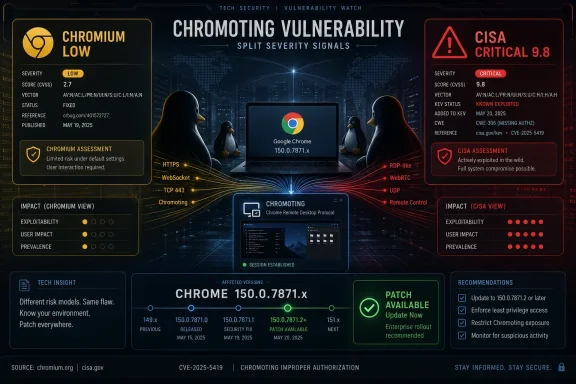 A Low-Severity Chrome Bug Became a Critical Enterprise Signal
The underlying defect is described by NVD as a use after free in Chromoting, Google’s long-running code name for the remote-desktop plumbing behind Chrome Remote Desktop. The affected product is Google Chrome on Linux prior to version 150.0.7871.47, and the attack vector in the CVE text is unusually direct: a remote attacker could execute arbitrary code via malicious network traffic.That language does not sound “low” to anyone responsible for endpoints. Remote code execution, no authentication, no user interaction, and total confidentiality, integrity, and availability impact is the shape of a vulnerability that security dashboards are trained to light up in red. CISA’s Authorized Data Publisher enrichment did exactly that, assigning CVSS 3.1 vector AV:N/AC:L/PR:N/UI:N/S:U/C:H/I:H/A:H, producing a 9.8 critical score.
Yet the same CVE description preserves Chromium’s own security severity as Low. That is not a typo in the user-facing record; it is a revealing collision between two scoring cultures. Chromium severity often reflects exploitability in the browser’s specific architecture, reachable surfaces, sandboxing expectations, and bug bounty triage conventions. CVSS, by contrast, tends to flatten the world into a formal model: if a network attacker can trigger arbitrary code execution without privileges or interaction, the math is merciless.
The result is a record that looks schizophrenic unless you understand the layers. Google’s advisory tells Chrome users, “This was not one of our marquee emergency bugs.” CISA’s enrichment tells security teams, “If this condition is reachable in your environment, treat the impact as severe.” Both can be true, and that is precisely why this CVE deserves more attention than its Chromium label would suggest.
The CPE Trail Is Messy, and That Matters More Than It Should
The user’s question — “Are we missing a CPE here?” — goes to the operational heart of the matter. NVD’s initial analysis reportedly added a configuration that combines Google Chrome versions up to but excluding 150.0.7871.47 with the Linux kernel CPE. In plain English, the vulnerability is being modeled as Chrome on Linux, not Chrome everywhere.That is broadly consistent with the CVE description. The record says “Google Chrome on Linux,” not Windows, macOS, Android, ChromeOS, or all Chromium products. If you are building a scanner rule, the minimum safe interpretation is that the vulnerable application CPE is Google Chrome and the platform condition is Linux.
But there is still a wrinkle. Google’s Stable Channel Update for Desktop, published June 30, 2026, lists Chrome 150.0.7871.46 for Linux and 150.0.7871.46/.47 for Windows and Mac, according to Google’s Chrome Releases blog. NVD’s CVE text, however, says Linux prior to 150.0.7871.47. That off-by-one-looking version boundary is exactly the kind of detail that causes vulnerability scanners to disagree, tickets to churn, and administrators to distrust automated findings.
There are several possible explanations. Google may have assigned the CVE’s fixed-version metadata from a broader internal branch while the public Linux stable package appeared as .46. NVD may have normalized against a version boundary supplied by Chrome’s CVE List entry. Or the public advisory may have used platform-specific build numbers that do not map neatly to every CVE’s “less than” field. Without a public Chromium bug discussion — the referenced issue requires permissions — outside observers cannot confidently resolve the discrepancy.
That uncertainty is not academic. A scanner that keys strictly on “Linux Chrome less than 150.0.7871.47” may mark Linux systems running 150.0.7871.46 as vulnerable even if Google’s Linux stable channel considered that build current. A scanner that keys on the Chrome Releases platform table may consider 150.0.7871.46 sufficient for Linux. Until Google or NVD cleans up the boundary, administrators should assume the safest remediation is to update to the latest available Chrome build in their channel rather than chasing the exact patch floor in isolation.
Chromoting Is Not Just a Feature; It Is an Attack Surface
Chromoting has always occupied an awkward place in Chrome’s architecture. To most users, Chrome Remote Desktop is a convenience feature: a way to reach a machine from elsewhere, help a relative, or access a headless box without setting up a full VPN and remote-management stack. To defenders, it is a privileged remote-access capability embedded in a browser ecosystem that is already one of the most exposed software surfaces on any workstation.A memory-safety bug in that area lands differently from, say, a rendering quirk in a rarely used UI panel. Chromoting deals with network sessions, remote input, display streaming, authentication handoff, and long-lived service behavior. Even if a particular bug is difficult to trigger in practice, the component’s job is to listen, broker, and move control across boundaries that enterprises spend years trying to harden.
That is why the phrase “malicious network traffic” should slow readers down. Many browser RCEs require a user to visit a hostile page, click a link, open a document, or at least cross paths with attacker-controlled content. This CVE’s wording does not describe a web-page drive-by. It describes network traffic aimed at the affected surface.
The public record does not prove that internet-wide exploitation is feasible, and CISA’s SSVC field lists exploitation as “none.” That distinction matters. There is no public evidence in the NVD record that the bug is being used in the wild, and it does not appear to be a Chrome zero-day in the familiar emergency-patch sense. Still, for systems where Chrome Remote Desktop or Chromoting-related services are enabled, administrators should treat the component as a legitimate remote attack surface rather than an inert browser feature.
The “Low” Label Is a Bad Shortcut for Patch Priority
The most dangerous reading of this record is also the easiest one: Chromium says Low, therefore the patch can wait. That conclusion ignores both the CVE wording and the way enterprises actually ingest risk.Severity labels are not universal constants. Chromium’s internal severity exists inside a project-specific triage process. CVSS exists to help organizations compare risk across products. SSVC exists to support decision-making based on exploitation status, automatable behavior, and technical impact. They are different instruments, not different translations of the same sentence.
CISA’s enrichment history shows that even those instruments moved. The record first showed a high attack complexity vector and an SSVC automatable value of “no,” then changed to low attack complexity and automatable “yes.” That is not unusual in fast-moving CVE enrichment, but it is a warning against treating the first score your scanner sees as gospel.
For patch managers, the practical reading is narrower and more useful. If you run Chrome on Linux and especially if Chrome Remote Desktop is enabled, CVE-2026-14121 belongs in the urgent validation pile. If you run managed Windows fleets, the direct exposure described in the CVE is not your primary issue, but Chromium-based browser cadence still is. Microsoft Edge, Brave, Vivaldi, Opera, Electron-based apps, and embedded Chromium components all depend on how quickly their maintainers absorb upstream Chromium security fixes, even when a specific CVE is platform-scoped.
That does not mean every Chromium CVE automatically applies to every Chromium-derived product. It means administrators should stop thinking of “Chrome update” as a consumer-app chore. Browser patching is now part of endpoint attack-surface management, and remote-access-adjacent components deserve particular scrutiny.
The Version Boundary Is the Administrator’s Real Enemy
The version data around CVE-2026-14121 is unusually easy to misread. NVD says Chrome on Linux prior to 150.0.7871.47. Google’s public Stable Channel Update says Linux was updated to 150.0.7871.46, while Windows and Mac received 150.0.7871.46/.47. Malwarebytes and Born’s IT and Windows Blog both noted the same broad Chrome 150 stable update and its large number of security fixes, though reporting differed on whether the batch contained 382 or 433 fixes depending on how the update’s security entries were counted and described.For humans, this is a footnote. For vulnerability-management systems, it is a tripwire. The scanner wants a clean comparison: installed version less than fixed version equals vulnerable. Chrome’s platform-specific build numbering makes that comparison less clean than the CVE schema implies.
This is where CPEs can amplify confusion. CPE is meant to identify affected platforms and products, but it is not a perfect inventory language for modern browser releases. A Linux platform CPE combined with a Chrome application CPE conveys “Chrome on Linux,” but it does not necessarily explain package-channel nuance, distro repository lag, vendor repackaging, or whether a Chromium-based derivative includes the vulnerable component.
The NVD entry also includes a conspicuous “Are we missing a CPE here?” prompt, which is boilerplate on many vulnerability pages but especially relevant here. If the only affected configuration is Google Chrome on Linux, the existing Chrome-plus-Linux model may be sufficient. If Chromium, Chrome Remote Desktop host packages, or downstream browser builds independently carry the vulnerable Chromoting code, then the ecosystem may indeed be under-modeled.
Administrators should not wait for the taxonomy to become elegant. The right move is to inventory actual installed browser versions and remote desktop components, verify package updates from trusted vendor channels, and suppress scanner noise only after confirming that the endpoint is on a build newer than the vendor’s available fix for that platform.
Windows Shops Should Still Care About a Linux Chrome CVE
At first glance, a Linux-only Chrome bug may seem like a poor fit for a Windows-focused publication. In 2026, that boundary is artificial. Windows enterprises routinely operate Linux developer workstations, WSL-heavy engineering environments, cloud-hosted Linux desktops, CI runners, kiosk systems, VDI pools, and administrative jump boxes where Chrome is installed for convenience even when it is not part of a formal standard image.Those machines are often worse governed than the Windows fleet. They may not be enrolled in the same endpoint-management stack, may update through distro repositories rather than Google’s own packages, and may be owned by teams that regard browser patching as someone else’s problem. If Chrome Remote Desktop is present because a developer needed quick access during a production incident, the asset may not show up where the security team expects it.
Windows admins also care because Microsoft Edge rides the Chromium train. This CVE’s public wording does not say Edge is affected, and Microsoft would need to publish its own advisory or release notes for that conclusion. But the broader update cadence remains relevant: when Chrome ships a large stable-channel security update, Edge administrators should check the corresponding Edge stable and extended-stable releases rather than assume upstream fixes appear instantly everywhere.
The same logic applies to Electron apps, though with even more caution. A vulnerability in Chromoting is not the same as a vulnerability in every app that embeds Chromium. Most Electron applications do not ship Chrome Remote Desktop. But the incident is another reminder that Chromium is not one thing; it is a platform with many components, only some of which are present in a given downstream product.
For WindowsForum’s audience, the correct posture is therefore neither panic nor dismissal. Treat CVE-2026-14121 as a specific Linux Chrome issue, then use it as a prompt to audit the parts of your environment where “browser” and “remote access” quietly overlap.
Browser Patch Bundles Are Becoming Too Large to Read Like Bulletins
Google’s June 30 stable-channel update was not a tidy one-CVE emergency advisory. It was a large patch bundle with hundreds of fixes and improvements, according to Google’s Chrome Releases blog and subsequent coverage by Malwarebytes and Born’s IT and Windows Blog. That scale changes how administrators consume the information.When a bulletin contains a handful of vulnerabilities, security teams can reason about each one. When a release contains hundreds of fixes, the update itself becomes the security unit. The question shifts from “Do we care about this CVE?” to “How quickly can we validate and deploy this browser milestone without breaking line-of-business workflows?”
That is an uncomfortable shift for enterprises that still treat browsers like desktop applications rather than critical infrastructure. Chrome, Edge, and their derivatives are privileged interpreters for untrusted code, document viewers, identity portals, remote-access clients, password managers, and policy enforcement points. A browser update is not just a UI refresh; it is often the most important security maintenance event on the endpoint.
The CVE-2026-14121 record illustrates the gap between patch-bundle reality and CVE-by-CVE triage. A single bug can carry a low Chromium severity, a critical CISA score, unclear version-floor implications, and a platform-specific CPE model. Multiply that by hundreds of fixes, and manual interpretation becomes a losing game.
The answer is not to ignore the details. It is to design update processes that do not depend on heroic interpretation every time a browser ships. Enterprises need rings, canaries, rollback plans, and telemetry that answer the operational question quickly: did the update install, did the business break, and are the exposed systems still exposed?
The Private Bug Keeps the Public Guessing
The Chromium issue linked from the CVE record is not publicly readable without permissions. That is standard for many browser security bugs, especially soon after release, but it means defenders must reason from metadata rather than root-cause detail.We do not know from the public record which exact object lifetime error occurred, which Chromoting code path was reachable, whether an attacker needed a particular service state, or how mitigations such as sandboxing, memory allocators, and process boundaries affected exploit reliability. We also do not know whether the Linux-only scope reflects code differences, packaging differences, platform-specific behavior, or simply the affected build identified by the reporter.
That lack of detail makes the CVSS score look both necessary and blunt. Necessary, because organizations need a decision signal before exploit write-ups appear. Blunt, because CVSS cannot capture implementation nuance it does not know. A 9.8 score is useful for prioritization, but it should not be mistaken for a full exploitability analysis.
The responsible public position is therefore conditional. If you have affected Linux Chrome builds, patch. If Chromoting or Chrome Remote Desktop is enabled, patch faster and consider exposure controls. If your scanner reports Windows Chrome or unrelated Chromium products as vulnerable solely because of this CVE, demand evidence from the detection logic before creating noise for desktop teams.
That balance is increasingly important. Overbroad vulnerability findings burn trust. Underbroad findings miss real exposure. CVE-2026-14121 sits exactly where those two failure modes meet.
Remote Access Features Deserve Their Own Browser Policy
Most organizations have browser policies. Fewer have browser remote access policies. That distinction is becoming harder to defend.Chrome Remote Desktop is useful, simple, and often outside the traditional remote-management procurement process. It can be enabled by users who would never be allowed to deploy a full remote administration tool. It can bridge personal Google accounts, unmanaged machines, and corporate endpoints if policy is loose. Even when used legitimately, it complicates the network and identity assumptions that defenders rely on.
CVE-2026-14121 does not prove that Chrome Remote Desktop is unsafe. It proves that remote-access code inside a browser can have memory-safety vulnerabilities with remote-code-execution consequences. That should be enough to justify tighter governance.
For managed Chrome environments, administrators should review policies controlling remote access, extension installation, sign-in behavior, and component updates. Linux fleets should be checked for Chrome packages installed outside standard configuration management. Developer systems deserve special attention because they are more likely to combine Linux, elevated privileges, unusual browser flags, and ad hoc remote access.
The browser has become the universal client. The remote desktop feature inside it should not be treated as a harmless accessory.
The Patch Is Simple; The Inventory Is Not
For individual users, the answer is straightforward: update Chrome. Use the browser’s About page, restart when prompted, and verify that the installed version is no longer behind the current stable build for your platform. Linux users who install Chrome through Google’s repository should make sure their package manager has pulled the latest stable package.For organizations, the work is less glamorous. They need to know where Google Chrome is installed on Linux, whether those systems are managed, whether Chrome Remote Desktop is enabled, and whether any vulnerability scanner is using the disputed 150.0.7871.47 boundary in a way that creates false positives or false negatives.
The Chrome Releases blog is the vendor source for the stable-channel update. NVD is the public aggregation and enrichment source for the CVE record. CISA’s ADP enrichment is the reason many scanners and dashboards will treat the issue as critical. Those three sources do not speak with exactly the same voice, and administrators should resist the urge to pretend they do.
The cleanest remediation evidence is not a screenshot of a CVE page. It is endpoint inventory showing the installed Chrome build, package source, update timestamp, platform, and remote-access feature state. If your vulnerability process cannot produce that view quickly, CVE-2026-14121 is less a crisis than a diagnostic test you did not pass.
The Practical Reading of CVE-2026-14121 Is Narrow but Sharp
This CVE is not a reason to declare every Chromium-based browser compromised. It is not, based on the public record, a known exploited zero-day. It is also not something administrators should wave away because Chromium’s severity label says Low. The useful middle ground is specific, testable, and fast.- Google Chrome on Linux prior to the fixed Chrome 150 stable build is the directly described affected target in the public CVE record.
- CISA’s enrichment rates the vulnerability as critical because the modeled attack requires network access only, no privileges, and no user interaction, with high impact across confidentiality, integrity, and availability.
- The public version data is awkward because NVD references versions prior to 150.0.7871.47 while Google’s public stable-channel table lists Linux as 150.0.7871.46 in the June 30 update.
- Administrators should update Linux Chrome to the newest available stable package rather than relying on a single version comparison copied from one database.
- Chrome Remote Desktop and Chromoting-related usage should be inventoried and governed as remote-access infrastructure, not merely as a browser convenience.
- Windows administrators should verify Edge and other Chromium-derived browser update cadence separately, but they should not assume this Linux-scoped Chrome CVE automatically applies to every Chromium product.
References
- Primary source: NVD / Chromium
Published: 2026-07-03T07:00:51-07:00
NVD - CVE-2026-14121
 nvd.nist.gov
- Security advisory: MSRC
Published: 2026-07-03T07:00:51-07:00
Original feed URL
Security Update Guide - Microsoft Security Response Center
 msrc.microsoft.com
- Related coverage: cvefeed.io
CVE-2026-14121 - Google Chrome Use-After-Free Remote Code Execution
Use after free in Chromoting in Google Chrome on Linux prior to 150.0.7871.47 allowed a remote attacker to execute arbitrary code via malicious network traffic. (Chromium security severity: Low)cvefeed.io
