

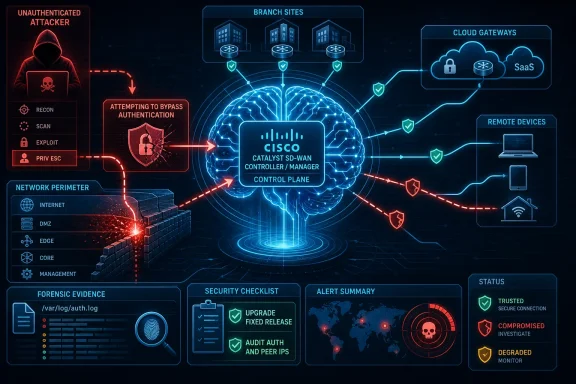
The sharper story is that SD-WAN control planes have become premium targets because they are not merely another management UI on the perimeter. They are the machinery that decides how branches, data centers, cloud gateways, and remote sites trust one another. When attackers can step into that machinery with administrative authority, the blast radius is no longer the box they touched; it is the network the box orchestrates.
The Patch Alert Is Really a Control-Plane Alarm
Most enterprise security teams know how to process a vendor advisory: identify affected assets, map versions, schedule maintenance, patch, and move on. CVE-2026-20182 resists that muscle memory because the affected layer is not a commodity edge service but the SD-WAN control plane, where authentication, topology, device trust, and policy intent converge.
Cisco’s advisory describes an authentication bypass affecting Cisco Catalyst SD-WAN Controller and Manager systems. The key phrase is not merely “remote attacker” or even “unauthenticated.” It is “administrative privileges.” In an SD-WAN environment, administrative control is not just local privilege; it can become policy privilege, route privilege, and trust privilege.
Cisco also said PSIRT became aware of limited exploitation in May 2026. “Limited” should not be misread as “unimportant.” In exploitation reporting, especially around infrastructure devices, limited often means the vendor has evidence of use without necessarily being able to describe the entire campaign, victim set, or attacker objective in public.
That is why the response must start with remediation but cannot end there. A patched controller is the beginning of recovery. The harder question is whether any attacker used control-plane access to alter trust relationships, establish unauthorized peer connections, change configuration, or create a persistence path that survives the patch window.
The First Job Is To Upgrade, Then Prove the Fabric Was Not Touched
Cisco published the CVE-2026-20182 advisory on May 14, 2026, and updated it on May 27, 2026. The advisory states that there are no workarounds available. In practice, that pushes affected organizations toward fixed software and post-upgrade validation rather than compensating controls as a substitute for patching.
Cisco’s guidance points administrators toward log review and TAC engagement where compromise is suspected. The advisory specifically calls out auditing /var/log/auth.log for entries involving accepted public-key authentication for vmanage-admin from unknown or unauthorized IP addresses, then comparing those IP addresses against the expected System IPs listed in the Cisco Catalyst SD-WAN Manager web UI under the Devices view’s System IP column. Cisco also advises customers seeking help with compromise determination to open a TAC case and collect admin-tech files from control components.
That sequence matters. If an attacker gained administrative access before the fix landed, merely installing the fixed release may close the door while leaving uncertainty about what happened inside the room. Incident responders should preserve logs before rotation, collect controller state, and document the pre-remediation topology so they can spot changes that look innocuous in isolation but are abnormal for the environment.
This is especially true for organizations that have already internalized SD-WAN as “network plumbing.” The more reliable and abstracted the fabric has become, the more tempting it is to assume the controller’s view is the truth. During a suspected control-plane compromise, the controller’s view becomes evidence, not gospel.
Attackers Have Learned That the Orchestrator Is Worth More Than the Edge
The industry spent years hardening internet-facing VPNs, firewalls, and remote-access gateways because they were obvious choke points. SD-WAN changed the topology without changing the attacker’s incentive. If anything, it concentrated more operational power behind management and control-plane interfaces that decide how traffic is steered and how sites authenticate into the fabric.
A branch router compromise is valuable. A controller compromise is better. The former may provide a foothold in one place; the latter can provide knowledge of the whole fabric and, depending on privileges and configuration, a path to influence many places.
That distinction explains why a control-plane authentication bypass is not just another high-scoring CVE. The vulnerability is positioned near the trust logic that lets SD-WAN components recognize and coordinate with one another. If attackers can bypass that trust boundary and obtain administrative privileges, they may be able to move from access to orchestration.
For defenders, the lesson is architectural. We have spent a decade telling users that the network perimeter is gone, but many organizations still operate management planes as if they are protected by obscurity, inherited trust, or “only admins know where that lives.” The control plane is now a perimeter of its own.
CVE-2026-20182 Arrived After Another Perfect-Score Warning
The May advisory did not land in a vacuum. Cisco’s earlier February 25, 2026 SD-WAN advisory for CVE-2026-20127 also carried a CVSS base score of 10.0 and no workaround. That earlier issue involved Catalyst SD-WAN Controller and Manager systems as well, and its presence in the same year makes the May warning harder to dismiss as a one-off.
The important point is not that two advisories prove a systemic failure. Public facts do not support that kind of sweeping claim. The point is narrower and more useful: Cisco SD-WAN control components have had multiple critical advisories in a short period, and defenders should treat the control-plane attack surface as an active operational risk area rather than a theoretical concern.
WindowsForum readers have already been tracking adjacent Cisco SD-WAN exploitation and Known Exploited Vulnerabilities attention, including discussion around Cisco Catalyst SD-WAN flaws and CISA urgency. That audience instinct is right. These bugs belong in the same mental bucket as exploited VPN and firewall vulnerabilities: infrastructure weaknesses that may sit outside Windows but decide whether Windows environments remain reachable, segmented, monitored, and recoverable.
For Windows-heavy enterprises, this is not somebody else’s network story. Active Directory, Microsoft 365 access paths, endpoint management, backup networks, and remote administration often depend on the network fabric behaving exactly as designed. If the SD-WAN controller’s intent is compromised, the Windows estate can inherit the risk without a single Windows CVE being involved.
Segmentation Fails Quietly When the Policy Brain Is Untrusted
Segmentation is often sold as a containment story: if one site, subnet, workload, or identity tier is compromised, policy prevents easy lateral movement. SD-WAN can make that promise more scalable by centralizing intent and distributing enforcement. But the same centralization turns the controller into a high-value policy brain.
If attackers can influence that brain, defenders have to ask uncomfortable questions. Were routing policies changed? Were access rules loosened? Were new peers introduced? Were management paths exposed? Were logs altered, redirected, or simply left too short-lived to answer those questions?
The danger is not always dramatic sabotage. A skilled attacker may prefer a small, plausible change over a noisy takeover. A peer connection that looks ordinary at first glance, a configuration adjustment that resembles emergency maintenance, or a route preference change that subtly improves attacker visibility can all matter more than obvious defacement.
That is why blast-radius analysis after SD-WAN controller exposure should not be limited to “Was the controller patched?” It should include a comparison of intended segmentation against actual forwarding behavior, a review of recent control-plane events against maintenance records, and an assessment of whether any sensitive management or identity systems became reachable in ways they should not have been.
The Absence of a Workaround Changes the Politics of Maintenance
“No workaround available” is one of the most consequential phrases in a security advisory because it removes the usual bargaining position. There is no supported knob that makes the vulnerability go away while the organization waits for a more convenient maintenance window. There may be mitigations that reduce exposure, but mitigation is not remediation.
That matters in SD-WAN because upgrades are rarely treated like patching a single workstation. Controllers are part of a live network fabric. Organizations must think about compatibility, change windows, rollback planning, managed cloud variants, and the operational risk of touching infrastructure that keeps branches and applications online.
Still, the exploitation note changes the calculus. A planned outage risk is visible and bounded. A control-plane compromise risk is often invisible until after the damage is done. For critical infrastructure software with known exploitation and no workaround, “we are waiting for the next quarterly window” becomes a security decision, not an operations preference.
The best-run teams will not treat this as a panic patch. They will treat it as an emergency change with evidence preservation. That means capturing logs, documenting current state, validating expected peers, then upgrading and validating again.
Incident Response Must Start With the Assumption That Trust Was the Target
Traditional edge-device incident response often asks whether the attacker got a shell, dropped malware, or pivoted inward. Those questions still matter, but SD-WAN control-plane incidents require an additional lens: did the attacker manipulate trust?
A controller or manager can be more valuable as a source of legitimacy than as a place to run tools. If an attacker can make a connection or configuration appear authorized, downstream detection becomes harder. Network teams may see expected protocols, expected device families, and plausible management activity while missing the fact that the initiator or timing is wrong.
That is why Cisco’s emphasis on checking authentication logs and validating control connections is more than procedural hygiene. It points defenders toward the real forensic problem: distinguishing legitimate fabric behavior from attacker-created lookalikes. In an SD-WAN environment, normal is highly environment-specific, which makes asset inventory and change records part of the detection stack.
Organizations that cannot quickly answer which controllers should talk to which systems, from which IPs, during which windows, are at a disadvantage. The vulnerability may be technical, but the response exposes whether the organization’s network governance is mature enough to detect abuse of its own automation.
Windows Shops Should Treat This as a Dependency Risk, Not a Cisco-Only Problem
Many WindowsForum readers live in environments where Cisco infrastructure and Microsoft platforms are deeply interdependent. Windows endpoints authenticate across links the SD-WAN fabric carries. Domain controllers, Entra-connected services, management servers, software deployment systems, and backup infrastructure may all rely on routing and segmentation policies enforced or coordinated by the network layer.
That means the practical question for a Windows administrator is not “Do I manage Cisco SD-WAN?” It is “Do my Windows systems rely on a network fabric whose control plane could alter who reaches what?” If the answer is yes, then this advisory belongs in the Windows risk register.
A compromised SD-WAN control plane can undermine assumptions that Windows defenders make during incident response. A subnet believed to be isolated may not be. A management path believed to be restricted may have changed. A site believed to be clean may have had its traffic steered or exposed differently during the compromise window.
This is where collaboration between network and Windows teams becomes essential. Network engineers need to know which Windows assets represent high-value identity, management, and recovery functions. Windows administrators need to know whether the SD-WAN fabric has experienced suspicious peer activity or administrative access. Neither side can accurately define blast radius alone.
The Cloud-Managed Variant Does Not Eliminate Customer Responsibility
Cisco’s SD-WAN ecosystem includes different deployment models, including on-premises and Cisco-hosted arrangements. The advisory’s existence across deployment types is a reminder that cloud-managed infrastructure changes operational responsibility but does not eliminate the need for customer-side verification and communication.
For cloud-managed services, customers may not perform the same upgrade actions themselves, but they still need to confirm remediation status through the appropriate service interface or support channel. They also need to understand what evidence is available if suspicious activity is suspected. Outsourcing operations does not outsource accountability to the business when connectivity, segmentation, or incident reconstruction is on the line.
The distinction matters because some organizations treat vendor-managed infrastructure as a black box until something breaks. A zero-day exploitation notice is the wrong moment to discover that nobody knows how to retrieve relevant logs, who can open a high-priority support case, or which internal team owns validation of the managed service’s security posture.
The operational maturity test is simple: can the organization prove, in writing, whether it was exposed, whether it has been remediated, and whether suspicious control-plane activity was reviewed? If not, the SD-WAN management model is not the only problem.
CISA Attention Reinforces the Clock, But the Architecture Is the Lesson
CISA Known Exploited Vulnerabilities attention around Cisco SD-WAN flaws has already made this category visible to defenders who track federal remediation pressure. That matters because KEV listings tend to cut through ordinary vulnerability noise. They tell teams that exploitation is not hypothetical and that patch prioritization should move accordingly.
But the more durable lesson is not that one more CVE entered a catalog. It is that control-plane software is becoming a first-order target. Attackers are not simply chasing the largest number of exposed boxes; they are chasing the boxes that define trust for everything else.
That is a different security model than the one many organizations still use. If SD-WAN controllers sit in privileged network zones, are accessible from too many places, retain too little log history, or are monitored only for uptime, they are being treated as infrastructure utilities when they should be treated as tier-zero-adjacent systems.
The Windows analogy is useful: organizations learned, often painfully, that domain controllers are not ordinary servers. SD-WAN controllers deserve a similar mental upgrade. They may not hold user passwords or Kerberos tickets, but they can influence the pathways by which those assets are reached and defended.
The Real Remediation Is Smaller Exposure and Better Memory
Upgrading fixed software is the non-negotiable part. The longer-term fix is to reduce the ways attackers can reach control components and increase the organization’s ability to remember what happened when something goes wrong. That means restricting access, centralizing logs, validating peer relationships, and making controller changes visible to security operations rather than burying them in network-only workflows.
Cisco’s broader hardening guidance aligns with common sense: keep management and control components away from unsecured networks, filter access through known trusted hosts, monitor unexpected traffic, disable unneeded services, and maintain secure administrative practices. The uncomfortable part is that many organizations already know these principles and still make exceptions for convenience, legacy dependencies, or emergency access.
Those exceptions become liabilities when the target is a controller. A forgotten firewall allowance or exposed management path is not merely a route to a login page; it is a route toward the fabric’s decision-making layer. In a world where attackers increasingly target appliances and infrastructure services, “not Windows” does not mean “not part of the endpoint security story.”
The fix is not to turn every network team into a security operations center. It is to make SD-WAN control-plane events first-class security signals. Authentication anomalies, peer changes, controller upgrades, and policy modifications should be visible to the people responsible for incident response.
The Cisco SD-WAN Warning Compresses the To-Do List
The value of this advisory is that it forces priorities. There is a known critical flaw, known limited exploitation, no workaround, and a control-plane blast radius that can reach beyond the affected appliance. The response should be disciplined rather than theatrical.
- Organizations running affected Cisco Catalyst SD-WAN Controller or Manager systems should upgrade to a fixed release rather than relying on compensating controls as a substitute.
- Administrators should preserve and review relevant logs, including authentication evidence involving
vmanage-adminand unknown or unauthorized IP addresses. - Network teams should validate control connections and peer relationships against documented topology, maintenance windows, and known-good system IP assignments.
- Security teams should treat suspected controller compromise as a fabric-level incident that may affect segmentation, routing, and access assumptions.
- Windows and identity administrators should identify which domain, management, backup, and endpoint services depend on SD-WAN-enforced reachability.
- Organizations using hosted or managed SD-WAN services should confirm remediation status and evidence availability through the service GUI, Cisco TAC, or their contracted provider.
The deeper story behind CVE-2026-20182 is that attackers are following enterprise trust to its source. SD-WAN promised to make the wide-area network programmable, resilient, and easier to operate; that same programmability makes the controller a prize. The next phase of infrastructure defense will not be won by patching faster alone, but by treating the control plane as a protected security boundary whose compromise can redraw the network before defenders realize the map has changed.