

Microsoft’s Security Update Guide records CVE-2026-20922 as a Windows NTFS vulnerability that can lead to remote code execution, and the vendor’s published “report confidence” metadata is the single most important triage signal for how aggressively administrators should respond.
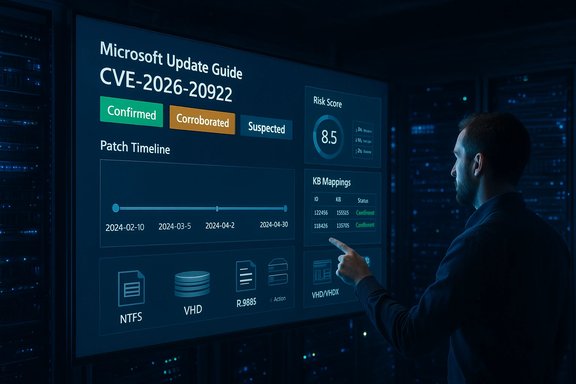
CVE-2026-20922 appears in Microsoft’s Update Guide as an NTFS-area vulnerability with an RCE classification; the vendor entry carries an explicit confidence/visibility flag that informs defenders whether the issue is confirmed, corroborated, or suspected. That label matters operationally because confirmed RCEs normally map to tested security updates and demand immediate mass deployment, whereas corroborated or suspected entries require a mixed strategy of patching, tighter controls, and active hunting. NTFS parsing vulnerabilities historically follow a familiar pattern: adversaries supply a crafted disk image (VHD/VHDX/raw disk) or mount specially constructed media, the kernel or privileged file-service code parses on‑disk metadata, and a memory‑safety fault (uninitialized read, out‑of‑bounds read/write, integer overflow, or use‑after‑free) is triggered. That fault can yield denial‑of‑service, information disclosure, or — in chained, advanced attacks — arbitrary code execution in kernel or privileged process context. Prior waves of NTFS vulnerabilities published in 2025 illustrated the operational risk: several NTFS bugs were patched during March 2025 and some were observed in the wild, driving emergency responses from defenders and regulators.
Summary checklist (one‑page action items)
Source: MSRC Security Update Guide - Microsoft Security Response Center
 Background / Overview
CVE-2026-20922 appears in Microsoft’s Update Guide as an NTFS-area vulnerability with an RCE classification; the vendor entry carries an explicit confidence/visibility flag that informs defenders whether the issue is confirmed, corroborated, or suspected. That label matters operationally because confirmed RCEs normally map to tested security updates and demand immediate mass deployment, whereas corroborated or suspected entries require a mixed strategy of patching, tighter controls, and active hunting. NTFS parsing vulnerabilities historically follow a familiar pattern: adversaries supply a crafted disk image (VHD/VHDX/raw disk) or mount specially constructed media, the kernel or privileged file-service code parses on‑disk metadata, and a memory‑safety fault (uninitialized read, out‑of‑bounds read/write, integer overflow, or use‑after‑free) is triggered. That fault can yield denial‑of‑service, information disclosure, or — in chained, advanced attacks — arbitrary code execution in kernel or privileged process context. Prior waves of NTFS vulnerabilities published in 2025 illustrated the operational risk: several NTFS bugs were patched during March 2025 and some were observed in the wild, driving emergency responses from defenders and regulators. What Microsoft’s “report confidence” means for CVE-2026-20922
Microsoft’s Update Guide attaches a short, deliberate metadata field to each CVE entry that describes the vendor’s degree of confidence in the advisory and the completeness of published technical detail. Practically, this breaks down to three operational tiers:- Confirmed / High confidence — Microsoft has validated the vulnerability, released patches or KB mappings, and typically gives a clear remediation path. Treat as urgent: patch immediately.
- Corroborated / Medium confidence — Third‑party research or telemetry supports Microsoft’s claim. Public technical indicators may exist and can accelerate weaponization; prioritize patching and hunting quickly.
- Suspected / Low confidence — The vendor knows of a report but lacks full corroboration. Technical details are likely limited; triage by exposure and monitor for follow‑up.
Technical anatomy — plausible root causes and exploitation vectors
Microsoft’s public advisories for NTFS issues often withhold low‑level exploit mechanics to reduce immediate weaponization risk. When patch diffs or trusted third‑party analyses become available, they typically reveal one of the recurring defect classes:- Heap-based buffer overflow (CWE‑122 / CWE‑120): malformed run lists, cluster mappings, or attribute records lead to writes past a buffer boundary. These are powerful primitives and have produced high-severity EoP/RCEs in the past.
- Out‑of‑bounds or uninitialized reads (CWE‑125 / KMSAN warnings): these leak kernel memory or produce indeterminate behavior that attackers can chain into additional primitives. A growing body of kernel bugs are resolved by replacing non‑zeroing slab allocations with zeroing variants to eliminate such indeterminate reads.
- Integer overflow / arithmetic errors in length/runlist parsing: malformed VHD/NTFS metadata can cause miscalculated sizes and unsafe memory operations. These are common in filesystem code that manipulates cluster runs and extents.
- Race conditions / TOCTOU: parallel operations on filesystem metadata can create time‑of‑check/time‑of‑use windows; defenders see this pattern in virtualization-host exploitation scenarios.
- Local user / image-supply vector: the most likely trigger is a user or automated service mounting, previewing, or inspecting an NTFS disk image (VHD, VHDX, RAW) that intentionally contains malformed metadata. Where hosts automatically mount or inspect images (CI/CD runners, virtualization hosts, backup appliances), the “local” nature of the bug becomes effectively network‑exposed.
- Privileged parsing contexts: kernel drivers and privileged services that parse NTFS metadata are high-value targets because faults here execute with large privileges. Virtualization hosts and image‑ingestion services are high-priority assets to protect.
Exploitability & likely impact (practical assessment)
There are three factors defenders must weigh:- Trigger complexity: Mounting or provisioning a crafted NTFS image is straightforward in many environments. Social engineering — or simply uploading a VHD to an automated image pipeline — is all an attacker needs in many real-world scenarios. That makes exploit complexity deceptively low in environments that accept third‑party images.
- Privilege and blast radius: If the vulnerable parsing runs in kernel context or within a privileged Windows service, successful exploitation can yield SYSTEM‑level code execution, leading to full host compromise and lateral movement. Virtualization hosts and shared image‑processing services have the largest blast radius.
- Public research and weaponization risk: Historically, when vendor patches are published, researchers and attackers reverse‑engineer diffs to produce proofs‑of‑concept. If CVE‑2026‑20922 is published with a patch (or if a patch appears and is reverse‑engineered), unpatched fleets face an elevated risk window. That “patch‑diff” exploitation vector is a consistent pattern in the modern threat lifecycle.
Recommended immediate actions (0–72 hours)
These are short, practical, low‑regret steps to reduce risk now.- Consult Microsoft’s Update Guide entry for CVE‑2026‑20922 and map KB→SKU. The Update Guide is the canonical mapping for which updates apply to which Windows builds; use it to feed your patch orchestration tools. If the Update Guide shows a confirmed status and a KB mapping, treat it as actionable.
- Prioritize hosts by exposure. Give top priority to:
- Virtualization hosts and hypervisors that may mount guest disks.
- Image‑ingestion pipelines, CI/CD runners, and backup appliances that auto‑mount or scan VHD/VHDX images.
- Domain controllers, jump boxes, and admin workstations that host mountable images or preview workflows.
- Patch quickly but stage safely. Where Microsoft publishes a KB, stage the update in a pilot ring, validate critical workloads, then roll to high‑exposure systems first. Reboots are typically required for kernel or driver updates; build reboot windows into your deployment plan.
- Short‑term compensations if patching is impossible immediately:
- Restrict mount privileges: require administrative approval for mounting external images or loopback devices.
- Isolate image processing: perform image analysis in disposable sandbox VMs that do not run on shared, high‑value hosts.
- Block preview/thumbnailing of untrusted VHD/VHDX content in server-side rendering pipelines.
- Hunt and telemetry tuning (concurrent): Configure endpoint telemetry and kernel logs to forward filesystem‑related oops/panic signatures and unexpected mount events to your SIEM/EDR. Hunt for unusual image mount operations or for non‑privileged accounts triggering mounts.
Detection, hunting, and post‑patch validation
Detection is hard for kernel‑level memory faults, but the following signals are high‑value:- Kernel oops/panic and blue‑screen events referencing NTFS or related driver names immediately after image mounts. These often precede exploit attempts or accidental crashes from malformed images.
- Unexpected mounts of VHD/VHDX or RAW images originating from automation accounts or user processes that do not normally perform mounts. Correlate with process creation (Event ID 4688 on Windows) for suspicious ancestry (e.g., explorer.exe or a service mounting an image and soon after spawning a SYSTEM shell).
- Sudden changes to privileged tokens, unexpected service creations, or persistence behaviors shortly after an image‑mount event; those are classic post‑exploit indicators in kernel or local escalation attacks.
- Confirm the patched KB is installed on the target machine and the system build matches Microsoft’s published mappings.
- Reboot into the updated build and confirm that kernel logs no longer show the prior oops signatures when mounting test images.
- For Linux hosts that may use ntfs3/ntfs drivers, verify module versions and whether a zeroing allocation fix has been applied (where applicable). If your Linux environment mounts Windows images, include those hosts in the audit window.
Cross‑validation and corroboration — what is verifiable now
- Microsoft’s Update Guide lists CVE‑2026‑20922 as a Windows NTFS RCE entry and provides the vendor’s confidence metadata and KB mapping details in the official UI. This entry is the authoritative mapping for which Microsoft updates apply.
- Independent incident-response guidance and community write‑ups repeatedly emphasize prioritizing virtualization hosts and image‑ingestion pipelines in NTFS advisories; that consensus is borne out by prior NTFS incidents and vendor advisories.
- There is no confirmed, publicly published proof‑of‑concept exploit for CVE‑2026‑20922 (unless updated telemetry or independent vendor write‑ups appear). Any claim of a working exploit should be treated as needing corroboration from at least two independent, trusted sources.
Operational priorities for enterprise defenders
- Triage by exposure:
- High: Virtualization hosts, image ingestion and backup appliances, CI/CD runners that accept disk images.
- Medium: Shared admin workstations and build servers that mount external NTFS media.
- Low: Single‑user desktops that never mount untrusted media.
- Patch cadence and rollout plan:
- Obtain KB mappings from Microsoft’s Update Guide immediately. Pilot in 24–72 hours if possible. Patch high‑exposure hosts first, then broaden. Reboot windows must be enforced for kernel/driver fixes.
- Short‑term mitigations:
- Blacklist or restrict mount drivers where feasible, disable automatic mounting of removable media in high‑value hosts, and sandbox image inspection workflows.
- Hunting and telemetry:
- Forward kernel oops/BSOD details centrally, track unexpected VHD/VHDX mounts, and correlate process creation with mount events. Instrument EDR to alert on anomalous escalation behaviors following image mounts.
Risks, strengths, and open questions
Notable strengths in the current defensive posture:- Microsoft’s Update Guide provides a clear mapping of CVE → KB → SKU, and the vendor’s confidence metadata gives defenders an operational lever for triage. Use the Update Guide as the canonical input to your patch‑orchestration pipeline.
- The security community has converged on practical mitigation patterns for NTFS parsing bugs: restrict mounting privileges, sandbox image ingestion, and prioritize virtualization hosts — those practices reduce attack surface even when technical details are sparse.
- If Microsoft lists CVE‑2026‑20922 with only limited public technical detail, reverse‑engineering of a patch (or a future research write‑up) could quickly produce weaponizable PoCs. That “patch-diff” window is historically a high‑risk period for unpatched fleets.
- The Update Guide entry is authoritative but may be rendered in a JavaScript UI that automated scrapers cannot always extract; manual checks (or programmatic calls to official vendor tooling) are necessary to ensure you apply the correct KB for each SKU and build.
Practical playbook — step‑by‑step for SOCs and patch managers
- Immediately open Microsoft’s Update Guide entry for CVE‑2026‑20922, extract KB→SKU mappings and record the relevant KB identifiers for each Windows build in your estate.
- Run an asset query to find high‑exposure hosts: virtualization clusters, backup appliances, CI runners, and forensic/image analysis hosts. Prioritize those systems for immediate patching.
- Stage the patch in a pilot ring and validate critical workloads and driver compatibility. Reboot into the patched build and test image‑mounting behavior using trusted test images.
- If you cannot patch immediately, restrict mount privileges, disable automatic image previewing on servers, and isolate image ingestion workflows into sandbox VMs.
- Tune EDR/SIEM to alert on: kernel oops/BSOD messages referencing NTFS, unexpected VHD/VHDX mounts from automation accounts, and process creation anomalies following mount events. Start targeted hunts across high‑value hosts.
Conclusion
CVE‑2026‑20922 is a vendor‑recorded NTFS remote code execution entry; Microsoft’s Update Guide is the authoritative starting point for KB mappings and the vendor’s confidence assessment. Because NTFS parsing bugs have a proven history of being weaponized — especially where privileged services mount or inspect disk images — defenders must assume a conservative posture: confirm vendor KB mappings, prioritize virtualization and image‑processing hosts, and apply patches rapidly while applying immediate compensating controls to reduce exposure. Monitor kernel telemetry for NTFS‑related oops/BSOD signatures and hunt for anomalous image mount activity. Finally, treat any detailed exploitation claims without multiple corroborating sources as unverified until independent technical analyses or vendor patch diffs become available.Summary checklist (one‑page action items)
- Check Microsoft Update Guide for CVE‑2026‑20922 KB→SKU mapping.
- Inventory and prioritize: virtualization hosts, image ingestion servers, backup appliances, CI/CD runners.
- Stage and deploy vendor patches (pilot → high‑exposure → broad). Reboot as required.
- Short‑term mitigations: restrict mounting privileges, sandbox image processing, disable auto‑preview of disk images.
- Tune detection: forward kernel oops/BSOD logs, hunt on unexpected VHD/VHDX mounts and post‑mount escalation behaviors.
Source: MSRC Security Update Guide - Microsoft Security Response Center
