

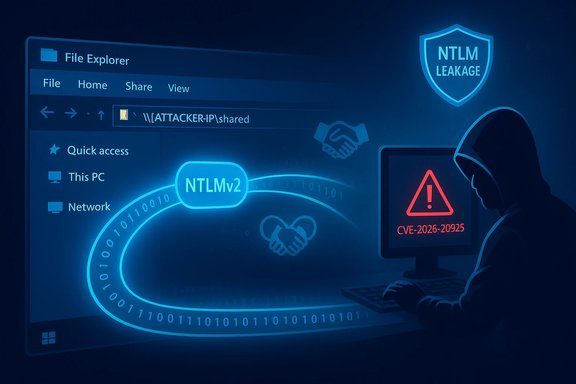
Microsoft has assigned CVE-2026-20925 to an information-disclosure / spoofing defect in NTLM authentication — a File Explorer–adjacent weakness that, based on the vendor entry and community precedent, can cause a Windows host to leak NTLM negotiation material (NTLMv2 challenge/response blobs) to an attacker-controlled SMB endpoint with very little user interaction. Microsoft’s Security Update Guide lists the identifier and brief description, but the advisory currently offers limited technical detail; defenders should treat the CVE as real, urgent, and potentially weaponizable while awaiting fuller vendor notes and KB mappings.
NT LAN Manager (NTLM) is a long‑standing Windows authentication family that uses challenge/response exchanges. Although NTLMv2 is more robust than legacy NTLM, captured negotiation blobs remain valuable to attackers: they can be cracked offline, relayed to other services, or abused in pass‑the‑hash/relay-style attack chains when other environmental protections (SMB signing, Kerberos enforcement, SMB egress filtering) are absent. Recent years have seen multiple exploit chains that coerce Windows components (File Explorer, preview handlers, web servers on Windows) to resolve attacker-controlled UNC/SMB resources and thereby leak NTLM artifacts. Those incidents form the operational template that makes CVE‑2026‑20925 noteworthy. Security vendors and community writeups from the 2024–2025 wave of NTLM leaks showed a repeating pattern: specially crafted files or file metadata make Explorer or in‑process preview handlers attempt to contact remote SMB shares; Windows then initiates an SMB connection and negotiates authentication, exposing the NTLM blobs. Microsoft has sometimes responded with behavioral hardening (for example, preventing previews of Internet‑zoned files or changing how Mark‑of‑the‑Web is handled), but full patching of every parser and preview handler is slow and complex.
The practical result: even when a CVE entry is terse or lacking PoC details, the class of vulnerability is well understood and has clear mitigations and detection strategies. The vendor’s confidence metric (how certain the entry and technical details are) matters operationally: an identifier‑only entry still demands conservative mitigation because the attack primitive is low friction and prior CVEs were exploited rapidly in the wild.
The recommended defensive posture is immediate and pragmatic: assume the vulnerability is exploitable in realistic ways, apply behavioral mitigations (disable previews on high‑risk hosts, enforce MoTW handling), block SMB egress, and monitor for Explorer‑originated SMB/NTLM activity while awaiting Microsoft’s KBs and formal patches. Cross‑check vendor guidance and vendor‑agnostic security advisories as they appear, and treat any community PoC claims as probable but unverified until they are matched to vendor patches or authoritative technical write‑ups. By combining immediate, low‑cost mitigations with medium‑term architectural fixes (reducing NTLM reliance, enforcing SMB signing, and network egress restrictions), organizations can sharply reduce the operational value of this class of bug even before final patches land. The bottom line: act now, verify often, and treat Explorer‑adjacent NTLM leaks as a high‑urgency item in your incident‑risk playbook.
Source: MSRC Security Update Guide - Microsoft Security Response Center
 Background / Overview
NT LAN Manager (NTLM) is a long‑standing Windows authentication family that uses challenge/response exchanges. Although NTLMv2 is more robust than legacy NTLM, captured negotiation blobs remain valuable to attackers: they can be cracked offline, relayed to other services, or abused in pass‑the‑hash/relay-style attack chains when other environmental protections (SMB signing, Kerberos enforcement, SMB egress filtering) are absent. Recent years have seen multiple exploit chains that coerce Windows components (File Explorer, preview handlers, web servers on Windows) to resolve attacker-controlled UNC/SMB resources and thereby leak NTLM artifacts. Those incidents form the operational template that makes CVE‑2026‑20925 noteworthy. Security vendors and community writeups from the 2024–2025 wave of NTLM leaks showed a repeating pattern: specially crafted files or file metadata make Explorer or in‑process preview handlers attempt to contact remote SMB shares; Windows then initiates an SMB connection and negotiates authentication, exposing the NTLM blobs. Microsoft has sometimes responded with behavioral hardening (for example, preventing previews of Internet‑zoned files or changing how Mark‑of‑the‑Web is handled), but full patching of every parser and preview handler is slow and complex.The practical result: even when a CVE entry is terse or lacking PoC details, the class of vulnerability is well understood and has clear mitigations and detection strategies. The vendor’s confidence metric (how certain the entry and technical details are) matters operationally: an identifier‑only entry still demands conservative mitigation because the attack primitive is low friction and prior CVEs were exploited rapidly in the wild.
What Microsoft’s advisory actually says (and what it omits)
Microsoft’s Update Guide page for CVE‑2026‑20925 confirms the CVE and provides the canonical vendor listing but — as is common during staged disclosures — does not publish a full technical write‑up or per‑SKU KB mapping in the initial entry. That limited public posture is deliberate: it reduces the short‑term risk of automated exploitation while patches are finalized and rolled out. Administrators must therefore rely on the Update Guide entry for authoritative remediation steps once Microsoft publishes linked KBs and packages. Community analysis and historical patterning strongly suggest the following, even when Microsoft’s advisory is terse:- The vulnerability is in the Explorer/preview/metadata handling family that can cause a Windows client to contact an attacker SMB host during rendering or file metadata resolution.
- The leak artifact is NTLM negotiation material (NTLMv2 response blob), which can be used offline or relayed for further credential misuse.
- Exploitation typically requires very low‑interaction user behavior — selecting or merely viewing a file in Explorer, extracting an archive, or allowing a preview to render — which is why defenders treat these bugs with unusually high urgency.
How these NTLM hash‑disclosure/spoofing bugs work — technical primer
The attack primitive is simple to explain but subtle to fully eliminate across a complex OS:- Many file formats, icons, and metadata references can contain external resource URIs (images, PE icon resources, UNC/\ paths, file:// references) that the Shell or a preview handler resolves when generating thumbnails or previews.
- If such a reference resolves to a remote SMB host that requires authentication, Windows will typically attempt a network authentication handshake toward that host. Because the client seeks to authenticate under the user’s context, it sends negotiable NTLM blobs during the SMB session setup.
- An attacker who controls the remote SMB endpoint can record those blobs. The blob itself is not a plaintext password but may be sufficient for offline cracking, or — in environments where relaying or weak protections exist — to impersonate the user to other services.
- Previewing a malicious document in File Explorer or in an email preview pane.
- Viewing or extracting archives that contain crafted paths or metadata.
- Opening or simply navigating to folders that contain maliciously crafted shortcuts or .library‑ms files.
- Web servers or applications on Windows that improperly normalize encoded path fragments into UNC paths (e.g., AllowEncodedSlashes/MergeSlashes misconfigurations in Apache on Windows), which can result in server‑side resolution of attacker UNC targets and similar NTLM leakage.
Who’s at risk (practical exposure model)
High‑risk targets:- Administrative workstations, jump hosts, and privileged operator machines that routinely authenticate to network resources.
- Servers or endpoints that process untrusted files (mail gateways, content ingestion hosts, document triage VDI machines).
- Networks that permit outbound SMB to the Internet (TCP 445/139) or that fail to require SMB signing/NTLM blocking.
- Environments still relying on NTLM for internal services where Kerberos cannot be enforced.
Verification, confidence and cross‑checks
Vendor confirmation: Microsoft has issued the Update Guide entry for CVE‑2026‑20925, which establishes the vulnerability’s existence in Microsoft’s canonical database; however, the entry currently lacks extended technical detail and mapped KBs necessary for precise remediation scheduling. Independent corroboration: Historically, NTLM hash‑leak CVEs (for example, CVE‑2025‑24054 and others in 2024–2025) were quickly analyzed and reproduced by multiple vendors and researchers (Check Point Research, The Hacker News summaries, PT Security / dbugs writeups). Those prior analyses confirm the exploit pattern and the urgency of mitigations; they therefore inform defensive assumptions about CVE‑2026‑20925. Treat this as evidence‑based inference rather than a direct technical mapping until independent reports appear for the 2026 identifier. Confidence metric interpretation: Microsoft’s internal and public classification of vulnerability entries often progresses through three stages:- Identifier‑only entry (low public detail; existence confirmed but exploit mechanics unpublished).
- Corroborated researcher reports or vendor technical notes (medium confidence).
- Full KB mapping, engineering notes, and patches with known fixes (high confidence).
Immediate, high‑priority mitigations (operational playbook)
Apply this prioritized, practical checklist across endpoints, servers, and your patch‑management pipeline:- Confirm vendor remediation status
- Check Microsoft’s Update Guide CVE‑2026‑20925 entry frequently for KB mappings and installable packages; extract KB numbers and deploy them through normal testing and rollout channels once published.
- Short‑term platform hardening (apply immediately where practical)
- Disable the File Explorer Preview pane and thumbnail generation on high‑risk hosts (especially admin jump hosts and ingestion servers).
- Enforce Mark‑of‑the‑Web (MoTW) handling policies that prevent Internet‑zoned files from being rendered by in‑process preview handlers. Microsoft previously adopted this behavioral hardening for similar issues.
- Network controls
- Block outbound SMB (TCP 445/139) to untrusted networks at the egress firewall level; allow explicit exceptions where absolutely necessary and logged.
- Enforce SMB signing and require Kerberos where possible. Disable NTLM authentication entirely when legacy applications do not require it.
- Detection and telemetry
- Alert on explorer.exe initiating outbound SMB/UNC connections to unusual endpoints. Hunt for anomalous NTLM authentication attempts originating from Explorer/preview processes.
- Correlate EDR telemetry for handle duplications, token swaps, or unexplained in‑process loads by explorer.exe or preview handler DLLs.
- User controls and operational behavior
- Train high‑risk users (helpdesk, legal, HR) to avoid previewing untrusted documents and to refrain from bulk unblocking of files (which defeats MoTW protections).
- Prefer staged pilot deployments of any registry/workaround changes — don’t roll out untested registry edits enterprise‑wide.
- Vendor/third‑party mitigations
- Where Microsoft KBs are not yet available, consult trusted security vendors’ detection rules and vendor advisories for temporary signatures or mitigations (they often publish scanning modules for NTLM leakage patterns). Cross‑check vendor guidance against Microsoft once KBs are released.
Recommended long‑term remediation and architectural changes
- Migrate away from NTLM: Prioritize Kerberos or modern authentication (Negotiate, Azure AD, and passwordless constructions) in places where NTLM is used solely for historical compatibility.
- Harden authentication posture: Require SMB signing domain‑wide, and implement NTLM blocking lists via Group Policy where legacy usage is limited and replacement timelines exist.
- Reduce attack surface: Centralize document triage (antivirus sandboxing, isolated document viewers) and avoid in‑process previewing of untrusted content on privileged machines.
- Patch and lifecycle planning: Upgrade legacy OSes and prioritize removal of long‑running, unsupported Windows builds from high‑risk network segments; use vendor‑backed extended support where necessary. Several community posts documented scenarios where unofficial micropatches (e.g., 0patch) were used as stopgaps for EOL systems — that approach should be strictly governed by organizational risk policy.
Detection playbook: what to log and why it matters
- Explorer‑originated outbound SMB attempts: investigate any explorer.exe process that resolves a UNC path to an external IP or domain. These often correlate with preview/thumbnail activity.
- Unexpected NTLM sessions from endpoints: look for NTLM authentication negotiation blobs to endpoints outside known file servers or within unusual country IP ranges.
- File system events where files are unblocked en masse or attachments are mass‑unblocked via PowerShell scripts — these actions can remove MoTW protections and increase exposure.
- Suspicious archive extraction on servers that process untrusted uploads: archives that contain Windows metadata or encoded UNC paths should be treated as suspicious.
Strengths and weaknesses of Microsoft’s likely response
Strengths- Microsoft’s staged disclosure model reduces immediate PoC-driven mass exploitation: publishing a CVE ID and short advisory allows patch engineering and phased KB mapping without releasing exploit details.
- Platform behavioral hardenings (like blocking previews of Internet‑zoned files) are high‑leverage mitigations that reduce many attack paths at once. Those changes were effective for earlier NTLM leak classes.
- Partial behavioral mitigations carry operational costs. Blocking the Preview pane for Internet‑zoned files is blunt and slows workflows (legal, procurement, mailroom triage) — and naive bulk unblocking defeats the protection.
- When vendor advisories are terse, defenders must act on inference built from past incidents; that leads to defensive overreach or misapplied mitigations in complex production environments.
- Legacy systems, long patch windows, and environments allowing SMB egress remain critical weak points that require network and authentication rearchitecting — short‑term patches are necessary but not sufficient.
Risk rating and prioritization guidance
Use the following heuristic to prioritize patching and mitigations across your estate:- Critical: Domain controllers, administrative jump boxes, VDI hosts, mail gateways, and servers that process untrusted documents. Apply mitigations first (disable previews, block SMB egress) and schedule patches once KBs are published.
- High: User workstations used by privileged or compliance staff. Pilot fixes, roll out Group Policy hardenings (SMB signing, NTLM restrictions).
- Medium: Standard user endpoints with limited network privileges. Deploy behavior mitigations and detection, schedule patches as part of normal cycles.
- Low: Isolated systems with no egress or jump host exposure. Maintain vigilance but place lower patch urgency unless environment changes.
What we still don’t know (and how to treat those unknowns)
- Exact exploit primitive for CVE‑2026‑20925: Microsoft’s Update Guide entry confirms the issue but omits PoC details. Until the vendor’s KBs or independent researchers publish a technical write‑up, any assertion about the specific file format or preview handler exploited should be qualified as unverified.
- Whether an active exploit is in the wild: absence of public exploit reports does not equal absence of exploitation. Prior CVEs in the NTLM family were weaponized rapidly once details or simple triggers were available; treat CVE‑2026‑20925 with elevated urgency while monitoring telemetry and vendor feeds.
Practical checklist for Windows administrators (quick reference)
- Verify whether your environment is listed as affected once Microsoft publishes KB mappings; extract KB numbers from the Update Guide and deploy to pilot rings.
- Immediately disable File Explorer Preview and thumbnail generation on admin and ingestion hosts.
- Block SMB egress to untrusted networks and require SMB signing where possible.
- Harden authentication: block NTLM or restrict its use via policy; prefer Kerberos and modern auth.
- Monitor for explorer.exe outbound SMB/UNC connections and anomalous NTLM auth attempts.
- Avoid bulk unblocking of Internet‑zoned files; use audited, policy‑driven unblocking for specific, validated exceptions.
Conclusion
CVE‑2026‑20925 is another entry in a class of NTLM hash disclosure and spoofing vulnerabilities that repeatedly haunt Windows environments. Microsoft’s Update Guide confirms the CVE, but public technical detail is currently limited — a familiar pattern that forces defenders to act on strong inference built from past incidents and established exploit primitives. The tactical payoff for attackers who can reliably coerce Explorer or server components to authenticate to attacker SMB endpoints remains high: NTLM blobs are a proven pivot tool for lateral movement, credential theft, and privilege escalation.The recommended defensive posture is immediate and pragmatic: assume the vulnerability is exploitable in realistic ways, apply behavioral mitigations (disable previews on high‑risk hosts, enforce MoTW handling), block SMB egress, and monitor for Explorer‑originated SMB/NTLM activity while awaiting Microsoft’s KBs and formal patches. Cross‑check vendor guidance and vendor‑agnostic security advisories as they appear, and treat any community PoC claims as probable but unverified until they are matched to vendor patches or authoritative technical write‑ups. By combining immediate, low‑cost mitigations with medium‑term architectural fixes (reducing NTLM reliance, enforcing SMB signing, and network egress restrictions), organizations can sharply reduce the operational value of this class of bug even before final patches land. The bottom line: act now, verify often, and treat Explorer‑adjacent NTLM leaks as a high‑urgency item in your incident‑risk playbook.
Source: MSRC Security Update Guide - Microsoft Security Response Center
