

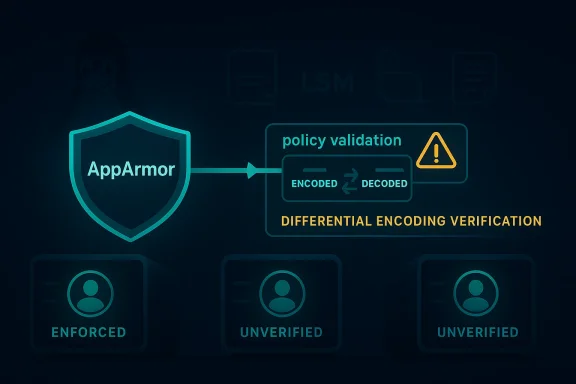
CVE-2026-23409 is the kind of Linux kernel issue that looks deceptively small from the outside but matters because it sits in a trust boundary that very few users think about until something breaks. Microsoft’s Security Update Guide has surfaced the vulnerability as an AppArmor flaw involving differential encoding verification, which immediately places it in the category of policy enforcement bugs rather than a simple crash or cosmetic defect. In practice, that makes this a security story about whether the kernel can correctly validate what it thinks it is loading, comparing, or accepting as policy input. The important part is not the label alone, but the broader fact that AppArmor is one of the Linux security mechanisms that governs how processes are confined and how those confinement rules are interpreted.
AppArmor is a Linux mandatory access control framework that attaches policy to tasks rather than to users in the abstract. The kernel documentation describes it as a task-centered security extension, with profiles loaded from user space and enforced by the kernel when those profiles are active. If AppArmor fails to validate something it is supposed to verify, the consequences are not limited to one malformed request; the failure can affect the integrity of a confinement decision itself. That is why even a narrowly described verification flaw deserves attention from administrators who rely on it for container isolation, desktop hardening, or appliance-style restrictions.
The phrase “differential encoding verification” is important because it suggests the bug is not about ordinary access checking. It implies a comparison or validation step involving encoded data, where the security problem may arise if the kernel accepts a malformed representation, misreads a delta, or fails to confirm that the encoded form actually matches the expected structure. In security code, that is exactly the sort of mistake that can turn a valid-looking input stream into an invalid trust decision. AppArmor is especially sensitive to this kind of issue because its job is to transform policy text and metadata into kernel-enforced rules.
Microsoft’s decision to publish the issue in its update guide is also significant in its own right. The company has spent the last few years widening how it publishes security intelligence, including machine-readable advisory formats, and that has made the Microsoft portal a common intake point for enterprise defenders even when the underlying bug lives in Linux. In mixed estates, that matters: a Linux kernel CVE can be triaged alongside Windows, firmware, and cloud-host advisories, which shortens the distance between disclosure and remediation. That cross-platform visibility is useful, but it can also blur the line between who publishes the alert and who actually ships the fix.
The Linux kernel’s own CVE process adds another layer of context. Kernel maintainers are explicit that CVEs are typically assigned after fixes are available in stable trees, and that many kernel CVEs cover bugs whose exploitability is not immediately obvious. That philosophy explains why a verification defect in AppArmor would still be tracked as a security issue: the kernel community treats many correctness bugs as security-relevant because their real-world impact depends on how the code is used and what else is on the system. In other words, the question is often not whether the bug is “obviously exploitable,” but whether it weakens a control that users depend on to keep a system trustworthy.
Another reason this CVE matters is timing. The current information trail shows that Microsoft’s page exists for the vulnerability, but the broader ecosystem around Linux kernel disclosure changes quickly, and kernel documentation makes clear that downstream relevance depends on whether specific supported branches have absorbed the fix. For operators, that means the advisory is not the end of the story; it is the start of version matching, patch validation, and deployment planning. That is especially true for AppArmor because it tends to be enabled selectively, and many systems that could use it do not actually enforce it at runtime.
The practical use cases are broad. Desktop distributions rely on AppArmor for application confinement, servers use it for service sandboxing, and appliances use it to reduce the blast radius of daemon compromise. In each case, the trust assumption is similar: the kernel should enforce the profile exactly as written and should not accept malformed policy input that can alter the decision-making process. A differential encoding verification flaw can therefore be more serious than it first appears because it attacks the consistency of the policy pipeline itself.
This matters because modern security subsystems often favor compact encodings for performance or storage reasons. That choice is reasonable, but it shifts complexity into the verification path. A system can be fast, compact, and secure, but only if the conversion between formats is boringly correct. The moment the kernel becomes unsure whether an encoded delta is valid, the consequences are not confined to one structure; they can ripple into policy acceptance, policy comparison, or rule activation.
That arrangement has real operational benefits. It normalizes triage, gives security teams a single identifier to track, and can feed automation pipelines that classify risk across operating systems. It also means a Linux CVE is no longer a niche upstream-only event; it is part of a broad enterprise update workflow. The catch is that the advisory channel and the patch channel are not the same thing. Microsoft can spotlight the issue, but actual remediation still depends on kernel maintainers, distribution backporting, and the administrator’s update cadence.
The actual impact will depend on how the flaw is reached. If the differential encoding logic only affects a narrow policy-loading path, then exploitation may require local access, specific administrative behavior, or a carefully constructed profile update. If the bug affects more general verification logic, then the blast radius could be broader. The public description does not give enough detail to overstate the exploitability, and that is a good reason to stay cautious rather than speculative. The most responsible reading is that it is a trust-boundary bug until proven otherwise.
The kernel documentation makes clear that AppArmor exposes interfaces such as current, exec, prev, and related process contexts. Those hooks help explain why correctness matters so much: the system is constantly translating between process activity and security state. A bug in the translation or verification stage can cascade into the wrong security context being associated with the wrong action. That is the sort of defect that rarely looks catastrophic in a single stack trace but can be significant across a fleet.
OEMs and appliance vendors face an even more delicate problem. They often ship kernels that are not identical to upstream LTS branches, and they may preserve local changes for hardware compatibility or certification reasons. That makes verification bugs especially troublesome, because a vendor might believe it has a security baseline while actually carrying an older variant of the affected code. In those scenarios, a clean CVE entry is helpful but not sufficient; the vendor still has to prove the exact backport landed in the image customers run.
There is also the usual risk of patch fragmentation. Some distributions will backport quickly, others will take longer, and OEM images may lag behind both. Administrators may see the CVE in a public portal and assume the fix has arrived everywhere, when in reality the running kernel might still be vulnerable. That is why the operational burden falls on version checking, not just on reading the advisory.
There is also a broader trend to watch. Microsoft’s continuing role as a publication point for Linux CVEs shows that vulnerability management is becoming increasingly platform-agnostic even when the remediation remains platform-specific. That is good for visibility, but it raises the bar for internal process maturity. Security teams need to know not only where to read about a flaw, but how to translate that reading into kernel version checks, backport validation, and policy-specific testing.
Source: MSRC Security Update Guide - Microsoft Security Response Center
 Background
AppArmor is a Linux mandatory access control framework that attaches policy to tasks rather than to users in the abstract. The kernel documentation describes it as a task-centered security extension, with profiles loaded from user space and enforced by the kernel when those profiles are active. If AppArmor fails to validate something it is supposed to verify, the consequences are not limited to one malformed request; the failure can affect the integrity of a confinement decision itself. That is why even a narrowly described verification flaw deserves attention from administrators who rely on it for container isolation, desktop hardening, or appliance-style restrictions.The phrase “differential encoding verification” is important because it suggests the bug is not about ordinary access checking. It implies a comparison or validation step involving encoded data, where the security problem may arise if the kernel accepts a malformed representation, misreads a delta, or fails to confirm that the encoded form actually matches the expected structure. In security code, that is exactly the sort of mistake that can turn a valid-looking input stream into an invalid trust decision. AppArmor is especially sensitive to this kind of issue because its job is to transform policy text and metadata into kernel-enforced rules.
Microsoft’s decision to publish the issue in its update guide is also significant in its own right. The company has spent the last few years widening how it publishes security intelligence, including machine-readable advisory formats, and that has made the Microsoft portal a common intake point for enterprise defenders even when the underlying bug lives in Linux. In mixed estates, that matters: a Linux kernel CVE can be triaged alongside Windows, firmware, and cloud-host advisories, which shortens the distance between disclosure and remediation. That cross-platform visibility is useful, but it can also blur the line between who publishes the alert and who actually ships the fix.
The Linux kernel’s own CVE process adds another layer of context. Kernel maintainers are explicit that CVEs are typically assigned after fixes are available in stable trees, and that many kernel CVEs cover bugs whose exploitability is not immediately obvious. That philosophy explains why a verification defect in AppArmor would still be tracked as a security issue: the kernel community treats many correctness bugs as security-relevant because their real-world impact depends on how the code is used and what else is on the system. In other words, the question is often not whether the bug is “obviously exploitable,” but whether it weakens a control that users depend on to keep a system trustworthy.
Another reason this CVE matters is timing. The current information trail shows that Microsoft’s page exists for the vulnerability, but the broader ecosystem around Linux kernel disclosure changes quickly, and kernel documentation makes clear that downstream relevance depends on whether specific supported branches have absorbed the fix. For operators, that means the advisory is not the end of the story; it is the start of version matching, patch validation, and deployment planning. That is especially true for AppArmor because it tends to be enabled selectively, and many systems that could use it do not actually enforce it at runtime.
What AppArmor Actually Protects
AppArmor is often misunderstood as just another toggle in a Linux hardening checklist, but it is better thought of as a policy engine that shapes what a process can do once the kernel has loaded the appropriate profile. The kernel docs note that tasks without a profile remain effectively unconfined, which means the feature only delivers value when administrators actively deploy and maintain policy. That makes verification bugs especially sensitive: they may not affect every machine, but they can invalidate the assurance model for the machines that do depend on the feature most.The practical use cases are broad. Desktop distributions rely on AppArmor for application confinement, servers use it for service sandboxing, and appliances use it to reduce the blast radius of daemon compromise. In each case, the trust assumption is similar: the kernel should enforce the profile exactly as written and should not accept malformed policy input that can alter the decision-making process. A differential encoding verification flaw can therefore be more serious than it first appears because it attacks the consistency of the policy pipeline itself.
Why verification bugs are different
Verification bugs are not the same as ordinary parsing errors. A parse bug may reject something it should accept or accept something it should reject, but a verification flaw can sometimes allow an input that looks valid to pass through multiple layers before the kernel discovers it no longer matches the original expectation. That is dangerous in any security subsystem, and especially so in one that is supposed to make privilege decisions based on trusted state. AppArmor’s value depends on the kernel’s ability to distinguish between legitimate policy and manipulated policy data.- AppArmor depends on accurate policy loading.
- Policy enforcement only works if validation is reliable.
- A small verification bug can undermine a much larger trust boundary.
- Confined applications are only as safe as the policy they inherit.
- Mis-verified encoded data can create silent enforcement gaps.
Interpreting the “Differential Encoding” Part
The term “differential encoding” strongly suggests that the kernel is not simply comparing raw values, but rather reconstructing or validating data that has been stored in a compressed or delta-based form. In security engineering, any time one representation must be transformed back into another before being checked, there is a risk that the transformation itself becomes the weak point. If the encoded form can be manipulated to produce a misleading decoded state, the verification step may approve something the kernel should have rejected. That is the class of failure implied by this CVE.This matters because modern security subsystems often favor compact encodings for performance or storage reasons. That choice is reasonable, but it shifts complexity into the verification path. A system can be fast, compact, and secure, but only if the conversion between formats is boringly correct. The moment the kernel becomes unsure whether an encoded delta is valid, the consequences are not confined to one structure; they can ripple into policy acceptance, policy comparison, or rule activation.
What could go wrong in practice
One risk is that malformed encoded input might not be rejected consistently. Another is that the reconstructed value could differ subtly from the intended one, creating a logic gap between what the administrator believes was loaded and what the kernel actually enforces. A third possibility is that the bug only appears under specific update, reload, or namespace conditions, which would make it harder to detect in ordinary testing. That last point is especially relevant in AppArmor environments, where profiles may be stacked, reloaded, or deployed through orchestration systems rather than hand-edited on a single machine.- Validation paths are often more fragile than steady-state enforcement.
- Encoded data creates extra opportunities for mismatch.
- Reconstructed state can diverge from intended state.
- Reload and update flows are common places for hidden bugs.
- Silent acceptance is often worse than an obvious rejection.
Why Microsoft’s Advisory Matters for Linux Users
It can seem odd at first that Microsoft is the source many administrators will check for a Linux kernel AppArmor issue, but that reflects how modern vulnerability management actually works. Microsoft’s Security Update Guide has become a central aggregation point for CVE tracking, including vulnerabilities in open-source components used across ecosystems. For organizations with heterogeneous fleets, that means one security team may rely on Microsoft’s publication layer even while the underlying remediation comes from Linux distributors.That arrangement has real operational benefits. It normalizes triage, gives security teams a single identifier to track, and can feed automation pipelines that classify risk across operating systems. It also means a Linux CVE is no longer a niche upstream-only event; it is part of a broad enterprise update workflow. The catch is that the advisory channel and the patch channel are not the same thing. Microsoft can spotlight the issue, but actual remediation still depends on kernel maintainers, distribution backporting, and the administrator’s update cadence.
Enterprise workflow implications
For enterprise teams, this kind of advisory is useful because it compresses decision-making. Security operations can map the CVE to Linux hosts, container nodes, or appliance images, then ask which products actually ship AppArmor and which kernel builds include the fix. That is a better workflow than waiting for every vendor to publish its own summary from scratch. But it also requires discipline: an advisory’s existence does not automatically mean the running kernel is safe. Version verification still matters, and it matters a lot.- Microsoft advisories can centralize intake.
- Linux fixes still come from Linux maintainers and distributors.
- Mixed fleets benefit from normalized CVE identifiers.
- Patch validation remains version-specific.
- Security teams should not assume a published CVE equals protection.
The Technical Risk Profile
At a high level, a verification bug in AppArmor is a policy integrity problem. That does not automatically mean remote code execution or a dramatic privilege escalation, but it does mean the kernel may enforce a weaker or incorrect policy boundary than the administrator intended. In security terms, that can be just as important as a more theatrical memory corruption bug, because it undermines the mechanism that stands between a confined process and the broader system.The actual impact will depend on how the flaw is reached. If the differential encoding logic only affects a narrow policy-loading path, then exploitation may require local access, specific administrative behavior, or a carefully constructed profile update. If the bug affects more general verification logic, then the blast radius could be broader. The public description does not give enough detail to overstate the exploitability, and that is a good reason to stay cautious rather than speculative. The most responsible reading is that it is a trust-boundary bug until proven otherwise.
Likely classes of impact
The first class is policy bypass or policy weakening, where a malformed encoded element slips through validation and changes what the kernel accepts. The second is policy instability, where repeated loads or updates behave inconsistently and cause operational headaches. The third is diagnostic confusion, where administrators think AppArmor is protecting a workload when the policy state is not what they expect. Even if the bug never becomes a public exploit, those outcomes can still be serious in an enterprise environment.- Possible policy bypass if verification is too permissive.
- Possible inconsistency between intended and loaded policy.
- Possible confusion during reload or update cycles.
- Possible weakening of confinement guarantees.
- Possible exposure in systems that rely on AppArmor for hard isolation.
AppArmor in the Broader Linux Security Stack
AppArmor sits inside the Linux Security Modules framework, alongside SELinux, Smack, and other enforcement mechanisms. That matters because bugs in one module do not necessarily affect the others, but they do shape how defenders think about Linux hardening as a whole. If one policy engine has a verification flaw, organizations that depend on it may need to revisit assumptions about whether the module is being used as a primary control or merely as a compensating layer.The kernel documentation makes clear that AppArmor exposes interfaces such as current, exec, prev, and related process contexts. Those hooks help explain why correctness matters so much: the system is constantly translating between process activity and security state. A bug in the translation or verification stage can cascade into the wrong security context being associated with the wrong action. That is the sort of defect that rarely looks catastrophic in a single stack trace but can be significant across a fleet.
Why this matters beyond desktops
AppArmor is often discussed in the context of Ubuntu desktops, but it shows up in servers, containers, and embedded systems too. In those environments, the security boundary may be smaller but the operational tolerance for error is even lower. A flawed policy verification path can jeopardize appliance integrity, reduce the confidence of container isolation, or complicate incident response when the system cannot reliably report what it believes is enforced. That makes the issue relevant far beyond consumer Linux installations.- AppArmor is part of the kernel’s broader LSM architecture.
- Verification bugs affect how security contexts are trusted.
- Servers and appliances may care more than desktops.
- Confined workloads depend on correct policy translation.
- Misreporting security state can hinder incident response.
Implications for Linux Distributors and OEMs
For downstream distributors, the immediate task is straightforward in principle and messy in practice: determine which maintained kernel branches include the fix and where AppArmor is actually enabled in shipped configurations. That sounds simple, but kernel backporting is never just copy-and-paste. Patch context, release cadence, and distribution-specific changes can alter the timing and even the shape of the final fix. Linux maintainers have long emphasized that stable trees are the bridge between upstream discovery and production protection.OEMs and appliance vendors face an even more delicate problem. They often ship kernels that are not identical to upstream LTS branches, and they may preserve local changes for hardware compatibility or certification reasons. That makes verification bugs especially troublesome, because a vendor might believe it has a security baseline while actually carrying an older variant of the affected code. In those scenarios, a clean CVE entry is helpful but not sufficient; the vendor still has to prove the exact backport landed in the image customers run.
What good remediation looks like
Good remediation here means more than “patch the package.” It means checking whether the kernel is configured with AppArmor, confirming which policy-loading paths are in use, and validating that the vendor build includes the corrected verification logic. In enterprise fleets, the right response is usually a combination of patch intake, config inventory, and targeted functional testing. A security advisory is not a substitute for asset knowledge.- Identify which kernels actually ship AppArmor.
- Confirm whether the vendor backport includes the fix.
- Test policy loading and enforcement behavior after patching.
- Re-check appliance and embedded images, not just servers.
- Treat version drift as a real risk, not an administrative detail.
Strengths and Opportunities
The encouraging part of this story is that the Linux ecosystem has matured into a place where even subtle policy bugs are likely to be named, tracked, and routed through the right channels. That gives defenders a better chance to respond quickly and gives maintainers a chance to fix the problem once, correctly, instead of leaving it to drift. It also reinforces the value of layered disclosure across communities, including Microsoft’s role in surfacing the issue to enterprise audiences.- The issue is visible through a mainstream CVE channel.
- AppArmor users can map the problem to a specific trust boundary.
- Linux maintainers have a strong precedent for stable backporting.
- Enterprises can fold the fix into standard kernel update workflows.
- Cross-platform advisories make triage easier in mixed fleets.
- Security teams get a clear reason to audit AppArmor deployment.
- The case reinforces better testing of verification paths.
Risks and Concerns
The biggest concern is underestimation. Because the issue is described as a verification flaw rather than a memory corruption bug, some teams may assume it is merely a correctness problem. That would be a mistake, because policy verification is the mechanism that determines whether confinement holds up under pressure. If validation is wrong, the resulting exposure may be subtle, persistent, and hard to detect.There is also the usual risk of patch fragmentation. Some distributions will backport quickly, others will take longer, and OEM images may lag behind both. Administrators may see the CVE in a public portal and assume the fix has arrived everywhere, when in reality the running kernel might still be vulnerable. That is why the operational burden falls on version checking, not just on reading the advisory.
- The bug may be misread as low severity because it is abstract.
- Different vendors may backport at different speeds.
- Policy verification defects can be hard to observe in production.
- Users may not realize they rely on AppArmor at all.
- Mixed fleets make exposure mapping more difficult.
- Stale kernels can remain in service longer than expected.
- Security teams may overtrust the presence of a CVE entry.
Looking Ahead
The next question is not whether the CVE exists — it does — but how quickly downstream systems absorb the fix and how clearly vendors explain their exposure. For organizations that depend on AppArmor, the immediate work is to inventory kernels, confirm whether the feature is enabled, and identify which products actually load policy through the affected path. If the fix lands broadly, the practical risk should narrow, but only for systems that are actively updated.There is also a broader trend to watch. Microsoft’s continuing role as a publication point for Linux CVEs shows that vulnerability management is becoming increasingly platform-agnostic even when the remediation remains platform-specific. That is good for visibility, but it raises the bar for internal process maturity. Security teams need to know not only where to read about a flaw, but how to translate that reading into kernel version checks, backport validation, and policy-specific testing.
What to watch next
- Distributor advisories that specify the exact fixed kernel builds.
- Whether long-term support branches receive the patch quickly.
- Confirmation of which AppArmor deployment patterns are affected.
- Any clarification about the practical impact of the encoding flaw.
- Evidence that enterprise scanners and patch tools map the CVE correctly.
Source: MSRC Security Update Guide - Microsoft Security Response Center
