
Microsoft’s CVE-2026-32070 shines a fresh spotlight on one of Windows’ most security-sensitive kernel components: the Common Log File System (CLFS) driver. The vulnerability is classified as an elevation of privilege issue, which means a successful exploit could let a local attacker move from limited access to higher system rights. Even before detailed exploit mechanics are public, the label alone is enough to raise concern because CLFS has a long history of attracting sophisticated abuse and repeated hardening efforts. Microsoft’s own CLFS mitigation guidance, updated in February 2026, shows the company is still actively reinforcing the driver’s trust model. (support.microsoft.com)
What makes this disclosure especially notable is not just the CVE itself, but the broader pattern behind it. Microsoft has repeatedly had to patch CLFS elevation-of-privilege flaws over the years, and the company now ships an authentication mitigation that adds HMAC-based integrity checks to CLFS log files. That is a strong signal that Microsoft views the attack surface as both real and persistent. In other words, CVE-2026-32070 is not an isolated oddity; it sits inside an ongoing defensive redesign of a kernel subsystem that attackers have historically found valuable.
CLFS is a foundational Windows component used for transactional and diagnostic logging. It is not a consumer-facing feature in the usual sense, but it sits deep in the operating system’s plumbing, where reliability and integrity matter far more than convenience. Because it parses structured files in kernel mode, a bug in CLFS is especially consequential: malformed input can become a privilege boundary problem, and privilege boundary problems are the sort of issues attackers love to chain into full system compromise. Microsoft’s historical advisories describe CLFS vulnerabilities as cases where the driver improperly handles objects in memory.
The interesting part is how consistent that pattern has been. Microsoft issued CLFS-related elevation-of-privilege fixes in multiple years, including updates documented in 2016, 2017, 2018, and 2025. Those records show that CLFS is not merely theoretically risky; it has been repeatedly weaponized or at least treated as a realistic local escalation vector. That history matters because attackers tend to revisit subsystems that are both reachable and rewarding: local privilege escalation vulnerabilities are often used after an initial foothold to turn a modest intrusion into domain-wide damage.
Microsoft’s February 2026 CLFS authentication mitigation adds another layer to this story. The company now places an authentication code on CLFS logfiles and uses a system-unique cryptographic key to validate file integrity before parsing internal structures. If the integrity check fails, CLFS refuses to open the logfile. That is a significant architectural response, because it acknowledges that merely validating memory handling after parsing is not enough; the file itself must be trusted before the driver looks inside it. (support.microsoft.com)
This is also a useful reminder of how vulnerability metadata should be read. A CVE entry can signal that a weakness exists, but the confidence level and technical detail can vary. Microsoft’s own public language for prior CLFS bugs often says the driver “improperly handles objects in memory,” which is accurate but broad. That broadness is common in Microsoft advisories for kernel bugs, especially early in the disclosure lifecycle, when the vendor wants to communicate urgency without overexposing exploit mechanics.
Another reason is operational durability. CLFS supports internal Windows functionality that cannot easily be removed or radically simplified without breaking compatibility. Microsoft can harden it, but it cannot treat the component as disposable. The result is a long-term security maintenance problem: the attack surface is not going away, so the only viable strategy is continuous repair, authentication, and defensive depth.
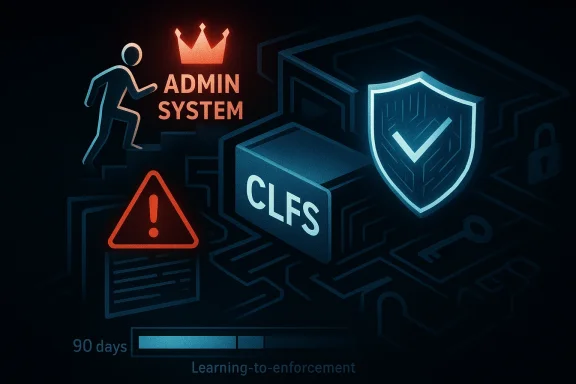
The mitigation is also designed with a transition period. Microsoft documents a 90-day learning mode before enforcement, during which CLFS automatically adds authentication codes to logfiles that do not yet have them. After that period, the driver transitions into enforcement mode and expects valid authentication codes for logfile access. This staged deployment is practical, but it also shows the operational burden of tightening a kernel subsystem that many products and system paths may already depend on. (support.microsoft.com)
There is also a subtle but important message for defenders. Microsoft’s mitigation makes logfiles system-unique and less portable, which is a tradeoff between security and convenience. It is the sort of change that enterprises feel immediately, because it affects logon, shutdown, and file-sharing workflows. That kind of tradeoff is often the price of reducing kernel attack surface: the safer path tends to be the less frictionless one. (support.microsoft.com)
Microsoft’s own earlier CLFS guidance makes the exploitation model clear: a local attacker typically needs to log on and run a specially crafted application. That is a classic pattern for Windows privilege escalation, and it explains why endpoint security, application control, and least privilege remain so important. Even a vulnerability that is not remotely exploitable can be devastating once an attacker has achieved initial access through phishing, stolen credentials, or another software flaw.
The other reason these bugs matter is reliability. Attackers prefer vulnerabilities that can be triggered consistently across many systems, and CLFS has historically been stable enough to remain a recurring target. When a subsystem keeps appearing in advisories, it signals a combination of reach, complexity, and exploitability that makes it worth sustained offensive attention.
What changes over time is not the broad vulnerability class, but the defensive posture. Early advisories centered on memory handling. The 2026 mitigation introduces explicit file authentication, which shows a deeper assumption: the driver cannot safely trust the logfile unless cryptographic verification says so. That is a stronger security model, and it reflects the reality that pure validation-by-parsing has not been enough to keep CLFS safe. (support.microsoft.com)
It is also a warning to defenders. If you manage Windows endpoints, assuming that one historical patch “fixed CLFS” is a mistake. The subsystem keeps changing, and attackers keep finding value in it. Security teams should read the history as a pattern of ongoing exposure, not a closed chapter.
For enterprises, the impact is broader and more complicated. CLFS appears in system workflows that matter to endpoint fleet health, including login and shutdown behavior, and the new authentication mitigation can increase disk I/O during logfile open operations. Microsoft explicitly notes that logon and system shutdown may incur additional reads because the entire logfile must be validated before parsing. That means administrators need to think about performance, compatibility, and security together rather than treating the patch as a pure checkbox. (support.microsoft.com)
This is one of those cases where enterprise and consumer realities diverge sharply. Home users mostly care about “did Windows update and reboot cleanly?” Enterprises care about whether a mitigation affects sign-in latency, shutdown times, offline servicing, and software that depends on CLFS-backed structures. The security gain may be worth it, but the deployment story is always more nuanced in large environments.
That said, certainty about existence is not the same thing as certainty about exploitation quality. A vulnerability can be real, confirmed, and still have incomplete public details about reachability, exploit reliability, or weaponization. That matters for defenders because response planning should reflect the fact that the weakest point in a chain may not yet be public, but the need to patch can still be urgent.
The safest reading is also the simplest: confirmed kernel elevation bugs deserve prompt attention because they can be chained, and chaining is where serious intrusions often happen. The public metadata may be sparse now, but sparse metadata does not equal low risk.
The wider ecosystem also feels the effects when Microsoft makes a subsystem harder to abuse. A mitigation like CLFS authentication changes the assumptions attackers can make, which in turn influences exploit development economics. If file tampering becomes harder to leverage into privilege escalation, attackers may shift toward other drivers or kernel surfaces that still offer weaker integrity checks. Security hardening often displaces adversary effort rather than eliminating it outright. (support.microsoft.com)
For Microsoft, the strategic move is clear: reduce trust in mutable on-disk structures, add integrity validation earlier, and document the performance tradeoffs openly. That is a credible path forward, even if it is not glamorous. Security often advances through boring, cumulative hardening, not dramatic single-step fixes.
Administrators should also watch for guidance on compatibility and performance. Microsoft has already documented additional I/O, system-unique logfile behavior, and a learning-to-enforcement transition for CLFS authentication. If CVE-2026-32070 is related to the same trust assumptions, more operational guidance may follow. Enterprises will want to know whether the patch has any side effects on imaging, recovery, or logging-heavy workloads. (support.microsoft.com)
Source: MSRC Security Update Guide - Microsoft Security Response Center
What makes this disclosure especially notable is not just the CVE itself, but the broader pattern behind it. Microsoft has repeatedly had to patch CLFS elevation-of-privilege flaws over the years, and the company now ships an authentication mitigation that adds HMAC-based integrity checks to CLFS log files. That is a strong signal that Microsoft views the attack surface as both real and persistent. In other words, CVE-2026-32070 is not an isolated oddity; it sits inside an ongoing defensive redesign of a kernel subsystem that attackers have historically found valuable.
 Background
CLFS is a foundational Windows component used for transactional and diagnostic logging. It is not a consumer-facing feature in the usual sense, but it sits deep in the operating system’s plumbing, where reliability and integrity matter far more than convenience. Because it parses structured files in kernel mode, a bug in CLFS is especially consequential: malformed input can become a privilege boundary problem, and privilege boundary problems are the sort of issues attackers love to chain into full system compromise. Microsoft’s historical advisories describe CLFS vulnerabilities as cases where the driver improperly handles objects in memory.The interesting part is how consistent that pattern has been. Microsoft issued CLFS-related elevation-of-privilege fixes in multiple years, including updates documented in 2016, 2017, 2018, and 2025. Those records show that CLFS is not merely theoretically risky; it has been repeatedly weaponized or at least treated as a realistic local escalation vector. That history matters because attackers tend to revisit subsystems that are both reachable and rewarding: local privilege escalation vulnerabilities are often used after an initial foothold to turn a modest intrusion into domain-wide damage.
Microsoft’s February 2026 CLFS authentication mitigation adds another layer to this story. The company now places an authentication code on CLFS logfiles and uses a system-unique cryptographic key to validate file integrity before parsing internal structures. If the integrity check fails, CLFS refuses to open the logfile. That is a significant architectural response, because it acknowledges that merely validating memory handling after parsing is not enough; the file itself must be trusted before the driver looks inside it. (support.microsoft.com)
This is also a useful reminder of how vulnerability metadata should be read. A CVE entry can signal that a weakness exists, but the confidence level and technical detail can vary. Microsoft’s own public language for prior CLFS bugs often says the driver “improperly handles objects in memory,” which is accurate but broad. That broadness is common in Microsoft advisories for kernel bugs, especially early in the disclosure lifecycle, when the vendor wants to communicate urgency without overexposing exploit mechanics.
Why CLFS keeps showing up
The likely reason CLFS remains a recurring target is simple: it is a privileged parser. Any privileged parser that accepts structured input can become a gadget for attackers who know how to shape that input into an unsafe state. Kernel components amplify the risk because even a narrowly scoped memory corruption can become a full machine takeover if exploited successfully. That is why local privilege escalation bugs are so prized in real-world intrusion chains.Another reason is operational durability. CLFS supports internal Windows functionality that cannot easily be removed or radically simplified without breaking compatibility. Microsoft can harden it, but it cannot treat the component as disposable. The result is a long-term security maintenance problem: the attack surface is not going away, so the only viable strategy is continuous repair, authentication, and defensive depth.
- Kernel parsers are high-value targets
- Local privilege escalation is often a post-compromise step
- Compatibility constraints make CLFS hard to redesign
- Repeated fixes suggest a durable attack surface
What Microsoft’s mitigation tells us
The CLFS authentication mitigation is more revealing than it may first appear. Microsoft adds a hash-based message authentication code to CLFS logfiles and stores the cryptographic key in a registry location accessible only to Administrators and SYSTEM. In practice, this means the driver is no longer relying solely on structural parsing correctness; it is also requiring cryptographic proof that the file has not been tampered with. That is a meaningful hardening step and a sign that Microsoft expects file tampering to be a realistic precondition for exploitation. (support.microsoft.com)The mitigation is also designed with a transition period. Microsoft documents a 90-day learning mode before enforcement, during which CLFS automatically adds authentication codes to logfiles that do not yet have them. After that period, the driver transitions into enforcement mode and expects valid authentication codes for logfile access. This staged deployment is practical, but it also shows the operational burden of tightening a kernel subsystem that many products and system paths may already depend on. (support.microsoft.com)
Why this matters for CVE-2026-32070
If Microsoft is already hardening the file format around CLFS, that suggests the company sees real-world risk in the component’s trust chain. CVE-2026-32070 may or may not be directly related to the new mitigation, but the overlap is important: the same subsystem is being patched, authenticated, and constrained because it has repeatedly proven brittle under hostile inputs. That does not prove the exact root cause of the CVE, but it does tell us where Microsoft is focusing its defensive energy. (support.microsoft.com)There is also a subtle but important message for defenders. Microsoft’s mitigation makes logfiles system-unique and less portable, which is a tradeoff between security and convenience. It is the sort of change that enterprises feel immediately, because it affects logon, shutdown, and file-sharing workflows. That kind of tradeoff is often the price of reducing kernel attack surface: the safer path tends to be the less frictionless one. (support.microsoft.com)
- HMAC authentication increases file integrity confidence
- A 90-day learning mode smooths deployment
- System-unique keys reduce portability
- Security gains come with real operational costs
Why local elevation bugs remain such a problem
Elevation-of-privilege vulnerabilities are often underappreciated by casual users because they do not sound as dramatic as remote code execution. In reality, local privilege escalation is one of the most valuable categories for attackers already inside a system. Once they have any foothold, they can use a kernel or driver bug to gain SYSTEM privileges, disable security tools, dump credentials, and move laterally. That is why CVE-2026-32070 should be read as a serious enterprise risk, not just a technical footnote.Microsoft’s own earlier CLFS guidance makes the exploitation model clear: a local attacker typically needs to log on and run a specially crafted application. That is a classic pattern for Windows privilege escalation, and it explains why endpoint security, application control, and least privilege remain so important. Even a vulnerability that is not remotely exploitable can be devastating once an attacker has achieved initial access through phishing, stolen credentials, or another software flaw.
The attacker’s perspective
From the attacker’s point of view, a CLFS bug is especially attractive because kernel exploitation can unlock the rest of the system. A single successful local escalation can be enough to bypass user-mode protections and access protected assets. In practical terms, that means CLFS bugs are often excellent “second-stage” exploits in targeted intrusion campaigns, especially against high-value enterprise endpoints.The other reason these bugs matter is reliability. Attackers prefer vulnerabilities that can be triggered consistently across many systems, and CLFS has historically been stable enough to remain a recurring target. When a subsystem keeps appearing in advisories, it signals a combination of reach, complexity, and exploitability that makes it worth sustained offensive attention.
- Initial foothold is often enough
- Kernel escalation turns user compromise into full compromise
- Repeated patches indicate attacker interest
- Enterprise endpoints are the most likely target
Historical pattern: CLFS has been here before
Microsoft’s record shows a long-running sequence of CLFS security updates. In 2016, Microsoft documented multiple CLFS elevation-of-privilege vulnerabilities. In 2017 and 2018, additional CLFS issues were again patched. Then in 2025, Microsoft’s monthly security update notes listed multiple CLFS elevation-of-privilege CVEs, including CVE-2025-32706 and CVE-2025-32701. That is the kind of timeline that tells a very specific story: CLFS is a recurring engineering and security pressure point, not a one-off bug farm.What changes over time is not the broad vulnerability class, but the defensive posture. Early advisories centered on memory handling. The 2026 mitigation introduces explicit file authentication, which shows a deeper assumption: the driver cannot safely trust the logfile unless cryptographic verification says so. That is a stronger security model, and it reflects the reality that pure validation-by-parsing has not been enough to keep CLFS safe. (support.microsoft.com)
The significance of repeated patching
Repeated patching is not merely evidence of vendor diligence; it is evidence of subsystem complexity. Kernel file handlers and log parsers tend to be rich with edge cases, and edge cases are where security bugs breed. The repetition itself is telling because Microsoft does not typically invest this kind of mitigation machinery unless the risk is persistent and operationally relevant.It is also a warning to defenders. If you manage Windows endpoints, assuming that one historical patch “fixed CLFS” is a mistake. The subsystem keeps changing, and attackers keep finding value in it. Security teams should read the history as a pattern of ongoing exposure, not a closed chapter.
- 2016, 2017, 2018, and 2025 all included CLFS fixes
- Recurring bugs usually mean recurring attack value
- Hardening evolved from patching memory bugs to authenticating files
- Defenders should treat CLFS as an ongoing risk surface
Enterprise impact versus consumer impact
For consumers, the immediate takeaway is straightforward: this is a Windows security issue that should be patched as soon as Microsoft releases updates for the affected platforms. Most home users will never see CLFS directly, and that is part of the problem. Security components that live below the surface are easy to ignore until an attacker has already taken advantage of them. The practical consumer lesson is still the oldest one in Windows security: keep updates current and do not run untrusted software with unnecessary privileges.For enterprises, the impact is broader and more complicated. CLFS appears in system workflows that matter to endpoint fleet health, including login and shutdown behavior, and the new authentication mitigation can increase disk I/O during logfile open operations. Microsoft explicitly notes that logon and system shutdown may incur additional reads because the entire logfile must be validated before parsing. That means administrators need to think about performance, compatibility, and security together rather than treating the patch as a pure checkbox. (support.microsoft.com)
Operational tradeoffs for IT teams
The mitigation’s system-unique key also changes the calculus for imaging, cloning, and file portability. Logfiles created on one system are not meant to be casually opened on another without re-authentication, which can complicate some administrative workflows. Microsoft providesfsutil clfs authenticate for administrators, but that is still extra overhead for teams managing many machines or handling recovery scenarios. (support.microsoft.com)This is one of those cases where enterprise and consumer realities diverge sharply. Home users mostly care about “did Windows update and reboot cleanly?” Enterprises care about whether a mitigation affects sign-in latency, shutdown times, offline servicing, and software that depends on CLFS-backed structures. The security gain may be worth it, but the deployment story is always more nuanced in large environments.
- Consumers need prompt patching
- Enterprises need rollout planning
- Logon and shutdown performance can be affected
- File portability becomes more restricted
- Administrative recovery workflows may need updating
The confidence question behind the CVE
The text that describes the confidence metric around CVE-2026-32070 matters because it explains how to interpret the disclosure itself. The metric is really about how certain the public can be that the vulnerability exists and how much technical detail is known. A confirmed vendor acknowledgment typically implies more confidence than a mere rumor or researcher hypothesis. In this case, the Microsoft Security Response Center entry indicates that the issue is real enough to merit a tracked CVE, which is a meaningful signal even if exploit details remain limited.That said, certainty about existence is not the same thing as certainty about exploitation quality. A vulnerability can be real, confirmed, and still have incomplete public details about reachability, exploit reliability, or weaponization. That matters for defenders because response planning should reflect the fact that the weakest point in a chain may not yet be public, but the need to patch can still be urgent.
How defenders should read limited detail
When Microsoft discloses a CLFS elevation-of-privilege vulnerability, the prudent assumption is that the driver’s trust boundary has been compromised in some way. Even without a published proof-of-concept or exploit write-up, the historical pattern suggests the issue is worth prioritizing. Security teams should not wait for exploit code to appear before treating the CVE as operationally important.The safest reading is also the simplest: confirmed kernel elevation bugs deserve prompt attention because they can be chained, and chaining is where serious intrusions often happen. The public metadata may be sparse now, but sparse metadata does not equal low risk.
- CVE presence signals a real tracked issue
- Public detail may lag behind internal knowledge
- Lack of exploit code does not equal lack of risk
- Kernel escalation bugs should be prioritized quickly
Competitive and ecosystem implications
CLFS is not a market product in the usual sense, but its security posture still matters to the broader Windows ecosystem. Every recurring kernel bug reinforces the incentive for Microsoft to invest in deeper platform hardening, more machine-readable vulnerability disclosure, and tighter security-by-default behavior. That has implications for endpoint security vendors, managed service providers, and enterprise customers who build policies around Windows trust boundaries.The wider ecosystem also feels the effects when Microsoft makes a subsystem harder to abuse. A mitigation like CLFS authentication changes the assumptions attackers can make, which in turn influences exploit development economics. If file tampering becomes harder to leverage into privilege escalation, attackers may shift toward other drivers or kernel surfaces that still offer weaker integrity checks. Security hardening often displaces adversary effort rather than eliminating it outright. (support.microsoft.com)
What this means for security vendors
For security vendors, repeated CLFS issues are a reminder that kernel telemetry and exploit detection remain crucial. If an attacker can use a local privilege escalation bug to turn a standard user session into SYSTEM, user-mode defenses alone may be too late. Behavioral detection, exploit mitigation, and rapid patch orchestration all become part of the answer.For Microsoft, the strategic move is clear: reduce trust in mutable on-disk structures, add integrity validation earlier, and document the performance tradeoffs openly. That is a credible path forward, even if it is not glamorous. Security often advances through boring, cumulative hardening, not dramatic single-step fixes.
- Platform hardening changes attacker economics
- Kernel telemetry remains essential
- Exploit paths may shift to other drivers
- Security-by-default becomes more valuable over time
Strengths and Opportunities
Microsoft’s approach to CLFS shows several strengths. First, the company is not pretending the problem is hypothetical; it is adding concrete cryptographic validation to the subsystem. Second, the staged rollout suggests an attempt to balance security with operational continuity. Third, the company is documenting the tradeoffs clearly enough for administrators to understand what changes when the mitigation is enabled.Key strengths
- Cryptographic integrity checks improve trust
- Learning mode reduces deployment shock
- Administrative tooling exists for recovery
- The mitigation is explicit rather than vague
- Microsoft is addressing file-level tampering, not just symptoms
- Long-term hardening can shrink exploit opportunities
- Transparent documentation helps enterprises plan
Risks and Concerns
The obvious risk is that CLFS remains a privileged parsing surface in the Windows kernel, which means any future flaw can have outsized consequences. A second concern is rollout complexity: hardening that affects logon, shutdown, and log file portability can create operational friction, especially in large fleets. A third issue is that attackers often adapt quickly when one route gets harder, so closing one CLFS path may simply shift interest to adjacent components.Key risks
- Local privilege escalation is highly valuable to attackers
- Kernel bugs can become full system compromises
- Operational friction may slow enterprise adoption
- Performance changes can surprise administrators
- Attackers may pivot to adjacent kernel surfaces
- Older systems may be harder to secure consistently
- Incomplete public detail can create a false sense of safety
Looking Ahead
The most important thing to watch is how Microsoft classifies and remediates CVE-2026-32070 once the update lands in the main patch stream. If the fix is paired with additional CLFS hardening, it will strengthen the case that Microsoft is systematically redesigning the subsystem’s trust model. If the issue remains limited to a narrower patch, it may still indicate a broader concern inside the driver that is being addressed incrementally.Administrators should also watch for guidance on compatibility and performance. Microsoft has already documented additional I/O, system-unique logfile behavior, and a learning-to-enforcement transition for CLFS authentication. If CVE-2026-32070 is related to the same trust assumptions, more operational guidance may follow. Enterprises will want to know whether the patch has any side effects on imaging, recovery, or logging-heavy workloads. (support.microsoft.com)
What to monitor next
- Patch notes for CVE-2026-32070
- Any exploitability updates from Microsoft
- Changes to CLFS authentication behavior
- Enterprise performance feedback after rollout
- Whether adjacent kernel components receive similar hardening
Source: MSRC Security Update Guide - Microsoft Security Response Center
Last edited:
