

CVE-2026-3219, published April 20, 2026, documents a medium-severity flaw in Python’s pip package installer in which concatenated ZIP and tar archives could be interpreted as ZIP files even when the filename or archive contents suggested otherwise. The bug is not a Windows vulnerability in the classic sense, but it matters enormously on Windows machines that build, test, package, or deploy Python software. Its lesson is simple: in a modern supply chain, file parsing behavior is security policy. A tool that guesses wrong about an archive may not be executing exploit code itself, but it can still become the hand that installs the wrong thing.
The headline sounds almost quaint: pip didn’t reject a file that was both a ZIP archive and a tar archive. That is the sort of bug description that can make even seasoned administrators reach for the coffee and ask whether this is really worth interrupting a patch queue. It is, because pip is not a niche utility tucked away on developer laptops anymore; it is part of the plumbing behind CI systems, automation scripts, container builds, AI notebooks, Windows developer workstations, and production deployment pipelines.
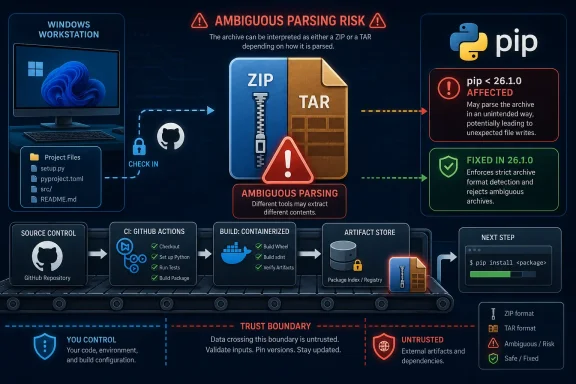
The vulnerability affects pip versions before 26.1.0, with the fixed behavior arriving in pip 26.1.0. The issue was assigned CVE-2026-3219 and described as a case where pip handled concatenated tar and ZIP files as ZIP files regardless of filename or whether a file identified as both formats. In practical terms, pip could be given an archive whose name or apparent type suggested one thing while the installer acted on another.
That distinction matters because Python packaging is already a trust negotiation. When a developer runs
The good news is that this is not a wormable remote-code-execution panic in the Patch Tuesday tradition. The bad news is that it belongs to a class of bugs that attackers love precisely because they sit between human expectation and machine behavior. The exploit story is not “pip instantly owns your box.” It is “pip may install a different payload than the operator, scanner, or filename led you to believe.”
CVE-2026-3219 is rooted in an interpretation conflict. A specially formed file can satisfy more than one parser’s idea of what kind of archive it is. In pip’s vulnerable behavior, a concatenated tar-and-ZIP file could be treated as ZIP, even if the surrounding cues suggested tar. That means the file extension, the actual bytes, and the installer’s chosen extraction path could diverge.
Security engineers have a name for this general family of trouble: parser differential. One component sees one object, another sees a different object, and the attacker positions malicious intent in the gap. Email gateways, antivirus engines, archive extractors, web servers, and package managers have all had variations of this problem because complex formats invite multiple plausible interpretations.
The fix in pip is deliberately conservative: proceed only when an archive identifies uniquely as ZIP or tar, not both. That is the right instinct. In security-sensitive installation flows, ambiguity should not be resolved by preference order, historical convenience, or “the parser that happens to accept it first.” Ambiguity should be treated as a failure condition.
This is the same logic administrators apply elsewhere. A script with a mismatched signature should not run because it “looks mostly right.” A certificate with a broken chain should not be trusted because the hostname seems familiar. A package archive that can be read as two different things should not get the benefit of the doubt merely because one parser is willing to unpack it.
The Windows risk is often indirect. A compromised or confusing package installation may happen on a developer’s Windows workstation, but the resulting artifact can travel into a container image, a serverless function, a desktop application, or an internal tool. In that sense, the endpoint where pip runs is less important than the trust boundary it crosses.
Windows also has its own long-running tension around file identity. Mark-of-the-Web, file extensions, SmartScreen reputation, alternate data streams, installer prompts, and archive extraction behavior all exist because users and tools routinely infer trust from names and containers. A package manager that ignores an expected archive identity is not identical to a Windows shell trust bypass, but the mental model is familiar: what the user sees is not necessarily what the system processes.
The most exposed Windows environments are not casual Python users installing
There is also the unpleasant reality of developer tooling sprawl. Many organizations inventory Windows patches more carefully than they inventory pip versions. A fully patched Windows 11 workstation can still contain old Python interpreters, stale virtual environments, orphaned build agents, and project-local packaging tools that never appear in normal endpoint vulnerability dashboards.
CVSS is good at describing a vulnerability in isolation. Package management vulnerabilities rarely live in isolation. They sit inside pipelines where a small integrity failure can become a distribution problem, and where “user interaction required” may mean nothing more dramatic than a developer running a normal install command on a file they believe they understand.
The phrase “installing incorrect files” sounds almost bureaucratic, but it is doing a lot of work. Incorrect files can be benign in a reproducibility sense, or they can be a vehicle for malicious setup code, dependency confusion, or poisoned build output. Python’s packaging ecosystem has spent years wrestling with the fact that installation is not merely file copying; builds can execute code, dependencies can resolve dynamically, and environments often contain secrets.
The CVE does not, by itself, prove a widespread campaign or a turnkey exploit circulating in the wild. That distinction matters. But defenders should not wait for a dramatic exploit kit before fixing tooling that makes archive identity ambiguous. The patch is straightforward, the affected surface is common, and the class of bug is well understood.
The more interesting question is not whether this single CVE deserves emergency war-room treatment. In most organizations, it probably does not. The better question is why so many software supply chains still rely on tools making permissive guesses about files whose identity ought to be non-negotiable.
Backward compatibility often pushes package managers toward leniency. The ecosystem contains ancient projects, oddball packaging scripts, hand-rolled archives, and build systems that have survived only because tools accepted their quirks. Every strictness change risks breaking someone’s pipeline, and maintainers know that angry users often appear faster than grateful defenders.
But secure defaults require maintainers to decide when compatibility has become complicity. If a file can be interpreted two ways, the correct answer is not to choose the interpretation that preserves yesterday’s behavior. The correct answer is to stop and force the producer of the artifact to make it unambiguous.
That shift is visible across modern developer tooling. Lockfiles, trusted publishing, provenance metadata, reproducible builds, dependency age gates, signature checks, and stricter archive validation are all attempts to reduce the number of invisible guesses between source and execution. CVE-2026-3219 is a small example of that larger movement: fewer assumptions, more explicit boundaries.
For administrators, the key point is that upgrading pip is not just about silencing a scanner finding. It changes how pip treats malformed or suspicious inputs. If a build breaks after the upgrade because an archive is ambiguous, that breakage is not the patch causing trouble. It is the patch revealing that the pipeline was accepting something it should not have accepted.
Attackers understand this better than most users. They exploit the distance between names, icons, MIME types, magic bytes, parser behavior, and extraction logic. The more components that touch a file, the more chances there are for disagreement. A security scanner may inspect one view of the object while the application consumes another.
Python packaging adds a particular twist because the packaging formats themselves encode trust expectations. A wheel is a ZIP-based built distribution. A source distribution may be tar-based and may trigger build-time behavior. A local archive passed to pip is not just “some compressed files”; it is a candidate software package.
That makes archive identity part of the software’s security context. If the package manager sees ZIP where the operator expects tar, or if one tool audits the tar portion while another installs the ZIP portion, the organization has lost a basic chain-of-custody property. The concern is not academic. Supply-chain attacks often succeed by abusing precisely these mundane seams.
The right defensive position is boring and strict. File extension, content type, parser result, repository metadata, and expected hash should agree. When they do not agree, automation should stop. Humans can investigate the exception; pipelines should not paper over it.
This is where CVE-2026-3219 becomes more interesting than its score. Many build systems ingest archives as normal workflow artifacts. Teams pass packages between stages, cache dependencies, mirror external repositories, and test local source distributions before publication. A permissive parser in that chain can become an implicit trust decision.
Windows-based build agents deserve special scrutiny. They often live at the intersection of corporate identity, source control, code signing, artifact publishing, and cloud credentials. A build agent that installs unexpected files may not immediately compromise a production server, but it may influence what gets signed, tested, published, or deployed.
The safest pipelines already assume that build inputs are hostile until verified. They pin versions, use hashes, isolate environments, avoid installing arbitrary local artifacts from untrusted branches, and rebuild from clean state. Those practices reduce the blast radius of CVE-2026-3219 because they make it harder for an ambiguous archive to enter the process unnoticed.
The weakest pipelines are the ones that treat internal artifacts as inherently safe. Insider mistakes, compromised developer accounts, poisoned caches, and dependency confusion all exploit that assumption. A malformed archive does not care whether it came from the public internet or a trusted file share if the installer accepts it blindly.
Microsoft has a stake in Python packaging because Windows developers, Visual Studio users, Azure customers, GitHub workflows, and enterprise endpoints all rely on the Python ecosystem. A flaw in pip can surface in Microsoft-adjacent environments even when Microsoft is not the upstream maintainer. That is the normal shape of modern platform risk.
The Knowledge Base disclaimer text is legal boilerplate, but it also unintentionally captures the operational truth of third-party components. Vendors can publish advisories, scanners can flag versions, and package maintainers can ship fixes, but each organization still owns the messy work of finding where the tool lives. pip may exist in system Python, pyenv installs, Conda environments, embedded application runtimes, Visual Studio workloads, GitHub Actions images, and project virtual environments.
This is why a Windows administrator’s job has expanded. Patch management used to mean operating systems, browsers, Office, firmware, and a handful of approved applications. Now it also means developer ecosystems: npm, pip, NuGet, Maven, Cargo, Go modules, container base images, and whatever package manager a team adopted last quarter.
Microsoft’s advisory presence should therefore be read less as “this is a Microsoft bug” and more as “this affects Microsoft customers.” That is a useful distinction. It nudges Windows shops to treat open-source developer tooling as first-class infrastructure rather than unofficial software living below the patch-management waterline.
Python’s environment model is powerful because it allows isolation. That same isolation complicates vulnerability response. A central update may leave old virtual environments untouched, and a developer may have several interpreters installed side by side. Build images can freeze vulnerable versions long after workstations have moved on.
The most useful response starts with inventory. Teams should identify where pip is installed, which automated jobs invoke it, and whether those jobs install local archives or only fetch from trusted indexes with pinned hashes. The organizations with the least to fear are the ones that can answer those questions quickly.
There is also a policy angle. If a pipeline accepts arbitrary
For Windows endpoints, defenders should pay special attention to developer workstations and shared build hosts. Those machines often sit outside the strictest server-hardening regimes while holding access to source repositories and deployment secrets. A medium-severity packaging flaw can become more consequential when it occurs on a machine with high-value credentials.
That tension is not unique to Python. JavaScript, Java, .NET, Rust, Go, and container ecosystems all wrestle with how much the installer should trust the artifact. The industry has spent years building faster ways to pull code from strangers and only recently began adding equally serious machinery for proving that code is what it claims to be.
The archive layer is especially stubborn because it predates the modern threat model. ZIP and tar were not designed with today’s supply-chain attacks in mind. Their flexibility, concatenation behavior, metadata quirks, path handling, and parser differences are features in one context and liabilities in another.
The lesson for maintainers is clear: installation tools should prefer explicit rejection over clever interpretation. The lesson for enterprises is harsher: if your build process depends on permissive behavior, you may have encoded vulnerability into your workflow. A package manager can fix one ambiguity, but it cannot compensate for a culture that treats every artifact as trustworthy because it appeared in the right folder.
This is where security-minded development teams are moving toward layered controls. They use lockfiles to reduce dependency drift, hashes to bind names to bytes, isolated build environments to contain surprises, and artifact repositories to centralize policy. None of those controls is glamorous, but together they make bugs like CVE-2026-3219 less likely to matter.
That requires some cultural adjustment. Developers prize speed, and package managers are judged harshly when they interrupt the flow. But a failed install caused by suspicious archive structure is not needless friction. It is the tool refusing to convert confusion into execution.
Security teams should avoid turning this into another context-free ticket that says “upgrade pip.” Those tickets get closed, reopened, suppressed, and forgotten. A better ticket asks where pip consumes local or third-party archives, whether those artifacts are verified, and whether CI jobs could install something different from what reviewers think they approved.
For smaller teams, the right move is still straightforward. Update pip, rebuild base images, refresh CI runners, and remove stale virtual environments where practical. Then check whether any internal instructions still tell users to install downloaded archives manually rather than using pinned packages from a trusted index.
For larger enterprises, this CVE is an excuse to revisit the software supply-chain map. Find the package managers, find the artifact stores, find the build agents, and find the places where file type validation is assumed rather than enforced. The goal is not to panic over a medium-severity pip flaw. The goal is to use it as a cheap rehearsal for a more serious packaging incident.
CVE-2026-3219 will probably not be remembered as the Python packaging crisis of 2026, and that is fine. Its importance is quieter: it shows the industry continuing to close the gap between what files appear to be and what tools actually do with them. For Windows administrators and developers alike, the next phase of security is not only about patching operating systems faster; it is about making every automated trust decision in the build chain explicit, verifiable, and unwilling to guess.
 A Small Parser Bug Lands in a Very Large Supply Chain
The headline sounds almost quaint: pip didn’t reject a file that was both a ZIP archive and a tar archive. That is the sort of bug description that can make even seasoned administrators reach for the coffee and ask whether this is really worth interrupting a patch queue. It is, because pip is not a niche utility tucked away on developer laptops anymore; it is part of the plumbing behind CI systems, automation scripts, container builds, AI notebooks, Windows developer workstations, and production deployment pipelines.The vulnerability affects pip versions before 26.1.0, with the fixed behavior arriving in pip 26.1.0. The issue was assigned CVE-2026-3219 and described as a case where pip handled concatenated tar and ZIP files as ZIP files regardless of filename or whether a file identified as both formats. In practical terms, pip could be given an archive whose name or apparent type suggested one thing while the installer acted on another.
That distinction matters because Python packaging is already a trust negotiation. When a developer runs
pip install, they are delegating a chain of decisions to tooling: resolve dependencies, fetch artifacts, unpack them, build them if needed, and place code into an environment that may later run with valuable credentials. If one step in that chain is ambiguous, every downstream assumption inherits the ambiguity.The good news is that this is not a wormable remote-code-execution panic in the Patch Tuesday tradition. The bad news is that it belongs to a class of bugs that attackers love precisely because they sit between human expectation and machine behavior. The exploit story is not “pip instantly owns your box.” It is “pip may install a different payload than the operator, scanner, or filename led you to believe.”
The Dangerous Word Is Not ZIP, It Is “Ambiguous”
Archive formats are old enough to have fossil layers. ZIP, tar, gzip, wheels, source distributions, and the many wrappers around them were designed across different eras with different assumptions about storage, portability, compression, and tooling. The modern package manager has to make sense of this history while operating at automation speed.CVE-2026-3219 is rooted in an interpretation conflict. A specially formed file can satisfy more than one parser’s idea of what kind of archive it is. In pip’s vulnerable behavior, a concatenated tar-and-ZIP file could be treated as ZIP, even if the surrounding cues suggested tar. That means the file extension, the actual bytes, and the installer’s chosen extraction path could diverge.
Security engineers have a name for this general family of trouble: parser differential. One component sees one object, another sees a different object, and the attacker positions malicious intent in the gap. Email gateways, antivirus engines, archive extractors, web servers, and package managers have all had variations of this problem because complex formats invite multiple plausible interpretations.
The fix in pip is deliberately conservative: proceed only when an archive identifies uniquely as ZIP or tar, not both. That is the right instinct. In security-sensitive installation flows, ambiguity should not be resolved by preference order, historical convenience, or “the parser that happens to accept it first.” Ambiguity should be treated as a failure condition.
This is the same logic administrators apply elsewhere. A script with a mismatched signature should not run because it “looks mostly right.” A certificate with a broken chain should not be trusted because the hostname seems familiar. A package archive that can be read as two different things should not get the benefit of the doubt merely because one parser is willing to unpack it.
Why Windows Shops Should Not Dismiss a Python Packaging CVE
For WindowsForum readers, the first instinct may be to sort this into the Linux-and-open-source bucket. That would be a mistake. Python is now embedded across the Windows estate: data science stacks on Windows 11, administrative automation in enterprise environments, security tools, build agents, Azure workflows, developer workstations, test harnesses, and countless vendor products that quietly bundle Python somewhere in their internals.The Windows risk is often indirect. A compromised or confusing package installation may happen on a developer’s Windows workstation, but the resulting artifact can travel into a container image, a serverless function, a desktop application, or an internal tool. In that sense, the endpoint where pip runs is less important than the trust boundary it crosses.
Windows also has its own long-running tension around file identity. Mark-of-the-Web, file extensions, SmartScreen reputation, alternate data streams, installer prompts, and archive extraction behavior all exist because users and tools routinely infer trust from names and containers. A package manager that ignores an expected archive identity is not identical to a Windows shell trust bypass, but the mental model is familiar: what the user sees is not necessarily what the system processes.
The most exposed Windows environments are not casual Python users installing
requests into a virtual environment. They are organizations that ingest local packages, vendor-supplied archives, internal source distributions, build artifacts from less-trusted branches, or files mirrored from third-party repositories. If pip is part of an automated chain that installs archives supplied by another team, another contractor, or another system, CVE-2026-3219 deserves attention.There is also the unpleasant reality of developer tooling sprawl. Many organizations inventory Windows patches more carefully than they inventory pip versions. A fully patched Windows 11 workstation can still contain old Python interpreters, stale virtual environments, orphaned build agents, and project-local packaging tools that never appear in normal endpoint vulnerability dashboards.
Medium Severity Does Not Mean Low Consequence
The published severity for CVE-2026-3219 sits in the medium range, and some advisory ecosystems rate the practical impact lower under CVSS 3.1 because exploitation is local or user-assisted and the direct confidentiality or availability impact is limited. That is fair as far as scoring systems go. It is also incomplete as a way of thinking about software supply-chain risk.CVSS is good at describing a vulnerability in isolation. Package management vulnerabilities rarely live in isolation. They sit inside pipelines where a small integrity failure can become a distribution problem, and where “user interaction required” may mean nothing more dramatic than a developer running a normal install command on a file they believe they understand.
The phrase “installing incorrect files” sounds almost bureaucratic, but it is doing a lot of work. Incorrect files can be benign in a reproducibility sense, or they can be a vehicle for malicious setup code, dependency confusion, or poisoned build output. Python’s packaging ecosystem has spent years wrestling with the fact that installation is not merely file copying; builds can execute code, dependencies can resolve dynamically, and environments often contain secrets.
The CVE does not, by itself, prove a widespread campaign or a turnkey exploit circulating in the wild. That distinction matters. But defenders should not wait for a dramatic exploit kit before fixing tooling that makes archive identity ambiguous. The patch is straightforward, the affected surface is common, and the class of bug is well understood.
The more interesting question is not whether this single CVE deserves emergency war-room treatment. In most organizations, it probably does not. The better question is why so many software supply chains still rely on tools making permissive guesses about files whose identity ought to be non-negotiable.
Pip’s Fix Is a Security Posture, Not Just a Patch
The behavioral change in pip 26.1.0 is modest but philosophically important. The installer now refuses to continue when an archive presents itself as both ZIP and tar. That turns a confusing install into an error, which is exactly what secure tooling should do.Backward compatibility often pushes package managers toward leniency. The ecosystem contains ancient projects, oddball packaging scripts, hand-rolled archives, and build systems that have survived only because tools accepted their quirks. Every strictness change risks breaking someone’s pipeline, and maintainers know that angry users often appear faster than grateful defenders.
But secure defaults require maintainers to decide when compatibility has become complicity. If a file can be interpreted two ways, the correct answer is not to choose the interpretation that preserves yesterday’s behavior. The correct answer is to stop and force the producer of the artifact to make it unambiguous.
That shift is visible across modern developer tooling. Lockfiles, trusted publishing, provenance metadata, reproducible builds, dependency age gates, signature checks, and stricter archive validation are all attempts to reduce the number of invisible guesses between source and execution. CVE-2026-3219 is a small example of that larger movement: fewer assumptions, more explicit boundaries.
For administrators, the key point is that upgrading pip is not just about silencing a scanner finding. It changes how pip treats malformed or suspicious inputs. If a build breaks after the upgrade because an archive is ambiguous, that breakage is not the patch causing trouble. It is the patch revealing that the pipeline was accepting something it should not have accepted.
The File Extension Was Never a Security Boundary
One of the oldest mistakes in computing is trusting the suffix. Users do it, scripts do it, and sometimes security tools do it. A file named.tar.gz, .zip, .whl, or .txt carries a suggestion, not a guarantee.Attackers understand this better than most users. They exploit the distance between names, icons, MIME types, magic bytes, parser behavior, and extraction logic. The more components that touch a file, the more chances there are for disagreement. A security scanner may inspect one view of the object while the application consumes another.
Python packaging adds a particular twist because the packaging formats themselves encode trust expectations. A wheel is a ZIP-based built distribution. A source distribution may be tar-based and may trigger build-time behavior. A local archive passed to pip is not just “some compressed files”; it is a candidate software package.
That makes archive identity part of the software’s security context. If the package manager sees ZIP where the operator expects tar, or if one tool audits the tar portion while another installs the ZIP portion, the organization has lost a basic chain-of-custody property. The concern is not academic. Supply-chain attacks often succeed by abusing precisely these mundane seams.
The right defensive position is boring and strict. File extension, content type, parser result, repository metadata, and expected hash should agree. When they do not agree, automation should stop. Humans can investigate the exception; pipelines should not paper over it.
CI Systems Turn User-Assisted Bugs Into Machine-Speed Mistakes
A vulnerability that requires someone to install a crafted archive may sound limited on a personal laptop. In a CI environment, that “someone” may be a robot executing hundreds of times per day. The attacker does not need to persuade a human to double-click an attachment if they can get a malformed package into a dependency path, artifact store, pull request workflow, or internal package mirror.This is where CVE-2026-3219 becomes more interesting than its score. Many build systems ingest archives as normal workflow artifacts. Teams pass packages between stages, cache dependencies, mirror external repositories, and test local source distributions before publication. A permissive parser in that chain can become an implicit trust decision.
Windows-based build agents deserve special scrutiny. They often live at the intersection of corporate identity, source control, code signing, artifact publishing, and cloud credentials. A build agent that installs unexpected files may not immediately compromise a production server, but it may influence what gets signed, tested, published, or deployed.
The safest pipelines already assume that build inputs are hostile until verified. They pin versions, use hashes, isolate environments, avoid installing arbitrary local artifacts from untrusted branches, and rebuild from clean state. Those practices reduce the blast radius of CVE-2026-3219 because they make it harder for an ambiguous archive to enter the process unnoticed.
The weakest pipelines are the ones that treat internal artifacts as inherently safe. Insider mistakes, compromised developer accounts, poisoned caches, and dependency confusion all exploit that assumption. A malformed archive does not care whether it came from the public internet or a trusted file share if the installer accepts it blindly.
Microsoft’s Role Is a Signal About Ecosystem Interdependence
The user-submitted source points to Microsoft’s Security Update Guide entry for CVE-2026-3219, which is notable because the vulnerable component is pip, not a Windows DLL or a Microsoft cloud service. That reflects how security advisories now map to the software people actually run, not just the software a single vendor authored.Microsoft has a stake in Python packaging because Windows developers, Visual Studio users, Azure customers, GitHub workflows, and enterprise endpoints all rely on the Python ecosystem. A flaw in pip can surface in Microsoft-adjacent environments even when Microsoft is not the upstream maintainer. That is the normal shape of modern platform risk.
The Knowledge Base disclaimer text is legal boilerplate, but it also unintentionally captures the operational truth of third-party components. Vendors can publish advisories, scanners can flag versions, and package maintainers can ship fixes, but each organization still owns the messy work of finding where the tool lives. pip may exist in system Python, pyenv installs, Conda environments, embedded application runtimes, Visual Studio workloads, GitHub Actions images, and project virtual environments.
This is why a Windows administrator’s job has expanded. Patch management used to mean operating systems, browsers, Office, firmware, and a handful of approved applications. Now it also means developer ecosystems: npm, pip, NuGet, Maven, Cargo, Go modules, container base images, and whatever package manager a team adopted last quarter.
Microsoft’s advisory presence should therefore be read less as “this is a Microsoft bug” and more as “this affects Microsoft customers.” That is a useful distinction. It nudges Windows shops to treat open-source developer tooling as first-class infrastructure rather than unofficial software living below the patch-management waterline.
The Practical Fix Is Easy; Finding Every Copy Is Not
On a single machine, remediation is simple: upgrade pip to 26.1.0 or later. In a managed estate, the hard part is knowing which pip matters. The version invoked bypython -m pip may not be the same as the one used by a project’s virtual environment, a Conda environment, a CI runner, or a bundled vendor runtime.Python’s environment model is powerful because it allows isolation. That same isolation complicates vulnerability response. A central update may leave old virtual environments untouched, and a developer may have several interpreters installed side by side. Build images can freeze vulnerable versions long after workstations have moved on.
The most useful response starts with inventory. Teams should identify where pip is installed, which automated jobs invoke it, and whether those jobs install local archives or only fetch from trusted indexes with pinned hashes. The organizations with the least to fear are the ones that can answer those questions quickly.
There is also a policy angle. If a pipeline accepts arbitrary
.tar.gz, .zip, or .whl files from untrusted sources, upgrading pip is necessary but not sufficient. The pipeline should enforce checksums, verify provenance where possible, and reject artifacts whose observed type does not match the expected type. Dependency installation should be treated as code execution preparation, not as a harmless download step.For Windows endpoints, defenders should pay special attention to developer workstations and shared build hosts. Those machines often sit outside the strictest server-hardening regimes while holding access to source repositories and deployment secrets. A medium-severity packaging flaw can become more consequential when it occurs on a machine with high-value credentials.
Archive Confusion Is a Symptom of a Bigger Packaging Problem
CVE-2026-3219 is not an indictment of pip so much as a reminder of the impossible job package managers perform. They must be fast, compatible, scriptable, cross-platform, and forgiving enough to keep decades of projects working. At the same time, they are expected to enforce trust boundaries in a hostile internet.That tension is not unique to Python. JavaScript, Java, .NET, Rust, Go, and container ecosystems all wrestle with how much the installer should trust the artifact. The industry has spent years building faster ways to pull code from strangers and only recently began adding equally serious machinery for proving that code is what it claims to be.
The archive layer is especially stubborn because it predates the modern threat model. ZIP and tar were not designed with today’s supply-chain attacks in mind. Their flexibility, concatenation behavior, metadata quirks, path handling, and parser differences are features in one context and liabilities in another.
The lesson for maintainers is clear: installation tools should prefer explicit rejection over clever interpretation. The lesson for enterprises is harsher: if your build process depends on permissive behavior, you may have encoded vulnerability into your workflow. A package manager can fix one ambiguity, but it cannot compensate for a culture that treats every artifact as trustworthy because it appeared in the right folder.
This is where security-minded development teams are moving toward layered controls. They use lockfiles to reduce dependency drift, hashes to bind names to bytes, isolated build environments to contain surprises, and artifact repositories to centralize policy. None of those controls is glamorous, but together they make bugs like CVE-2026-3219 less likely to matter.
The Real Patch Is Making Ambiguity Expensive
The narrow response to CVE-2026-3219 is to upgrade pip. The broader response is to make ambiguous artifacts operationally expensive. If a file’s name, format, metadata, hash, and provenance do not line up, the path of least resistance should be rejection, not installation.That requires some cultural adjustment. Developers prize speed, and package managers are judged harshly when they interrupt the flow. But a failed install caused by suspicious archive structure is not needless friction. It is the tool refusing to convert confusion into execution.
Security teams should avoid turning this into another context-free ticket that says “upgrade pip.” Those tickets get closed, reopened, suppressed, and forgotten. A better ticket asks where pip consumes local or third-party archives, whether those artifacts are verified, and whether CI jobs could install something different from what reviewers think they approved.
For smaller teams, the right move is still straightforward. Update pip, rebuild base images, refresh CI runners, and remove stale virtual environments where practical. Then check whether any internal instructions still tell users to install downloaded archives manually rather than using pinned packages from a trusted index.
For larger enterprises, this CVE is an excuse to revisit the software supply-chain map. Find the package managers, find the artifact stores, find the build agents, and find the places where file type validation is assumed rather than enforced. The goal is not to panic over a medium-severity pip flaw. The goal is to use it as a cheap rehearsal for a more serious packaging incident.
The Admin’s Checklist Hides in the Fine Print
The organizations that handle this well will not be the ones that write the longest advisory. They will be the ones that translate a small parser fix into concrete hygiene across developer systems and build automation.- Upgrade pip to version 26.1.0 or later wherever Python environments are actively used for development, testing, packaging, or deployment.
- Inventory project virtual environments, CI runner images, container build stages, and embedded Python runtimes instead of assuming a system-wide pip upgrade covers everything.
- Treat local archive installation as a higher-risk operation, especially when artifacts originate from contractors, pull requests, shared drives, or internal mirrors with weak publishing controls.
- Require hashes, trusted indexes, or provenance checks for repeatable builds so that a package name and version are not the only things standing between the pipeline and unexpected code.
- Investigate any build failure caused by stricter archive validation as a signal of malformed or ambiguous inputs, not merely as a compatibility nuisance.
- Review Windows developer workstations and build hosts with the same seriousness applied to servers, because those machines often hold credentials that can turn a packaging mistake into a supply-chain incident.
CVE-2026-3219 will probably not be remembered as the Python packaging crisis of 2026, and that is fine. Its importance is quieter: it shows the industry continuing to close the gap between what files appear to be and what tools actually do with them. For Windows administrators and developers alike, the next phase of security is not only about patching operating systems faster; it is about making every automated trust decision in the build chain explicit, verifiable, and unwilling to guess.
References
- Primary source: MSRC
Published: 2026-06-03T01:40:29-07:00
Security Update Guide - Microsoft Security Response Center
 msrc.microsoft.com
- Related coverage: datacomm.com
CVE-2026-3219 pip doesn’t reject concatenated ZIP and tar archives - DataComm Networks Incorporated
Information published.www.datacomm.com - Related coverage: sentinelone.com
CVE-2026-3219: pip Archive Handling Vulnerability
CVE-2026-3219 is an archive handling vulnerability in pip. Learn about its impact, affected versions, and mitigation methods for this Python tool.www.sentinelone.com
- Related coverage: thewindowsupdate.com
- Related coverage: vulnios.com
🔴 CVE-2026-3219 pip doesn't reject concatenated ZIP and tar archives · Vulnios
Information published.vulnios.com - Related coverage: securityvulnerability.io
CVE-2026-3219 : File Handling Vulnerability in pip by PyPa
Explore the vulnerability in pip by PyPa that mishandles concatenated archives, potentially causing installation issues. Learn more about CVE-2026-3219.securityvulnerability.io

- Related coverage: resolvedsecurity.com
