

Microsoft disclosed CVE-2026-33113 on June 9, 2026, as a Microsoft SharePoint Server spoofing vulnerability in its Security Update Guide, placing another on-premises collaboration-server flaw into the monthly patch cycle for administrators who still run SharePoint outside Microsoft 365. The sparse public description is the story: Microsoft is confirming the bug exists while withholding the technical path attackers would need to reproduce it. For defenders, that makes the vulnerability less a dramatic zero-day alarm than a familiar SharePoint operations test. Patch discipline, exposure management, and skepticism about “medium-looking” spoofing flaws matter more than the label on the advisory.
The most important fact about CVE-2026-33113 is not that it is called a spoofing vulnerability. It is that Microsoft has put its name behind it. In vulnerability-management terms, vendor acknowledgement changes the confidence calculation: this is no longer rumor, researcher speculation, or a scanner artifact waiting for confirmation.
That distinction matters because SharePoint sits in an awkward place in enterprise security. It is old enough to carry years of customizations, plug-ins, service accounts, and brittle upgrade assumptions, yet important enough that many organizations still expose it to employees, partners, or the internet. A confirmed SharePoint flaw does not need a cinematic exploit chain to deserve attention.
The user-supplied metric language points to a specific issue in scoring: how certain are we that the vulnerability exists, and how much technical detail is available to attackers? In CVSS terminology, that maps closely to report confidence. A vulnerability acknowledged by the vendor typically sits at the high-confidence end of the spectrum, even if the exploit mechanics remain opaque.
That creates a strange but common defender’s problem. The vulnerability is real enough to patch, but not described enough to model precisely. Microsoft’s restraint reduces copycat exploitation risk, but it also leaves administrators making decisions with an incomplete mental picture.
SharePoint makes that ambiguity more dangerous. The platform is a permissioned web application, a document repository, a workflow engine, and often a front door into internal business processes. If a flaw lets an attacker convincingly impersonate a trusted origin, action, or identity context, the impact depends heavily on what the victim environment has built around SharePoint.
That is why a SharePoint spoofing bug should not be dismissed merely because the word sounds less severe. A spoofing vulnerability in a consumer app might be annoying. A spoofing vulnerability in a corporate document portal can become a staging point for credential theft, malicious document delivery, workflow manipulation, or social-engineering campaigns that appear to originate from inside the house.
The right posture is not panic. It is seriousness without theatrics. Treat the label as a starting point, not a verdict.
For CVE-2026-33113, Microsoft’s advisory gives defenders high confidence in existence. The flaw is not hypothetical. It has passed through the vendor’s disclosure process and landed in the Security Update Guide.
But confidence in existence is not the same as confidence in exploit detail. Publicly available information appears limited. That is good from one angle: would-be attackers do not get a ready-made cookbook from the advisory itself. It is less comfortable from another: administrators cannot easily judge whether their particular configuration, authentication topology, or SharePoint customization meaningfully changes risk.
This is where mature vulnerability programs separate themselves from checkbox patching. They do not wait for a proof of concept before caring, and they do not assume every confirmed CVE is equally urgent. They ask whether the affected product is exposed, business-critical, externally reachable, difficult to restore, or historically targeted.
SharePoint often answers yes to several of those questions.
The SharePoint Server population is also not uniform. Some deployments are carefully maintained farms with tested update rings and documented rollback plans. Others are the digital equivalent of a load-bearing wall nobody wants to touch, running custom code written by a consultant who left three reorganizations ago.
That diversity changes the risk calculus. A cloud service flaw can often be remediated centrally by the vendor. A SharePoint Server flaw becomes a distributed operations campaign, with each organization responsible for finding its servers, checking build levels, testing cumulative updates, applying patches, and confirming that business workflows still function.
The result is predictable. Even when Microsoft ships a fix, exposure lingers. Attackers know that on-premises enterprise software often has a patch half-life measured in weeks or months, not hours. They also know that once advisories publish, defenders and attackers start racing through the same inventory lists.
That history is why administrators tend to read SharePoint advisories with more suspicion than the raw wording may justify. A single spoofing issue may be limited. A spoofing issue paired with weak segmentation, exposed administrative endpoints, stale service accounts, or another vulnerability can become more interesting.
The industry has also learned that initial classifications can understate operational risk. A vulnerability may be “spoofing” in the narrow taxonomy while still enabling an attacker to deceive users or systems in ways that lead to credential capture, unauthorized actions, or a follow-on exploit. Labels compress complexity; attackers expand it.
This is especially true in environments where SharePoint is trusted by default. If users are trained to accept prompts, links, document workflows, and internal-looking notifications from SharePoint, then a spoofing bug has social as well as technical leverage.
The second question is whether SharePoint is treated as a tier-zero-adjacent asset. In many organizations, it should be. It may not be a domain controller, but it often stores sensitive documents, legal material, HR files, engineering plans, incident reports, and credentials embedded in scripts or configuration files.
The third question is whether patching SharePoint is routine or exceptional. If the update process requires a war room every time, the organization has a resilience problem as much as a vulnerability problem. Security updates should not feel like invasive surgery on a system nobody understands.
CVE-2026-33113 is therefore a useful forcing function. It asks whether the organization knows where SharePoint lives, who owns it, how quickly it can be updated, and what compensating controls exist while patches move through change control.
But the window does not stay quiet indefinitely. Skilled attackers can diff patches, inspect changed files, study authentication and request-handling paths, and infer what Microsoft fixed. The more valuable the target, the more likely someone will spend that effort.
This is why “no public exploit” should never become “no risk.” It means defenders may have a grace period. A grace period is useful only if it is spent reducing exposure, not waiting for better blog posts.
SharePoint’s complexity also gives attackers multiple ways to benefit from partial understanding. They may not need a universal exploit if they can craft convincing lures, target a misconfigured farm, or combine the vulnerability with environmental weaknesses. Real intrusions are rarely as tidy as CVE pages.
There is no perfect balance. Detailed advisories help defenders build detections, assess exposure, and explain urgency to executives. They also help adversaries reproduce bugs faster. Sparse advisories reduce immediate weaponization risk but push more burden onto patch management and vendor trust.
For CVE-2026-33113, Microsoft’s confirmation is the decisive data point. The lack of deeper technical explanation should not be interpreted as lack of importance. It should be interpreted as a reason to prioritize boring fundamentals: update, verify, monitor, and reduce reachability.
The uncomfortable truth is that most organizations do not lose because an advisory lacked a perfect paragraph. They lose because known affected systems remained unpatched, exposed, or poorly monitored after the fix was available.
Next comes update validation. SharePoint patching has historically required attention to farm topology, language packs, configuration wizards, and post-update health checks. A security update that is installed but not fully applied across the farm can create a false sense of completion.
Administrators should also review exposure. If a SharePoint instance does not need to be reachable from the public internet, it should not be. If partner or remote access is required, it should sit behind strong authentication, conditional access, reverse proxy controls, and logging that someone actually reviews.
Monitoring should focus on abnormal authentication flows, unexpected document access patterns, suspicious requests to SharePoint endpoints, changes to pages or workflows, and new files that resemble credential-harvesting lures. Without public technical details, detection starts broad and narrows as the community learns more.
Finally, organizations should document the decision. If patching is delayed for compatibility reasons, record who accepted that risk, what compensating controls were applied, and when the exception expires. Silent delay is how temporary exposure becomes permanent exposure.
CVE-2026-33113 punishes the second model. A confirmed vulnerability in a high-value collaboration platform should not trigger a scavenger hunt for credentials, documentation, maintenance windows, and backup procedures. If it does, the CVE is merely exposing a preexisting governance failure.
This is not unique to SharePoint. Exchange, SQL Server, Remote Desktop gateways, VPN concentrators, and identity systems all suffer from the same pattern. But SharePoint has a special knack for becoming invisible because it is “just the intranet” until it becomes an incident.
The best organizations will use this advisory as another prompt to simplify. Retire unused farms. Move workloads that can move. Segment what must remain. Remove stale customizations. Make patching repeatable enough that the next advisory is operationally annoying, not existentially frightening.
 Microsoft Confirms the Bug, but Not the Blueprint
The most important fact about CVE-2026-33113 is not that it is called a spoofing vulnerability. It is that Microsoft has put its name behind it. In vulnerability-management terms, vendor acknowledgement changes the confidence calculation: this is no longer rumor, researcher speculation, or a scanner artifact waiting for confirmation.That distinction matters because SharePoint sits in an awkward place in enterprise security. It is old enough to carry years of customizations, plug-ins, service accounts, and brittle upgrade assumptions, yet important enough that many organizations still expose it to employees, partners, or the internet. A confirmed SharePoint flaw does not need a cinematic exploit chain to deserve attention.
The user-supplied metric language points to a specific issue in scoring: how certain are we that the vulnerability exists, and how much technical detail is available to attackers? In CVSS terminology, that maps closely to report confidence. A vulnerability acknowledged by the vendor typically sits at the high-confidence end of the spectrum, even if the exploit mechanics remain opaque.
That creates a strange but common defender’s problem. The vulnerability is real enough to patch, but not described enough to model precisely. Microsoft’s restraint reduces copycat exploitation risk, but it also leaves administrators making decisions with an incomplete mental picture.
“Spoofing” Sounds Softer Than It Often Is
Spoofing is one of those security words that can lull people into underreaction. It does not carry the immediate dread of remote code execution, privilege escalation, or wormable network compromise. In practice, spoofing can mean anything from misleading UI state to impersonating a trusted identity boundary in a way that supports a broader compromise.SharePoint makes that ambiguity more dangerous. The platform is a permissioned web application, a document repository, a workflow engine, and often a front door into internal business processes. If a flaw lets an attacker convincingly impersonate a trusted origin, action, or identity context, the impact depends heavily on what the victim environment has built around SharePoint.
That is why a SharePoint spoofing bug should not be dismissed merely because the word sounds less severe. A spoofing vulnerability in a consumer app might be annoying. A spoofing vulnerability in a corporate document portal can become a staging point for credential theft, malicious document delivery, workflow manipulation, or social-engineering campaigns that appear to originate from inside the house.
The right posture is not panic. It is seriousness without theatrics. Treat the label as a starting point, not a verdict.
The Confidence Metric Is Doing More Work Than the Severity Badge
The metric text supplied with the CVE is unusually useful because it captures a gap many patch dashboards hide. Severity tells you what the vulnerability could do under the scoring model. Confidence tells you how much the public record can be trusted and how much usable information may already be in circulation.For CVE-2026-33113, Microsoft’s advisory gives defenders high confidence in existence. The flaw is not hypothetical. It has passed through the vendor’s disclosure process and landed in the Security Update Guide.
But confidence in existence is not the same as confidence in exploit detail. Publicly available information appears limited. That is good from one angle: would-be attackers do not get a ready-made cookbook from the advisory itself. It is less comfortable from another: administrators cannot easily judge whether their particular configuration, authentication topology, or SharePoint customization meaningfully changes risk.
This is where mature vulnerability programs separate themselves from checkbox patching. They do not wait for a proof of concept before caring, and they do not assume every confirmed CVE is equally urgent. They ask whether the affected product is exposed, business-critical, externally reachable, difficult to restore, or historically targeted.
SharePoint often answers yes to several of those questions.
On-Prem SharePoint Remains a Long Tail Microsoft Cannot Wish Away
Microsoft’s cloud-first strategy has not eliminated on-premises SharePoint. It has merely concentrated it in organizations with specific constraints: regulatory environments, legacy integrations, custom workflows, data-sovereignty requirements, or simple institutional inertia. Those are exactly the environments where patching can be slow.The SharePoint Server population is also not uniform. Some deployments are carefully maintained farms with tested update rings and documented rollback plans. Others are the digital equivalent of a load-bearing wall nobody wants to touch, running custom code written by a consultant who left three reorganizations ago.
That diversity changes the risk calculus. A cloud service flaw can often be remediated centrally by the vendor. A SharePoint Server flaw becomes a distributed operations campaign, with each organization responsible for finding its servers, checking build levels, testing cumulative updates, applying patches, and confirming that business workflows still function.
The result is predictable. Even when Microsoft ships a fix, exposure lingers. Attackers know that on-premises enterprise software often has a patch half-life measured in weeks or months, not hours. They also know that once advisories publish, defenders and attackers start racing through the same inventory lists.
The Shadow of Earlier SharePoint Incidents Hangs Over Every New Advisory
CVE-2026-33113 does not land in a vacuum. SharePoint has spent years as a high-value target because it blends authentication, documents, intranet trust, and server-side complexity. When SharePoint bugs are chained, the platform can become a pivot point rather than a mere application flaw.That history is why administrators tend to read SharePoint advisories with more suspicion than the raw wording may justify. A single spoofing issue may be limited. A spoofing issue paired with weak segmentation, exposed administrative endpoints, stale service accounts, or another vulnerability can become more interesting.
The industry has also learned that initial classifications can understate operational risk. A vulnerability may be “spoofing” in the narrow taxonomy while still enabling an attacker to deceive users or systems in ways that lead to credential capture, unauthorized actions, or a follow-on exploit. Labels compress complexity; attackers expand it.
This is especially true in environments where SharePoint is trusted by default. If users are trained to accept prompts, links, document workflows, and internal-looking notifications from SharePoint, then a spoofing bug has social as well as technical leverage.
The Practical Risk Starts With Exposure, Not Acronyms
For administrators, the first useful question is not whether CVE-2026-33113 sounds scary. It is whether any affected SharePoint Server instance is reachable by people who should not be able to reach it. Internet exposure, partner portals, VPN access, and hybrid configurations all change the answer.The second question is whether SharePoint is treated as a tier-zero-adjacent asset. In many organizations, it should be. It may not be a domain controller, but it often stores sensitive documents, legal material, HR files, engineering plans, incident reports, and credentials embedded in scripts or configuration files.
The third question is whether patching SharePoint is routine or exceptional. If the update process requires a war room every time, the organization has a resilience problem as much as a vulnerability problem. Security updates should not feel like invasive surgery on a system nobody understands.
CVE-2026-33113 is therefore a useful forcing function. It asks whether the organization knows where SharePoint lives, who owns it, how quickly it can be updated, and what compensating controls exist while patches move through change control.
Attackers Do Not Need Full Public Details Forever
One comforting reading of the advisory is that sparse details limit attacker action. That is partly true. Lack of public exploit detail slows opportunistic exploitation, especially by lower-skill actors who rely on published proof-of-concept code.But the window does not stay quiet indefinitely. Skilled attackers can diff patches, inspect changed files, study authentication and request-handling paths, and infer what Microsoft fixed. The more valuable the target, the more likely someone will spend that effort.
This is why “no public exploit” should never become “no risk.” It means defenders may have a grace period. A grace period is useful only if it is spent reducing exposure, not waiting for better blog posts.
SharePoint’s complexity also gives attackers multiple ways to benefit from partial understanding. They may not need a universal exploit if they can craft convincing lures, target a misconfigured farm, or combine the vulnerability with environmental weaknesses. Real intrusions are rarely as tidy as CVE pages.
Microsoft’s Minimalism Is a Security Trade-Off
Microsoft’s Security Update Guide often gives administrators just enough to prioritize and patch, but not enough to satisfy curiosity. That approach frustrates defenders who want root-cause clarity. It also denies attackers an official exploit narrative on release day.There is no perfect balance. Detailed advisories help defenders build detections, assess exposure, and explain urgency to executives. They also help adversaries reproduce bugs faster. Sparse advisories reduce immediate weaponization risk but push more burden onto patch management and vendor trust.
For CVE-2026-33113, Microsoft’s confirmation is the decisive data point. The lack of deeper technical explanation should not be interpreted as lack of importance. It should be interpreted as a reason to prioritize boring fundamentals: update, verify, monitor, and reduce reachability.
The uncomfortable truth is that most organizations do not lose because an advisory lacked a perfect paragraph. They lose because known affected systems remained unpatched, exposed, or poorly monitored after the fix was available.
The Admin Playbook Is Boring Because It Works
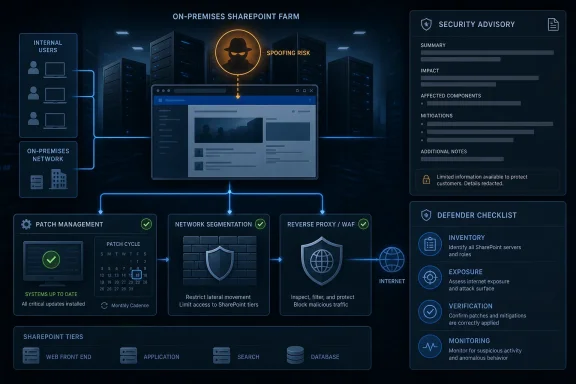
The right response begins with inventory. Identify SharePoint Server Subscription Edition, SharePoint Server 2019, and any older supported or lingering unsupported installations in the environment. Do not rely solely on memory, CMDB entries, or the one administrator who “knows where SharePoint is.”Next comes update validation. SharePoint patching has historically required attention to farm topology, language packs, configuration wizards, and post-update health checks. A security update that is installed but not fully applied across the farm can create a false sense of completion.
Administrators should also review exposure. If a SharePoint instance does not need to be reachable from the public internet, it should not be. If partner or remote access is required, it should sit behind strong authentication, conditional access, reverse proxy controls, and logging that someone actually reviews.
Monitoring should focus on abnormal authentication flows, unexpected document access patterns, suspicious requests to SharePoint endpoints, changes to pages or workflows, and new files that resemble credential-harvesting lures. Without public technical details, detection starts broad and narrows as the community learns more.
Finally, organizations should document the decision. If patching is delayed for compatibility reasons, record who accepted that risk, what compensating controls were applied, and when the exception expires. Silent delay is how temporary exposure becomes permanent exposure.
The Real Test Is Whether SharePoint Has an Owner
Every SharePoint vulnerability eventually reveals an organizational chart. In some companies, ownership is clear: infrastructure manages the servers, security manages risk, application teams test workflows, and leadership understands the maintenance cost. In others, SharePoint belongs to everyone and therefore no one.CVE-2026-33113 punishes the second model. A confirmed vulnerability in a high-value collaboration platform should not trigger a scavenger hunt for credentials, documentation, maintenance windows, and backup procedures. If it does, the CVE is merely exposing a preexisting governance failure.
This is not unique to SharePoint. Exchange, SQL Server, Remote Desktop gateways, VPN concentrators, and identity systems all suffer from the same pattern. But SharePoint has a special knack for becoming invisible because it is “just the intranet” until it becomes an incident.
The best organizations will use this advisory as another prompt to simplify. Retire unused farms. Move workloads that can move. Segment what must remain. Remove stale customizations. Make patching repeatable enough that the next advisory is operationally annoying, not existentially frightening.
The Signal Inside CVE-2026-33113 Is Confidence, Not Drama
CVE-2026-33113 is not the kind of advisory that gives defenders a cinematic villain or a ready-made exploit chain. Its signal is quieter: Microsoft says the vulnerability exists, the affected product is strategically sensitive, and public technical detail is limited. That combination argues for prompt action rather than panic.- Microsoft’s acknowledgement gives defenders high confidence that CVE-2026-33113 is real, even though the public advisory does not provide a full technical recipe.
- The spoofing label should not be treated as harmless, because SharePoint’s trust relationships can turn deception into meaningful business risk.
- Organizations running on-premises SharePoint should prioritize inventory and exposure checks before debating abstract severity.
- Patch deployment should include farm-wide verification, not merely confirmation that an installer ran on one server.
- Sparse public details may slow opportunistic attackers, but patch diffing and exploit development can narrow that advantage over time.
- The advisory is another reason to retire, isolate, or modernize SharePoint deployments that no longer have clear ownership.
References
- Primary source: MSRC
Published: 2026-06-09T07:00:00-07:00
Security Update Guide - Microsoft Security Response Center
 msrc.microsoft.com
- Related coverage: sentinelone.com
CVE-2026-33112: Microsoft SharePoint Server RCE Vulnerability
CVE-2026-33112 is a remote code execution vulnerability in Microsoft SharePoint Server. Learn about its impact, affected versions, and mitigation methods.www.sentinelone.com
- Related coverage: techradar.com
Microsoft releases urgent SharePoint security flaw patches - here's what you need to know, and how to update | TechRadar
Patches for a critical severity SharePoint bug are now availablewww.techradar.com - Related coverage: rapid7.com
Rapid7 Vulnerability Database
Rapid7's VulnDB is curated repository of vetted computer software exploits and exploitable vulnerabilities.www.rapid7.com - Related coverage: pcgamer.com
Microsoft confirms SharePoint vulnerabilities have been exploited by suspected Chinese hackers, as reports indicate the US Nuclear Security Administration may have been among those compromised | PC Gamer
'Investigations into other actors also using these exploits are still ongoing.'www.pcgamer.com - Related coverage: caloes.ca.gov
</rdf:Alt> </dc:title> <dc:description> <rdf:Alt> <rdf:li xml:lang="x-default"/> </rdf:Alt> </dc:description> <dc:creator> <rdf:Seq> <rdf:li>(Contra
</rdf:Alt> </dc:description> <dc:creator> <rdf:Seq> <rdf:li>(Contractor) Melanie, Barlow@CalOESwww.caloes.ca.gov
- Related coverage: ncsc.gov.bh
Advisory Exploitation of CVE 2023 29357 Share Point Vulnerability a98d6994bb
PDF documentwww.ncsc.gov.bh
- Related coverage: appsecure.security
CVE-2021-33113 | High Vulnerability in Intel WiFi Firmware
High-severity vulnerability in Intel WiFi firmware. Improper input validation allows unauthorized access. Immediate patching required.www.appsecure.security
- Official source: microsoft.com
MSRC - Microsoft Security Response Center
The Microsoft Security Response Center is part of the defender community and on the front line of security response evolution. For over twenty years, we have been engaged with security researchers working to protect customers and the broader ecosystem.www.microsoft.com
- Official source: msrc-ppe.microsoft.com
- Official source: learn.microsoft.com
Security Advisories and Bulletins | Microsoft Learn
learn.microsoft.com - Related coverage: sra.io
