

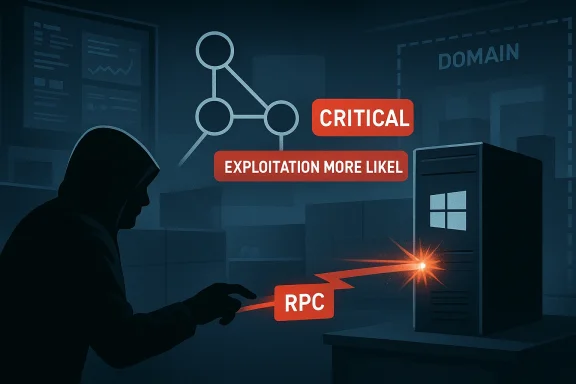
Microsoft’s CVE-2026-33826 is the kind of Active Directory flaw that immediately grabs defenders’ attention because it combines a critical severity rating with Microsoft’s assessment that exploitation is more likely. The advisory language points to an authenticated attacker sending a specially crafted RPC call to a vulnerable host, with successful exploitation yielding code execution under the permissions of that RPC host process. In practical terms, this is not a vague “could happen someday” issue; it is a vendor-confirmed remote code execution vulnerability in one of Windows’ most sensitive identity components, and Microsoft’s own wording suggests real-world attacker interest is plausible. (securityboulevard.com)
Active Directory is the backbone of Windows identity in most enterprises, so any remotely reachable flaw in that stack deserves disproportionate attention. Microsoft’s April 2026 Patch Tuesday roundup lists Windows Active Directory among the product families receiving fixes, and the Tenable analysis identifies CVE-2026-33826 as a critical RCE with a CVSS score of 8 and an “Exploitation More Likely” designation. The same reporting also says the attack requires the attacker to be authenticated and to operate inside the same restricted Active Directory domain as the target. (securityboulevard.com)
That combination matters because it narrows the attack model while preserving serious impact. A flaw that requires domain adjacency and authentication is not as broadly exposed as a public-facing unauthenticated web bug, but in enterprise reality it can still be devastating when an attacker already has some foothold. Once inside the right domain context, a malicious RPC request against a vulnerable host can become a fast path to code execution in a high-value identity tier. (securityboulevard.com)
Microsoft’s broader guidance on vulnerability handling also helps interpret how to think about the advisory. In MSRC’s explanation of its update process, Microsoft emphasizes that the Security Update Guide is meant to combine severity, CVSS, exploitability context, mitigations, and deployment guidance so customers can make risk-based decisions. That framing suggests CVE-2026-33826 should not be read as just another catalog entry; it is intended as a signal for prioritization, testing, and patch sequencing.
Historically, Active Directory bugs have often been the high-leverage vulnerabilities that turn a single compromised workstation or service account into domain-wide exposure. Even without a public exploit description, a confirmed AD remote code execution issue raises immediate questions about privilege boundaries, RPC exposure, and whether the vulnerable component is present on domain controllers or other domain-integrated servers. That is why defenders care so much about the exact mechanics, even before exploitation details become public. (securityboulevard.com)
That matters for defenders because confidence and urgency are related but not identical. A confirmed flaw with limited public detail can still be extremely dangerous if the affected attack surface is broad and the component is hard to isolate. Here, the fact pattern points to an AD/RPC pathway in an enterprise identity system, which is exactly the sort of environment where “authenticated attacker” can still translate into serious operational risk. The need for authentication does not make a domain flaw safe; it often just means the attacker needs a foothold first. (securityboulevard.com)
Instead, the gap in public detail should be read as a typical vendor-security tradeoff. Microsoft has enough confidence to publish a CVE, rate it critical, and assign exploitability context; it simply has not fully exposed the internals of the bug in the public summary. For incident responders, that usually means the safest assumption is that exploitation is technically feasible if an attacker can reach the right RPC path with valid domain context. (securityboulevard.com)
The fact that Microsoft says the code executes with the same permissions as the RPC host also matters. That means the impact will depend on what identity the host process runs under and what resources it can touch. If that host sits on a domain controller or privileged domain member, the blast radius could be severe even if the exploit path is narrower than a public-facing RCE. (securityboulevard.com)
This kind of constraint often shifts the threat model from perimeter defense to internal containment. If an attacker can obtain a valid account, compromise a service account, or move laterally into the right domain context, the barrier to exploitation may collapse quickly. In enterprise security, “authenticated” often means “already dangerous.” (securityboulevard.com)
The practical issue for defenders is that AD environments are highly interconnected. Domain controllers, management servers, certificate infrastructure, identity sync tools, backup systems, and monitoring agents often trust one another in ways that are hard to inventory precisely. That interconnectedness means a vulnerability with a narrow entry condition can still have a broad business impact once triggered. (securityboulevard.com)
The distinction matters because consumer-grade risk models understate the danger of domain-centric bugs. In a small business or enterprise, one vulnerable AD-connected host can be a force multiplier for an attacker, especially if the service is used by administrative tooling or privileged automation. What looks like a contained RCE on paper can become a domain-control event in practice. (securityboulevard.com)
That is especially true for Active Directory. A patch in this area cannot always be treated like a workstation-only update because authentication services are central to production operations. Administrators often need to validate replication, logon behavior, service dependencies, and interoperability with line-of-business systems before rolling patches broadly.
That does not guarantee exploitation, but it does signal that Microsoft’s internal view is uncomfortable enough to elevate urgency. When a critical AD flaw is given that treatment, defenders should assume it belongs near the front of the patch queue, especially on systems that participate in identity or RPC-heavy workflows. Delay should be the exception, not the strategy. (securityboulevard.com)
Security teams should also think about service accounts. If the vulnerable host runs under a privileged service identity, code execution in that context could be more damaging than the CVSS score alone suggests. That is one reason why enterprise defenders frequently rate identity-plane vulnerabilities above many generic workstation RCEs. (securityboulevard.com)
The second control is limiting who can talk to identity services in the first place. RPC exposure inside a domain should not be treated as universally harmless just because it is “internal.” In practice, internal traffic can be attacker traffic once credentials or a machine account are compromised. Segmentation only works if the trust boundary is real. (securityboulevard.com)
It is also sensible to correlate identity logs with endpoint telemetry. If a host that participates in AD suddenly receives a burst of unusual RPC requests from a compromised user or workstation, that should be investigated quickly. The right telemetry here is often indirect, because the exploit path itself may still be opaque. (securityboulevard.com)
The advisory also reinforces how much Microsoft’s security ecosystem depends on timely publication and clear exploitability signals. The CVE alone is not enough; administrators need the exploitability assessment, the attack prerequisites, and the service context to make the right call. That is why Microsoft’s guidance architecture matters as much as the patch itself.
Another concern is operational drift: some organizations will delay patching AD-related systems because they fear disrupting authentication or management workflows. That caution is understandable, but it can create a dangerous window if the vulnerability is actively targeted. The longer a critical identity bug stays open, the more likely it is to be chained into broader compromise.
Microsoft’s patch cadence means customers now have a remediation path, but the hard work shifts to validation, inventory, and monitoring. Enterprises that have already segmented identity tiers, restricted RPC exposure, and maintained disciplined patch rings will be in the best shape. Those that have not will need to move quickly and carefully. That is the perennial Active Directory lesson: the real risk is rarely the CVE alone, but the trust fabric around it.
Source: MSRC Security Update Guide - Microsoft Security Response Center
 Overview
Active Directory is the backbone of Windows identity in most enterprises, so any remotely reachable flaw in that stack deserves disproportionate attention. Microsoft’s April 2026 Patch Tuesday roundup lists Windows Active Directory among the product families receiving fixes, and the Tenable analysis identifies CVE-2026-33826 as a critical RCE with a CVSS score of 8 and an “Exploitation More Likely” designation. The same reporting also says the attack requires the attacker to be authenticated and to operate inside the same restricted Active Directory domain as the target. (securityboulevard.com)That combination matters because it narrows the attack model while preserving serious impact. A flaw that requires domain adjacency and authentication is not as broadly exposed as a public-facing unauthenticated web bug, but in enterprise reality it can still be devastating when an attacker already has some foothold. Once inside the right domain context, a malicious RPC request against a vulnerable host can become a fast path to code execution in a high-value identity tier. (securityboulevard.com)
Microsoft’s broader guidance on vulnerability handling also helps interpret how to think about the advisory. In MSRC’s explanation of its update process, Microsoft emphasizes that the Security Update Guide is meant to combine severity, CVSS, exploitability context, mitigations, and deployment guidance so customers can make risk-based decisions. That framing suggests CVE-2026-33826 should not be read as just another catalog entry; it is intended as a signal for prioritization, testing, and patch sequencing.
Historically, Active Directory bugs have often been the high-leverage vulnerabilities that turn a single compromised workstation or service account into domain-wide exposure. Even without a public exploit description, a confirmed AD remote code execution issue raises immediate questions about privilege boundaries, RPC exposure, and whether the vulnerable component is present on domain controllers or other domain-integrated servers. That is why defenders care so much about the exact mechanics, even before exploitation details become public. (securityboulevard.com)
What Microsoft Has Said
Microsoft’s public wording is the foundation here. The advisory entry described by Tenable says the flaw affects Windows Active Directory, carries CVSS 8, is rated critical, and is assessed as “Exploitation More Likely” under Microsoft’s Exploitability Index. It also states that successful exploitation requires an authenticated attacker to send a specially crafted RPC call to a vulnerable RPC host, resulting in code execution with the same permissions as that host. (securityboulevard.com)The confidence signal
The user’s quoted metric is important because it describes the confidence in the vulnerability’s existence and the credibility of the technical details. Microsoft’s publication of a dedicated CVE entry and patch guidance is itself a strong confirmation signal, and the advisory language implies this is not merely a speculative research lead. In other words, Microsoft is signaling that the vulnerability is real enough to patch, prioritize, and track operationally.That matters for defenders because confidence and urgency are related but not identical. A confirmed flaw with limited public detail can still be extremely dangerous if the affected attack surface is broad and the component is hard to isolate. Here, the fact pattern points to an AD/RPC pathway in an enterprise identity system, which is exactly the sort of environment where “authenticated attacker” can still translate into serious operational risk. The need for authentication does not make a domain flaw safe; it often just means the attacker needs a foothold first. (securityboulevard.com)
Why the advisory language is restrained
Microsoft’s wording avoids over-disclosure, which is standard for advisories involving active or likely exploitation paths. The company routinely balances customer warning against details that could accelerate abuse, and its MSRC documentation explains that this balance is part of the coordinated vulnerability disclosure process. That means the lack of deep exploit mechanics should not be mistaken for uncertainty about the issue’s existence.Instead, the gap in public detail should be read as a typical vendor-security tradeoff. Microsoft has enough confidence to publish a CVE, rate it critical, and assign exploitability context; it simply has not fully exposed the internals of the bug in the public summary. For incident responders, that usually means the safest assumption is that exploitation is technically feasible if an attacker can reach the right RPC path with valid domain context. (securityboulevard.com)
How the Attack Works at a High Level
The core of the advisory is the RPC path. Microsoft’s summary, as reported by Tenable, says exploitation requires an authenticated attacker to send a specially crafted RPC call to a vulnerable host. That tells us the vulnerable code is reachable through Windows’ remote procedure machinery, which is a common enterprise communications layer and often deeply trusted inside domain environments. (securityboulevard.com)RPC as an enterprise attack surface
RPC remains one of the most important and dangerous attack surfaces in Windows because it is everywhere, often invisible, and frequently granted broad trust. When a security flaw sits behind RPC, it can inherit the complexity of identity, service permissions, and network reachability in ways that are not obvious from the CVE label alone. In this case, the risk is heightened because the vulnerable service is tied to Active Directory, where trust relationships are the point of the system. (securityboulevard.com)The fact that Microsoft says the code executes with the same permissions as the RPC host also matters. That means the impact will depend on what identity the host process runs under and what resources it can touch. If that host sits on a domain controller or privileged domain member, the blast radius could be severe even if the exploit path is narrower than a public-facing RCE. (securityboulevard.com)
Why “same restricted AD domain” is a big qualifier
The advisory note that the attacker must be in the “same restricted Active Directory domain as the target system” is a major clue. It suggests the exploit path is constrained by domain membership, trust relationships, or other AD-scoped authorization checks rather than being directly reachable from the open internet. That is a meaningful reduction in exposure, but it also means the issue is tailored to a very realistic post-compromise phase inside enterprise environments. (securityboulevard.com)This kind of constraint often shifts the threat model from perimeter defense to internal containment. If an attacker can obtain a valid account, compromise a service account, or move laterally into the right domain context, the barrier to exploitation may collapse quickly. In enterprise security, “authenticated” often means “already dangerous.” (securityboulevard.com)
Why Active Directory Vulnerabilities Hit Hard
Active Directory issues are so consequential because AD is not just a directory; it is the trust fabric for Windows environments. Authentication, authorization, service principals, group policy, certificate services, and application access all often depend on it directly or indirectly. When Active Directory is impacted, defenders have to think in terms of identity compromise, not just one server crashing or one process misbehaving. (securityboulevard.com)Domain-wide consequences
A remote code execution flaw in Active Directory can create a cascade of follow-on risks. An attacker who gains code execution on an identity-related host may be able to steal tokens, dump credentials, tamper with directory state, or pivot into additional privileged systems. Even if the initial exploit lands under only the RPC host’s account, that can still be enough to start an internal escalation chain. (securityboulevard.com)The practical issue for defenders is that AD environments are highly interconnected. Domain controllers, management servers, certificate infrastructure, identity sync tools, backup systems, and monitoring agents often trust one another in ways that are hard to inventory precisely. That interconnectedness means a vulnerability with a narrow entry condition can still have a broad business impact once triggered. (securityboulevard.com)
Enterprise vs. consumer impact
For consumers, this CVE is mostly invisible because Active Directory is not typically a home-user concern. For enterprises, it is a different story entirely, because AD often underpins the entire Windows estate. That means the real impact is concentrated where identity is centralized and where an internal attacker or compromised account can move quickly between systems. (securityboulevard.com)The distinction matters because consumer-grade risk models understate the danger of domain-centric bugs. In a small business or enterprise, one vulnerable AD-connected host can be a force multiplier for an attacker, especially if the service is used by administrative tooling or privileged automation. What looks like a contained RCE on paper can become a domain-control event in practice. (securityboulevard.com)
Patch Tuesday Context
CVE-2026-33826 lands in a very busy April 2026 Patch Tuesday cycle. Security Boulevard’s roundup says Microsoft addressed 163 CVEs that month, including two zero-days, with a mix of critical, important, and moderate fixes. Within that larger batch, Active Directory was just one of many affected areas, which is exactly why defenders need disciplined prioritization rather than ad hoc patching. (securityboulevard.com)Why large patch batches create risk
Large Patch Tuesday releases are a double-edged sword. On one hand, they show Microsoft is tackling a broad swath of vulnerabilities at once; on the other hand, they create testing and deployment pressure for administrators who have to validate fixes across mixed estates. The more critical updates in the bundle, the more tempting it becomes to stagger deployment, but that can leave identity infrastructure exposed longer than ideal. (securityboulevard.com)That is especially true for Active Directory. A patch in this area cannot always be treated like a workstation-only update because authentication services are central to production operations. Administrators often need to validate replication, logon behavior, service dependencies, and interoperability with line-of-business systems before rolling patches broadly.
Why the exploitability index matters
Microsoft’s Exploitability Index exists to guide these decisions. In its own explanation of the security update process, Microsoft says the guide includes assigned severity, CVSS score, and exploitability information so customers can prioritize deployment based on risk. For CVE-2026-33826, the “Exploitation More Likely” assessment pushes this into the higher-priority category even before any public exploit code appears.That does not guarantee exploitation, but it does signal that Microsoft’s internal view is uncomfortable enough to elevate urgency. When a critical AD flaw is given that treatment, defenders should assume it belongs near the front of the patch queue, especially on systems that participate in identity or RPC-heavy workflows. Delay should be the exception, not the strategy. (securityboulevard.com)
Likely Enterprise Exposure
The exact affected products and topology are not fully described in the public snippet, but the advisory language points to Windows Active Directory and a vulnerable RPC host. That combination suggests the most important question for defenders is not whether they run Active Directory at all, but where the RPC service is exposed within the domain and what privilege tier it occupies. (securityboulevard.com)Who should care first
Domain controllers are the obvious top priority, but they may not be the only relevant systems. Any server performing AD-related RPC duties, especially in privileged management tiers, should be scrutinized as part of remediation planning. Systems that bridge authentication, directory services, or delegated administration should also be near the front of the queue. (securityboulevard.com)Security teams should also think about service accounts. If the vulnerable host runs under a privileged service identity, code execution in that context could be more damaging than the CVSS score alone suggests. That is one reason why enterprise defenders frequently rate identity-plane vulnerabilities above many generic workstation RCEs. (securityboulevard.com)
Inventory and segmentation
The first operational control is knowing where the vulnerable RPC-hosting component exists. That sounds obvious, but identity infrastructure is notorious for hidden dependencies and legacy services that linger across upgrades. If segmentation is weak or administrative tiers are flattened, a single authenticated foothold may be enough to reach the right target. (securityboulevard.com)The second control is limiting who can talk to identity services in the first place. RPC exposure inside a domain should not be treated as universally harmless just because it is “internal.” In practice, internal traffic can be attacker traffic once credentials or a machine account are compromised. Segmentation only works if the trust boundary is real. (securityboulevard.com)
Defensive Priorities
For administrators, the message is straightforward: patch quickly, but validate carefully. Microsoft’s own update guidance stresses the role of security updates in risk-based deployment, and that principle is especially true here because Active Directory changes can have outsized operational consequences if rushed without testing.Immediate actions
- Identify whether your environment includes the specific AD/RPC-hosting components covered by the advisory.
- Apply Microsoft’s April 2026 security updates to the most exposed or privileged systems first.
- Validate authentication, replication, and management workflows after patching.
- Review service accounts and administrative trusts around AD-related RPC services.
- Watch for unusual authenticated RPC activity inside the domain. (securityboulevard.com)
Detection and monitoring
At a minimum, defenders should look for unexpected RPC patterns involving identity-related servers. Authentication anomalies, lateral movement from lower-trust hosts, and unusual service-side crashes or reboots all deserve closer inspection. Because Microsoft has not publicly disclosed exploit details, hunting will be more about behavioral anomalies than signature-based detection. (securityboulevard.com)It is also sensible to correlate identity logs with endpoint telemetry. If a host that participates in AD suddenly receives a burst of unusual RPC requests from a compromised user or workstation, that should be investigated quickly. The right telemetry here is often indirect, because the exploit path itself may still be opaque. (securityboulevard.com)
Competitive and Market Implications
Although this is a Microsoft vulnerability, the broader market implications are real. Security vendors, patch-management platforms, and exposure-management tools all use Microsoft’s advisory feed to drive prioritization logic, and a critical AD RCE with likely exploitation will immediately become a high-value detection and remediation target. That makes the quality of vulnerability intelligence a competitive differentiator for enterprise security vendors.How defenders will consume this news
Large organizations will likely treat this as a top-tier patch item in their vulnerability management queues. Some will accelerate patching on domain infrastructure, while others may use compensating controls and tighter segmentation while testing. Either way, the security market responds quickly when an identity-plane flaw gets a critical label from Microsoft. (securityboulevard.com)The advisory also reinforces how much Microsoft’s security ecosystem depends on timely publication and clear exploitability signals. The CVE alone is not enough; administrators need the exploitability assessment, the attack prerequisites, and the service context to make the right call. That is why Microsoft’s guidance architecture matters as much as the patch itself.
Why third-party research will matter
If additional technical analysis emerges, it will likely come from independent researchers and security vendors reverse-engineering the patch or reproducing the attack path. That is a normal lifecycle for high-impact Microsoft bugs: the public advisory arrives first, then broader technical understanding follows as defenders and attackers both study the fix. In the meantime, the safest posture is to assume the public detail level is intentionally incomplete.Strengths and Opportunities
The upside of this disclosure is that defenders have a clear signal from Microsoft rather than a rumor chain. A confirmed CVE, a critical rating, and an exploitation-likely assessment give enterprises concrete reason to prioritize the issue. That clarity can also help justify temporary change freezes, emergency maintenance windows, and focused monitoring around identity infrastructure. In a crowded patch cycle, strong signals save time. (securityboulevard.com)- Confirmed vendor advisory means the vulnerability is not just speculative.
- Critical severity helps it rise above routine patch noise.
- Exploitation More Likely is a strong prioritization cue.
- Authenticated attack path suggests the bug fits realistic post-compromise scenarios.
- RPC-based exposure gives defenders a concrete telemetry and segmentation focus.
- Active Directory context makes the issue highly relevant to enterprise identity teams.
- Microsoft’s patch cycle guidance supports risk-based deployment planning. (securityboulevard.com)
Risks and Concerns
The biggest concern is that the flaw sits in a trust-heavy identity layer where internal access often receives too much confidence. Even if exploitation requires authentication and domain membership, those are common preconditions in real intrusions. Once an attacker has a foothold inside the right domain, the remaining steps may be far easier than the defensive assumptions suggest. (securityboulevard.com)Another concern is operational drift: some organizations will delay patching AD-related systems because they fear disrupting authentication or management workflows. That caution is understandable, but it can create a dangerous window if the vulnerability is actively targeted. The longer a critical identity bug stays open, the more likely it is to be chained into broader compromise.
- Authenticated access requirement may lull teams into underestimating the threat.
- Domain-scoped attack conditions still map well to lateral movement scenarios.
- Patch hesitation could leave privileged infrastructure exposed.
- Limited public technical detail makes signature detection difficult.
- RPC service complexity increases the chance of hidden exposure paths.
- Identity-plane compromise can cascade into credentials, policy, and admin control.
- Delayed remediation raises the likelihood of opportunistic abuse. (securityboulevard.com)
Looking Ahead
The next few days and weeks will likely determine whether CVE-2026-33826 becomes merely a serious patch item or a broader incident-response event. If exploit proof-of-concept code appears, defenders should expect rapid reassessment of urgency and likely a spike in targeted scanning or internal abuse attempts. If no exploit emerges, the vulnerability will still remain important because AD bugs often matter most in chained intrusion scenarios rather than mass exploitation. (securityboulevard.com)Microsoft’s patch cadence means customers now have a remediation path, but the hard work shifts to validation, inventory, and monitoring. Enterprises that have already segmented identity tiers, restricted RPC exposure, and maintained disciplined patch rings will be in the best shape. Those that have not will need to move quickly and carefully. That is the perennial Active Directory lesson: the real risk is rarely the CVE alone, but the trust fabric around it.
- Watch for Microsoft follow-up guidance or revision notes.
- Monitor whether exploit code or technical analysis appears publicly.
- Prioritize domain controllers and AD-adjacent servers in patching.
- Review RPC exposure and unusual authenticated internal traffic.
- Recheck service account privileges tied to identity infrastructure.
- Validate replication and authentication health after updating. (securityboulevard.com)
Source: MSRC Security Update Guide - Microsoft Security Response Center
