

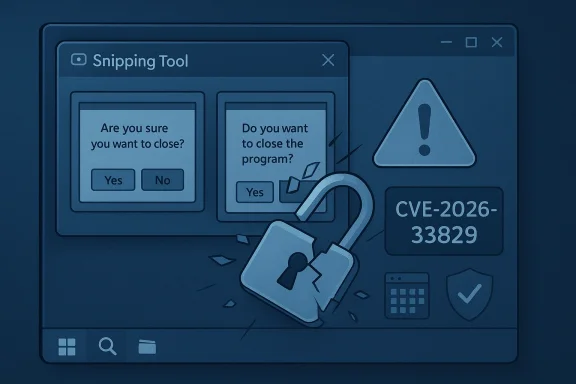
Microsoft has added a new Windows Snipping Tool spoofing vulnerability entry, CVE-2026-33829, to its Security Update Guide, signaling that the flaw has been formally tracked and disclosed through Microsoft’s vulnerability pipeline. The issue is categorized as a spoofing bug, which matters because spoofing flaws often undermine trust boundaries rather than simply crash software or leak data. At the same time, the public-facing record is still sparse, so the exact mechanics, exploitability, and patch scope remain the key unknowns. Microsoft’s own update-guide framework emphasizes that this confidence metric reflects how certain the vendor is that the vulnerability exists and how much technical detail is currently available.
Microsoft has long used the Security Update Guide to surface vulnerabilities as they move from internal validation to public disclosure. For defenders, that matters because the existence of a CVE is often the first reliable sign that a bug is real, even when the technical explanation is still incomplete. In practice, a named CVE gives IT teams a way to track remediation, assess exposure, and watch for follow-up guidance from Microsoft.
The Snipping Tool itself is not a niche utility anymore. It sits in the daily workflow of consumers, support staff, power users, and enterprise help desks because screenshots have become a standard way to share, document, and troubleshoot. That ubiquity makes any flaw in the tool more interesting than the average utility bug, because the blast radius can extend from casual consumer use to business operations and security workflows. Microsoft has previously patched Snipping Tool issues affecting information disclosure, which shows that the app has been on the security radar before.
The word spoofing also deserves careful attention. In Microsoft’s taxonomy, spoofing typically means an attacker can misrepresent content, identity, or trust context to trick a user or another system. That is different from remote code execution, but it can still be serious, especially if the flaw enables phishing-like deception, trusted-path abuse, or false content presentation inside a workflow people assume is safe. The security significance is often behavioral as much as technical: if users believe they are viewing one thing while the system is actually showing another, the trust model breaks.
What makes CVE-2026-33829 notable is not just the label, but the timing. Microsoft is publishing it into a threat landscape where attackers increasingly blend UI deception, file abuse, and trust exploitation into multi-stage intrusion chains. Even when the vendor has not disclosed the root cause, a named spoofing vulnerability in a high-use built-in Windows app is enough to justify a closer look from enterprise defenders. That is especially true when Microsoft has already demonstrated, in prior cycles, that “low-profile” utility issues can still become operationally relevant once details land and exploit paths become clearer.
That uncertainty should not be mistaken for low importance. Microsoft’s confidence metric exists because not all CVEs arrive with the same level of corroboration, exploit insight, or root-cause clarity. A vulnerability can move from “recognized undesirable behavior” to a better-understood technical weakness over time, and the amount of attacker knowledge available rises as researchers, vendors, or threat actors fill in the blanks. The industry has seen that pattern repeatedly with Windows issues that start with sparse descriptions and later become high-priority patch events.
For Snipping Tool specifically, the security context is shaped by prior history. Microsoft has already addressed a Windows Snipping Tool information disclosure vulnerability in the past, which confirms that the application’s handling of images, edits, and exports can create security edges. That does not mean CVE-2026-33829 is the same class of bug, but it does show that this utility is not immune from trust or data-handling errors.
There is also a broader lesson here about built-in Windows tools. Users often grant them a degree of trust that third-party apps must earn through reputation. When a native tool carries a spoofing flaw, the impact can be amplified because the attacker is not necessarily asking the victim to install something foreign; they may be abusing the look and feel of a default Windows component that already feels legitimate. That is why even a “spoofing” CVE can have outsized social-engineering value if the bug proves usable in a phishing or workflow-deception chain.
The Windows Snipping Tool Spoofing Vulnerability label suggests the concern is not purely local cosmetic behavior. Microsoft does not usually assign spoofing terminology lightly; it reserves it for cases where deception, impersonation, or trust abuse is at the core of the issue. That means defenders should think beyond the app’s ordinary screenshot function and consider whether exported images, overlays, metadata, dialogs, or file interactions could be manipulated into misleading outcomes.
In practical terms, this means defenders should treat the CVE as “real and worth tracking,” while treating exploitability details as pending. That is a balanced posture: neither panic over a still-vague disclosure nor dismiss it because the current write-up is short. Security operations often fail when teams wait for perfect detail before they move, and Microsoft’s advisory process is designed to reduce that delay.
The tool is also embedded in workflows that assume authenticity. Help desk staff use screenshots to verify problems, users rely on them to document errors, and administrators use them in change records or incident notes. If a spoofing issue alters what the recipient believes they are seeing, the vulnerability can undermine not just the image itself but the downstream decision based on that image. That is a trust-layer problem, not merely a graphics bug.
The prior Snipping Tool disclosure bug in 2023 is a reminder that Microsoft’s image-capture tools are not immune to edge cases. While that issue involved information disclosure rather than spoofing, it demonstrated that screenshot workflows can expose residual data, unexpected content, or inconsistent output. The lesson is simple: built-in tools inherit the same security obligations as any externally shipped application, even when users assume they are inherently safe.
The company’s own monthly security communications also illustrate how vulnerability disclosure evolves. Microsoft has previously noted when flaws were already being exploited or when technical details were circulating before patch release, and it has urged rapid deployment in those cases. That pattern suggests that if CVE-2026-33829 matures into a more concrete advisory, customers should expect Microsoft to provide clearer urgency language or mitigation steps.
The broader significance is that Microsoft is increasingly transparent about vulnerabilities earlier in the lifecycle. That transparency helps customers, but it also means security teams must get comfortable acting on incomplete information. In a fast-moving threat environment, “we know it exists” is often enough to trigger defensive prioritization even when “we know exactly how it works” is not yet available. That is the reality of modern vulnerability management.
The operational risk is not limited to attackers exploiting the bug directly. In large organizations, even a bug that only misleads a subset of users can create noise, false positives, and wasted investigation cycles. Security teams may spend time verifying a screenshot’s authenticity instead of responding to the actual incident, which is exactly the kind of friction adversaries like to create.
There is also a policy angle. Some organizations use Snipping Tool or its Windows-integrated equivalents in secure environments because they are perceived as safer and easier to manage than third-party utilities. A newly tracked vulnerability in that same tool weakens the assumption that native always means trustworthy. Native software is not automatically safer; it is just more deeply embedded.
The consumer impact may also be indirect. A deceptive screenshot can be enough to persuade someone to click a link, approve a request, install a remote-support tool, or disclose personal information. Those are classic social-engineering outcomes, and they are often more realistic than a direct technical compromise in consumer settings. The attack does not need to be sophisticated if the lie is convincing enough.
It is also wise to treat screenshots as supporting evidence, not absolute proof, especially in security or account-related disputes. That advice is not new, but vulnerabilities like this reinforce it. A screenshot may still be useful, but it should be corroborated where possible with logs, timestamps, or direct system records.
Another key question is whether the issue is local, network-based, or chainable. Microsoft’s CVE title mentions spoofing, but that alone does not define the attack vector. Depending on the eventual write-up, the flaw might be exploitable only under certain user interactions, or it might be usable remotely through a deceptive workflow that leverages the tool’s output.
It would also matter if Microsoft links the bug to a broader Windows component rather than just the Snipping Tool app itself. That would suggest the problem is more structural and could affect related screenshot or image-handling paths. Structural bugs generally create more durable risk because they can survive simple UI changes or packaging updates.
The real opportunity is to treat this as a teaching moment about built-in Windows utilities. If organizations can harden their operational habits around a relatively ordinary tool like Snipping Tool, they become more resilient to more sophisticated deception later. That is how small advisories can improve broader security maturity.
There is also a broader trust issue. If users begin to question the authenticity of screenshots or screenshot-based instructions, that could complicate help-desk interactions and even internal security operations. In a world where so much communication already happens through visual snippets, any vulnerability that undermines screenshot integrity deserves a serious response. Trust erosion is a security cost all its own.
Security researchers may also weigh in once the advisory stabilizes. If they can reproduce the issue or identify a plausible abuse path, the industry will move from general awareness to concrete risk assessment. That transition is where spoofing bugs often become much more operationally important, because they stop being abstract trust issues and start becoming demonstrable attack techniques.
Source: MSRC Security Update Guide - Microsoft Security Response Center
 Background
Microsoft has long used the Security Update Guide to surface vulnerabilities as they move from internal validation to public disclosure. For defenders, that matters because the existence of a CVE is often the first reliable sign that a bug is real, even when the technical explanation is still incomplete. In practice, a named CVE gives IT teams a way to track remediation, assess exposure, and watch for follow-up guidance from Microsoft.The Snipping Tool itself is not a niche utility anymore. It sits in the daily workflow of consumers, support staff, power users, and enterprise help desks because screenshots have become a standard way to share, document, and troubleshoot. That ubiquity makes any flaw in the tool more interesting than the average utility bug, because the blast radius can extend from casual consumer use to business operations and security workflows. Microsoft has previously patched Snipping Tool issues affecting information disclosure, which shows that the app has been on the security radar before.
The word spoofing also deserves careful attention. In Microsoft’s taxonomy, spoofing typically means an attacker can misrepresent content, identity, or trust context to trick a user or another system. That is different from remote code execution, but it can still be serious, especially if the flaw enables phishing-like deception, trusted-path abuse, or false content presentation inside a workflow people assume is safe. The security significance is often behavioral as much as technical: if users believe they are viewing one thing while the system is actually showing another, the trust model breaks.
What makes CVE-2026-33829 notable is not just the label, but the timing. Microsoft is publishing it into a threat landscape where attackers increasingly blend UI deception, file abuse, and trust exploitation into multi-stage intrusion chains. Even when the vendor has not disclosed the root cause, a named spoofing vulnerability in a high-use built-in Windows app is enough to justify a closer look from enterprise defenders. That is especially true when Microsoft has already demonstrated, in prior cycles, that “low-profile” utility issues can still become operationally relevant once details land and exploit paths become clearer.
Overview
The current public information on CVE-2026-33829 is limited, and that limitation is itself meaningful. Microsoft’s update guide structure allows the company to publish a CVE before every technical detail is ready for broad consumption, which helps customers begin tracking exposure early. In other words, the presence of the CVE tells us the issue is real enough to merit formal disclosure, but it does not yet tell us whether the impact is narrow, opportunistic, or potentially weaponizable at scale.That uncertainty should not be mistaken for low importance. Microsoft’s confidence metric exists because not all CVEs arrive with the same level of corroboration, exploit insight, or root-cause clarity. A vulnerability can move from “recognized undesirable behavior” to a better-understood technical weakness over time, and the amount of attacker knowledge available rises as researchers, vendors, or threat actors fill in the blanks. The industry has seen that pattern repeatedly with Windows issues that start with sparse descriptions and later become high-priority patch events.
For Snipping Tool specifically, the security context is shaped by prior history. Microsoft has already addressed a Windows Snipping Tool information disclosure vulnerability in the past, which confirms that the application’s handling of images, edits, and exports can create security edges. That does not mean CVE-2026-33829 is the same class of bug, but it does show that this utility is not immune from trust or data-handling errors.
There is also a broader lesson here about built-in Windows tools. Users often grant them a degree of trust that third-party apps must earn through reputation. When a native tool carries a spoofing flaw, the impact can be amplified because the attacker is not necessarily asking the victim to install something foreign; they may be abusing the look and feel of a default Windows component that already feels legitimate. That is why even a “spoofing” CVE can have outsized social-engineering value if the bug proves usable in a phishing or workflow-deception chain.
Why spoofing matters more than it sounds
Spoofing vulnerabilities often sit at the intersection of UX and security engineering. They can be used to make malicious content appear trusted, to hide the true origin of data, or to mislead users about what a tool is actually doing. In enterprise environments, that can create audit, reporting, and incident-response confusion even before any deeper compromise occurs. That subtlety is why spoofing bugs are easy to underestimate and hard to ignore.What Microsoft Is Signaling
Microsoft’s publication of a CVE name and classification is a signal to customers, even when the technical write-up is thin. It indicates that the company considers the issue worthy of tracking as a discrete vulnerability, not merely as a bug report or compatibility defect. For security teams, that alone is enough to justify inventory checks, patch monitoring, and watchfulness for revised advisory language.The Windows Snipping Tool Spoofing Vulnerability label suggests the concern is not purely local cosmetic behavior. Microsoft does not usually assign spoofing terminology lightly; it reserves it for cases where deception, impersonation, or trust abuse is at the core of the issue. That means defenders should think beyond the app’s ordinary screenshot function and consider whether exported images, overlays, metadata, dialogs, or file interactions could be manipulated into misleading outcomes.
What the confidence metric tells us
Microsoft’s own description of its vulnerability confidence metric is useful here. It measures how certain the company is that the vulnerability exists and how credible the technical details are, which means the number is really a proxy for evidence quality. The higher the confidence, the more likely attackers and researchers have a concrete path to understand, reproduce, or weaponize the issue.In practical terms, this means defenders should treat the CVE as “real and worth tracking,” while treating exploitability details as pending. That is a balanced posture: neither panic over a still-vague disclosure nor dismiss it because the current write-up is short. Security operations often fail when teams wait for perfect detail before they move, and Microsoft’s advisory process is designed to reduce that delay.
Signals defenders should watch
- Any Microsoft revision that adds an attack vector or impact description.
- A later release of affected product versions or build numbers.
- References to screenshot, clipboard, UI, or file-format handling in follow-up notes.
- Proof-of-concept research from reputable security researchers.
- Evidence that the issue can be chained with phishing or file-based deception.
Why Snipping Tool Is a Security-Relevant Surface
Snipping Tool has a deceptively large attack surface because it deals with visual content, editing behavior, file output, and user trust all at once. Any app that lets people capture, annotate, save, or share visual evidence becomes a candidate for misrepresentation if its rendering or export pipeline is inconsistent. That is why screenshot utilities are more than convenience software in modern Windows environments.The tool is also embedded in workflows that assume authenticity. Help desk staff use screenshots to verify problems, users rely on them to document errors, and administrators use them in change records or incident notes. If a spoofing issue alters what the recipient believes they are seeing, the vulnerability can undermine not just the image itself but the downstream decision based on that image. That is a trust-layer problem, not merely a graphics bug.
The trust chain around screenshots
Screenshots are often treated as evidence, but evidence handling is only as strong as the capture tool. If the screenshot utility can be induced to represent content incorrectly, then the artifact becomes unreliable as documentation. In an enterprise setting, that can affect incident triage, support escalation, compliance workflows, and even legal preservation practices.The prior Snipping Tool disclosure bug in 2023 is a reminder that Microsoft’s image-capture tools are not immune to edge cases. While that issue involved information disclosure rather than spoofing, it demonstrated that screenshot workflows can expose residual data, unexpected content, or inconsistent output. The lesson is simple: built-in tools inherit the same security obligations as any externally shipped application, even when users assume they are inherently safe.
Practical implications
- A spoofing flaw could confuse the person viewing a screenshot.
- It could weaken evidence collection in support scenarios.
- It could be abused in social engineering.
- It may affect shared documents, not just local use.
- It deserves monitoring even before exploit details are public.
Historical Context and Related Vulnerabilities
Microsoft has seen multiple spoofing-related CVEs over the years, spanning Bluetooth, Office, Exchange, TLS, Print Spooler, and other components. The common thread is trust abuse: something appears legitimate while the underlying state is not. That history matters because it shows spoofing bugs are not rare anomalies; they are recurring security problems across the Microsoft ecosystem.The company’s own monthly security communications also illustrate how vulnerability disclosure evolves. Microsoft has previously noted when flaws were already being exploited or when technical details were circulating before patch release, and it has urged rapid deployment in those cases. That pattern suggests that if CVE-2026-33829 matures into a more concrete advisory, customers should expect Microsoft to provide clearer urgency language or mitigation steps.
A familiar disclosure pattern
The disclosure cycle typically starts with a sparse CVE entry, then expands with build numbers, affected versions, or mitigation guidance. For defenders, the problem is that the first public clue often arrives before the operationally useful clue. This is why patch management teams need processes that do not depend on detailed exploit write-ups before they begin preparing updates.The broader significance is that Microsoft is increasingly transparent about vulnerabilities earlier in the lifecycle. That transparency helps customers, but it also means security teams must get comfortable acting on incomplete information. In a fast-moving threat environment, “we know it exists” is often enough to trigger defensive prioritization even when “we know exactly how it works” is not yet available. That is the reality of modern vulnerability management.
Related lessons from past Microsoft bugs
- Early CVE publication is a warning, not a verdict on severity.
- Low-visibility components can still carry meaningful risk.
- Trust abuse is often more dangerous than simple crashes.
- UI-driven flaws can be chained into phishing or deception.
- The absence of detail is not the absence of urgency.
Enterprise Impact
Enterprises should view CVE-2026-33829 through the lens of workflow integrity. A spoofing flaw in a screenshot tool can distort documentation, tamper with evidence, or confuse ticket-based operations. That matters in environments where screenshots are used to validate security alerts, confirm support actions, or demonstrate compliance.The operational risk is not limited to attackers exploiting the bug directly. In large organizations, even a bug that only misleads a subset of users can create noise, false positives, and wasted investigation cycles. Security teams may spend time verifying a screenshot’s authenticity instead of responding to the actual incident, which is exactly the kind of friction adversaries like to create.
Why SOCs should care
Security operations centers depend on artifacts, and screenshots frequently become part of that evidence trail. If a capture tool is capable of producing deceptive output, analysts may need to revisit their assumptions about user-submitted images and internal documentation. That can slow response timelines and complicate post-incident reviews.There is also a policy angle. Some organizations use Snipping Tool or its Windows-integrated equivalents in secure environments because they are perceived as safer and easier to manage than third-party utilities. A newly tracked vulnerability in that same tool weakens the assumption that native always means trustworthy. Native software is not automatically safer; it is just more deeply embedded.
Enterprise considerations
- Review where screenshot evidence is used in business processes.
- Watch for user instructions that rely on screenshots for validation.
- Confirm patch deployment channels for Windows endpoints.
- Reassess trust in screenshot-based incident documentation.
- Prepare for later Microsoft guidance if the CVE becomes more detailed.
Consumer Impact
For consumers, the most immediate concern is deception. If the flaw can be abused in a way that changes what a screenshot appears to show, it could help scammers reinforce false narratives, fake support interactions, or manipulate personal records. The average user may not think of a screenshot utility as a security boundary, but spoofing vulnerabilities tend to exploit exactly that blind spot.The consumer impact may also be indirect. A deceptive screenshot can be enough to persuade someone to click a link, approve a request, install a remote-support tool, or disclose personal information. Those are classic social-engineering outcomes, and they are often more realistic than a direct technical compromise in consumer settings. The attack does not need to be sophisticated if the lie is convincing enough.
What regular users should know
Microsoft has not yet published the kind of detailed remediation guidance that would let users draw hard conclusions about exploitation paths. Until that changes, the safest assumption is that standard Windows update hygiene matters here. Users who keep their systems current reduce the chance that a disclosed issue remains a usable attack surface.It is also wise to treat screenshots as supporting evidence, not absolute proof, especially in security or account-related disputes. That advice is not new, but vulnerabilities like this reinforce it. A screenshot may still be useful, but it should be corroborated where possible with logs, timestamps, or direct system records.
Consumer takeaways
- Keep Windows fully updated.
- Be wary of support scams that rely on visual proof.
- Do not treat screenshots as irrefutable evidence.
- Use alternate verification when something feels off.
- Watch for Microsoft’s patch or advisory expansion.
Likely Technical Questions
At this stage, the biggest unanswered question is what exactly is being spoofed. It could involve UI elements, image rendering, file metadata, clipboard behavior, or some interaction between capture and export. Without more disclosure from Microsoft, any claim about the root cause would be speculation, so the responsible position is to avoid overfitting the label to a specific exploit theory.Another key question is whether the issue is local, network-based, or chainable. Microsoft’s CVE title mentions spoofing, but that alone does not define the attack vector. Depending on the eventual write-up, the flaw might be exploitable only under certain user interactions, or it might be usable remotely through a deceptive workflow that leverages the tool’s output.
What would raise the severity
A future advisory would become much more important if Microsoft says the flaw can be exploited without elevated privileges, can be triggered remotely, or can be chained with phishing. Those are the kinds of details that turn a “watch this” item into a “patch immediately” item. Until then, security teams should treat the CVE as a live tracking item rather than a finished exploit narrative.It would also matter if Microsoft links the bug to a broader Windows component rather than just the Snipping Tool app itself. That would suggest the problem is more structural and could affect related screenshot or image-handling paths. Structural bugs generally create more durable risk because they can survive simple UI changes or packaging updates.
Open technical unknowns
- Exact vulnerable code path.
- Whether the issue is local or remotely reachable.
- Whether user interaction is required.
- Whether the bug affects screenshots, annotations, or exports.
- Whether Microsoft rates it as low, moderate, or higher impact later.
Strengths and Opportunities
This disclosure has an upside for defenders: it arrives early enough for teams to prepare before a fully weaponized exploit narrative is publicly visible. Microsoft’s structured CVE process gives enterprises a chance to inventory exposure, test update channels, and review trust assumptions around screenshot use. It also offers a chance to strengthen governance around evidence handling, which is often neglected until a problem appears.The real opportunity is to treat this as a teaching moment about built-in Windows utilities. If organizations can harden their operational habits around a relatively ordinary tool like Snipping Tool, they become more resilient to more sophisticated deception later. That is how small advisories can improve broader security maturity.
- Use the CVE to validate patching workflows.
- Revisit how screenshots are used in evidence chains.
- Train users to verify suspicious support requests.
- Strengthen incident documentation with multiple sources.
- Prepare for Microsoft’s later technical clarifications.
- Review whether native tools are assumed to be “trusted by default.”
- Treat spoofing as a trust issue, not just an app issue.
Risks and Concerns
The main risk is that the current vagueness may cause underreaction. When a CVE has a narrow public description, busy IT teams sometimes postpone action until exploit details are easier to understand, but that delay can be costly once the advisory gains momentum. Spoofing bugs also lend themselves to social engineering, which can make them easier to abuse than a more technical flaw might first appear.There is also a broader trust issue. If users begin to question the authenticity of screenshots or screenshot-based instructions, that could complicate help-desk interactions and even internal security operations. In a world where so much communication already happens through visual snippets, any vulnerability that undermines screenshot integrity deserves a serious response. Trust erosion is a security cost all its own.
- Delayed patching because details are incomplete.
- Abuse in phishing or help-desk impersonation.
- Confusion in incident response documentation.
- Overreliance on screenshots as proof.
- False confidence in built-in Windows apps.
- Possible chaining with other Windows trust issues.
- Longer-term erosion of user confidence in visual evidence.
Looking Ahead
The next meaningful milestone will be Microsoft’s own expansion of the CVE entry, whether that arrives as affected builds, remediation notes, or a revised severity assessment. If the company adds more technical substance, security teams should revisit priorities immediately. If a patch lands, that will likely settle the question of exposure more than any third-party speculation can.Security researchers may also weigh in once the advisory stabilizes. If they can reproduce the issue or identify a plausible abuse path, the industry will move from general awareness to concrete risk assessment. That transition is where spoofing bugs often become much more operationally important, because they stop being abstract trust issues and start becoming demonstrable attack techniques.
What to watch
- Microsoft’s update-guide revisions.
- Any patch details in Patch Tuesday or out-of-band releases.
- Public research showing proof-of-concept behavior.
- Enterprise detection guidance from Microsoft or trusted vendors.
- Signs that the issue can be chained into phishing or deception.
Source: MSRC Security Update Guide - Microsoft Security Response Center
Last edited:
