

Microsoft disclosed CVE-2026-33834 on May 12, 2026 as a Windows Event Logging Service elevation-of-privilege vulnerability, meaning a successful attacker would not break in remotely from scratch but could potentially turn existing local access into more powerful Windows permissions. The important word is existing. This is not the cinematic firewall-bypass bug that sells itself to executives, but it sits in a part of Windows that defenders, auditors, and incident responders trust by default. That makes the vulnerability less glamorous and more operationally awkward.
The user-supplied MSRC language around “confidence” is the tell. Microsoft’s listing does not merely describe a hypothetical weakness class; it places the issue inside the formal CVE machinery, where the vulnerability exists with vendor acknowledgement even if the root-cause details remain sparse. That combination is increasingly common in Windows security: enough information to patch and prioritize, not enough to hand defenders a neat exploit narrative.
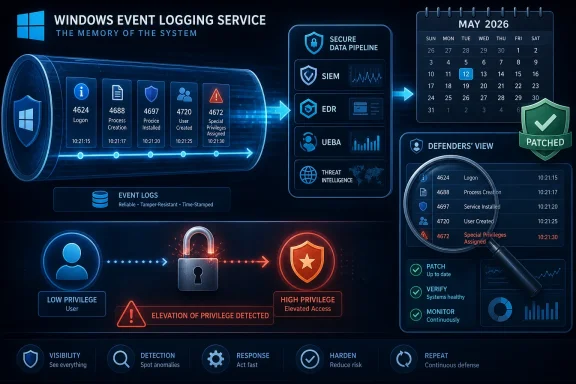
Windows Event Logging is supposed to be the system’s memory. It records logons, service starts, application failures, policy changes, and the thousands of small signals that let administrators reconstruct what happened after something goes wrong. In modern Windows estates, those events are no longer just local breadcrumbs; they feed SIEM pipelines, endpoint detection tools, compliance archives, and forensic timelines.
That is why a vulnerability in the Event Logging Service deserves more attention than the phrase “local privilege escalation” usually gets. Attackers do not need every bug to be remotely exploitable. In real intrusions, local privilege escalation is often the second or third move, used after phishing, stolen credentials, exposed remote access, or a compromised application has already opened the door.
The practical risk is not that CVE-2026-33834 single-handedly topples a domain. It is that a low-privilege foothold on a workstation or server may become more useful if the attacker can climb into a higher-integrity context. Once that happens, the distinction between “they got in” and “they own the box” starts to collapse.
Microsoft’s public description gives administrators the impact category, the affected component, and the obligation to apply the relevant Windows security update. It does not, at least from the public material available at disclosure, provide a lush exploit write-up. That is frustrating for defenders who want to understand exploitability, but it is also the point: the patch is meant to land before the bug becomes a cookbook.
That matters because organizations often misread sparse advisories as weak advisories. A short Microsoft CVE page can look underwhelming compared with a third-party blog full of packet captures, proof-of-concept snippets, and diagrams. But an acknowledged Microsoft CVE in a supported Windows component is not a forum rumor; it is a patch-management event.
The confidence metric also speaks to attacker knowledge. If the vendor confirms the vulnerability but withholds the root cause, the public may not yet know exactly how to exploit it. That does not mean attackers are blind. Patch diffing, telemetry, insider access to crash patterns, and focused reverse engineering can quickly narrow the search area once a fix ships.
The awkward middle ground is where defenders live. They may not have public exploit details, but they must assume motivated attackers can learn faster than a slow enterprise can patch. That is especially true for Windows privilege-escalation bugs, where exploitation often depends on predictable local service behavior rather than rare environmental conditions.
Windows is full of privileged services by necessity. They broker access to files, devices, logs, credentials, network stacks, installation routines, and management interfaces. The security model depends on those services accepting requests from less-privileged code without becoming confused about who should be allowed to do what.
That boundary is hard to defend forever. Race conditions, improper access checks, unsafe file handling, weak impersonation logic, and service misconfigurations have all appeared in Windows privilege-escalation history. The Event Logging Service is particularly sensitive because it sits at the intersection of system observability and privileged service execution.
For administrators, the lesson is not to panic about one CVE in isolation. It is to stop treating privilege escalation as a secondary class of vulnerability that can wait for the next maintenance window. If an attacker already has a foothold, the fastest route to serious damage is often not another phishing email; it is a local bug that removes the remaining guardrails.
That does not mean CVE-2026-33834 is necessarily a log-forgery bug, a deletion bug, or an anti-forensics bug. Microsoft’s label says elevation of privilege, not tampering or information disclosure. Still, the affected component matters because administrators depend on event logging not merely for system health, but for accountability.
This is where the operational stakes widen. If a service tied to auditability has a privilege-escalation flaw, defenders have to think beyond exploit execution. They need to ask which machines are most valuable, where logging data is collected, which endpoints process untrusted workloads, and whether compromised local accounts could use the bug as part of a longer chain.
The highest-priority systems are not always domain controllers. Build servers, jump boxes, remote desktop hosts, management servers, and endpoints used by administrators can be more attractive targets. A local privilege-escalation bug on one of those systems can become a stepping stone into the rest of the environment.
Enterprise reality is messier. Some systems cannot reboot casually. Some servers are pinned to maintenance windows. Some line-of-business applications still treat cumulative updates as a threat. Some organizations know exactly how exposed they are; others only discover unsupported Windows builds when a vulnerability forces the question.
That is why the patch itself is the easy part. The harder part is deciding where CVE-2026-33834 sits in the queue. Because it is a local privilege-escalation vulnerability, internet exposure alone is the wrong prioritization filter. The better question is where an attacker is most likely to land first and where a privilege jump would hurt most.
Workstations used by administrators deserve special treatment. So do shared servers, developer machines, VDI pools, remote-access hosts, and endpoints where standard users can run untrusted code. If those systems remain unpatched while low-risk kiosks are updated first, the organization has optimized for dashboard green rather than attack-path reduction.
There are good reasons for restraint. Detailed exploit notes can shorten the time between patch release and weaponization. Many customers need a patch more than they need a root-cause essay. Coordinated disclosure also means Microsoft may be balancing researcher credit, affected platform breadth, and downstream ecosystem readiness.
But opacity has a cost. Defenders build prioritization models from signals: exploitability assessments, CVSS vectors, product role, exploit maturity, public proof-of-concept code, and observed exploitation. When the public record is thin, teams must infer risk from the component and impact. That favors mature security programs and penalizes smaller shops that rely on vendor prose.
CVE-2026-33834 is a useful example of that tradeoff. The advisory category is enough to demand action, but not enough to confidently model every attack path. The right response is not to invent details. It is to patch promptly, monitor for post-disclosure research, and treat local privilege escalation in core Windows services as a serious class.
Patch diffing is not magic, but it is effective. When a Windows update changes binaries associated with a vulnerable service, researchers and attackers can compare old and new versions, inspect modified functions, and look for newly added checks. The absence of public proof-of-concept code on disclosure day is therefore a temporary comfort, not a durable defense.
This is one reason Microsoft’s exploitability guidance, where available, deserves attention but should not be treated as a sleeping pill. “Exploitation less likely” does not mean exploitation impossible. “Not publicly disclosed” does not mean privately unknown. “No known active exploitation” means exactly that: no known active exploitation at the time of publication.
The calendar matters. The days immediately after Patch Tuesday are when defenders and attackers are studying the same material for opposite reasons. A slow patch cycle gives the offensive side more time to turn an advisory into a working exploit.
But administrators do not need to wait for the exploit archaeology before acting. The vulnerability affects a built-in Windows service, carries an elevation-of-privilege impact, and is acknowledged through Microsoft’s security update process. That is enough to move it out of the “interesting” pile and into the “patch and verify” pile.
Verification is the part many environments skip. Installing cumulative updates is not the same as proving coverage. Teams should confirm deployment status, reboot completion, build numbers, and exception lists. A server that downloaded the update but never rebooted is still a liability dressed up as progress.
Security teams should also watch for a familiar pattern after disclosure. Third-party scanners may lag. NVD enrichment may arrive later or differ in severity interpretation. Asset inventories may miss systems that are offline, roaming, or managed outside the standard endpoint stack. CVE management is only as good as the asset truth underneath it.
This does not mean defenders should distrust every event. It means they should avoid building an incident-response worldview around a single source of truth. Endpoint logs, EDR telemetry, network data, identity-provider events, and cloud control-plane records should corroborate one another. When one layer is compromised or unreliable, the others must still help tell the story.
That approach also changes patch prioritization. Systems that generate high-value security telemetry deserve the same urgency as systems that store sensitive data. A monitoring server, a collector, or an administrator workstation may not look like a crown jewel in a CMDB, but attackers understand its leverage.
CVE-2026-33834 is therefore not just another Windows service bug. It is a reminder that the machinery of visibility is part of the attack surface. The tools that tell you what happened must themselves be kept current, isolated where appropriate, and monitored for failure.
Source: MSRC Security Update Guide - Microsoft Security Response Center
The user-supplied MSRC language around “confidence” is the tell. Microsoft’s listing does not merely describe a hypothetical weakness class; it places the issue inside the formal CVE machinery, where the vulnerability exists with vendor acknowledgement even if the root-cause details remain sparse. That combination is increasingly common in Windows security: enough information to patch and prioritize, not enough to hand defenders a neat exploit narrative.
 Microsoft’s Quietest Windows Bugs Often Live in the Loudest Subsystems
Windows Event Logging is supposed to be the system’s memory. It records logons, service starts, application failures, policy changes, and the thousands of small signals that let administrators reconstruct what happened after something goes wrong. In modern Windows estates, those events are no longer just local breadcrumbs; they feed SIEM pipelines, endpoint detection tools, compliance archives, and forensic timelines.That is why a vulnerability in the Event Logging Service deserves more attention than the phrase “local privilege escalation” usually gets. Attackers do not need every bug to be remotely exploitable. In real intrusions, local privilege escalation is often the second or third move, used after phishing, stolen credentials, exposed remote access, or a compromised application has already opened the door.
The practical risk is not that CVE-2026-33834 single-handedly topples a domain. It is that a low-privilege foothold on a workstation or server may become more useful if the attacker can climb into a higher-integrity context. Once that happens, the distinction between “they got in” and “they own the box” starts to collapse.
Microsoft’s public description gives administrators the impact category, the affected component, and the obligation to apply the relevant Windows security update. It does not, at least from the public material available at disclosure, provide a lush exploit write-up. That is frustrating for defenders who want to understand exploitability, but it is also the point: the patch is meant to land before the bug becomes a cookbook.
Report Confidence Is Not a Footnote, It Is a Risk Signal
The metric text attached to this vulnerability describes the degree of confidence in the vulnerability’s existence and in the credibility of the known technical details. In plain English, it asks whether defenders are looking at rumor, partial research, or a confirmed vendor-recognized flaw. For CVE-2026-33834, the meaningful fact is that the issue is in Microsoft’s own security update pipeline.That matters because organizations often misread sparse advisories as weak advisories. A short Microsoft CVE page can look underwhelming compared with a third-party blog full of packet captures, proof-of-concept snippets, and diagrams. But an acknowledged Microsoft CVE in a supported Windows component is not a forum rumor; it is a patch-management event.
The confidence metric also speaks to attacker knowledge. If the vendor confirms the vulnerability but withholds the root cause, the public may not yet know exactly how to exploit it. That does not mean attackers are blind. Patch diffing, telemetry, insider access to crash patterns, and focused reverse engineering can quickly narrow the search area once a fix ships.
The awkward middle ground is where defenders live. They may not have public exploit details, but they must assume motivated attackers can learn faster than a slow enterprise can patch. That is especially true for Windows privilege-escalation bugs, where exploitation often depends on predictable local service behavior rather than rare environmental conditions.
Elevation of Privilege Is the Workhorse of Windows Intrusions
Remote code execution gets the headlines because it suggests an attacker can start outside the network and end inside the process. Elevation of privilege is less dramatic, but it is the engine room of many real compromises. It turns a beachhead into persistence, a standard user into a local administrator, or a contained process into a broader system problem.Windows is full of privileged services by necessity. They broker access to files, devices, logs, credentials, network stacks, installation routines, and management interfaces. The security model depends on those services accepting requests from less-privileged code without becoming confused about who should be allowed to do what.
That boundary is hard to defend forever. Race conditions, improper access checks, unsafe file handling, weak impersonation logic, and service misconfigurations have all appeared in Windows privilege-escalation history. The Event Logging Service is particularly sensitive because it sits at the intersection of system observability and privileged service execution.
For administrators, the lesson is not to panic about one CVE in isolation. It is to stop treating privilege escalation as a secondary class of vulnerability that can wait for the next maintenance window. If an attacker already has a foothold, the fastest route to serious damage is often not another phishing email; it is a local bug that removes the remaining guardrails.
The Logging Layer Is a Trust Boundary, Whether Microsoft Calls It One or Not
Security teams often think of logs as evidence, not attack surface. That mental model is incomplete. Any Windows service that receives, formats, stores, forwards, or protects events must parse data, enforce permissions, interact with files, and expose interfaces to other processes. Every one of those activities can become a security boundary when privilege levels differ.That does not mean CVE-2026-33834 is necessarily a log-forgery bug, a deletion bug, or an anti-forensics bug. Microsoft’s label says elevation of privilege, not tampering or information disclosure. Still, the affected component matters because administrators depend on event logging not merely for system health, but for accountability.
This is where the operational stakes widen. If a service tied to auditability has a privilege-escalation flaw, defenders have to think beyond exploit execution. They need to ask which machines are most valuable, where logging data is collected, which endpoints process untrusted workloads, and whether compromised local accounts could use the bug as part of a longer chain.
The highest-priority systems are not always domain controllers. Build servers, jump boxes, remote desktop hosts, management servers, and endpoints used by administrators can be more attractive targets. A local privilege-escalation bug on one of those systems can become a stepping stone into the rest of the environment.
Patch Tuesday Still Solves the Easy Part
The obvious remediation is to install Microsoft’s May 2026 security updates for affected Windows versions. For consumer PCs and well-managed Windows 11 fleets, that answer is usually enough. Windows Update, Windows Update for Business, Intune, Configuration Manager, or another patch platform should eventually deliver the fix.Enterprise reality is messier. Some systems cannot reboot casually. Some servers are pinned to maintenance windows. Some line-of-business applications still treat cumulative updates as a threat. Some organizations know exactly how exposed they are; others only discover unsupported Windows builds when a vulnerability forces the question.
That is why the patch itself is the easy part. The harder part is deciding where CVE-2026-33834 sits in the queue. Because it is a local privilege-escalation vulnerability, internet exposure alone is the wrong prioritization filter. The better question is where an attacker is most likely to land first and where a privilege jump would hurt most.
Workstations used by administrators deserve special treatment. So do shared servers, developer machines, VDI pools, remote-access hosts, and endpoints where standard users can run untrusted code. If those systems remain unpatched while low-risk kiosks are updated first, the organization has optimized for dashboard green rather than attack-path reduction.
Sparse Advisories Push More Work Onto Defenders
Microsoft has improved the structure of its vulnerability disclosures over the years, including more consistent CVE pages, machine-readable formats, and increasing use of common weakness taxonomy. But many Windows advisories still leave defenders with a familiar problem: the vendor knows enough to patch; the customer knows enough to worry; neither side can publicly say everything.There are good reasons for restraint. Detailed exploit notes can shorten the time between patch release and weaponization. Many customers need a patch more than they need a root-cause essay. Coordinated disclosure also means Microsoft may be balancing researcher credit, affected platform breadth, and downstream ecosystem readiness.
But opacity has a cost. Defenders build prioritization models from signals: exploitability assessments, CVSS vectors, product role, exploit maturity, public proof-of-concept code, and observed exploitation. When the public record is thin, teams must infer risk from the component and impact. That favors mature security programs and penalizes smaller shops that rely on vendor prose.
CVE-2026-33834 is a useful example of that tradeoff. The advisory category is enough to demand action, but not enough to confidently model every attack path. The right response is not to invent details. It is to patch promptly, monitor for post-disclosure research, and treat local privilege escalation in core Windows services as a serious class.
Attackers Read Patch Notes Differently Than Administrators Do
Administrators read a CVE page to decide what must be fixed. Attackers read it to decide what should be reverse engineered. A component name, an impact category, and a patch release can be enough to begin narrowing the hunt.Patch diffing is not magic, but it is effective. When a Windows update changes binaries associated with a vulnerable service, researchers and attackers can compare old and new versions, inspect modified functions, and look for newly added checks. The absence of public proof-of-concept code on disclosure day is therefore a temporary comfort, not a durable defense.
This is one reason Microsoft’s exploitability guidance, where available, deserves attention but should not be treated as a sleeping pill. “Exploitation less likely” does not mean exploitation impossible. “Not publicly disclosed” does not mean privately unknown. “No known active exploitation” means exactly that: no known active exploitation at the time of publication.
The calendar matters. The days immediately after Patch Tuesday are when defenders and attackers are studying the same material for opposite reasons. A slow patch cycle gives the offensive side more time to turn an advisory into a working exploit.
The Practical Response Is Boring, Which Is Why It Works
For WindowsForum readers, the temptation is to chase the missing technical detail. What is the bug class? Which call path? Which token boundary? Which file or registry object? Those are fair questions, and independent researchers may eventually answer them.But administrators do not need to wait for the exploit archaeology before acting. The vulnerability affects a built-in Windows service, carries an elevation-of-privilege impact, and is acknowledged through Microsoft’s security update process. That is enough to move it out of the “interesting” pile and into the “patch and verify” pile.
Verification is the part many environments skip. Installing cumulative updates is not the same as proving coverage. Teams should confirm deployment status, reboot completion, build numbers, and exception lists. A server that downloaded the update but never rebooted is still a liability dressed up as progress.
Security teams should also watch for a familiar pattern after disclosure. Third-party scanners may lag. NVD enrichment may arrive later or differ in severity interpretation. Asset inventories may miss systems that are offline, roaming, or managed outside the standard endpoint stack. CVE management is only as good as the asset truth underneath it.
The CVE Is About Windows, but the Lesson Is About Trust
The deeper issue is that logging infrastructure is often trusted more than it is threat-modeled. Organizations centralize logs, build detections around them, and use them as evidence after incidents. Yet the local services that generate and handle those logs remain ordinary software, with ordinary bugs and extraordinary privileges.This does not mean defenders should distrust every event. It means they should avoid building an incident-response worldview around a single source of truth. Endpoint logs, EDR telemetry, network data, identity-provider events, and cloud control-plane records should corroborate one another. When one layer is compromised or unreliable, the others must still help tell the story.
That approach also changes patch prioritization. Systems that generate high-value security telemetry deserve the same urgency as systems that store sensitive data. A monitoring server, a collector, or an administrator workstation may not look like a crown jewel in a CMDB, but attackers understand its leverage.
CVE-2026-33834 is therefore not just another Windows service bug. It is a reminder that the machinery of visibility is part of the attack surface. The tools that tell you what happened must themselves be kept current, isolated where appropriate, and monitored for failure.
The May 2026 Patch Queue Has a Clear Windows Signal
The cleanest way to handle this CVE is to fold it into a disciplined May 2026 Windows update cycle rather than treating it as a one-off emergency divorced from everything else. That means prioritizing by attack path, not by habit, and keeping an eye on whether public exploit details emerge in the days after release.- Apply the relevant May 2026 Windows security updates to affected systems and verify that installation and reboot completion actually occurred.
- Prioritize administrator workstations, remote-access hosts, shared servers, developer machines, and systems where untrusted users or code are more likely to obtain an initial foothold.
- Do not downgrade the issue simply because it is elevation of privilege rather than remote code execution; local privilege escalation is often the bridge between compromise and control.
- Monitor for follow-up research, exploit proof-of-concept code, and scanner logic changes, because public understanding of Windows CVEs often improves after Patch Tuesday.
- Treat logging infrastructure as part of the security boundary by correlating Windows events with endpoint, identity, and network telemetry rather than relying on one record stream alone.
Source: MSRC Security Update Guide - Microsoft Security Response Center
