

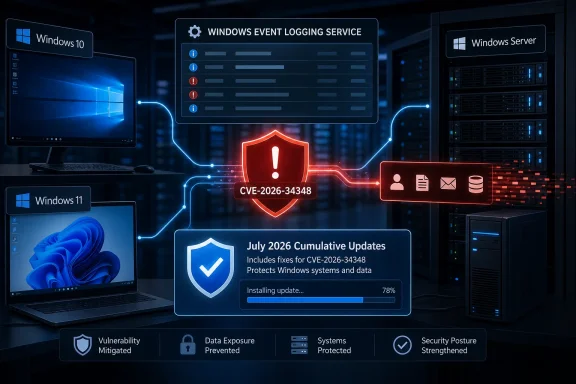
CVE-2026-34348 exposes information through the Windows Event Logging Service, and Microsoft has shipped fixes across Windows 10, Windows 11, Windows Server 2019, Windows Server 2022, and Windows Server 2025. The vulnerability carries a CVSS 3.1 base score of 6.5 and is rated Important, making July’s cumulative security updates the direct remediation path for affected systems.
Detailed in Microsoft’s Security Update Guide on July 14, 2026, the flaw is described as a protection mechanism failure that allows an authorized attacker to disclose information over a network. The National Vulnerability Database, which is still enriching its entry, identifies the underlying weakness as CWE-693, or Protection Mechanism Failure.
Microsoft’s scoring says exploitation requires low privileges but no user interaction. The attack can be initiated over a network, has low attack complexity, and can produce a high confidentiality impact, although Microsoft assigns no integrity or availability impact.
That combination makes CVE-2026-34348 more relevant to enterprise environments than its Medium CVSS label might initially suggest. It does not give an unauthenticated Internet attacker immediate control of a Windows machine, but it may allow someone who already possesses valid access to retrieve information that Windows was expected to protect.
Microsoft’s CVSS vector is CVSS:3.1/AV:N/AC:L/PR:L/UI:N/S:U/C:H/I:N/A:N. In practical terms, an attacker needs an authorized, low-privilege position but does not need to persuade another user to open a document, visit a website, or approve a prompt.
The network attack vector is the important detail. This is not characterized as a purely local information leak requiring interactive access to the target computer. An attacker may be able to reach the vulnerable component across network boundaries wherever the relevant Windows functionality is exposed and authorization requirements can be met.
Microsoft has not publicly described the exact information that can be disclosed, the affected Event Logging Service operation, or a reproducible exploitation sequence. Administrators should therefore avoid assuming that the issue is limited to ordinary event log entries. The vendor’s high confidentiality impact assessment indicates that successful exploitation could reveal information with significant security value.
There is no claimed ability to modify logs, erase records, execute code, elevate privileges, or interrupt the Event Logging Service through this CVE. Those distinctions matter because the name of the affected service could otherwise lead defenders to interpret the flaw as a log-tampering vulnerability.
At the same time, information disclosure frequently becomes more dangerous when chained with another weakness. Data exposed by one vulnerability can help an attacker understand account activity, system configuration, security controls, or other internal state needed to make a later attack more reliable.
Windows Server 2019, Windows Server 2022, and Windows Server 2025 are also listed. Server Core installations are included where applicable, so the absence of the full Windows desktop experience does not remove exposure.
Microsoft’s fixed build thresholds include:
Because Windows security fixes are cumulative, administrators do not need a separate Event Logging Service hotfix if the appropriate July 2026 cumulative update—or a later update that supersedes it—is installed. Build verification is preferable to checking only whether a particular KB appears in update history, especially on machines managed through Windows Server Update Services, Microsoft Configuration Manager, or layered image-maintenance processes.
At publication, Microsoft assessed exploitation as less likely and said CVE-2026-34348 was neither publicly disclosed nor known to be exploited. No public proof-of-concept code or detailed technical write-up was identified in the initial advisory.
That status supports normal accelerated patching rather than emergency isolation based on this CVE alone. However, it should not become a reason to defer the update indefinitely. The affected component is built into Windows, the attack complexity is low, and the confidentiality impact is rated high once an attacker meets the privilege requirement.
The distinction between “authorized attacker” and “trusted user” is also important. An authorized attacker may be a compromised standard account, a malicious tenant user, or an intruder who obtained credentials through phishing, password reuse, token theft, or another vulnerability. Low privileges reduce initial access risk, but they also make the flaw potentially useful after an attacker gains an ordinary foothold.
CVE-2026-34348 should not be read as evidence that all event logs are exposed or that remote event forwarding is inherently unsafe. Microsoft has not published enough technical detail to support either conclusion. The concrete finding is narrower: a protection mechanism failure in the service can permit network-based information disclosure to a low-privileged authorized attacker.
For administrators, the appropriate response is to patch rather than attempt speculative service changes. Disabling Windows Event Log would disrupt diagnostics, auditing, application operation, and incident-response visibility while providing no vendor-backed substitute mitigation. Microsoft has not published a workaround that should replace the security update.
Organizations with staged deployment rings should prioritize domain controllers, management servers, jump hosts, multi-user systems, remote desktop infrastructure, and servers reachable by broad user populations. These machines are more likely to combine valuable logged activity with accounts that an attacker could use to satisfy the low-privilege requirement.
Security teams should also confirm that centralized log collection continues normally after deployment. That is an operational validation step, not an indication that Microsoft has reported logging failures from the fix. Checking collector health, event-forwarding subscriptions, SIEM ingestion, and expected security event volumes can catch unrelated update or configuration problems before they create a monitoring gap.
CVE-2026-34348 is not one of July 2026’s known exploited vulnerabilities, but its reach across current Windows client and server generations makes it difficult to ignore. The practical endpoint is straightforward: install the applicable July cumulative update, verify the fixed OS build, and keep Event Logging Service exposure governed by the same account, firewall, and segmentation controls used for other security-sensitive Windows services.
Detailed in Microsoft’s Security Update Guide on July 14, 2026, the flaw is described as a protection mechanism failure that allows an authorized attacker to disclose information over a network. The National Vulnerability Database, which is still enriching its entry, identifies the underlying weakness as CWE-693, or Protection Mechanism Failure.
Microsoft’s scoring says exploitation requires low privileges but no user interaction. The attack can be initiated over a network, has low attack complexity, and can produce a high confidentiality impact, although Microsoft assigns no integrity or availability impact.
That combination makes CVE-2026-34348 more relevant to enterprise environments than its Medium CVSS label might initially suggest. It does not give an unauthenticated Internet attacker immediate control of a Windows machine, but it may allow someone who already possesses valid access to retrieve information that Windows was expected to protect.
 The Network Vector Raises the Stakes
Microsoft’s CVSS vector is CVSS:3.1/AV:N/AC:L/PR:L/UI:N/S:U/C:H/I:N/A:N. In practical terms, an attacker needs an authorized, low-privilege position but does not need to persuade another user to open a document, visit a website, or approve a prompt.The network attack vector is the important detail. This is not characterized as a purely local information leak requiring interactive access to the target computer. An attacker may be able to reach the vulnerable component across network boundaries wherever the relevant Windows functionality is exposed and authorization requirements can be met.
Microsoft has not publicly described the exact information that can be disclosed, the affected Event Logging Service operation, or a reproducible exploitation sequence. Administrators should therefore avoid assuming that the issue is limited to ordinary event log entries. The vendor’s high confidentiality impact assessment indicates that successful exploitation could reveal information with significant security value.
There is no claimed ability to modify logs, erase records, execute code, elevate privileges, or interrupt the Event Logging Service through this CVE. Those distinctions matter because the name of the affected service could otherwise lead defenders to interpret the flaw as a log-tampering vulnerability.
At the same time, information disclosure frequently becomes more dangerous when chained with another weakness. Data exposed by one vulnerability can help an attacker understand account activity, system configuration, security controls, or other internal state needed to make a later attack more reliable.
Supported Windows Generations Need the Fix
The CVE record identifies a broad set of affected client and server releases. These include Windows 10 Version 1809, Windows 10 Version 21H2, Windows 10 Version 22H2, Windows 11 Version 23H2, Windows 11 Version 24H2, Windows 11 Version 25H2, and Windows 11 version 26H1.Windows Server 2019, Windows Server 2022, and Windows Server 2025 are also listed. Server Core installations are included where applicable, so the absence of the full Windows desktop experience does not remove exposure.
Microsoft’s fixed build thresholds include:
- Windows 10 Version 1809 and Windows Server 2019 are protected at build 17763.9020 or later.
- Windows 10 Version 21H2 and 22H2 are protected at builds 19044.7548 and 19045.7548 or later.
- Windows 11 Version 23H2 is protected at build 22631.7376 or later.
- Windows 11 Version 24H2 and 25H2 are protected at builds 26100.8875 and 26200.8875 or later.
- Windows 11 version 26H1 is covered by its applicable servicing update, with Microsoft’s CVE data listing build 28000.2269 among the relevant boundaries.
- Windows Server 2022 is protected at build 20348.5386 or later.
- Windows Server 2025 is protected at build 26100.33158 or later.
Because Windows security fixes are cumulative, administrators do not need a separate Event Logging Service hotfix if the appropriate July 2026 cumulative update—or a later update that supersedes it—is installed. Build verification is preferable to checking only whether a particular KB appears in update history, especially on machines managed through Windows Server Update Services, Microsoft Configuration Manager, or layered image-maintenance processes.
Confirmed Does Not Mean Exploited
The report-confidence language attached to the advisory indicates that the vulnerability is confirmed. That means Microsoft has acknowledged the defect and supplied an official correction; it does not mean attacks have been observed.At publication, Microsoft assessed exploitation as less likely and said CVE-2026-34348 was neither publicly disclosed nor known to be exploited. No public proof-of-concept code or detailed technical write-up was identified in the initial advisory.
That status supports normal accelerated patching rather than emergency isolation based on this CVE alone. However, it should not become a reason to defer the update indefinitely. The affected component is built into Windows, the attack complexity is low, and the confidentiality impact is rated high once an attacker meets the privilege requirement.
The distinction between “authorized attacker” and “trusted user” is also important. An authorized attacker may be a compromised standard account, a malicious tenant user, or an intruder who obtained credentials through phishing, password reuse, token theft, or another vulnerability. Low privileges reduce initial access risk, but they also make the flaw potentially useful after an attacker gains an ordinary foothold.
Event Logging Is Security Infrastructure
Windows Event Logging sits beneath a large portion of routine administration and security monitoring. Windows components, applications, audit policy, PowerShell, authentication services, and endpoint protection products all rely on event channels to record activity, even when a separate SIEM or collector ultimately stores and analyzes those records.CVE-2026-34348 should not be read as evidence that all event logs are exposed or that remote event forwarding is inherently unsafe. Microsoft has not published enough technical detail to support either conclusion. The concrete finding is narrower: a protection mechanism failure in the service can permit network-based information disclosure to a low-privileged authorized attacker.
For administrators, the appropriate response is to patch rather than attempt speculative service changes. Disabling Windows Event Log would disrupt diagnostics, auditing, application operation, and incident-response visibility while providing no vendor-backed substitute mitigation. Microsoft has not published a workaround that should replace the security update.
Organizations with staged deployment rings should prioritize domain controllers, management servers, jump hosts, multi-user systems, remote desktop infrastructure, and servers reachable by broad user populations. These machines are more likely to combine valuable logged activity with accounts that an attacker could use to satisfy the low-privilege requirement.
Security teams should also confirm that centralized log collection continues normally after deployment. That is an operational validation step, not an indication that Microsoft has reported logging failures from the fix. Checking collector health, event-forwarding subscriptions, SIEM ingestion, and expected security event volumes can catch unrelated update or configuration problems before they create a monitoring gap.
CVE-2026-34348 is not one of July 2026’s known exploited vulnerabilities, but its reach across current Windows client and server generations makes it difficult to ignore. The practical endpoint is straightforward: install the applicable July cumulative update, verify the fixed OS build, and keep Event Logging Service exposure governed by the same account, firewall, and segmentation controls used for other security-sensitive Windows services.
References
- Primary source: MSRC
Published: 2026-07-14T07:00:00-07:00
Security Update Guide - Microsoft Security Response Center
 msrc.microsoft.com
