

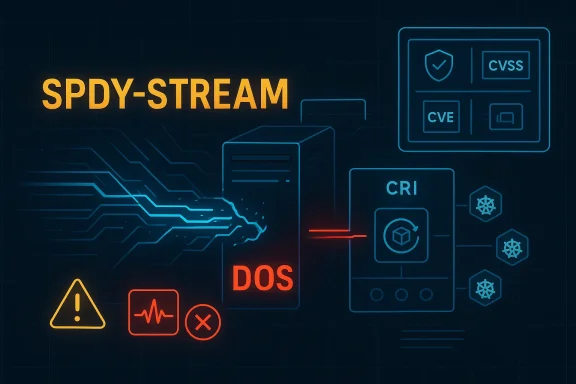
At a high level, that matters because Microsoft’s Security Update Guide is not just a marketing page; it is the company’s structured channel for CVE data, including entries for vulnerabilities in open source libraries bundled into Microsoft products. Microsoft has said it uses the guide to track vulnerabilities in bundled open-source components and to expose those issues through CVSS-scored records and machine-readable feeds, which is why even a terse advisory title can be operationally important for defenders
Background
SpdyStream sits in the long shadow of the SPDY protocol family, the experimental predecessor that influenced HTTP/2’s design. Although SPDY itself is effectively historical, the protocol’s naming still appears in modern software stacks, especially in compatibility layers, embedded networking code, and components that preserve legacy transport behaviors. When a CVE references SpdyStream, it usually points to a code path that still exists for compatibility or internal abstraction, even if the original protocol is no longer headline material.
That is what makes this kind of issue interesting. The bug is not necessarily about “SPDY the protocol” as much as it is about the state machine logic that survives inside a larger transport system. In modern networking code, state bugs are often more dangerous than they first appear because they show up in edge conditions: closed sessions, malformed sequences, repeated transitions, or unexpected reuse of objects after teardown.
The “CRI” part of the title also matters, because it suggests a container-runtime or container-related execution path. In practical terms, that shifts the vulnerability from a purely theoretical protocol problem into a reliability issue that can affect workloads, orchestration, or host services. A denial-of-service in container plumbing is particularly painful because these services often sit close to the control plane, where crashes can cascade into broader instability.
Microsoft’s recent disclosure practices also provide context. The company has made a point of publishing vulnerability records in a more machine-readable form, including CVRF and CSAF, and it has repeatedly emphasized that CVEs in open-source dependencies can matter even when Microsoft is not the upstream author. That means a Microsoft advisory can be a downstream signal about a shared component that appears in multiple products or services
Another important point is that a denial-of-service bug in infrastructure code is not “just a crash.” In shared services, a crash can trigger restart loops, failed health checks, pod churn, and cascading retries. The result may look small in a vulnerability database, but operationally it can become a real outage amplifier. That distinction is central to how administrators should read a CVE like this one.
What the Advisory Tells Us
The advisory title itself gives away the first-order impact: denial of service. That means the vulnerable code path is most likely capable of being forced into a failure state that interrupts service availability rather than leaking data or enabling code execution. For operators, that is still serious, because availability failures often become the first visible symptom in production.
The second clue is the object name, SpdyStream. In codebases that preserve protocol abstractions, stream objects are usually responsible for per-connection lifecycle management, frame sequencing, and teardown. If the vulnerability is attached to that object, the likely failure mode is a broken assumption about stream state, object ownership, or cleanup timing.
Why the wording matters
A title that says “DOS on CRI” is usually a warning that the issue is service-impacting by design, not incidental. Microsoft generally chooses those labels carefully, and its Security Update Guide documentation is intended to help customers sort vulnerabilities by impact and remediation priority rather than by technical curiosity alone
That distinction is important because a lot of teams underestimate denial-of-service flaws. They assume “no code execution” means “low urgency,” when in reality a reliable crash in the wrong component can halt fleets, break automation, or interrupt CI/CD pipelines. In cloud and container environments, availability is security.
- Availability impact usually means forced service disruption, not just a noisy log entry.
- Stream-level bugs often indicate fragile lifecycle handling.
- Container-adjacent components can have outsized blast radius.
- Legacy protocol labels often survive in modern code paths.
- Downstream Microsoft advisories can signal shared-library exposure across products.
Historical Context: Why SPDY Still Matters
SPDY itself is mostly a historical artifact now, but the engineering patterns behind it still matter. Modern transport stacks borrow heavily from the same design ideas: multiplexed streams, layered state transitions, and strict cleanup rules when sessions fail. Those are powerful concepts, but they are also fertile ground for subtle denial-of-service bugs.
Protocol libraries and runtime glue code tend to accumulate compatibility layers over time. That is especially true in container ecosystems, where components need to support many versions, shims, and edge cases. A stream object that was originally built for one protocol family may later be reused in a wrapper or adapter, and that reuse can preserve old assumptions long after the original design has faded.
A bug name like SpdyStream also hints at the kind of technical debt defenders should expect. Legacy transport objects often carry responsibilities that feel routine until something goes wrong: ref counting, frame dispatch, stream closure, and deferred cleanup. If any of those steps are handled out of order, a malicious or malformed input sequence can push the code into a bad state.
The significance of protocol state
The real story here is not the protocol label itself, but the state machine beneath it. State machine bugs are notoriously deceptive because they often require no exotic payloads. They can be triggered by sending valid-looking inputs in the wrong order, or by forcing a component to re-enter a state it assumed was already closed.
Microsoft’s current vulnerability-disclosure ecosystem reinforces that point. The company now emphasizes structured vulnerability metadata, including CVSS, CVE mapping, and machine-readable advisories, because the practical question is always the same: what breaks, how badly, and where does it live in the stack?
Likely Technical Shape of the Bug
Without the full advisory text, the safest reading is that this is probably a state-validation failure in the stream lifecycle. In plain English, the component likely trusted a transition or callback that should have been rejected, and that mistake allowed a crash condition to emerge. That is a classic denial-of-service pattern in parser and protocol code.
The most common failure modes in that family are null dereferences, failed assertions, use-after-close mistakes, or invalid state transitions that trigger a fatal check. Even if the root cause is small, the operational impact can be large if the component sits inside a shared runtime or control-plane service.
What a stream bug usually looks like
A stream object generally tracks things like open/closed state, pending frames, outstanding callbacks, and whether teardown has already occurred. If any of those fields are used after the stream has been logically retired, the code may crash or abort the process. In a container runtime path, that can interrupt workload handling or destabilize a management service.
A few technical signatures would fit the advisory title:
- A frame processed after stream teardown.
- A callback fired against an already-released object.
- A missing guard around a terminal state.
- A failed invariant in a debug or hardened build.
- A race between shutdown and inbound event handling.
That list is not a claim about the exact bug, but it is the most plausible reading based on the title and Microsoft’s usual disclosure style. That uncertainty matters. It is better to avoid overconfident speculation than to pretend the advisory already tells us more than it does.
One reason this matters to defenders is that denial-of-service bugs in protocol engines are often reproducible with low effort. Attackers do not need to “own” the system if they can make it reboot or fall out of service repeatedly. The result may be indistinguishable from a bad deployment to an on-call team until the root cause is identified.
Why assertions and checks matter
If the vulnerable path is driven by a failed assertion or an unchecked invariant, the underlying design issue is likely the same: the code trusted a state transition too much. That is a warning sign in any security-sensitive network stack, because network input should be treated as hostile by default. A single missing check can turn normal cleanup into a crash path.
- Unchecked state is the usual root of these bugs.
- Hard failures are common in debug-hardened code.
- Race conditions may amplify the crash rate.
- Teardown paths are often the most fragile.
- Control-plane callers face the biggest availability risk.
CRI and Container Exposure
The most interesting part of the title is the CRI reference. In container ecosystems, CRI usually evokes the Container Runtime Interface, the layer that lets Kubernetes talk to a container runtime. If a stream bug touches that layer, the implications can extend beyond one pod or one image. It can affect scheduling, lifecycle management, or workload orchestration.
That makes the vulnerability more serious than a generic app-level crash. A container runtime sits close to the infrastructure’s nervous system. If it becomes unreliable, the surrounding orchestration stack can respond with retries, restarts, failed probes, or degraded node behavior.
Why container-adjacent crashes are noisy
Container ecosystems tend to amplify faults. A crash in a runtime-adjacent daemon can trigger reconcilers, health checks, and supervisor loops that create more load while trying to recover. In that way, a denial-of-service flaw can become a failure multiplier, not just a failure point.
Enterprises should think about this in layers. A consumer app crash is bad; a runtime crash can be platform-wide. The more central the component, the more likely the outage will spread through shared services rather than remain isolated to one workload.
This is why Microsoft’s disclosure cadence matters for administrators. If a vulnerability appears in a guide associated with Microsoft’s ecosystem, it can be an indicator that the issue is relevant to bundled code, downstream packaging, or a product that depends on the affected component in more than one place
- Kubernetes-style environments can magnify a runtime fault.
- Node-level services may be the real target, not the app container.
- Health checks can turn a crash into a restart storm.
- Shared runtime components are harder to isolate.
- Control-plane disruption is often worse than workload disruption.
Enterprise Impact
For enterprises, the core question is not whether the bug is glamorous; it is whether it can interrupt business services. The answer, in a CRI-adjacent component, is very likely yes if the vulnerable code sits on a critical path. A denial-of-service in runtime infrastructure can break deployments, stop job scheduling, or interfere with autoscaling.
That means security and operations teams should treat this as a platform risk, not a point issue. Even if the vulnerability only affects a subset of builds or configurations, that subset may include the most sensitive machines in the estate. The systems that most need stability are often the ones most exposed to shared runtime components.
Operational consequences to expect
The first symptoms may be indirect. You might see failed deploys, delayed pod starts, terminated sessions, or repeated health-check failures before anyone links the problem to a CVE. In managed environments, that can cascade into alert noise and wasted triage time.
A few patterns are especially relevant:
- Services begin restarting with no obvious application error.
- Orchestration systems mark nodes or pods unhealthy.
- Retry logic increases traffic and worsens the failure.
- Monitoring shows intermittent drops rather than a clean outage.
- Rollback and redeploy steps fail to stabilize the service.
Those symptoms are exactly why availability bugs deserve fast patching. The absence of data theft does not make the issue benign. A company can lose money, SLA credits, and operational confidence from a crash-only bug just as surely as from a more dramatic exploit.
Consumer and Developer Impact
Consumers are less likely to see SpdyStream in the wild by name, but they may still feel the effects indirectly. Anything that depends on modern transport libraries, containerized tooling, or developer-facing infrastructure can inherit the crash risk through a shared dependency. That includes update systems, desktop tooling, and developer platforms.
Developers should pay particular attention if their software runs on top of container orchestration or uses managed runtime plumbing. A bug in a lower layer can surface as a build failure, a broken local cluster, or an apparently random service exit. These are the kinds of issues that are easy to misdiagnose as flaky infrastructure.
Why indirect exposure is common
Most users do not install protocol libraries directly. They consume them through packages, vendors, platform images, or runtime bundles. That means the vulnerable component may be several layers below the user-visible product, which makes it harder to inventory and slower to patch.
This is one of the reasons Microsoft’s approach to CVE transparency has evolved. The company has said it wants customers to be able to consume vulnerability data through structured channels, because modern software supply chains are too layered for simple “one product, one fix” thinking
- Indirect exposure is the norm, not the exception.
- Developer tools can carry runtime dependencies invisibly.
- Update mechanisms may be part of the blast radius.
- Desktop applications can inherit lower-layer crashes.
- Bundled libraries are harder to notice in inventories.
Why Microsoft’s Disclosure Model Matters
Microsoft’s disclosure model has shifted notably over the last few years. The company now publishes security data not only through the Security Update Guide, but also through CVRF and CSAF formats, and it has repeatedly emphasized machine-readable access to vulnerability information. That matters because modern incident response depends on automation as much as manual investigation
For a CVE like this one, the disclosure path tells us something about seriousness even before the full details are visible. Microsoft does not invest in this level of structured reporting for trivia. It does it because customers need a way to triage, map, and remediate issues across a sprawling product ecosystem.
What that means for patch management
The practical result is that administrators should not wait for a perfect narrative summary before acting. A vulnerability entry in Microsoft’s guide is often the first reliable signal that a downstream dependency has crossed the threshold from theoretical bug to actionable risk. That is especially true when the affected component is embedded in complex infrastructure.
Structured disclosure is a defensive tool. It gives security teams a chance to automate detection, prioritize remediation, and cross-reference vendor backports more quickly. It also helps separate genuine product exposure from mere academic interest.
- Machine-readable advisories speed up triage.
- Structured CVEs support inventory automation.
- Downstream bundling can hide true exposure.
- Patch timing matters more than perfect detail.
- Vendor metadata helps resolve ambiguity fast.
Strengths and Opportunities
The good news is that a denial-of-service disclosure like this one gives defenders a clean action item: find where the component is used and patch it. It also reinforces a larger industry lesson that infrastructure libraries deserve the same scrutiny as visible applications. The more teams internalize that lesson, the less likely they are to be blindsided by a low-glamour outage bug.
- Clear remediation path once fixed builds are identified.
- Inventory hygiene improves when teams trace dependencies.
- Runtime hardening can reduce the blast radius of future bugs.
- Structured disclosure makes automation easier.
- Container teams can tighten lifecycle testing.
- Edge-case fuzzing may expose related stream bugs.
- Patch urgency can be aligned with service criticality.
A second opportunity is to use the disclosure as a test case for dependency mapping. If your organization cannot quickly tell where a stream-handling component lives, that is a process gap worth fixing now. The same is true for build pipelines, images, and vendor appliances that hide library versions behind opaque packaging.
Risks and Concerns
The main concern is that denial-of-service issues are often underestimated because they do not sound as dramatic as remote code execution. That is a mistake in infrastructure environments, where a repeatable crash can be enough to cause meaningful downtime. The title’s CRI reference also raises the stakes, because container plumbing can affect broad sets of workloads.
- Underestimating crash-only bugs can delay patching.
- Container runtime exposure can widen the outage surface.
- Restart loops may convert one crash into a service storm.
- Opaque vendor packaging can hide the true affected version.
- Legacy stream logic may exist in more places than expected.
- Operational fragility can make “simple” DoS bugs costly.
- Insufficient observability may slow root-cause analysis.
Another concern is uncertainty. Because the public advisory details are thin in the browser, defenders may be tempted to wait for a cleaner explanation. That is a risky posture. In security operations, incomplete metadata is still metadata, and the safest default is to assume the component is relevant until proven otherwise.
Finally, there is the risk of transitive exposure. A single library bug can appear in multiple products with different patch cadences, meaning one team may already be safe while another is still vulnerable. That is exactly the sort of asymmetry that makes coordinated remediation difficult.
Looking Ahead
The next thing to watch is whether Microsoft expands the advisory with a more detailed impact statement, affected-product matrix, or fixed-build guidance. If that happens, it will clarify whether the issue is isolated to a specific container-runtime integration or whether it reaches broader platform components. Either way, the existence of the CVE already justifies inventory work.
The second thing to watch is whether downstream vendors issue their own notices. In modern software supply chains, the first advisory is rarely the last. A Microsoft entry can be the visible tip of a much broader dependency chain, especially when an open-source component is embedded in multiple packages or images.
Watch list
- Microsoft’s final advisory text and affected versions.
- Downstream vendor backports or distro rebuilds.
- Container platform release notes and patch bundles.
- Any mention of repeated crash or restart behavior.
- Evidence that CRI exposure is limited to specific integrations.
Administrators should also monitor whether exploitability is limited to a local, authenticated, or network-reachable path. That distinction will shape urgency and containment strategy. If the bug can be triggered by untrusted input on a service boundary, it should move immediately to the top of the patch queue.
Microsoft’s CVE-2026-35469 entry looks like a classic example of why availability bugs in infrastructure code deserve serious attention. A stream-handling flaw in a CRI-related path may not read like a headline-grabbing exploit, but in modern environments, service disruption is the attack. The safest response is to assume the component is production-relevant, inventory where it lives, and patch as soon as a fixed build or vendor backport is available.