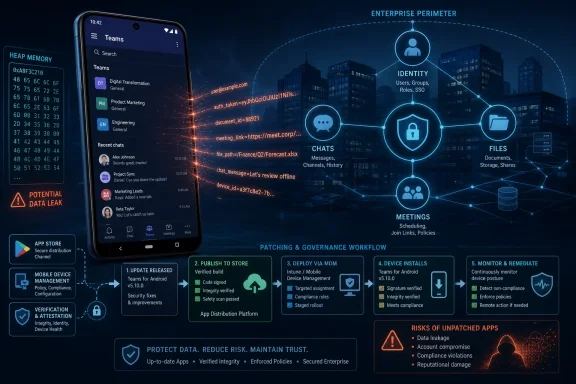
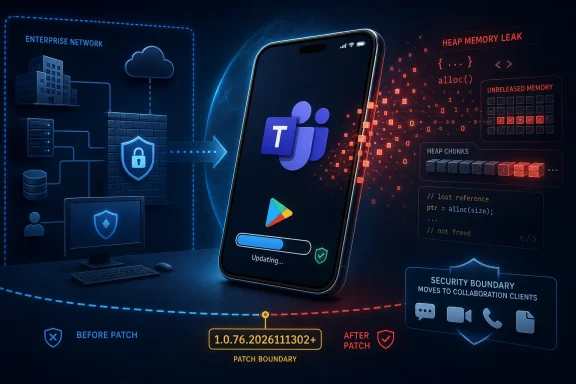
Microsoft disclosed CVE-2026-42835 on June 9, 2026, as a high-severity Microsoft Teams for Android information-disclosure vulnerability affecting versions from 1.0.0 before build 1.0.76.2026111302, with a Microsoft-provided fix now available through Google Play. The bug is not a Windows kernel emergency, and that is precisely why it matters. It shows how Microsoft’s security boundary has moved from the PC under the desk to the collaboration client in everyone’s pocket. For enterprise IT, “patch Microsoft” now means managing Teams, Android, identity, mobile app state, and tenant hygiene as one attack surface.
There was a time when Patch Tuesday mostly meant Windows cumulative updates, Office fixes, Exchange drama, and the occasional browser patch that made administrators wince. That world has not vanished, but it is no longer sufficient. Microsoft’s June 2026 security release is a reminder that the company’s most sensitive surfaces increasingly live in the places administrators once treated as adjacent to the real estate of enterprise security.
Teams for Android is not a sidecar to the Microsoft estate. It is a front door. It carries chat history, call context, files, calendar metadata, meeting invites, tenant identities, and enough organizational graph data to make a reconnaissance team’s work dramatically easier.
That is why CVE-2026-42835 deserves more attention than a typical mobile app patch note. Microsoft rates the issue at CVSS 8.1, with network attack vector, low complexity, low privileges required, and no user interaction. Even with exploitation assessed as less likely at disclosure, the shape of the bug is the kind defenders should not wave away.
The phrase information disclosure has a calming effect it has not earned. It sounds passive, almost bureaucratic. In modern collaboration systems, information disclosure is often the prelude to impersonation, phishing, credential replay, social engineering, and lateral movement.
But memory leaks do not have to be cinematic to be useful. Heap memory is where applications temporarily hold the messy, valuable residue of real use: identifiers, fragments of messages, tokens, cached metadata, serialized objects, and pointers into the current workflow. An attacker does not always need the whole conversation when a session artifact, internal meeting title, tenant hint, or document name will do.
The vulnerability is tied to CWE-74, improper neutralization of special elements in output used by a downstream component. In plain English, Teams for Android is alleged to pass data onward without sufficiently cleaning it for the thing that processes it next. That is the old injection story wearing a mobile collaboration badge.
The downstream-component angle is important because modern apps are not single monoliths. Teams on Android is a web of UI layers, rendering components, identity libraries, push notification paths, media handlers, and service integrations. Sanitization failures become dangerous when one layer assumes another has already made data safe.
This is also why the Android label should not lull Windows-focused administrators. The vulnerable client is only one endpoint in a Microsoft 365 trust chain. If it exposes useful secrets or metadata, the consequences can play out in Entra ID, SharePoint, OneDrive, Outlook, Teams channels, and the human workflow of the business.
The most important part is not the 8.1 number by itself. It is the combination of authentication required and no user interaction. That puts the vulnerability in the uncomfortable middle ground where it is not internet-anonymous doom, but it is also not a “convince the CFO to open a file” bug.
Many Microsoft 365 tenants have more low-privilege identities than they think. Employees, contractors, guest users, test accounts, stale service accounts, shared frontline identities, and business-to-business collaboration accounts all create a broad pool of authenticated footholds. A vulnerability that requires only low privilege must be evaluated against that real population, not against an idealized tenant diagram.
Microsoft’s “Exploitation Less Likely” assessment is useful, but it is not a permission slip to delay. The company also indicates an official fix is available, and the exploit code maturity is unproven. That means defenders are being given the best possible version of vulnerability management: a meaningful bug, a known patched boundary, and no public exploit race at the moment of disclosure.
That makes the Android client a sensitive instrument. Security teams often run live incident bridges in Teams. Executives discuss regulatory exposure there. Engineers paste file names, service names, hostnames, tenant details, and snippets of operational context into channels because Teams is where people already are.
An attacker who can extract even limited memory data from a collaboration client may not receive a neat ZIP file labeled “secrets.” But they may receive the raw ingredients for the next step. A meeting title can reveal an acquisition. A participant list can reveal the right target. A file name can reveal a project codename. A cached message fragment can reveal which system is broken, which vendor is involved, or which administrator is under pressure.
This is the uncomfortable reality of collaboration security. Metadata is no longer secondary. In a tenant-scale attack, the map can be as valuable as the treasure.
The Windows world learned this lesson through Exchange, SharePoint, and Active Directory. Mobile collaboration clients bring the same lesson to devices that are harder to inventory, harder to patch uniformly, and often used outside the network locations where defenders have the best telemetry.
The delivery mechanism is the Google Play Store, which is both convenient and operationally slippery. For unmanaged users, the advice is simple: update Teams. For enterprises, the question is whether that update actually lands everywhere it needs to land.
Mobile patching is not the same as Windows Update. App updates can be delayed by user settings, store access, battery constraints, device compliance rules, regional rollouts, OEM behavior, work-profile configuration, and whether the device is fully managed or merely enrolled for app protection. The user may believe everything is current because Android itself is current, while Teams remains behind.
This is where Microsoft Intune, Android Enterprise management, conditional access, and mobile threat defense integrations matter. The vulnerability is fixed in an app build, so the control has to observe the app build. A compliance dashboard that only says the device is encrypted and has a PIN is not answering the relevant question.
Organizations should treat this as a test of whether their mobile application inventory is real. If the security team cannot tell which Android devices are running vulnerable Teams builds, then CVE-2026-42835 has already revealed a process vulnerability, even before any exploit appears.
A modern Microsoft 365 tenant is designed for collaboration beyond the walls. Guest access, cross-tenant collaboration, shared channels, external meetings, contractor accounts, partner identities, and mobile-first workflows are features, not mistakes. The result is that the population of identities capable of interacting with Teams may be much larger and more varied than the permanent employee directory.
Low privileges also do not mean low value. A compromised contractor account may not be able to administer the tenant, but it may be able to see certain Teams spaces, join meetings, interact with chats, or trigger vulnerable code paths. A stale guest account with limited access can still become a reconnaissance foothold if the vulnerable client or workflow exposes memory fragments.
This is where identity hygiene and vulnerability management converge. The fix is not only “install the patched app.” It is also “reduce the number of accounts that make low-privilege exploitation practical.” Dormant guests, unused collaboration channels, and permissive external access policies all raise the blast radius of bugs like this.
The uncomfortable truth is that authenticated vulnerabilities fit the way attackers already operate. Phishing, token theft, password spraying, session hijacking, and infostealer logs routinely produce valid credentials. Once an attacker has any authenticated position, vulnerabilities that require low privilege become part of the playbook.
That is not a criticism of Microsoft so much as a description of the platform world Microsoft helped build. Teams is a cross-platform client for a cloud service. Its security depends on Android, Google’s app distribution model, Microsoft’s mobile code, tenant identity controls, and enterprise device policy. No single patching muscle covers the whole chain.
For users, this looks easy. Open Play Store, update Teams, move on. For administrators, the reality is more layered. Personal Android devices under BYOD may have Teams protected by app protection policies but not full device management. Fully managed devices may update automatically, but only if policy is configured properly. Ruggedized frontline devices may sit on pinned app versions because business units fear workflow disruption.
The risk is not that Google Play is an inadequate delivery mechanism. The risk is that enterprises have not built Microsoft app patch verification with the same rigor they apply to Windows cumulative updates. In 2026, that distinction is indefensible.
Teams is not a productivity accessory. It is a security-relevant client connected to core business data. Its mobile build number deserves a place in compliance reporting alongside OS version, encryption state, and device health.
Collaboration apps are especially exposed to parser and rendering problems because they ingest everything. Messages, mentions, emojis, links, cards, file previews, adaptive components, meeting metadata, notifications, external identities, and third-party integrations all move through the client. Every feature that makes Teams feel rich also increases the number of places where data must be interpreted safely.
The problem compounds on mobile. Android clients operate under memory constraints, lifecycle interruptions, background restrictions, and a mixture of native and web-derived components. A desktop app may have more room to isolate processes or maintain richer diagnostic state. A mobile client must be efficient, responsive, and battery-aware while still handling hostile or malformed input.
This is why information-disclosure bugs in collaboration clients should receive more respect. They often arise at the seam between components, where assumptions travel faster than threat models. One part of the app thinks it is passing inert output; another treats that output as instructions, markup, or structured input.
Microsoft is hardly alone here. Slack, Zoom, Discord, browsers, email clients, and messaging apps all live in the danger zone between communication and code interpretation. Teams simply matters more in the WindowsForum context because it is deeply embedded in Microsoft’s enterprise stack.
Imagine a low-privilege attacker with a valid account in a large tenant. The goal may not be to crash Teams or steal every message. The goal may be to learn which teams exist, which executives meet with which engineers, what file names appear in active workflows, which incident channels light up after an alert, and which users are likely to approve a request under time pressure.
That kind of targeting intelligence makes phishing sharper. It makes social engineering more believable. It makes business email compromise less generic. It helps an attacker choose which SharePoint library, Teams channel, or identity to probe next.
Mobile clients can be particularly rich in this regard because they preserve immediacy. Push notifications, recent chats, meeting reminders, and cached state reflect what users are doing now, not what was archived months ago. The operational value of fresh context is high.
This is why the phrase “small portions of heap memory” should not end the conversation. The leaked data may be small, but the system it comes from is densely packed with meaning.
Teams outages are not merely inconvenient. They can interrupt support desks, sales calls, incident bridges, classroom sessions, executive approvals, hospital operations, manufacturing coordination, and helpdesk escalation. If a vulnerability has a path to destabilizing the client or service interaction, it may create operational disruption even without data theft.
On Android, availability has another wrinkle: mobile-first workers. Many frontline employees do not treat Teams on Android as a secondary screen. It may be the primary way they receive shifts, assignments, calls, urgent updates, and documentation.
For those environments, patching Teams for Android is not only a confidentiality measure. It is a continuity measure. A vulnerable build that can leak memory or behave unpredictably under crafted input is a risk to the workflow itself.
This is a recurring blind spot in enterprise security. Desktop endpoints receive mature patch orchestration because they are considered “real computers.” Mobile devices, especially employee-owned ones, are often treated as access conveniences. The business has already moved beyond that fiction.
The next step is enforcement. If the organization uses Intune or another MDM platform, Teams for Android should be subject to a minimum version requirement where possible. Conditional access policies should prevent risky or noncompliant mobile clients from accessing corporate data, especially in tenants with sensitive Teams usage.
For BYOD environments, app protection policies become crucial. They cannot magically patch the Play Store app, but they can limit data movement, require approved apps, enforce access conditions, and reduce the risk of unmanaged sprawl. If an organization allows Teams from personal Android devices with no meaningful app governance, this vulnerability is another argument for changing that posture.
Administrators should also review guest and external collaboration settings. A low-privilege authenticated attack path becomes less attractive when the tenant has fewer stale identities, fewer forgotten guest accounts, and tighter policies around shared channels. Vulnerability management and identity lifecycle management belong in the same meeting.
Detection will be harder. Microsoft says exploitation was less likely at disclosure and no public proof-of-concept was known from the reporting available at the time. Even so, teams should watch for unusual Teams access patterns, unexpected Android client versions, anomalous guest activity, and suspicious sign-ins that precede collaboration data access.
That simplicity is useful, but it also hides the broader problem. Most users do not know whether their Teams client holds sensitive cached state. They do not know whether their tenant permits guest accounts that could interact with them. They do not know whether a crafted message, meeting artifact, or downstream component interaction is the relevant trigger.
Users should not be expected to reason through CVSS vectors. That is the job of vendors and administrators. The user-level behavior is merely to update promptly and avoid running stale productivity apps.
Still, organizations should communicate mobile app updates with the same seriousness as desktop patching. A short message saying “Teams for Android must be updated today” is more useful than a generic monthly reminder about cyber hygiene. Specificity changes behavior.
The old security-awareness model told users not to click suspicious links. Modern collaboration security also requires telling users that the apps themselves are part of the patch surface.
In that queue, many organizations will naturally chase the scariest acronyms first. Remote code execution on infrastructure beats information disclosure on Android in most triage rooms. Domain controller risk beats mobile app risk. Publicly disclosed zero-days beat “exploitation less likely.”
That triage instinct is rational but dangerous if it becomes tunnel vision. Collaboration clients connect the human organization to the technical one. They are where credentials, decisions, documents, and relationships meet. A vulnerability in that layer can improve the odds of exploiting everything else.
The broader June story is not that every bug is equally urgent. It is that Microsoft’s ecosystem has become too distributed for old patch categories. Windows Update is one lane. App stores are another. Cloud service changes are another. Admin center configuration, identity policy, browser state, and mobile management are all part of the same security program.
A Windows administrator who does not care about Teams for Android is now making an identity and data-risk decision, whether they intend to or not.
This is the kind of vulnerability where organizations can look competent. They do not need emergency reverse engineering. They do not need to wait for a vendor workaround. They need app inventory, version enforcement, tenant hygiene, and a willingness to treat mobile collaboration clients as first-class endpoints.
The most concrete takeaways are straightforward:
 Microsoft’s Patch Tuesday Has Escaped the Desktop
There was a time when Patch Tuesday mostly meant Windows cumulative updates, Office fixes, Exchange drama, and the occasional browser patch that made administrators wince. That world has not vanished, but it is no longer sufficient. Microsoft’s June 2026 security release is a reminder that the company’s most sensitive surfaces increasingly live in the places administrators once treated as adjacent to the real estate of enterprise security.Teams for Android is not a sidecar to the Microsoft estate. It is a front door. It carries chat history, call context, files, calendar metadata, meeting invites, tenant identities, and enough organizational graph data to make a reconnaissance team’s work dramatically easier.
That is why CVE-2026-42835 deserves more attention than a typical mobile app patch note. Microsoft rates the issue at CVSS 8.1, with network attack vector, low complexity, low privileges required, and no user interaction. Even with exploitation assessed as less likely at disclosure, the shape of the bug is the kind defenders should not wave away.
The phrase information disclosure has a calming effect it has not earned. It sounds passive, almost bureaucratic. In modern collaboration systems, information disclosure is often the prelude to impersonation, phishing, credential replay, social engineering, and lateral movement.
The Heap Leak Is Small, but the Context Is Large
According to the disclosed details, a successful attacker could read small portions of heap memory from Microsoft Teams for Android. That formulation matters. Microsoft is not describing wholesale mailbox dumping, remote code execution, or unauthenticated device takeover.But memory leaks do not have to be cinematic to be useful. Heap memory is where applications temporarily hold the messy, valuable residue of real use: identifiers, fragments of messages, tokens, cached metadata, serialized objects, and pointers into the current workflow. An attacker does not always need the whole conversation when a session artifact, internal meeting title, tenant hint, or document name will do.
The vulnerability is tied to CWE-74, improper neutralization of special elements in output used by a downstream component. In plain English, Teams for Android is alleged to pass data onward without sufficiently cleaning it for the thing that processes it next. That is the old injection story wearing a mobile collaboration badge.
The downstream-component angle is important because modern apps are not single monoliths. Teams on Android is a web of UI layers, rendering components, identity libraries, push notification paths, media handlers, and service integrations. Sanitization failures become dangerous when one layer assumes another has already made data safe.
This is also why the Android label should not lull Windows-focused administrators. The vulnerable client is only one endpoint in a Microsoft 365 trust chain. If it exposes useful secrets or metadata, the consequences can play out in Entra ID, SharePoint, OneDrive, Outlook, Teams channels, and the human workflow of the business.
CVSS Is Not the Risk, but It Points to the Right Argument
The CVSS vector reported for CVE-2026-42835 is doing a lot of work: network reachable, low attack complexity, low privileges required, no user interaction, unchanged scope, high confidentiality impact, no integrity impact, and high availability impact. CVSS is not a crystal ball, and anyone who has run a vulnerability program knows that base scores can both overstate and understate reality. Still, the vector tells administrators what sort of defensive posture is required.The most important part is not the 8.1 number by itself. It is the combination of authentication required and no user interaction. That puts the vulnerability in the uncomfortable middle ground where it is not internet-anonymous doom, but it is also not a “convince the CFO to open a file” bug.
Many Microsoft 365 tenants have more low-privilege identities than they think. Employees, contractors, guest users, test accounts, stale service accounts, shared frontline identities, and business-to-business collaboration accounts all create a broad pool of authenticated footholds. A vulnerability that requires only low privilege must be evaluated against that real population, not against an idealized tenant diagram.
Microsoft’s “Exploitation Less Likely” assessment is useful, but it is not a permission slip to delay. The company also indicates an official fix is available, and the exploit code maturity is unproven. That means defenders are being given the best possible version of vulnerability management: a meaningful bug, a known patched boundary, and no public exploit race at the moment of disclosure.
Mobile Teams Is Now Part of the Incident-Response Room
Teams is not merely where people chat about work. In many organizations, it is where work is coordinated, escalated, approved, and audited informally. It is also where incidents unfold in real time.That makes the Android client a sensitive instrument. Security teams often run live incident bridges in Teams. Executives discuss regulatory exposure there. Engineers paste file names, service names, hostnames, tenant details, and snippets of operational context into channels because Teams is where people already are.
An attacker who can extract even limited memory data from a collaboration client may not receive a neat ZIP file labeled “secrets.” But they may receive the raw ingredients for the next step. A meeting title can reveal an acquisition. A participant list can reveal the right target. A file name can reveal a project codename. A cached message fragment can reveal which system is broken, which vendor is involved, or which administrator is under pressure.
This is the uncomfortable reality of collaboration security. Metadata is no longer secondary. In a tenant-scale attack, the map can be as valuable as the treasure.
The Windows world learned this lesson through Exchange, SharePoint, and Active Directory. Mobile collaboration clients bring the same lesson to devices that are harder to inventory, harder to patch uniformly, and often used outside the network locations where defenders have the best telemetry.
The Patch Boundary Is Clear, Which Makes Excuses Harder
The affected range is unusually actionable: Microsoft Teams for Android versions from 1.0.0 up to, but not including, 1.0.76.2026111302. That patched build is the line administrators should care about. If corporate Teams access is allowed from Android, the device should be at that version or newer.The delivery mechanism is the Google Play Store, which is both convenient and operationally slippery. For unmanaged users, the advice is simple: update Teams. For enterprises, the question is whether that update actually lands everywhere it needs to land.
Mobile patching is not the same as Windows Update. App updates can be delayed by user settings, store access, battery constraints, device compliance rules, regional rollouts, OEM behavior, work-profile configuration, and whether the device is fully managed or merely enrolled for app protection. The user may believe everything is current because Android itself is current, while Teams remains behind.
This is where Microsoft Intune, Android Enterprise management, conditional access, and mobile threat defense integrations matter. The vulnerability is fixed in an app build, so the control has to observe the app build. A compliance dashboard that only says the device is encrypted and has a PIN is not answering the relevant question.
Organizations should treat this as a test of whether their mobile application inventory is real. If the security team cannot tell which Android devices are running vulnerable Teams builds, then CVE-2026-42835 has already revealed a process vulnerability, even before any exploit appears.
“Authenticated Attacker” Is Not the Comfort It Used to Be
Security advisories often sound less alarming when they include the word authenticated. That instinct comes from a period when authenticated meant someone had already crossed a meaningful moat. In cloud collaboration environments, that moat is crowded, federated, delegated, and often partially unmanaged.A modern Microsoft 365 tenant is designed for collaboration beyond the walls. Guest access, cross-tenant collaboration, shared channels, external meetings, contractor accounts, partner identities, and mobile-first workflows are features, not mistakes. The result is that the population of identities capable of interacting with Teams may be much larger and more varied than the permanent employee directory.
Low privileges also do not mean low value. A compromised contractor account may not be able to administer the tenant, but it may be able to see certain Teams spaces, join meetings, interact with chats, or trigger vulnerable code paths. A stale guest account with limited access can still become a reconnaissance foothold if the vulnerable client or workflow exposes memory fragments.
This is where identity hygiene and vulnerability management converge. The fix is not only “install the patched app.” It is also “reduce the number of accounts that make low-privilege exploitation practical.” Dormant guests, unused collaboration channels, and permissive external access policies all raise the blast radius of bugs like this.
The uncomfortable truth is that authenticated vulnerabilities fit the way attackers already operate. Phishing, token theft, password spraying, session hijacking, and infostealer logs routinely produce valid credentials. Once an attacker has any authenticated position, vulnerabilities that require low privilege become part of the playbook.
Microsoft’s Security Perimeter Now Runs Through Google Play
There is a strategic oddity here that Windows administrators should not miss. A Microsoft enterprise security issue may now be remediated through Google Play, enforced through an MDM policy, validated by conditional access, and exploited through a collaboration workflow that never touches a traditional Windows endpoint.That is not a criticism of Microsoft so much as a description of the platform world Microsoft helped build. Teams is a cross-platform client for a cloud service. Its security depends on Android, Google’s app distribution model, Microsoft’s mobile code, tenant identity controls, and enterprise device policy. No single patching muscle covers the whole chain.
For users, this looks easy. Open Play Store, update Teams, move on. For administrators, the reality is more layered. Personal Android devices under BYOD may have Teams protected by app protection policies but not full device management. Fully managed devices may update automatically, but only if policy is configured properly. Ruggedized frontline devices may sit on pinned app versions because business units fear workflow disruption.
The risk is not that Google Play is an inadequate delivery mechanism. The risk is that enterprises have not built Microsoft app patch verification with the same rigor they apply to Windows cumulative updates. In 2026, that distinction is indefensible.
Teams is not a productivity accessory. It is a security-relevant client connected to core business data. Its mobile build number deserves a place in compliance reporting alongside OS version, encryption state, and device health.
The Bug Is Also a Warning About Collaboration App Design
CVE-2026-42835 appears, from the available description, to be a sanitization failure involving output sent to a downstream component. That should sound familiar because it is one of the oldest categories in software security. The new part is the environment.Collaboration apps are especially exposed to parser and rendering problems because they ingest everything. Messages, mentions, emojis, links, cards, file previews, adaptive components, meeting metadata, notifications, external identities, and third-party integrations all move through the client. Every feature that makes Teams feel rich also increases the number of places where data must be interpreted safely.
The problem compounds on mobile. Android clients operate under memory constraints, lifecycle interruptions, background restrictions, and a mixture of native and web-derived components. A desktop app may have more room to isolate processes or maintain richer diagnostic state. A mobile client must be efficient, responsive, and battery-aware while still handling hostile or malformed input.
This is why information-disclosure bugs in collaboration clients should receive more respect. They often arise at the seam between components, where assumptions travel faster than threat models. One part of the app thinks it is passing inert output; another treats that output as instructions, markup, or structured input.
Microsoft is hardly alone here. Slack, Zoom, Discord, browsers, email clients, and messaging apps all live in the danger zone between communication and code interpretation. Teams simply matters more in the WindowsForum context because it is deeply embedded in Microsoft’s enterprise stack.
The Android Client Is a Reconnaissance Gold Mine
Defenders often prioritize vulnerabilities by asking whether they enable code execution. That is reasonable but incomplete. Attackers prioritize by asking whether a flaw advances an operation. CVE-2026-42835 may do exactly that if exploitability proves practical.Imagine a low-privilege attacker with a valid account in a large tenant. The goal may not be to crash Teams or steal every message. The goal may be to learn which teams exist, which executives meet with which engineers, what file names appear in active workflows, which incident channels light up after an alert, and which users are likely to approve a request under time pressure.
That kind of targeting intelligence makes phishing sharper. It makes social engineering more believable. It makes business email compromise less generic. It helps an attacker choose which SharePoint library, Teams channel, or identity to probe next.
Mobile clients can be particularly rich in this regard because they preserve immediacy. Push notifications, recent chats, meeting reminders, and cached state reflect what users are doing now, not what was archived months ago. The operational value of fresh context is high.
This is why the phrase “small portions of heap memory” should not end the conversation. The leaked data may be small, but the system it comes from is densely packed with meaning.
Availability Impact Deserves a Second Look
The CVSS vector also indicates high availability impact. In an information-disclosure story, that can feel odd. But defenders should pay attention because collaboration availability is now a business-continuity issue.Teams outages are not merely inconvenient. They can interrupt support desks, sales calls, incident bridges, classroom sessions, executive approvals, hospital operations, manufacturing coordination, and helpdesk escalation. If a vulnerability has a path to destabilizing the client or service interaction, it may create operational disruption even without data theft.
On Android, availability has another wrinkle: mobile-first workers. Many frontline employees do not treat Teams on Android as a secondary screen. It may be the primary way they receive shifts, assignments, calls, urgent updates, and documentation.
For those environments, patching Teams for Android is not only a confidentiality measure. It is a continuity measure. A vulnerable build that can leak memory or behave unpredictably under crafted input is a risk to the workflow itself.
This is a recurring blind spot in enterprise security. Desktop endpoints receive mature patch orchestration because they are considered “real computers.” Mobile devices, especially employee-owned ones, are often treated as access conveniences. The business has already moved beyond that fiction.
Administrators Need Evidence, Not Hope
The practical response to CVE-2026-42835 starts with inventory. Security teams need to know which Android devices can access corporate Teams, which of those devices are managed, which are BYOD, and which app versions are installed. Without that, every remediation plan is guesswork.The next step is enforcement. If the organization uses Intune or another MDM platform, Teams for Android should be subject to a minimum version requirement where possible. Conditional access policies should prevent risky or noncompliant mobile clients from accessing corporate data, especially in tenants with sensitive Teams usage.
For BYOD environments, app protection policies become crucial. They cannot magically patch the Play Store app, but they can limit data movement, require approved apps, enforce access conditions, and reduce the risk of unmanaged sprawl. If an organization allows Teams from personal Android devices with no meaningful app governance, this vulnerability is another argument for changing that posture.
Administrators should also review guest and external collaboration settings. A low-privilege authenticated attack path becomes less attractive when the tenant has fewer stale identities, fewer forgotten guest accounts, and tighter policies around shared channels. Vulnerability management and identity lifecycle management belong in the same meeting.
Detection will be harder. Microsoft says exploitation was less likely at disclosure and no public proof-of-concept was known from the reporting available at the time. Even so, teams should watch for unusual Teams access patterns, unexpected Android client versions, anomalous guest activity, and suspicious sign-ins that precede collaboration data access.
Users Have the Simplest Job and the Least Context
For individual Android users, the instruction is refreshingly direct: update Microsoft Teams through the Play Store. If the installed build is older than 1.0.76.2026111302, it should be considered vulnerable. Users who rely on automatic updates should still confirm the app has actually updated.That simplicity is useful, but it also hides the broader problem. Most users do not know whether their Teams client holds sensitive cached state. They do not know whether their tenant permits guest accounts that could interact with them. They do not know whether a crafted message, meeting artifact, or downstream component interaction is the relevant trigger.
Users should not be expected to reason through CVSS vectors. That is the job of vendors and administrators. The user-level behavior is merely to update promptly and avoid running stale productivity apps.
Still, organizations should communicate mobile app updates with the same seriousness as desktop patching. A short message saying “Teams for Android must be updated today” is more useful than a generic monthly reminder about cyber hygiene. Specificity changes behavior.
The old security-awareness model told users not to click suspicious links. Modern collaboration security also requires telling users that the apps themselves are part of the patch surface.
The June 2026 Lesson Is Bigger Than Teams
CVE-2026-42835 landed in a large June 2026 Microsoft security release that reportedly addressed 198 vulnerabilities across the ecosystem, including multiple critical remote-code-execution bugs and publicly disclosed issues. That scale matters because it shows how difficult prioritization has become. A mobile Teams information-disclosure bug has to compete for attention against Windows, Hyper-V, Kerberos, Remote Desktop, SharePoint, Office, Secure Boot, and developer tooling.In that queue, many organizations will naturally chase the scariest acronyms first. Remote code execution on infrastructure beats information disclosure on Android in most triage rooms. Domain controller risk beats mobile app risk. Publicly disclosed zero-days beat “exploitation less likely.”
That triage instinct is rational but dangerous if it becomes tunnel vision. Collaboration clients connect the human organization to the technical one. They are where credentials, decisions, documents, and relationships meet. A vulnerability in that layer can improve the odds of exploiting everything else.
The broader June story is not that every bug is equally urgent. It is that Microsoft’s ecosystem has become too distributed for old patch categories. Windows Update is one lane. App stores are another. Cloud service changes are another. Admin center configuration, identity policy, browser state, and mobile management are all part of the same security program.
A Windows administrator who does not care about Teams for Android is now making an identity and data-risk decision, whether they intend to or not.
The Teams Patch That Belongs in the Same Meeting as Windows Update
The operational response to CVE-2026-42835 should be boring, fast, and provable. That is the standard enterprise security keeps claiming to want. The fix exists, the vulnerable version boundary is known, and exploitation was not publicly mature at disclosure.This is the kind of vulnerability where organizations can look competent. They do not need emergency reverse engineering. They do not need to wait for a vendor workaround. They need app inventory, version enforcement, tenant hygiene, and a willingness to treat mobile collaboration clients as first-class endpoints.
The most concrete takeaways are straightforward:
- Organizations should verify that Microsoft Teams for Android is updated to build 1.0.76.2026111302 or later wherever corporate Teams access is permitted.
- Security teams should confirm app-level version compliance, not merely Android OS compliance or device enrollment status.
- Tenants with broad guest access, stale accounts, or permissive external collaboration should treat low-privilege authenticated vulnerabilities as more serious than the phrase suggests.
- BYOD environments should use app protection and conditional access controls to reduce exposure from unmanaged or outdated Teams clients.
- Incident responders should remember that Teams metadata, meeting context, and cached collaboration artifacts can be valuable reconnaissance even when full message theft is not demonstrated.
- Patch Tuesday triage should include Microsoft mobile apps and cloud-connected clients alongside Windows, Office, Exchange, SharePoint, and server workloads.
References
- Primary source: cyberpress.org
Published: 2026-06-12T05:32:08.093281
- Related coverage: windowsforum.com
CVE-2026-42835: High-Severity Microsoft Teams Android Info Disclosure Fix | Windows Forum
Microsoft disclosed CVE-2026-42835 on June 9, 2026, as a high-severity Microsoft Teams for Android information disclosure vulnerability that can let an...windowsforum.com - Related coverage: stack.watch
Microsoft Teams Security Vulnerabilities in 2026
 stack.watch
- Related coverage: blogs.npav.net
Microsoft Teams Android Vulnerability Enables Device Spoofing Attacks
Microsoft warns of a new Microsoft Teams Android vulnerability that could allow spoofing attacks on local devices. Update immediately to stay protected. blogs.npav.net
- Related coverage: cve.imfht.com

Microsoft Teams for Android Vulnerabilities (6 CVEs) | Shenlong CVE Platform
All 6 CVE vulnerabilities found in Microsoft Teams for Android, with AI-generated Chinese analysis, references, and POCs.
cve.imfht.com
- Security advisory: msrc.microsoft.com
Security Update Guide - Microsoft Security Response Center
 msrc.microsoft.com
- Related coverage: cirt.gov.jm
Microsoft Teams Spoofing Vulnerability Could Allow Local Device Impersonation on Android | Jamaica Cyber Incident Response Team
Threat: CriticalTarget Audience:www.cirt.gov.jm - Related coverage: sentinelone.com
CVE-2026-21535: Microsoft Teams Information Disclosure
CVE-2026-21535 is an information disclosure vulnerability in Microsoft Teams. Learn about its impact, affected versions, and mitigation methods.www.sentinelone.com
- Related coverage: app.opencve.io
Teams CVEs and Security Vulnerabilities - OpenCVE
Explore the latest vulnerabilities and security issues of Teams in the CVE databaseapp.opencve.io - Related coverage: cvedetails.com
- Related coverage: redpacketsecurity.com
CVE Alert: CVE-2026-21535 - Microsoft - Microsoft Teams - RedPacket Security
Improper access control in Microsoft Teams allows an unauthorized attacker to disclose information over a network.www.redpacketsecurity.com