
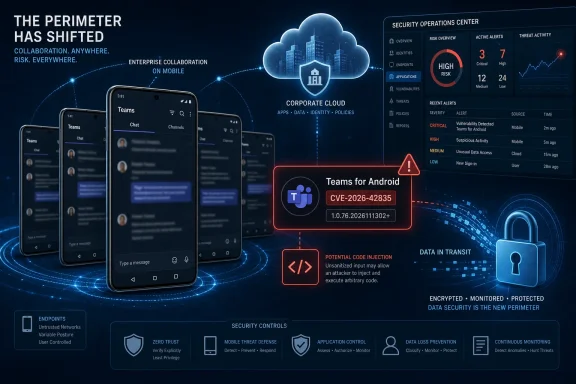
 Teams on Android Is No Longer a Side Door
CVE-2026-42835 lands in the awkward category of bugs that are easy to underestimate because the product name sounds familiar and the platform sounds secondary. “Teams for Android” can read like a companion app, something employees use between meetings or while commuting. In most organizations, however, Teams is where authentication context, internal conversation, shared documents, calendar metadata, guest collaboration, and incident response chatter all converge.
Microsoft describes the vulnerability as an information disclosure issue caused by improper neutralization of special elements in output used by a downstream component — in plain English, an injection class problem. The published CVSS 3.1 score is 8.1, which places it in high-severity territory. The vector is especially notable: network attack vector, low attack complexity, low privileges required, no user interaction, high confidentiality impact, no integrity impact, and high availability impact.
That combination should make mobile admins pause. This is not described as a physical-access flaw or a bug that requires tricking a user into opening a local file. Microsoft’s scoring says an authorized attacker can reach it over a network, does not need elevated privileges, and does not need the victim to tap through a prompt.
The affected product listing covers Microsoft Teams for Android from version 1.0.0 up to versions before 1.0.76.2026111302. Microsoft’s advisory marks the remediation level as an official fix and the report confidence as confirmed. In other words, this is not rumor, telemetry speculation, or a third-party scanner extrapolation. It is a vendor-acknowledged vulnerability with a defined fixed version boundary.
The CVSS Score Tells a More Interesting Story Than the Name
Information disclosure vulnerabilities often get mentally filed below remote code execution, privilege escalation, and authentication bypass. That habit is understandable, but it is increasingly dangerous in collaboration platforms. The sensitive asset in Teams is not merely the app process; it is the data graph the app can see.
The CVSS vector for CVE-2026-42835 is doing a lot of work. A network-reachable issue with low attack complexity and no required user interaction is qualitatively different from a bug that depends on local access, elaborate timing, or social engineering. The low-privilege requirement matters too: Microsoft is not saying an anonymous internet user can exploit it, but it is saying the bar is not administrative control.
That distinction is exactly where modern enterprise risk lives. Many organizations have thousands of valid, low-privilege identities: employees, contractors, vendors, guests, service accounts, test users, and stale accounts that should have been disabled after a project ended. A flaw that can be reached by an authorized attacker may still be highly relevant if the authorization requirement maps to the messy reality of tenant access.
The impact metrics sharpen the point. Microsoft’s vector assigns high confidentiality impact and high availability impact, while integrity impact is none. That suggests the core concern is not silent modification of Teams content. It is exposure, leakage, or disruption arising from how Teams for Android passes output to another component.
Microsoft has not published exploit code or a full technical walkthrough, and that restraint is normal for Patch Tuesday advisories. The absence of a public proof-of-concept should not be confused with the absence of urgency. The vulnerability maturity data says exploitability is unproven, but report confidence is confirmed.
“Authorized Attacker” Is Not the Comforting Phrase It Used to Be
Security advisories often use phrases that sound narrower than they are. “Authorized attacker” is one of them. To a casual reader, it can sound as if the attacker already needs to be inside the castle, making the vulnerability less urgent. To an identity administrator, it sounds more like Tuesday.
Modern Microsoft 365 environments are built around delegated access, guest collaboration, federated identities, mobile sign-ins, and conditional access rules that vary by user, device, geography, app, and risk signal. The old mental model of a hard perimeter has little value when a legitimate identity can be phished, purchased, created through a forgotten guest invitation, or abused through an over-permissive collaboration policy.
That is why Teams vulnerabilities deserve more attention than their product category sometimes receives. Teams is not only a chat client. It is a front end to SharePoint files, meeting artifacts, chats, channel histories, phone calls, app integrations, bots, connectors, and in some organizations, operational workflows that were never designed as formal line-of-business applications but have become indispensable anyway.
A low-privilege attacker who can disclose information through Teams does not necessarily need domain admin to cause damage. Meeting titles, participant lists, internal file names, project channels, escalation threads, incident-room context, and organizational relationships can all be useful. For attackers, metadata is not trivia; it is targeting material.
The more organizations centralize work in Teams, the more any Teams client vulnerability becomes a question about information architecture. If sensitive conversations, legal strategy, merger planning, customer incidents, or security-response discussions are all happening in one collaboration surface, then “information disclosure” becomes a business risk rather than a mere app bug.
Android Patch Management Remains the Enterprise Blind Spot
Windows admins have muscle memory for Patch Tuesday. They know the cadence, the tooling, the rollback anxiety, the change windows, and the politics of forced reboots. Android app patching, by contrast, often sits in a gray zone between endpoint management, mobile device management, app-store automation, and user behavior.
That gap matters for CVE-2026-42835. The fix is tied to Teams for Android versioning, not a Windows cumulative update. For unmanaged or lightly managed devices, the practical mitigation may depend on whether Google Play auto-updates are enabled, whether the user is on a network that permits updates, whether the device has storage constraints, and whether the organization has policies requiring current app versions.
For managed devices, the answer should be more straightforward, but only if the mobile estate is actually governed. Microsoft Intune, Android Enterprise, managed Google Play, compliance policies, and conditional access can all help push organizations toward the fixed Teams version. But many environments still treat mobile app updates as “best effort,” especially for bring-your-own-device fleets where the organization manages apps rather than the entire device.
The Android ecosystem also complicates verification. An admin may know that Teams has an update available, but still need to prove that a specific user population is running at least 1.0.76.2026111302. That is a reporting and enforcement problem, not simply a patch availability problem.
This is where high-severity mobile collaboration bugs expose process debt. If an organization cannot quickly answer which Android devices have Teams installed, which version is deployed, whether updates are mandatory, and whether noncompliant clients are blocked from accessing corporate data, then the vulnerability is only partly about Microsoft’s code. The rest is about asset visibility.
Microsoft’s Disclosure Is Sparse, but the Silence Has Meaning
Microsoft’s advisory does not give defenders a packet capture, exploit chain, affected endpoint, or detailed reproduction path. That is frustrating, but it is not unusual. Patch Tuesday entries are often designed to communicate enough for prioritization without handing attackers a roadmap.
The most useful details are therefore the structured ones. The vulnerability is in Microsoft Teams for Android. The weakness maps to CWE-74, an injection category involving output consumed by a downstream component. The attack vector is network. The attacker needs low privileges. No user interaction is required. The fix boundary is a specific Teams for Android version.
Those details are enough to shape a defensive response. This is not a bug that should wait for a quarterly mobile-app refresh. It should be handled as a priority update for any Android user who accesses corporate Teams data, especially in environments with external collaboration, guest users, contractors, regulated data, or sensitive incident-response workflows.
The sparse disclosure also makes exploit monitoring harder. Defenders cannot easily write a targeted detection rule for a vulnerability whose operational details are not public. In practice, that shifts the response back to exposure reduction: update the app, tighten access, review mobile compliance, and watch for suspicious Teams activity through available audit logs.
There is a subtle irony here. The less public technical detail Microsoft releases, the less defenders can hunt specifically — but the less attackers can trivially weaponize from the advisory alone. That trade-off is familiar, and it is one reason mature security programs do not wait for exploit writeups before patching high-confidence, high-severity vendor-confirmed bugs.
The June Patch Tuesday Crowd May Hide the Mobile Risk
CVE-2026-42835 arrived as part of Microsoft’s June 2026 Patch Tuesday, a release that included hundreds of flaws and multiple publicly disclosed zero-days. In that kind of volume, a Teams for Android information disclosure issue can disappear behind Exchange, Windows, Office, and server-side vulnerabilities that feel more traditional.
That would be a mistake. Patch Tuesday triage is not simply a severity scoreboard. It is a map of where an organization’s actual exposure meets exploitability, data sensitivity, and operational dependency.
For many enterprises, Teams for Android is deployed broadly to executives, sales staff, field workers, support engineers, healthcare staff, manufacturing supervisors, and on-call responders. Those users are often the very people whose communications have high intelligence value. Mobile devices are also more likely to operate outside the corporate network, mix personal and business contexts, and move through unpredictable connectivity environments.
The security team’s instinct may be to prioritize servers first, then Windows endpoints, then browsers, then productivity apps. That hierarchy is not wrong, but it is incomplete. A collaboration app with high-value data and network-reachable attack characteristics deserves to be in the first triage meeting, not discovered later by the mobile team.
The larger Patch Tuesday lesson is that Microsoft’s security perimeter is now distributed across clients, cloud services, mobile apps, identity layers, and collaboration surfaces. Administrators who still treat “Microsoft patching” as synonymous with Windows Update are managing yesterday’s estate.
The Fix Is Simple; Proving the Fix Is Not
For individual users, the answer is boring and effective: update Microsoft Teams for Android through the official app channel. The affected range ends before version 1.0.76.2026111302, so anything older than that should be treated as needing remediation.
For enterprise IT, the job is to make that boring answer enforceable. Mobile application management policies should require approved Teams versions. Conditional access should be able to block access from noncompliant devices or outdated apps where the organization’s licensing and architecture permit it. App protection policies should limit the amount of Teams data that can leak from the managed app boundary.
The hard part is exception handling. Some users will have old devices. Some Android builds will lag app updates. Some regions may have store-access constraints. Some BYOD users will resist management. Some executive devices will be treated as special until a security incident proves they should not have been.
That is why vulnerability response has to be joined to governance. If Teams is critical enough to carry company communications, it is critical enough to be governed. If an Android device is allowed to access corporate Teams data, it should be visible in inventory, subject to compliance checks, and removable from access when it falls behind.
This is also a good moment to review guest and low-privilege access. CVE-2026-42835 requires an authorized attacker, which makes stale identities, unmanaged guest accounts, and overly broad channel access more relevant. Patching closes the specific door, but identity hygiene reduces the damage if another door opens later.
The Signal Beneath This Teams Bug Is Bigger Than Teams
The most important thing about CVE-2026-42835 may be what it says about the new normal. Enterprise collaboration clients are becoming rich, stateful, extensible applications that broker sensitive data between cloud services, local device features, embedded viewers, notifications, identity tokens, and third-party integrations. That architecture is powerful, but every handoff between components is a potential security boundary.
An injection weakness in output used by a downstream component is exactly the kind of flaw that emerges in complex application plumbing. The vulnerability description does not say “Teams stores a password in a text file” or “a debug endpoint is open.” It points to how one component’s output is consumed by another. That is where modern client-side security often gets messy.
Mobile clients add another layer. Android apps must interact with intents, web views, notification systems, file providers, account managers, deep links, and local storage models. A flaw in any of those interactions can turn into information exposure if sensitive content crosses a boundary in a way the developer did not intend.
For WindowsForum readers, the lesson is not that Android is uniquely fragile. It is that Windows-centric security programs must now govern non-Windows clients with the same seriousness they bring to domain controllers and laptops. Microsoft 365 has made the endpoint plural.
The practical future of Microsoft security is cross-platform. Your Windows patch dashboard may be green while your mobile collaboration clients remain exposed. Your identity policy may look strict while old guest accounts still have enough privilege to matter. Your data-loss prevention strategy may cover documents while Teams conversations reveal the business context around those documents.
The Concrete Moves Before This Becomes Just Another CVE
CVE-2026-42835 should not create panic, but it should force a short, disciplined response cycle. The bug is confirmed, the affected product is specific, the fixed version boundary is public, and the attack characteristics are serious enough to justify quick action.
- Organizations should verify that Microsoft Teams for Android is updated to version 1.0.76.2026111302 or later wherever corporate Teams access is permitted.
- Mobile admins should use MDM or MAM reporting to identify Android devices running vulnerable Teams versions rather than relying on app-store auto-update assumptions.
- Conditional access policies should be reviewed to ensure outdated or unmanaged mobile clients cannot continue accessing sensitive Teams data indefinitely.
- Security teams should audit guest users, low-privilege accounts, and stale collaboration access because the vulnerability requires authorization rather than administrative control.
- Incident responders should treat Teams metadata, chats, files, and meeting context as sensitive assets when evaluating the possible impact of information disclosure.
- Patch Tuesday triage should include mobile Microsoft apps alongside Windows, Office, Exchange, browsers, and cloud-facing services.
CVE-2026-42835 is the kind of vulnerability that rewards organizations with boring fundamentals: current apps, visible devices, enforceable access, and clean identities. Microsoft has supplied the fix, but the more revealing test is whether enterprises can prove that the fix reached the phones where work actually happens. The next serious Microsoft client vulnerability may not arrive through Windows Update at all, and the organizations that understand that now will be the ones least surprised when collaboration security becomes the next front line.
