

Microsoft’s “Important” Label Hides a 9.6 Base Score
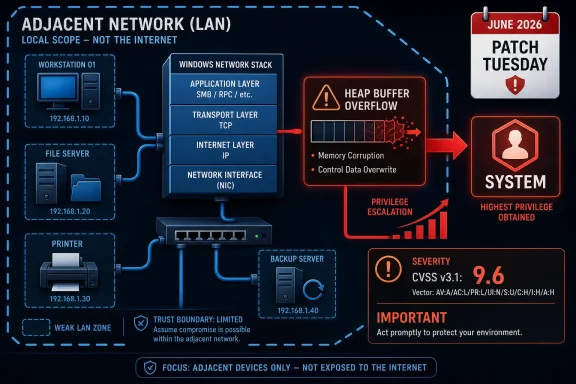
Microsoft rates CVE-2026-42904 as Important, but the CVSS base score lands at 9.6, a number most administrators instinctively associate with Critical urgency. That apparent mismatch is not a clerical oddity; it reflects how Microsoft weighs exploitability context alongside theoretical impact. The bug is not described as internet-routable remote code execution, but successful exploitation would cross into the kind of privilege level that defenders reserve for worst-case scenarios.
The vulnerability sits in Windows TCP/IP, one of the least optional components in the operating system. TCP/IP is not an add-on, a role service, or a feature a desktop owner knowingly enables after installation. It is the plumbing beneath ordinary networking, and that makes even constrained flaws in the stack operationally sensitive.
Microsoft’s executive summary describes the root problem as a heap-based buffer overflow. In plain English, that means data handled by the networking stack can overrun memory boundaries in a way that may let an attacker influence execution or state. The consequence Microsoft assigns is elevation of privilege, not direct remote code execution, but the FAQ makes the meaningful end state clear: a successful attacker could gain SYSTEM privileges.
That is the reason the advisory deserves more attention than its “Important” banner might receive in a crowded month of patches. A bug that begins on the adjacent network but ends as SYSTEM is not a mere housekeeping issue. It is a lateral-movement accelerator waiting for the wrong environment.
The Adjacent-Network Requirement Narrows the Door, Not the Damage
The most important constraint in Microsoft’s scoring is the attack vector: adjacent. This is not a vulnerability Microsoft says can be exploited from anywhere on the internet. The attacker needs LAN access, meaning the practical danger depends heavily on how much trust an organization places in its local network.
That distinction matters. A coffee-shop attacker, a compromised guest Wi-Fi client, a hostile device in a dorm network, or malware already present on a flat enterprise subnet lives in a different threat model from a random internet scanner. CVE-2026-42904 is not described as wormable across the public internet, but it may still matter inside networks where “inside” has become a dangerously broad category.
Many organizations have spent the last decade preaching zero trust while leaving old assumptions embedded in VLANs, printer networks, lab environments, and remote-access enclaves. Adjacent-network bugs punish that gap. They do not need the whole world to be reachable; they need a foothold where segmentation is sloppy, device hygiene is uneven, or wireless access is treated as a convenience layer instead of an attack surface.
For home users, the risk picture is different but not nonexistent. A trusted home network filled with phones, smart TVs, IoT devices, work laptops, and visiting devices is no longer a simple two-computer LAN. A vulnerability requiring local network proximity can still become meaningful when the least trustworthy device in the house shares a broadcast domain with the most important one.
“Confirmed” Is the Metric Administrators Should Not Skim Past
The user-provided CVSS definition for Report Confidence is the quiet center of this advisory. Microsoft marks CVE-2026-42904 as Confirmed, meaning the vendor acknowledges the vulnerability’s existence and the technical basis is credible enough to support operational action. In vulnerability management, that is very different from rumor, speculative research, or a vague impact statement with no root cause.
Report Confidence does not say exploit code is public. It does not say attackers are using the bug. It says the vulnerability is real enough that defenders should stop debating whether the advisory describes a valid problem. That shifts the conversation from “is this credible?” to “how fast can we test and deploy the fix?”
Microsoft also lists Exploit Code Maturity as Unproven. That is the other half of the story. The company is effectively saying that, at publication, it is not aware of public exploit code or observed in-the-wild exploitation, while also confirming that the underlying flaw exists.
Those two facts can coexist. A vulnerability can be confirmed and still not weaponized. In fact, that is the sweet spot for defenders: the bug is real, the vendor has issued an official fix, and exploitation has not yet become a public race. The goal is to patch while the issue is still in that window.
A Heap Overflow in TCP/IP Is a Familiar Kind of Bad News
Windows TCP/IP vulnerabilities have a long history of producing anxiety disproportionate to their final exploitability. That is because network-stack bugs inhabit privileged, exposed, highly complex code. Even when the trigger conditions are narrow, the affected component is close enough to the kernel and broad enough in deployment to make defenders uneasy.
CVE-2026-42904 is classified under CWE-122, heap-based buffer overflow. This category has been around for decades, yet it remains stubbornly relevant because systems software still has to parse untrusted data at high speed. Network stacks are especially unforgiving: they must accept malformed, fragmented, reordered, and hostile traffic while preserving performance and compatibility.
The advisory’s impact field is elevation of privilege rather than remote code execution, which may tempt some teams to downgrade it in their queues. That would be too glib. SYSTEM privileges on Windows are the prize attackers often seek after initial access, and a flaw reachable from an adjacent network may be useful in chains that begin with phishing, rogue access points, compromised VPN clients, or infected endpoints.
The right mental model is not “remote attacker owns the internet.” It is “a device near me may be able to turn network adjacency into operating-system control.” That is a narrower scenario, but in enterprise networks, adjacency is often abundant.
Patch Tuesday Turns Theory Into a Build Number
Microsoft has issued official fixes across affected Windows versions, which is why the temporal score is lower than the alarming base score. The advisory lists updates for Windows 10, Windows 11, Windows Server 2022, and Windows Server 2025, including Server Core installations. In other words, this is not a niche SKU problem.
The fixed builds are specific enough for administrators to verify state rather than rely on vague “patched” labels. Windows 11 23H2 moves to build 22631.7219. Windows 11 24H2 and 25H2 move to build 26100.8655 and 26200.8655 respectively, while Windows Server 2025 is listed at 26100.32995. Windows 10 22H2 is listed at 19045.7417, and Windows Server 2022 at 20348.5256.
That build-number trail matters in mixed environments. Windows patch compliance is often reported through a stack of tools that do not always agree: Intune, WSUS, ConfigMgr, third-party scanners, vulnerability platforms, EDR dashboards, and homegrown inventory scripts. The build number is the common denominator when the dashboard says green but the asset owner is not convinced.
The presence of Windows 10 21H2 in the advisory also raises the old lifecycle issue. Some Windows 10 editions remain in support through enterprise servicing channels while others do not. Microsoft’s Security Update Guide tells customers to check lifecycle status, which is polite vendor language for a harsher operational truth: vulnerability management becomes messier when old versions are kept alive for business reasons.
The Risk Is Highest Where the LAN Still Means “Trusted”
The organizations most exposed to this kind of flaw are not necessarily the ones with the most Windows machines. They are the ones where network access still conveys excessive trust. Flat networks, permissive east-west traffic, shared administrative zones, and long-lived legacy segments all make adjacent-network vulnerabilities more attractive.
Campus networks are a classic example. So are factories, hospitals, labs, and branch offices where operational requirements have historically beaten segmentation projects. In those settings, the attacker does not need internet reachability if gaining a local foothold is easy enough.
Wireless networks deserve special attention. The CVSS adjacent vector includes scenarios such as shared physical or logical networks, and Wi-Fi is the everyday version of that condition. Guest Wi-Fi segmentation, client isolation, NAC posture checks, and sensible firewalling between wireless and wired assets are not luxuries when the underlying OS networking stack has a confirmed flaw.
Remote access can also blur adjacency. VPNs often place users into internal network zones that behave like local subnets, especially in older designs. If a compromised laptop connects through a VPN and gains proximity to servers or peer clients, “adjacent” can become a much broader concept than the word suggests.
Exploitation Unlikely Is Not a Permission Slip
Microsoft’s exploitability assessment says exploitation is unlikely. That should shape urgency, but it should not become an excuse for indefinite delay. “Unlikely” is a snapshot at publication, not a lifetime guarantee.
The security industry has repeatedly watched advisories age from obscure Patch Tuesday entries into exploit-chain components. Once a patch is available, attackers can study the differences between vulnerable and fixed code, infer the bug class, and test possible triggers. Not every vulnerability yields a reliable exploit, but the clock starts when the update ships.
The combination here is awkward for defenders: no public exploit, no known active exploitation, official fix available, confirmed vulnerability, and high-impact privilege gain. That is precisely the kind of issue that should move quickly through normal patch channels rather than trigger emergency shutdowns. It is not time to panic; it is time to avoid becoming the organization that waits until the first proof-of-concept circulates.
For most businesses, the practical response is straightforward. Test the June 2026 cumulative updates against representative systems, prioritize internet-edge-adjacent and LAN-exposed Windows assets, and watch for unusual networking or kernel crash telemetry during deployment. The patch is the mitigation path Microsoft is advertising.
Windows Clients Matter as Much as Servers Here
Server administrators tend to focus on TCP/IP vulnerabilities because servers listen, route, and expose services. But this advisory covers Windows clients as well, and the local-network angle makes clients important. A laptop on a hostile network can be both target and bridge.
Windows 11 endpoints on corporate Wi-Fi, Windows 10 systems in extended operational use, and ARM64 devices are all represented in the affected-product list. That breadth argues against a server-only patching mindset. If the bug can be triggered from an adjacent network without prior privileges or user interaction, endpoints deserve attention.
The lack of user interaction is especially notable. There is no email attachment to avoid, no malicious document to close, no browser warning to heed. Network-adjacent exploitation, by design, happens below the level where user training helps. That makes patching, segmentation, and network controls more important than awareness campaigns.
For managed fleets, this is a good moment to verify update rings. Consumer and small-business Windows Update behavior will likely carry many devices forward automatically, but enterprises often defer cumulative updates for testing. That is reasonable; leaving high-impact network-stack fixes in a long queue is not.
Research Credit Signals Coordinated Disclosure, Not Internet Drama
Microsoft credits Jonghoi Kim and Donghyeon Oh of Patchpoint, indicating the vulnerability came through a coordinated research path rather than a public surprise. That matters because coordinated disclosure usually gives the vendor time to produce a fix before broad technical details appear. It also means defenders are reading the advisory at the beginning of the public-risk phase, not after exploitation has already forced disclosure.
There is a temptation in security reporting to treat every CVE as either a five-alarm fire or background noise. CVE-2026-42904 fits neither category neatly. It is confirmed, severe in potential impact, and fixed, but not publicly exploited according to Microsoft at release.
That nuance is useful. It lets defenders be disciplined instead of theatrical. The correct operational posture is not “drop everything everywhere,” but neither is it “wait for next quarter.” It is to push the update through existing expedited channels and focus verification on systems where adjacent-network exposure is plausible.
The advisory also illustrates the value of reading more than the severity label. “Important” could understate the concern for teams that triage purely by vendor severity. “CVSS 9.6” could overstate internet-facing urgency for teams that ignore attack vector. The truth is in the interaction between the two.
The June Patch Queue Has a Clear LAN Priority
For administrators deciding what to do next, CVE-2026-42904 should be treated as a network-adjacent privilege-escalation risk with a vendor-confirmed root cause and official patches available. It is not a public zero-day, but it is not speculative either. The most concrete reading of the advisory is that the window for quiet remediation is open now.
- Microsoft released the advisory on June 9, 2026, and identifies the flaw as a Windows TCP/IP heap-based buffer overflow.
- A successful attacker could gain SYSTEM privileges, which makes the impact serious even though the attack vector is adjacent rather than internet-wide.
- Microsoft says the vulnerability was not publicly disclosed and not exploited at the time of publication.
- The CVSS report-confidence value is Confirmed, while exploit-code maturity is Unproven, creating a patch-now-but-don’t-panic risk profile.
- Fixed builds are available for supported Windows 10, Windows 11, Windows Server 2022, and Windows Server 2025 systems.
- Environments with flat LANs, permissive Wi-Fi, broad VPN access, or weak internal segmentation should prioritize validation and rollout.
The larger lesson is that Windows security in 2026 is no longer just about guarding the internet edge. The local network is full of semi-trusted devices, contractor laptops, unmanaged hardware, VPN clients, lab machines, and consumer-grade gear that can turn “adjacent” into “near enough.” CVE-2026-42904 may never become a widely exploited bug, and Microsoft’s current assessment points away from imminent mass abuse. But the confirmed flaw, SYSTEM outcome, and official fixes make the responsible path obvious: patch while the story is still boring.