

Microsoft disclosed CVE-2026-42907 on June 9, 2026, as a Windows Shell information disclosure vulnerability affecting supported Windows client and server releases, with public listings placing it at medium severity and tying remediation to the June Patch Tuesday security updates. The headline is not that Windows Shell has another bug; that is almost routine. The more useful story is that this is the kind of vulnerability whose danger lives in context, chaining, and operational timing rather than in a dramatic standalone exploit. For Windows administrators, CVE-2026-42907 is a reminder that “information disclosure” is not a polite synonym for “ignore.”
CVE-2026-42907 arrived in the June 2026 security update cycle, a month already crowded enough to make any single medium-severity entry look small. Microsoft’s own Security Update Guide entry identifies the issue as a Windows Shell information disclosure vulnerability, and third-party mirrors of the advisory list affected product families including Windows 10, Windows 11, Windows Server 2019, Windows Server 2022, and Windows Server 2025.
That breadth matters. Windows Shell is not an obscure optional component sitting off to the side of the operating system. It is the user-facing and file-navigation fabric of Windows: Explorer, shell integration, desktop affordances, file handling, metadata presentation, shortcuts, previews, icons, and the plumbing that lets users interact with the system without thinking about where the boundary between UI and OS really is.
The Shell’s ubiquity is why information disclosure bugs in this area deserve more respect than their severity labels often receive. A vulnerability that leaks sensitive information from one local or interactive context may not hand an attacker SYSTEM privileges, but it can supply the missing piece for a later step: a path, a token-adjacent artifact, a username, a file attribute, a network location, an internal naming convention, or evidence that a target opened or rendered something.
Microsoft has not publicly filled in the sort of exploit narrative that would let defenders say with confidence exactly what CVE-2026-42907 exposes or how attackers would operationalize it. That absence is itself part of the story. In modern vulnerability management, defenders often patch first and understand later.
That ambiguity is especially acute in Windows Shell. The Shell often brokers user interaction with untrusted or semi-trusted content: downloaded files, archives, removable media, network shares, shortcuts, cloud-synced folders, thumbnails, previews, and documents whose icons and metadata may be generated by handlers outside the narrow core of Explorer. A Shell bug does not need to look like a traditional remote exploit to matter in a phishing-heavy enterprise environment.
The practical question is not whether CVE-2026-42907 is “just” an information disclosure flaw. The question is what information becomes available, under what user action, and whether the disclosure crosses a security boundary that administrators assumed was firm. A leak from a low-privilege context into a more privileged one, from local machine state into attacker-observable behavior, or from protected content into user-accessible metadata can all be useful to an adversary.
That is why admins should resist the old reflex of sorting Patch Tuesday by remote code execution first, elevation of privilege second, and everything else as cleanup. Attackers do not read severity spreadsheets the way change advisory boards do. They assemble paths.
That distinction matters for CVE-2026-42907 because the public record is thin. Microsoft acknowledges the vulnerability and assigns it to Windows Shell, which is a strong signal that the issue is real and that the vendor has enough information to ship a fix. But the advisory does not, at least publicly, walk defenders through a detailed root cause, proof-of-concept path, or attacker playbook.
High confidence does not mean high severity. It means the issue is not rumorware. Low public detail does not mean low attacker interest. In fact, after a vendor patch lands, the calculus changes: adversaries can compare binaries, diff changed code paths, and work backward from the fix. The defender’s advantage is temporary, and it is measured in deployment speed.
This is one of the quiet tensions in Microsoft’s Security Update Guide model. The company publishes enough to support risk decisions but often withholds the kind of detail that would make an article like this more technically satisfying. That is defensible from a harm-reduction perspective, but it leaves administrators managing a gray zone: the bug is confirmed, the product surface is important, and the exploit specifics are not public.
Explorer is where users double-click. It is where they preview. It is where they unzip. It is where they browse network paths, copy files from cloud shares, inspect downloads, and interact with objects whose visual representation may conceal complicated parsing logic. That makes the Shell both mundane and privileged in the practical sense: it is trusted by users even when it is handling untrusted content.
The Windows ecosystem has a long memory of Shell-adjacent problems. Shortcut processing, icon extraction, preview handlers, file association logic, thumbnail generation, and metadata parsing have all, at various times, formed part of attack chains. Some of those chains needed user interaction; others abused automatic rendering behaviors. The lesson is not that CVE-2026-42907 is one of those bugs in disguise. The lesson is that the Shell is a recurring place where convenience and attack surface meet.
For enterprise defenders, this should change the mental model. A Shell information disclosure vulnerability is not merely a desktop nuisance. It is a risk in VDI environments, RDS hosts, developer workstations, help-desk machines, file servers used interactively, and administrative jump boxes where Explorer is used against sensitive shares.
The public score reported for CVE-2026-42907 is 6.5, squarely in the medium range. A score like that usually implies meaningful but bounded impact: some confidentiality exposure, limited prerequisites, or requirements around local context, privileges, or user interaction. It does not scream “drop everything.” It says “do not lose this in the noise.”
That nuance is the point. Patch management is not a binary contest between emergency response and indifference. Most vulnerabilities live in the middle, where organizations need predictable update rings, test coverage, rollback planning, and telemetry. CVE-2026-42907 belongs in that middle lane unless Microsoft or credible researchers add evidence of exploitation or an unexpectedly dangerous attack path.
The mistake would be to treat “medium” as “optional.” In a month with many patches, that is how backlog begins. Backlog then becomes inherited exposure, and inherited exposure is exactly what attackers hope to find when they weaponize older issues after the initial news cycle has moved on.
Windows cumulative updates make individual vulnerability remediation less modular than many administrators would like. You are not usually choosing whether to patch one Shell flaw. You are choosing whether to deploy a monthly operating-system update that contains dozens or hundreds of fixes, any of which may be more important tomorrow than they look today.
That model has drawbacks. It can force organizations to accept broad change for narrow risk. It can also obscure which fix caused a regression. But it has one major advantage: it reduces the number of decisions required to stay reasonably current. In an estate of thousands of endpoints, fewer bespoke decisions often means fewer forgotten exposures.
The correct response to CVE-2026-42907 is therefore not a special emergency process in most environments. It is disciplined execution of the process Microsoft’s servicing model assumes: pilot, validate, broaden, monitor, and close the loop.
VDI and remote desktop environments also deserve scrutiny. In shared or semi-shared Windows environments, even small information leaks can become more interesting because user sessions, redirected drives, network shares, and profile containers create complex trust relationships. A Shell flaw that looks pedestrian on a single-user consumer PC may be more consequential when multiplied across session hosts.
File-heavy workflows are another place to focus. Legal teams, finance departments, engineering groups, and support desks often handle archives, customer submissions, logs, screenshots, and documents from outside the organization. If a Shell vulnerability can be triggered by browsing or rendering file-related content, those users sit closer to the plausible exposure path.
Administrators should also keep an eye on endpoint detection and response telemetry after rollout. Not because CVE-2026-42907 is known to be exploited, but because patch cycles often create attacker experimentation. Failed exploit attempts, odd Explorer crashes, unusual access to file metadata, and suspicious network share interactions can provide early hints that a quiet bug is becoming operationally interesting.
An information disclosure vulnerability can support several of those goals. It can reduce uncertainty during reconnaissance. It can reveal whether a target has a particular configuration. It can expose hints about where sensitive files live. It can help bypass assumptions baked into another exploit. In some cases, it can turn a fragile chain into a reliable one.
That is why the lack of public technical detail cuts both ways. Defenders cannot easily build compensating controls specific to CVE-2026-42907. But attackers also lack an off-the-shelf public recipe, at least for now. The patch release changes that balance over time as reverse engineers study the update.
The safest assumption is not that this vulnerability will become a blockbuster. Most medium-severity information disclosure bugs do not. The safer assumption is that it will become part of the background corpus of known Windows weaknesses, and that unpatched systems will slowly become easier to reason about from an attacker’s perspective.
Still, minimalism has costs. When an advisory says “Windows Shell information disclosure” and offers little more, enterprise teams must map that phrase onto their own architecture without knowing whether the most relevant risk is local privacy, cross-user leakage, network-triggered behavior, malicious file handling, or something else entirely. That uncertainty tends to push organizations toward either overreaction or underreaction.
The better response is to treat the advisory as a confirmed signal but not a complete story. Patch the affected systems. Watch for revisions. Monitor credible researcher write-ups. Compare Microsoft’s exploitability assessment, if present, against your own exposure. Do not wait for a proof of concept to begin normal deployment, because by the time one appears, the defenders who treated the update as routine hygiene will already be ahead.
This is where mature vulnerability programs separate themselves from reactive ones. They do not need every bug to arrive with a cinematic exploit demo. They know that predictable patch velocity is itself a control.
That long tail includes lab machines, conference-room PCs, disconnected engineering systems, gold images, dormant VMs, thin-client backends, remote-access hosts, and servers where administrators occasionally use Explorer because it is convenient. It also includes machines pinned to old builds for application compatibility, or Windows Server instances treated as infrastructure furniture until an audit forces attention.
A Shell vulnerability on a server may sound less relevant if nobody browses the web from the server console. But administrators do open shares, copy installers, inspect logs, mount ISOs, and interact with files during maintenance windows. The Shell is often present even when it is not supposed to be part of the workload.
That is the uncomfortable lesson of Windows attack surface: installed components matter even when they are not the application you think you are securing. The operating system is the platform, and the Shell is one of the platform’s most human-facing parts.
But responsible coverage should also avoid the opposite error: minimizing it because the score is medium and the impact category is information disclosure. The vulnerability is vendor-acknowledged, affects broad Windows product families, and sits in a component that interacts constantly with files, user behavior, and enterprise data. That is enough to justify timely deployment.
The best organizations will not create a bespoke war room for this CVE. They will use it as one more reason to ensure June updates are moving, exceptions are documented, and unsupported assumptions about “low-risk desktops” are challenged. They will remember that information disclosure is often the connective tissue of larger attacks.
This is not the patch that defines the month. It is the patch that reveals whether the month is being managed well.
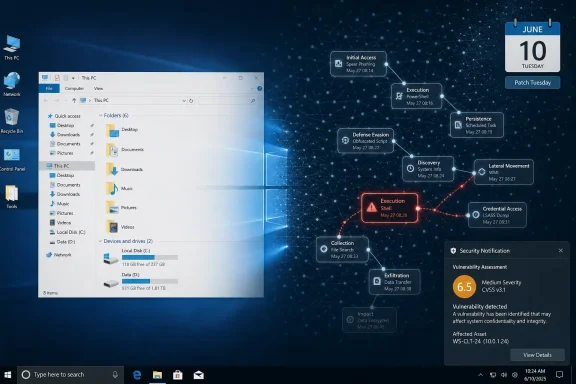 Microsoft’s Quiet Shell Bug Lands in a Loud Patch Cycle
CVE-2026-42907 arrived in the June 2026 security update cycle, a month already crowded enough to make any single medium-severity entry look small. Microsoft’s own Security Update Guide entry identifies the issue as a Windows Shell information disclosure vulnerability, and third-party mirrors of the advisory list affected product families including Windows 10, Windows 11, Windows Server 2019, Windows Server 2022, and Windows Server 2025.That breadth matters. Windows Shell is not an obscure optional component sitting off to the side of the operating system. It is the user-facing and file-navigation fabric of Windows: Explorer, shell integration, desktop affordances, file handling, metadata presentation, shortcuts, previews, icons, and the plumbing that lets users interact with the system without thinking about where the boundary between UI and OS really is.
The Shell’s ubiquity is why information disclosure bugs in this area deserve more respect than their severity labels often receive. A vulnerability that leaks sensitive information from one local or interactive context may not hand an attacker SYSTEM privileges, but it can supply the missing piece for a later step: a path, a token-adjacent artifact, a username, a file attribute, a network location, an internal naming convention, or evidence that a target opened or rendered something.
Microsoft has not publicly filled in the sort of exploit narrative that would let defenders say with confidence exactly what CVE-2026-42907 exposes or how attackers would operationalize it. That absence is itself part of the story. In modern vulnerability management, defenders often patch first and understand later.
The Word “Disclosure” Does Too Much Work
Information disclosure is one of the most deceptively bland categories in the vulnerability taxonomy. It spans everything from inconsequential metadata leaks to disclosures that meaningfully weaken authentication, privacy, sandboxing, or exploit mitigation. The label tells you the direction of harm, not the blast radius.That ambiguity is especially acute in Windows Shell. The Shell often brokers user interaction with untrusted or semi-trusted content: downloaded files, archives, removable media, network shares, shortcuts, cloud-synced folders, thumbnails, previews, and documents whose icons and metadata may be generated by handlers outside the narrow core of Explorer. A Shell bug does not need to look like a traditional remote exploit to matter in a phishing-heavy enterprise environment.
The practical question is not whether CVE-2026-42907 is “just” an information disclosure flaw. The question is what information becomes available, under what user action, and whether the disclosure crosses a security boundary that administrators assumed was firm. A leak from a low-privilege context into a more privileged one, from local machine state into attacker-observable behavior, or from protected content into user-accessible metadata can all be useful to an adversary.
That is why admins should resist the old reflex of sorting Patch Tuesday by remote code execution first, elevation of privilege second, and everything else as cleanup. Attackers do not read severity spreadsheets the way change advisory boards do. They assemble paths.
Report Confidence Is the Small Metric With a Big Message
The user-supplied MSRC language points to an often overlooked scoring concept: report confidence. In CVSS terms, report confidence measures how certain the ecosystem is that a vulnerability exists and how reliable the public technical details are. It is not a measure of impact; it is a measure of evidentiary maturity.That distinction matters for CVE-2026-42907 because the public record is thin. Microsoft acknowledges the vulnerability and assigns it to Windows Shell, which is a strong signal that the issue is real and that the vendor has enough information to ship a fix. But the advisory does not, at least publicly, walk defenders through a detailed root cause, proof-of-concept path, or attacker playbook.
High confidence does not mean high severity. It means the issue is not rumorware. Low public detail does not mean low attacker interest. In fact, after a vendor patch lands, the calculus changes: adversaries can compare binaries, diff changed code paths, and work backward from the fix. The defender’s advantage is temporary, and it is measured in deployment speed.
This is one of the quiet tensions in Microsoft’s Security Update Guide model. The company publishes enough to support risk decisions but often withholds the kind of detail that would make an article like this more technically satisfying. That is defensible from a harm-reduction perspective, but it leaves administrators managing a gray zone: the bug is confirmed, the product surface is important, and the exploit specifics are not public.
Windows Shell Is a Boundary Even When Microsoft Does Not Call It One
Microsoft and the wider security community have spent years arguing over what counts as a security boundary in Windows. Browser sandboxes, virtualization boundaries, credentials, kernel/user separation, and remote authentication flows are easy to recognize. The Shell is messier because it sits between human behavior and operating-system machinery.Explorer is where users double-click. It is where they preview. It is where they unzip. It is where they browse network paths, copy files from cloud shares, inspect downloads, and interact with objects whose visual representation may conceal complicated parsing logic. That makes the Shell both mundane and privileged in the practical sense: it is trusted by users even when it is handling untrusted content.
The Windows ecosystem has a long memory of Shell-adjacent problems. Shortcut processing, icon extraction, preview handlers, file association logic, thumbnail generation, and metadata parsing have all, at various times, formed part of attack chains. Some of those chains needed user interaction; others abused automatic rendering behaviors. The lesson is not that CVE-2026-42907 is one of those bugs in disguise. The lesson is that the Shell is a recurring place where convenience and attack surface meet.
For enterprise defenders, this should change the mental model. A Shell information disclosure vulnerability is not merely a desktop nuisance. It is a risk in VDI environments, RDS hosts, developer workstations, help-desk machines, file servers used interactively, and administrative jump boxes where Explorer is used against sensitive shares.
Medium Severity Is a Triage Category, Not a Moral Judgment
A medium CVSS score tends to flatten urgency. It tells busy teams that the vulnerability is less immediately catastrophic than a wormable remote-code-execution bug or a privilege escalation already exploited in the wild. That is useful triage, but it can become misleading when medium-severity issues sit on components used by nearly every Windows machine in the estate.The public score reported for CVE-2026-42907 is 6.5, squarely in the medium range. A score like that usually implies meaningful but bounded impact: some confidentiality exposure, limited prerequisites, or requirements around local context, privileges, or user interaction. It does not scream “drop everything.” It says “do not lose this in the noise.”
That nuance is the point. Patch management is not a binary contest between emergency response and indifference. Most vulnerabilities live in the middle, where organizations need predictable update rings, test coverage, rollback planning, and telemetry. CVE-2026-42907 belongs in that middle lane unless Microsoft or credible researchers add evidence of exploitation or an unexpectedly dangerous attack path.
The mistake would be to treat “medium” as “optional.” In a month with many patches, that is how backlog begins. Backlog then becomes inherited exposure, and inherited exposure is exactly what attackers hope to find when they weaponize older issues after the initial news cycle has moved on.
The Patch Tuesday Machine Rewards Discipline, Not Drama
For home users, the practical answer is simple: install the June 2026 Windows security updates through Windows Update unless there is a known compatibility blocker on your machine. For managed environments, the answer is more complicated but not fundamentally different. CVE-2026-42907 should move through normal cumulative update deployment rings with attention to systems where Shell interaction intersects with sensitive data.Windows cumulative updates make individual vulnerability remediation less modular than many administrators would like. You are not usually choosing whether to patch one Shell flaw. You are choosing whether to deploy a monthly operating-system update that contains dozens or hundreds of fixes, any of which may be more important tomorrow than they look today.
That model has drawbacks. It can force organizations to accept broad change for narrow risk. It can also obscure which fix caused a regression. But it has one major advantage: it reduces the number of decisions required to stay reasonably current. In an estate of thousands of endpoints, fewer bespoke decisions often means fewer forgotten exposures.
The correct response to CVE-2026-42907 is therefore not a special emergency process in most environments. It is disciplined execution of the process Microsoft’s servicing model assumes: pilot, validate, broaden, monitor, and close the loop.
Where Administrators Should Look First
The machines that deserve early attention are not necessarily the most powerful ones. They are the ones where Shell-based interaction is frequent and the data nearby is valuable. An executive laptop, a finance workstation, a developer machine with secrets in local tooling, or an admin jump box may be more relevant than a lightly used kiosk.VDI and remote desktop environments also deserve scrutiny. In shared or semi-shared Windows environments, even small information leaks can become more interesting because user sessions, redirected drives, network shares, and profile containers create complex trust relationships. A Shell flaw that looks pedestrian on a single-user consumer PC may be more consequential when multiplied across session hosts.
File-heavy workflows are another place to focus. Legal teams, finance departments, engineering groups, and support desks often handle archives, customer submissions, logs, screenshots, and documents from outside the organization. If a Shell vulnerability can be triggered by browsing or rendering file-related content, those users sit closer to the plausible exposure path.
Administrators should also keep an eye on endpoint detection and response telemetry after rollout. Not because CVE-2026-42907 is known to be exploited, but because patch cycles often create attacker experimentation. Failed exploit attempts, odd Explorer crashes, unusual access to file metadata, and suspicious network share interactions can provide early hints that a quiet bug is becoming operationally interesting.
The Attacker’s View Is Less About the Leak Than the Chain
Security teams often evaluate vulnerabilities one at a time because advisories arrive one at a time. Attackers rarely operate that way. They care about whether a bug helps them discover, authenticate, persist, escalate, evade, or move.An information disclosure vulnerability can support several of those goals. It can reduce uncertainty during reconnaissance. It can reveal whether a target has a particular configuration. It can expose hints about where sensitive files live. It can help bypass assumptions baked into another exploit. In some cases, it can turn a fragile chain into a reliable one.
That is why the lack of public technical detail cuts both ways. Defenders cannot easily build compensating controls specific to CVE-2026-42907. But attackers also lack an off-the-shelf public recipe, at least for now. The patch release changes that balance over time as reverse engineers study the update.
The safest assumption is not that this vulnerability will become a blockbuster. Most medium-severity information disclosure bugs do not. The safer assumption is that it will become part of the background corpus of known Windows weaknesses, and that unpatched systems will slowly become easier to reason about from an attacker’s perspective.
Microsoft’s Minimalism Keeps Defenders Dependent
There is a reason security advisories are terse. Publishing exploit mechanics can accelerate harm. Microsoft has spent decades learning that advisory detail is a double-edged instrument, particularly for Windows components deployed at planetary scale.Still, minimalism has costs. When an advisory says “Windows Shell information disclosure” and offers little more, enterprise teams must map that phrase onto their own architecture without knowing whether the most relevant risk is local privacy, cross-user leakage, network-triggered behavior, malicious file handling, or something else entirely. That uncertainty tends to push organizations toward either overreaction or underreaction.
The better response is to treat the advisory as a confirmed signal but not a complete story. Patch the affected systems. Watch for revisions. Monitor credible researcher write-ups. Compare Microsoft’s exploitability assessment, if present, against your own exposure. Do not wait for a proof of concept to begin normal deployment, because by the time one appears, the defenders who treated the update as routine hygiene will already be ahead.
This is where mature vulnerability programs separate themselves from reactive ones. They do not need every bug to arrive with a cinematic exploit demo. They know that predictable patch velocity is itself a control.
The Real Risk Is the Estate You Forgot
CVE-2026-42907 is a good test of asset discipline. Fully managed Windows 11 laptops will likely receive the June cumulative update quickly. Intune, Configuration Manager, Windows Update for Business, Autopatch-style rings, and EDR dashboards all make the mainstream fleet visible. The problem is the long tail.That long tail includes lab machines, conference-room PCs, disconnected engineering systems, gold images, dormant VMs, thin-client backends, remote-access hosts, and servers where administrators occasionally use Explorer because it is convenient. It also includes machines pinned to old builds for application compatibility, or Windows Server instances treated as infrastructure furniture until an audit forces attention.
A Shell vulnerability on a server may sound less relevant if nobody browses the web from the server console. But administrators do open shares, copy installers, inspect logs, mount ISOs, and interact with files during maintenance windows. The Shell is often present even when it is not supposed to be part of the workload.
That is the uncomfortable lesson of Windows attack surface: installed components matter even when they are not the application you think you are securing. The operating system is the platform, and the Shell is one of the platform’s most human-facing parts.
The June Advisory Says More About Process Than Panic
CVE-2026-42907 should not be inflated into a crisis without evidence. There is no public basis, as of this writing, to describe it as exploited in the wild, weaponized at scale, or capable of standalone compromise. Responsible coverage should say that plainly.But responsible coverage should also avoid the opposite error: minimizing it because the score is medium and the impact category is information disclosure. The vulnerability is vendor-acknowledged, affects broad Windows product families, and sits in a component that interacts constantly with files, user behavior, and enterprise data. That is enough to justify timely deployment.
The best organizations will not create a bespoke war room for this CVE. They will use it as one more reason to ensure June updates are moving, exceptions are documented, and unsupported assumptions about “low-risk desktops” are challenged. They will remember that information disclosure is often the connective tissue of larger attacks.
This is not the patch that defines the month. It is the patch that reveals whether the month is being managed well.
The Shell Bug’s Practical Lesson Is Patch Velocity
The useful response to CVE-2026-42907 is neither alarm nor apathy. It is to treat a confirmed Windows Shell information disclosure flaw as a normal but meaningful reason to keep June 2026 cumulative update deployment on schedule.- Organizations should include CVE-2026-42907 in the June 2026 Windows patch cycle rather than deferring it because of its medium severity label.
- Administrators should prioritize endpoints and session hosts where users frequently handle external files, archives, network shares, or sensitive document repositories.
- Security teams should watch for Microsoft advisory revisions or credible researcher analysis that clarifies the vulnerable Shell behavior.
- Exception lists should be reviewed carefully because unpatched legacy machines often become the durable exposure after Patch Tuesday attention fades.
- Home users should allow Windows Update to install the relevant June security updates unless a documented compatibility issue applies to their specific device.
References
- Primary source: MSRC
Published: 2026-06-09T07:00:00-07:00
Security Update Guide - Microsoft Security Response Center
 msrc.microsoft.com
- Related coverage: sentinelone.com
CVE-2026-20847: Windows Shell Information Disclosure Flaw
CVE-2026-20847 is an information disclosure vulnerability in Windows Shell. Learn about its impact, affected versions, and mitigation methods.www.sentinelone.com
- Official source: microsoft.com
MSRC - Microsoft Security Response Center
The Microsoft Security Response Center is part of the defender community and on the front line of security response evolution. For over twenty years, we have been engaged with security researchers working to protect customers and the broader ecosystem.www.microsoft.com
- Official source: msrc-ppe.microsoft.com
- Official source: learn.microsoft.com
Security Advisories and Bulletins | Microsoft Learn
learn.microsoft.com - Related coverage: sra.io
