Microsoft has published CVE-2026-45503 as a Microsoft Exchange Server information disclosure vulnerability in the Security Update Guide, with the public record emphasizing confidence in the vulnerability’s existence and available technical detail rather than a fully disclosed exploit narrative. That distinction matters: an Exchange flaw does not need a dramatic remote-code-execution label to become operationally important. Information disclosure in a mail server is often the quiet prelude to credential theft, privilege escalation, lateral movement, or more convincing social engineering. The practical question for administrators is not whether this is the loudest Exchange bug of the year, but whether their patching process still treats “disclosure” as second-tier risk.
Microsoft Exchange Server has always occupied a peculiar place in enterprise security. It is infrastructure, but it is also a diary, a directory, a routing hub, a calendar system, and a long-lived bridge between internal identity and the public Internet. If attackers can learn something they were not meant to learn from Exchange, they may not need to “own” the server immediately to make progress.
That is why information disclosure vulnerabilities deserve more respect than their name often receives. The phrase can sound bloodless, as if the bug merely leaks an error message or a harmless header. In real environments, “information” can mean user identifiers, configuration details, authentication artifacts, mailbox metadata, internal hostnames, tokens, or clues that make the next exploit attempt far more accurate.
CVE-2026-45503 arrives in a category that administrators have learned not to dismiss. Exchange has spent years as one of the highest-value targets in Microsoft’s on-premises estate, partly because it is exposed, partly because it is complex, and partly because it sits next to the information attackers most want. Even organizations that moved most mailboxes to the cloud often keep some Exchange footprint for hybrid management, legacy workflows, relays, compliance, or operational inertia.
The result is a familiar security paradox. The fewer on-premises Exchange servers an organization has, the easier it is for executives to forget they exist; the more forgotten they are, the more valuable they become to an attacker. CVE-2026-45503 should be read through that lens.
That may seem like scoring-system plumbing, but it shapes attacker behavior. When a vulnerability is merely rumored, defenders may wait and attackers may experiment. When a vendor acknowledges it, the market changes: defenders get a clearer reason to act, but attackers also get confirmation that the hunt is worth their time.
The most important line in the supplied description is not the part about confidence itself. It is the warning that the metric “also suggests the level of technical knowledge available to would-be attackers.” That is the hinge of the story. Vulnerability metadata is not just a tool for risk teams; it is also a roadmap of certainty.
A confirmed vulnerability with sparse technical detail creates a tense middle ground. Attackers may not have a copy-and-paste exploit, but they know there is something real to investigate. Defenders may not have enough detail to write perfect detections, but they know enough to prioritize inventory, exposure reduction, and patch validation.
This is one of the uncomfortable truths of modern disclosure. The public advisory is designed to help defenders, yet every field in that advisory also helps adversaries decide where to spend time. The answer is not less disclosure. It is faster operational response.
That triage can be rational, but it can also be dangerously incomplete. Information disclosure is often a force multiplier. It can reveal enough about a target to turn a brittle attack into a reliable one, or enough about an organization to make a phishing lure land with uncanny precision.
Exchange makes that multiplier effect more serious. A mail system is both a communications archive and an identity-adjacent service. It knows who talks to whom, how users are addressed, which services send automated mail, what distribution lists exist, and how administrators have wired together the organization’s messaging topology.
Even small leaks can matter. A version clue can narrow exploit selection. An internal name can help map an environment. A mailbox-related disclosure can support business email compromise. A token or session-adjacent leak, if present in any vulnerability of this class, can change the risk profile entirely.
The public CVE title does not by itself establish which of those scenarios applies to CVE-2026-45503. That uncertainty is precisely why the confidence discussion matters. Administrators should avoid both extremes: do not invent technical details that Microsoft has not published, but do not assume “information disclosure” means “low consequence.”
But sparse disclosure shifts burden onto enterprise defenders. A security operations team cannot always tell from a brief advisory whether the most important compensating control is patching, isolation, logging, endpoint detection, mail-flow review, authentication hardening, or all of the above. With Exchange, the answer is often “all of the above,” which is operationally true but not operationally cheap.
This is where mature vulnerability management separates itself from checkbox compliance. The right response is not merely to ask whether the CVE exists in a scanner feed. It is to ask which Exchange servers are Internet-facing, which are hybrid-only, which are unsupported or lagging cumulative updates, which have Emergency Mitigation service enabled where applicable, and which sit in network zones that still assume Exchange is trusted by default.
The hardest environments are the ones with partial modernization. A company may have moved users to Exchange Online but retained an on-premises server for management. Another may have acquired an organization with a legacy Exchange deployment still handling application mail. A third may run Exchange in a regulated enclave where migration has been delayed for years.
For these shops, a new Exchange CVE is not an abstract Microsoft bulletin. It is a reminder that the old server in the corner remains part of the threat surface, even when the business has emotionally moved on.
That does not mean every CVE becomes a working exploit. Many do not. But the post-patch window is where the asymmetry becomes obvious: defenders must test, schedule, deploy, and avoid breaking mail; attackers need only find one exposed, slow-moving organization.
Exchange amplifies the pain because patching it is rarely treated like patching a desktop application. Administrators worry about cumulative update prerequisites, schema implications, maintenance windows, third-party integrations, mail flow, load balancers, certificates, backups, and the basic terror of touching a system everyone notices when it breaks.
Those operational concerns are real. They are also why attackers like Exchange. A vulnerability in a painful-to-patch system has a longer shelf life than the same vulnerability in a commodity endpoint component with automatic updates and rapid rollback.
The practical lesson from CVE-2026-45503 is that patch planning should begin before every detail is public. Waiting for exploit code, blog dissections, or proof-of-concept chatter is a luxury Exchange administrators do not have.
But the on-premises Exchange installed base persists because enterprise reality is messy. Some organizations need hybrid identity and mail workflows. Some have regulatory constraints. Some have custom applications that were built around SMTP relay, mailbox access, or legacy authentication assumptions. Some simply have not funded the migration work.
That persistence changes how we should read an Exchange CVE in 2026. The existence of a cloud alternative does not reduce the urgency for organizations still running the server. If anything, it can increase neglect: as strategic attention moves to Microsoft 365, the remaining on-premises systems may receive less investment, fewer dedicated specialists, and slower lifecycle management.
Hybrid deployments also complicate ownership. Is the Exchange server a messaging team asset, an identity team asset, an application-platform dependency, or an infrastructure relic? If nobody can answer quickly, patching will lag.
CVE-2026-45503 therefore belongs in a broader conversation about Exchange debt. The issue is not just whether one vulnerability leaks information. It is whether organizations can still account for every Exchange role, endpoint, dependency, and trust relationship they operate.
Inventory must include version and update state, not just hostname. Exchange security updates are tied to supported builds, and administrators who are far behind may discover that they cannot simply apply the latest fix without a more involved upgrade path. That is where vulnerability management becomes change management.
Exposure also matters. An Internet-facing Exchange server sits in a different risk category from one isolated behind strict access controls, but internal-only should not be confused with safe. Many Exchange compromises begin after an attacker has gained some foothold elsewhere. Internal reachability can still be enough.
Logging and monitoring deserve equal attention. If a vulnerability is described only at a high level, defenders may not be able to write perfect indicators, but they can still look for anomalous access patterns, unusual authentication behavior, unexpected mailbox activity, suspicious requests to Exchange endpoints, and changes in server behavior after patch deployment.
The organizations that fare best are not necessarily the ones with the most elegant detection rule on day one. They are the ones that know where Exchange is, know who owns it, and can change it without convening a week-long archeological expedition.
That is why information disclosure is so context-dependent. The same class of bug can be mildly embarrassing in one environment and strategically damaging in another. A leaked detail from a test server may not matter much. A leak from a production messaging system tied to privileged accounts may matter enormously.
Security teams should resist the temptation to reduce CVE-2026-45503 to its label. The better approach is to ask what an unauthorized party could learn from the affected Exchange surface, and what that knowledge would unlock in the organization’s actual environment.
This is also where executive communication matters. “Information disclosure” can sound less urgent to nontechnical leadership than “data exposure” or “attacker reconnaissance.” Administrators should translate the risk into business language without overstating known facts. The issue is not necessarily that mailboxes have been breached; it is that a vulnerability in a mail infrastructure component may reveal information that attackers are not entitled to have.
The distinction is important. Panic produces bad decisions, but euphemism produces delay.
Exchange now demands lifecycle discipline: supported versions, current cumulative updates, documented hybrid architecture, strong authentication, restricted administrative access, network segmentation, certificate hygiene, dependency mapping, and tested recovery. A CVE is only one event in that larger program.
The reason is simple. Exchange is not just software; it is a trust broker. It interacts with Active Directory, identity systems, client access, mobile devices, compliance tooling, backup platforms, security gateways, and line-of-business applications. A weakness in Exchange can ripple outward because so many other systems assume it is legitimate.
CVE-2026-45503 should push organizations to review those assumptions. Which systems trust Exchange implicitly? Which service accounts have broad rights? Which legacy protocols remain enabled? Which logs would show misuse? Which administrators can modify Exchange configuration, and how are those privileges protected?
The vulnerability may be specific, but the response should be architectural. That is the lesson Exchange keeps teaching, often at uncomfortable volume.
Testing remains essential. Exchange updates can touch components that affect client access, transport, Outlook connectivity, OWA, ECP, hybrid functions, and third-party integrations. A rushed patch that breaks mail can create its own incident, especially in organizations where email remains the default incident-response coordination tool.
But testing should not become an alibi for indefinite delay. The most defensible posture is rapid validation followed by staged deployment, beginning with the most exposed and most sensitive systems. Administrators should also confirm backups and recovery plans before making changes, because resilience is part of security operations, not a separate discipline.
Where patching cannot happen immediately, compensating controls become urgent. Reduce exposure, restrict access paths, validate authentication requirements, monitor aggressively, and document the exception with an expiration date. A temporary mitigation without a deadline is often just a permanent vulnerability wearing a change-control badge.
Security teams should take several concrete lessons from this advisory.
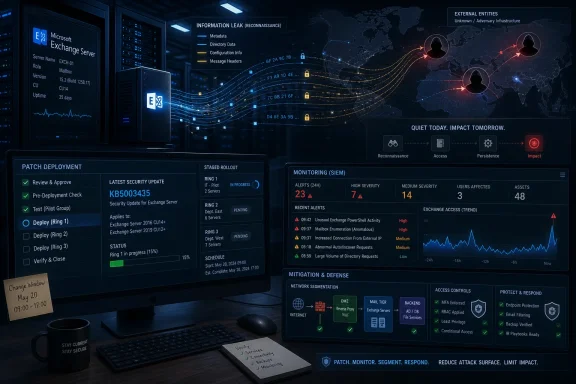 Exchange Remains the Server Attackers Read Before They Break
Microsoft Exchange Server has always occupied a peculiar place in enterprise security. It is infrastructure, but it is also a diary, a directory, a routing hub, a calendar system, and a long-lived bridge between internal identity and the public Internet. If attackers can learn something they were not meant to learn from Exchange, they may not need to “own” the server immediately to make progress.That is why information disclosure vulnerabilities deserve more respect than their name often receives. The phrase can sound bloodless, as if the bug merely leaks an error message or a harmless header. In real environments, “information” can mean user identifiers, configuration details, authentication artifacts, mailbox metadata, internal hostnames, tokens, or clues that make the next exploit attempt far more accurate.
CVE-2026-45503 arrives in a category that administrators have learned not to dismiss. Exchange has spent years as one of the highest-value targets in Microsoft’s on-premises estate, partly because it is exposed, partly because it is complex, and partly because it sits next to the information attackers most want. Even organizations that moved most mailboxes to the cloud often keep some Exchange footprint for hybrid management, legacy workflows, relays, compliance, or operational inertia.
The result is a familiar security paradox. The fewer on-premises Exchange servers an organization has, the easier it is for executives to forget they exist; the more forgotten they are, the more valuable they become to an attacker. CVE-2026-45503 should be read through that lens.
The Confidence Metric Is Not Bureaucracy; It Is a Threat Signal
The user-supplied MSRC text describes a metric that measures “the degree of confidence in the existence of the vulnerability and the credibility of the known technical details.” In plain English, that metric is about how solid the public knowledge is. It distinguishes between a vague report, a plausible but incomplete technical claim, and a vulnerability confirmed by the vendor or the author of the affected technology.That may seem like scoring-system plumbing, but it shapes attacker behavior. When a vulnerability is merely rumored, defenders may wait and attackers may experiment. When a vendor acknowledges it, the market changes: defenders get a clearer reason to act, but attackers also get confirmation that the hunt is worth their time.
The most important line in the supplied description is not the part about confidence itself. It is the warning that the metric “also suggests the level of technical knowledge available to would-be attackers.” That is the hinge of the story. Vulnerability metadata is not just a tool for risk teams; it is also a roadmap of certainty.
A confirmed vulnerability with sparse technical detail creates a tense middle ground. Attackers may not have a copy-and-paste exploit, but they know there is something real to investigate. Defenders may not have enough detail to write perfect detections, but they know enough to prioritize inventory, exposure reduction, and patch validation.
This is one of the uncomfortable truths of modern disclosure. The public advisory is designed to help defenders, yet every field in that advisory also helps adversaries decide where to spend time. The answer is not less disclosure. It is faster operational response.
Information Disclosure Is the Bug Class That Makes Other Bugs Better
Security teams tend to rank vulnerabilities by immediate outcome. Remote code execution gets a red siren. Elevation of privilege gets urgency. Security feature bypass receives nervous attention. Information disclosure, by contrast, often gets filtered into the “patch in normal cycle” bucket unless exploitation is confirmed.That triage can be rational, but it can also be dangerously incomplete. Information disclosure is often a force multiplier. It can reveal enough about a target to turn a brittle attack into a reliable one, or enough about an organization to make a phishing lure land with uncanny precision.
Exchange makes that multiplier effect more serious. A mail system is both a communications archive and an identity-adjacent service. It knows who talks to whom, how users are addressed, which services send automated mail, what distribution lists exist, and how administrators have wired together the organization’s messaging topology.
Even small leaks can matter. A version clue can narrow exploit selection. An internal name can help map an environment. A mailbox-related disclosure can support business email compromise. A token or session-adjacent leak, if present in any vulnerability of this class, can change the risk profile entirely.
The public CVE title does not by itself establish which of those scenarios applies to CVE-2026-45503. That uncertainty is precisely why the confidence discussion matters. Administrators should avoid both extremes: do not invent technical details that Microsoft has not published, but do not assume “information disclosure” means “low consequence.”
Microsoft’s Minimalism Leaves Defenders With Work to Do
Microsoft advisories often provide enough information to identify affected products, severity, impact, exploitability assessment, and remediation path, while withholding exploit mechanics. That is defensible. Over-disclosure can accelerate exploitation, especially for server-side products with large exposed footprints.But sparse disclosure shifts burden onto enterprise defenders. A security operations team cannot always tell from a brief advisory whether the most important compensating control is patching, isolation, logging, endpoint detection, mail-flow review, authentication hardening, or all of the above. With Exchange, the answer is often “all of the above,” which is operationally true but not operationally cheap.
This is where mature vulnerability management separates itself from checkbox compliance. The right response is not merely to ask whether the CVE exists in a scanner feed. It is to ask which Exchange servers are Internet-facing, which are hybrid-only, which are unsupported or lagging cumulative updates, which have Emergency Mitigation service enabled where applicable, and which sit in network zones that still assume Exchange is trusted by default.
The hardest environments are the ones with partial modernization. A company may have moved users to Exchange Online but retained an on-premises server for management. Another may have acquired an organization with a legacy Exchange deployment still handling application mail. A third may run Exchange in a regulated enclave where migration has been delayed for years.
For these shops, a new Exchange CVE is not an abstract Microsoft bulletin. It is a reminder that the old server in the corner remains part of the threat surface, even when the business has emotionally moved on.
Patch Tuesday Is a Calendar, but Attackers Work From Diff Files
Microsoft’s monthly security cadence gives enterprises predictability, but it also gives attackers rhythm. Once updates ship, researchers and adversaries can compare patched and unpatched binaries, inspect changed components, and build hypotheses about the flaw. This is especially relevant when public advisory text is thin.That does not mean every CVE becomes a working exploit. Many do not. But the post-patch window is where the asymmetry becomes obvious: defenders must test, schedule, deploy, and avoid breaking mail; attackers need only find one exposed, slow-moving organization.
Exchange amplifies the pain because patching it is rarely treated like patching a desktop application. Administrators worry about cumulative update prerequisites, schema implications, maintenance windows, third-party integrations, mail flow, load balancers, certificates, backups, and the basic terror of touching a system everyone notices when it breaks.
Those operational concerns are real. They are also why attackers like Exchange. A vulnerability in a painful-to-patch system has a longer shelf life than the same vulnerability in a commodity endpoint component with automatic updates and rapid rollback.
The practical lesson from CVE-2026-45503 is that patch planning should begin before every detail is public. Waiting for exploit code, blog dissections, or proof-of-concept chatter is a luxury Exchange administrators do not have.
The Cloud Did Not Kill the On-Premises Exchange Problem
Microsoft would prefer many customers to be in Exchange Online, and from a security-maintenance standpoint, that preference is not mysterious. Cloud-hosted services let Microsoft deploy mitigations and fixes centrally, observe attack patterns at scale, and remove much of the patching burden from individual organizations.But the on-premises Exchange installed base persists because enterprise reality is messy. Some organizations need hybrid identity and mail workflows. Some have regulatory constraints. Some have custom applications that were built around SMTP relay, mailbox access, or legacy authentication assumptions. Some simply have not funded the migration work.
That persistence changes how we should read an Exchange CVE in 2026. The existence of a cloud alternative does not reduce the urgency for organizations still running the server. If anything, it can increase neglect: as strategic attention moves to Microsoft 365, the remaining on-premises systems may receive less investment, fewer dedicated specialists, and slower lifecycle management.
Hybrid deployments also complicate ownership. Is the Exchange server a messaging team asset, an identity team asset, an application-platform dependency, or an infrastructure relic? If nobody can answer quickly, patching will lag.
CVE-2026-45503 therefore belongs in a broader conversation about Exchange debt. The issue is not just whether one vulnerability leaks information. It is whether organizations can still account for every Exchange role, endpoint, dependency, and trust relationship they operate.
The Real Exposure Starts With Inventory
The first defensive task is boring and unavoidable: find every Exchange Server instance. Not every server will be obvious. Some will be powered on only for management purposes, some will be behind VPNs, some will be in disaster recovery environments, and some may live in acquired networks with documentation that has not survived the acquisition.Inventory must include version and update state, not just hostname. Exchange security updates are tied to supported builds, and administrators who are far behind may discover that they cannot simply apply the latest fix without a more involved upgrade path. That is where vulnerability management becomes change management.
Exposure also matters. An Internet-facing Exchange server sits in a different risk category from one isolated behind strict access controls, but internal-only should not be confused with safe. Many Exchange compromises begin after an attacker has gained some foothold elsewhere. Internal reachability can still be enough.
Logging and monitoring deserve equal attention. If a vulnerability is described only at a high level, defenders may not be able to write perfect indicators, but they can still look for anomalous access patterns, unusual authentication behavior, unexpected mailbox activity, suspicious requests to Exchange endpoints, and changes in server behavior after patch deployment.
The organizations that fare best are not necessarily the ones with the most elegant detection rule on day one. They are the ones that know where Exchange is, know who owns it, and can change it without convening a week-long archeological expedition.
Severity Scores Do Not Understand Your Mailbox
CVSS and advisory fields are useful, but they are generic by design. They cannot know whether your Exchange server handles executive mail, legal discovery, medical information, merger negotiations, customer support archives, or authentication-related workflows. They cannot know whether the server is exposed to the Internet or forgotten in a flat internal network.That is why information disclosure is so context-dependent. The same class of bug can be mildly embarrassing in one environment and strategically damaging in another. A leaked detail from a test server may not matter much. A leak from a production messaging system tied to privileged accounts may matter enormously.
Security teams should resist the temptation to reduce CVE-2026-45503 to its label. The better approach is to ask what an unauthorized party could learn from the affected Exchange surface, and what that knowledge would unlock in the organization’s actual environment.
This is also where executive communication matters. “Information disclosure” can sound less urgent to nontechnical leadership than “data exposure” or “attacker reconnaissance.” Administrators should translate the risk into business language without overstating known facts. The issue is not necessarily that mailboxes have been breached; it is that a vulnerability in a mail infrastructure component may reveal information that attackers are not entitled to have.
The distinction is important. Panic produces bad decisions, but euphemism produces delay.
Exchange Security Is Now a Lifecycle Discipline
For years, many organizations treated Exchange security as a patching problem. Install the security update, reboot in the maintenance window, check mail flow, close the ticket. That model is no longer sufficient.Exchange now demands lifecycle discipline: supported versions, current cumulative updates, documented hybrid architecture, strong authentication, restricted administrative access, network segmentation, certificate hygiene, dependency mapping, and tested recovery. A CVE is only one event in that larger program.
The reason is simple. Exchange is not just software; it is a trust broker. It interacts with Active Directory, identity systems, client access, mobile devices, compliance tooling, backup platforms, security gateways, and line-of-business applications. A weakness in Exchange can ripple outward because so many other systems assume it is legitimate.
CVE-2026-45503 should push organizations to review those assumptions. Which systems trust Exchange implicitly? Which service accounts have broad rights? Which legacy protocols remain enabled? Which logs would show misuse? Which administrators can modify Exchange configuration, and how are those privileges protected?
The vulnerability may be specific, but the response should be architectural. That is the lesson Exchange keeps teaching, often at uncomfortable volume.
The Quiet CVE Still Demands a Loud Change Window
For administrators, the immediate response should be disciplined rather than dramatic. Confirm whether your environment runs affected Microsoft Exchange Server versions, review the MSRC entry for remediation guidance, and plan deployment according to Microsoft’s supported update path. If the server is no longer needed, retirement should be on the table; an unnecessary Exchange server is not a convenience, it is inherited risk.Testing remains essential. Exchange updates can touch components that affect client access, transport, Outlook connectivity, OWA, ECP, hybrid functions, and third-party integrations. A rushed patch that breaks mail can create its own incident, especially in organizations where email remains the default incident-response coordination tool.
But testing should not become an alibi for indefinite delay. The most defensible posture is rapid validation followed by staged deployment, beginning with the most exposed and most sensitive systems. Administrators should also confirm backups and recovery plans before making changes, because resilience is part of security operations, not a separate discipline.
Where patching cannot happen immediately, compensating controls become urgent. Reduce exposure, restrict access paths, validate authentication requirements, monitor aggressively, and document the exception with an expiration date. A temporary mitigation without a deadline is often just a permanent vulnerability wearing a change-control badge.
The Administrator’s Reading of CVE-2026-45503 Should Be Narrow and Wide at Once
The narrow reading is straightforward: CVE-2026-45503 is an Exchange Server information disclosure vulnerability, and affected systems should be remediated according to Microsoft’s guidance. The wide reading is more important: Exchange remains a high-value, high-friction platform where even non-RCE flaws can create meaningful attacker advantage.Security teams should take several concrete lessons from this advisory.
- Organizations should verify every on-premises and hybrid Exchange Server instance, including management-only, disaster recovery, and legacy application relay systems.
- Administrators should treat vendor-confirmed vulnerability confidence as an acceleration signal, because it tells attackers that the issue is real even when exploit details are limited.
- Information disclosure should be assessed according to business context, not just generic severity language, because Exchange often contains or exposes unusually valuable organizational knowledge.
- Patch planning should account for Exchange’s operational fragility without allowing testing requirements to become open-ended delay.
- Environments that cannot patch immediately should reduce exposure, strengthen monitoring, and set a firm deadline for full remediation.
- Long-term Exchange risk reduction requires lifecycle management, not just one-off security updates.
References
- Primary source: MSRC
Published: 2026-06-09T07:00:00-07:00
Security Update Guide - Microsoft Security Response Center
 msrc.microsoft.com
- Official source: techcommunity.microsoft.com
Addressing Exchange Server May 2026 vulnerability CVE-2026-42897 | Microsoft Community Hub
We wanted to tell you how to address the Exchange Server May 2026 vulnerability CVE-2026-42897. techcommunity.microsoft.com
- Related coverage: sentinelone.com
CVE-2025-33051: Exchange Server Information Disclosure Flaw
CVE-2025-33051 is an information disclosure vulnerability in Microsoft Exchange Server. Learn about its impact, affected versions, and mitigation methods.www.sentinelone.com
- Related coverage: messageware.com
Critical: Exchange Server Vulnerability CVE-2026-42897 - Messageware
CVE-2026-42897 is an actively exploited Exchange Server vulnerability. Learn what's affected, the current risk level, and how Microsoft is mitigating it.www.messageware.com - Related coverage: cve.circl.lu
Vulnerability-Lookup
Vulnerability-Lookup - Fast vulnerability lookup correlation from different sources.cve.circl.lu - Related coverage: tomsguide.com
Do you use Microsoft Exchange? Hackers are actively exploiting a new zero-day flaw | Tom's Guide
Microsoft warns of a new zero-day vulnerability that leaves Exchange open to hackers.www.tomsguide.com
- Related coverage: thehackernews.com
On-Prem Microsoft Exchange Server CVE-2026-42897 Exploited via Crafted Email
CVE-2026-42897 is exploited in on-prem Exchange; crafted emails enable spoofing, forcing urgent mitigation.thehackernews.com
- Related coverage: stack.watch
- Related coverage: vulnerability.circl.lu
Vulnerability-Lookup
Vulnerability-Lookup - Fast vulnerability lookup correlation from different sources.vulnerability.circl.lu - Related coverage: thehackerwire.com
CVE-2026-42897 - High Vulnerability
CVE-2026-42897 is a High severity vulnerability (CVSS 8.1). Improper neutralization of input during web page generation ('cross-site scripting') in Microsoft Exchange Server allows an unauthorized attacker to perform...www.thehackerwire.com
- Related coverage: ncsc.gov.ie
- Related coverage: tcrmf.org
- Official source: microsoft.com
MSRC - Microsoft Security Response Center
The Microsoft Security Response Center is part of the defender community and on the front line of security response evolution. For over twenty years, we have been engaged with security researchers working to protect customers and the broader ecosystem.www.microsoft.com
- Related coverage: api.urlscan.io

api.msrc.microsoft.com - urlscan.io
urlscan.io - Website scanner for suspicious and malicious URLs
api.urlscan.io
- Related coverage: deepwiki.com
MSRC API Reference | microsoft/MSRC-Microsoft-Security-Updates-API | DeepWiki
This document provides technical reference information for the Microsoft Security Response Center (MSRC) CVRF API that underlies the MsrcSecurityUpdates PowerShell module. This covers the REST API enddeepwiki.com - Related coverage: stackoverflow.com
security - Microsoft CVRF API - Stack Overflow
It has come to my attention that, starting from February 9, 2021,
Microsoft Security Response Center has removed registrations requirements to their CVRF API.
That could be a nice way tostackoverflow.com
- Related coverage: bleepingcomputer.com
- Official source: github.com
"cvrf" data of JSON fomat is not found on "https://api.msrc.microsoft.com/cvrf/v3.0/cvrf/yyyy-mmm". · Issue #143 · microsoft/MSRC-Microsoft-Security-Updates-API · GitHub
I have been retrieving monthly JSON format "cvrf" data via the API below by specifying "application/json" for the "Content-Type" header. However, from this month, I cannot seem to find the JSON format data, and only XML format seems to b... github.com
- Official source: learn.microsoft.com
api microsoft errors - Microsoft Q&A
Hello, Could you please check this issue? From yesterday I tried for many times to reach these URLs but I received 503 and 404 Errors. • https://api.msrc.microsoft.com/ • https://api.msrc.microsoft.com/Updates There is any changement in…learn.microsoft.com - Related coverage: sra.io