

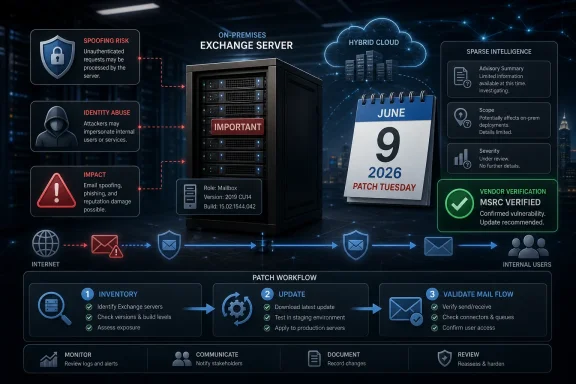
CVE-2026-45501 is an Important-rated Microsoft Exchange Server spoofing vulnerability disclosed in Microsoft’s June 9, 2026 security updates, affecting on-premises Exchange Server and arriving alongside a broader Exchange patch set that also includes spoofing, information-disclosure, privilege-escalation, and remote-code-execution fixes. The useful story is not that Exchange has another CVE; that sentence has become almost ambient noise in enterprise security. The useful story is that Microsoft is asking administrators to trust a sparse advisory model at the exact moment when Exchange operators need fast, concrete judgment. For defenders, the “confidence” question is no longer academic: it determines whether this becomes a routine maintenance ticket or a same-week change window.
Microsoft’s June 2026 Patch Tuesday was not a quiet one. The company released fixes for roughly 200 vulnerabilities across its product stack, including three publicly disclosed zero-days in Windows components and a dense block of Exchange Server issues. Buried inside that list is CVE-2026-45501, described plainly as a Microsoft Exchange Server spoofing vulnerability and rated Important.
That combination deserves attention because Exchange is not an ordinary application. It is identity-adjacent, internet-facing in many organizations, deeply connected to mail flow, and historically painful to patch in large estates. Even when a flaw is not labeled Critical, the product context raises the operational stakes.
The problem for administrators is that Microsoft’s Security Update Guide often provides just enough information to trigger process, but not always enough to guide risk appetite. A label such as “spoofing” can cover a range of outcomes, from misleading interface behavior to meaningful attacker control over what a user or system believes it is seeing. In Exchange, that ambiguity matters.
The user-supplied MSRC text about confidence captures the central tension. Vulnerability management is not just severity arithmetic; it is an exercise in deciding how much to believe, how quickly to act, and how much technical detail might already be available to attackers.
Yet Exchange history has trained administrators not to shrug. Since the ProxyLogon era, on-premises Exchange has been treated less like a mail server and more like a standing perimeter asset with privilege implications. A modest-looking Exchange CVE can quickly become urgent if it touches authentication, webmail rendering, transport behavior, or hybrid trust.
This is why the confidence metric matters. If Microsoft has assigned a CVE and shipped or associated a security update, the existence of the vulnerability is not speculative in the normal sense. Vendor acknowledgement gives defenders a strong basis to treat the bug as real, even when the mechanics remain private.
But confidence in existence is not the same as confidence in exploitability details. For CVE-2026-45501, defenders should separate those two ideas. The vulnerability exists strongly enough to justify patching; the public record does not yet support breathless claims about active exploitation, weaponized code, or a specific attack chain.
That breadth makes Exchange spoofing bugs especially awkward to triage. Email is already a spoofing battleground, and administrators have spent years hardening SPF, DKIM, DMARC, anti-phishing policies, transport rules, and mailbox auditing. A product-level spoofing vulnerability implies the attacker may be abusing behavior inside the trusted platform, not merely sending a fraudulent message from outside it.
CVE-2026-45501 should therefore be read in context with the rest of the June Exchange batch, not as an isolated line item. Microsoft also listed other Exchange vulnerabilities in the same update cycle, including another spoofing CVE, information-disclosure issues, elevation of privilege, and remote code execution. That cluster tells defenders that June is an Exchange maintenance month, not a single-checkbox event.
The absence of public exploit details cuts both ways. It limits attacker copycats who rely on advisory text. It also limits administrators who want to model blast radius before approving downtime. In that gap, mature security programs fall back to exposure, asset criticality, and compensating controls.
The weaker signal is the public technical narrative. At the time of writing, there is no widely established public root-cause analysis, no mainstream reporting of exploitation in the wild for this specific CVE, and no broadly circulated exploit procedure tied to CVE-2026-45501. That means defenders should not inflate the story beyond the evidence.
This creates a practical rating in plain English: high confidence that the vulnerability exists, lower confidence in the public community’s understanding of the underlying mechanics. That is not a reason to delay. It is a reason to avoid theatrical certainty.
For attackers, sparse details may reduce immediate mass exploitation by low-skill actors. For well-resourced actors, the patch itself can become the documentation. Once security updates are available, reverse engineering becomes a race against deployment, particularly for high-value perimeter products.
This is why “no public exploit” is comforting only for a short time. A vulnerability can move from opaque to actionable once enough researchers, criminals, or state-backed teams analyze the update. The speed of that transition varies, but Exchange is attractive enough that defenders should assume someone is looking.
The Exchange Server installed base also complicates matters. Many organizations still run on-premises Exchange because of regulatory requirements, hybrid dependencies, legacy workflows, or institutional inertia. Some are not running it as their primary mailbox platform anymore, but keep it alive for recipient management or hybrid mail flow. That can create an especially dangerous blind spot: a server that feels legacy but still holds privileged trust.
A lightly used Exchange server is still an Exchange server. If it is reachable, trusted, domain-joined, and maintained irregularly, it may be more attractive than the production mailbox platform everyone watches closely.
That matters because it changes how June’s Exchange fixes will be received. Administrators are not looking at CVE-2026-45501 in a vacuum; they are looking at it after a recent reminder that Exchange spoofing bugs can be more than cosmetic. Even if CVE-2026-45501 is not known to be exploited, the category has fresh operational memory.
The May episode also reinforced the value and limits of Microsoft’s mitigation machinery. The Exchange Emergency Mitigation Service can buy time when Microsoft pushes emergency protections, but it is not a substitute for being on supported builds and applying security updates. Older or neglected servers may not receive the same practical protection.
That is the uncomfortable lesson for organizations that have treated Exchange as a solved problem because mailboxes moved to the cloud. Hybrid infrastructure remains infrastructure. If the server exists to keep identity, routing, or management glue alive, it still needs a security owner.
Severity scores and labels are abstractions. Exposure is concrete. An Exchange server reachable from the internet, used by remote staff, or integrated into authentication and mail-routing workflows carries more risk than an isolated lab system. The same CVE can therefore demand different timelines in different environments.
For most organizations, the right operational stance is to treat the June Exchange security update as a priority deployment, not a speculative future task. That does not necessarily mean reckless same-hour installation without backups or health checks. It does mean change management should recognize the product’s history and attacker interest.
The best patching plan is boring: verify supported versions, run health checks, snapshot or back up appropriately, install in a controlled sequence, test mail flow and client access, then confirm build numbers and services. The worst plan is also familiar: wait for a public exploit before discovering the server is too old, too customized, or too fragile to update quickly.
Those questions determine whether CVE-2026-45501 is a manageable maintenance item or a stressful outage risk. Vulnerability confidence may tell you whether the bug is real, but asset confidence tells you whether your response is real. Many organizations are stronger at the former than the latter.
Exchange patching has long punished neglect. Security updates often depend on being at a supported cumulative update level, and older servers may require intermediate work before the latest fix can be applied. That turns a one-line CVE into a multi-step remediation project.
The danger is that organizations discover this only after a vulnerability becomes famous. CVE-2026-45501 is an opportunity to avoid that pattern. If the June update is straightforward, apply it. If it is not straightforward, that is itself a finding worth escalating.
A defender may see “spoofing” and “Important” and place CVE-2026-45501 below remote code execution bugs. An attacker may see “Exchange Server” and “security update available” and begin diffing. The attacker does not need Microsoft to publish a tutorial if the patched code tells the story.
This is why the public absence of details should not be confused with the private absence of knowledge. Vulnerability researchers, offensive teams, and criminal groups all operate in the space between patch release and patch adoption. For a product like Exchange, that window is valuable.
The strongest countermeasure is to shrink the window. That sounds obvious, but Exchange estates often have business constraints that slow deployment: maintenance windows, DAG coordination, third-party transport agents, custom integrations, compliance archiving, and fear of breaking mail. Attackers benefit from that hesitation.
Microsoft’s sparse advisory style is partly designed to avoid handing attackers a map. But once the fix exists, the map can be reconstructed. Security through advisory minimalism has a shelf life.
Hybrid deployments blur boundaries. A vulnerability in an on-premises component may not directly compromise Exchange Online, but the on-premises server can still hold credentials, connectors, certificates, trust relationships, and administrative pathways that matter. The operational question is not simply where the mailbox lives. It is what the server can influence.
This is why Exchange hardening should be tied to identity hygiene. Administrators should review privileged accounts, service accounts, certificate handling, OAuth and hybrid configuration, management endpoints, and firewall exposure. A spoofing vulnerability may not be an identity compromise by itself, but Exchange lives too close to identity to be treated casually.
The long-term answer is simplification. If an organization no longer needs an on-premises Exchange server, it should have a plan to remove it cleanly. If it still needs one, it should be treated as a tier-one asset, not a relic in the corner.
For CVE-2026-45501, the vendor-confirmed existence is the anchor. Microsoft’s acknowledgement gives the vulnerability enough certainty to justify action. The limited public detail should shape how we describe the risk, not whether we patch.
That means defenders should avoid both extremes. There is no need to claim that CVE-2026-45501 is being widely exploited if that has not been shown. There is also no wisdom in dismissing an Exchange Server security update because the advisory does not include a dramatic exploit narrative.
Good vulnerability management lives in that middle ground. It prioritizes based on product exposure, business criticality, known exploitation, exploitability signals, and operational readiness. CVE-2026-45501 scores highly on product sensitivity even if the public exploit story remains thin.
The first step is to identify every Exchange server, including management-only and hybrid systems. That sounds elementary, but stale Exchange hosts often survive migrations because they are entangled with recipient management or relay workflows. If they are domain-joined and reachable, they belong in the patch plan.
The second step is to verify update level. Exchange security updates are not a magical overlay for any build that happens to exist. Unsupported cumulative updates, expired assumptions, and missing prerequisites can turn a security sprint into a remediation slog.
The third step is to check whether Emergency Mitigation Service is enabled and healthy, while remembering that EEMS is not a substitute for patching. It is a safety net for specific scenarios, not a general absolution for weak maintenance.
The fourth step is to validate after installation. Build numbers, service health, mail flow, Outlook on the web, transport queues, event logs, and backup status all matter. A patch that silently breaks mail or leaves one node behind creates its own incident.
That mismatch places administrators in a difficult position. They are asked to act urgently without always being told precisely why. In a perfect estate, that is fine: patch the supported server and move on. In a real estate, every Exchange update competes with uptime, staffing, compliance, and fear of regression.
The answer is not for Microsoft to publish exploit recipes. The answer is for organizations to stop requiring exploit recipes before they take Exchange maintenance seriously. If a vendor-confirmed Exchange vulnerability lands in a monthly security update, the burden should shift to proving why a server can safely wait.
This is especially true when the same patch cycle includes multiple Exchange flaws. CVE-2026-45501 may be the named item under discussion, but administrators should not cherry-pick one CVE from the bundle and ignore the rest. Attackers chain weaknesses; defenders should patch systems.
Here is the concrete readout for Windows and Exchange teams:
 Microsoft Ships Another Exchange Warning Into a Tired Patch Tuesday
Microsoft’s June 2026 Patch Tuesday was not a quiet one. The company released fixes for roughly 200 vulnerabilities across its product stack, including three publicly disclosed zero-days in Windows components and a dense block of Exchange Server issues. Buried inside that list is CVE-2026-45501, described plainly as a Microsoft Exchange Server spoofing vulnerability and rated Important.That combination deserves attention because Exchange is not an ordinary application. It is identity-adjacent, internet-facing in many organizations, deeply connected to mail flow, and historically painful to patch in large estates. Even when a flaw is not labeled Critical, the product context raises the operational stakes.
The problem for administrators is that Microsoft’s Security Update Guide often provides just enough information to trigger process, but not always enough to guide risk appetite. A label such as “spoofing” can cover a range of outcomes, from misleading interface behavior to meaningful attacker control over what a user or system believes it is seeing. In Exchange, that ambiguity matters.
The user-supplied MSRC text about confidence captures the central tension. Vulnerability management is not just severity arithmetic; it is an exercise in deciding how much to believe, how quickly to act, and how much technical detail might already be available to attackers.
The Advisory Is Sparse, but the Product History Is Loud
CVE-2026-45501 does not currently read like a richly documented bug. Public reporting has identified it as part of the June 2026 Microsoft security release, but there is little widely available technical detail about the underlying flaw, exploitation path, or real-world abuse. That makes it a very different kind of Exchange problem from the headline-grabbing issues where proof-of-concept code, observed exploitation, and emergency mitigations arrive together.Yet Exchange history has trained administrators not to shrug. Since the ProxyLogon era, on-premises Exchange has been treated less like a mail server and more like a standing perimeter asset with privilege implications. A modest-looking Exchange CVE can quickly become urgent if it touches authentication, webmail rendering, transport behavior, or hybrid trust.
This is why the confidence metric matters. If Microsoft has assigned a CVE and shipped or associated a security update, the existence of the vulnerability is not speculative in the normal sense. Vendor acknowledgement gives defenders a strong basis to treat the bug as real, even when the mechanics remain private.
But confidence in existence is not the same as confidence in exploitability details. For CVE-2026-45501, defenders should separate those two ideas. The vulnerability exists strongly enough to justify patching; the public record does not yet support breathless claims about active exploitation, weaponized code, or a specific attack chain.
“Spoofing” Is a Small Word Doing Too Much Work
Spoofing is one of Microsoft’s broadest vulnerability categories. It can mean an attacker is able to impersonate a user, misrepresent content, manipulate trust indicators, confuse a client, or induce a victim into acting on false information. In a browser-adjacent or mail-adjacent product, that can become a phishing accelerator. In a server-side protocol path, it can carry deeper consequences.That breadth makes Exchange spoofing bugs especially awkward to triage. Email is already a spoofing battleground, and administrators have spent years hardening SPF, DKIM, DMARC, anti-phishing policies, transport rules, and mailbox auditing. A product-level spoofing vulnerability implies the attacker may be abusing behavior inside the trusted platform, not merely sending a fraudulent message from outside it.
CVE-2026-45501 should therefore be read in context with the rest of the June Exchange batch, not as an isolated line item. Microsoft also listed other Exchange vulnerabilities in the same update cycle, including another spoofing CVE, information-disclosure issues, elevation of privilege, and remote code execution. That cluster tells defenders that June is an Exchange maintenance month, not a single-checkbox event.
The absence of public exploit details cuts both ways. It limits attacker copycats who rely on advisory text. It also limits administrators who want to model blast radius before approving downtime. In that gap, mature security programs fall back to exposure, asset criticality, and compensating controls.
The Confidence Signal Is Stronger Than the Narrative Signal
The metric described in the prompt measures how certain we are that a vulnerability is real and how credible the public technical details are. For CVE-2026-45501, the strongest confidence signal is Microsoft’s own acknowledgement through MSRC. That is meaningful because Microsoft is the vendor of the affected technology and the authority shipping the fix guidance.The weaker signal is the public technical narrative. At the time of writing, there is no widely established public root-cause analysis, no mainstream reporting of exploitation in the wild for this specific CVE, and no broadly circulated exploit procedure tied to CVE-2026-45501. That means defenders should not inflate the story beyond the evidence.
This creates a practical rating in plain English: high confidence that the vulnerability exists, lower confidence in the public community’s understanding of the underlying mechanics. That is not a reason to delay. It is a reason to avoid theatrical certainty.
For attackers, sparse details may reduce immediate mass exploitation by low-skill actors. For well-resourced actors, the patch itself can become the documentation. Once security updates are available, reverse engineering becomes a race against deployment, particularly for high-value perimeter products.
Exchange Administrators Have Learned to Fear the Patch Diff
The modern Exchange risk cycle does not end when Microsoft publishes an advisory. In some cases, that is when the race begins. Attackers can compare patched and unpatched binaries, inspect changed components, and infer the vulnerable code path. That is especially relevant when advisories are thin and updates are broad.This is why “no public exploit” is comforting only for a short time. A vulnerability can move from opaque to actionable once enough researchers, criminals, or state-backed teams analyze the update. The speed of that transition varies, but Exchange is attractive enough that defenders should assume someone is looking.
The Exchange Server installed base also complicates matters. Many organizations still run on-premises Exchange because of regulatory requirements, hybrid dependencies, legacy workflows, or institutional inertia. Some are not running it as their primary mailbox platform anymore, but keep it alive for recipient management or hybrid mail flow. That can create an especially dangerous blind spot: a server that feels legacy but still holds privileged trust.
A lightly used Exchange server is still an Exchange server. If it is reachable, trusted, domain-joined, and maintained irregularly, it may be more attractive than the production mailbox platform everyone watches closely.
The June Patch Set Lands After a May Wake-Up Call
CVE-2026-45501 also arrives in the shadow of a more urgent May Exchange disclosure. In May 2026, Microsoft addressed CVE-2026-42897, another Exchange Server spoofing issue associated with Outlook Web Access and described in public reporting as actively exploited. That earlier flaw involved crafted email and browser-context script execution under certain user-interaction conditions, with Microsoft pointing administrators toward the Exchange Emergency Mitigation Service while permanent fixes were pending or staged.That matters because it changes how June’s Exchange fixes will be received. Administrators are not looking at CVE-2026-45501 in a vacuum; they are looking at it after a recent reminder that Exchange spoofing bugs can be more than cosmetic. Even if CVE-2026-45501 is not known to be exploited, the category has fresh operational memory.
The May episode also reinforced the value and limits of Microsoft’s mitigation machinery. The Exchange Emergency Mitigation Service can buy time when Microsoft pushes emergency protections, but it is not a substitute for being on supported builds and applying security updates. Older or neglected servers may not receive the same practical protection.
That is the uncomfortable lesson for organizations that have treated Exchange as a solved problem because mailboxes moved to the cloud. Hybrid infrastructure remains infrastructure. If the server exists to keep identity, routing, or management glue alive, it still needs a security owner.
“Important” Does Not Mean “Optional” in an Internet-Facing Mail Server
Microsoft’s Important rating is easy to misread. In desktop software, an Important spoofing flaw might be folded into the normal monthly patch cadence. In Exchange Server, especially when exposed to the internet or used in hybrid topologies, the same severity label should trigger a more serious conversation.Severity scores and labels are abstractions. Exposure is concrete. An Exchange server reachable from the internet, used by remote staff, or integrated into authentication and mail-routing workflows carries more risk than an isolated lab system. The same CVE can therefore demand different timelines in different environments.
For most organizations, the right operational stance is to treat the June Exchange security update as a priority deployment, not a speculative future task. That does not necessarily mean reckless same-hour installation without backups or health checks. It does mean change management should recognize the product’s history and attacker interest.
The best patching plan is boring: verify supported versions, run health checks, snapshot or back up appropriately, install in a controlled sequence, test mail flow and client access, then confirm build numbers and services. The worst plan is also familiar: wait for a public exploit before discovering the server is too old, too customized, or too fragile to update quickly.
Sparse Advisories Shift Burden Onto Asset Management
When Microsoft does not provide deep technical detail, the defender’s advantage comes from knowing the environment. Which Exchange versions are deployed? Which servers are internet-facing? Which are hybrid? Which are still running legacy cumulative updates? Which administrators know how to recover them if an update fails?Those questions determine whether CVE-2026-45501 is a manageable maintenance item or a stressful outage risk. Vulnerability confidence may tell you whether the bug is real, but asset confidence tells you whether your response is real. Many organizations are stronger at the former than the latter.
Exchange patching has long punished neglect. Security updates often depend on being at a supported cumulative update level, and older servers may require intermediate work before the latest fix can be applied. That turns a one-line CVE into a multi-step remediation project.
The danger is that organizations discover this only after a vulnerability becomes famous. CVE-2026-45501 is an opportunity to avoid that pattern. If the June update is straightforward, apply it. If it is not straightforward, that is itself a finding worth escalating.
The Attacker’s View Is Different From the Administrator’s View
Administrators read advisories to decide what must be fixed. Attackers read advisories to decide what might be profitable. Those are not symmetrical exercises.A defender may see “spoofing” and “Important” and place CVE-2026-45501 below remote code execution bugs. An attacker may see “Exchange Server” and “security update available” and begin diffing. The attacker does not need Microsoft to publish a tutorial if the patched code tells the story.
This is why the public absence of details should not be confused with the private absence of knowledge. Vulnerability researchers, offensive teams, and criminal groups all operate in the space between patch release and patch adoption. For a product like Exchange, that window is valuable.
The strongest countermeasure is to shrink the window. That sounds obvious, but Exchange estates often have business constraints that slow deployment: maintenance windows, DAG coordination, third-party transport agents, custom integrations, compliance archiving, and fear of breaking mail. Attackers benefit from that hesitation.
Microsoft’s sparse advisory style is partly designed to avoid handing attackers a map. But once the fix exists, the map can be reconstructed. Security through advisory minimalism has a shelf life.
Hybrid Exchange Keeps Extending the Blast Radius Debate
The on-premises Exchange conversation is no longer just about on-premises mailboxes. Many Microsoft 365 customers maintain Exchange servers for hybrid management, coexistence, mail relay, or legacy administrative functions. That makes Exchange risk harder to explain to executives who think the company “moved to the cloud.”Hybrid deployments blur boundaries. A vulnerability in an on-premises component may not directly compromise Exchange Online, but the on-premises server can still hold credentials, connectors, certificates, trust relationships, and administrative pathways that matter. The operational question is not simply where the mailbox lives. It is what the server can influence.
This is why Exchange hardening should be tied to identity hygiene. Administrators should review privileged accounts, service accounts, certificate handling, OAuth and hybrid configuration, management endpoints, and firewall exposure. A spoofing vulnerability may not be an identity compromise by itself, but Exchange lives too close to identity to be treated casually.
The long-term answer is simplification. If an organization no longer needs an on-premises Exchange server, it should have a plan to remove it cleanly. If it still needs one, it should be treated as a tier-one asset, not a relic in the corner.
The Confidence Metric Should Change the Conversation, Not End It
The prompt’s definition of confidence is useful because it forces a distinction that security teams often collapse. A vulnerability can be real even when its details are incomplete. A vulnerability can be technically well understood even when its exploitation likelihood is low. A vulnerability can be actively exploited even when its CVSS score is not the highest item on the board.For CVE-2026-45501, the vendor-confirmed existence is the anchor. Microsoft’s acknowledgement gives the vulnerability enough certainty to justify action. The limited public detail should shape how we describe the risk, not whether we patch.
That means defenders should avoid both extremes. There is no need to claim that CVE-2026-45501 is being widely exploited if that has not been shown. There is also no wisdom in dismissing an Exchange Server security update because the advisory does not include a dramatic exploit narrative.
Good vulnerability management lives in that middle ground. It prioritizes based on product exposure, business criticality, known exploitation, exploitability signals, and operational readiness. CVE-2026-45501 scores highly on product sensitivity even if the public exploit story remains thin.
The Practical Work Starts Before the Reboot
For WindowsForum readers running or advising Exchange environments, the immediate work is not glamorous. It is verifying inventory, supportability, update readiness, and post-patch validation. The organizations that handle CVE-2026-45501 well will be the ones that already know where Exchange lives and who owns it.The first step is to identify every Exchange server, including management-only and hybrid systems. That sounds elementary, but stale Exchange hosts often survive migrations because they are entangled with recipient management or relay workflows. If they are domain-joined and reachable, they belong in the patch plan.
The second step is to verify update level. Exchange security updates are not a magical overlay for any build that happens to exist. Unsupported cumulative updates, expired assumptions, and missing prerequisites can turn a security sprint into a remediation slog.
The third step is to check whether Emergency Mitigation Service is enabled and healthy, while remembering that EEMS is not a substitute for patching. It is a safety net for specific scenarios, not a general absolution for weak maintenance.
The fourth step is to validate after installation. Build numbers, service health, mail flow, Outlook on the web, transport queues, event logs, and backup status all matter. A patch that silently breaks mail or leaves one node behind creates its own incident.
Microsoft’s Sparse Disclosure Model Needs Operational Skepticism
Microsoft is not alone in publishing advisories that minimize technical specifics. Vendors have legitimate reasons to avoid describing exploit paths before customers have had time to patch. But the model works best when customers can update quickly and reliably. Exchange is often neither quick nor simple.That mismatch places administrators in a difficult position. They are asked to act urgently without always being told precisely why. In a perfect estate, that is fine: patch the supported server and move on. In a real estate, every Exchange update competes with uptime, staffing, compliance, and fear of regression.
The answer is not for Microsoft to publish exploit recipes. The answer is for organizations to stop requiring exploit recipes before they take Exchange maintenance seriously. If a vendor-confirmed Exchange vulnerability lands in a monthly security update, the burden should shift to proving why a server can safely wait.
This is especially true when the same patch cycle includes multiple Exchange flaws. CVE-2026-45501 may be the named item under discussion, but administrators should not cherry-pick one CVE from the bundle and ignore the rest. Attackers chain weaknesses; defenders should patch systems.
What June’s Exchange Patch Really Tells Administrators
CVE-2026-45501 is not yet a public panic story, and that is precisely why it is a useful test of security discipline. The organizations that only move when exploit code trends on social media will be late by design. The organizations that understand Exchange’s risk profile will treat this as scheduled urgency.Here is the concrete readout for Windows and Exchange teams:
- CVE-2026-45501 is a vendor-acknowledged Microsoft Exchange Server spoofing vulnerability included in the June 9, 2026 Microsoft security update cycle.
- Public technical details for this specific CVE appear limited, so claims about exploitation mechanics should be treated cautiously unless new evidence emerges.
- The confidence that the vulnerability exists is high because Microsoft has assigned and published the advisory, even if public root-cause detail remains sparse.
- Exchange Server’s role as an internet-facing, identity-adjacent mail platform makes Important-rated vulnerabilities operationally significant.
- Administrators should patch supported Exchange servers, verify build levels, check Emergency Mitigation Service health, and validate mail flow after deployment.
- Hybrid or lightly used Exchange servers should be included in the same response plan because low usage does not equal low trust.
References
- Primary source: MSRC
Published: 2026-06-09T07:00:00-07:00
Security Update Guide - Microsoft Security Response Center
 msrc.microsoft.com
- Official source: support.microsoft.com
- Official source: microsoft.com
MSRC - Microsoft Security Response Center
The Microsoft Security Response Center is part of the defender community and on the front line of security response evolution. For over twenty years, we have been engaged with security researchers working to protect customers and the broader ecosystem.www.microsoft.com
- Related coverage: cve.circl.lu
Vulnerability-Lookup
Vulnerability-Lookup - Fast vulnerability lookup correlation from different sources.cve.circl.lu - Related coverage: stack.watch
- Related coverage: tomsguide.com
Do you use Microsoft Exchange? Hackers are actively exploiting a new zero-day flaw | Tom's Guide
Microsoft warns of a new zero-day vulnerability that leaves Exchange open to hackers.www.tomsguide.com


- Related coverage: techradar.com
Microsoft urges users to be on alert following high-severity flaw in hybrid Exchange deployments | TechRadar
Security bug allowed hackers to move from on-prem to the cloudwww.techradar.com - Related coverage: ncsc.gov.ie
- Related coverage: it.nc.gov
- Related coverage: bleepingcomputer.com
Microsoft June 2026 Patch Tuesday fixes 6 zero-days, 200 flaws
Today is Microsoft's June 2026 Patch Tuesday, with security updates for 200 flaws, including five publicly disclosed zero-day vulnerabilities and one actively exploited in attacks.www.bleepingcomputer.com - Related coverage: elevenforum.com
Microsoft June / July 2026 Security Updates | Windows 11 Forum
June 2026 Security Updates This release consists of the following 206 Microsoft CVEs: Tag CVE Base Score CVSS Vector Exploitability FAQs? Workarounds...www.elevenforum.com - Related coverage: threatprotect.qualys.com
- Related coverage: vulnerability.circl.lu
Vulnerability-Lookup
Vulnerability-Lookup - Fast vulnerability lookup correlation from different sources.vulnerability.circl.lu - Related coverage: cvefeed.io
Microsoft > Exchange server Vulnerability Maturity Index CVE
Product security and vulnerability maturity CVE Indexcvefeed.io - Official source: techcommunity.microsoft.com
Addressing Exchange Server May 2026 vulnerability CVE-2026-42897 | Microsoft Community Hub
We wanted to tell you how to address the Exchange Server May 2026 vulnerability CVE-2026-42897. techcommunity.microsoft.com
- Related coverage: feedly.com
June 2026 Early Security Update: 2 Critical Vulnerabilities Amid 6 CVEs - Feedly
Track the latest security advisories and their associated vulnerabilities, exploits, patches, CVSS and EPSS scores, threat actors, and MITRE ATT&CK TTP informationfeedly.com - Related coverage: sra.io

