Microsoft has listed CVE-2026-47631 as a Microsoft Exchange Server spoofing vulnerability in its Security Update Guide, and the advisory’s available framing centers on confidence in the vulnerability’s existence and the credibility of known technical details rather than a full public technical breakdown. That distinction matters. Exchange vulnerabilities do not need cinematic exploit chains to become operational headaches; they need only a credible path from email trust to identity confusion. For administrators, the absence of exploit poetry is not the same thing as the absence of risk.
The most striking thing about CVE-2026-47631 is not what Microsoft has said, but how little technical room the public record appears to leave defenders. The entry identifies Exchange Server and a spoofing impact, but the surrounding metric language emphasizes confidence, corroboration, and the credibility of technical details. In plainer English, Microsoft is telling administrators that vulnerability management is partly an evidence problem.
That is not unusual for enterprise security advisories. Vendors often disclose enough to trigger patching and prioritization without publishing a ready-made exploitation guide. In the Exchange world, that restraint is understandable: mail servers sit at the junction of authentication, transport, browser rendering, identity, compliance, and business continuity.
But sparse disclosure creates a familiar asymmetry. Attackers can experiment against exposed services, while defenders must decide whether to interrupt a fragile messaging environment based on a few lines of advisory text and a severity model. That is why the confidence metric is more than bureaucratic metadata. It is a signal about how much weight an organization should place on the vendor’s claim before independent research fills in the blanks.
Exchange is not just an email server. It is a memory palace for the enterprise: calendars, delegated access, executive correspondence, retention obligations, discovery targets, mobile sync, hybrid connectors, and authentication handshakes. A spoofing vulnerability in that environment deserves to be judged by the workflows it can disturb, not by the modest sound of the category name.
That does not mean every Exchange spoofing CVE is the next ProxyShell or Hafnium-scale event. It does mean security teams should resist impact-label complacency. If a flaw lets an attacker convincingly impersonate content, context, or identity inside a trusted mail surface, the blast radius is social as much as technical.
That sequence is uncomfortable because patching decisions usually cannot wait for the final stage. By the time a detailed write-up exists, exploit developers and red teams may already have mapped the same territory. The confidence metric tries to compress that uncertainty into something defenders can use.
For CVE-2026-47631, the practical reading is simple: treat Microsoft’s acknowledgement as meaningful, but do not assume the public technical record is complete. If Microsoft says the vulnerability exists, that is already a higher-confidence signal than rumor or unverified scanning chatter. If the technical details remain thin, that does not lower the risk; it lowers the defender’s visibility.
The scars are institutional. Many organizations still remember emergency patching windows, post-compromise web shell hunts, forensic uncertainty, and the uneasy realization that applying an update does not prove the server was clean before the update arrived. Exchange incidents have repeatedly shown that mailbox infrastructure is both a technical system and an intelligence target.
That history should shape how CVE-2026-47631 is handled. A spoofing flaw may not imply remote code execution, privilege escalation, or full server compromise. But Exchange’s role means even lower-sounding impacts can become useful links in an intrusion chain, especially when paired with phishing, stolen credentials, weak conditional access, legacy authentication, or exposed Outlook Web Access paths.
Consider how employees use email in practice. They approve invoices, accept calendar changes, open shared documents, reset passwords, follow help-desk instructions, and respond to urgent requests based on accumulated trust signals. If Exchange mishandles one of those signals, the attacker does not need to defeat every control. They need to make one malicious interaction feel routine.
This is why security teams should not isolate CVE-2026-47631 from anti-phishing, identity, and monitoring programs. The vulnerability belongs in the same conversation as mailbox auditing, transport rules, Safe Links or equivalent rewriting, DMARC enforcement, conditional access, and privileged account hygiene. The flaw may be in Exchange, but the defense is organizational.
The better operating model is tiered response. If Exchange is internet-facing, high-value, hybrid-connected, or used by executives and regulated teams, the threshold for action should be low. If the server is internal-only but reachable from broad user networks, the risk is still not trivial. If the deployment is legacy, poorly monitored, or hard to patch, the vulnerability is not less important; the environment is more brittle.
Microsoft’s Security Update Guide is designed for that triage discipline. It gives administrators enough structured information to sort by product, impact, severity, exploitability, and release date. The problem is that many organizations still treat those fields as advisory decorations rather than operational inputs.
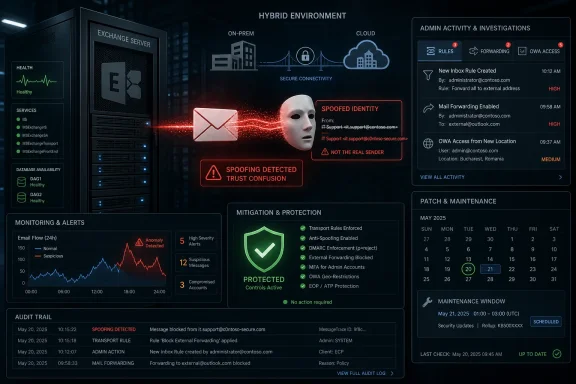
Hybrid deployments complicate spoofing risk because identity and mail flow assumptions cross boundaries. An attacker who can manipulate trust on the on-premises side may find downstream opportunities in cloud mailboxes, user behavior, or administrative processes. Even when a specific CVE does not directly bridge into Exchange Online, the operational reality of hybrid systems means defenders should not evaluate it in isolation.
This is one of Microsoft’s awkward product truths. Cloud migration can reduce exposure, but it often leaves behind a management server, connector, relay path, or exception that becomes the forgotten hinge of the environment. CVE-2026-47631 should prompt teams to ask not merely whether Exchange is patched, but why it is still present, what it can reach, and who is watching it.
For Exchange spoofing concerns, sensible monitoring starts with the surfaces where trust is expressed. Administrators should review Outlook Web Access exposure, authentication logs, unusual mailbox access, unexpected inbox rules, suspicious forwarding configuration, anomalous delegated access, and changes to transport or organization settings. The point is not to pretend these are guaranteed indicators of CVE-2026-47631 exploitation. The point is to watch the places where a spoofing-driven campaign would likely try to cash out.
This is also where security teams should be honest about logging gaps. Many Exchange environments can tell administrators whether an update installed. Fewer can quickly reconstruct who accessed which mailbox, what rules changed, which sessions looked abnormal, and whether a user interaction followed a suspicious message. A vulnerability advisory is often a stress test of telemetry maturity.
Emergency mitigations can buy time. They are not a durable operating model. They may depend on supported versions, current update baselines, outbound connectivity, and administrators who have not disabled protective services because a previous mitigation broke something obscure. In the real world, the server most in need of emergency help is often the one least prepared to receive it.
CVE-2026-47631 should therefore be read as another vote against “set and forget” Exchange administration. If an organization cannot patch Exchange predictably, cannot verify configuration drift, and cannot monitor mailbox abuse, it has not outsourced risk to Microsoft. It has accumulated risk in one of the most attractive systems it owns.
The defender’s task is to make Exchange boring again. That means maintaining an accurate inventory of servers, roles, build numbers, certificates, namespaces, load balancer paths, and hybrid dependencies. It means knowing whether a server is still required or merely left behind because nobody wanted to own the decommissioning project.
A vulnerability like CVE-2026-47631 exposes the cost of ambiguity. If the first response to an advisory is “Do we still have Exchange?” the organization has already lost valuable time. If the second response is “Who can patch it?” the problem is no longer a CVE. It is governance.
That translation must avoid hype. If Microsoft has not published evidence of active exploitation or full technical details, say so. But also explain that Exchange sits in the communication path for payments, legal approvals, HR processes, and operational emergencies. The risk is not that every spoofing flaw becomes catastrophic. The risk is that defenders dismiss the class until it appears in an incident report.
Good vulnerability communication is neither panic nor sedation. It is calibrated urgency. CVE-2026-47631 deserves that treatment: confirm exposure, apply available updates or mitigations, review logs, tighten mail trust controls, and brief stakeholders in terms they can act on.
At the same time, defenders should review compensating controls. Strong multifactor authentication, disabled legacy authentication, restricted administrative access, monitored mailbox delegation, and clean mail flow configuration all reduce the likelihood that a spoofing flaw becomes a larger compromise. These controls do not “patch” CVE-2026-47631, but they reduce the attacker’s room to maneuver.
There is also a communications task. Help desks should know that Exchange spoofing advisories can coincide with phishing waves. Finance and executive support teams should be reminded to verify unusual requests through out-of-band channels. Incident responders should be prepared to investigate mailbox artifacts, not merely endpoint alerts.
For Exchange, the answer usually leans toward action. The platform is too central, too historically targeted, and too operationally sensitive to treat vendor-confirmed spoofing casually. Even if CVE-2026-47631 turns out to require narrow conditions, the work performed in response — inventory cleanup, patch readiness, log review, and exposure reduction — is not wasted.
This is the uncomfortable bargain of defensive security. Sometimes the specific vulnerability is less damaging than feared, but the response reveals neglected systems that needed attention anyway. Microsoft’s confidence metric is not just about attacker knowledge. It is also a mirror held up to the defender’s confidence in their own environment.
 Microsoft’s Sparse Advisory Still Says Something Important
The most striking thing about CVE-2026-47631 is not what Microsoft has said, but how little technical room the public record appears to leave defenders. The entry identifies Exchange Server and a spoofing impact, but the surrounding metric language emphasizes confidence, corroboration, and the credibility of technical details. In plainer English, Microsoft is telling administrators that vulnerability management is partly an evidence problem.That is not unusual for enterprise security advisories. Vendors often disclose enough to trigger patching and prioritization without publishing a ready-made exploitation guide. In the Exchange world, that restraint is understandable: mail servers sit at the junction of authentication, transport, browser rendering, identity, compliance, and business continuity.
But sparse disclosure creates a familiar asymmetry. Attackers can experiment against exposed services, while defenders must decide whether to interrupt a fragile messaging environment based on a few lines of advisory text and a severity model. That is why the confidence metric is more than bureaucratic metadata. It is a signal about how much weight an organization should place on the vendor’s claim before independent research fills in the blanks.
Spoofing Is the Word That Makes Admins Underreact
“Spoofing” still sounds, to many executives, like a cosmetic problem: a fake sender, a misleading page, a message that looks more trustworthy than it is. In modern Exchange deployments, that framing is dangerously narrow. Spoofing can sit upstream of credential theft, session abuse, business email compromise, mailbox rule manipulation, or the quiet erosion of trust inside the organization’s communications layer.Exchange is not just an email server. It is a memory palace for the enterprise: calendars, delegated access, executive correspondence, retention obligations, discovery targets, mobile sync, hybrid connectors, and authentication handshakes. A spoofing vulnerability in that environment deserves to be judged by the workflows it can disturb, not by the modest sound of the category name.
That does not mean every Exchange spoofing CVE is the next ProxyShell or Hafnium-scale event. It does mean security teams should resist impact-label complacency. If a flaw lets an attacker convincingly impersonate content, context, or identity inside a trusted mail surface, the blast radius is social as much as technical.
The Confidence Metric Is a Warning About the Fog Before the Patch Cycle Clears
The user-supplied metric description gets at a rarely discussed truth of vulnerability management: public certainty evolves. At first, a CVE may be little more than an acknowledged undesirable impact. Later, researchers may infer the affected component or root cause. Eventually, the vendor, researcher, or exploit telemetry may confirm the mechanism.That sequence is uncomfortable because patching decisions usually cannot wait for the final stage. By the time a detailed write-up exists, exploit developers and red teams may already have mapped the same territory. The confidence metric tries to compress that uncertainty into something defenders can use.
For CVE-2026-47631, the practical reading is simple: treat Microsoft’s acknowledgement as meaningful, but do not assume the public technical record is complete. If Microsoft says the vulnerability exists, that is already a higher-confidence signal than rumor or unverified scanning chatter. If the technical details remain thin, that does not lower the risk; it lowers the defender’s visibility.
Exchange Has Earned Its Paranoia
Exchange administrators are not paranoid because of one bad month. They are paranoid because the product’s history has taught them that on-premises messaging infrastructure attracts patient, capable, and opportunistic adversaries. Once an Exchange server becomes a target, the difference between “internet-facing business necessity” and “persistent attack surface” collapses.The scars are institutional. Many organizations still remember emergency patching windows, post-compromise web shell hunts, forensic uncertainty, and the uneasy realization that applying an update does not prove the server was clean before the update arrived. Exchange incidents have repeatedly shown that mailbox infrastructure is both a technical system and an intelligence target.
That history should shape how CVE-2026-47631 is handled. A spoofing flaw may not imply remote code execution, privilege escalation, or full server compromise. But Exchange’s role means even lower-sounding impacts can become useful links in an intrusion chain, especially when paired with phishing, stolen credentials, weak conditional access, legacy authentication, or exposed Outlook Web Access paths.
The Real Risk Is Trust Confusion at Enterprise Scale
A spoofing vulnerability is ultimately a trust-confusion bug. The system presents something as more authentic, more local, more authorized, or more benign than it should. In consumer software, that can be annoying. In enterprise mail, it can become a decision engine for fraud and lateral movement.Consider how employees use email in practice. They approve invoices, accept calendar changes, open shared documents, reset passwords, follow help-desk instructions, and respond to urgent requests based on accumulated trust signals. If Exchange mishandles one of those signals, the attacker does not need to defeat every control. They need to make one malicious interaction feel routine.
This is why security teams should not isolate CVE-2026-47631 from anti-phishing, identity, and monitoring programs. The vulnerability belongs in the same conversation as mailbox auditing, transport rules, Safe Links or equivalent rewriting, DMARC enforcement, conditional access, and privileged account hygiene. The flaw may be in Exchange, but the defense is organizational.
The Patch Decision Should Not Wait for a Perfect Exploit Narrative
Administrators often want the story before the action. Was it exploited? Is there public proof-of-concept code? Does it require authentication? Does the attacker need a victim to click? Is Exchange Online affected? Which cumulative update branch is exposed? Those are reasonable questions, but they can become a delaying tactic when the affected system is business-critical.The better operating model is tiered response. If Exchange is internet-facing, high-value, hybrid-connected, or used by executives and regulated teams, the threshold for action should be low. If the server is internal-only but reachable from broad user networks, the risk is still not trivial. If the deployment is legacy, poorly monitored, or hard to patch, the vulnerability is not less important; the environment is more brittle.
Microsoft’s Security Update Guide is designed for that triage discipline. It gives administrators enough structured information to sort by product, impact, severity, exploitability, and release date. The problem is that many organizations still treat those fields as advisory decorations rather than operational inputs.
Hybrid Exchange Turns “On-Prem” Into a Cloud Risk Conversation
The phrase “Exchange Server” can mislead boards and budget owners into thinking this is a legacy on-premises problem. In many environments, Exchange Server remains present precisely because the organization has moved to Microsoft 365 but still needs hybrid management, mail relay, application integration, or coexistence. The result is a smaller Exchange footprint that may be less loved, less staffed, and more dangerous.Hybrid deployments complicate spoofing risk because identity and mail flow assumptions cross boundaries. An attacker who can manipulate trust on the on-premises side may find downstream opportunities in cloud mailboxes, user behavior, or administrative processes. Even when a specific CVE does not directly bridge into Exchange Online, the operational reality of hybrid systems means defenders should not evaluate it in isolation.
This is one of Microsoft’s awkward product truths. Cloud migration can reduce exposure, but it often leaves behind a management server, connector, relay path, or exception that becomes the forgotten hinge of the environment. CVE-2026-47631 should prompt teams to ask not merely whether Exchange is patched, but why it is still present, what it can reach, and who is watching it.
Sparse Technical Detail Changes the Defender’s Job
When a vendor advisory lacks a detailed root cause, defenders should shift from exploit-specific detection to behavior and exposure reduction. Waiting for perfect indicators is a losing strategy. By the time high-fidelity indicators are public, early exploitation may already have moved through the environment.For Exchange spoofing concerns, sensible monitoring starts with the surfaces where trust is expressed. Administrators should review Outlook Web Access exposure, authentication logs, unusual mailbox access, unexpected inbox rules, suspicious forwarding configuration, anomalous delegated access, and changes to transport or organization settings. The point is not to pretend these are guaranteed indicators of CVE-2026-47631 exploitation. The point is to watch the places where a spoofing-driven campaign would likely try to cash out.
This is also where security teams should be honest about logging gaps. Many Exchange environments can tell administrators whether an update installed. Fewer can quickly reconstruct who accessed which mailbox, what rules changed, which sessions looked abnormal, and whether a user interaction followed a suspicious message. A vulnerability advisory is often a stress test of telemetry maturity.
Emergency Mitigation Is Not a Substitute for Maintenance
Microsoft’s Exchange security posture has increasingly leaned on emergency mitigation, health checking, and strongly guided update paths. That is a rational response to a product deployed across wildly inconsistent customer environments. It is also an admission that many Exchange servers are not maintained with the discipline their risk profile demands.Emergency mitigations can buy time. They are not a durable operating model. They may depend on supported versions, current update baselines, outbound connectivity, and administrators who have not disabled protective services because a previous mitigation broke something obscure. In the real world, the server most in need of emergency help is often the one least prepared to receive it.
CVE-2026-47631 should therefore be read as another vote against “set and forget” Exchange administration. If an organization cannot patch Exchange predictably, cannot verify configuration drift, and cannot monitor mailbox abuse, it has not outsourced risk to Microsoft. It has accumulated risk in one of the most attractive systems it owns.
Version Sprawl Is Where Security Guidance Goes to Die
Exchange patching is notoriously sensitive to version levels, cumulative updates, schema changes, prerequisites, and maintenance sequencing. That complexity is not an excuse, but it is a reality. It explains why organizations delay, why administrators fear breaking mail, and why attackers keep returning to the platform.The defender’s task is to make Exchange boring again. That means maintaining an accurate inventory of servers, roles, build numbers, certificates, namespaces, load balancer paths, and hybrid dependencies. It means knowing whether a server is still required or merely left behind because nobody wanted to own the decommissioning project.
A vulnerability like CVE-2026-47631 exposes the cost of ambiguity. If the first response to an advisory is “Do we still have Exchange?” the organization has already lost valuable time. If the second response is “Who can patch it?” the problem is no longer a CVE. It is governance.
The Security Team Must Translate Spoofing Into Business Risk
One reason spoofing vulnerabilities underperform in boardroom urgency is that the category sounds abstract. Security teams should translate CVE-2026-47631 into scenarios the business understands. Could a trusted mail interface help an attacker deceive a finance user? Could mailbox access or presentation confusion support executive impersonation? Could manipulated trust signals weaken incident response during an active phishing campaign?That translation must avoid hype. If Microsoft has not published evidence of active exploitation or full technical details, say so. But also explain that Exchange sits in the communication path for payments, legal approvals, HR processes, and operational emergencies. The risk is not that every spoofing flaw becomes catastrophic. The risk is that defenders dismiss the class until it appears in an incident report.
Good vulnerability communication is neither panic nor sedation. It is calibrated urgency. CVE-2026-47631 deserves that treatment: confirm exposure, apply available updates or mitigations, review logs, tighten mail trust controls, and brief stakeholders in terms they can act on.
The Practical Response Is Broader Than One CVE
The immediate administrative work should begin with Microsoft’s official advisory and the organization’s Exchange inventory. From there, teams should validate affected versions, identify applicable updates or mitigations, and test deployment in a maintenance window that reflects the role Exchange plays in the business. For internet-facing systems, delay should require a documented exception, not a vague hope that more details will arrive.At the same time, defenders should review compensating controls. Strong multifactor authentication, disabled legacy authentication, restricted administrative access, monitored mailbox delegation, and clean mail flow configuration all reduce the likelihood that a spoofing flaw becomes a larger compromise. These controls do not “patch” CVE-2026-47631, but they reduce the attacker’s room to maneuver.
There is also a communications task. Help desks should know that Exchange spoofing advisories can coincide with phishing waves. Finance and executive support teams should be reminded to verify unusual requests through out-of-band channels. Incident responders should be prepared to investigate mailbox artifacts, not merely endpoint alerts.
The Signal Hidden in Microsoft’s Metadata
The advisory language around confidence points to an important shift in vulnerability management. Modern defenders are not just consuming patches; they are consuming claims about evidence. Severity, exploitability, disclosure status, and confidence are all attempts to answer the same question: how much should we disrupt the business today to prevent a possible compromise tomorrow?For Exchange, the answer usually leans toward action. The platform is too central, too historically targeted, and too operationally sensitive to treat vendor-confirmed spoofing casually. Even if CVE-2026-47631 turns out to require narrow conditions, the work performed in response — inventory cleanup, patch readiness, log review, and exposure reduction — is not wasted.
This is the uncomfortable bargain of defensive security. Sometimes the specific vulnerability is less damaging than feared, but the response reveals neglected systems that needed attention anyway. Microsoft’s confidence metric is not just about attacker knowledge. It is also a mirror held up to the defender’s confidence in their own environment.
The Exchange Admin’s Short List for CVE-2026-47631
CVE-2026-47631 should not send every organization into crisis mode, but it should force a disciplined Exchange review. The most useful response is concrete, documented, and fast enough to matter.- Confirm whether any Microsoft Exchange Server instances remain in production, hybrid management, relay, lab, or forgotten legacy roles.
- Check Microsoft’s official Security Update Guide for the current CVE-2026-47631 status before relying on secondhand summaries.
- Prioritize internet-facing and hybrid-connected Exchange servers for update validation, mitigation review, and post-change monitoring.
- Review mailbox auditing, inbox rule changes, forwarding behavior, delegated access, and Outlook Web Access exposure for suspicious activity.
- Treat “spoofing” as a trust-boundary problem that can support phishing, fraud, and session abuse rather than as a cosmetic label.
- Use this advisory as a forcing function to remove obsolete Exchange servers and document why any remaining servers still exist.
References
- Primary source: MSRC
Published: 2026-06-09T07:00:00-07:00
Security Update Guide - Microsoft Security Response Center
 msrc.microsoft.com
- Related coverage: blog.gridinsoft.com
Exchange Server CVE-2026-42897 Exploited Through Crafted OWA Email
Microsoft says Exchange Server CVE-2026-42897 has exploitation detected. Check Exchange Emergency Mitigation Service and OWA exposure now. blog.gridinsoft.com
- Related coverage: cve.circl.lu
Vulnerability-Lookup
Vulnerability-Lookup - Fast vulnerability lookup correlation from different sources.cve.circl.lu - Related coverage: theregister.com
Exploited Exchange Server flaw turns OWA inboxes into script launchpads
Microsoft mitigation may bork inline images, calendar printing while admins wait for a proper patchwww.theregister.com - Related coverage: cybersecuritynews.com
Microsoft Exchange Server Vulnerabilities Let Attackers Spoof and Tamper Over Network
Critical security vulnerabilities in Microsoft Exchange Server enable attackers to perform spoofing and tampering attacks over network connections. cybersecuritynews.com
- Related coverage: neuracybintel.com
NeuraCyb - Cybersecurity Intelligence & Investigation
Cybersecurity Intelligence and Investigation Platform www.neuracybintel.com
- Official source: techcommunity.microsoft.com
Addressing Exchange Server May 2026 vulnerability CVE-2026-42897 | Microsoft Community Hub
We wanted to tell you how to address the Exchange Server May 2026 vulnerability CVE-2026-42897. techcommunity.microsoft.com
- Related coverage: notebookcheck.net
Microsoft Exchange Server zero-day exploited via crafted email - Notebookcheck News
Microsoft confirms active exploitation of Exchange Server zero-day CVE-2026-42897 via crafted email with no permanent patch available for on-prem deployments. www.notebookcheck.net
- Related coverage: techtimes.com
Exchange Server OWA Zero-Day CVE-2026-42897 Exploited With No Permanent Patch and New Mitigation Gaps
Microsoft confirmed on May 14 that CVE-2026-42897 — a cross-site scripting flaw in the Outlook Web Access component of Exchange Server 2016, 2019, and Subscription Edition — is under activewww.techtimes.com - Related coverage: stack.watch
- Related coverage: securityaffairs.com
CVE-2026-42897: Microsoft confirms active exploitation of Exchange Server zero-day
Microsoft warned that attackers are exploiting a new Exchange Server zero-day vulnerability, tracked as CVE-2026-42897, in the wild.securityaffairs.com
- Related coverage: tomsguide.com
Do you use Microsoft Exchange? Hackers are actively exploiting a new zero-day flaw | Tom's Guide
Microsoft warns of a new zero-day vulnerability that leaves Exchange open to hackers.www.tomsguide.com - Related coverage: techradar.com
Microsoft urges users to be on alert following high-severity flaw in hybrid Exchange deployments | TechRadar
Security bug allowed hackers to move from on-prem to the cloudwww.techradar.com - Official source: microsoft.com
MSRC - Microsoft Security Response Center
The Microsoft Security Response Center is part of the defender community and on the front line of security response evolution. For over twenty years, we have been engaged with security researchers working to protect customers and the broader ecosystem.www.microsoft.com
- Official source: learn.microsoft.com
Security Advisories and Bulletins | Microsoft Learn
learn.microsoft.com - Related coverage: api.urlscan.io

api.msrc.microsoft.com - urlscan.io
urlscan.io - Website scanner for suspicious and malicious URLs
api.urlscan.io
- Official source: github.com
GitHub - microsoft/MSRC-Microsoft-Security-Updates-API: Repo with getting started projects for the Microsoft Security Updates API (msrc.microsoft.com/update-guide) · GitHub
Repo with getting started projects for the Microsoft Security Updates API (msrc.microsoft.com/update-guide) - microsoft/MSRC-Microsoft-Security-Updates-API github.com
- Related coverage: deepwiki.com
MSRC API Reference | microsoft/MSRC-Microsoft-Security-Updates-API | DeepWiki
This document provides technical reference information for the Microsoft Security Response Center (MSRC) CVRF API that underlies the MsrcSecurityUpdates PowerShell module. This covers the REST API enddeepwiki.com - Related coverage: sra.io